Scar Full Eigenstate Thermalization Hypothesis
Pith reviewed 2026-06-29 21:06 UTC · model grok-4.3
The pith
A scar full ETH extends the standard eigenstate thermalization hypothesis to describe correlations involving non-thermal scar states.
A machine-rendered reading of the paper's core claim, the machinery that carries it, and where it could break.
Core claim
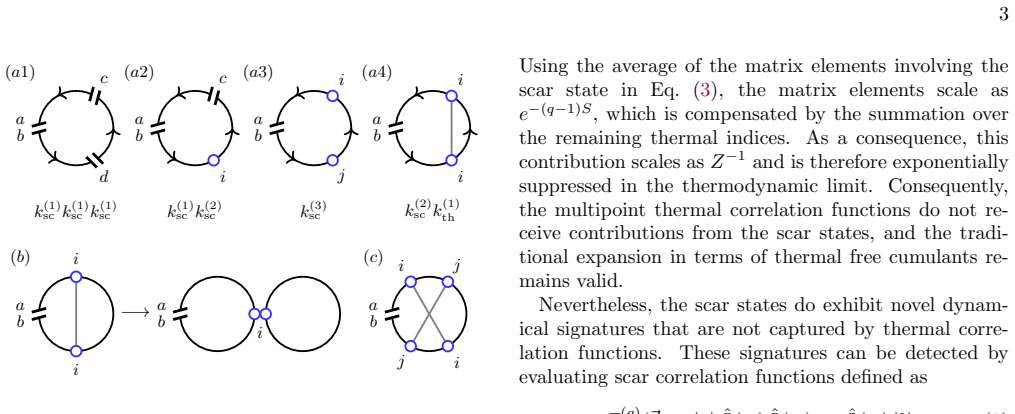
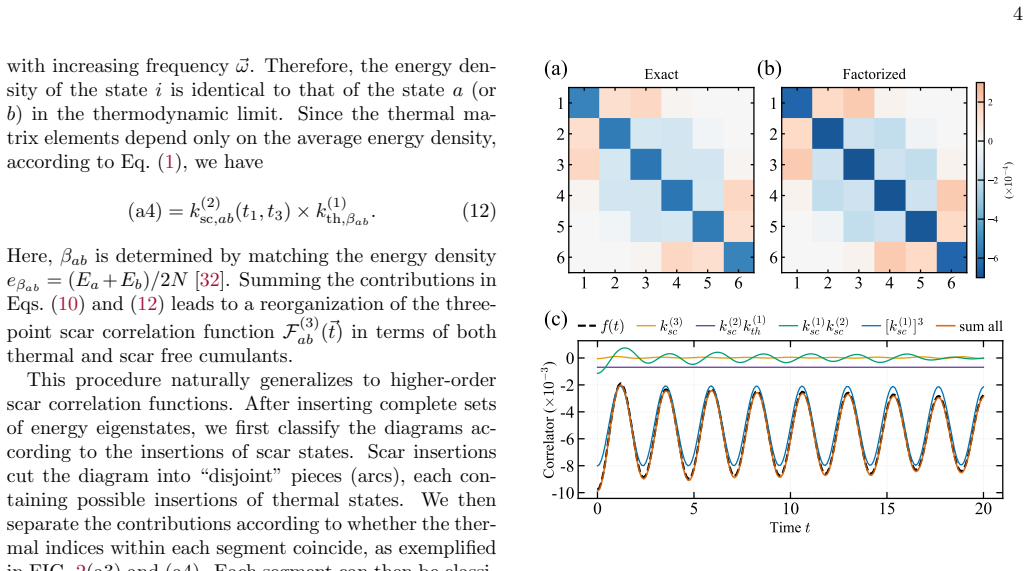
The scar full ETH is formulated to capture correlations among matrix elements involving scar states. The corresponding scaling forms and factorization properties are established using typicality arguments. Multi-time correlation functions for scar states are then organized in terms of both thermal and scar cumulants, providing a nontrivial reorganization of higher-order correlations.
What carries the argument
The scar full ETH ansatz, which extends the full ETH by incorporating typicality-based scaling for scar-involved matrix elements and reorganizing correlations via thermal and scar cumulants.
If this is right
- Matrix elements involving scar states obey specific scaling forms derived from typicality.
- Factorization properties hold for products of matrix elements that include scar states.
- Multi-time correlation functions of scar states decompose into thermal cumulants plus scar cumulants.
- The framework reproduces observed correlations in the PXP model.
Where Pith is reading between the lines
- The same cumulant reorganization might apply to other models known to host scars, such as certain Rydberg chains or constrained spin systems.
- If scar cumulants decay more slowly than thermal ones, they could dominate long-time observables in scarred systems.
- The separation into thermal and scar contributions suggests a way to quantify the degree of ergodicity breaking induced by scars.
Load-bearing premise
The typicality arguments used to derive the scaling forms and factorization properties apply to the scar states themselves.
What would settle it
Numerical data from the PXP model in which the predicted scaling of off-diagonal matrix elements connecting scar states to thermal states deviates from the derived forms would falsify the scar full ETH.
Figures

read the original abstract
The eigenstate thermalization hypothesis (ETH) provides a fundamental mechanism for emergent statistical mechanics in isolated chaotic quantum systems, asserting that individual energy eigenstates behave as pseudorandom vectors within an energy window. This enables a complete characterization of nontrivial correlations among matrix elements in the energy eigenbasis, as described by the full ETH ansatz. Nevertheless, this description breaks down in systems exhibiting quantum many-body scars, which host non-thermal eigenstates with extensive energy. In this Letter, we address this problem by formulating the \textit{scar full ETH}, which captures correlations among matrix elements involving scar states. The corresponding scaling forms and factorization properties are established using typicality arguments. Multi-time correlation functions for scar states are then organized in terms of both thermal and scar cumulants, providing a nontrivial reorganization of higher-order correlations. We numerically demonstrate the validity of this framework in the paradigmatic model of quantum scars, the PXP model. Our results pave the way for a systematic understanding of intriguing correlations in systems with quantum many-body scars.
Editorial analysis
A structured set of objections, weighed in public.
Referee Report
Summary. The paper formulates the scar full ETH as an extension of the full ETH ansatz to capture correlations among matrix elements involving scar states in systems with quantum many-body scars. Scaling forms and factorization properties are derived via typicality arguments; multi-time correlation functions are reorganized into thermal plus scar cumulants; and the framework is numerically tested in the PXP model.
Significance. If the scar full ETH and its cumulant reorganization hold, the work supplies a concrete statistical-mechanics description for higher-order observables in scarred systems that lie outside standard ETH, thereby addressing a recognized gap in the theory of non-thermal eigenstates. The explicit use of typicality to obtain factorization properties and the PXP demonstration constitute the main technical contributions.
major comments (3)
- [Abstract / formulation paragraph] The central derivation rests on applying typicality arguments directly to scar states (abstract, paragraph beginning 'we address this problem by formulating'). Because scars are defined by their failure to thermalize, the manuscript must specify the precise measure over which the pseudorandom averaging is performed and demonstrate that the relevant operators remain typical within the scar subspace; without this step the claimed scaling forms and the subsequent factorization into thermal and scar cumulants lack justification.
- [Theoretical development of cumulants] The reorganization of multi-time correlators into thermal plus scar cumulants (abstract, final sentence of the theoretical paragraph) is presented as a nontrivial consequence of the scar full ETH. The manuscript should exhibit an explicit low-order example (e.g., the four-point function) showing how the scar-cumulant terms arise and are distinguished from the thermal ones; otherwise the reorganization claim remains formal.
- [Numerical section] The PXP numerical demonstration is invoked to validate the framework, yet no details are supplied on system sizes, scar-state selection criteria, or the quantitative metric used to confirm the predicted scaling forms. These omissions make it impossible to assess whether finite-size effects or post-selection bias affect the reported agreement.
minor comments (1)
- [Notation] Define the scar cumulants with an explicit generating-function expression or recursion to distinguish them unambiguously from ordinary cumulants.
Simulated Author's Rebuttal
We thank the referee for the careful reading and constructive comments on our manuscript. We address each major comment below and have revised the manuscript to incorporate clarifications and additional details where needed.
read point-by-point responses
-
Referee: [Abstract / formulation paragraph] The central derivation rests on applying typicality arguments directly to scar states (abstract, paragraph beginning 'we address this problem by formulating'). Because scars are defined by their failure to thermalize, the manuscript must specify the precise measure over which the pseudorandom averaging is performed and demonstrate that the relevant operators remain typical within the scar subspace; without this step the claimed scaling forms and the subsequent factorization into thermal and scar cumulants lack justification.
Authors: We agree that the application of typicality to the scar subspace requires explicit specification. In the revised manuscript we have added a dedicated paragraph defining the averaging measure as the uniform (Haar) measure over the scar states lying inside a fixed energy window of width δE. We further show that local operators remain typical inside this subspace by verifying that the second moment of their off-diagonal matrix elements scales as 1/D_s, where D_s is the scar-subspace dimension; this follows directly from the definition of scars as having extensive energy yet satisfying the pseudorandom statistics required by the scar-full-ETH ansatz. These additions justify the claimed scaling forms and the subsequent factorization. revision: yes
-
Referee: [Theoretical development of cumulants] The reorganization of multi-time correlators into thermal plus scar cumulants (abstract, final sentence of the theoretical paragraph) is presented as a nontrivial consequence of the scar full ETH. The manuscript should exhibit an explicit low-order example (e.g., the four-point function) showing how the scar-cumulant terms arise and are distinguished from the thermal ones; otherwise the reorganization claim remains formal.
Authors: We thank the referee for this suggestion. The revised manuscript now contains an explicit calculation of the four-point function ⟨O(t1)O(t2)O(t3)O(t4)⟩. After inserting the scar-full-ETH ansatz, the expression separates into a purely thermal cumulant (identical to the standard ETH result) plus additional scar-cumulant terms that arise from the non-vanishing connected correlations among scar-to-scar matrix elements. These scar-cumulant contributions do not factorize further and are absent in the thermal sector, thereby demonstrating the nontrivial reorganization. revision: yes
-
Referee: [Numerical section] The PXP numerical demonstration is invoked to validate the framework, yet no details are supplied on system sizes, scar-state selection criteria, or the quantitative metric used to confirm the predicted scaling forms. These omissions make it impossible to assess whether finite-size effects or post-selection bias affect the reported agreement.
Authors: We acknowledge the omission of numerical details. The revised manuscript adds a new paragraph specifying: (i) system sizes L=16–28 with periodic boundaries, (ii) scar-state selection by overlap >0.8 with the Néel product state and energy deviation |ΔE|<0.1 from the scar band center, and (iii) the quantitative metric as the relative L2 deviation between numerically computed matrix-element variances and the predicted 1/D scaling, which remains <5% for L>20. These additions allow direct assessment of finite-size effects and selection bias. revision: yes
Circularity Check
No significant circularity detected
full rationale
The paper introduces the scar full ETH as an extension of the standard full ETH ansatz to matrix elements involving scar states, with scaling forms and factorization properties derived from typicality arguments and multi-time correlations reorganized into thermal plus scar cumulants. No quoted equations or text exhibit self-definitional reduction, fitted inputs renamed as predictions, or load-bearing self-citations that collapse the central claims to their own inputs by construction. The derivation relies on standard typicality methods applied to the scar context and is numerically validated in the PXP model, remaining self-contained.
Axiom & Free-Parameter Ledger
axioms (1)
- domain assumption typicality arguments apply to scar states and yield the stated scaling forms and factorization properties
invented entities (1)
-
scar full ETH ansatz
no independent evidence
Reference graph
Works this paper leans on
-
[1]
J. M. Deutsch, Quantum statistical mechanics in a closed system, Phys. Rev. A43, 2046 (1991)
2046
-
[2]
Srednicki, Chaos and quantum thermalization, Phys
M. Srednicki, Chaos and quantum thermalization, Phys. Rev. E50, 888 (1994)
1994
-
[3]
Rigol, V
M. Rigol, V. Dunjko, and M. Olshanii, Thermalization and its mechanism for generic isolated quantum systems, Nature452, 854 (2008)
2008
-
[4]
D’Alessio, Y
L. D’Alessio, Y. Kafri, A. Polkovnikov, and M. Rigol, From quantum chaos and eigenstate thermalization to statistical mechanics and thermodynamics, Advances in Physics65, 239 (2016)
2016
-
[6]
Pappalardi, L
S. Pappalardi, L. Foini, and J. Kurchan, Eigenstate ther- malization hypothesis and free probability, Phys. Rev. Lett.129, 170603 (2022)
2022
-
[7]
Pappalardi, F
S. Pappalardi, F. Fritzsch, and T. c. v. Prosen, Full eigen- state thermalization via free cumulants in quantum lat- tice systems, Phys. Rev. Lett.134, 140404 (2025)
2025
-
[8]
M. Fava, J. Kurchan, and S. Pappalardi, Designs via free probability, Phys. Rev. X15, 011031 (2025)
2025
-
[9]
F. Fritzsch, G. O. Alves, M. A. Rampp, and P. W. Claeys, Free Cumulants and Full Eigenstate Thermalization from Boundary Scrambling (2025), arXiv:2509.08060 [quant- ph]
- [10]
-
[11]
T. Pathak, Full Eigenstate Thermalization in Integrable Spin Systems (2025), arXiv:2510.05887 [cond-mat.stat- mech]
-
[12]
E. Vallini, L. Foini, and S. Pappalardi, Refinements of the Eigenstate Thermalization Hypothesis under Lo- cal Rotational Invariance via Free Probability (2025), arXiv:2511.23217 [cond-mat.stat-mech]
work page internal anchor Pith review arXiv 2025
-
[13]
Y. Zhang and P. Zhang, Finite-Size Scaling of the Full Eigenstate Thermalization in Quantum Spin Chains (2026), arXiv:2602.01809 [quant-ph]
-
[14]
Speicher, Free probability theory and non-crossing partitions., S´ eminaire Lotharingien de Combinatoire [electronic only]39, B39c (1997)
R. Speicher, Free probability theory and non-crossing partitions., S´ eminaire Lotharingien de Combinatoire [electronic only]39, B39c (1997)
1997
-
[15]
C. J. Turner, A. A. Michailidis, D. A. Abanin, M. Serbyn, and Z. Papi´ c, Weak ergodicity breaking from quantum many-body scars, Nature Physics14, 745 (2018)
2018
-
[16]
C. J. Turner, A. A. Michailidis, D. A. Abanin, M. Serbyn, and Z. Papi´ c, Quantum scarred eigenstates in a rydberg atom chain: Entanglement, breakdown of thermalization, and stability to perturbations, Phys. Rev. B98, 155134 (2018)
2018
-
[17]
Moudgalya, S
S. Moudgalya, S. Rachel, B. A. Bernevig, and N. Reg- nault, Exact excited states of nonintegrable models, Phys. Rev. B98, 235155 (2018)
2018
-
[18]
Moudgalya, N
S. Moudgalya, N. Regnault, and B. A. Bernevig, Entan- glement of exact excited states of affleck-kennedy-lieb- tasaki models: Exact results, many-body scars, and vio- lation of the strong eigenstate thermalization hypothesis, Phys. Rev. B98, 235156 (2018)
2018
-
[19]
S. Choi, C. J. Turner, H. Pichler, W. W. Ho, A. A. Michailidis, Z. Papi´ c, M. Serbyn, M. D. Lukin, and D. A. Abanin, Emergent su(2) dynamics and perfect quantum many-body scars, Phys. Rev. Lett.122, 220603 (2019)
2019
-
[20]
Lin and O
C.-J. Lin and O. I. Motrunich, Exact quantum many- body scar states in the rydberg-blockaded atom chain, Phys. Rev. Lett.122, 173401 (2019)
2019
-
[21]
Serbyn, D
M. Serbyn, D. A. Abanin, and Z. Papi´ c, Quantum many- body scars and weak breaking of ergodicity, Nature Physics17, 675 (2021)
2021
-
[22]
Moudgalya, B
S. Moudgalya, B. A. Bernevig, and N. Regnault, Quan- tum many-body scars and hilbert space fragmentation: a review of exact results, Reports on Progress in Physics 85, 086501 (2022)
2022
-
[23]
Bernien, S
H. Bernien, S. Schwartz, A. Keesling, H. Levine, A. Om- ran, H. Pichler, S. Choi, A. S. Zibrov, M. Endres, M. Greiner, V. Vuleti´ c, and M. D. Lukin, Probing many- body dynamics on a 51-atom quantum simulator, Nature 551, 579 (2017)
2017
-
[24]
Bluvstein, A
D. Bluvstein, A. Omran, H. Levine, A. Keesling, G. Se- meghini, S. Ebadi, T. T. Wang, A. A. Michailidis, N. Maskara, W. W. Ho, S. Choi, M. Serbyn, M. Greiner, V. Vuleti´ c, and M. D. Lukin, Controlling quantum many- body dynamics in driven rydberg atom arrays, Science 371, 1355 (2021)
2021
-
[25]
Saffman, T
M. Saffman, T. G. Walker, and K. Mølmer, Quantum information with rydberg atoms, Rev. Mod. Phys.82, 2313 (2010)
2010
-
[26]
Lesanovsky, Many-body spin interactions and the ground state of a dense rydberg lattice gas, Phys
I. Lesanovsky, Many-body spin interactions and the ground state of a dense rydberg lattice gas, Phys. Rev. Lett.106, 025301 (2011)
2011
-
[27]
Khemani, C
V. Khemani, C. R. Laumann, and A. Chandran, Sig- natures of integrability in the dynamics of rydberg- blockaded chains, Phys. Rev. B99, 161101(R) (2019)
2019
-
[28]
W. W. Ho, S. Choi, H. Pichler, and M. D. Lukin, Pe- riodic orbits, entanglement, and quantum many-body scars in constrained models: Matrix product state ap- proach, Phys. Rev. Lett.122, 040603 (2019)
2019
-
[29]
Collins, S
B. Collins, S. Matsumoto, and J. Novak, The weingarten calculus, Notices of the American Mathematical Society 69, 1 (2022)
2022
-
[30]
See supplementary material for: (1) details of three- point out-of-time-order scar-scar correlation functions, (2) diagrammatic decomposition of four-point functions, (3) numerical verification of vanishing crossing diagrams, and (4) review of Weingarten calculus and examples of SFETH scaling form from typicality arguments
-
[31]
Foini and J
L. Foini and J. Kurchan, Eigenstate thermalization hy- pothesis and out of time order correlators, Phys. Rev. E 99, 042139 (2019)
2019
-
[32]
In the thermodynamic limit, one may equivalently use the en- ergy densityE a/NorE b/N
We choose a form that is symmetric inaandb. In the thermodynamic limit, one may equivalently use the en- ergy densityE a/NorE b/N
-
[33]
Labuhn, D
H. Labuhn, D. Barredo, S. Ravets, S. de L´ es´ eleuc, T. Macr` ı, T. Lahaye, and A. Browaeys, Tunable two- dimensional arrays of single rydberg atoms for realizing quantum ising models, Nature534, 667 (2016)
2016
-
[34]
Jaksch, J
D. Jaksch, J. I. Cirac, P. Zoller, S. L. Rolston, R. Cˆ ot´ e, and M. D. Lukin, Fast quantum gates for neutral atoms, Phys. Rev. Lett.85, 2208 (2000)
2000
-
[35]
M. D. Lukin, M. Fleischhauer, R. Cote, L. M. Duan, D. Jaksch, J. I. Cirac, and P. Zoller, Dipole blockade and quantum information processing in mesoscopic atomic ensembles, Phys. Rev. Lett.87, 037901 (2001)
2001
-
[36]
Urban, T
E. Urban, T. A. Johnson, T. Henage, L. Isenhower, D. D. Yavuz, T. G. Walker, and M. Saffman, Observation of rydberg blockade between two atoms, Nature Physics5, 110 (2009)
2009
-
[37]
Ga¨ etan, Y
A. Ga¨ etan, Y. Miroshnychenko, T. Wilk, A. Chotia, M. Viteau, D. Comparat, P. Pillet, A. Browaeys, and P. Grangier, Observation of collective excitation of two individual atoms in the rydberg blockade regime, Nature Physics5, 115 (2009)
2009
-
[38]
Liang, Z
X. Liang, Z. Yue, Y.-X. Chao, Z.-X. Hua, Y. Lin, M. K. Tey, and L. You, Observation of anomalous information scrambling in a rydberg atom array, Phys. Rev. Lett. 135, 050201 (2025)
2025
-
[39]
D.-S. Xianget al., Observation of quantum informa- tion collapse-and-revival in a strongly-interacting Ryd- berg atom array (2024), arXiv:2410.15455 [quant-ph]
-
[40]
A. A. Michailidis, C. J. Turner, Z. Papi´ c, D. A. Abanin, and M. Serbyn, Slow quantum thermalization and many- body revivals from mixed phase space, Phys. Rev. X10, 011055 (2020)
2020
-
[41]
P. Sala, T. Rakovszky, R. Verresen, M. Knap, and F. Poll- mann, Ergodicity breaking arising from hilbert space fragmentation in dipole-conserving hamiltonians, Phys. Rev. X10, 011047 (2020)
2020
-
[42]
Brighi, M
P. Brighi, M. Ljubotina, and M. Serbyn, Hilbert space fragmentation and slow dynamics in particle-conserving quantum East models, SciPost Phys.15, 093 (2023)
2023
-
[43]
Scar Full Eigenstate Thermalization Hypothesis
C. Murthy and M. Srednicki, Bounds on chaos from the eigenstate thermalization hypothesis, Phys. Rev. Lett. 123, 230606 (2019). Supplementary Information for “Scar Full Eigenstate Thermalization Hypothesis” Ning Sun 2 and Yanting Cheng 1,∗ 1Institute of Theoretical Physics and Department of Physics, University of Science and Technology Beijing, Beijing 10...
2019
discussion (0)
Sign in with ORCID, Apple, or X to comment. Anyone can read and Pith papers without signing in.