Crosstalk In Contemporary Quantum Devices
Pith reviewed 2026-06-29 17:39 UTC · model grok-4.3
The pith
Crosstalk noise inhibits individual qubit addressability and causes unintended interactions across all quantum computing platforms.
A machine-rendered reading of the paper's core claim, the machinery that carries it, and where it could break.
Core claim
Crosstalk noise derives from phenomena in quantum devices which inhibit individual addressability or cause unintended interactions among qubits. This review provides a comprehensive overview of crosstalk from quantum computing literature across a range of physical systems, focusing on physical origins, methods of mitigation and known consequential security vulnerabilities. Multiple crosstalk mechanisms are described for all major quantum computing platforms, which are usually implicitly addressed through device design, tuning, and mitigation techniques. Accelerating research regarding security implications is observed, with multiple avenues for further exploration, especially for non-superco
What carries the argument
crosstalk noise, the set of phenomena that inhibit individual addressability or cause unintended interactions among qubits
If this is right
- Crosstalk must be addressed through design, tuning, and mitigation for any quantum platform to operate reliably beyond one or two qubits.
- Device performance reports and algorithm benchmarks should include explicit crosstalk analysis rather than treating it as implicit.
- Security research on crosstalk-induced vulnerabilities should expand beyond superconducting systems to other platforms.
- A single reference covering origins and mitigations across platforms reduces the effort needed to study an unfamiliar quantum hardware type.
Where Pith is reading between the lines
- Placing platform-specific crosstalk details side by side may reveal common mitigation principles that could be adapted across hardware types.
- The noted gap in security studies for non-superconducting systems points to a practical need for targeted experiments on ion traps or spin qubits.
- Engineers building new quantum processors could treat the reviewed mitigation catalogue as a checklist during initial design rather than after fabrication.
- If crosstalk remains unmitigated at larger scales, claims of quantum advantage for algorithms on real hardware will stay confined to small system sizes.
Load-bearing premise
The mechanisms and severity of crosstalk between platforms varies significantly, increasing the barrier of entry associated with understanding and performing research on unfamiliar quantum platforms.
What would settle it
An experimental demonstration of a multi-qubit device in which crosstalk is eliminated uniformly across platforms without platform-specific design or tuning would contradict the review's premise that crosstalk mechanisms and mitigations must be treated as platform-dependent.
Figures

read the original abstract
Crosstalk noise derives from phenomena in quantum devices which inhibit individual addressability or cause unintended interactions among qubits. It is widely considered one of the major problems to be solved for a quantum computing platform to operate at scales beyond one or two qubits. Despite this, detailed discussion of crosstalk is often neglected when quantum device performance is described both in the context of device benchmarking and individual algorithm execution. Additionally, while the potential for crosstalk exists in all quantum platforms, the mechanisms and severity of crosstalk between platforms varies significantly, increasing the barrier of entry associated with understanding and performing research on unfamiliar quantum platforms. While previous work focused on theoretical formalism or platform specific details, in this review article, we provide a comprehensive overview of crosstalk from quantum computing literature across a range of physical systems focusing on physical origins, methods of mitigation and known consequential security vulnerabilities. We describe multiple crosstalk mechanisms for all major quantum computing platforms, which are usually implicitly addressed through device design, tuning, and mitigation techniques. We also observe accelerating research regarding security implications, however with multiple avenues for further exploration, especially for non-superconducting systems. Together, this review provides a comprehensive entry point for researchers and industry engineers interested in understanding and addressing the challenges arising from crosstalk phenomena in modern quantum computing systems.
Editorial analysis
A structured set of objections, weighed in public.
Referee Report
Summary. The manuscript is a review article synthesizing existing literature on crosstalk noise in quantum devices. It covers physical origins, mitigation techniques, and security vulnerabilities across multiple quantum computing platforms, positioning itself as a comprehensive entry point for researchers while noting platform-specific variations and accelerating security research.
Significance. If the literature synthesis proves comprehensive and accurate, the review could serve as a useful consolidation that lowers barriers for cross-platform understanding of crosstalk, particularly by highlighting security implications. The absence of new derivations or experiments means its contribution rests entirely on the quality of coverage and synthesis rather than novel claims.
minor comments (2)
- [Abstract] Abstract: the claim of coverage for 'all major quantum computing platforms' would benefit from an explicit enumeration of the platforms discussed (e.g., superconducting, trapped-ion, photonic) to allow readers to assess completeness immediately.
- [Abstract] Abstract: the sentence beginning 'While previous work focused on theoretical formalism...' contains a minor grammatical awkwardness ('in this review article, we provide'); consider rephrasing for smoother flow.
Simulated Author's Rebuttal
We thank the referee for their constructive summary of our review manuscript on crosstalk in contemporary quantum devices. The report recommends minor revision but provides no specific major comments to address. We will incorporate any minor suggestions during the revision process to improve clarity or coverage where appropriate.
Circularity Check
Review synthesis with no derivations or self-referential claims
full rationale
The manuscript is a review article whose central contribution is a literature synthesis of crosstalk mechanisms, mitigation, and security implications across quantum platforms. No equations, derivations, fitted parameters, or new formal results are present. All statements are descriptive summaries of external literature, with no load-bearing steps that reduce to self-citation chains, definitions, or inputs by construction. This matches the default expectation for non-circular review papers.
Axiom & Free-Parameter Ledger
Forward citations
Cited by 1 Pith paper
-
Non-Clifford Crosstalk Noise in Surface Codes Using Hybrid Stabilizer-Tensor Network Methods
Hybrid simulations of coherent crosstalk noise in surface codes show higher logical error rates, lower thresholds, and quantitative dependence on noise distribution.
Reference graph
Works this paper leans on
-
[1]
crosstalk noise sources
We thank Neil Dowling for discussions during the initial stages of this work. Appendix A: Theoretical Descriptions of Crosstalk Experimentally, crosstalk noise arises due to insufficient isolation between qubits or insuffi- cient individual addressability. While such ef- fects can vary significantly between platforms, more general theoretical discussion o...
-
[2]
a) CC BY 4.0 [1]
Figure 1 Quantum computing platforms. a) CC BY 4.0 [1]. b) CC BY 4.0 [2]. c) CC BY 4.0 [3]. d) CC BY 4.0 [4]. e) CC BY 4.0 [5]. f) CC BY 4.0 [6]
-
[3]
a) CC BY 4.0 from the preprint at arXiv:2108.04530, which was later pub- lished as Ref
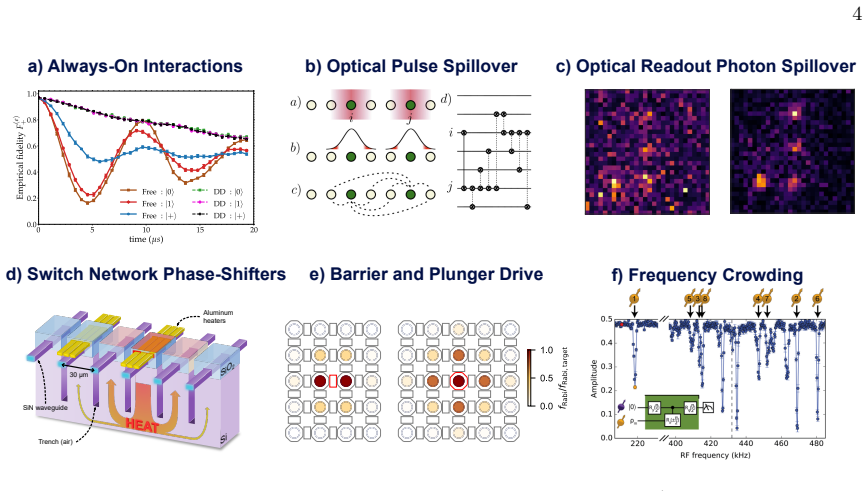
Figure 2 Crosstalk phenomena. a) CC BY 4.0 from the preprint at arXiv:2108.04530, which was later pub- lished as Ref. [27]. b) CC BY 4.0 [28]. c) CC BY 4.0 [29]. d) CC BY 4.0 [30]. e) CC BY 4.0 [31]. f) CC BY 4.0 [32]
-
[4]
a) Original figure based on the description given in Ref
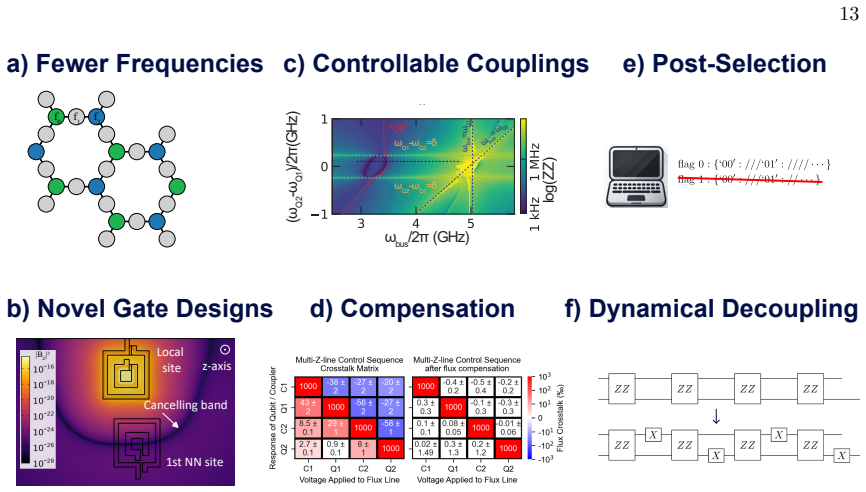
Figure 3 Crosstalk mitigation techniques. a) Original figure based on the description given in Ref. [22]. b) CC BY 4.0 [127]. c) CC BY 4.0 [40]. d) CC BY-NC-SA 4.0 [51]. e) Adapted with permission from authors of Ref. [126]. f) Originalfigurebasedondescriptionsgiven in Refs. [43, 44]. 26
-
[5]
a) Adapted from Ref
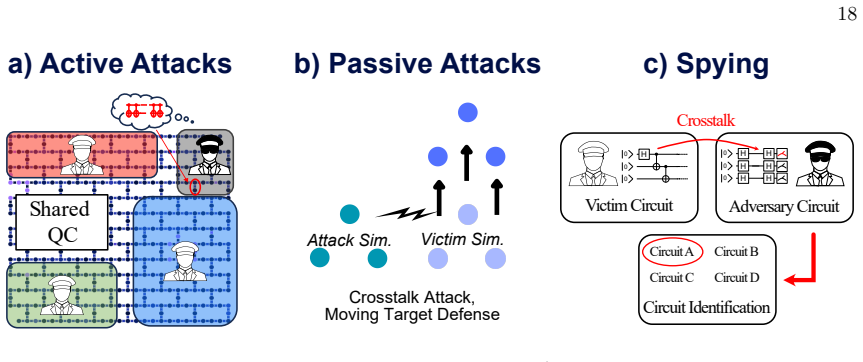
Figure 4 Crosstalk security vulnerabilities. a) Adapted from Ref. [147] with permission from the authors. b) CC BY 4.0 [67]. c) Original figure based on the description given in Ref. [154]. Assets from Ref. [147] were used with permission from the au- thors
-
[6]
Building logical qubits in a superconducting quantum computing system
Jay M. Gambetta, Jerry M. Chow, and Matthias Steffen. “Building logical qubits in a superconducting quantum computing system”. npj Quantum Information3, 2 (2017). doi:https://doi.org/10.1038/ s41534-016-0004-0
2017
-
[7]
Benchmarking a trapped-ion quan- tum computer with 30 qubits
Jwo-Sy Chen, Erik Nielsen, Matthew Ebert, Volkan Inlek, Kenneth Wright, Vandiver Chaplin, Andrii Maksymov, Eduardo Páez, Amrit Poudel, Peter Maunz, and John Gam- ble. “Benchmarking a trapped-ion quan- tum computer with 30 qubits”. Quantum 8, 1516 (2024). doi:https://doi.org/10. 22331/q-2024-11-07-1516
2024
-
[8]
A.G. Radnaev, W.C. Chung, D.C. Cole, D. Mason, T.G. Ballance, M.J. Bedalov, D.A. Belknap, M.R. Berman, M. Blakely, I.L. Bloomfield, P.D. Buttler, C. Camp- bell, A. Chopinaud, E. Copenhaver, M.K. Dawes, S.Y. Eubanks, A.J. Friss, D.M. Gar- cia, J. Gilbert, M. Gillette, P. Goiporia, P. Gokhale, J. Goldwin, D. Goodwin, T.M. Graham, C.J. Guttormsson, G.T. Hick...
-
[9]
A manufacturable plat- form for photonic quantum computing
PsiQuantum team. “A manufacturable plat- form for photonic quantum computing”. Na- ture641, 876–883 (2025). doi:https://doi. org/10.1038/s41586-025-08820-7
-
[10]
As- sessment of the errors of high-fidelity two- qubit gates in silicon quantum dots
Tuomo Tanttu, Wee Han Lim, Jonathan Y. Huang, Nard Dumoulin Stuyck, Will Gilbert, Rocky Y. Su, MengKe Feng, Jesus D. Ci- fuentes, Amanda E. Seedhouse, Stefan K. Ser- itan, Corey I. Ostrove, Kenneth M. Rudinger, Ross C. C. Leon, Wister Huang, Christo- pher C. Escott, Kohei M. Itoh, Nikolay V. Abrosimov, Hans-Joachim Pohl, Michael L. W. Thewalt, Fay E. Huds...
-
[11]
Lachlan Oberg, Cedric Weber, Hung-Hsiang Yang, Wolfgang M Klesse, Philipp Reinke, Santiago Corujeira Gallo, Alastair Stacey, Christopher I Pakes, and Marcus W Do- herty. “Bottom-up fabrication of scalable room-temperature diamond quantum com- puting and sensing technologies”. Materials for Quantum Technology5, 033001 (2025). doi:https://doi.org/10.1088/26...
-
[12]
Andrew Steane. “Quantum computing”. Re- ports on Progress in Physics61, 117 (1998). doi:https://doi.org/10.1088/0034-4885/ 61/2/002
-
[13]
Simulating physics with computers
Richard P Feynman. “Simulating physics with computers”. International Journal of Theoretical Physics21, 467–488 (1982). doi:https://doi.org/https://doi.org/10. 1007/BF02650179
1982
-
[14]
Jacob Biamonte, Peter Wittek, Nicola Pan- cotti, Patrick Rebentrost, Nathan Wiebe, and Seth Lloyd. “Quantum machine learning”. Nature549, 195–202 (2017). doi:https: 27 //doi.org/10.1038/nature23474
-
[15]
A fast quantum me- chanical algorithm for database search
Lov K. Grover. “A fast quantum me- chanical algorithm for database search”. In Proceedings of the Twenty-Eighth Annual ACM Symposium on Theory of Comput- ing. Page 212–219. STOC ’96New York, NY, USA (1996). Association for Computing Machinery. doi:https://doi.org/10.1145/ 237814.237866
-
[16]
Algorithms for quantum com- putation: discrete logarithms and factoring
P.W. Shor. “Algorithms for quantum com- putation: discrete logarithms and factoring”. In Proceedings 35th Annual Symposium on Foundations of Computer Science. Pages 124–
-
[17]
doi:https://doi.org/10.1109/ SFCS.1994.365700
(1994). doi:https://doi.org/10.1109/ SFCS.1994.365700
-
[18]
How to factor 2048 bit RSA integers with less than a million noisy qubits
Craig Gidney. “How to factor 2048 bit rsa integers with less than a million noisy qubits” (2025). arXiv:2505.15917
work page internal anchor Pith review Pith/arXiv arXiv 2048
-
[19]
Athena Caesura, Cristian L. Cortes, William Pol, Sukin Sim, Mark Steudtner, Gian- Luca R. Anselmetti, Matthias Degroote, Nikolaj Moll, Raffaele Santagati, Michael Streif, and Christofer S. Tautermann. “Faster quantum chemistry simulations on a quantum computer with improved tensor factorization and active volume compilation”. PRX Quan- tum6, 030337 (2025)...
-
[20]
A series of fast- paced advances in quantum error cor- rection
Earl Campbell. “A series of fast- paced advances in quantum error cor- rection”. Nature Reviews Physics 6, 160–161 (2024). doi:https: //doi.org/10.1038/s42254-024-00706-3
-
[21]
Quantum computing in the NISQ era and beyond
John Preskill. “Quantum computing in the NISQ era and beyond”. Quantum2, 79 (2018). doi:https://doi.org/10.22331/ q-2018-08-06-79
2018
-
[22]
Mind the gaps: The fraught road to quantum advantage
Jens Eisert and John Preskill. “Mind the gaps: The fraught road to quantum advan- tage” (2025). arXiv:2510.19928
work page internal anchor Pith review Pith/arXiv arXiv 2025
-
[23]
Detecting crosstalk errors in quantum information processors
Mohan Sarovar, Timothy Proctor, Kenneth Rudinger, Kevin Young, Erik Nielsen, and Robin Blume-Kohout. “Detecting crosstalk errors in quantum information processors”. Quantum4, 321 (2020). doi:https://doi. org/10.22331/q-2020-09-11-321
-
[24]
Ran- domized benchmarking of quantum gates
E. Knill, D. Leibfried, R. Reichle, J. Britton, R. B. Blakestad, J. D. Jost, C. Langer, R. Oz- eri, S. Seidelin, and D. J. Wineland. “Ran- domized benchmarking of quantum gates”. Phys. Rev. A77, 012307 (2008). doi:https: //doi.org/10.1103/PhysRevA.77.012307
-
[25]
Characterization of addressability by simultaneous random- ized benchmarking
Jay M. Gambetta, A. D. Córcoles, S. T. Merkel, B. R. Johnson, John A. Smolin, Jerry M. Chow, Colm A. Ryan, Chad Rigetti, S. Poletto, Thomas A. Ohki, Mark B. Ketchen, and M. Steffen. “Characterization of addressability by simultaneous random- ized benchmarking”. Phys. Rev. Lett.109, 240504 (2012). doi:https://doi.org/10. 1103/PhysRevLett.109.240504
2012
-
[26]
Quantum characteriza- tion, verification, and validation
Robin Blume-Kohout, Timothy Proctor, and Kevin Young. “Quantum characteriza- tion, verification, and validation” (2025). arXiv:2503.16383
-
[27]
Exponential sup- pression of bit or phase errors with cyclic error correction
Google Quantum AI. “Exponential sup- pression of bit or phase errors with cyclic error correction”. Nature595, 383– 387 (2021). doi:https://doi.org/10.1038/ s41586-021-03588-y
2021
-
[28]
Topological and subsystem codes on low-degree graphs with flag qubits
Christopher Chamberland, Guanyu Zhu, Theodore J. Yoder, Jared B. Hertzberg, and Andrew W. Cross. “Topological and subsystem codes on low-degree graphs with flag qubits”. Phys. Rev. X10, 011022 (2020). doi:https://doi.org/10. 1103/PhysRevX.10.011022
2020
-
[29]
Reducing unitary and spectator errors in cross resonance with optimized rotary echoes
Neereja Sundaresan, Isaac Lauer, Emily Pritchett, Easwar Magesan, Petar Jurcevic, and Jay M. Gambetta. “Reducing unitary and spectator errors in cross resonance with optimized rotary echoes”. PRX Quantum1, 020318 (2020). doi:https://doi.org/10. 1103/PRXQuantum.1.020318
2020
-
[30]
Quantifying the effects of local many- qubit errors and nonlocal two-qubit errors on the surface code
Austin G. Fowler and John M. Marti- nis. “Quantifying the effects of local many- qubit errors and nonlocal two-qubit errors on the surface code”. Phys. Rev. A89, 032316 (2014). doi:https://doi.org/10. 1103/PhysRevA.89.032316
2014
-
[31]
A sur- vey and tutorial on security and resilience of quantum computing
Abdullah Ash Saki, Mahabubul Alam, Kous- tubh Phalak, Aakarshitha Suresh, Rasit Onur Topaloglu, and Swaroop Ghosh. “A sur- vey and tutorial on security and resilience of quantum computing”. In 2021 IEEE Eu- ropean Test Symposium (ETS). Pages 1–
2021
-
[32]
doi:https://doi.org/10.1109/ ETS50041.2021.9465397
(2021). doi:https://doi.org/10.1109/ ETS50041.2021.9465397
-
[33]
Se- curity vulnerabilities in quantum cloud sys- tems: A survey on emerging threats
Justin Coupel and Tasnuva Farheen. “Se- curity vulnerabilities in quantum cloud sys- tems: A survey on emerging threats” (2025). arXiv:2504.19064
-
[34]
Suppression of crosstalk in superconducting qubits using dynam- 28 ical decoupling
Vinay Tripathi, Huo Chen, Mostafa Khezri, Ka-Wa Yip, E.M. Levenson-Falk, and Daniel A. Lidar. “Suppression of crosstalk in superconducting qubits using dynam- 28 ical decoupling”. Phys. Rev. Appl.18, 024068 (2022). doi:https://doi.org/10. 1103/PhysRevApplied.18.024068
2022
-
[35]
Crosstalk suppres- sion for fault-tolerant quantum error correction with trapped ions
Pedro Parrado-Rodríguez, Ciarán Ryan- Anderson, Alejandro Bermudez, and Markus Müller. “Crosstalk suppres- sion for fault-tolerant quantum error correction with trapped ions”. Quan- tum5, 487 (2021). doi:https: //doi.org/10.22331/q-2021-06-29-487
-
[36]
Enabling fast and ac- curate neutral atom readout through image denoising
Chaithanya Naik Mude, Linipun Phuttitarn, Satvik Maurya, Kunal Sinha, Mark Saffman, and Swamit Tannu. “Enabling fast and ac- curate neutral atom readout through image denoising” (2025). arXiv:2510.25982
-
[37]
Andreas Fyrillas, Nicolas Heurtel, Simone Pi- acentini, Nicolas Maring, Jean Senellart, and Nadia Belabas. “Resource-efficient crosstalk mitigation for the high-fidelity operation of photonic integrated circuits with induced phase shifters” (2025). arXiv:2506.05988
-
[38]
Robust and localised control of a 10-spin qubit array in germanium
Valentin John, Cécile X. Yu, Barnaby van Straaten, Esteban A. Rodríguez-Mena, Mauricio Rodríguez, Stefan D. Oosterhout, Lucas E. A. Stehouwer, Giordano Scap- pucci, Maximilian Rimbach-Russ, Stefano Bosco, Francesco Borsoi, Yann-Michel Ni- quet, and Menno Veldhorst. “Robust and localised control of a 10-spin qubit array in germanium”. Nature Communications...
2025
-
[39]
A ten-qubit solid-state spin regis- ter with quantum memory up to one minute
C. E. Bradley, J. Randall, M. H. Abobeih, R. C. Berrevoets, M. J. Degen, M. A. Bakker, M. Markham, D. J. Twitchen, and T. H. Taminiau. “A ten-qubit solid-state spin regis- ter with quantum memory up to one minute”. Phys. Rev. X9, 031045 (2019). doi:https: //doi.org/10.1103/PhysRevX.9.031045
-
[40]
Charge-insensitive qubit design derived from the cooper pair box
Jens Koch, Terri M. Yu, Jay Gambetta, A. A. Houck, D. I. Schuster, J. Majer, Alexandre Blais, M. H. Devoret, S. M. Girvin, and R. J. Schoelkopf. “Charge-insensitive qubit design derived from the cooper pair box”. Phys. Rev. A76, 042319 (2007). doi:https://doi.org/ 10.1103/PhysRevA.76.042319
-
[41]
Super- conducting quantum bits
John Clarke and Frank K. Wilhelm. “Super- conducting quantum bits”. Nature453, 1031– 1042 (2008). doi:https://doi.org/10.1038/ nature07128
2008
-
[42]
Su- perconducting circuits for quantum informa- tion: An outlook
M. H. Devoret and R. J. Schoelkopf. “Su- perconducting circuits for quantum informa- tion: An outlook”. Science339, 1169– 1174 (2013). doi:https://doi.org/10.1126/ science.1231930
2013
-
[43]
A quantum engineer’s guide to supercon- ducting qubits
P. Krantz, M. Kjaergaard, F. Yan, T. P. Orlando, S. Gustavsson, and W. D. Oliver. “A quantum engineer’s guide to supercon- ducting qubits”. Applied Physics Reviews 6, 021318 (2019). doi:https://doi.org/10. 1063/1.5089550
2019
-
[44]
Efficientzgates for quan- tum computing
David C. McKay, Christopher J. Wood, Sarah Sheldon, Jerry M. Chow, and Jay M. Gambetta. “Efficientzgates for quan- tum computing”. Phys. Rev. A96, 022330 (2017). doi:https://doi.org/10. 1103/PhysRevA.96.022330
2017
-
[45]
Fully microwave-tunable universal gates in super- conducting qubits with linear couplings and fixed transition frequencies
Chad Rigetti and Michel Devoret. “Fully microwave-tunable universal gates in super- conducting qubits with linear couplings and fixed transition frequencies”. Phys. Rev. B 81, 134507(2010). doi:https://doi.org/10. 1103/PhysRevB.81.134507
2010
-
[46]
Procedure for systematically tuning up cross-talk in the cross-resonance gate
Sarah Sheldon, Easwar Magesan, Jerry M. Chow, and Jay M. Gambetta. “Procedure for systematically tuning up cross-talk in the cross-resonance gate”. Phys. Rev. A93, 060302 (2016). doi:https://doi.org/10. 1103/PhysRevA.93.060302
2016
-
[47]
Tunable coupling architecture for fixed-frequency transmon su- perconducting qubits
J. Stehlik, D. M. Zajac, D. L. Underwood, T. Phung, J. Blair, S. Carnevale, D. Klaus, G. A. Keefe, A. Carniol, M. Kumph, Matthias Steffen, and O. E. Dial. “Tunable coupling architecture for fixed-frequency transmon su- perconducting qubits”. Phys. Rev. Lett.127, 080505 (2021). doi:https://doi.org/10. 1103/PhysRevLett.127.080505
2021
-
[48]
Effective hamiltonian models of the cross- resonance gate
Easwar Magesan and Jay M. Gambetta. “Effective hamiltonian models of the cross- resonance gate”. Phys. Rev. A101, 052308 (2020). doi:https://doi.org/10. 1103/PhysRevA.101.052308
2020
-
[49]
Software mitigation of crosstalk on noisy intermediate- scale quantum computers
Prakash Murali, David C. Mckay, Margaret Martonosi, and Ali Javadi-Abhari. “Software mitigation of crosstalk on noisy intermediate- scale quantum computers”. In Proceed- ings of the Twenty-Fifth International Con- ference on Architectural Support for Pro- gramming Languages and Operating Systems. Page 1001–1016. ASPLOS ’20New York, NY, USA (2020). Associa...
-
[50]
Multi-qubit dynam- ical decoupling for enhanced crosstalk 29 suppression
Siyuan Niu, Aida Todri-Sanial, and Nicholas T Bronn. “Multi-qubit dynam- ical decoupling for enhanced crosstalk 29 suppression”. Quantum Science and Tech- nology9, 045003 (2024). doi:https: //doi.org/10.1088/2058-9565/ad5a37
-
[51]
Syncopated dynamical decoupling for suppressing crosstalk in quantum cir- cuits
Bram Evert, Zoe Gonzalez Izquierdo, James Sud, Hong-Ye Hu, Shon Grabbe, Eleanor G. Rieffel, Matthew J. Reagor, and Zhihui Wang. “Syncopated dynamical decoupling for suppressing crosstalk in quantum cir- cuits” (2024). arXiv:2403.07836
-
[52]
Experimental characteri- zation, modeling, and analysis of crosstalk in a quantum computer
Abdullah Ash-Saki, Mahabubul Alam, and Swaroop Ghosh. “Experimental characteri- zation, modeling, and analysis of crosstalk in a quantum computer”. IEEE Trans- actions on Quantum Engineering1, 1– 6 (2020). doi:https://doi.org/10.1109/ TQE.2020.3023338
-
[53]
K. X. Wei, E. Magesan, I. Lauer, S. Srini- vasan, D. F. Bogorin, S. Carnevale, G. A. Keefe, Y. Kim, D. Klaus, W. Landers, N. Sun- daresan, C. Wang, E. J. Zhang, M. Stef- fen, O. E. Dial, D. C. McKay, and A. Kan- dala. “Hamiltonian engineering with mul- ticolor drives for fast entangling gates and quantum crosstalk cancellation”. Phys. Rev. Lett.129, 06050...
-
[54]
Benchmarking quan- tum processor performance at scale
David C. McKay, Ian Hincks, Emily J. Pritch- ett, Malcolm Carroll, Luke C. G. Govia, and Seth T. Merkel. “Benchmarking quan- tum processor performance at scale” (2023). arXiv:2311.05933
-
[55]
Impact of spectators on a two-qubit gate in a tunable coupling superconducting circuit
T.-Q. Cai, X.-Y. Han, Y.-K. Wu, Y.-L. Ma, J.-H. Wang, Z.-L. Wang, H.-Y Zhang, H.-Y Wang, Y.-P. Song, and L.-M. Duan. “Impact of spectators on a two-qubit gate in a tunable coupling superconducting circuit”. Phys. Rev. Lett.127, 060505 (2021). doi:https://doi. org/10.1103/PhysRevLett.127.060505
-
[56]
Suppressing quantum errors by scaling a surface code logical qubit
Google Quantum AI. “Suppressing quantum errors by scaling a surface code logical qubit”. Nature614, 676–681 (2023). doi:https:// doi.org/10.1038/s41586-022-05434-1
-
[57]
Quantum error correction below the sur- face code threshold
Google Quantum AI and Collaborators. “Quantum error correction below the sur- face code threshold”. Nature638, 920– 926 (2025). doi:https://doi.org/10.1038/ s41586-024-08449-y
2025
-
[58]
Characterizing and mitigating flux crosstalk in superconducting qubits-couplers system
Chen-Hsun Ma, Myrron Albert Callera Aguila, Nien-Yu Li, Li-Chieh Hsiao, Yi- ShiangHuang, Yen-ChunChen, Teik-HuiLee, Chin-Chia Chang, Jyh-Yang Wang, Ssu-Yen Huang, Hsi-Sheng Goan, Chiao-Hsuan Wang, Cen-Shawn Wu, Chii-Dong Chen, and Chung- Ting Ke. “Characterizing and mitigating flux crosstalk in superconducting qubits-couplers system” (2025). arXiv:2508.03434
-
[59]
Quantum trajectory approach to circuit qed: Quantum jumps and the zeno effect
Jay Gambetta, Alexandre Blais, M. Bois- sonneault, A. A. Houck, D. I. Schuster, and S. M. Girvin. “Quantum trajectory approach to circuit qed: Quantum jumps and the zeno effect”. Phys. Rev. A77, 012112 (2008). doi:https://doi.org/10. 1103/PhysRevA.77.012112
2008
-
[60]
Ma- chine learning for discriminating quan- tum measurement trajectories and improv- ing readout
Easwar Magesan, Jay M. Gambetta, A. D. Córcoles, and Jerry M. Chow. “Ma- chine learning for discriminating quan- tum measurement trajectories and improv- ing readout”. Phys. Rev. Lett.114, 200501 (2015). doi:https://doi.org/10. 1103/PhysRevLett.114.200501
2015
-
[61]
Measuring error rates of mid-circuit measurements
Daniel Hothem, Jordan Hines, Charles Bald- win, Dan Gresh, Robin Blume-Kohout, and Timothy Proctor. “Measuring error rates of mid-circuit measurements”. Nature Commu- nications16, 5761 (2025). doi:https://doi. org/10.1038/s41467-025-60923-x
-
[62]
Miti- gating measurement crosstalk via pulse shap- ing
Yang Gao, Feiyu Li, Yang Liu, Zhen Yang, Jiayu Ding, Wuerkaixi Nuerbolati, Ruixia Wang, Tang Su, Yanjun Ma, Yirong Jin, Haifeng Yu, He Wang, and Fei Yan. “Miti- gating measurement crosstalk via pulse shap- ing” (2025). arXiv:2509.05437
-
[63]
Ef- ficient and scalable architectures for multi- level superconducting qubit readout
Chaithanya Naik Mude, Satvik Maurya, Ben- jamin Lienhard, and Swamit Tannu. “Ef- ficient and scalable architectures for multi- level superconducting qubit readout” (2025). arXiv:2405.08982
-
[64]
Enhancing qubit readout with autoencoders
Piero Luchi, Paolo E. Trevisanutto, Alessan- dro Roggero, Jonathan L. DuBois, Yaniv J. Rosen, Francesco Turro, Valentina Amitrano, and Francesco Pederiva. “Enhancing qubit readout with autoencoders”. Phys. Rev. Appl. 20, 014045(2023). doi:https://doi.org/10. 1103/PhysRevApplied.20.014045
2023
-
[65]
Deep-neural- network discrimination of multiplexed superconducting-qubit states
Benjamin Lienhard, Antti Vepsäläinen, Luke C.G. Govia, Cole R. Hoffer, Jack Y. Qiu, Diego Ristè, Matthew Ware, David Kim, Roni Winik, Alexander Melville, Bethany Niedzielski, Jonilyn Yoder, Guil- hem J. Ribeill, Thomas A. Ohki, Hari K. Krovi, Terry P. Orlando, Simon Gustavsson, and William D. Oliver. “Deep-neural- network discrimination of multiplexed sup...
-
[66]
Quantum crosstalk analysis for simultaneous gate operations on superconducting qubits
Peng Zhao, Kehuan Linghu, Zhiyuan Li, Peng Xu, Ruixia Wang, Guangming Xue, Yirong Jin, and Haifeng Yu. “Quantum crosstalk analysis for simultaneous gate operations on superconducting qubits”. PRX Quantum3, 020301 (2022). doi:https://doi.org/10. 1103/PRXQuantum.3.020301
2022
-
[67]
Suppression of midcircuit measurement crosstalk errors with micromotion
J. P. Gaebler, C. H. Baldwin, S. A. Moses, J. M. Dreiling, C. Figgatt, M. Foss-Feig, D. Hayes, and J. M. Pino. “Suppression of midcircuit measurement crosstalk errors with micromotion”. Phys. Rev. A104, 062440 (2021). doi:https://doi.org/10. 1103/PhysRevA.104.062440
2021
-
[68]
High-fidelity indirect read- out of trapped-ion hyperfine qubits
Stephen D. Erickson, Jenny J. Wu, Pan-Yu Hou, Daniel C. Cole, Shawn Geller, Alex Kwiatkowski, Scott Glancy, Emanuel Knill, DanielH.Slichter, AndrewC.Wilson, andDi- etrich Leibfried. “High-fidelity indirect read- out of trapped-ion hyperfine qubits”. Phys. Rev. Lett.128, 160503 (2022). doi:https:// doi.org/10.1103/PhysRevLett.128.160503
-
[69]
Re- alization of a crosstalk-avoided quantum net- work node using dual-type qubits of the same ion species
L. Feng, Y.-Y. Huang, Y.-K. Wu, W.-X. Guo, J.-Y. Ma, H.-X. Yang, L. Zhang, Y. Wang, C.-X. Huang, C. Zhang, L. Yao, B.-X. Qi, Y.- F. Pu, Z.-C. Zhou, and L.-M. Duan. “Re- alization of a crosstalk-avoided quantum net- work node using dual-type qubits of the same ion species”. Nature Communications15, 204 (2024). doi:https://doi.org/10.1038/ s41467-023-44220-z
2024
-
[70]
Sungjoo Lim, Seunghyun Baek, Jacob Whit- low, Marissa D’ Onofrio, Tianyi Chen, Samuel Phiri, Stephen Crain, Kenneth R. Brown, Jungsang Kim, and Junki Kim. “Design and characterization of individual address- ing optics based on multi-channel acousto- optic modulator for 171yb+ qubits”. Op- tics & Laser Technology180, 111436 (2025). doi:https://doi.org/http...
-
[71]
Crosstalk Insensitive Trapped-Ion Entanglement through Coupling Matrix Engineering
Vikram Kashyap, Caleb Walton, and Sara Mouradian. “Crosstalk insensitive trapped- ion entanglement through coupling matrix en- gineering” (2025). arXiv:2508.20329
work page internal anchor Pith review Pith/arXiv arXiv 2025
-
[72]
A trapped-ion-based quan- tum byte with 10−5 next-neighbour cross- talk
C. Piltz, T. Sriarunothai, A. F. Varón, and C. Wunderlich. “A trapped-ion-based quan- tum byte with 10−5 next-neighbour cross- talk”. NatureCommunications5, 4679(2014). doi:https://doi.org/10.1038/ncomms5679
-
[73]
Two-qubit entangling gates within arbitrarilylong chains of trapped ions
K. A. Landsman, Y. Wu, P. H. Leung, D. Zhu, N. M. Linke, K. R. Brown, L. Duan, and C. Monroe. “Two-qubit entangling gates within arbitrarilylong chains of trapped ions”. Phys. Rev. A100, 022332 (2019). doi:https: //doi.org/10.1103/PhysRevA.100.022332
-
[74]
Evaluation of noise and crosstalk in neutral atom quantum computers
Pranet Sharma, Yizhuo Tan, Konstantinos- Nikolaos Papadopoulos, and Jakub Sze- fer. “Evaluation of noise and crosstalk in neutral atom quantum computers” (2025). arXiv:2507.22140
-
[75]
Midcircuit qubit measurement and rearrangement in a171Ybatomic array
M. A. Norcia, W. B. Cairncross, K. Barnes, P. Battaglino, A. Brown, M. O. Brown, K. Cassella, C.-A. Chen, R. Coxe, D. Crow, J. Epstein, C. Griger, A. M. W. Jones, H. Kim, J. M. Kindem, J. King, S. S. Kon- dov, K. Kotru, J. Lauigan, M. Li, M. Lu, E. Megidish, J. Marjanovic, M. McDonald, T. Mittiga, J. A. Muniz, S. Narayanaswami, C. Nishiguchi, R. Notermans...
-
[76]
En- hanced measurement of neutral-atom qubits with machine learning
L. Phuttitarn, B. M. Becker, R. Chinnarasu, T. M. Graham, and M. Saffman. “En- hanced measurement of neutral-atom qubits with machine learning”. Phys. Rev. Appl. 22, 024011(2024). doi:https://doi.org/10. 1103/PhysRevApplied.22.024011
2024
-
[77]
Continuous operation of large-scale atom ar- rays in optical lattices
Flavien Gyger, Maximilian Ammenwerth, Renhao Tao, Hendrik Timme, Stepan Sni- girev, Immanuel Bloch, and Johannes Zeiher. “Continuous operation of large-scale atom ar- rays in optical lattices”. Phys. Rev. Res.6, 033104 (2024). doi:https://doi.org/10. 1103/PhysRevResearch.6.033104
2024
-
[78]
Switch networks for photonic fusion-based quantum computing
Sara Bartolucci, Patrick Birchall, Damien Bonneau, Hugo Cable, Mercedes Gimeno- Segovia, Konrad Kieling, Naomi Nickerson, Terry Rudolph, and Chris Sparrow. “Switch networks for photonic fusion-based quantum computing” (2021). arXiv:2109.13760
-
[79]
Quantum transport simulations in a pro- grammable nanophotonic processor
Nicholas C. Harris, Gregory R. Steinbrecher, Mihika Prabhu, Yoav Lahini, Jacob Mower, Darius Bunandar, Changchen Chen, Franco N. C. Wong, Tom Baehr-Jones, Michael Hochberg, Seth Lloyd, and Dirk Englund. “Quantum transport simulations in a pro- grammable nanophotonic processor”. Nature Photonics11, 447–452 (2017). doi:https: //doi.org/10.1038/nphoton.2017.95. 31
-
[80]
Unscrambling light— automatically undoing strong mixing between modes
Andrea Annoni, Emanuele Guglielmi, Marco Carminati, Giorgio Ferrari, Marco Sampi- etro, David AB Miller, Andrea Melloni, and Francesco Morichetti. “Unscrambling light— automatically undoing strong mixing between modes”. Light: Science & Applications6, e17110–e17110 (2017). doi:https://doi. org/10.1038/lsa.2017.110
discussion (0)
Sign in with ORCID, Apple, or X to comment. Anyone can read and Pith papers without signing in.