Super-Arrhenius Dynamic Slowdown Revealed by Slow Variable Modulation in the Fragile Supercooled Liquid
Pith reviewed 2026-07-01 16:56 UTC · model grok-4.3
The pith
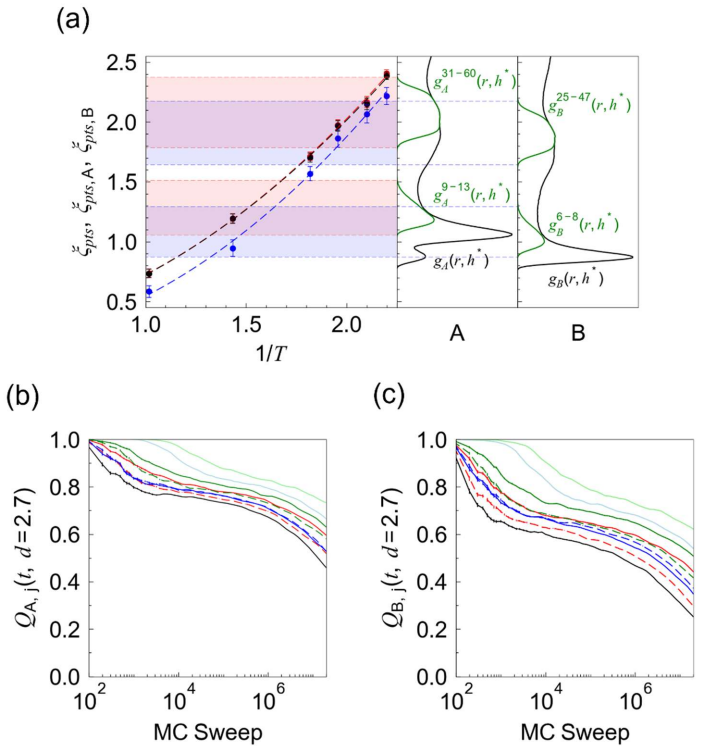
In the Kob-Andersen Lennard-Jones model, particles in the outer region of the first coordination shell serve as slow variables that modulate jump dynamics and cause the super-Arrhenius dynamic slowdown.
A machine-rendered reading of the paper's core claim, the machinery that carries it, and where it could break.
Core claim
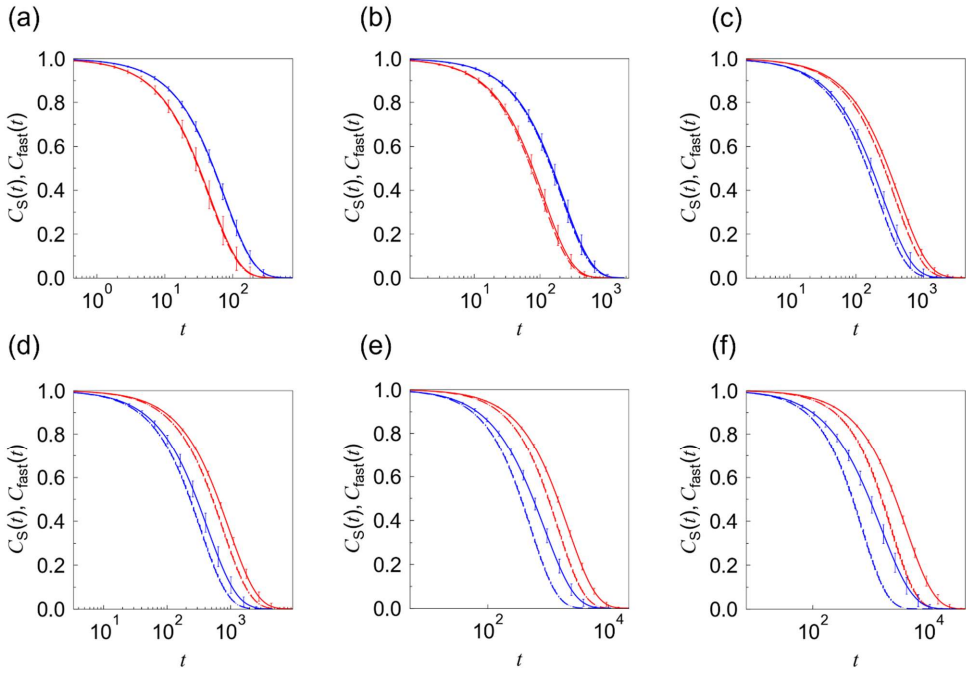
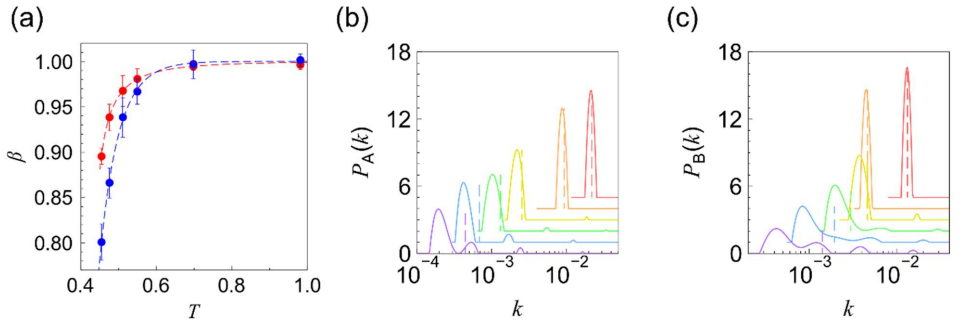
By comparing survival probability with its slow-fluctuation limit, particles in the outer region of the first coordination shell modulate the jump dynamics, enhance the jump rate fluctuations, and induce the dynamic slowdown. As temperature decreases, this extends to the second coordination shell and beyond, corresponding to an increase in the static correlation length.
What carries the argument
The distribution shift during jump motion in the outer region of the first coordination shell, used as a slow variable to compare survival probability with slow-fluctuation limit.
If this is right
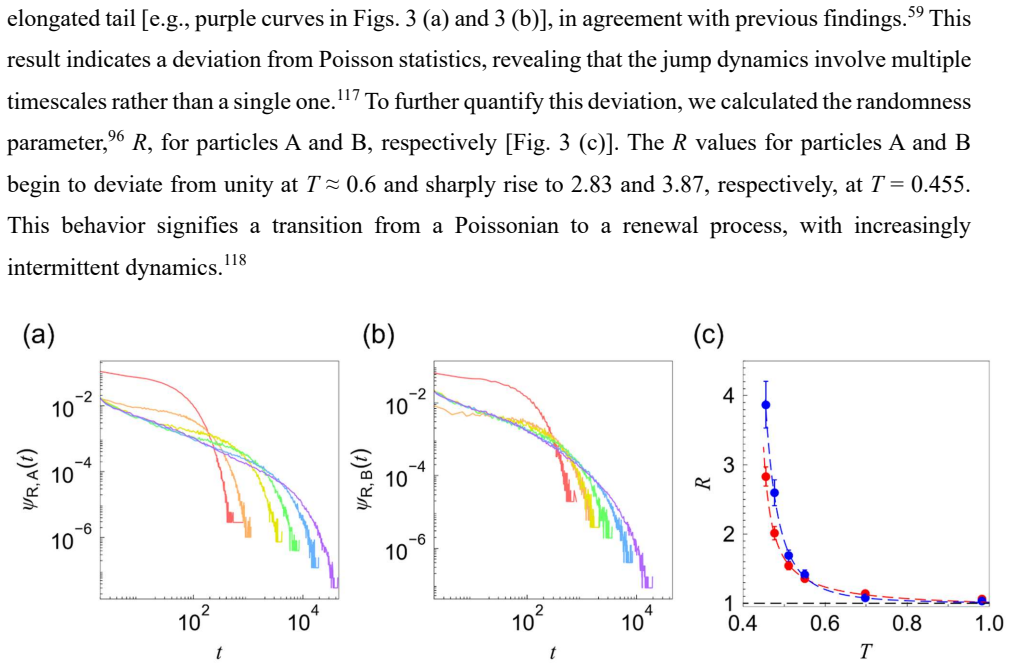
- Non-Poissonian dynamics emerge as temperature decreases in the mildly supercooled regime.
- The modulation by these slow variables intensifies the dynamic slowdown with further supercooling.
- The spatial growth of the slow variables to outer shells corresponds closely to the increase in static correlation length.
Where Pith is reading between the lines
- This local modulation mechanism may link dynamic heterogeneity directly to structural features around mobile particles.
- The same approach could be applied to other fragile glass-forming models to test whether the spatial extension of slow variables is a general feature.
- Tracking how the affected region grows with cooling might provide a way to relate dynamic and static length scales in supercooled liquids.
Load-bearing premise
The assumption that the observed distribution shift in the outer region of the first coordination shell functions as a slow variable modulating jump dynamics.
What would settle it
If the survival probability fails to match its slow-fluctuation limit when the distribution shift is treated as the slow variable, the claim that these particles modulate jump dynamics would be falsified.
Figures


read the original abstract
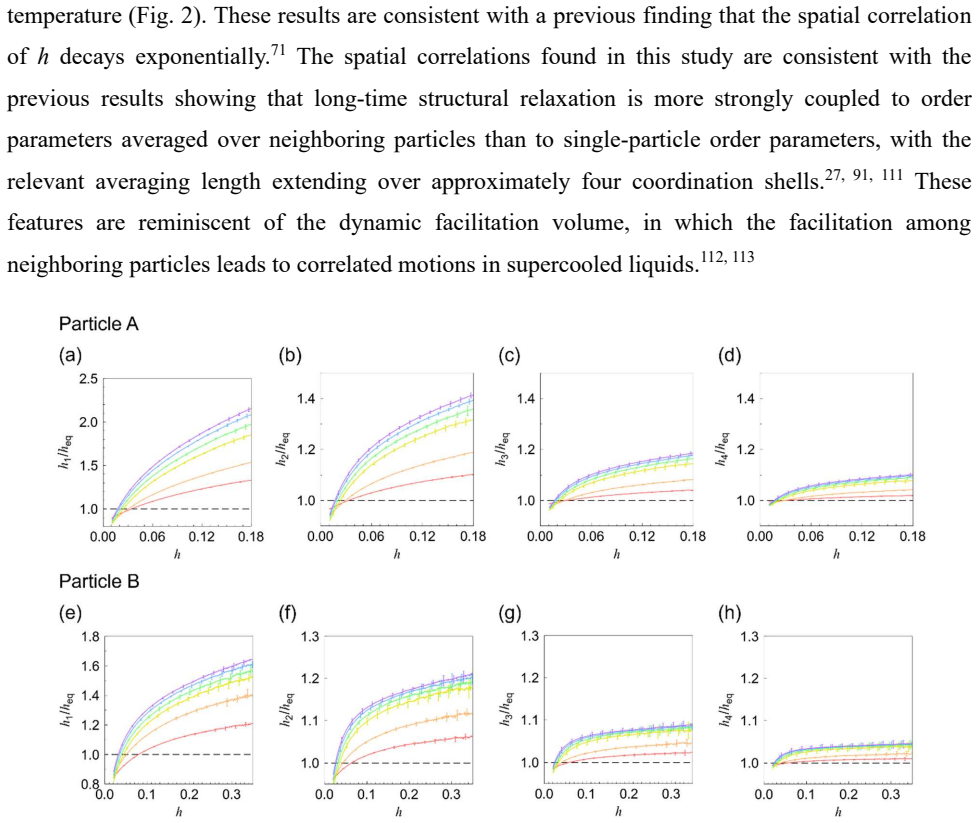
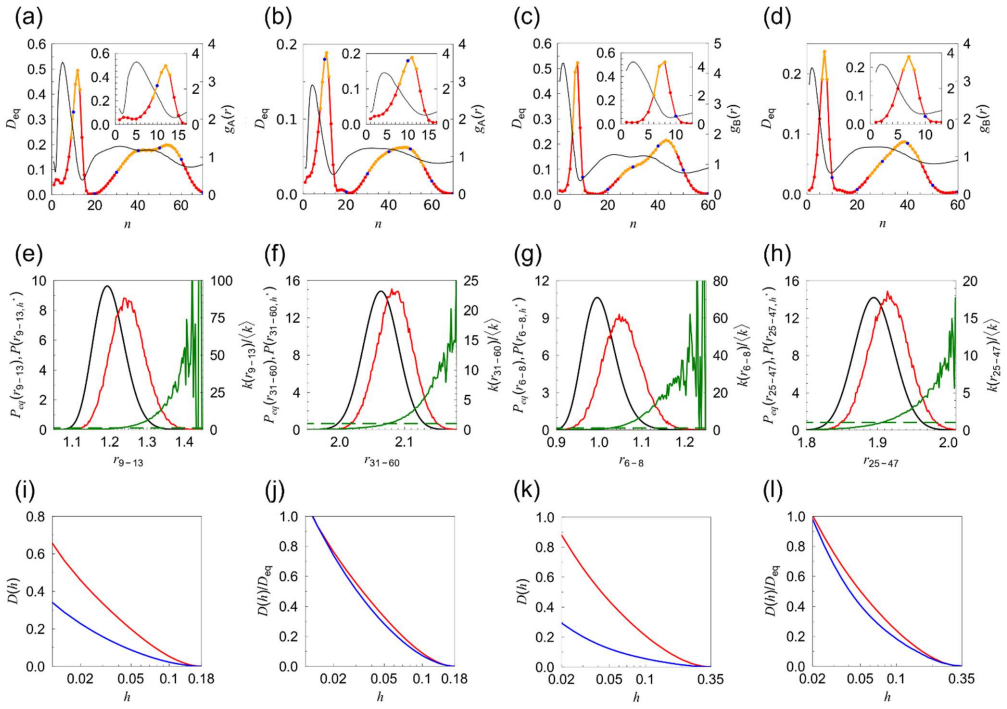
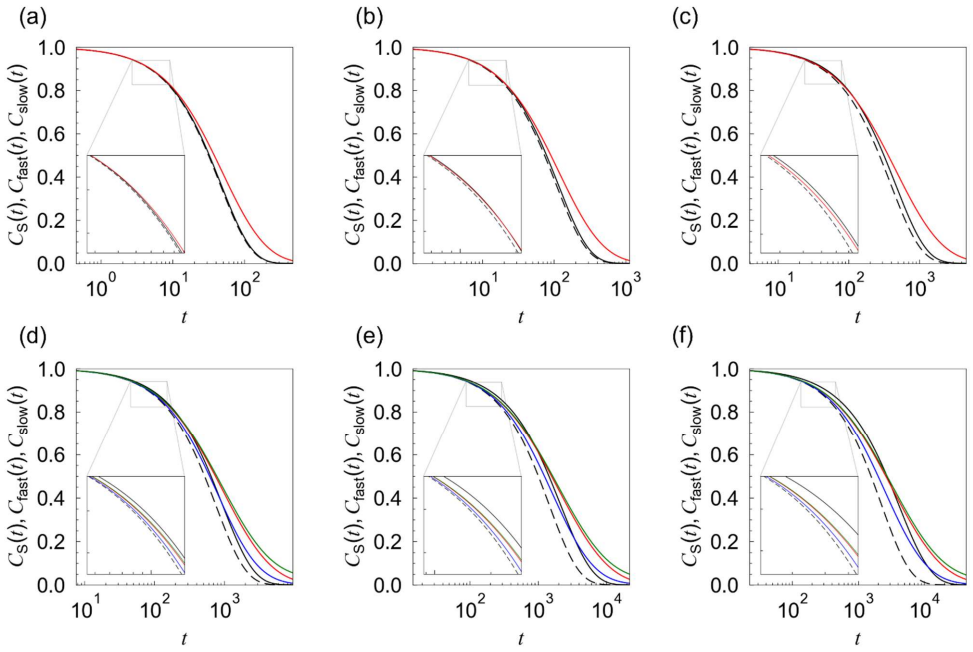
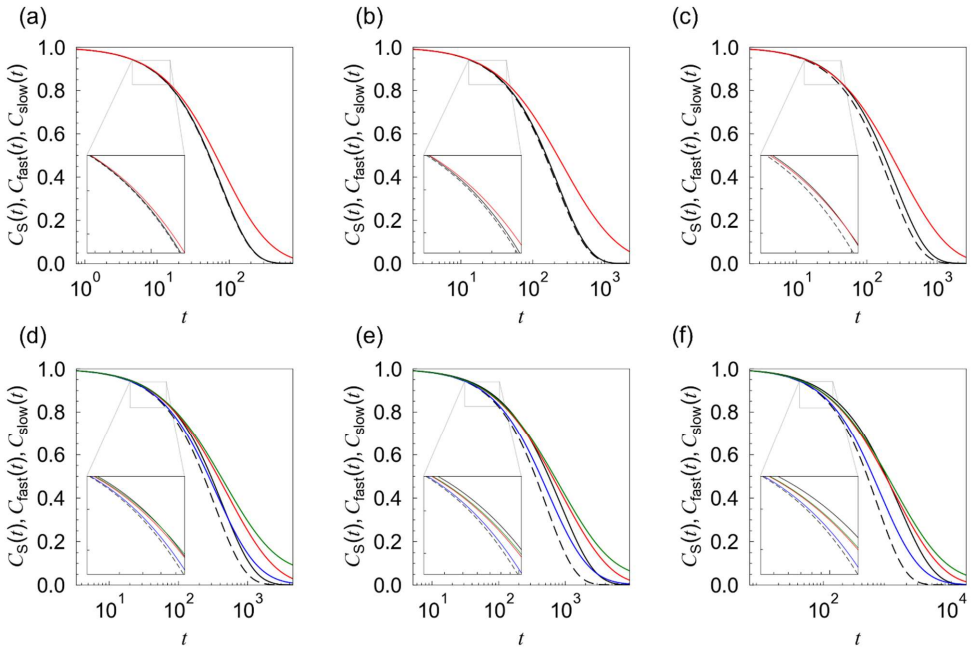
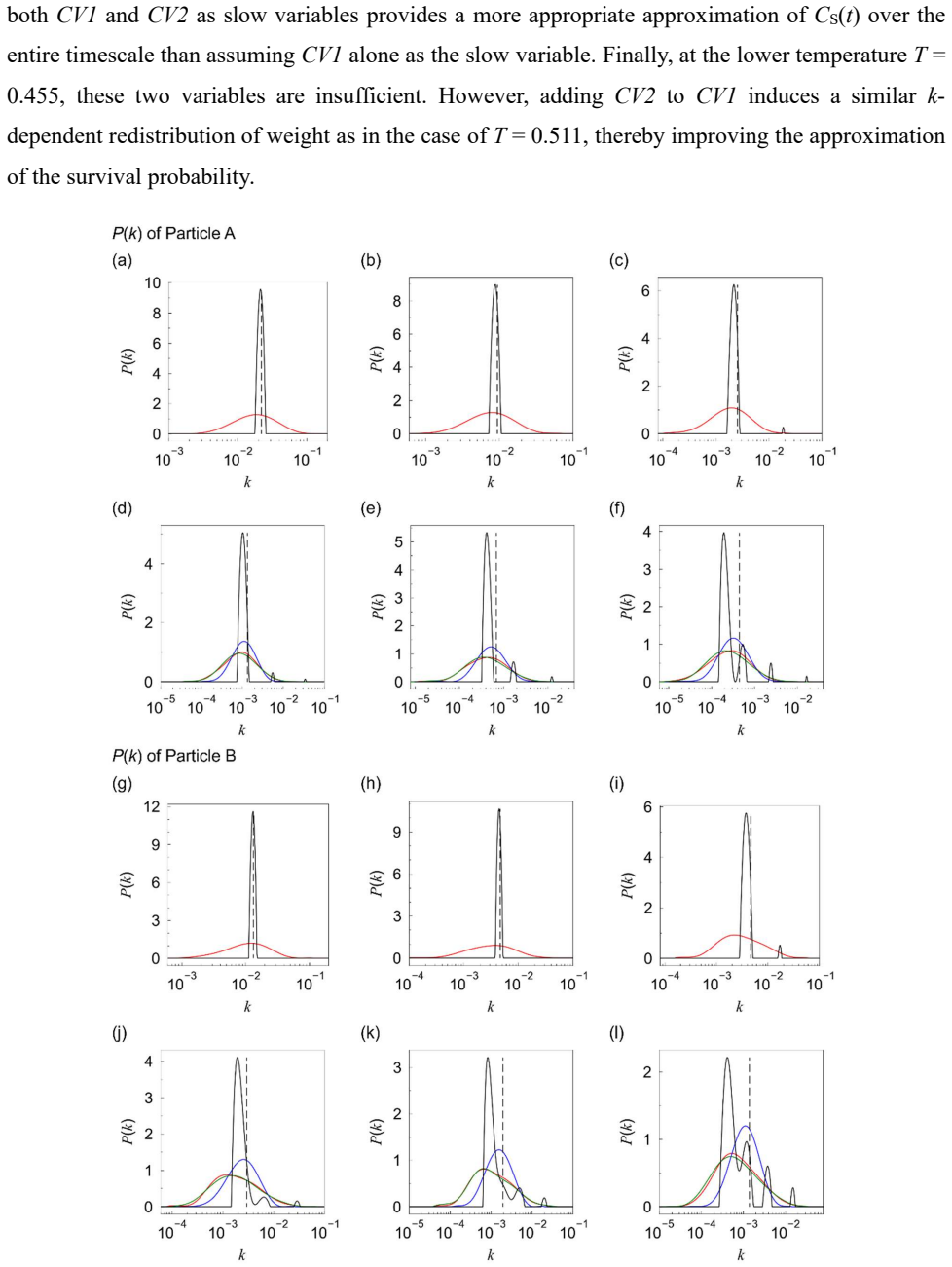
The super-Arrhenius dynamic slowdown in fragile supercooled liquids remains one of the central unresolved questions in condensed matter physics. In this study, we analyze particle jump dynamics in a prototypical fragile glass-forming liquid, the Kob-Andersen Lennard-Jones (KALJ) model. Using the displacement of jumping particles as the reaction coordinate, we demonstrate the emergence of non-Poissonian dynamics as the temperature decreases. In the mildly supercooled regime, the outer region of the first coordination shell of a jumping particle exhibits a significant distribution shift during the jump motion. By comparing the survival probability with its slow-fluctuation limit using this distribution as a slow variable, we confirm that particles in this region modulate the jump dynamics, enhance the jump rate fluctuations, and thereby induce the dynamic slowdown as supercooling proceeds. As the temperature decreases, this behavior extends to the outer regions of the second coordination shell and beyond, intensifying the dynamic slowdown. This spatial growth of the slow variables responsible for dynamic disorder exhibits close correspondence with an increase in the static correlation length. These results provide a microscopic mechanism for the super-Arrhenius dynamic slowdown in the KALJ model.
Editorial analysis
A structured set of objections, weighed in public.
Referee Report
Summary. The paper analyzes jump dynamics in the Kob-Andersen Lennard-Jones model of a fragile glassformer. Using particle displacement as the reaction coordinate, it reports non-Poissonian jump statistics at low temperature, a distribution shift in the outer first-coordination shell during jumps, and a comparison of survival probabilities to their slow-fluctuation limit that is taken to demonstrate modulation of jump rates by this structural feature. The effect is claimed to spread to outer shells with decreasing temperature and to track the growth of a static correlation length, thereby supplying a microscopic mechanism for super-Arrhenius slowdown.
Significance. If the identified distribution shift can be shown to be an independent, pre-existing slow variable rather than a kinematic byproduct of the chosen reaction coordinate, the work would supply a concrete, spatially resolved account of how local structural fluctuations produce dynamic heterogeneity and the growth of dynamic length scales in fragile liquids. The survival-probability test and its extension across shells constitute a falsifiable protocol that could be applied to other models.
major comments (2)
- [Section describing the reaction coordinate and the survival-probability comparison (near the abstract's description of '] The central claim that the outer-first-shell distribution shift functions as an independent slow variable modulating jump rates rests on the comparison of survival probability to its slow-fluctuation limit. Because the reaction coordinate is defined directly from the displacement of the jumping particle, any observed shift during the jump is at least partly a kinematic consequence of the motion itself; the manuscript does not demonstrate that the shift precedes and controls the jump event rather than co-occurring with it. This ambiguity propagates to the claim that the same mechanism extends to the second shell and beyond.
- [Results section on temperature dependence and correlation-length comparison] The assertion that the spatial growth of the slow-variable region 'exhibits close correspondence' with the increase in static correlation length is load-bearing for the mechanistic interpretation, yet no quantitative measure of this correspondence (overlap integral, scaling exponents, or error bars on the lengths) is supplied in the results that would allow the reader to judge the strength of the match.
minor comments (2)
- [Methods or Results] Notation for the slow-fluctuation limit of the survival probability should be defined explicitly with an equation number rather than described only in prose.
- [Figure captions] Figure captions should state the temperature values, system size, and number of independent trajectories used for each panel so that the reported distribution shifts can be assessed for statistical significance.
Simulated Author's Rebuttal
We thank the referee for the careful reading and constructive comments on our manuscript. We address each major comment below and indicate the revisions that will be incorporated.
read point-by-point responses
-
Referee: The central claim that the outer-first-shell distribution shift functions as an independent slow variable modulating jump rates rests on the comparison of survival probability to its slow-fluctuation limit. Because the reaction coordinate is defined directly from the displacement of the jumping particle, any observed shift during the jump is at least partly a kinematic consequence of the motion itself; the manuscript does not demonstrate that the shift precedes and controls the jump event rather than co-occurring with it. This ambiguity propagates to the claim that the same mechanism extends to the second shell and beyond.
Authors: We agree that the displacement-based reaction coordinate requires care to separate kinematic effects from structural modulation. The survival-probability comparison is performed by treating the outer-shell distribution as a fixed, slowly varying variable whose value is sampled from the equilibrium distribution; the close match to the observed survival probability indicates that this structural feature controls the rate fluctuations rather than arising solely as a co-occurring byproduct. The outer-shell particles are spatially distinct from the central particle whose displacement defines the coordinate, supporting independence. We will add a new subsection with time-resolved distribution profiles conditioned on jump initiation to explicitly demonstrate that the shift begins prior to significant displacement of the central particle, and we will extend this timing analysis to the second shell. revision: yes
-
Referee: The assertion that the spatial growth of the slow-variable region 'exhibits close correspondence' with the increase in static correlation length is load-bearing for the mechanistic interpretation, yet no quantitative measure of this correspondence (overlap integral, scaling exponents, or error bars on the lengths) is supplied in the results that would allow the reader to judge the strength of the match.
Authors: We acknowledge that a purely qualitative statement of correspondence is insufficient for a load-bearing claim. In the revised manuscript we will add quantitative comparisons, including the overlap integral between the radial extent of the modulating region and the static correlation length, the scaling of both lengths with temperature, and error bars obtained from block averaging over independent trajectories. revision: yes
Circularity Check
No significant circularity; derivation relies on independent simulation observables
full rationale
The paper identifies a distribution shift in the first coordination shell using displacement of jumping particles as reaction coordinate, then compares survival probability to its slow-fluctuation limit. This chain is constructed from direct simulation outputs (particle trajectories in KALJ model) rather than by redefining the slow variable in terms of the jump statistics it seeks to explain. No equations or steps reduce the claimed modulator to a tautological fit or self-citation; the spatial extension at lower T and correspondence to static correlation length are presented as emergent observations. The method is self-contained against external benchmarks (simulation data) with no load-bearing self-citation or ansatz smuggling visible in the provided text.
Axiom & Free-Parameter Ledger
Reference graph
Works this paper leans on
-
[1]
Berthier, P
L. Berthier, P. Charbonneau and S. Yaida, J. Chem. Phys. 144, 024501 (2016)
2016
-
[2]
V ogel, Phys
H. V ogel, Phys. Z. 22 (1921)
1921
-
[3]
G. S. Fulcher, J. Am. Ceram. Soc. 8 (1925)
1925
-
[4]
Tammann and W
G. Tammann and W. Hesse, Z. Anorg. Allg. Chem. 156 (1926)
1926
discussion (0)
Sign in with ORCID, Apple, or X to comment. Anyone can read and Pith papers without signing in.