Spin-Dependent Nucleon-Nucleus Interactions Constrained by Neutron Observables and Their Impact on Near-Barrier Proton Fusion
Pith reviewed 2026-07-01 16:44 UTC · model grok-4.3
The pith
Spin-dependent nucleon-nucleus interactions change near-barrier proton fusion cross sections by only 0.01-0.03 percent.
A machine-rendered reading of the paper's core claim, the machinery that carries it, and where it could break.
Core claim
Neutron spin observables constrain the central spin-spin radial form factors through DWBA analysis in the unlike channel; when the same form factors are reconstructed for the like channel and included in a coupled-channels fusion calculation for p+93Nb, they produce only a 0.01-0.03 percent change in the cross section near the barrier, demonstrating that the real spin-dependent correction is strongly suppressed.
What carries the argument
Radial form factors for the spin-spin, tensor, and spin-orbit components inside a folding framework that transfers constraints from neutron-proton to proton-proton channels.
If this is right
- The observed sign systematics of the neutron spin observables are reproduced, validating the operator conventions used.
- The effective fusion barrier receives only a weak modification from the spin-dependent terms.
- The real spin-dependent correction remains strongly suppressed for near-barrier fusion in the p+93Nb system.
Where Pith is reading between the lines
- The same neutron-to-proton mapping could be tested on other targets where both neutron spin data and fusion data exist.
- If the suppression persists across systems, spin-dependent terms can often be omitted from near-barrier fusion models without loss of accuracy.
- The approach links scattering observables directly to reaction rates, offering a route to constrain proton-induced processes when direct spin data are scarce.
Load-bearing premise
The unlike-channel interaction fixed by neutron scattering can be accurately reconstructed into the like-channel interaction needed for the proton fusion calculation.
What would settle it
A precision measurement of the p+93Nb fusion excitation function near the barrier that deviates by more than 0.05 percent from the spin-independent prediction.
Figures



read the original abstract
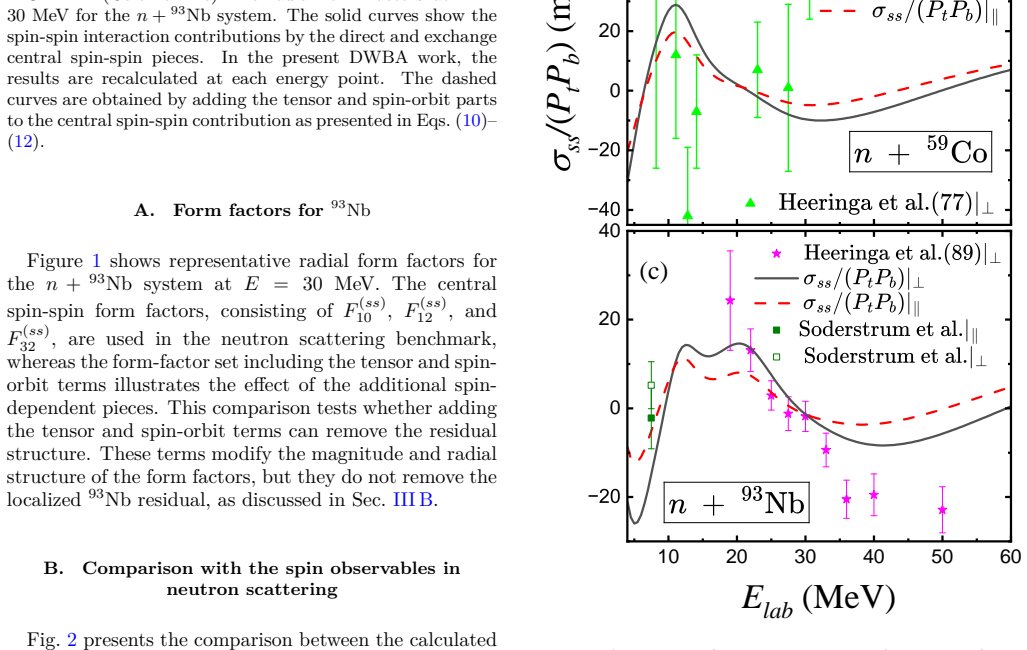
We investigate the role of spin-dependent nucleon-nucleus interactions in nuclear reactions. To this end, we use neutron spin observables to constrain the dominant central spin-spin form factors and then apply the corresponding like-channel interactions to near-barrier fusion in the $p+{}^{93}$Nb system. The interactions are constructed within a folding framework based on a finite-range effective nucleon-nucleon force and organized in terms of radial form factors associated with their spin-spin, tensor, and spin-orbit components. Neutron spin observables in the $n+{}^{27}$Al, $n+{}^{59}$Co, and $n+{}^{93}$Nb target systems are analyzed within a distorted-wave Born approximation (DWBA) framework to constrain the sign and normalization in the central spin-spin parts of the radial form factors and to examine the assembled operator conventions. The calculation reproduces the observed sign systematics of the neutron spin observables for the three targets, indicating that the essential spin-dependent structure is properly incorporated. The unlike-channel (neutron-proton) interaction constrained by neutron scattering is then reconstructed for the corresponding like-channel (proton-proton) interaction and applied to a coupled-channels description of near-barrier fusion for the $p+{}^{93}$Nb system. The resultant spin-dependent interactions lead only to a weak modification of the effective barrier and change the fusion cross section by about $0.01$-$0.03\%$ in the present calculation. These results show that the corresponding real spin-dependent correction in the like-channel is strongly suppressed in near-barrier fusion in $p+{}^{93}\mathrm{Nb}$. The present work thus connects the neutron-scattering constraints on the operator conventions with the fusion calculation in the proton channel, and quantifies the magnitude of the corresponding real spin-dependent correction in near-barrier fusion.
Editorial analysis
A structured set of objections, weighed in public.
Referee Report
Summary. The manuscript constrains the central spin-spin radial form factors of nucleon-nucleus interactions by fitting neutron spin observables in DWBA calculations for the n+27Al, n+59Co, and n+93Nb systems. These unlike-channel (n-p) constraints are then mapped via isospin symmetry to the corresponding like-channel (p-p) interactions within a folding model based on a finite-range effective NN force. The mapped interactions are inserted into a coupled-channels calculation of near-barrier fusion for p+93Nb, where they produce only a 0.01–0.03% change in the fusion cross section and a weak modification of the effective barrier, leading to the conclusion that real spin-dependent corrections are strongly suppressed in this regime.
Significance. If the mapping and suppression result hold, the work demonstrates that neutron spin data can be used to set operator conventions that then yield falsifiable, small-effect predictions for proton fusion, supporting the neglect of spin-dependent terms in near-barrier fusion modeling. The reproduction of observed sign systematics across three targets provides a non-trivial consistency check on the form-factor conventions. The quantitative bound (0.01–0.03%) is a concrete, testable output that could guide future experiments or model simplifications.
major comments (1)
- [abstract / transfer paragraph] The reconstruction of the like-channel (p-p) central spin-spin form factors from the unlike-channel (n-p) constraints (abstract and the paragraph describing the transfer) relies on specific isospin coefficients inside the folding model whose validity is not tested against any proton spin observable. Because the headline 0.01–0.03% fusion change is obtained only after this mapping, an unquantified uncertainty in the isospin transfer directly affects the central claim of strong suppression; the manuscript should either provide an independent check or propagate the mapping uncertainty into the fusion result.
Simulated Author's Rebuttal
We thank the referee for the careful and constructive review. The single major comment is addressed point-by-point below.
read point-by-point responses
-
Referee: [abstract / transfer paragraph] The reconstruction of the like-channel (p-p) central spin-spin form factors from the unlike-channel (n-p) constraints (abstract and the paragraph describing the transfer) relies on specific isospin coefficients inside the folding model whose validity is not tested against any proton spin observable. Because the headline 0.01–0.03% fusion change is obtained only after this mapping, an unquantified uncertainty in the isospin transfer directly affects the central claim of strong suppression; the manuscript should either provide an independent check or propagate the mapping uncertainty into the fusion result.
Authors: The isospin coefficients used for the n-p to p-p mapping are not free parameters but are fixed by the isospin decomposition of the finite-range effective NN force that underlies the folding model. This is the standard construction for nucleon-nucleus potentials from NN interactions. We agree that the manuscript does not validate the mapping against proton spin observables, as the study is deliberately focused on neutron constraints transferred via isospin symmetry. In revision we will (i) quote the explicit numerical values of the isospin coefficients employed, (ii) state their origin in the effective NN force, and (iii) add a short paragraph noting the isospin-symmetry assumption and its implications for the quoted 0.01–0.03 % effect. This makes the mapping transparent without requiring new data or a full uncertainty propagation, which would lie outside the present scope. revision: yes
Circularity Check
No significant circularity; neutron constraints yield forward prediction for fusion
full rationale
The derivation constrains central spin-spin radial form factors from neutron spin observables in DWBA for n+27Al, n+59Co and n+93Nb, then reconstructs the like-channel (p-p) operator within the folding model for application to p+93Nb coupled-channels fusion. The reported 0.01-0.03% change in fusion cross section is presented as a prediction from those externally fixed parameters rather than a fit to fusion data. No quoted step reduces the final result to the neutron inputs by construction, no self-citation is load-bearing for the central claim, and the isospin reconstruction is an explicit model step whose validity is not claimed to be proven inside the paper. The chain is therefore self-contained against external neutron benchmarks.
Axiom & Free-Parameter Ledger
free parameters (1)
- normalization and sign of central spin-spin form factors
axioms (2)
- domain assumption DWBA framework accurately extracts spin-dependent form factors from neutron observables
- domain assumption Reconstruction from unlike to like channel preserves the essential spin-dependent structure for fusion
Reference graph
Works this paper leans on
-
[1]
+ (11 /20)∆VB(S = 5) ≃ 5.2 × 10⁻⁵ MeV. Thus the diagonal barrier splitting is largely traceless under the unpolarized spin average. The residual fusion modifica- tion is therefore controlled by the small nonlinearity of the penetrability, the weak off-diagonal couplings at RB, and the radial localization of the spin-dependent form factors. 9 /s53 /s54 /s5...
-
[2]
This reflects the weak coupling strength of the spin-dependent interaction in the barrier region
× 10−4 in ratio, corresponding to approximately 0.01– 0.03 %. This reflects the weak coupling strength of the spin-dependent interaction in the barrier region. In prac- tical terms, the present calculation does not indicate that spin dependence is irrelevant in general, but suggests that the present real interaction produces only a very weak effect in thi...
-
[3]
energy-independent imaginary terms applied to all three radial form factors, F10, F12, and F32,
-
[4]
energy-independent imaginary terms applied to F10 only,
-
[5]
low-energy-localized terms of the form exp[−(E/E0)2] applied to all three retained form factors,
-
[6]
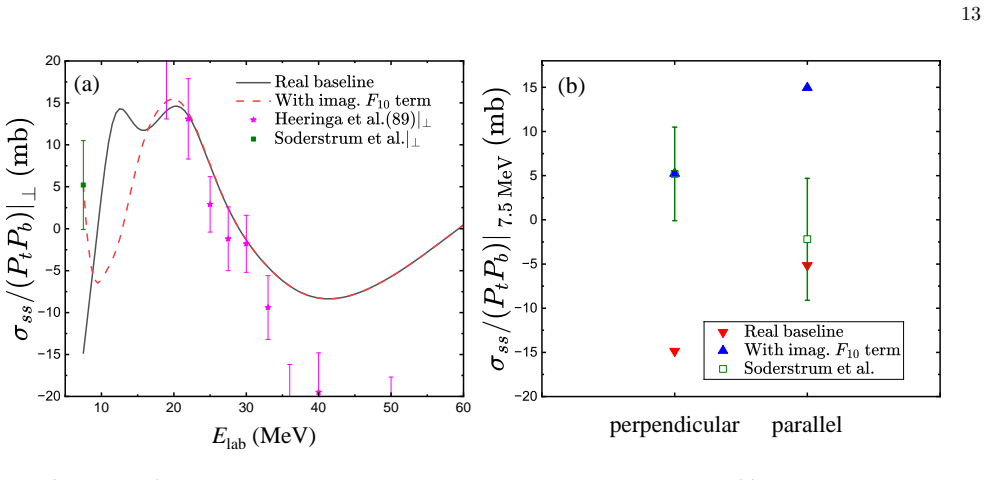
the same low-energy-localized form applied only to F10. The broad scan used η ∈ [−3, 3] and a reference low- energy weight exp[−(E/15 MeV)2], while the refined F10- only scan used η ∈ [−10, 10] and E0 ∈ [5, 25] MeV. After the 93Nb neutron baseline was updated by reconstructing the central spin-spin parts of F10, F12, and F32 at each calculation energy, th...
-
[7]
Direct and exchange parts in the nucleon-nucleus spin-spin interaction First, we obtain the direct term in the folded nucleon- nucleus spin-spin interaction, U (ss,dir) k (R), by folding the multipole component of the projectile–valence-nucleon interaction v(ss) k (R, αrt) with the valence radial density U (ss,dir) k (R) = Z ∞ 0 drt u2 lt (rt) v(ss) k (R,...
-
[8]
T ensor interaction part in the nucleon-nucleus spin-spin interaction The tensor radial moments are built from the Horie– Sasaki decomposition [ 29], which is a tensor-multipole expansion of the nucleon–nucleon tensor interaction in terms of two coordinates: the external projectile–target coordinate R and the internal valence coordinate rt. For example, t...
-
[9]
Direct spin-orbit combinations The direct neutron spin-orbit contribution is built from the k = 0 , k = 2 , and recoil-weighted k = 1 , k = 3 multipoles of the unlike-nucleon spin-orbit interaction. 15 Defining U (ls) k (R) = Z ∞ 0 drt u2 lt (rt) v(ls) k (R, αrt), (A10) U (ls) 1/r (R) = Z ∞ 0 drt u2 lt (rt) rt v(ls) 1 (R, αrt), (A11) U (ls) 3/r (R) = Z ∞ ...
-
[10]
Assembled 93Nb form factors For the stretched g9/2 channel of 93Nb, the coefficients used here are a = 1 /4, b = 1 , c = −2/11, and the co- efficients in F32 are reduced to c(ss) 32 = −3/11, c (22) 32 = 6/77, c (24) 32 = 162/1001, and c(ls) 32 = 9/11. The assembled form-factor sets used in the present analysis are F (ss) 10 (R) = a U (ss) 0 (R) , F 10(R) = ...
-
[11]
Equations ( A17)– (A19) give the F (ss) and F (ss+t+ls) sets shown in Fig
= 0 .7171371656 fixes the (2, 4) tensor normalization in F32. Equations ( A17)– (A19) give the F (ss) and F (ss+t+ls) sets shown in Fig. 1. ACKNOWLEDGMENTS K. Heo and M.-K.C. acknowledge support from the Na- tional Research Foundation of Korea (NRF) under Grant No. RS-2024-00460031. M.-K.C. was also supported by the NRF Basic Science Research Program unde...
work page 2024
-
[12]
T. L. McAbee, W. J. Thompson, and H. Ohnishi, Nucl. Phys. A 509, 39 (1990)
work page 1990
-
[13]
T. L. McAbee, Spin-Spin Interactions in Nucleon- Nucleus Scattering , Ph.D. thesis, University of North Carolina at Chapel Hill (1986)
work page 1986
-
[14]
N. M. Clarke, Journal of Physics A: Mathematical, Nu- clear and General 7, L16 (1974)
work page 1974
-
[15]
Y. Sakuragi and M. Katsuma, Nucl. Instrum. Meth- ods Phys. Res. Sect. A 402, 347 (1998) , proceedings of the 7th RCNP International Workshop on Polarized He Beams and Gas Targets and Their Application
work page 1998
- [16]
-
[17]
S. Ishikawa, M. Tanifuji, Y. Iseri, and Y. Yamamoto, Phys. Rev. C 72, 027601 (2005)
work page 2005
-
[18]
E. S. Cunningham, J. S. Al-Khalili, and R. C. Johnson, Phys. Rev. C 87, 054601 (2013)
work page 2013
-
[19]
F. Petrovich, D. Stanley, L. A. Parks, and P. Nagel, Phys. Rev. C 17, 1642 (1978)
work page 1978
-
[20]
A. P. Stamp, Phys. Rev. 153, 1052 (1967)
work page 1967
- [21]
-
[22]
W. Heeringa, H. Postma, H. Dobiasch, R. Fischer, H. O. Klages, R. Maschuw, and B. Zeitnitz, Phys. Rev. C 16, 1389 (1977)
work page 1977
-
[23]
C. R. Gould, D. G. Haase, L. W. Seagondollar, J. P. Soderstrum, K. E. Nash, M. B. Schneider, and N. R. 16 Roberson, Phys. Rev. Lett. 57, 2371 (1986)
work page 1986
-
[24]
J. P. Soderstrum, C. R. Gould, D. G. Haase, N. R. Rober- son, M. B. Schneider, and L. W. Seagondollar, Phys. Rev. C 45, 326 (1992)
work page 1992
-
[25]
W. Heeringa, H. O. Klages, C. Woelfl, and R. W. Finlay, Phys. Rev. Lett. 63, 2456 (1989)
work page 1989
-
[26]
M. M. Nagadi, G. J. Weisel, R. L. Walter, J. P. Delaroche, and P. Romain, Phys. Rev. C 70, 064604 (2004)
work page 2004
-
[27]
A. B. Balantekin and N. Takigawa, Rev. Mod. Phys. 70, 77 (1998)
work page 1998
-
[28]
M. Dasgupta, D. J. Hinde, N. Rowley, and A. M. Ste- fanini, Annu. Rev. Nucl. Part. Sci. 48, 401 (1998)
work page 1998
- [29]
- [30]
-
[31]
R. L. Varner, W. J. Thompson, T. L. McAbee, E. J. Ludwig, and T. B. Clegg, Phys. Rep. 201, 57 (1991)
work page 1991
-
[32]
G. R. Satchler and W. G. Love, Phys. Rep. 55, 183 (1979)
work page 1979
-
[33]
G. F. Bertsch, J. Borysowicz, H. McManus, and W. G. Love, Nucl. Phys. A 284, 399 (1977)
work page 1977
-
[34]
N. Anantaraman, H. Toki, and G. F. Bertsch, Nucl. Phys. A 398, 269 (1983)
work page 1983
-
[35]
W. G. Love, Nucl. Phys. A 312, 160 (1978)
work page 1978
-
[36]
M. Wang, W. J. Huang, F. G. Kondev, G. Audi, and S. Naimi, Chin. Phys. C 45, 030003 (2021)
work page 2021
-
[37]
D. M. Brink and G. R. Satchler, Angular Momentum, 3rd ed. (Oxford University Press, Oxford, 1993)
work page 1993
-
[38]
A. R. Edmonds, Angular Momentum in Quantum Me- chanics, 2nd ed. (Princeton University Press, Princeton, 1960)
work page 1960
-
[39]
K. S. Krane, Nucl. Data Tables 11, 407 (1973)
work page 1973
- [40]
-
[41]
F. A. Brieva and J. R. Rook, Nucl. Phys. A 291, 299 (1977)
work page 1977
-
[42]
F. A. Brieva and J. R. Rook, Nucl. Phys. A 291, 317 (1977)
work page 1977
- [43]
- [44]
- [45]
- [46]
-
[47]
C. D. Goodman et al. , Phys. Rev. Lett. 54, 877 (1985)
work page 1985
- [48]
-
[49]
A. H. Hussein and H. S. Sherif, Phys. Rev. C 8, 518 (1973)
work page 1973
-
[50]
L. F. Canto, P. R. S. Gomes, R. Donangelo, and M. S. Hussein, Phys. Rep. 424, 1 (2006)
work page 2006
- [51]
discussion (0)
Sign in with ORCID, Apple, or X to comment. Anyone can read and Pith papers without signing in.