Isospin-breaking effects on the threshold cusp structures in Λ N-Sigma N scattering
Pith reviewed 2026-06-29 17:29 UTC · model grok-4.3
The pith
Isospin breaking modifies the relative sharpness and type of cusps in Λp elastic scattering
A machine-rendered reading of the paper's core claim, the machinery that carries it, and where it could break.
Core claim
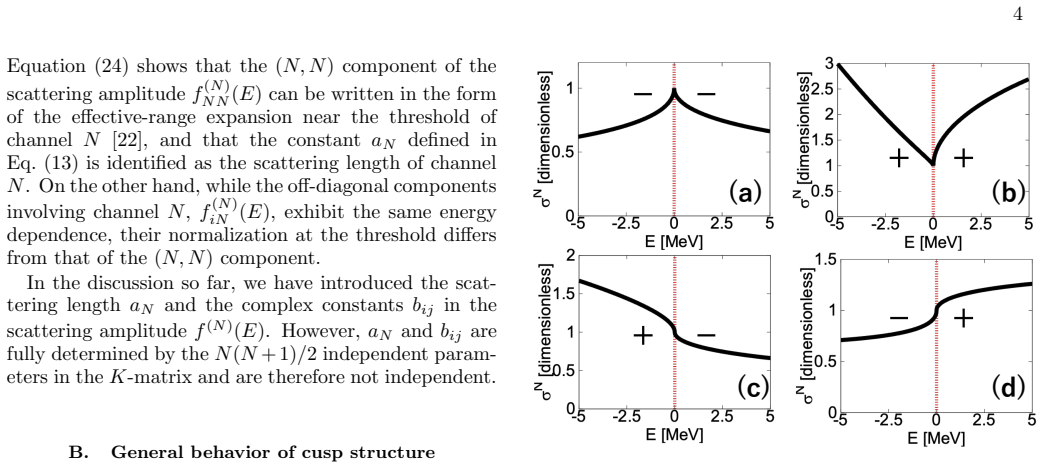
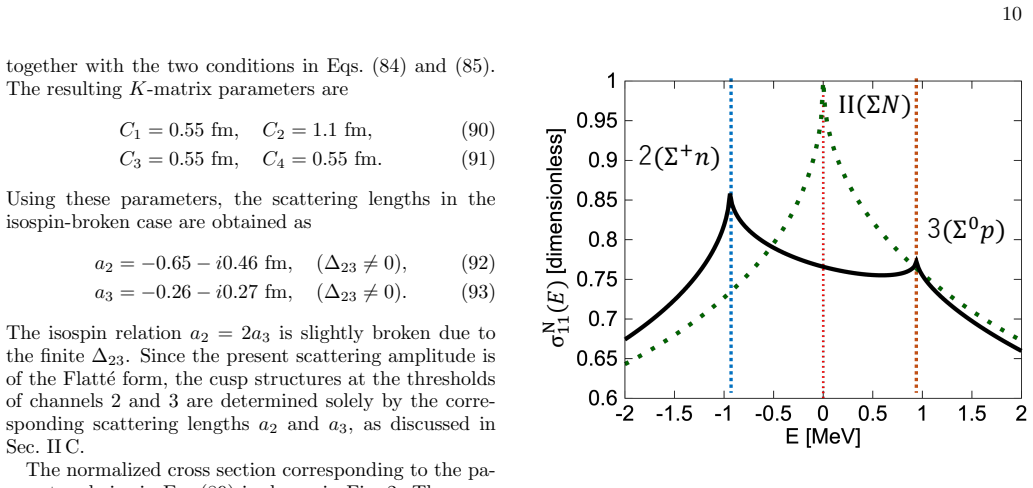
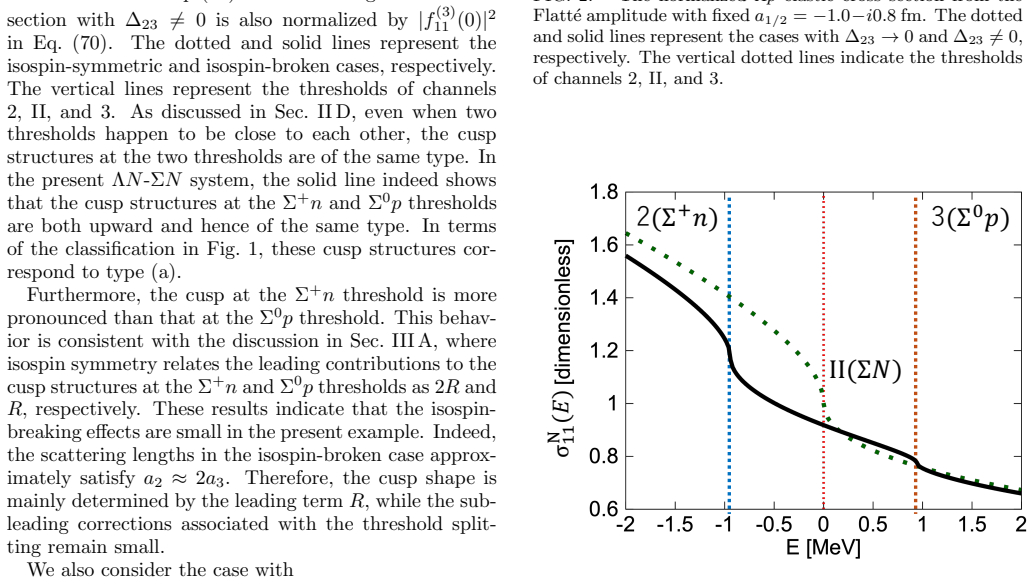
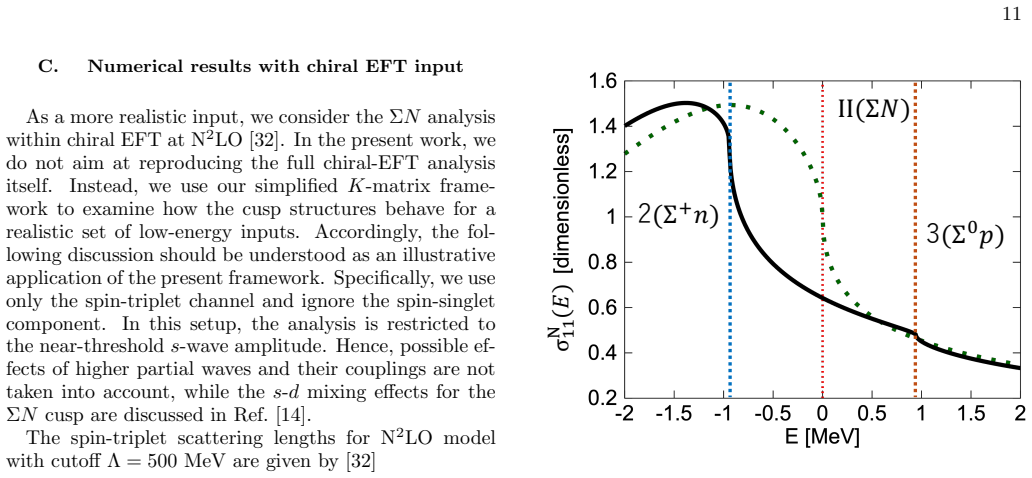
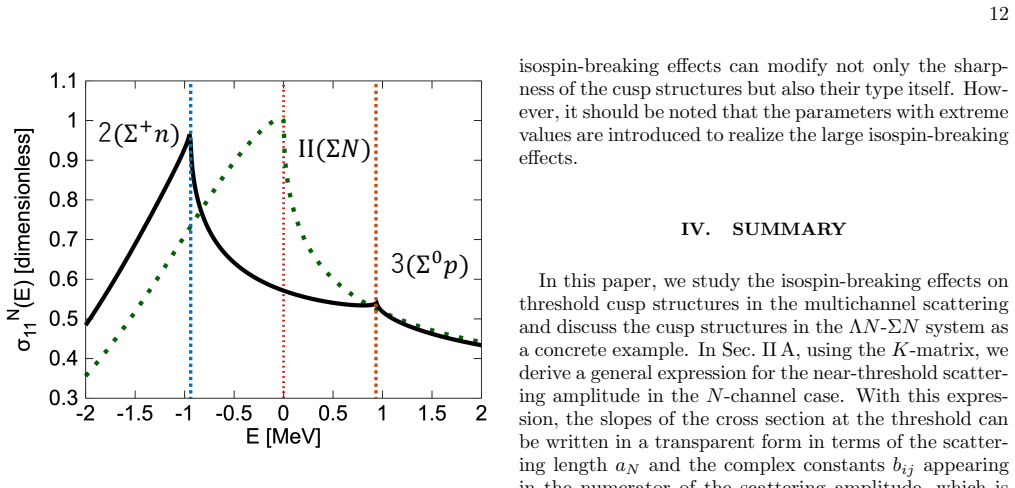
Using the K-matrix representation, we derive a general expression for the scattering amplitude near the thresholds and show that the cusp structures can be classified by the signs of the slopes of the cross section above and below threshold. We also show that additional restrictions appear in two- or three-channel systems and in the Flatté amplitude. For three-channel scattering with two nearby thresholds, we clarify how the two cusp structures are related when the threshold splitting is small and how they merge into a single cusp in the degenerate limit. Finally, we discuss the cusp structures in the Λp elastic cross section in the coupled ΛN-ΣN system with charge Q=+1. We show that, when i
What carries the argument
The K-matrix representation of the multichannel scattering amplitude near thresholds, which classifies cusps by the signs of the slopes of the cross section and imposes relations among cusps in three-channel systems with small threshold splitting.
If this is right
- In three-channel systems the two cusp structures are constrained by isospin symmetry when threshold splitting is small.
- The two cusps merge into a single cusp in the limit of degenerate thresholds.
- Isospin breaking can significantly modify the relative sharpness of the cusps.
- Isospin breaking may change the cusp type itself.
Where Pith is reading between the lines
- The same classification and symmetry constraints could be tested in other three-channel systems with small threshold splittings, such as different charge channels in meson-baryon scattering.
- Experimental resolution of individual cusp features would allow extraction of isospin-breaking strengths directly from cross-section data.
- The general K-matrix expression provides a model-independent way to analyze cusp data before fitting to specific interactions.
Load-bearing premise
The K-matrix representation remains valid for deriving the general expression of the scattering amplitude near the thresholds and for classifying the cusp structures by the signs of the slopes.
What would settle it
A precise measurement of the Λp elastic cross section near the ΣN thresholds that shows the relative sharpness or types of the two cusps remain unchanged when isospin-breaking parameters from chiral EFT are included.
Figures
read the original abstract
We discuss the isospin-breaking effects on threshold cusp structures in multichannel scattering near two-body thresholds. In hadronic systems with isospin symmetry, two or more nearly degenerate thresholds can appear, and their small splitting due to isospin breaking can generate multiple cusp structures in a narrow energy region. In this paper, using the $K$-matrix representation, we derive a general expression for the scattering amplitude near the thresholds and show that the cusp structures can be classified by the signs of the slopes of the cross section above and below threshold. We also show that additional restrictions appear in two- or three-channel systems and in the Flatt\'e amplitude. For three-channel scattering with two nearby thresholds, we clarify how the two cusp structures are related when the threshold splitting is small and how they merge into a single cusp in the degenerate limit. Finally, we discuss the cusp structures in the $\Lambda p$ elastic cross section in the coupled $\Lambda N$-$\Sigma N$ system with charge $Q=+1$. We show that, when isospin breaking is small, the two cusp structures are constrained by isospin symmetry. We also perform quantitative calculations using both simplified examples and realistic input based on N$^2$LO chiral effective field theory, and find that isospin breaking can significantly modify the relative sharpness of the cusps and may even change the cusp type itself.
Editorial analysis
A structured set of objections, weighed in public.
Referee Report
Summary. The manuscript derives a general expression for the multichannel scattering amplitude near thresholds using the K-matrix formalism and classifies cusp structures according to the signs of the slopes of the cross sections above and below threshold. It identifies additional restrictions for two- and three-channel systems and the Flatté amplitude, shows how two nearby cusps are related by isospin symmetry when the threshold splitting is small and merge into one in the degenerate limit, and applies the framework to the Λp elastic cross section in the Q=+1 ΛN-ΣN system. Quantitative examples with both simplified parameters and N²LO chiral-EFT input demonstrate that small isospin breaking can alter the relative sharpness of the cusps or change their type.
Significance. If the central derivations hold, the paper supplies a systematic algebraic framework for predicting and interpreting multiple cusp structures arising from small threshold splittings, with direct applicability to hyperon-nucleon scattering data. The explicit demonstration that the two cusps merge in the isospin-symmetric limit and the quantitative illustration that realistic isospin breaking can modify or flip cusp types are useful contributions. The work appropriately builds on the standard K-matrix parametrization T=[K^{-1}-iρ]^{-1} and external EFT input rather than introducing new free parameters.
minor comments (2)
- The abstract would be strengthened by a brief mention of the key classification criterion (signs of cross-section slopes) or the K-matrix expression used.
- [§5] In the quantitative section on the ΛN-ΣN system, the specific numerical values adopted for the K-matrix elements from the N²LO chiral EFT should be tabulated or explicitly referenced for reproducibility.
Simulated Author's Rebuttal
We thank the referee for the positive assessment of our work and the recommendation to accept the manuscript.
Circularity Check
No significant circularity identified
full rationale
The derivation relies on the standard external K-matrix parametrization T = [K^{-1} - iρ]^{-1} and its algebraic consequences for multichannel amplitudes, cusp slope signs, two/three-channel restrictions, and Flatté form. Relations between cusps under small threshold splitting and their merger in the isospin limit follow directly from vanishing splitting and reduced independent K-matrix elements. Quantitative examples insert external N²LO chiral EFT values for K-matrix elements and momenta; no parameters are fitted to the target observables inside the paper, and no load-bearing self-citations or self-definitional steps appear.
Axiom & Free-Parameter Ledger
axioms (1)
- domain assumption K-matrix representation is valid for describing the scattering amplitude near thresholds
Reference graph
Works this paper leans on
-
[1]
𝑝) ΙΙ(Σ𝑁) σ!!
Therefore, the signs of the real and imaginary parts ofW (0) andX (0) are identical. As a result, the cross sectionσ (3) 11 (E) shows the same types of cusp struc- tures at the thresholds of channels 2 and 3, provided that W(κ 3) W (0) ≪1, X(p2) X(0) ≪1.(67) In this situation, the cusp structure at the threshold of channel 2 is restricted to the types (a)...
-
[2]
E. P. Wigner, Phys. Rev.73, 1002 (1948)
1948
-
[3]
A. M. Badalian, L. P. Kok, M. I. Polikarpov, and Y. A. Simonov, Phys. Rept.82, 31 (1982)
1982
- [4]
-
[5]
V. Baru, J. Haidenbauer, C. Hanhart, Y. Kalashnikova, and A. E. Kudryavtsev, Phys. Lett. B586, 53 (2004), hep-ph/0308129
work page internal anchor Pith review Pith/arXiv arXiv 2004
- [6]
- [7]
-
[8]
Determination of the pi Sigma scattering lengths from the weak decays of Lambda_c
T. Hyodo and M. Oka, Phys. Rev. C84, 035201 (2011), 1105.5494
work page internal anchor Pith review Pith/arXiv arXiv 2011
-
[9]
Budini and L
P. Budini and L. Fonda, Phys. Rev. Lett.6, 419 (1961)
1961
-
[10]
U.-G. Meißner, G. M¨ uller, and S. Steininger, Phys. Lett. B406, 154 (1997), hep-ph/9704377
work page internal anchor Pith review Pith/arXiv arXiv 1997
- [11]
-
[12]
NA48/2, J. R. Batleyet al., Phys. Lett. B633, 173 (2006), hep-ex/0511056
work page internal anchor Pith review Pith/arXiv arXiv 2006
-
[13]
J. R. Batleyet al., Eur. Phys. J. C64, 589 (2009), 0912.2165
work page internal anchor Pith review Pith/arXiv arXiv 2009
-
[14]
S. Sakai, F.-K. Guo, and B. Kubis, Phys. Lett. B808, 135623 (2020), 2004.09824
-
[15]
J. Haidenbauer and U.-G. Meißner, Chin. Phys. C45, 094104 (2021), 2105.00836
-
[16]
R. H. Dalitz and A. Deloff, Czech. J. Phys. B32, 1021 (1982)
1982
-
[17]
F.-K. Guoet al., Rev. Mod. Phys.90, 015004 (2018), 1705.00141
work page internal anchor Pith review Pith/arXiv arXiv 2018
- [18]
-
[19]
C. Hanhart and A. Nefediev, Phys. Rev. D106, 114003 (2022), 2209.10165
- [20]
-
[21]
Interplay of quark and meson degrees of freedom in a near-threshold resonance: multi-channel case
C. Hanhart, Y. S. Kalashnikova, and A. V. Nefediev, Eur. Phys. J. A47, 101 (2011), 1106.1185
work page internal anchor Pith review Pith/arXiv arXiv 2011
-
[22]
Structure and compositeness of hadron resonances
T. Hyodo, Int. J. Mod. Phys. A28, 1330045 (2013), 1310.1176
work page internal anchor Pith review Pith/arXiv arXiv 2013
- [23]
-
[24]
T. Kinugawa and T. Hyodo, Eur. Phys. J. A61, 154 (2025), 2411.12285
-
[25]
A. Gal, E. V. Hungerford, and D. J. Millener, Rev. Mod. Phys.88, 035004 (2016), 1605.00557
work page internal anchor Pith review Pith/arXiv arXiv 2016
- [26]
-
[27]
M. M. Nagels, T. A. Rijken, and J. J. de Swart, Phys. Rev. D15, 2547 (1977)
1977
-
[28]
Holzenkamp, K
B. Holzenkamp, K. Holinde, and J. Speth, Nucl. Phys. A500, 485 (1989)
1989
-
[29]
P. M. M. Maessen, T. A. Rijken, and J. J. de Swart, Phys. Rev. C40, 2226 (1989)
1989
-
[30]
Hyperon-nucleon interaction at next-to-leading order in chiral effective field theory
J. Haidenbaueret al., Nucl. Phys. A915, 24 (2013), 14 1304.5339
work page internal anchor Pith review Pith/arXiv arXiv 2013
-
[31]
Strangeness $S=-1$ hyperon-nucleon scattering in covariant chiral effective field theory
K.-W. Li, X.-L. Ren, L.-S. Geng, and B. Long, Phys. Rev.D94, 014029 (2016), 1603.07802
work page internal anchor Pith review Pith/arXiv arXiv 2016
-
[32]
J. Haidenbauer, U. G. Meißner, and A. Nogga, Eur. Phys. J. A56, 91 (2020), 1906.11681
-
[33]
J. Haidenbauer, U.-G. Meißner, A. Nogga, and H. Le, Eur. Phys. J. A59, 63 (2023), 2301.00722
-
[34]
J. Haidenbauer, U.-G. Meißner, and A. Nogga, Prog. Part. Nucl. Phys.149, 104242 (2026), 2508.05243
-
[35]
J-PARC E40, K. Miwaet al., Phys. Rev. C104, 045204 (2021), 2104.13608
-
[36]
CLAS, J. Rowleyet al., Phys. Rev. Lett.127, 272303 (2021), 2108.03134
-
[37]
J-PARC E40, K. Miwaet al., Phys. Rev. Lett.128, 072501 (2022), 2111.14277
-
[38]
Nanamuraet al., PTEP2022, 093D01 (2022), 2203.08393
J-PARC E40, T. Nanamuraet al., PTEP2022, 093D01 (2022), 2203.08393
-
[39]
ALICE, S. Acharyaet al., Phys. Rev. C99, 024001 (2019), 1805.12455
work page internal anchor Pith review Pith/arXiv arXiv 2019
-
[40]
ALICE, S. Acharyaet al., Phys. Lett. B805, 135419 (2020), 1910.14407
-
[41]
ALICE, S. Acharyaet al., Phys. Lett. B833, 137272 (2022), 2104.04427
- [42]
-
[43]
Ichikawaet al., EPJ Web Conf.271, 02012 (2022)
Y. Ichikawaet al., EPJ Web Conf.271, 02012 (2022)
2022
-
[44]
K. Sone and T. Hyodo, Threshold cusp structures in multi-channel scattering, 2025, 2507.17260
-
[45]
K. Sone and T. Hyodo, Threshold Cusp Structures in the Presence of Isospin Symmetry Breaking, in15th Interna- tional Conference on Hypernuclear and Strange Particle Physics, 2026, 2603.01518
-
[46]
L. D. Landau and E. M. Lifshitz,Quantum Mechan- ics: Non-Relativistic Theory, 2nd ed. (Addison-Wesley, Reading, Massachusetts, 1965)
1965
-
[47]
S. M. Flatte, Phys. Lett. B63, 224 (1976)
1976
-
[48]
Navaset al., Phys
Particle Data Group, S. Navaset al., Phys. Rev. D110, 030001 (2024)
2024
-
[49]
T. Nishibuchi and T. Hyodo, Phys. Rev. C109, 015203 (2024), 2305.10753
discussion (0)
Sign in with ORCID, Apple, or X to comment. Anyone can read and Pith papers without signing in.