Nonclassical energy-change distribution as a witness of non-Markovian quantum dynamics
Pith reviewed 2026-06-29 17:20 UTC · model grok-4.3
The pith
Negative values in the energy-change distribution always witness violations of CP-divisibility.
A machine-rendered reading of the paper's core claim, the machinery that carries it, and where it could break.
Core claim
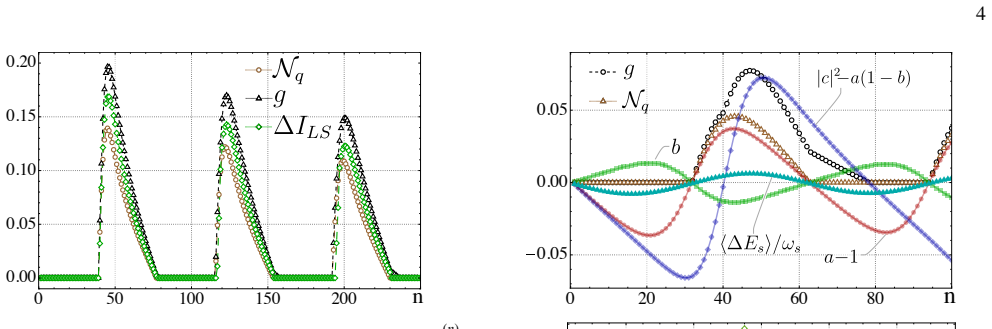
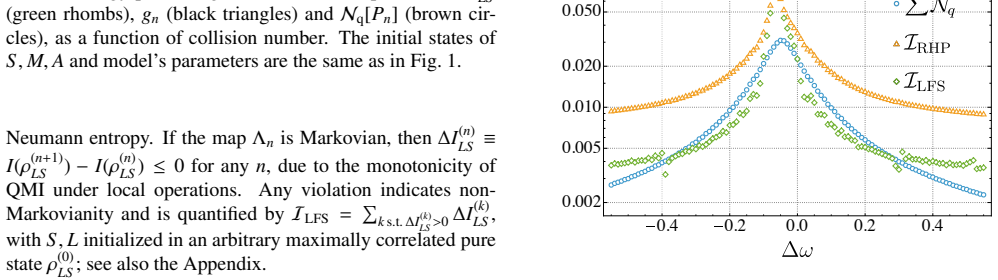
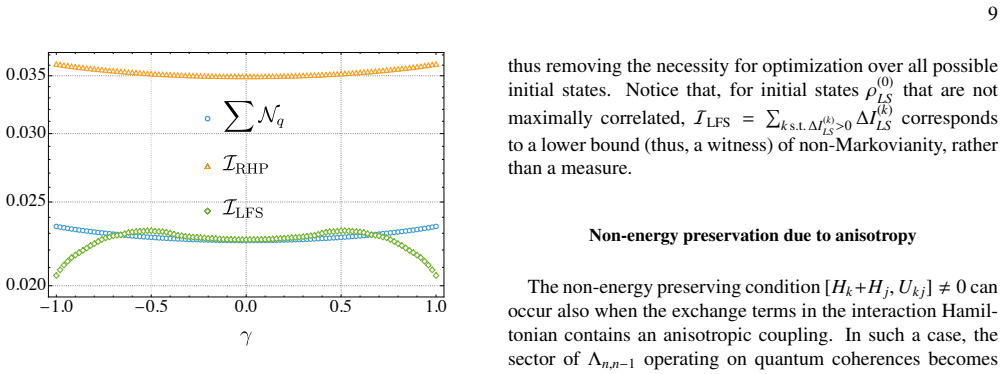
Violations of CP-divisibility are always witnessed by non-positive values of the energy-change Kirkwood-Dirac quasiprobability distribution associated with the system's Hamiltonian, evaluated at consecutive times. The link between non CP-divisibility and non-positivity of the system's energy-change distribution is stronger when the system-environment interactions are energy-preserving. The witness works whenever anomalous energy fluxes, due to non-Markovianity, are realized. Anomalous fluxes are also detected by the non-Markovianity measure built over the quantum mutual information between the states of the open system and of a quantum correlated reference.
What carries the argument
the energy-change Kirkwood-Dirac quasiprobability distribution associated with the system's Hamiltonian
Load-bearing premise
The dynamics must realize anomalous energy fluxes due to non-Markovianity, which occurs more readily when interactions are energy-preserving.
What would settle it
An experiment realizing a CP-divisibility violation while the energy-change Kirkwood-Dirac distribution remains non-negative at every pair of consecutive times would refute the witness.
Figures

read the original abstract
We address the problem of identifying non-Markovian quantum time evolutions of an open quantum system by only performing measurements of the system's energy. We demonstrate that violations of CP-divisibility are always witnessed by non-positive values of the energy-change Kirkwood-Dirac quasiprobability distribution associated with the system's Hamiltonian, evaluated at consecutive times. The link between non CP-divisibility and non-positivity of the system's energy-change distribution is stronger when the system-environment interactions are energy-preserving. The witness works whenever anomalous energy fluxes, due to non-Markovianity, are realized. Anomalous fluxes are also detected by the non-Markovianity measure built over the quantum mutual information between the states of the open system and of a quantum correlated reference.
Editorial analysis
A structured set of objections, weighed in public.
Referee Report
Summary. The manuscript claims that violations of CP-divisibility in the dynamics of an open quantum system are always witnessed by non-positive values of the energy-change Kirkwood-Dirac quasiprobability distribution associated with the system Hamiltonian, evaluated at consecutive times. The witness is effective whenever anomalous energy fluxes due to non-Markovianity occur and the connection is stronger when system-environment interactions are energy-preserving. The authors also construct a non-Markovianity measure from the quantum mutual information between the system and a correlated reference.
Significance. If the central link holds under the stated conditions, the result supplies a witness for non-Markovianity that requires only energy measurements on the system, avoiding full tomography. This is potentially useful for experimental platforms in which energy is the accessible observable. The use of Kirkwood-Dirac quasiprobabilities to connect nonclassical energy statistics to divisibility violations adds a new diagnostic tool in the study of open-system memory effects.
major comments (2)
- [Abstract] Abstract: the opening claim that CP-divisibility violations 'are always witnessed' by negativity of the energy-change KD distribution is immediately qualified by the statements that the witness 'works whenever anomalous energy fluxes... are realized' and is stronger for energy-preserving interactions. This tension must be resolved by an explicit statement, early in the introduction, of the precise conditions under which the witness is guaranteed to function.
- [Main derivation] Derivation of the witness (likely §3 or §4): the link between KD negativity and CP-divisibility violation appears to invoke either the existence of anomalous fluxes or the commutation [H_int, H_S] = 0. The manuscript should supply the full derivation steps, state the assumptions explicitly, and either prove that the witness is tight under those assumptions or exhibit a counter-example in which CP-divisibility is violated without producing KD negativity.
minor comments (1)
- [Abstract] Abstract and introduction: the phrase 'energy-change Kirkwood-Dirac quasiprobability distribution' should be accompanied by a brief definition or a forward reference to its precise mathematical definition on first appearance.
Simulated Author's Rebuttal
We thank the referee for the careful reading and constructive comments, which help clarify the scope and presentation of our results. We address each major comment below.
read point-by-point responses
-
Referee: [Abstract] Abstract: the opening claim that CP-divisibility violations 'are always witnessed' by negativity of the energy-change KD distribution is immediately qualified by the statements that the witness 'works whenever anomalous energy fluxes... are realized' and is stronger for energy-preserving interactions. This tension must be resolved by an explicit statement, early in the introduction, of the precise conditions under which the witness is guaranteed to function.
Authors: We agree that the abstract and opening paragraphs create an apparent tension between the unqualified claim of 'always witnessed' and the subsequent qualifications. In the revised manuscript we will insert, immediately after the first paragraph of the introduction, an explicit statement of the precise conditions: the witness is guaranteed whenever anomalous energy fluxes due to non-Markovianity occur, and the link is strengthened (but not required) when the interaction Hamiltonian commutes with the system Hamiltonian. This removes the ambiguity while preserving the original claims under the stated conditions. revision: yes
-
Referee: [Main derivation] Derivation of the witness (likely §3 or §4): the link between KD negativity and CP-divisibility violation appears to invoke either the existence of anomalous fluxes or the commutation [H_int, H_S] = 0. The manuscript should supply the full derivation steps, state the assumptions explicitly, and either prove that the witness is tight under those assumptions or exhibit a counter-example in which CP-divisibility is violated without producing KD negativity.
Authors: We will expand the derivation (currently in §§3–4) to include every intermediate step, explicitly list all assumptions (including the occurrence of anomalous fluxes and the optional commutation condition), and prove that the witness is tight under these assumptions: any CP-divisibility violation that produces an anomalous energy flux necessarily yields a negative value of the energy-change KD quasiprobability. The proof follows directly from the relation between the sign of the quasiprobability and the sign of the energy flux together with the definition of CP-divisibility; the expanded section will make this chain fully transparent. revision: yes
Circularity Check
No circularity: witness derived from standard channel properties and KD quasiprobability definition
full rationale
The paper's central claim links CP-divisibility violations to negativity in the energy-change Kirkwood-Dirac distribution via the definition of the quasiprobability and properties of quantum channels. No step reduces by construction to a fitted parameter renamed as prediction, a self-citation chain, or an ansatz smuggled from prior work by the same authors. The explicit qualification that the witness applies when anomalous fluxes occur is stated as a regime condition rather than a hidden definitional equivalence. The derivation remains self-contained against external benchmarks of CP-divisibility and quasiprobability theory.
Axiom & Free-Parameter Ledger
Forward citations
Cited by 1 Pith paper
-
Controlling the non-Markovianity of quantum Brownian motion
Modulating relative weights of interaction channels in a quantum Brownian motion model allows control over non-Markovianity, inducing transitions to Markovian regimes using Gaussian master equations.
Reference graph
Works this paper leans on
-
[1]
Altman, K
E. Altman, K. R. Brown, G. Carleo, L. D. Carr, E. Demler, C. Chin, B. DeMarco, S. E. Economou, M. A. Eriksson, K.- M. C. Fu, M. Greiner, K. R. Hazzard, R. G. Hulet, A. J. Koll´ar, B. L. Lev, M. D. Lukin, R. Ma, X. Mi, S. Misra, C. Monroe, K. Murch, Z. Nazario, K.-K. Ni, A. C. Potter, P. Roushan, M. Saffman, M. Schleier-Smith, I. Siddiqi, R. Simmonds, M. S...
2021
-
[2]
Rajak, S
A. Rajak, S. Suzuki, A. Dutta, and B. K. Chakrabarti, Quantum annealing: an overview, Philos. Trans. A Math. Phys. Eng. Sci. 381, 20210417 (2023)
2023
-
[3]
Ciccarello, S
F. Ciccarello, S. Lorenzo, V . Giovannetti, and G. M. Palma, Quantum collision models: Open system dynamics from re- peated interactions, Physics Reports Quantum Collision Mod- els: Open System Dynamics from Repeated Interactions,954, 1 (2022)
2022
-
[4]
Cusumano, Quantum collision models: A beginner guide, Entropy24, 10.3390/e24091258 (2022)
S. Cusumano, Quantum collision models: A beginner guide, Entropy24, 10.3390/e24091258 (2022)
-
[5]
Lorenzo, F
S. Lorenzo, F. Ciccarello, and G. M. Palma, Class of exact memory-kernel master equations, Phys. Rev. A93, 052111 (2016)
2016
-
[6]
Lorenzo, R
S. Lorenzo, R. McCloskey, F. Ciccarello, M. Paternostro, and G. M. Palma, Landauer’s Principle in Multipartite Open Quan- tum System Dynamics, Phys. Rev. Lett.115, 120403 (2015)
2015
-
[7]
Lorenzo, F
S. Lorenzo, F. Ciccarello, G. M. Palma, and B. Vacchini, Quantum Non-Markovian Piecewise Dynamics from Collision Models, Open Systems & Information Dynamics24, 1740011 (2017)
2017
-
[8]
Heisenberg, Zur theorie des ferromagnetismus - on the the- ory of ferromagnetism, Zeitschrift f¨ur Physik49, 619 (1928)
W. Heisenberg, Zur theorie des ferromagnetismus - on the the- ory of ferromagnetism, Zeitschrift f¨ur Physik49, 619 (1928)
1928
-
[9]
R. J. Baxter,Exactly solved models in statistical mechanics (Academic Press, 1982)
1982
-
[10]
J. M. Raimond, M. Brune, and S. Haroche, Manipulating quan- tum entanglement with atoms and photons in a cavity, Rev. Mod. Phys.73, 565 (2001)
2001
-
[11]
N. K. Bernardes, A. Cuevas, A. Orieux, C. H. Monken, P. Mat- aloni, F. Sciarrino, and M. F. Santos, Experimental observation of weak non-Markovianity, Scientific Reports5, 17520 (2015)
2015
-
[12]
Maffei, P
M. Maffei, P. A. Camati, and A. Auff`eves, Probing nonclassi- cal light fields with energetic witnesses in waveguide quantum electrodynamics, Phys. Rev. Res.3, L032073 (2021)
2021
-
[13]
S. N. Filippov, A. N. Glinov, and L. Lepp¨aj¨arvi, Phase covariant qubit dynamics and divisibility, Lobachevskii Journal of Math- ematics41, 617 (2020)
2020
-
[14]
Smirne, J
A. Smirne, J. Kołody ´nski, S. F. Huelga, and R. Demkowicz- Dobrza´nski, Ultimate precision limits for noisy frequency esti- mation, Phys. Rev. Lett.116, 120801 (2016)
2016
-
[15]
Siudzi ´nska, Geometry of phase-covariant qubit channels, J
K. Siudzi ´nska, Geometry of phase-covariant qubit channels, J. Phys. Commun.7, 075002 (2023)
2023
-
[16]
Holevo, A note on covariant dynamical semigroups, Rep
A. Holevo, A note on covariant dynamical semigroups, Rep. Math. Phys.32, 211 (1993)
1993
-
[17]
Rivas, S
´A. Rivas, S. F. Huelga, and M. B. Plenio, Quantum non- Markovianity: Characterization, quantification and detection, Reports on Progress in Physics77, 094001 (2014)
2014
-
[18]
U. Shrikant and P. Mandayam, Quantum non-Markovianity: Overview and recent developments, Front. Quantum Sci. Tech- nol.2, 10.3389/frqst.2023.1134583 (2023)
-
[19]
F. Ciccarello, Collision models in quantum optics, Quantum Measurements and Quantum Metrology4, 10.1515/qmetro- 2017-0007 (2017)
-
[20]
Meschede, H
D. Meschede, H. Walther, and G. M ¨uller, One-atom maser, Phys. Rev. Lett.54, 551 (1985)
1985
-
[21]
V . S. Ferreira, J. Banker, A. Sipahigil, M. H. Matheny, A. J. Keller, E. Kim, M. Mirhosseini, and O. Painter, Collapse and Revival of an Artificial Atom Coupled to a Structured Photonic Reservoir, Phys. Rev. X11, 041043 (2021)
2021
-
[22]
Cattaneo, G
M. Cattaneo, G. De Chiara, S. Maniscalco, R. Zambrini, and G. L. Giorgi, Collision Models Can Efficiently Simulate Any Multipartite Markovian Quantum Dynamics, Phys. Rev. Lett. 126, 130403 (2021)
2021
-
[23]
Lacroix, D
T. Lacroix, D. Cilluffo, S. F. Huelga, and M. B. Plenio, Mak- ing quantum collision models exact, Communications Physics 8, 268 (2025)
2025
-
[24]
Levy and M
A. Levy and M. Lostaglio, Quasiprobability Distribution for Heat Fluctuations in the Quantum Regime, PRX Quantum1, 010309 (2020)
2020
-
[25]
Lostaglio, A
M. Lostaglio, A. Belenchia, A. Levy, S. Hernandez-Gomez, N. Fabbri, and S. Gherardini, Kirkwood-Dirac quasiprobability approach to the statistics of incompatible observables, Quantum 7, 1128 (2023)
2023
-
[26]
Hern ´andez-G´omez, S
S. Hern ´andez-G´omez, S. Gherardini, A. Belenchia, M. Lostaglio, A. Levy, and N. Fabbri, Projective mea- surements can probe nonclassical work extraction and time correlations, Phys. Rev. Res.6, 023280 (2024)
2024
-
[27]
Santini, A
A. Santini, A. Solfanelli, S. Gherardini, and M. Collura, Work statistics, quantum signatures, and enhanced work extraction in quadratic fermionic models, Phys. Rev. B108, 104308 (2023)
2023
-
[28]
Gherardini and G
S. Gherardini and G. De Chiara, Quasiprobabilities in Quantum Thermodynamics and Many-Body Systems, PRX Quantum5, 030201 (2024)
2024
-
[29]
Quantum repeaters based on concatenated bosonic and discrete-variable quantum codes,
S. Hern ´andez-G´omez, T. Isogawa, A. Belenchia, A. Levy, N. Fabbri, S. Gherardini, and P. Cappellaro, Interferometry of quantum correlation functions to access quasiprobability distri- bution of work, npj Quantum Information10, 10.1038/s41534- 024-00913-x (2024)
-
[30]
D. R. M. Arvidsson-Shukur, W. F. Braasch Jr., S. De Bievre, J. Dressel, A. N. Jordan, C. Langrenez, M. Lostaglio, J. S. Lun- deen, and N. Yunger Halpern, Properties and applications of the kirkwood-dirac distribution, New J. Phys.26, 121201 (2024)
2024
-
[31]
Pezzutto, G
M. Pezzutto, G. De Chiara, and S. Gherardini, Non-positive en- ergy quasidistributions in coherent collision models, Quantum Sci. Technol.10, 035066 (2025)
2025
-
[32]
Yoshimura and R
K. Yoshimura and R. Hamazaki, Quasiprobability thermo- 6 dynamic uncertainty relation, Phys. Rev. Lett.136, 120406 (2026)
2026
-
[33]
Perciavalle, N
F. Perciavalle, N. Lo Gullo, and F. Plastina, Quantum coherence and anomalous work extraction in qubit gate dynamics, Phys. Rev. E113, 054126 (2026)
2026
-
[34]
Donelli, G
B. Donelli, G. De Chiara, F. Scazza, and S. Gherardini, Impact of quantum coherence on the dynamics and thermodynamics of quenched free fermions coupled to a localized defect, Phys. Rev. A113, 013311 (2026)
2026
-
[35]
Rivas, S
A. Rivas, S. F. Huelga, and M. B. Plenio, Entanglement and Non-Markovianity of Quantum Evolutions, Phys. Rev. Lett. 105, 050403 (2010)
2010
-
[36]
S. Luo, S. Fu, and H. Song, Quantifying non-Markovianity via correlations, Phys. Rev. A86, 044101 (2012)
2012
-
[37]
Solinas, M
P. Solinas, M. Amico, and N. Zangh `ı, Quasiprobabilities of work and heat in an open quantum system, Phys. Rev. A105, 032606 (2022)
2022
-
[38]
N. E. Comar, D. Cius, L. F. Santos, R. Wagner, and B. Ama- ral, Contextuality in Anomalous Heat Flow, PRX Quantum6, 030359 (2025)
2025
-
[39]
A. V . Mallik, L. M. Cangemi, A. Levy, and E. G. Dalla Torre, Probing quantum anomalous heat flow using mid-circuit mea- surements, Adv. Quantum Technol.8, e00328 (2025)
2025
-
[40]
Huang, Q
K. Huang, Q. Zhang, X. Liu, R. Li, X. Long, H. Liu, X. Wang, Y .-a. Fan, Y . Zheng, Y . Feng, Y . Zhou, J. Ng, X. Nie, Z.-X. Man, and D. Lu, Reversing Heat Flow by Coherence in a Multipartite Quantum System, Phys. Rev. Lett.136, 050403 (2026)
2026
-
[41]
H. Li, J. Zou, and B. Shao, Nondemolition quasiprobabilities of work and heat in the presence of a non-Markovian environment, Phys. Rev. A109, 032228 (2024)
2024
-
[42]
J. Lalita and S. Banerjee, Non-classicality of two-qubit quan- tum collision model: non-Markovian effects, arXiv preprint arXiv:2506.23818 (2025)
-
[43]
S. Luo, S. Fu, and H. Song, Quantifying non-markovianity via correlations, Phys. Rev. A86, 044101 (2012)
2012
-
[44]
Solinas and S
P. Solinas and S. Gherardini, Negativity of nondemolition quasiprobability distribution as a necessary and sufficient con- dition for macrorealism violation, Phys. Rev. A111, 052217 (2025)
2025
-
[45]
Melegari, M
D. Melegari, M. Cardi, and P. Solinas, Quantum simulations of macrorealism violation via the quantum nondemolition mea- surement protocol, Phys. Rev. A111, 052435 (2025)
2025
-
[46]
Solinas and S
P. Solinas and S. Gherardini, Quantumness certification via non-demolition measurements, Advances in Physics: X11, 2637832 (2026)
2026
-
[47]
Wang, Y .-K
G.-X. Wang, Y .-K. Wu, R. Yao, W.-Q. Lian, Z.-J. Cheng, Y .- L. Xu, C. Zhang, Y . Jiang, Y .-Z. Xu, B.-X. Qi, P.-Y . Hou, Z.-C. Zhou, L. He, and L.-M. Duan, Simulating the spin-boson model with a controllable reservoir in an ion trap, Phys. Rev. A109, 062402 (2024)
2024
-
[48]
K. Sun, M. Kang, H. Nuomin, G. Schwartz, D. N. Beratan, K. R. Brown, and J. Kim, Quantum simulation of spin-boson models with structured bath, Nat. Commun.16, 4042 (2025)
2025
-
[49]
J. F. Haase, P. J. Vetter, T. Unden, A. Smirne, J. Rosskopf, B. Naydenov, A. Stacey, F. Jelezko, M. B. Plenio, and S. F. Huelga, Controllable Non-Markovianity for a Spin Qubit in Di- amond, Phys. Rev. Lett.121, 060401 (2018)
2018
-
[50]
Dalacu, P
D. Dalacu, P. J. Poole, and R. L. Williams, Nanowire-based sources of non-classical light, Nanotechnology30, 232001 (2019)
2019
-
[51]
Sapienza, M
L. Sapienza, M. Davanc ¸o, A. Badolato, and K. Srinivasan, Nanoscale optical positioning of single quantum dots for bright and pure single-photon emission, Nature Communications6, 7833 (2015)
2015
-
[52]
Mirhosseini, E
M. Mirhosseini, E. Kim, X. Zhang, A. Sipahigil, P. B. Dieterle, A. J. Keller, A. Asenjo-Garcia, D. E. Chang, and O. Painter, Cavity quantum electrodynamics with atom-like mirrors, Na- ture569, 692 (2019). APPENDIX Iteration procedure of the system’s open dynamics Starting from the joint stateρ (n−1) S M of the system and mem- ory at stepn−1, and from the ...
2019
-
[53]
Then, we consider the following projectors on some of these eigenstates: P0 = |0⟩ ⟨0| = 1 0 0 0 ! ,P 1 = |1⟩ ⟨1| = 0 0 0 1 ! , P+ = |+⟩ ⟨+| = 1 2 1 1 1 1 ! ,P R = |R⟩ ⟨R| = 1 2 1−i i1 ! , (A.27) from which one ends up to the following identities: I=P 0 +P 1, σ x =2P + −(P 0 +P 1), σy =2P R −(P 0 +P 1), σ z =P 0 −P 1.(A.28) Thanks to the linearity of the m...
-
[54]
Run the dynamics of the system initializing it in the four probe statesP 0,P 1,P +,P R, in order to obtain their whole time evolutions{Λ n[P0]},{Λ n[P1]},{Λ n[P+]}, {Λn[PR]}for alln
-
[55]
(A.28), using the linearity ofΛ
At each stepn, fromΛ n[P0],Λ n[P1],Λ n[P+], Λn[PR] computeΛ n[I],Λ n[σx],Λ n[σy],Λ n[σz] through Eq. (A.28), using the linearity ofΛ
-
[56]
tl” stands for “time-local
Construct the vectors{ ⃗cn}, Eq. (A.25) and matrices {Mn}, Eq. (A.26) for alln. In this way, we can compute the evolved state via Eqs. (A.21)- (A.23), initializing the system in an arbitrary input state. Inverted map AssumingΛhas been successfully reconstructed, we show how to deriveΛ −1. As in (A.23), we can express the action of Λ−1 n on a generic (evol...
-
[57]
Any violation of the latter inequality is a signature of non- Markovianity and is measured via ILFS =sup ρ(0) LS X ks.t.∆I (k) LS >0 ∆I(k) LS .(A.37) InitializingS,Lin any maximally correlated pure stateρ (0) LS , whereinS,Loccupy Hilbert spaces of equal dimension, (A.37) reduces to ILFS = X ks.t.∆I (k) LS >0 ∆I(k) LS ,(A.38) thus removing the necessity f...
discussion (0)
Sign in with ORCID, Apple, or X to comment. Anyone can read and Pith papers without signing in.