Azimuthal asymmetry in exclusive quasi-elastic neutrino-nucleus interactions
Pith reviewed 2026-07-01 16:07 UTC · model grok-4.3
The pith
The outgoing nucleon in quasi-elastic neutrino-nucleus scattering shows an azimuthal asymmetry outside the lepton plane caused by parity violation.
A machine-rendered reading of the paper's core claim, the machinery that carries it, and where it could break.
Core claim
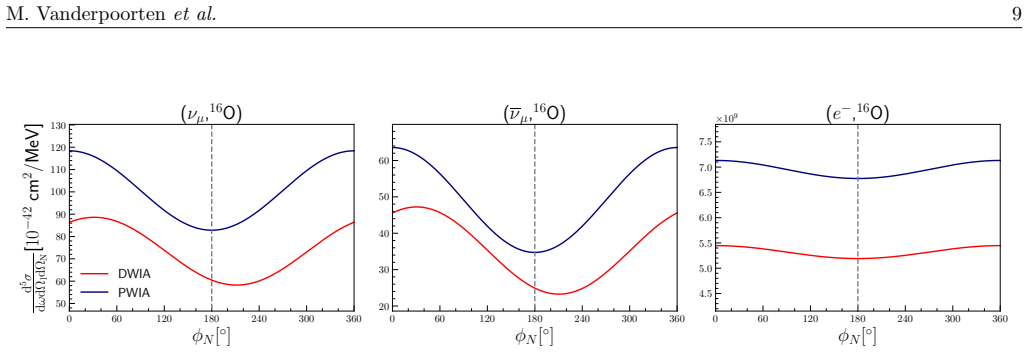
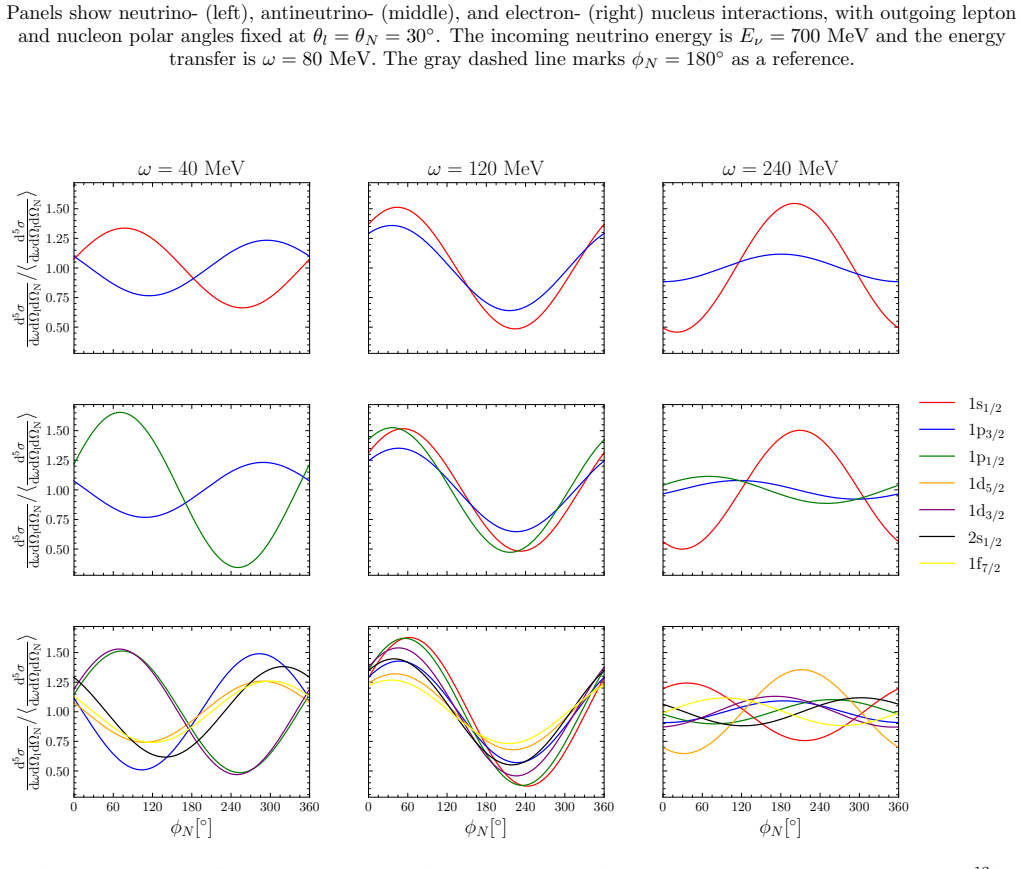
The azimuthal angle distribution of the outgoing nucleon in exclusive quasi-elastic neutrino-nucleus interactions is asymmetric, with a preference for emission outside the lepton scattering plane. This asymmetry is produced by parity violation in the weak interaction. In cross-section calculations the size of the asymmetry depends on the nuclear model employed and on the shell structure of the target nucleus, supplying a new observable for neutrino energy reconstruction.
What carries the argument
The azimuthal angle distribution of the outgoing nucleon, obtained from the general form of the quasi-elastic cross section and containing parity-violating contributions from the weak interaction.
If this is right
- The asymmetry supplies a new observable that depends on nuclear modeling and shell structure.
- It can be used as additional input for neutrino energy reconstruction in oscillation experiments.
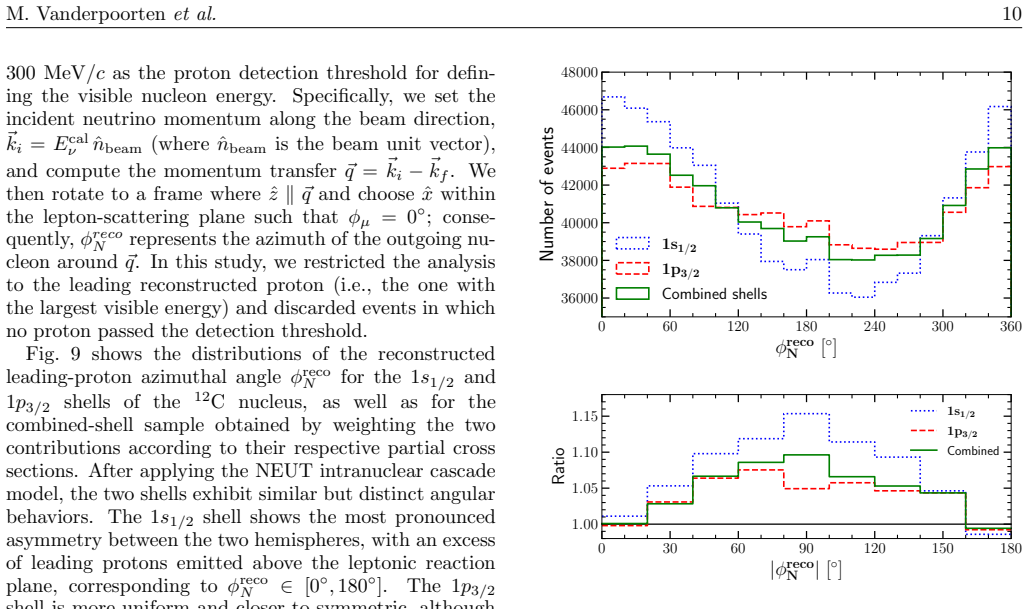
- The effect remains measurable after momentum detection thresholds and intranuclear cascades are applied.
- O(10^4) events on carbon-12 suffice to reach 99 percent on the asymmetry.
Where Pith is reading between the lines
- The asymmetry could serve as an independent test of nuclear models used in neutrino event generators.
- Similar azimuthal effects may appear in other parity-violating weak processes on nuclei.
- Detector designs that resolve azimuthal angles could extract extra nuclear-structure information from existing data sets.
- The size of the asymmetry might vary with neutrino energy in ways that help separate interaction channels.
Load-bearing premise
The predicted asymmetry stays large enough to be seen at 99 percent with O(10^4) events after realistic momentum cuts and an intranuclear cascade are included.
What would settle it
No statistically significant azimuthal asymmetry appears in a sample of roughly 10,000 quasi-elastic events on carbon-12 after the stated detection thresholds and cascade modeling.
Figures

read the original abstract
In neutrino oscillation experiments, exclusive measurements of neutrino-nucleus interactions play a critical role, by providing the theoretical and experimental input needed for a reliable estimation of the neutrino energy. In this paper, we derive the general form of the azimuthal angle distribution for quasi-elastic scattering, focusing on a dependency that has been routinely overlooked. We demonstrate that the outgoing nucleon exhibits a preference for emission outside the lepton scattering plane, with an asymmetric azimuthal distribution. In the context of neutrino-nucleus scattering, we argue that this asymmetry is caused by parity violation in the weak interaction. Furthermore, we show that in cross section calculations the asymmetry is sensitive to nuclear modeling choices and to the shell structure of the initial nucleus, thus providing a novel source of information for energy reconstruction in neutrino experiments. We study the experimental feasibility of observing this effect by applying a realistic momentum detection threshold and an intranuclear cascade. We estimate that the asymmetry is observable with $\mathcal{O}$($10^4$) events at the 99% confidence level for neutrino interactions on $^{12}$C, suggesting that the effect is within reach of the current generation of neutrino detectors.
Editorial analysis
A structured set of objections, weighed in public.
Referee Report
Summary. The paper derives the general form of the azimuthal angle distribution in exclusive quasi-elastic neutrino-nucleus scattering and shows that the outgoing nucleon has a preference for emission outside the lepton scattering plane, producing an asymmetric azimuthal distribution. It attributes this asymmetry to parity violation in the weak interaction and demonstrates its sensitivity to nuclear modeling choices and the shell structure of the target nucleus. The work further studies experimental observability by applying a realistic nucleon momentum threshold and an intranuclear cascade model, concluding that the effect remains detectable at the 99% confidence level with O(10^4) events on 12C and could serve as a new input for neutrino energy reconstruction.
Significance. If the central derivation of the azimuthal asymmetry is correct and the effect survives realistic final-state interactions at the claimed magnitude, the result would supply a previously overlooked observable that is directly sensitive to both the weak interaction structure and nuclear dynamics. This could furnish an independent handle on energy reconstruction systematics in neutrino oscillation experiments, complementing existing inclusive and exclusive channels.
major comments (2)
- [experimental feasibility discussion (abstract and results)] The feasibility claim in the abstract and the corresponding results section states that the asymmetry remains observable after the intranuclear cascade and momentum threshold, yet provides no explicit numerical value for the post-cascade asymmetry parameter A or the dilution factor. Without these quantities or the associated statistical power calculation, it is not possible to verify whether the 99% CL reach with O(10^4) events on 12C still holds once the cascade randomizes the azimuthal angle.
- [nuclear modeling and shell-structure results] The sensitivity of the asymmetry to shell structure is asserted, but the manuscript does not show that this sensitivity survives the same intranuclear cascade modeling used for the observability estimate; if the cascade washes out shell-specific features, the claimed novel source of information for energy reconstruction would be compromised.
minor comments (2)
- [formalism section] Notation for the azimuthal angle and the lepton scattering plane should be defined once at first use and used consistently thereafter.
- [results] The manuscript would benefit from a table summarizing the asymmetry values before and after the cascade for the different nuclear models considered.
Simulated Author's Rebuttal
We thank the referee for the careful reading of our manuscript and the constructive comments. We respond to each major comment below.
read point-by-point responses
-
Referee: [experimental feasibility discussion (abstract and results)] The feasibility claim in the abstract and the corresponding results section states that the asymmetry remains observable after the intranuclear cascade and momentum threshold, yet provides no explicit numerical value for the post-cascade asymmetry parameter A or the dilution factor. Without these quantities or the associated statistical power calculation, it is not possible to verify whether the 99% CL reach with O(10^4) events on 12C still holds once the cascade randomizes the azimuthal angle.
Authors: We agree that the manuscript does not report explicit numerical values for the post-cascade asymmetry parameter A or the associated dilution factor, even though the observability estimate incorporates the intranuclear cascade and momentum threshold. To permit independent verification of the 99% CL claim with O(10^4) events, we will add these quantities together with the statistical power calculation in the revised manuscript. revision: yes
-
Referee: [nuclear modeling and shell-structure results] The sensitivity of the asymmetry to shell structure is asserted, but the manuscript does not show that this sensitivity survives the same intranuclear cascade modeling used for the observability estimate; if the cascade washes out shell-specific features, the claimed novel source of information for energy reconstruction would be compromised.
Authors: The sensitivity to shell structure is shown within the impulse-approximation framework. The manuscript does not demonstrate that this sensitivity persists after the intranuclear cascade applied in the feasibility study. We will either extend the calculations to verify survival of the shell-specific features under the cascade or qualify the claim regarding its utility for energy reconstruction in the revised version. revision: yes
Circularity Check
No circularity detected; derivation follows from weak interaction formalism and applied nuclear models
full rationale
The paper derives the azimuthal distribution from the standard contraction of lepton and hadron tensors, identifying the parity-violating imaginary interference terms as the source of the asymmetry. It then computes the effect's dependence on nuclear models and shell structure via cross-section evaluations, followed by a simulation-based estimate of observability after momentum cuts and intranuclear cascade. No quoted steps equate a claimed prediction to a fitted input by construction, invoke self-citations as load-bearing uniqueness theorems, or rename known results; the chain remains self-contained against external benchmarks.
Axiom & Free-Parameter Ledger
Reference graph
Works this paper leans on
-
[3]
A. Hiramotoet al.(NINJA), Phys. Rev. D102, 10.1103/PhysRevD.102.072006 (2020)
-
[4]
Caiet al.(MINERνA), Nature614, 10.1038/s41586- 022-05478-3 (2023)
T. Caiet al.(MINERνA), Nature614, 10.1038/s41586- 022-05478-3 (2023)
-
[5]
T. Caiet al.(MINERνA), Phys. Rev. D101, 10.1103/PhysRevD.101.092001 (2020)
-
[6]
X.-G. Luet al.(MINERνA), Phys. Rev. Lett.121, 10.1103/PhysRevLett.121.022504 (2018)
-
[7]
T. Waltonet al.(MINERνA), Phys. Rev. D91, 10.1103/PhysRevD.91.071301 (2015)
-
[8]
Acciarriet al., A proposal for a three detector short- baseline neutrino oscillation program in the fermilab booster neutrino beam (2015)
R. Acciarriet al., A proposal for a three detector short- baseline neutrino oscillation program in the fermilab booster neutrino beam (2015)
2015
-
[10]
Abratenkoet al.(MicroBooNE), Phys
P. Abratenkoet al.(MicroBooNE), Phys. Rev. D112, 10.1103/xfs2-94m3 (2025)
-
[11]
Abratenkoet al.(MicroBooNE), Phys
P. Abratenkoet al.(MicroBooNE), Phys. Rev. D106, 10.1103/PhysRevD.106.L051102 (2022)
-
[13]
D. Douqa, S. Bordoni, L. Giannessi, F. S´ anchez, C. Schloesser, and A. Nikolakopoulos, Phys. Rev. D109, 10.1103/PhysRevD.109.073001 (2024)
-
[14]
S. Karpova, F. S´ anchez, and D. Douqa, Phys. Rev. D 112, 10.1103/nssd-tnvy (2025)
-
[15]
N. M. Coyle, S. W. Li, and P. A. N. Machado, Phys. Rev. D111, 10.1103/PhysRevD.111.093010 (2025)
-
[16]
N. M. Coyle, S. W. Li, and P. A. N. Machado, Journal of High Energy Physics2022, 10.1007/jhep12(2022)166 (2022)
-
[18]
Abbasluet al.(DUNE), Towards mono-energetic vir- tualνbeam cross-section measurements: A feasibility study ofν-Ar interaction analysis with DUNE-PRISM (2025)
S. Abbasluet al.(DUNE), Towards mono-energetic vir- tualνbeam cross-section measurements: A feasibility study ofν-Ar interaction analysis with DUNE-PRISM (2025)
2025
-
[19]
R. Acciarriet al.(DUNE), Long-Baseline Neutrino Fa- cility (LBNF) and Deep Underground Neutrino Exper- iment (DUNE): Conceptual Design Report, Volume 1: The LBNF and DUNE Projects (2016)
2016
-
[20]
R. Acciarriet al.(DUNE), Long-Baseline Neutrino Fa- cility (LBNF) and Deep Underground Neutrino Exper- iment (DUNE): Conceptual Design Report, Volume 2: The Physics Program for DUNE at LBNF (2015)
2015
-
[21]
J. Straitet al.(DUNE), Long-Baseline Neutrino Facility (LBNF) and Deep Underground Neutrino Experiment (DUNE): Conceptual Design Report, Volume 3: Long- Baseline Neutrino Facility for DUNE (2016)
2016
-
[22]
R. Acciarriet al.(DUNE), Long-Baseline Neutrino Fa- cility (LBNF) and Deep Underground Neutrino Experi- ment (DUNE): Conceptual Design Report, Volume 4 The DUNE Detectors at LBNF (2016)
2016
-
[23]
Scott (NuPRISM, Hyper-K), JPS Conf
M. Scott (NuPRISM, Hyper-K), JPS Conf. Proc.12, 10.7566/JPSCP.12.010039 (2016)
-
[24]
Abeet al.(Hyper-Kamiokande), Eur
K. Abeet al.(Hyper-Kamiokande), Eur. Phys. J. C86, 10.1140/epjc/s10052-025-14938-9 (2026)
-
[25]
A. A. Abudet al., Deep underground neutrino exper- iment (DUNE) near detector conceptual design report (2021)
2021
-
[26]
Zhu (Hyper-Kamiokande), PoSNOW2022, 10.22323/1.421.0028 (2023)
T. Zhu (Hyper-Kamiokande), PoSNOW2022, 10.22323/1.421.0028 (2023)
-
[27]
K. Abeet al., Nuclear Instruments and Methods in Physics Research Section A: Accelerators, Spec- trometers, Detectors and Associated Equipment659, 10.1016/j.nima.2011.06.067 (2011)
-
[28]
Acciarriet al., Journal of Instrumentation12
R. Acciarriet al., Journal of Instrumentation12
-
[29]
L. Aliagaet al.(MINERνA), Nucl. Instrum. Meth. A 743, 10.1016/j.nima.2013.12.053 (2014)
-
[30]
Alekouet al., Universe9, 10.3390/universe9080347 (2023)
A. Alekouet al., Universe9, 10.3390/universe9080347 (2023)
-
[32]
O. Moreno, T. W. Donnelly, J. W. Van Orden, and W. P. Ford, Phys. Rev. D90, 10.1103/PhysRevD.90.013014 (2014)
-
[33]
A. M. Bincer, Phys. Rev.118, 10.1103/PhysRev.118.855 (1960)
-
[34]
T. Donnelly, Progress in Particle and Nuclear Physics13, https://doi.org/10.1016/0146-6410(85)90008-0 (1985)
-
[35]
E. Hern´ andez, J. Nieves, and M. Valverde, Phys. Let. B647, https://doi.org/10.1016/j.physletb.2007.02.051 (2007)
-
[36]
E. Hern´ andez, J. Nieves, and M. Valverde, Phys. Rev. D 76, 10.1103/PhysRevD.76.033005 (2007)
-
[37]
K. Niewczas, A. Nikolakopoulos, J. Sobczyk, N. Ja- chowicz, and R. Gonz´ alez-Jim´ enez, Phys. Rev. D103, 10.1103/physrevd.103.053003 (2021)
-
[40]
M. Waroquier, G. Wenes, and K. Heyde, Nuclear Physics A404, https://doi.org/10.1016/0375-9474(83)90551-1 (1983)
-
[41]
D. Vautherin and D. M. Brink, Phys. Rev. C5, 10.1103/PhysRevC.5.626 (1972)
-
[42]
Ryckebusch, K
J. Ryckebusch, K. Heyde, D. Van Neck, and M. Waro- quier, Nuclear Physics A503, 694 (1989)
1989
-
[43]
N. Jachowicz, K. Heyde, J. Ryckebusch, and S. Rom- bouts, Phys. Rev. C65, 10.1103/PhysRevC.65.025501 (2002)
-
[45]
V. Pandey, N. Jachowicz, M. Martini, R. Gonz´ alez- Jim´ enez, J. Ryckebusch, T. Van Cuyck, and N. Van Des- sel, Physical Review C94, 10.1103/physrevc.94.054609 (2016)
-
[46]
$A$-dependence of quasielastic charged-current neutrino-nucleus cross sections
N. Van Dessel, N. Jachowicz, R. Gonz´ alez-Jim´ enez, V. Pandey, and T. Van Cuyck, Phys. Rev. C97, 044616 (2018), arXiv:1704.07817 [nucl-th]
work page internal anchor Pith review Pith/arXiv arXiv 2018
-
[47]
N. Van Dessel, N. Jachowicz, and A. Nikolakopoulos, Phys. Rev. C100, 055503 (2019), arXiv:1903.07726 M. Vanderpoortenet al. 16 [nucl-th]
-
[48]
N. Van Dessel, A. Nikolakopoulos, and N. Jachowicz, Phys. Rev. C101, 045502 (2020), arXiv:1912.10714 [nucl-th]
-
[49]
J. Amaro, J. Caballero, T. Donnelly, A. Lallena, E. Moya de Guerra, and J. Ud´ ıas, Nuclear Physics A 602, 10.1016/0375-9474(96)00034-6 (1996)
-
[51]
C. J. Joachain,Quantum Collision Theory(North- Holland Publishing Company, (1975))
1975
-
[52]
Messiah,Quantum Mechanics(North-Holland Pub- lishing Company, (1958))
A. Messiah,Quantum Mechanics(North-Holland Pub- lishing Company, (1958))
1958
-
[53]
Brink,Semi-Classical Methods for Nucleus-Nucleus Scattering(Cambridge University Press, (1985))
D. Brink,Semi-Classical Methods for Nucleus-Nucleus Scattering(Cambridge University Press, (1985))
1985
-
[54]
Blondelet al., JINST15(12)
A. Blondelet al., JINST15(12)
-
[55]
S. Dolanet al., Phys. Rev. D105, 10.1103/Phys- RevD.105.032010 (2022)
-
[56]
M. El Baz, F. S´ anchez, N. Jachowicz, K. Niewczas, A. K. Jha, and A. Nikolakopoulos, Phys. Rev. D111, 10.1103/v7sz-vn3b (2025)
-
[57]
Hayato, Acta Phys
Y. Hayato, Acta Phys. Polon. B40(2009)
2009
-
[58]
T. Donnelly and A. Raskin, Annals of Physics169, https://doi.org/10.1016/0003-4916(86)90173-9 (1986)
-
[59]
A. Raskin and T. Donnelly, Annals of Physics191, https://doi.org/10.1016/0003-4916(89)90337-0 (1989)
-
[60]
J. M. F. Pati˜ no,Semi-inclusive neutrino-nucleus reac- tions at intermediate energies, PhD thesis, Universidad de Sevilla (2023)
2023
discussion (0)
Sign in with ORCID, Apple, or X to comment. Anyone can read and Pith papers without signing in.