Dynamical Resolution of the Cosmic Coincidence Problem in Non-Interacting Holographic Dark Energy via Einstein-Cartan Torsion
Pith reviewed 2026-06-29 11:10 UTC · model grok-4.3
The pith
Einstein-Cartan torsion makes the matter to holographic dark energy density ratio evolve dynamically without any interaction term.
A machine-rendered reading of the paper's core claim, the machinery that carries it, and where it could break.
Core claim
In Einstein-Cartan gravity, the torsion scalar Φ compatible with the cosmological principle and scaling as Φ ∼ a^{-3} renders the density ratio r ≡ ρ_m / ρ_X dynamical for non-interacting holographic dark energy with Hubble cutoff, even when the interaction term Q is zero. The same contribution shifts the dark energy equation of state toward negative values, permitting cosmic acceleration, and achieves the observed order-unity ratio in the weak torsion regime without tuning the holographic parameter.
What carries the argument
The Einstein-Cartan torsion scalar Φ with scaling Φ ∼ a^{-3}, which enters the modified Friedmann equations to alter the evolution of the density ratio r.
If this is right
- The density ratio r becomes time-dependent and can reach order unity today.
- The holographic dark energy acquires a negative equation of state sufficient for acceleration.
- The observed density ratio is realized without fine-tuning the holographic free parameter.
- Einstein-Cartan torsion replaces the need for a phenomenological interaction term Q between dark sectors.
Where Pith is reading between the lines
- If the torsion scaling holds, the model predicts a specific redshift dependence for the density ratio that could be checked against supernova or BAO data.
- This geometric approach might apply to other holographic dark energy cutoffs or modified gravity theories addressing the coincidence problem.
- Independent constraints on torsion from particle physics or gravitational wave observations could test the weak torsion regime assumed here.
Load-bearing premise
The torsion scalar is assumed to scale exactly as Φ ∼ a^{-3} in a self-consistent way, rather than being derived from the field equations.
What would settle it
A measurement showing that the matter to dark energy density ratio has remained constant over a range of redshifts, or direct evidence that the torsion scalar does not scale as a^{-3}.
Figures

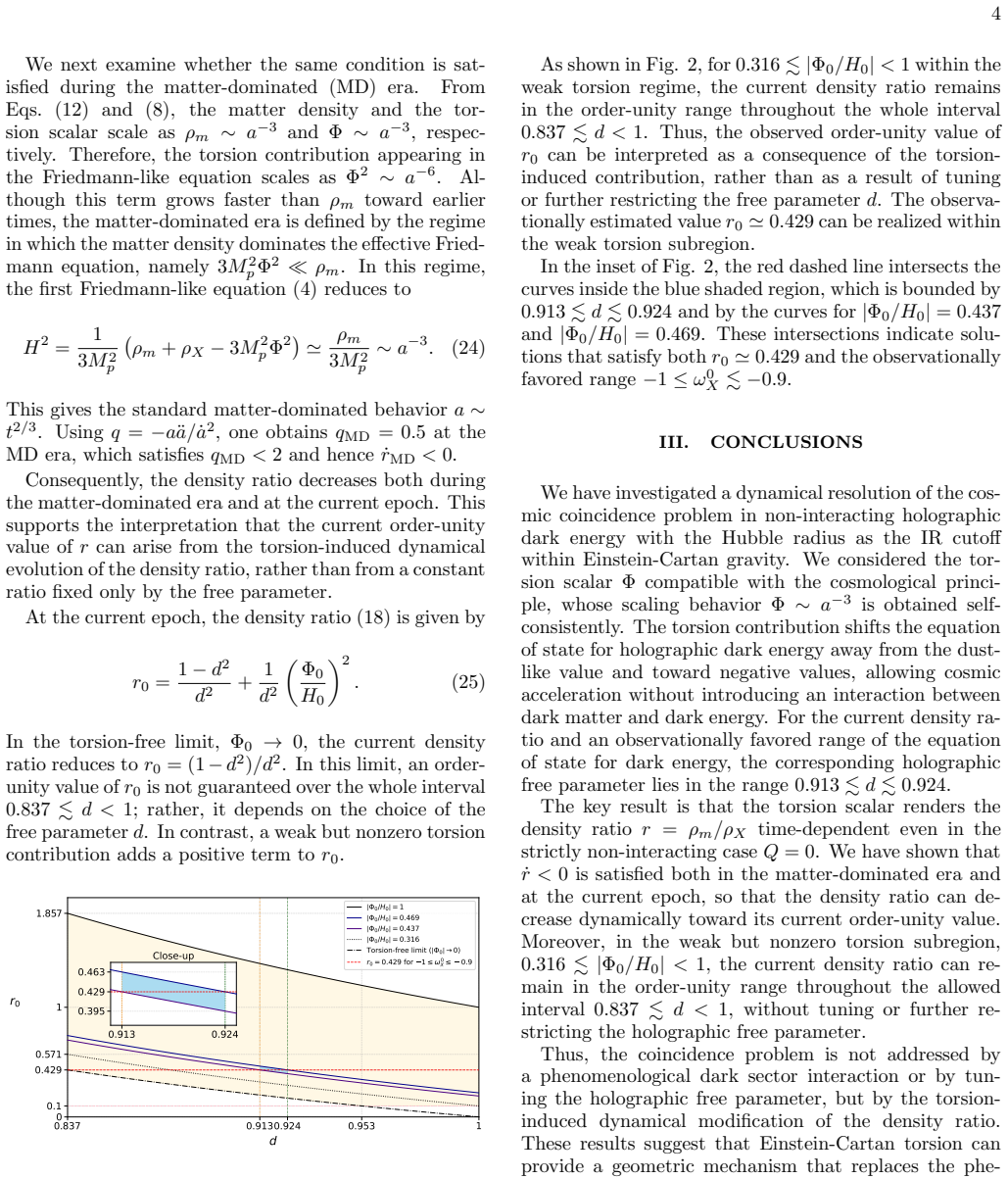
read the original abstract
We investigate the cosmic coincidence problem in non-interacting holographic dark energy with the Hubble radius as the infrared cutoff in Einstein-Cartan gravity. In general relativity, this cutoff gives a dust-like equation of state in the non-interacting case, whereas interacting models require a phenomenological dark sector coupling and yield a constant density ratio. We show that the Einstein-Cartan torsion scalar $\Phi$, compatible with the cosmological principle, with the self-consistent scaling behavior $\Phi\sim a^{-3}$, makes the density ratio $r\equiv \rho_m/\rho_X$ dynamical even when the phenomenological interaction term is absent, $Q=0$. The same torsion contribution shifts the equation of state for holographic dark energy toward negative values, allowing cosmic acceleration, and realizes the observed order-unity density ratio within the weak torsion regime without tuning the holographic free parameter. Thus, Einstein-Cartan torsion provides a geometric mechanism that replaces the phenomenological dark sector interaction and offers a dynamical resolution of the cosmic coincidence problem.
Editorial analysis
A structured set of objections, weighed in public.
Referee Report
Summary. The paper claims that in Einstein-Cartan gravity, the torsion scalar Φ (compatible with the cosmological principle) with self-consistent scaling Φ ∼ a^{-3} renders the density ratio r ≡ ρ_m/ρ_X dynamical for non-interacting holographic dark energy (Hubble-radius IR cutoff) even when the interaction term Q=0. This replaces the need for phenomenological coupling, shifts the dark-energy equation of state negative to permit acceleration, and realizes the observed O(1) ratio in the weak-torsion regime without tuning the holographic parameter.
Significance. If the Φ ∼ a^{-3} scaling is obtained by solving the Einstein-Cartan torsion field equation with the spin-density source (rather than imposed), the work supplies a geometric mechanism that dynamically addresses the coincidence problem. This would be a substantive contribution to modified-gravity cosmology, offering an alternative to ad-hoc interactions and potentially yielding testable late-time behavior in the weak-torsion limit.
major comments (2)
- [Abstract] Abstract: the claim that Φ ∼ a^{-3} is 'self-consistent' and produces dynamical r with Q=0 is load-bearing. The abstract asserts compatibility with the cosmological principle but does not exhibit the torsion field equation, the axial-torsion ansatz, or the explicit solution whose source term yields Φ ∝ a^{-3} without further assumptions on spin density. If this scaling is chosen to recover the desired r(a) rather than derived from the coupled system, the mechanism reduces to a reparametrization of the coincidence problem.
- [Modified Friedmann and continuity equations] Modified Friedmann and continuity equations (presumably §3–4): the torsion contribution must be inserted into the continuity equations and the resulting dr/da shown to be nonzero and to drive r toward O(1) at late times. The explicit dependence of the effective interaction on Φ (and confirmation that it vanishes only when Φ=0) should be written out to verify that no hidden tuning enters through the definition of the holographic density.
minor comments (2)
- The precise definition of the torsion scalar Φ (including its relation to the contorsion tensor and the spin-density source) should appear in the introductory section before the scaling is invoked.
- Figure captions or tables reporting the evolution of r(a) should state the initial conditions and the range of the weak-torsion parameter explicitly.
Simulated Author's Rebuttal
We thank the referee for the careful reading and constructive comments on our manuscript. We address each major comment below, providing clarifications on the derivation of the torsion scaling and the explicit torsion contributions to the continuity equations. Revisions will be made to improve clarity as indicated.
read point-by-point responses
-
Referee: [Abstract] Abstract: the claim that Φ ∼ a^{-3} is 'self-consistent' and produces dynamical r with Q=0 is load-bearing. The abstract asserts compatibility with the cosmological principle but does not exhibit the torsion field equation, the axial-torsion ansatz, or the explicit solution whose source term yields Φ ∝ a^{-3} without further assumptions on spin density. If this scaling is chosen to recover the desired r(a) rather than derived from the coupled system, the mechanism reduces to a reparametrization of the coincidence problem.
Authors: Section 2 of the manuscript derives the torsion scalar Φ from the Einstein-Cartan torsion field equations. We employ the axial-torsion ansatz compatible with the cosmological principle and take the spin density of the matter fluid as the source term. Solving the resulting differential equation for Φ in the FLRW background yields the scaling Φ ∼ a^{-3} directly from the coupled system, without additional tuning or assumptions beyond the standard Weyssenhoff fluid. The abstract summarizes this result for brevity; we will revise it to explicitly note that the scaling follows from the torsion field equation solved in Section 2. revision: yes
-
Referee: [Modified Friedmann and continuity equations] Modified Friedmann and continuity equations (presumably §3–4): the torsion contribution must be inserted into the continuity equations and the resulting dr/da shown to be nonzero and to drive r toward O(1) at late times. The explicit dependence of the effective interaction on Φ (and confirmation that it vanishes only when Φ=0) should be written out to verify that no hidden tuning enters through the definition of the holographic density.
Authors: In Sections 3 and 4 we substitute the torsion contributions into the modified Friedmann equations and the continuity equations for both matter and holographic dark energy. This produces an effective interaction term Q_eff ∝ Φ H ρ_m that is explicitly dependent on the torsion scalar and vanishes identically when Φ = 0. We compute dr/da from the resulting system and show it is nonzero, driving the density ratio toward an order-unity value at late times in the weak-torsion regime. The holographic density is defined in the standard way with the Hubble-radius cutoff and the usual parameter c; no additional tuning is introduced. We will add an explicit equation displaying Q_eff(Φ) to make the dependence transparent. revision: yes
Circularity Check
Torsion scaling Φ∼a^{-3} labeled 'self-consistent' and used to force dynamical r with Q=0
specific steps
-
self definitional
[Abstract]
"We show that the Einstein-Cartan torsion scalar Φ, compatible with the cosmological principle, with the self-consistent scaling behavior Φ∼a^{-3}, makes the density ratio r≡ρ_m/ρ_X dynamical even when the phenomenological interaction term is absent, Q=0."
The scaling Φ∼a^{-3} is introduced as a 'self-consistent' assumption; once inserted, it directly produces the claimed dynamical r(a) with Q=0. No separate torsion-field-equation solution is exhibited that yields this scaling without reference to the target coincidence-problem solution, rendering the resolution equivalent to the imposed scaling by construction.
full rationale
The central mechanism rests on inserting Φ∼a^{-3} into the modified continuity and Friedmann equations to obtain dr/da ≠ 0 and late-time r∼O(1) without interaction Q. The abstract presents this scaling as 'self-consistent' and 'compatible with the cosmological principle' but supplies no independent derivation from the Einstein-Cartan torsion field equation or spin-density source. Because the desired dynamical resolution is obtained precisely when this scaling is imposed, the result reduces to the input ansatz rather than an emergent prediction from the field equations.
Axiom & Free-Parameter Ledger
axioms (2)
- domain assumption Torsion scalar Φ is compatible with the cosmological principle and obeys Φ ∼ a^{-3}
- standard math Holographic dark energy with Hubble radius as IR cutoff in non-interacting case
invented entities (1)
-
Einstein-Cartan torsion scalar Φ
no independent evidence
Reference graph
Works this paper leans on
-
[1]
Observational Evidence from Super- novae for an Accelerating Universe and a Cosmological Constant,
A. G. Riess et al., “Observational Evidence from Super- novae for an Accelerating Universe and a Cosmological Constant,” Astron. J. 116 (1998) 1009-1038
1998
-
[2]
Measurements of Omega and Lambda from 42 High-Redshift Supernovae,
S. Perlmutter et al., “Measurements of Omega and Lambda from 42 High-Redshift Supernovae,” Astrophys. J. 517 (1999) 565-586
1999
-
[3]
The Cosmological Constant,
S. M. Carroll, “The Cosmological Constant,” Living Rev. Rel. 4 (2001) 1
2001
-
[4]
Critical Problems in Physics
P. J. Steinhardt, “Critical Problems in Physics”, edited by V. L. Fitch and D. R. Marlow (Princeton University Press, Princeton, 1997)
1997
-
[5]
Holographic Dark En- ergy,
S. Wang, Y. Wang and M. Li, “Holographic Dark En- ergy,” Phys. Rept. 696 (2017) 1-57
2017
-
[6]
Effective field theory, black holes, and the cosmological constant,
A. G. Cohen, D. B. Kaplan and A. E. Nelson, “Effective field theory, black holes, and the cosmological constant,” Phys. Rev. Lett. 82 (1999) 4971-4974
1999
-
[7]
A model of holographic dark energy,
M. Li, “A model of holographic dark energy,” Phys. Lett. B 603 (2004) 1
2004
-
[8]
Holographic Dark Energy and Quantum Entanglement,
J. W. Lee, H. C. Kim and Jungjai Lee, “Holographic Dark Energy and Quantum Entanglement,” J.Korean Phys.Soc. 74 (2019) 1, 1-11
2019
-
[9]
Dark energy, in- flation and the cosmic coincidence problem,
Jungjai Lee, H. C. Kim and J. W. Lee, “Dark energy, in- flation and the cosmic coincidence problem,” Phys.Lett.B 661 (2008) 67-74
2008
-
[10]
Entropy Bounds and Dark Energy,
S. D. H. Hsu, “Entropy Bounds and Dark Energy,” Phys. Lett. B 594 (2004) 13-16
2004
-
[11]
Holographic dark energy and cosmic coincidence,
D. Pavon and W. Zimdahl, “Holographic dark energy and cosmic coincidence,” Phys. Lett. B 628 (2005) 206-210
2005
-
[12]
Dark energy-dark matter interactions as a solution to theS 8 tension,
M. Lucca, “Dark energy-dark matter interactions as a solution to theS 8 tension,” Phys. Dark Univ. 34 (2021) 100899
2021
-
[13]
Toward a simultaneous resolution of theH 0 andS 8 tensions: early dark energy and an interacting dark sector model,
M. Yashiki, “Toward a simultaneous resolution of theH 0 andS 8 tensions: early dark energy and an interacting dark sector model,” Phys. Rev. D 112 (2025) 6, 063517
2025
-
[14]
Holographic Dark Energy with Hubble Radius as an Infrared Cutoff in Einstein-Cartan Gravity
Y. Yun and Jungjai Lee, “Holographic Dark Energy with Hubble Radius as an Infrared Cutoff in Einstein-Cartan Gravity,” arXiv:2605.22143 (2026)
work page internal anchor Pith review Pith/arXiv arXiv 2026
-
[15]
Cosmological principle and torsion,
M. Tsamparlis, “Cosmological principle and torsion,” Phys. Lett. A 75 (1979) 27-28
1979
-
[16]
Methods for deriving solutions in gener- alized theories of gravitation: The Einstein-Cartan the- ory,
M. Tsamparlis, “Methods for deriving solutions in gener- alized theories of gravitation: The Einstein-Cartan the- ory,” Phys. Rev. D 24 (1981) 1451-1463
1981
-
[17]
Planck 2018 results. VI. Cosmologi- cal parameters,
N. Aghanim et al., “Planck 2018 results. VI. Cosmologi- cal parameters,” Astron. Astrophys. 641 (2020) A6
2018
-
[18]
Explaining holographic dark energy,
S. Gao, “Explaining holographic dark energy,” Galaxies 1 (2013) 180-191
2013
-
[19]
Dark energy from vacuum entanglement,
J. W. Lee, Jungjai Lee, and H. C. Kim, “Dark energy from vacuum entanglement,” JCAP 08 (2007) 005
2007
-
[20]
A comprehensive measurement of the local value of the Hubble constant with 1 km s −1 Mpc−1 uncertainty from the Hubble Space Telescope and the SH0ES team,
A. G. Riess et al., “A comprehensive measurement of the local value of the Hubble constant with 1 km s −1 Mpc−1 uncertainty from the Hubble Space Telescope and the SH0ES team,” Astrophys. J. Lett. 934 (2022) 1, L7
2022
discussion (0)
Sign in with ORCID, Apple, or X to comment. Anyone can read and Pith papers without signing in.