Automated Unitary Coupled Cluster Circuit Design via Differentiable Quantum Architecture Search
Pith reviewed 2026-06-29 11:40 UTC · model grok-4.3
The pith
Differentiable architecture search finds VQE circuits with higher accuracy and fewer CNOT gates than ADAPT-VQE.
A machine-rendered reading of the paper's core claim, the machinery that carries it, and where it could break.
Core claim
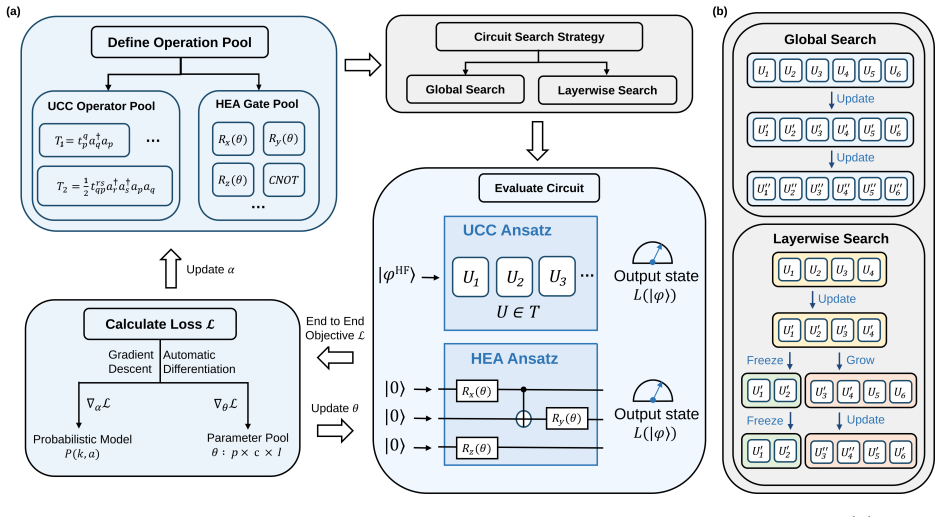
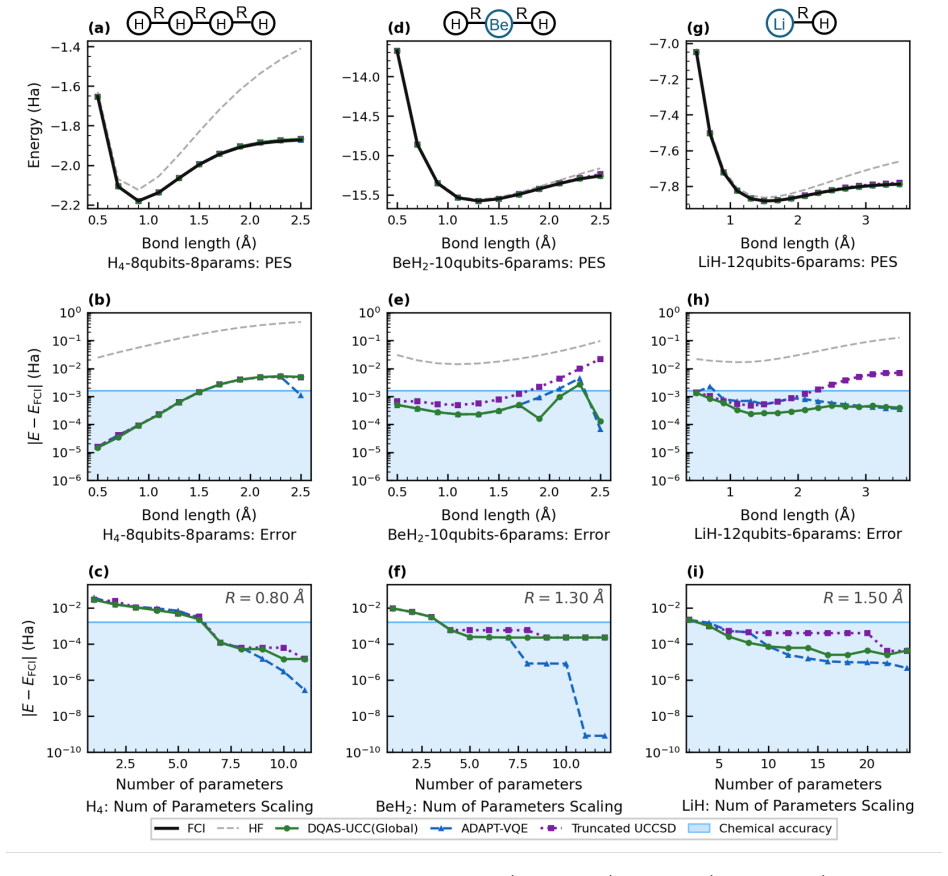
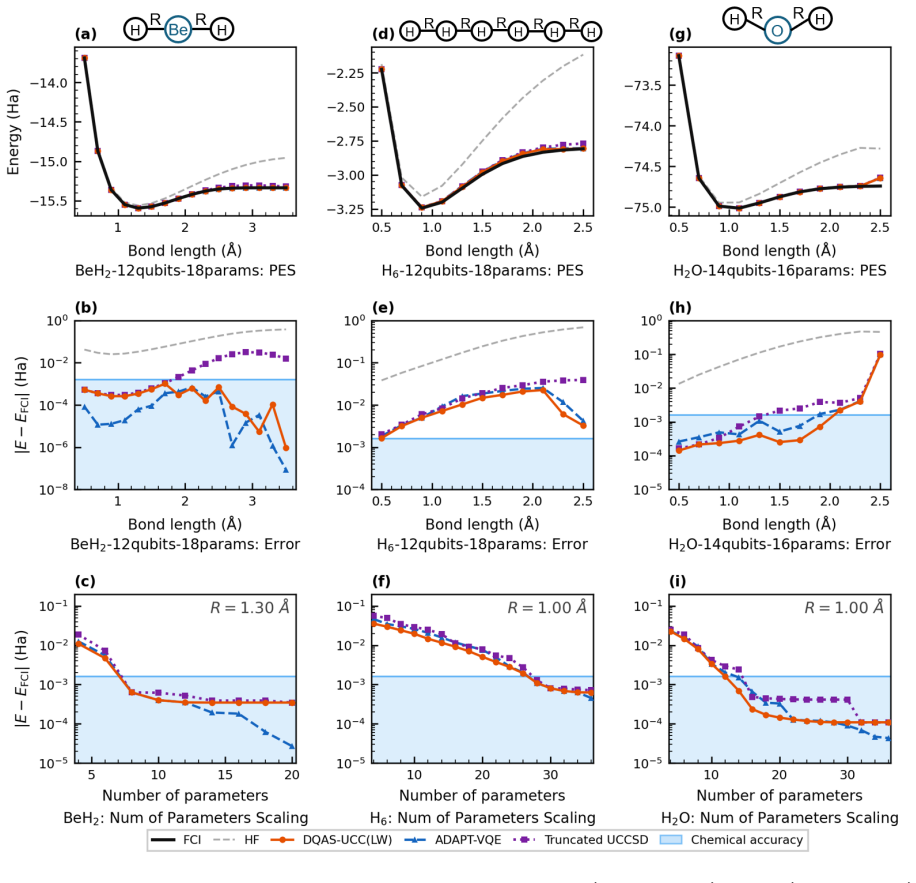
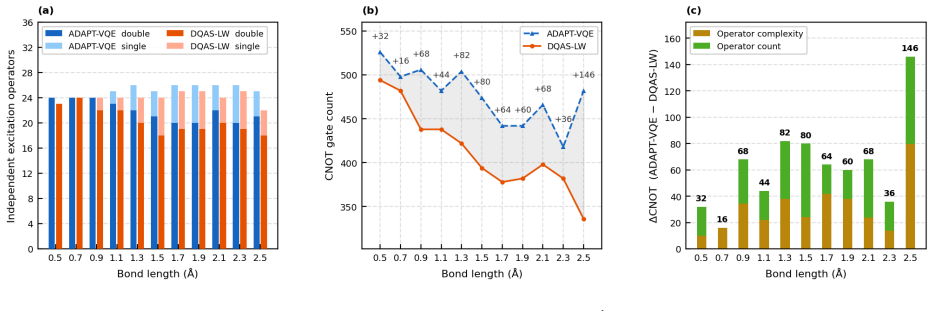
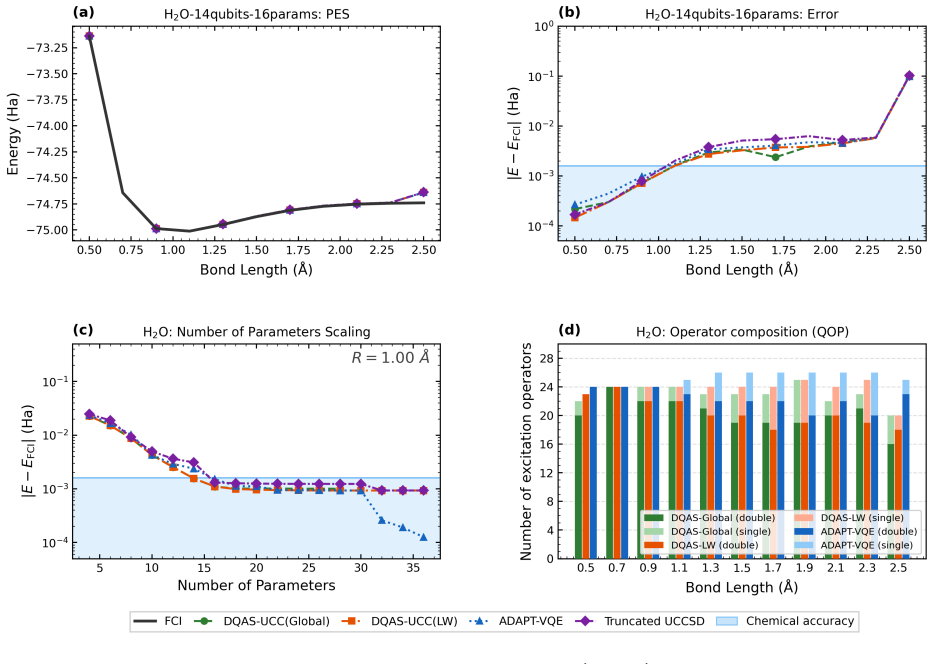
By turning discrete operator selection from the UCCSD pool into a continuous, differentiable problem, DQAS lets gradient-based search explore circuit architectures. Both the global mode that optimizes all selections together and the layerwise mode that builds circuits incrementally produce final discrete circuits that outperform ADAPT-VQE on the tested molecules, delivering higher accuracy with 13-17 percent fewer CNOT gates at matched depths and up to 2.7 times better accuracy for H2O; the gains also appear with the qubit-excitation-based pool.
What carries the argument
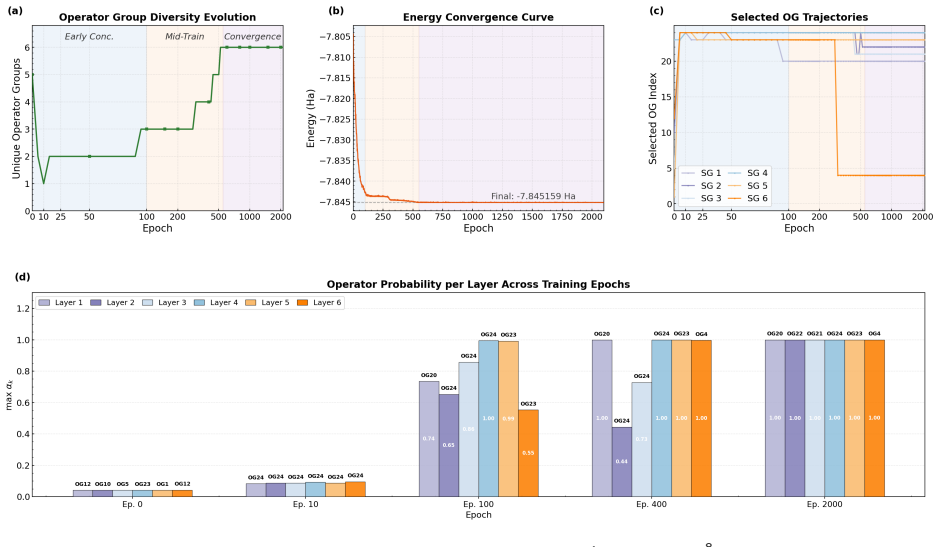
Differentiable Quantum Architecture Search (DQAS) on the UCCSD operator pool, using global simultaneous optimization and layerwise incremental construction that relax discrete choices into continuous parameters for gradient descent.
If this is right
- Both global and layerwise DQAS modes outperform ADAPT-VQE in accuracy for compact circuits on the five tested molecules.
- CNOT counts drop by 13-17 percent at equivalent circuit depths while accuracy improves, reaching a 2.7-fold gain on H2O.
- The accuracy and gate-count gains persist when the operator pool is changed from UCCSD to the qubit-excitation-based version.
- Gradient-based exploration of the combinatorial space replaces the greedy iterative selection used in adaptive methods.
Where Pith is reading between the lines
- The same relaxation approach could be tested on other variational algorithms that currently rely on manual or greedy operator selection.
- Layerwise construction may become more important when circuit depth increases, because it preserves early structural decisions during later optimization.
- Direct comparison on noisy hardware would show whether the reported gate reductions produce measurable improvements in actual energy estimates.
Load-bearing premise
The continuous relaxation of operator selection produces final discrete circuits whose accuracy and gate-count advantages survive evaluation on the benchmark molecules and operator pools without hidden post-selection effects.
What would settle it
Re-running the identical DQAS procedure on a new molecule outside the BeH2-H2O set or with a substantially altered operator pool and observing that the accuracy and CNOT advantages over ADAPT-VQE disappear.
Figures
read the original abstract
Designing compact and accurate circuits for the variational quantum eigensolver (VQE) is a central challenge in near-term quantum chemistry. Existing adaptive methods such as ADAPT-VQE design circuits by iteratively selecting operators from a predefined pool guided by gradient information and greedy heuristics. In this work, we adopt differentiable quantum architecture search (DQAS) as a circuit design framework based on the UCCSD operator pool, and introduce two complementary strategies: a global mode that simultaneously optimizes all operator selections, and a layerwise mode that constructs circuits incrementally while preserving previously learned structure. By relaxing discrete operator selection into a continuous differentiable optimization, DQAS enables gradient-based exploration over the combinatorial space of UCC circuit architectures. Benchmarks on BeH2, H4, LiH, H6, and H2O (8-14 qubits) show that both strategies achieve higher accuracy and fewer CNOT gates than ADAPT-VQE in the compact circuit regime, with up to 2.7-fold accuracy improvement for H2O and CNOT reductions of 13-17% at equivalent circuit depths. Benchmarks on the qubit-excitation-based (QEB) operator pool confirm that both advantages generalize beyond UCCSD. These results demonstrate that differentiable architecture search provides an effective and generalizable framework for designing accurate and compact VQE circuits in near-term quantum chemistry.
Editorial analysis
A structured set of objections, weighed in public.
Referee Report
Summary. The manuscript introduces differentiable quantum architecture search (DQAS) as a framework for automated design of unitary coupled cluster (UCC) circuits for VQE. It proposes global and layerwise optimization modes that relax discrete operator selection into continuous differentiable weights, and benchmarks these on BeH2, H4, LiH, H6, and H2O (8-14 qubits) using UCCSD and QEB operator pools, claiming higher accuracy and fewer CNOT gates than ADAPT-VQE in the compact regime (up to 2.7-fold accuracy gain on H2O and 13-17% CNOT reduction at matched depths).
Significance. If the empirical advantages are robust, the work offers a gradient-based alternative to greedy adaptive methods like ADAPT-VQE for exploring UCC circuit architectures, with the differentiable relaxation enabling systematic search over combinatorial spaces. The generalization test on the QEB pool and the focus on compact-circuit performance are strengths that could inform NISQ quantum chemistry applications.
major comments (2)
- [Abstract] Abstract and results section: the central claim that DQAS-derived discrete architectures deliver the stated accuracy and CNOT advantages requires explicit demonstration that the discretization and final selection step does not introduce post-selection effects unavailable to ADAPT-VQE's greedy gradient-driven procedure; the reported benchmarks on the five molecules do not rule out conditioning on the specific relaxation and selection used.
- [Methods] Methods (DQAS global/layerwise modes): the continuous relaxation of operator selection must be shown to produce final discrete circuits whose performance edge survives variation in random seeds, hyperparameter choices, and operator-pool ordering; without such controls, the 2.7-fold H2O improvement and 13-17% CNOT reductions cannot be attributed unambiguously to the DQAS framework rather than benchmark-specific tuning.
minor comments (2)
- Provide full tables of energy errors, CNOT counts, and circuit depths for all molecules and both pools, including standard deviations across independent runs.
- Clarify the precise definition of 'accuracy' (e.g., absolute energy error vs. relative to FCI or to ADAPT-VQE) and the depth-matching protocol used for the CNOT-reduction comparisons.
Simulated Author's Rebuttal
We thank the referee for the constructive comments and the recommendation for major revision. We address each point below, agreeing that additional demonstrations are needed to strengthen the claims regarding the source of the reported advantages.
read point-by-point responses
-
Referee: [Abstract] Abstract and results section: the central claim that DQAS-derived discrete architectures deliver the stated accuracy and CNOT advantages requires explicit demonstration that the discretization and final selection step does not introduce post-selection effects unavailable to ADAPT-VQE's greedy gradient-driven procedure; the reported benchmarks on the five molecules do not rule out conditioning on the specific relaxation and selection used.
Authors: We agree that the manuscript would benefit from an explicit demonstration that the discretization step (selecting operators with the highest learned weights) does not introduce post-selection biases unavailable to ADAPT-VQE. In the revised manuscript, we will add a dedicated subsection in the results (and corresponding appendix) that compares the DQAS final selection procedure against a controlled variant of ADAPT-VQE that also performs a final ranking or selection from gradient-informed candidates. This will clarify that the reported accuracy and CNOT gains arise from the differentiable search rather than the discretization alone. revision: yes
-
Referee: [Methods] Methods (DQAS global/layerwise modes): the continuous relaxation of operator selection must be shown to produce final discrete circuits whose performance edge survives variation in random seeds, hyperparameter choices, and operator-pool ordering; without such controls, the 2.7-fold H2O improvement and 13-17% CNOT reductions cannot be attributed unambiguously to the DQAS framework rather than benchmark-specific tuning.
Authors: We concur that robustness to initialization, hyperparameters, and pool ordering is essential for unambiguous attribution of the performance gains. The current manuscript reports results for fixed but representative settings; we will therefore add an appendix with additional experiments that vary random seeds (at least 5 per molecule), key hyperparameters (learning rate, temperature in the relaxation), and operator-pool permutations. These will demonstrate that the accuracy and CNOT advantages persist across variations, with summary statistics provided. revision: yes
Circularity Check
No circularity: empirical benchmarking of DQAS vs ADAPT-VQE on fixed molecular instances
full rationale
The paper's central claims consist of direct numerical comparisons (accuracy and CNOT counts) between DQAS-derived circuits and ADAPT-VQE on the same fixed benchmarks (BeH2, H4, LiH, H6, H2O) using the same operator pools. No derivation reduces a reported performance metric to a quantity defined by the authors' own prior equations or fitted parameters; the discretization step after continuous relaxation is presented as an empirical outcome rather than a self-referential identity. No self-citation load-bearing steps appear in the provided text. The result is therefore self-contained against external benchmarks.
Axiom & Free-Parameter Ledger
Reference graph
Works this paper leans on
-
[1]
J.; Aspuru- Guzik, A.; O’Brien, J
(1) Peruzzo, A.; McClean, J.; Shadbolt, P.; Yung, M.-H.; Zhou, X.-Q.; Love, P. J.; Aspuru- Guzik, A.; O’Brien, J. L. A variational eigenvalue solver on a photonic quantum pro- cessor.Nat. Commun.2014,5,
2014
-
[2]
H.; Tennyson, J
(2) Tilly, J.; Chen, H.; Cao, S.; Picozzi, D.; Setia, K.; Li, Y.; Grant, E.; Wossnig, L.; Rungger, I.; Booth, G. H.; Tennyson, J. The variational quantum eigensolver: a review of methods and best practices.Phys. Rep.2022,986, 1–128. (3) Cerezo, M.; Arrasmith, A.; Babbush, R.; Benjamin, S. C.; Endo, S.; Fujii, K.; Mc- Clean, J. R.; Mitarai, K.; Yuan, X.; C...
2022
-
[3]
M.; Gam- betta, J
(17) Kandala, A.; Mezzacapo, A.; Temme, K.; Takita, M.; Brink, M.; Chow, J. M.; Gam- betta, J. M. Hardware-efficient variational quantum eigensolver for small molecules and quantum magnets.Nature2017,549, 242–246. 28 (18) O’Malley, P. J. J. et al. Scalable quantum simulation of molecular energies.Phys. Rev. X2016,6, 031007. (19) Guo, S. et al. Experimenta...
2024
-
[4]
L.; Shkolnikov, V
(21) Tang, H. L.; Shkolnikov, V. O.; Barron, G. S.; Grimsley, H. R.; Mayhall, N. J.; Barnes, E.; Economou, S. E. qubit-ADAPT-VQE: An adaptive algorithm for construct- ing hardware-efficient ans¨ atze on a quantum processor.PRX Quantum2021,2, 020310. (22) Yordanov, Y. S.; Armaos, V.; Barnes, C. H. W.; Arvidsson-Shukur, D. R. M. Qubit- excitation-based adap...
2021
-
[5]
J.; Loos, P.-F.; Toulouse, J.; Benlaki, R
(23) Feniou, C.; Claudon, B.; Muhammad, M.; Dhiab, A.; Bhole, U.; Picard, J.; Stam- atopoulos, N.; Zeng, W. J.; Loos, P.-F.; Toulouse, J.; Benlaki, R. Overlap-ADAPT- VQE: practical quantum chemistry on quantum computers via overlap-guided compact ans¨ atze.Commun. Phys.2023,6,
2023
-
[6]
Efficient and Robust Parameter Optimization of the Unitary Coupled-Cluster Ansatz.J
(24) Li, W.; Ge, Y.; Zhang, S.-X.; Chen, Y.-Q.; Zhang, S. Efficient and Robust Parameter Optimization of the Unitary Coupled-Cluster Ansatz.J. Chem. Theory Comput.2024, 20, 3683–3696. (25) Jiang, X.; Sheng, Z.; Gong, C.; Li, W.; Shuai, Z. Measurement-efficient ADAPT-VQE with the SOAP parameter optimizer.J. Chem. Phys.2025,163, 224118. (26) Biamonte, J.; W...
2024
-
[7]
Z.; Chong, F
(32) Wang, H.; Ding, Y.; Gu, J.; Lin, Y.; Pan, D. Z.; Chong, F. T.; Han, S. QuantumNAS: Noise-adaptive search for robust quantum circuits. 2022 IEEE International Symposium on High-Performance Computer Architecture (HPCA). 2022; pp 692–708. (33) Saib, W.; Bonet-Monroig, X.; Dunjko, V.; Tavernelli, I.; B¨ ack, T.; Wang, H. Bench- marking adaptive quantum c...
2022
-
[8]
Progressive differentiable architecture search: bridg- ing the depth gap between search and evaluation
(42) Chen, X.; Xie, L.; Wu, J.; Tian, Q. Progressive differentiable architecture search: bridg- ing the depth gap between search and evaluation. Proceedings of the IEEE/CVF In- ternational Conference on Computer Vision (ICCV). 2019; pp 1294–1303. (43) Li, W.; Huang, Z.; Cao, C.; Huang, Y.; Shuai, Z.; Sun, X.; Sun, J.; Yuan, X.; Lv, D. TenCirChem: an effic...
2019
-
[9]
D.; Biamonte, J.; Aspuru-Guzik, A
31 (45) Whitfield, J. D.; Biamonte, J.; Aspuru-Guzik, A. Simulation of electronic structure Hamiltonians using quantum computers.Mol. Phys.2011,109, 735–750. (46) Yordanov, Y. S.; Arvidsson-Shukur, D. R. M.; Barnes, C. H. W. Efficient quantum circuits for quantum computational chemistry.Phys. Rev. A2020,102, 062612. (47) Seeley, J. T.; Richard, M. J.; Lov...
2011
-
[10]
R.; Mohseni, M.; van der Smagt, P.; Leib, M
(49) Skolik, A.; McClean, J. R.; Mohseni, M.; van der Smagt, P.; Leib, M. Layerwise learning for quantum neural networks.Quantum Mach. Intell.2021,3,
2021
-
[11]
(50) Sun, Q. et al. Recent developments in the PySCF program package.J. Chem. Phys. 2020,153, 024109. (51) McClean, J. R. et al. OpenFermion: the electronic structure package for quantum computers.Quantum Sci. Technol.2020,5, 034014. (52) Zhang, S.-X. et al. TensorCircuit: a quantum software framework for the NISQ era. Quantum2023,7,
2020
-
[12]
TensorCircuit-NG: A Universal, Composable, and Scalable Platform for Quantum Computing and Quantum Simulation.arXiv2025, (54) McClean, J
(53) Zhang, S.-X. TensorCircuit-NG: A Universal, Composable, and Scalable Platform for Quantum Computing and Quantum Simulation.arXiv2025, (54) McClean, J. R.; Boixo, S.; Smelyanskiy, V. N.; Babbush, R.; Neven, H. Barren plateaus in quantum neural network training landscapes.Nat. Commun.2018,9,
2018
-
[13]
O.; Barkoutsos, P
32 (56) Sokolov, I. O.; Barkoutsos, P. K.; Ollitrault, P. J.; Greenberg, D.; Rice, J.; Pis- toia, M.; Tavernelli, I. Quantum orbital-optimized unitary coupled cluster methods in the strongly correlated regime: Can quantum algorithms outperform their classical equivalents?J. Chem. Phys.2020,152, 124107. (57) Belaloui, N. E.; Tounsi, A.; Khamadja, A. R.; Lo...
2020
discussion (0)
Sign in with ORCID, Apple, or X to comment. Anyone can read and Pith papers without signing in.