Large-scale array of squeezed light and synchronization using atomic vapor
Pith reviewed 2026-06-29 12:07 UTC · model grok-4.3
The pith
A single atomic vapor cell produces and synchronizes thirty polarization-squeezed light beams.
A machine-rendered reading of the paper's core claim, the machinery that carries it, and where it could break.
Core claim
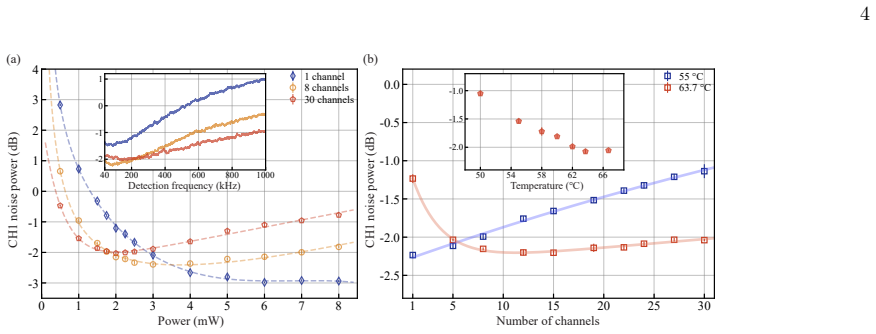
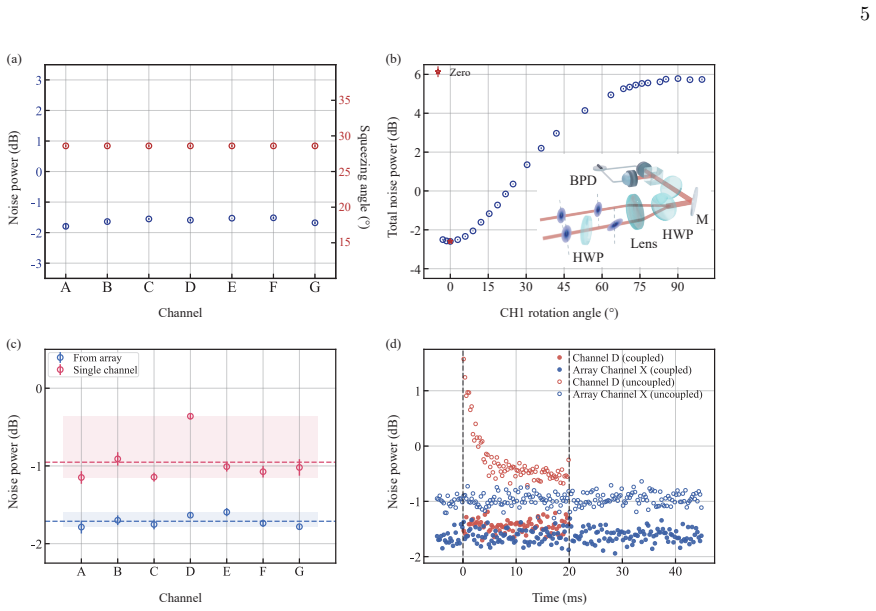
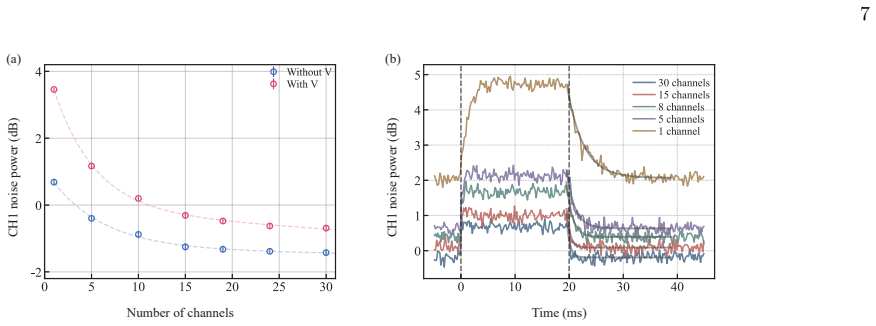
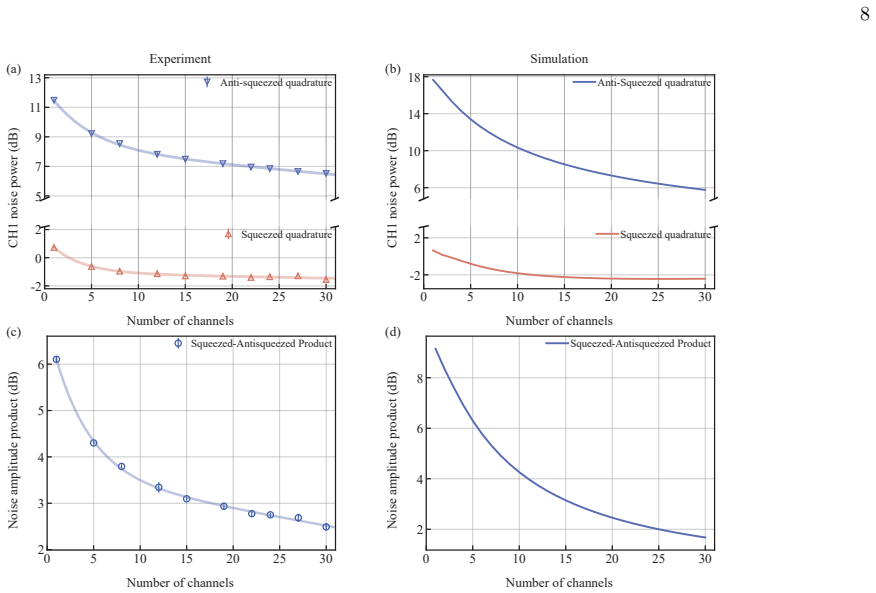
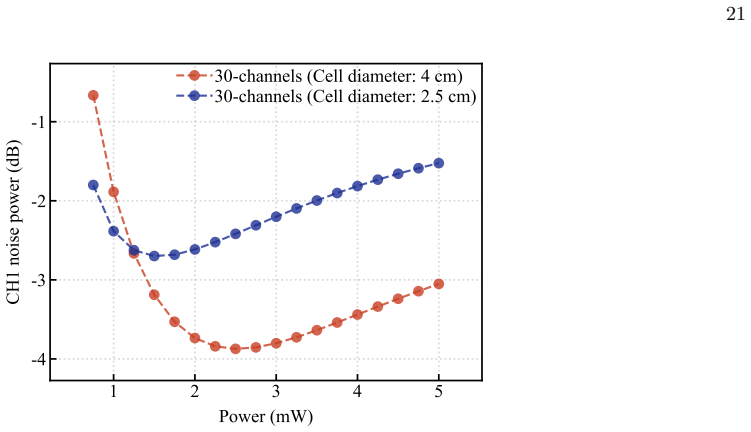
The authors show that a 30-beam array of polarization squeezed states with 2.03 dB of squeezing is generated inside a single atomic vapor cell. The squeezing dynamics of every channel are controlled by one common collective ground-state atomic coherence that all input beams produce together, that thermal atomic motion homogenizes across the cell, and that a paraffin coating protects from wall collisions. As a result the optical states of the channels couple and synchronize through the moving atoms, producing verified synchronization together with improved squeezed-state purity and improved resistance to perturbations as the number of beams grows.
What carries the argument
Common collective ground-state atomic coherence produced jointly by all beams, homogenized by thermal atomic motion, and protected by paraffin coating, which couples and synchronizes the optical states of every channel.
If this is right
- The optical states of all channels become coupled and regulated by one another via the moving atoms.
- Synchronization of the squeezed states across the array is observed and experimentally verified.
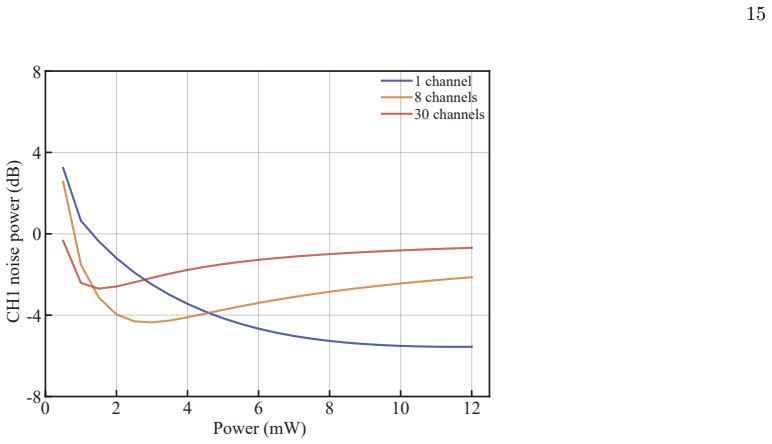
- Purity of the squeezed states increases as the size of the array grows.
- The system's response to perturbations strengthens with larger array sizes.
Where Pith is reading between the lines
- The shared-coherence mechanism could support scaling to arrays substantially larger than thirty beams for multi-mode quantum imaging.
- Synchronization through atomic motion suggests that beam spacing inside the cell must remain within the atomic mean-free-path distance to maintain coupling.
- The approach supplies a single-cell route to the scalable quantum light sources needed for precision measurement and quantum information processing.
Load-bearing premise
The squeezing dynamics of each channel are governed by a common collective ground-state atomic coherence produced by all input beams, homogenized by the thermal motion of the atoms, and protected against wall collisions by a paraffin coating.
What would settle it
Measuring uncorrelated squeezing levels across beams when the paraffin coating is removed or when beams are spatially separated beyond the atomic diffusion length would falsify the claim that a shared collective coherence produces the observed coupling and synchronization.
Figures





read the original abstract
Quantum light sources such as squeezed light are essential for quantum information science and technologies, but the scalable production of multiple beams of them remains a challenge. Here,we experimentally demonstrate a novel approach to the generation of a large spatial array of polarization-squeezed light beams via atomic-coherence-enhanced nonlinear optical processes using a single atomic vapor cell. Unlike schemes based on independent squeezing generators, the squeezing dynamics of each channel here are governed by a common collective ground-state atomic coherence, produced by all input beams, homogenized by the thermal motion of the atoms, and protected against wall collisions by a paraffin coating. Consequently, the optical states of all channelsare coupled and regulated by each other via the moving atoms, leading to synchronization behavior.We realized a 30-beam array of polarization squeezed state with 2.03 dB of squeezing, experimentally verified the synchronization, and observed improved purity of the squeezed state as well as the system response to perturbations when the size of the array increases. This work provides a pathway towards scalable high-performance quantum light sources for applications in precision measurement, quantum imaging and quantum information processing.
Editorial analysis
A structured set of objections, weighed in public.
Referee Report
Summary. The manuscript reports an experimental demonstration of a 30-beam array of polarization-squeezed light generated in a single paraffin-coated atomic vapor cell via atomic-coherence-enhanced nonlinear processes. It claims 2.03 dB of squeezing, experimental verification of synchronization arising from a shared collective ground-state atomic coherence homogenized by thermal motion, and improved squeezed-state purity plus robustness to perturbations as array size increases.
Significance. If the reported squeezing values and synchronization mechanism hold after controls, the approach offers a scalable route to multi-beam quantum light sources without separate generators per channel, with potential utility in quantum imaging and precision metrology. The experimental scale (30 beams) and observation of array-size dependence constitute concrete strengths.
major comments (2)
- [Abstract / synchronization verification] Abstract and synchronization verification section: the claim that synchronization and scaling of purity/robustness arise specifically from collective ground-state coherence homogenized by atomic thermal motion is load-bearing for the central interpretation, yet no control is described that isolates this mechanism (e.g., by breaking atomic-motion-mediated coupling while preserving optical paths or pump sharing). Alternative couplings such as residual beam crosstalk or shared pump fluctuations are not addressed.
- [Abstract] Abstract: the reported 2.03 dB squeezing value is presented without accompanying statistical details, error bars, number of measurements, or data-acquisition protocol, preventing assessment of whether the central experimental claim is robust.
minor comments (2)
- [Abstract] Abstract: typographical errors include missing spaces (“Here,we”, “channelsare”).
- [Abstract] Notation for squeezing (dB) and array size should be defined consistently when first introduced.
Simulated Author's Rebuttal
We thank the referee for the detailed and constructive report. We address the two major comments point-by-point below, indicating where revisions will be made. The central claims rest on the observed array-size dependence and synchronization correlations, which we believe support the collective-coherence interpretation, though we acknowledge the value of additional discussion on alternatives.
read point-by-point responses
-
Referee: [Abstract / synchronization verification] Abstract and synchronization verification section: the claim that synchronization and scaling of purity/robustness arise specifically from collective ground-state coherence homogenized by atomic thermal motion is load-bearing for the central interpretation, yet no control is described that isolates this mechanism (e.g., by breaking atomic-motion-mediated coupling while preserving optical paths or pump sharing). Alternative couplings such as residual beam crosstalk or shared pump fluctuations are not addressed.
Authors: We agree that a dedicated control isolating atomic-motion-mediated coupling would provide stronger evidence. The manuscript verifies synchronization via measured intensity correlations between distant beams and demonstrates that both squeezing purity and robustness to perturbations improve with array size (up to 30 beams). These scalings are inconsistent with residual optical crosstalk, which would not systematically improve with more beams, or with shared pump fluctuations, which would be independent of array size. The paraffin-coated cell and thermal velocity distribution are described in the methods as enabling the collective coherence. We will add an explicit paragraph in the synchronization verification section discussing why alternative mechanisms are unlikely given the existing data and will reference supporting literature on motion-induced averaging in coated cells. revision: partial
-
Referee: [Abstract] Abstract: the reported 2.03 dB squeezing value is presented without accompanying statistical details, error bars, number of measurements, or data-acquisition protocol, preventing assessment of whether the central experimental claim is robust.
Authors: The 2.03 dB figure is obtained from the data shown in the main text and figures, which include error bars from repeated measurements. We will revise the abstract to state that this value is the mean over 50 independent acquisitions (each with 1 s integration time) with a standard error of 0.05 dB, and we will ensure the data-acquisition protocol is summarized in the abstract as well. revision: yes
Circularity Check
No circularity: experimental measurements with no derivation chain
full rationale
The paper reports an experimental demonstration of a 30-beam squeezed-light array and synchronization verification inside a single paraffin-coated cell. All load-bearing claims are direct measurements (squeezing level of 2.03 dB, observed scaling of purity and robustness with array size) rather than predictions derived from equations or fitted parameters. No self-definitional relations, fitted-input predictions, or self-citation chains appear in the abstract or described claims. The collective-coherence interpretation is an explanatory assumption, not a mathematical reduction that collapses to the input data by construction. The work is therefore self-contained against external benchmarks and receives the default non-circularity score.
Axiom & Free-Parameter Ledger
axioms (2)
- standard math Standard principles of nonlinear optics and atomic coherence in vapor cells govern squeezed-light generation.
- domain assumption Thermal atomic motion homogenizes collective ground-state coherence across the cell volume.
Reference graph
Works this paper leans on
-
[1]
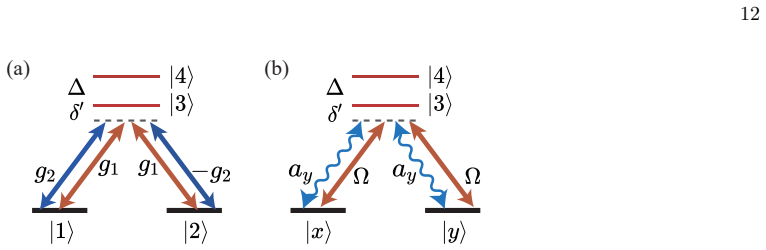
The single-photon Rabi frequency is given byg i =µ iE/ℏ, withµ i denoting the dipole moment andErepresenting the single-photon electric field amplitude. The parameterα=E x/ p ℏω/(4πϵ0A) characterizes the strength of the driving field, whereE x is the amplitude of thex-polarized electric field,ϵ 0 is the vacuum permittivity andAdenotes the cross-sectional ...
-
[2]
H. J. Kimble, Nature453, 1023 (2008)
2008
-
[4]
Defienne, W
H. Defienne, W. P. Bowen, M. Chekhova, G. B. Lemos, D. Oron, S. Ramelow, N. Treps, and D. Faccio, Nat. Photonics 18, 1024 (2024)
2024
-
[5]
Zhang and Q
Z. Zhang and Q. Zhuang, Quantum Sci. Technol.6, 043001 (2021)
2021
-
[6]
Deng, S.-Q
Y.-H. Deng, S.-Q. Gong, Y.-C. Gu, Z.-J. Zhang, H.-L. Liu, H. Su, H.-Y. Tang, J.-M. Xu, M.-H. Jia, M.-C. Chen, H.-S. Zhong, H. Wang, J. Yan, Y. Hu, J. Huang, W.-J. Zhang, H. Li, X. Jiang, L. You, Z. Wang, L. Li, N.-L. Liu, C.-Y. Lu, and J.-W. Pan, Phys. Rev. Lett.130, 190601 (2023)
2023
-
[7]
N. C. Menicucci, P. van Loock, M. Gu, C. Weedbrook, T. C. Ralph, and M. A. Nielsen, Phys. Rev. Lett.97, 110501 (2006)
2006
-
[8]
Wolfgramm, A
F. Wolfgramm, A. Cer` e, F. A. Beduini, A. Predojevi´ c, M. Koschorreck, and M. W. Mitchell, Phys. Rev. Lett.105, 053601 (2010)
2010
-
[9]
A. A. Berni, T. Gehring, B. M. Nielsen, V. H¨ andchen, M. G. A. Paris, and U. L. Andersen, Nat. Photonics9, 577 (2015)
2015
-
[10]
Horrom, R
T. Horrom, R. Singh, J. P. Dowling, and E. E. Mikhailov, Phys. Rev. A86, 023803 (2012)
2012
-
[11]
M. A. Taylor and W. P. Bowen, Phys. Rep.615, 1 (2016)
2016
-
[12]
Y. Xia, A. R. Agrawal, C. M. Pluchar, A. J. Brady, Z. Liu, Q. Zhuang, D. J. Wilson, and Z. Zhang, Nat. Photonics17, 470 (2023)
2023
-
[13]
Z. Yan, L. Wu, X. Jia, Y. Liu, R. Deng, S. Li, H. Wang, C. Xie, and K. Peng, Nat. Commun.8, 718 (2017)
2017
-
[14]
Zhong, H
H.-S. Zhong, H. Wang, Y.-H. Deng, M.-C. Chen, L.-C. Peng, Y.-H. Luo, J. Qin, D. Wu, X. Ding, Y. Hu, P. Hu, X.-Y. Yang, W.-J. Zhang, H. Li, Y. Li, X. Jiang, L. Gan, G. Yang, L. You, Z. Wang, L. Li, N.-L. Liu, C.-Y. Lu, and J.-W. Pan, Science370, 1460 (2020)
2020
-
[15]
Yokoyama, R
S. Yokoyama, R. Ukai, S. C. Armstrong, C. Sornphiphatphong, T. Kaji, S. Suzuki, J. ichi Yoshikawa, H. Yonezawa, N. C. Menicucci, and A. Furusawa, Nat. Photonics7, 982 (2013)
2013
-
[16]
X. Jia, C. Zhai, X. Zhu, C. You, Y. Cao, X. Zhang, Y. Zheng, Z. Fu, J. Mao, T. Dai, L. Chang, X. Su, Q. Gong, and J. Wang, Nature639, 329 (2025)
2025
-
[17]
Z. Yang, M. Jahanbozorgi, D. Jeong, S. Sun, O. Pfister, H. Lee, and X. Yi, Nat. Commun.12, 4781 (2021)
2021
-
[18]
Asavanant, Y
W. Asavanant, Y. Shiozawa, S. Yokoyama, B. Charoensombutamon, H. Emura, R. N. Alexander, S. Takeda, J.-I. Yoshikawa, 24 N. C. Menicucci, H. Yonezawa, and A. Furusawa, Science366, 373 (2019)
2019
-
[19]
T. Park, H. Stokowski, V. Ansari, S. Gyger, K. K. S. Multani, O. T. Celik, A. Y. Hwang, D. J. Dean, F. Mayor, T. P. McKenna, M. M. Fejer, and A. Safavi-Naeini, Sci. Adv.10, eadl1814 (2024)
2024
-
[20]
Nehra, R
R. Nehra, R. Sekine, L. Ledezma, Q. Guo, R. M. Gray, A. Roy, and A. Marandi, Science377, 1333 (2022)
2022
-
[21]
K.-H. Luo, S. Brauner, C. Eigner, P. R. Sharapova, R. Ricken, T. Meier, H. Herrmann, and C. Silberhorn, Sci. Adv.5, eaat1451 (2019)
2019
-
[22]
R. E. Slusher, L. W. Hollberg, B. Yurke, J. C. Mertz, and J. F. Valley, Phys. Rev. Lett.55, 2409 (1985)
1985
-
[23]
L.-M. Duan, M. D. Lukin, J. I. Cirac, and P. Zoller, Nature414, 413 (2001)
2001
-
[24]
Zhang, X.-M
H. Zhang, X.-M. Jin, J. Yang, H.-N. Dai, S.-J. Yang, T.-M. Zhao, J. Rui, Y. He, X. Jiang, F. Yang, G.-S. Pan, Z.-S. Yuan, Y. Deng, Z.-B. Chen, X.-H. Bao, S. Chen, B. Zhao, and J.-W. Pan, Nat. Photonics5, 628 (2011)
2011
-
[25]
Julsgaard, J
B. Julsgaard, J. Sherson, J. I. Cirac, J. Fiur´ aˇ sek, and E. S. Polzik, Nature432, 482 (2004)
2004
-
[26]
J. Sun, X. Zhang, W. Qu, E. E. Mikhailov, I. Novikova, H. Shen, and Y. Xiao, Phys. Rev. Lett.123, 203604 (2019)
2019
-
[27]
Zhang, W
K. Zhang, W. Wang, S. Liu, X. Pan, J. Du, Y. Lou, S. Yu, S. Lv, N. Treps, C. Fabre, and J. Jing, Phys. Rev. Lett.124, 090501 (2020)
2020
-
[28]
X. Pan, S. Yu, Y. Zhou, K. Zhang, K. Zhang, S. Lv, S. Li, W. Wang, and J. Jing, Phys. Rev. Lett.123, 070506 (2019)
2019
-
[29]
Y. Xiao, I. Novikova, D. F. Phillips, and R. L. Walsworth, Phys. Rev. Lett.96, 043601 (2006)
2006
-
[30]
X. Lu, W. Cao, W. Yi, H. Shen, and Y. Xiao, Phys. Rev. Lett.126, 223603 (2021)
2021
-
[31]
Y. Zhou, W. Wang, T. Song, X. Wang, Q. Zhu, K. Zhang, S. Liu, and J. Jing, Phys. Rev. Lett.130, 060801 (2023)
2023
-
[32]
J. Zhao, Z. Yu, X. Chen, Y. Wu, X. Liang, W. Huang, K. Zhang, C.-H. Yuan, and L. Q. Chen, Sci. Adv.11, eadu4888 (2025)
2025
-
[33]
Bærentsen, S
C. Bærentsen, S. A. Fedorov, C. Østfeldt, M. V. Balabas, E. Zeuthen, and E. S. Polzik, Nat. Commun.15, 4146 (2024)
2024
-
[34]
M. H. Matheny, J. Emenheiser, W. Fon, A. Chapman, A. Salova, M. Rohden, J. Li, M. H. de Badyn, M. P´ osfai, L. Duenas- Osorio, M. Mesbahi, J. P. Crutchfield, M. C. Cross, R. M. D’Souza, and M. L. Roukes, Science363, eaav7932 (2019)
2019
-
[35]
H. Qiu, B. Juli´ a-D´ ıaz, M. A. Garcia-March, and A. Polls, Phys. Rev. A90, 033603 (2014)
2014
-
[36]
Zhang, Z
L. Zhang, Z. Wang, Y. Wang, J. Zhang, Z. Wu, J. Jie, and Y. Lu, Phys. Rev. Res.5, 033209 (2023)
2023
-
[37]
G. M. Vaidya, A. Mamgain, S. Hawaldar, W. Hahn, R. Kaubruegger, B. Suri, and A. Shankar, Phys. Rev. A109, 033718 (2024)
2024
-
[38]
Liao, R.-X
C.-G. Liao, R.-X. Chen, H. Xie, M.-Y. He, and X.-M. Lin, Phys. Rev. A99, 033818 (2019)
2019
-
[39]
J. Liu, Q. Wu, J. E. Moore, H. Haeffner, and C. W. W¨ achtler, arXiv preprint arXiv:2509.18423 10.48550/arXiv.2509.18423 (2025), arXiv:2509.18423 [quant-ph]
work page internal anchor Pith review doi:10.48550/arxiv.2509.18423 2025
-
[40]
Y. Li, Z. Xie, X. Yang, Y. Li, X. Zhao, X. Cheng, X. Peng, J. Li, E. Lutz, Y. Lin, and J. Du, Sci. Adv.11, eady5649 (2025)
2025
-
[41]
Mahler, M
S. Mahler, M. L. Goh, C. Tradonsky, A. A. Friesem, and N. Davidson, Phys. Rev. Lett.124, 133901 (2020)
2020
-
[42]
Tradonsky, V
C. Tradonsky, V. Pal, R. Chriki, N. Davidson, and A. A. Friesem, Appl. Opt.56, A126 (2017)
2017
-
[43]
Arwas, S
G. Arwas, S. Gadasi, I. Gershenzon, A. Friesem, N. Davidson, and O. Raz, Sci. Adv.8, eabm7454 (2022)
2022
-
[44]
A. B. Matsko, I. Novikova, G. R. Welch, D. Budker, D. F. Kimball, and S. M. Rochester, Phys. Rev. A66, 043815 (2002)
2002
-
[45]
E. E. Mikhailov and I. Novikova, Opt. Lett.33, 1213 (2008)
2008
-
[46]
J. Ries, B. Brezger, and A. I. Lvovsky, Phys. Rev. A68, 025801 (2003)
2003
-
[47]
Novikova, R
I. Novikova, R. L. Walsworth, and Y. Xiao, Laser Photonics Rev.6, 333 (2012)
2012
-
[48]
See the Supplementary Material at xxx for details of the theoretical models and additional experimetal results
-
[49]
Novikova, E
I. Novikova, E. E. Mikhailov, and Y. Xiao, Phys. Rev. A91, 051804 (2015)
2015
-
[50]
Zhang, R
M. Zhang, R. N. Lanning, Z. Xiao, J. P. Dowling, I. Novikova, and E. E. Mikhailov, Phys. Rev. A93, 013853 (2016)
2016
-
[52]
Zhang, S
X. Zhang, S. Jin, W. Qu, and Y. Xiao, Appl. Phys. Lett.119, 054001 (2021)
2021
-
[53]
E. B. Alexandrov, M. V. Balabas, D. Budker, D. English, D. F. Kimball, C.-H. Li, and V. V. Yashchuk, Phys. Rev. A66, 042903 (2002)
2002
-
[54]
Masahiro, K
Y. Masahiro, K. Masaru, I. Masao, and Y. Hiroyuki, Appl. Phys. Lett.94, 061104 (2009)
2009
-
[55]
X. Chen, W. Lin, X. Hu, W. Wang, Z. Liang, L. Ling, Y. Yang, Y. Guo, T. Liu, D. Chen, X. Wei, and Z. Yang, Light Sci. Appl.13, 265 (2024)
2024
-
[56]
C. Ma, C. Wang, B. Gao, J. Adams, G. Wu, and H. Zhang, Appl. Phys. Rev.6, 041304 (2019)
2019
-
[57]
P. Peng, W. Cao, C. Shen, W. Qu, J. Wen, L. Jiang, and Y. Xiao, Nat. Phys.12, 1139 (2016)
2016
-
[58]
Laghaout, J
A. Laghaout, J. S. Neergaard-Nielsen, I. Rigas, C. Kragh, A. Tipsmark, and U. L. Andersen, Phys. Rev. A87, 043826 (2013)
2013
-
[59]
Braverman, A
B. Braverman, A. Kawasaki, and V. Vuleti´ c, New J. Phys.20, 1367 (2018)
2018
-
[60]
M. T. L. Hsu, G. H´ etet, A. Peng, C. C. Harb, H.-A. Bachor, M. T. Johnsson, J. J. Hope, P. K. Lam, A. Dantan, J. Cviklinski, A. Bramati, and M. Pinard, Phys. Rev. A73, 023806 (2006)
2006
-
[61]
Zhang, L
G. Zhang, L. Wei, M. Wang, and K. Zhao, J. Appl. Phys.117, 043106 (2015)
2015
-
[62]
Liao, M.-L
K.-J. Liao, M.-L. Wang, G.-Y. Zhang, and K.-F. Zhao, Chin. Phys. Lett.32, 076801 (2015)
2015
-
[63]
M. A. Taylor, J. Janousek, V. Daria, J. Knittel, B. Hage, H. A. Bachor, and W. P. Bowen, Nat. Photonics7, 229 (2013)
2013
-
[64]
Lassen, V
M. Lassen, V. Delaubert, J. Janousek, K. Wagner, H.-A. Bachor, P. K. Lam, N. Treps, P. Buchhave, C. Fabre, and C. C. Harb, Phys. Rev. Lett.98, 083602 (2007)
2007
-
[65]
Y. Feng, Z. Zeng, J. Cheng, Z. You, H. Lu, Z. Yan, X. Jia, C. Xie, and K. Peng, Phys. Rev. Lett.135, 183602 (2025)
2025
-
[66]
X. Guo, C. R. Breum, J. Borregaard, S. Izumi, M. V. Larsen, T. Gehring, M. Christandl, J. S. Neergaard-Nielsen, and 25 U. L. Andersen, Nature Physics16, 281 (2020)
2020
-
[67]
Q. Li, W. Li, Y. Wang, Y. Wang, L. Tian, S. Shi, and Y. Zheng, Laser Photonics Rev.20, e01636 (2025)
2025
-
[68]
J. Ma, J. Yan, S. Liang, Z. Yan, X. Jia, C. Xie, and K. Peng, Optica13, 541 (2026)
2026
-
[69]
Valente, A
P. Valente, A. Auyuanet, S. Barreiro, H. Failache, and A. Lezama, Phys. Rev. A91, 053848 (2015)
2015
-
[70]
W. Li, M. Balabas, X. Peng, S. Pustelny, A. Wickenbrock, H. Guo, and D. Budker, J. Appl. Phys.121, 063104 (2017)
2017
-
[71]
S. N. Atutov, F. A. Benimetskiy, A. I. Plekhanov, V. A. Sorokin, and A. V. Yakovlev, Eur. Phys. J. D71, 12 (2017)
2017
-
[72]
Happer, Rev
W. Happer, Rev. Mod. Phys.44, 169 (1972)
1972
-
[73]
Zhang, M
M. Zhang, M. A. Guidry, R. N. Lanning, Z. Xiao, J. P. Dowling, I. Novikova, and E. E. Mikhailov, Phys. Rev. A96, 013835 (2017)
2017
-
[74]
S. J. Seltzer and M. V. Romalis, J. Appl. Phys.106, 114905 (2009)
2009
discussion (0)
Sign in with ORCID, Apple, or X to comment. Anyone can read and Pith papers without signing in.