Universal thermodynamic topological classes of the charged dRGT black string
Pith reviewed 2026-06-29 10:57 UTC · model grok-4.3
The pith
The small branch of charged dRGT black strings is thermodynamically stable in the canonical ensemble but unstable in the grand canonical ensemble.
A machine-rendered reading of the paper's core claim, the machinery that carries it, and where it could break.
Core claim
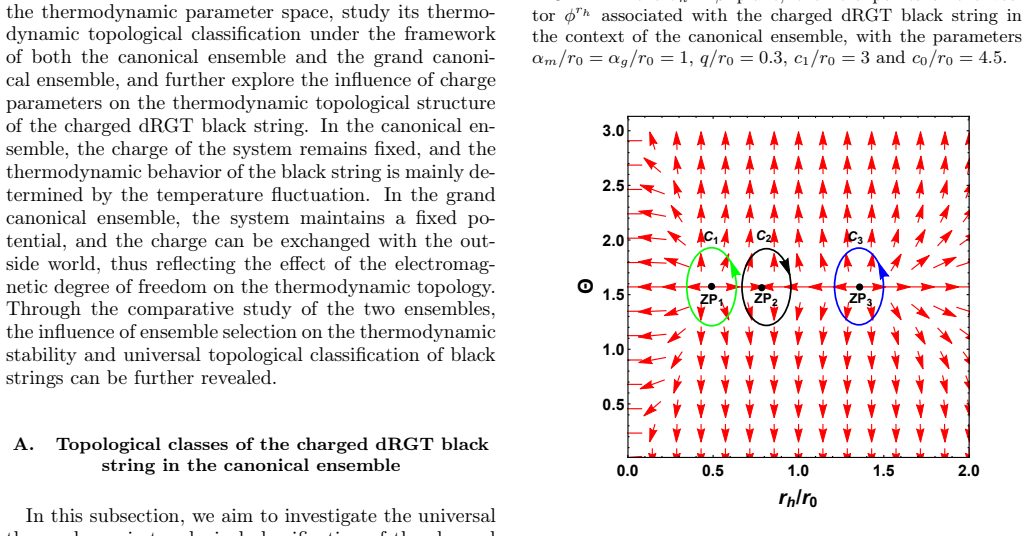
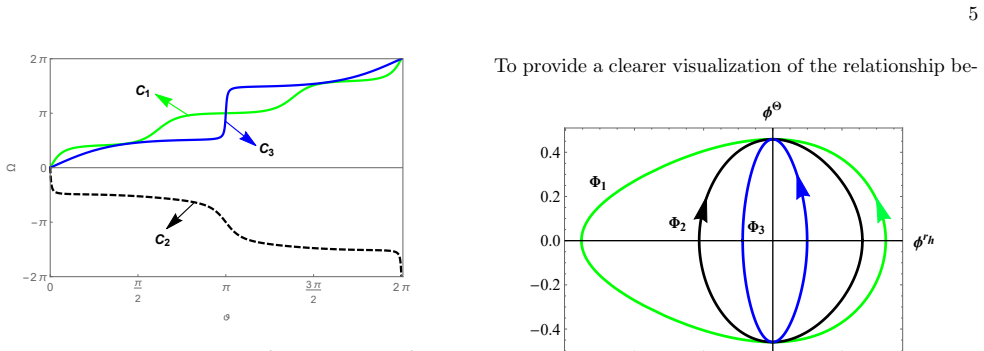
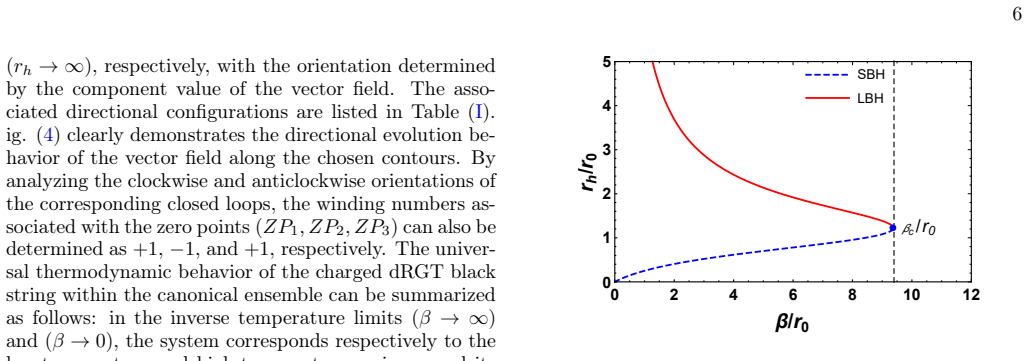
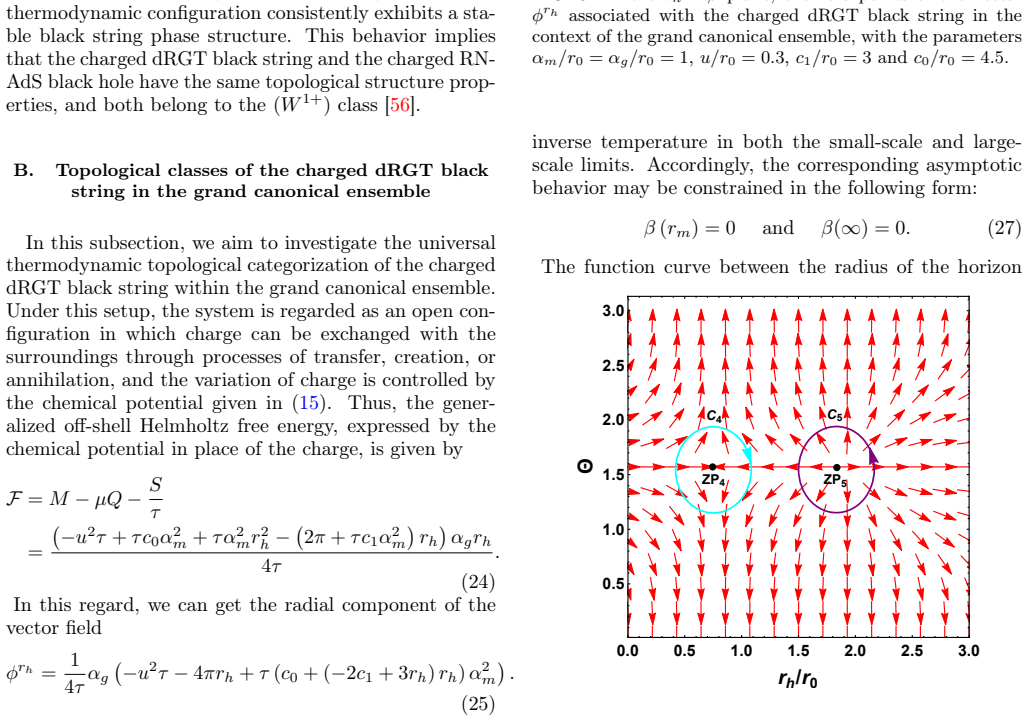
While the outermost large black string branch remains thermodynamically stable in both ensembles, the innermost small black string branch exhibits distinctly different stability properties: it is stable in the canonical ensemble but becomes thermodynamically unstable in the grand canonical ensemble, corresponding to the W^{1+} and W^{0-} topological categories, respectively.
What carries the argument
Thermodynamic topology classification via winding numbers that assign black-string branches to universal stability classes in each ensemble.
If this is right
- Ensemble choice controls which thermodynamic configurations of the charged dRGT black string are allowed.
- The coupling between dRGT massive gravity and the electromagnetic field is required to produce the nontrivial topological classes.
- When gravitational effects are neglected the charge alone does not change the topological classification.
- The large branch remains stable in both ensembles while the small branch does not.
Where Pith is reading between the lines
- The same ensemble dependence may appear in other black-string solutions once their metrics are inserted into the winding-number construction.
- Fixed-charge versus fixed-potential conditions may produce observable differences in evaporation or accretion rates for these objects.
Load-bearing premise
The winding-number definitions of thermodynamic topology correctly identify which black-string branches are stable or unstable in each ensemble.
What would settle it
An explicit computation of heat capacity or free energy for the small branch that shows stability in the grand canonical ensemble would contradict the assigned W^{0-} class.
Figures

read the original abstract
In this study, we explore universal thermodynamic topological classes of charged dRGT black string within both the canonical ensemble and grand canonical ensemble frameworks, and further analyze its asymptotic behavior under limiting parameter regimes. We demonstrate that, while the outermost large black string branch remains thermodynamically stable in both ensembles, the innermost small black string branch exhibits distinctly different stability properties: it is stable in the canonical ensemble but becomes thermodynamically unstable in the grand canonical ensemble, corresponding to the $W^{1+}$ and $W^{0-}$ topological categories,respectively.These findings demonstrate that the selection of thermodynamic ensemble has a significant influence on the thermodynamic configuration of the charged dRGT black string. In the limit where gravitational effects are neglected, the charge contribution does not modify the underlying topological classification. This implies that the coupling between dRGT massive gravity and the electromagnetic sector is essential for the emergence of nontrivial thermodynamic topology.These results contribute to a deeper understanding of the black string thermodynamics and provide a novel theoretical basis for exploring the basic properties of quantum gravity.
Editorial analysis
A structured set of objections, weighed in public.
Referee Report
Summary. The paper claims to classify the thermodynamic topology of charged dRGT black strings, finding that the large branch is thermodynamically stable in both canonical and grand canonical ensembles, while the small branch is stable in the canonical ensemble (W^{1+}) but unstable in the grand canonical ensemble (W^{0-}). It further shows that in the limit neglecting gravitational effects, the charge does not change the topological classification, indicating the importance of the dRGT massive gravity and electromagnetic coupling for nontrivial topology.
Significance. If the results hold, this work extends the thermodynamic topology approach to black strings in dRGT massive gravity, providing a framework for understanding ensemble-dependent stability and the role of modified gravity couplings. It could offer new insights into black hole thermodynamics in alternative gravity theories.
major comments (1)
- [Main text (results on stability mapping)] The equivalence between the topological classes W^{1+} / W^{0-} and the stability properties (based on heat capacity signs) for the small black string branch is central to the claim but lacks an explicit cross-check or derivation showing that the winding number construction reproduces the sign of the relevant thermodynamic response function in each ensemble. This verification is load-bearing for the conclusion that the ensemble choice influences the thermodynamic configuration via topology.
minor comments (1)
- [Abstract] The abstract is dense and could benefit from clearer separation of the main results from the implications.
Simulated Author's Rebuttal
We thank the referee for their careful reading of the manuscript and for highlighting the need for greater explicitness in connecting the topological classification to thermodynamic stability. We address the major comment below.
read point-by-point responses
-
Referee: [Main text (results on stability mapping)] The equivalence between the topological classes W^{1+} / W^{0-} and the stability properties (based on heat capacity signs) for the small black string branch is central to the claim but lacks an explicit cross-check or derivation showing that the winding number construction reproduces the sign of the relevant thermodynamic response function in each ensemble. This verification is load-bearing for the conclusion that the ensemble choice influences the thermodynamic configuration via topology.
Authors: We agree that an explicit derivation linking the winding-number construction to the sign of the heat capacity (or other response functions) in each ensemble would strengthen the presentation. Although the manuscript already computes the winding numbers for both ensembles and states their correspondence to stability, it does not contain a dedicated step-by-step verification that the topological charge directly reproduces the sign of the relevant thermodynamic derivative. In the revised version we will insert a short subsection (or appendix) that performs this cross-check explicitly for the small-branch solutions, showing how the winding number W^{1+} in the canonical ensemble aligns with positive heat capacity and how W^{0-} in the grand-canonical ensemble aligns with negative heat capacity. revision: yes
Circularity Check
No circularity identified; derivation relies on external thermodynamic topology framework
full rationale
The provided abstract states that stability differences map to W^{1+} and W^{0-} categories but contains no equations, parameter fits, or self-citations. No load-bearing step reduces by construction to an input (e.g., no self-definitional mapping of winding numbers to heat-capacity signs, no fitted parameter renamed as prediction). The central claim applies a pre-existing topological method to the dRGT black-string metric; absent explicit reduction in the text, the derivation chain is treated as self-contained against external benchmarks.
Axiom & Free-Parameter Ledger
Reference graph
Works this paper leans on
-
[1]
J. D. Bekenstein, Phys. Rev. D7, 2333 (1973)
1973
-
[2]
J. M. Bardeen, B. Carter and S. W. Hawking, Commun. Math. Phys. 31, 161. (1973)
1973
-
[3]
Hawking, Commun, Math
S.W. Hawking, Commun, Math. Phys.43, 199 (1975)
1975
-
[4]
Hawking and D.N
S.W. Hawking and D.N. Page, Commun, Math. Phys.87 , 577 (1983)
1983
-
[5]
Witten, Adv
E. Witten, Adv. Theor. Math. Phys.2, 505 (1998)
1998
-
[6]
Witten, Adv
E. Witten, Adv. Theor. Math. Phys.2, 253 (1998)
1998
-
[7]
Kastor, S
D. Kastor, S. Ray and J. Traschen, Classical Quantum Gravity 26, 195011 (2009)
2009
-
[8]
Y. Xiao, Y. Tian and Y.-X. Liu, Phys. Rev. Lett.132, 2 (2024)
2024
-
[9]
Wei and Y.-X
S.-W. Wei and Y.-X. Liu, Phys. Rev. D 87, 044014 (2013)
2013
-
[10]
Wei and Y.-X
S.-W. Wei and Y.-X. Liu, Phys. Rev. D 90, 044057 (2014)
2014
-
[11]
H. Xu, W. Xu, and L. Zhao, Eur. Phys. J. C74, 3074 (2014)
2014
-
[12]
Cai, L.-M
R.-G. Cai, L.-M. Cao, L. Li, and R.-Q. Yang, J. High Energy Phys. 1309, 005 (2013)
2013
-
[13]
Altamirano, D
N. Altamirano, D. Kubiznak, and R. B. Mann Phys. Rev. D 88, 101502 (2013)
2013
-
[14]
R. A. Hennigar, W. G. Brenna, and R. B. Mann J. High Energy Phys. 1507, 077 (2015)
2015
-
[15]
R. A. Hennigar, R. B. Mann, and E. Tjoa, Phys. Rev. Lett. 118, 021301 (2017)
2017
-
[16]
D.-C. Zou, R. Yue and M. Zhang, Eur. Phys. J. C77, 256 (2017)
2017
-
[17]
Yazdikarimi, A
H. Yazdikarimi, A. Sheykhi and Z. Dayyani, Phys. Rev. D 99, 124017 (2019)
2019
-
[18]
Sheykhi , M
A. Sheykhi , M. Arab and Z. Dayyani, Phys. Rev. D101, 064019 (2020)
2020
-
[19]
Hendi and K
S.H. Hendi and K. Jafarzade, Phys. Rev. D103, 104011 (2021)
2021
-
[20]
Z.-M. Xu, B. Wu, and W.-L. Yang, Sci. China Phys. Mech. Astron. 66, 240411 (2023)
2023
-
[21]
Zhang, H
M.-Y. Zhang, H. Chen, H. Hassanabadi, Z.-W. Long, and H. Yang, Chin. Phys. C48, 065101 (2024)
2024
-
[22]
R.H. Ali, G. Abbas, and G. Mustafa, Phys. Dark Univ. 44, 101465 (2024)
2024
-
[23]
Ma, H.-F
M.-S. Ma, H.-F. Li, and J.-H. Shi, Sci. China Phys. Mech. Astron. 69, 210411 (2026)
2026
-
[24]
Duan and M.L
Y.S. Duan and M.L. Ge, Sci. Sin.9, 1072 (1979)
1979
-
[25]
Duan, The structure of the topological current, SLAC-PUB- 3301 (1984)
Y.S. Duan, The structure of the topological current, SLAC-PUB- 3301 (1984)
1984
-
[26]
Wei, Y.X
S.W. Wei, Y.X. Liu and R.B. Mann, Phys. Rev. Lett. 129, 191101 (2022)
2022
-
[27]
Wei and Y.-X
S.-W. Wei and Y.-X. Liu, Phys. Rev. D 105, 104003 (2022)
2022
-
[28]
C. Fang, J. Jiang, and M. Zhang, J. High Energy Phys. 01, 102 (2023)
2023
-
[29]
Gogoi and P
N.J. Gogoi and P. Phukon, Phys. Rev. D108, 066016 (2023)
2023
-
[30]
Gogoi and P
N.J. Gogoi and P. Phukon, Phys. Rev. D107, 106009 (2023)
2023
-
[31]
Yerra and C
P.K. Yerra and C. Bhamidipati, Phys. Rev. D 105, 104053 (2022)
2022
-
[32]
Yerra and C
P.K. Yerra and C. Bhamidipati, Phys. Lett. B 835, 137591 (2022)
2022
-
[33]
Yerra, C
P.K. Yerra, C. Bhamidipati, and S. Mukherji, Phys. Rev. D 106, 064059 (2022)
2022
-
[34]
Wu, Phys
D. Wu, Phys. Rev. D107, 024024 (2023)
2023
-
[35]
Wu and S.-Q
D. Wu and S.-Q. Wu, Phys. Rev. D107, 084002 (2023)
2023
-
[36]
Wu, Phys
D. Wu, Phys. Rev. D108, 084041 (2023)
2023
-
[37]
D. Wu, Eur. Phys. J. C83, 365 (2023)
2023
-
[38]
D. Wu, Eur. Phys. J. C83, 589 (2023)
2023
-
[39]
High Energy Phys.06 (2024) 213
D.Wu, S.-Y.Gu, X.-D.Zhu, Q.-Q.Jiang, andS.-Z.Yang, J. High Energy Phys.06 (2024) 213
2024
-
[40]
X.-D. Zhu, D. Wu and D. Wen, Phys. Lett. B856 (2024) 138919
2024
-
[41]
Wei and Y.-X
S.-W. Wei and Y.-X. Liu, Phys. Rev. D 107, 064006 (2023)
2023
-
[42]
Ye and S.-W
X. Ye and S.-W. Wei, J. Cosmol. Astropart. Phys.07 (2023) 049
2023
-
[43]
N.-C. Bai, L. Li and J. Tao, Phys. Rev. D107, 064015 (2023). 10
2023
-
[44]
N.-C. Bai, L. Song, and J. Tao, Eur. Phys. J. C84, 43 (2024)
2024
-
[45]
Zhang, H
M.-Y. Zhang, H. Chen, H. Hassanabadi, Z.-W. Long, and H. Yang, Eur. Phys. J. C83, 773 (2023)
2023
-
[46]
Zhang, H
M.-Y. Zhang, H. Chen, H. Hassanabadi, Z.-W. Long, and H. Yang, Phys. Lett. B856, 138885 (2024)
2024
-
[47]
Hung and Cao H
Tran N. Hung and Cao H. Nam, Eur. Phys. J. C83, 582 (2023)
2023
-
[48]
Zhang,H.-Y
M.-Y. Zhang,H.-Y. Zhou, H. Chen, H. Hassanabadi and Z.-W. Long Eur. Phys. J. C84, 1251 (2024)
2024
-
[49]
H. Chen,D. Wu, M.-Y. Zhang, H. Hassanabadi and Z.-W. Long Phys. Dark Univ.46, 101617 (2024)
2024
-
[50]
Chen, M.-Y
H. Chen, M.-Y. Zhang, H. Hassanabadi, B.C. Lütfö˘glu and Z.-W. Long, Int. J. Geom. Meth. Mod. Phys.23 , 2550249 (2026)
2026
-
[51]
Alipour, M.A.S
M.R. Alipour, M.A.S. Afshar, S.N. Gashti, and J. Sadeghi, Phys. Dark Univ.42, 101361 (2023)
2023
-
[52]
Sadeghi, S.N
J. Sadeghi, S.N. Gashti, M.R. Alipour, and M.A.S. Af- shar, Ann. Phys. (Amsterdam)455, 169391 (2023)
2023
-
[53]
P. Yin, Y. Liu, J. Chen and Y. Wang, Eur. Phys. J. C 85, 661 (2025)
2025
-
[54]
Bhattacharya, K
K. Bhattacharya, K. Bamba, and D. Singleton, Phys. Lett. B 854, 138722 (2024)
2024
-
[55]
Fan, Phys
Z.-Y. Fan, Phys. Rev. D107, 044026 (2023)
2023
-
[56]
Wei, Y.-X
S.-W. Wei, Y.-X. Liu and Robert B. Mann, Phys. Rev. D 110, L081501 (2024)
2024
-
[57]
Chen, X.-D
Y. Chen, X.-D. Zhu and D. Wu, Phys. Lett. B 865, 139482 (2025)
2025
-
[58]
X.-D.Zhu, W.LiuandD.Wu, Phys.Lett.B 860, 139163 (2025)
2025
-
[59]
Rizwan, M
M. Rizwan, M. Jamil and M.Z. A. Moughal, Eur. Phys. J. C85, 359 (2025)
2025
-
[60]
Zhang, H.-Y
M.-Y. Zhang, H.-Y. Zhou, H. Chen, H. Hassanabadi and Z.-W. Long, Eur. Phys. J. C85, 1322 (2025)
2025
-
[61]
H. Chen, D. Wu, M.-Y. Zhang, S. Zare, H. Hassanabadi, B.C. Lütfö˘glu, and Z.-W. Long, Eur. Phys. J. C85, 828 (2025)
2025
-
[62]
D. Wu, W. Liu, S.-Q. Wu and Robert B. Mann, Phys. Rev. D111, L061501 (2025)
2025
-
[63]
Ai and D
W. Ai and D. Wu, Phys. Rev. D112, 124024 (2025)
2025
-
[64]
Chen, M.-Y
H. Chen, M.-Y. Zhang, H. Hassanabadi, Q. Huang and Z.-W. Long, Eur. Phys. J. C85, 1386 (2025)
2025
-
[65]
Tannukij, P
L. Tannukij, P. Wongjun and Suchant G. Ghosh, Eur. Phys. J. C77, 846 (2017)
2017
-
[66]
Boulware, and S
D.G. Boulware, and S. Deser, Phys. Rev. D 6, 3368 (1972)
1972
-
[67]
E.A.Bergshoe, O.Hohm, andP.K.Townsend, Phys.Rev. Lett. 102, 201301 2009)
2009
-
[68]
de Rham,and G
C. de Rham,and G. Gabadadze, Phys. Rev. D82, 044020 (2010)
2010
-
[69]
de Rham, G
C. de Rham, G. Gabadadze, and A. J. Tolley, Phys. Rev. Lett. 106, 231101 (2011)
2011
-
[70]
Lemos, Class
J.P.S. Lemos, Class. Quant. Grav.12, 1081 (1995)
1995
discussion (0)
Sign in with ORCID, Apple, or X to comment. Anyone can read and Pith papers without signing in.