REVIEW 1 major objections 2 minor 24 references
Reasoning that Travels: Dissecting How Chain-of-Thought Transfers Across Models
T0 review · 1 major / 2 minor · reviewed 2026-06-29 · grok-4.3
Pith's one-line read Cross-model chain-of-thought transfer works through answer extraction, reasoning scaffolding, or receiver competence depending on the task.
desk verdict Prefix trajectories show CoT transfer splits into benchmark-specific mechanisms (answer leakage on AIME, competence on MMLU-Pro, partial structure on ZebraLogic), plus an agreement early-stop signal, but artifact controls remain the open question. read the letter →
The pith
A machine-rendered reading of the paper's core claim, the machinery that carries it, and where it could break.
The reading
What carries the argument
The provider-receiver framework that supplies increasingly long CoT prefixes to a receiver under force-answer versus free-generation conditions.
What would settle it
Replacing the actual words in the prefixes with random but length-matched text and finding that the same performance patterns across modes and benchmarks remain unchanged would show the differences are not caused by reasoning content.
Extended reading notes
Core claim
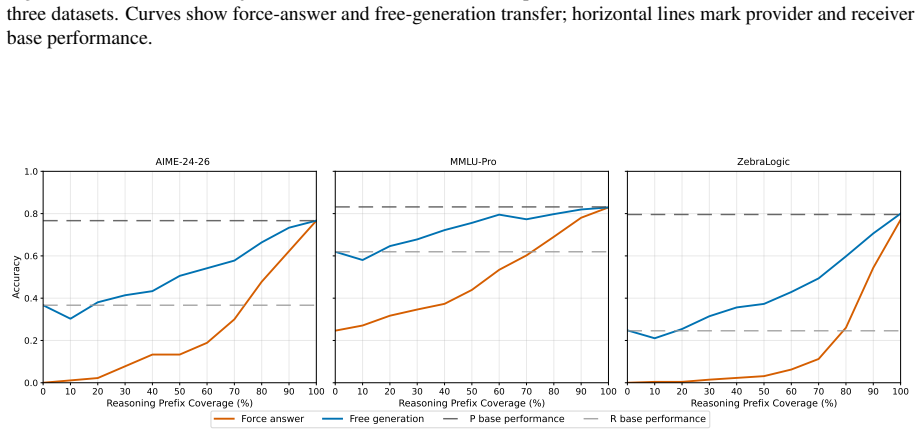
In the provider-receiver setup, full traces transfer successfully, yet prefix analysis shows distinct mechanisms: force-answer transfer on AIME is driven mainly by explicit answer availability, on MMLU-Pro by receiver competence, and on ZebraLogic by partial structured-answer information. In free-generation mode partial prefixes improve performance by guiding continued reasoning, and answer agreement among receivers supplies a signal for stopping provider reasoning early. Overall, cross-model CoT transfer is not a single phenomenon.
Load-bearing premise
Performance differences between force-answer and free-generation modes, and across benchmarks, are driven by the semantic content of the CoT prefixes rather than by model-specific generation artifacts or benchmark quirks.
Editorial extensions
If this is right
- Full traces enable successful transfer on the tested benchmarks.
- Partial prefixes can scaffold continued reasoning when the receiver is allowed to generate further steps.
- Receiver agreement provides a usable signal for cutting provider reasoning short without losing transfer benefit.
- Different tasks rely on different parts of the trace, so the same prefix length does not help equally everywhere.
Reading between the lines
- For tasks where answer extraction dominates, very short prefixes that contain only the final answer might achieve most of the gain.
- The same framework could be used to test transfer of other explicit artifacts such as code comments or proof steps.
- If receiver competence is the main driver on some benchmarks, fine-tuning the receiver on the task might reduce the value of any transferred trace.
Signed reviews
Editorial analysis
A structured set of objections, weighed in public.
Referee Report
Summary. The manuscript introduces a provider-receiver experimental framework to dissect cross-model chain-of-thought (CoT) transfer. Providers generate reasoning traces on benchmarks including AIME, MMLU-Pro, and ZebraLogic; receivers are given progressively longer prefixes under two modes (force-answer, where the receiver must answer directly, versus free-generation, where it may continue reasoning). The central claim is that successful transfer is not monolithic but reflects distinct mechanisms: explicit answer extraction (AIME force-answer), receiver competence (MMLU-Pro), partial structured information (ZebraLogic), and scaffolding (free-generation across benchmarks). Receiver agreement is proposed as a gold-free signal for early stopping of provider reasoning.
Significance. If the mechanistic distinctions survive controls for confounds, the work would meaningfully advance the field by replacing binary views of CoT transfer with a more granular account. The prefix-length curves, mode comparisons, and multi-benchmark design provide a reusable template for probing transfer; the agreement-based stopping rule is a concrete, immediately usable contribution. The absence of parameter fitting or invented formalisms keeps the claims tightly tied to observable behavior.
major comments (1)
- [Experimental setup / methods (§3–4)] Experimental setup / methods (abstract and §3–4): The claim that performance trajectories reveal distinct semantic mechanisms (answer extraction vs. scaffolding vs. competence) is load-bearing and rests on the assumption that differences arise from CoT content rather than generation artifacts (answer formatting, token distributions, or benchmark idiosyncrasies). The provided abstract gives no indication of controls that isolate these factors (e.g., shuffled prefixes, format-normalized baselines, or token-distribution matching), leaving the central interpretation vulnerable to the alternative explanation raised in the stress-test note.
minor comments (2)
- [Abstract] The abstract introduces 'force-answer' and 'free-generation' without a one-sentence operational definition; adding this would improve accessibility for readers outside the immediate sub-area.
- [Results (§4)] Figure captions or §4 should explicitly state the number of providers/receivers, model sizes, and statistical tests used for the reported accuracy differences; these details are referenced in the reader's soundness assessment as currently underspecified.
Simulated Author's Rebuttal
We thank the referee for the detailed and constructive review. Below we address the major comment directly and describe the revisions we will undertake.
read point-by-point responses
-
Referee: [Experimental setup / methods (§3–4)] Experimental setup / methods (abstract and §3–4): The claim that performance trajectories reveal distinct semantic mechanisms (answer extraction vs. scaffolding vs. competence) is load-bearing and rests on the assumption that differences arise from CoT content rather than generation artifacts (answer formatting, token distributions, or benchmark idiosyncrasies). The provided abstract gives no indication of controls that isolate these factors (e.g., shuffled prefixes, format-normalized baselines, or token-distribution matching), leaving the central interpretation vulnerable to the alternative explanation raised in the stress-test note.
Authors: We agree that the mechanistic interpretation would be strengthened by explicit controls for generation artifacts. The current design already provides partial protection against uniform artifacts because the identical provider generation process produces qualitatively different prefix-length trajectories across benchmarks (explicit-answer leakage on AIME, competence-driven gains on MMLU-Pro, structured-information effects on ZebraLogic). Nevertheless, benchmark-specific idiosyncrasies or formatting effects remain possible confounds. In the revision we will add (i) shuffled-prefix baselines that preserve length and token statistics but destroy semantic order, (ii) format-normalized controls that strip or standardize answer formatting, and (iii) token-distribution matching where feasible. These additions will be reported in an expanded §4 and will directly test whether performance gains depend on CoT content rather than surface features. The stress-test note already flags the artifact concern; the new experiments will quantify its practical impact. revision: yes
Circularity Check
No significant circularity; purely empirical comparisons
full rationale
The paper conducts an empirical investigation via a provider-receiver experimental setup, measuring receiver accuracy under varying prefix lengths, force-answer vs. free-generation modes, and across benchmarks (AIME, MMLU-Pro, ZebraLogic). No equations, parameter fitting, derivations, or self-citations appear as load-bearing elements in the provided text. All claims derive from direct experimental contrasts rather than any reduction of outputs to inputs by construction. This is the expected outcome for a non-derivational empirical study.
Assumptions & free parameters
assumptions (1)
- domain assumption Standard reasoning benchmarks (AIME, MMLU-Pro, ZebraLogic) validly isolate the contribution of reasoning traces
Cite this review
Pith. "Pith review of Reasoning that Travels: Dissecting How Chain-of-Thought Transfers Across Models." pith.science (2026). https://pith.science/paper/Y7HZHGO4
@misc{pith2026260528913,
  author       = {Pith},
  title        = {Pith review of: Reasoning that Travels: Dissecting How Chain-of-Thought Transfers Across Models},
  year         = {2026},
  howpublished = {\url{https://pith.science/paper/Y7HZHGO4}},
  note         = {Machine review of arXiv:2605.28913}
}
read the original abstract
Large reasoning models (LRMs) often generate extensive chain-of-thought (CoT) traces before producing a final answer. As explicit textual artifacts, these traces can be passed to other models to solve the same task, enabling cross-model reasoning transfer. Yet successful transfer alone does not reveal how the provided CoT contributes to another model's answer. We study this question with a controlled provider--receiver framework, where a provider generates a reasoning trace and a receiver solves the same problem from increasingly longer trace prefixes. We compare force-answer, where the receiver answers directly from the prefix, with free-generation, where it may continue reasoning before answering. Across models and benchmarks, full traces often transfer successfully, but prefix trajectories reveal distinct mechanisms. In force-answer mode, AIME transfer is largely driven by explicit answer availability. MMLU-Pro instead reflects a larger role for receiver competence, while ZebraLogic depends on partial structured-answer information rather than complete-answer leakage alone. In free-generation mode, partial CoTs improve performance across benchmarks, indicating that prefixes can guide continued reasoning. Finally, answer agreement among receivers provides a gold-free signal for stopping provider reasoning early. Overall, cross-model CoT transfer is not a single phenomenon: it can reflect answer extraction, reasoning scaffolding, or receiver-dependent competence.
Figures
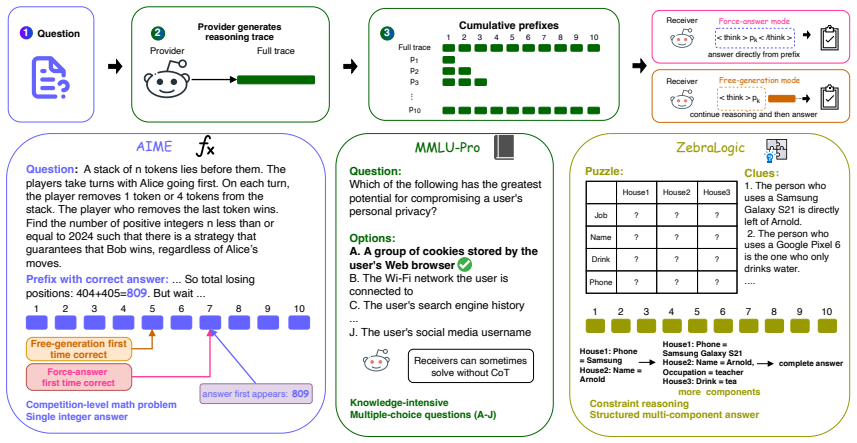


Figures from the paper (13 more)



Reference graph
Works this paper leans on
-
[1]
TrigReason: Trigger-Based Collaboration between Small and Large Reasoning Models
Trigreason: Trigger-based collaboration be- tween small and large reasoning models.CoRR, abs/2604.14847. A Additional Implementation Details A.1 Prompts and Answer Elicitation Base prompts.We use dataset-specific base prompts before applying the model-specific chat template. These prompts are used to generate the provider reasoning traces. For AIME-24–26,...
work page Pith review arXiv 2026
-
[3]
Do not solve the problem yourself
-
[4]
Do not give credit for hints, partial narrowing, or suggestive evidence
-
[5]
Count it as positive if the complete 13 correct answer is explicitly stated in one continuous answer statement
-
[6]
A continuous answer statement may cross an adjacent segment boundary if the segmentation merely cut one uninterrupted sentence or answer span into pieces
-
[7]
If a continuous answer statement crosses from segment N into segment N+1, count the leakage at segment N+1, because that is the segment where the full answer first becomes available
-
[8]
Do not mark segment N positive if it only contains an incomplete prefix of the answer and the full answer is completed only in segment N+1
-
[9]
If one segment mentions part of the answer, then there is other reasoning, and only later another segment adds the rest, that does not count
Do not combine information across separated reasoning steps. If one segment mentions part of the answer, then there is other reasoning, and only later another segment adds the rest, that does not count
Show all 24 references
-
[10]
earliest_explicit_segment
If the answer is never made explicit in one continuous answer statement, return null. Correct final answer: {GOLD_ANSWER} Reasoning segments: [Segment 1] {SEGMENT_1} [Segment 2] {SEGMENT_2} ... [Segment 10] {SEGMENT_10} Return JSON only with this schema: { "earliest_explicit_s...
-
[11]
Judge only what is explicitly stated in the reasoning text
-
[12]
Do not solve the puzzle yourself
-
[13]
Count a cell only if the full house-attribute-value assignment is explicitly stated
-
[14]
Do not infer cells from hints, eliminations, or other stated cells
-
[15]
If one cell’s full statement is split across two adjacent segments, count it in the later segment where it becomes complete
-
[16]
Return exactly 10 items: one for each segment 1 through 10
-
[17]
If a segment has no newly explicit correct cells, return an empty list for that segment
-
[18]
{CELL_ID_1}
Do not count the same cell more than once. Gold answer cells: - "{CELL_ID_1}": {HOUSE_1} | {ATTRIBUTE_1} = {VALUE_1} - "{CELL_ID_2}": {HOUSE_2} | {ATTRIBUTE_2} = {VALUE_2} ... Reasoning segments: [Segment 1] {SEGMENT_1} [Segment 2] {SEGMENT_2} ... [Segment 10] {SEGMENT_10} Ret...
2026
-
[19]
Use the question and the [Text snippet]
-
[20]
Judge the snippet’s role for the question, not in isolation
-
[21]
Do not use any material other than the question and the text snippet
-
[22]
Do not restate the problem
-
[23]
Do not solve the problem
-
[24]
Explain the judgment clearly
-
[25]
snippet_role_type
Return JSON only. [Question] {candidate.question} [Text snippet] {candidate.provider_prefix} Return JSON with this schema: { "snippet_role_type": "A|B|C", "snippet_role_reason": "explanation" } Label definitions: A. approach-level information The snippet mainly establishes how...
Reviewed June 29, 2026 · model on record in the stance chip above.
Discussion (0). Continue with ORCID to comment.