Dynamical Entanglement Phase Transitions in Holographic CFTs
Pith reviewed 2026-06-29 10:37 UTC · model grok-4.3
The pith
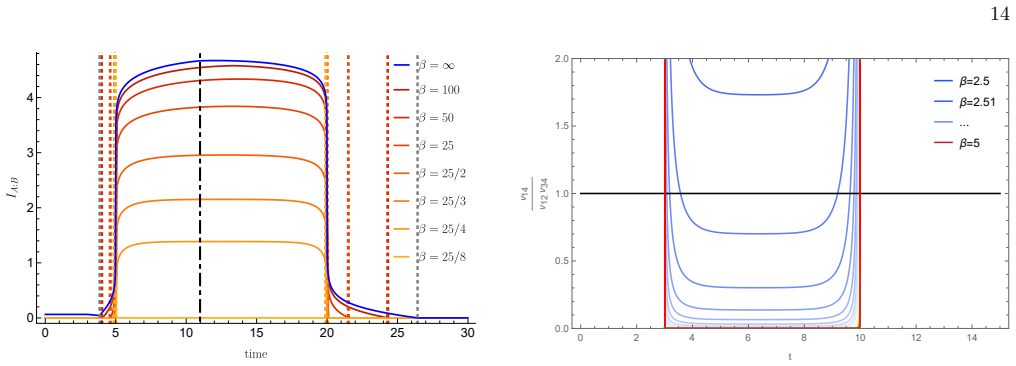
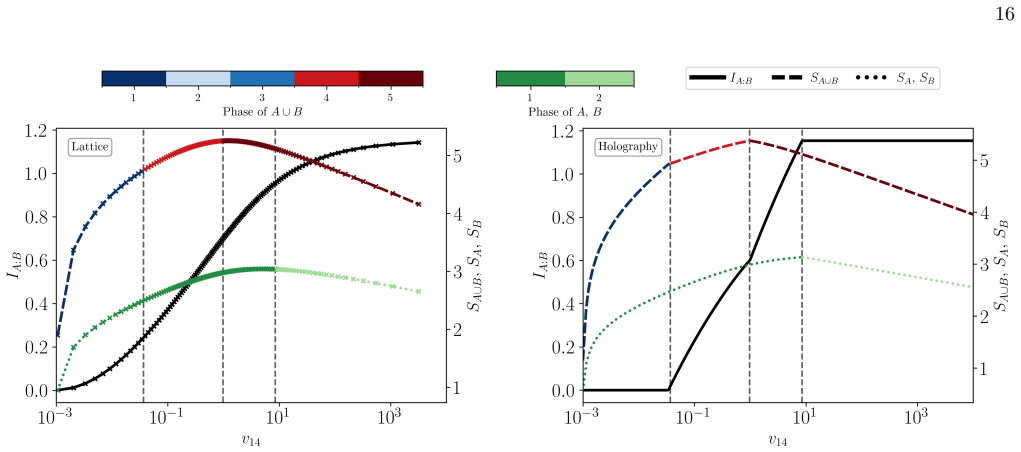
Holographic CFTs after a local quench exhibit six phases of mutual information governed by conformal block dominance and D4 symmetry breaking.
A machine-rendered reading of the paper's core claim, the machinery that carries it, and where it could break.
Core claim
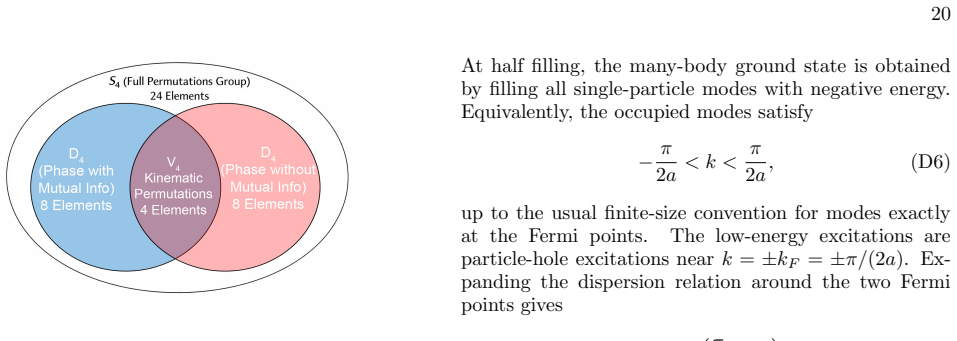
In the large-central-charge limit, the time evolution of mutual information organizes into six distinct phases, each controlled by the dominance of a different conformal block or holographic geodesic configuration. The onset of mutual information is governed by the breaking of a dynamical D4 symmetry acting on the interval endpoints to a Z2 x Z2 subgroup. This provides a concrete realization of dynamical quantum phase transitions in entanglement measures.
What carries the argument
Dominance of different conformal blocks (or equivalently holographic geodesic configurations) in the mutual information, together with the action of a dynamical D4 symmetry on interval endpoints.
If this is right
- Mutual information displays non-analytic features at critical times that are not captured by light-cone propagation from the quench points.
- The dynamics fall into exactly six phases distinguished by which conformal block dominates.
- Presence or absence of mutual information is controlled by whether the dynamical D4 symmetry has broken to its Z2 x Z2 subgroup.
- Finite-c corrections smooth transitions between phases that have mutual information but leave the onset transitions non-analytic.
Where Pith is reading between the lines
- The symmetry-breaking criterion for the onset of mutual information may apply to other entanglement measures such as negativity or reflected entropy.
- The six-phase structure could be checked in critical spin-chain numerics by tracking which geodesic configuration would dominate if c were taken larger.
- The same endpoint symmetry might organize entanglement dynamics after global quenches or in higher-dimensional holographic setups.
Load-bearing premise
The large central charge limit produces sharp non-analyticities in mutual information that map directly to distinct conformal block or geodesic dominances without being smoothed or cancelled at finite c.
What would settle it
Explicit calculation of the time-dependent mutual information for a large but finite central charge showing whether the predicted non-analytic points at the phase boundaries remain sharp or get rounded out.
Figures
read the original abstract
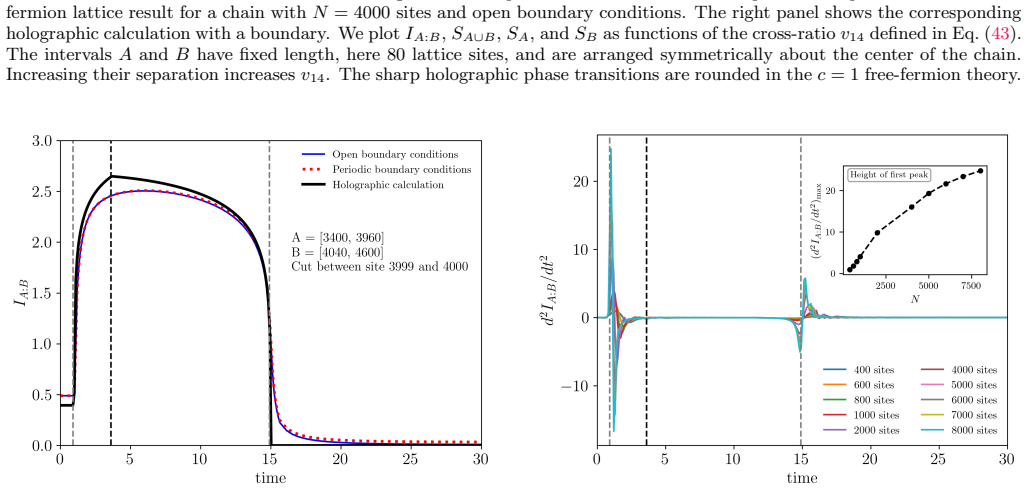
We study the time evolution of the entanglement structure of holographic conformal field theories after a local quench. Using the mutual information between two spatial intervals as a probe, we find that $1+1$-dimensional conformal field theories exhibit a rich pattern of dynamical phase transitions. In the large-central-charge limit, mutual information develops sharp non-analyticities at critical times, providing a concrete entanglement-based realization of dynamical quantum phase transitions. We find that the dynamics organize into six distinct phases of mutual information, each controlled by the dominance of a different conformal block, or equivalently, a different holographic geodesic configuration. This phase structure goes beyond the standard quasi-particle picture, explaining non-analytic features that are not captured by simple light-cone propagation from the quench points. We further identify a dynamical $D_4$ symmetry acting on the interval endpoints that controls the presence or absence of mutual information. The onset of mutual information is governed by the breaking of this symmetry to a $\mathbb{Z}_2 \times \mathbb{Z}_2$ subgroup, suggesting a symmetry-based characterization of non-equilibrium entanglement dynamics analogous to the role of symmetry in equilibrium critical phenomena. Finally, numerical studies of critical spin chains indicate that finite-$c$ effects smooth out the sharp large-$c$ transitions between different mutual-information phases, while the transitions between phases with and without mutual information appear to remain non-analytic. These results offer a unifying perspective on real-time entanglement dynamics and their critical features in conformal many-body systems.
Editorial analysis
A structured set of objections, weighed in public.
Referee Report
Summary. The manuscript studies the time evolution of mutual information between two intervals in 1+1d holographic CFTs after a local quench. In the large-central-charge limit it reports that mutual information develops sharp non-analyticities at critical times and organizes into six distinct phases, each controlled by the dominance of a different conformal block (equivalently, a different holographic geodesic configuration). It identifies a dynamical D4 symmetry on the interval endpoints whose breaking to a Z2×Z2 subgroup governs the onset of mutual information, and presents numerical results on critical spin chains indicating that finite-c effects smooth some but not all of the large-c transitions.
Significance. If substantiated, the results would constitute a concrete entanglement-based realization of dynamical quantum phase transitions with a symmetry characterization that extends beyond the quasi-particle picture. The explicit identification of six phases tied to geodesic dominance and the D4 symmetry breaking provide a new organizing principle for real-time entanglement dynamics. The numerical checks at finite c are a constructive element that directly addresses the robustness of the large-c claims.
major comments (2)
- [Abstract] Abstract: the central claim of six distinct phases with sharp non-analyticities requires that mutual information equals the length of a single dominant geodesic (or dominant conformal block) with all other contributions exponentially suppressed throughout each phase. The abstract asserts this structure but does not indicate an explicit verification that sub-leading saddles remain negligible near the reported critical times; without such a bound the non-analyticities could be rounded even at infinite c.
- [Abstract] Abstract: the asserted mapping from mutual information to specific holographic geodesic configurations after the local quench is invoked without a derivation or check of the geodesic-to-mutual-information correspondence in the time-dependent four-point function; this mapping is load-bearing for both the phase count and the D4 symmetry analysis.
minor comments (1)
- [Abstract] The abstract refers to 'numerical studies of critical spin chains' without specifying the lattice size, the precise quench protocol, or the observable used to extract mutual information; adding these details would improve reproducibility.
Simulated Author's Rebuttal
We thank the referee for their thoughtful report and constructive suggestions. We respond to each major comment below.
read point-by-point responses
-
Referee: [Abstract] Abstract: the central claim of six distinct phases with sharp non-analyticities requires that mutual information equals the length of a single dominant geodesic (or dominant conformal block) with all other contributions exponentially suppressed throughout each phase. The abstract asserts this structure but does not indicate an explicit verification that sub-leading saddles remain negligible near the reported critical times; without such a bound the non-analyticities could be rounded even at infinite c.
Authors: In the large-central-charge limit the mutual information is exactly equal to the length of the shortest geodesic (dominant block), with all other saddles contributing terms that are exponentially suppressed in c. The reported critical times are the loci at which two leading geodesic lengths cross; at those points every other configuration remains strictly longer, so its contribution vanishes as c → ∞. Consequently the non-analyticities remain sharp in the strict large-c limit. We will revise the abstract to state explicitly that the phase structure follows from this exponential suppression of sub-dominant saddles. revision: yes
-
Referee: [Abstract] Abstract: the asserted mapping from mutual information to specific holographic geodesic configurations after the local quench is invoked without a derivation or check of the geodesic-to-mutual-information correspondence in the time-dependent four-point function; this mapping is load-bearing for both the phase count and the D4 symmetry analysis.
Authors: The correspondence between mutual information and geodesic lengths follows from the standard replica-trick evaluation of the twist-operator four-point function in the large-c limit, where the dominant saddle determines the correlator. For the local-quench geometry the relevant time-dependent geodesics are identified by minimizing the lengths in the appropriate bulk spacetime. While this is the established holographic prescription, we agree that an explicit verification for the post-quench four-point function would make the mapping more transparent. We will add a short derivation (or reference to the relevant prior results) in the revised manuscript. revision: yes
Circularity Check
No significant circularity; derivation relies on standard holographic duality without self-referential reduction
full rationale
The paper's central claims about mutual information phases in the large-c limit, conformal block dominance, and geodesic configurations follow from established holographic duality (Ryu-Takayanagi formula and OPE channel decomposition) applied to the quench setup. No equations or steps reduce by construction to fitted inputs, self-citations, or ansatze imported from the authors' prior work. The D4 symmetry analysis and finite-c numerics are presented as independent checks rather than tautological. The derivation chain is self-contained against external benchmarks of AdS/CFT and CFT techniques.
Axiom & Free-Parameter Ledger
axioms (1)
- domain assumption AdS/CFT correspondence maps mutual information between boundary intervals to bulk geodesic configurations in the large-c limit
Reference graph
Works this paper leans on
-
[1]
P. C. Hohenberg and B. I. Halperin, Theory of dynamic critical phenomena, Rev. Mod. Phys.49, 435 (1977)
1977
-
[2]
J. L. Cardy, Conformal invariance and surface critical behavior, Nuclear Physics B240, 514 (1984)
1984
-
[3]
Sachdev,Quantum Phase Transitions(Cambridge University Press, 2011)
S. Sachdev,Quantum Phase Transitions(Cambridge University Press, 2011)
2011
-
[4]
M. Heyl, A. Polkovnikov, and S. Kehrein, Dynami- cal Quantum Phase Transitions in the Transverse-Field Ising Model, Phys. Rev. Lett.110, 135704 (2013), arXiv:1206.2505 [cond-mat.stat-mech]
work page internal anchor Pith review Pith/arXiv arXiv 2013
-
[5]
Sciolla and G
B. Sciolla and G. Biroli, Quantum quenches, dynami- cal transitions, and off-equilibrium quantum criticality, Phys. Rev. B88, 201110(R) (2013)
2013
-
[6]
Dynamical quantum phase transitions in systems with broken-symmetry phases
M. Heyl, Dynamical Quantum Phase Transitions in Sys- tems with Broken-Symmetry Phases, Phys. Rev. Lett. 113, 205701 (2014), arXiv:1403.4570 [cond-mat.stat- mech]
work page internal anchor Pith review Pith/arXiv arXiv 2014
-
[7]
Karrasch and D
C. Karrasch and D. Schuricht, Dynamical phase tran- sitions after quenches in nonintegrable models, Phys. Rev. B87, 195104 (2013)
2013
-
[8]
Vajna and B
S. Vajna and B. D´ ora, Disentangling dynamical phase transitions from equilibrium phase transitions, Phys. Rev. B89, 161105 (2014)
2014
-
[9]
B. Pozsgay, The dynamical free energy and the loschmidt echo for a class of quantum quenches in the heisenberg spin chain, Journal of Statistical Mechanics: Theory and Experiment2013, P10028 (2013)
2013
-
[10]
Andraschko and J
F. Andraschko and J. Sirker, Dynamical quantum phase transitions and the loschmidt echo: A transfer matrix approach, Phys. Rev. B89, 125120 (2014)
2014
-
[11]
J. C. Halimeh, M. Van Damme, V. Zauner-Stauber, and L. Vanderstraeten, Quasiparticle origin of dynamical quantum phase transitions, Phys. Rev. Res.2, 033111 (2020)
2020
-
[12]
J. C. Halimeh, M. Van Damme, L. Guo, J. Lang, and P. Hauke, Dynamical phase transitions in quantum spin models with antiferromagnetic long-range interactions, Phys. Rev. B104, 115133 (2021)
2021
- [13]
-
[14]
ˇZunkoviˇ c, A
B. ˇZunkoviˇ c, A. Silva, and M. Fabrizio, Dynamical phase transitions and loschmidt echo in the infinite- range xy model, Philosophical Transactions of the Royal Society A: Mathematical, Physical and Engineering Sci- ences374, 20150160 (2016)
2016
-
[15]
Homrighausen, N
I. Homrighausen, N. O. Abeling, V. Zauner-Stauber, and J. C. Halimeh, Anomalous dynamical phase in quantum spin chains with long-range interactions, Phys. Rev. B96, 104436 (2017)
2017
-
[16]
J. C. Halimeh and V. Zauner-Stauber, Dynamical phase diagram of quantum spin chains with long-range inter- actions, Phys. Rev. B96, 134427 (2017)
2017
-
[17]
Zauner-Stauber and J
V. Zauner-Stauber and J. C. Halimeh, Probing the anomalous dynamical phase in long-range quantum spin chains through fisher-zero lines, Phys. Rev. E96, 062118 (2017)
2017
-
[18]
Defenu, T
N. Defenu, T. Enss, and J. C. Halimeh, Dynamical crit- icality and domain-wall coupling in long-range hamilto- nians, Phys. Rev. B100, 014434 (2019)
2019
-
[19]
Uhrich, N
P. Uhrich, N. Defenu, R. Jafari, and J. C. Halimeh, Out-of-equilibrium phase diagram of long-range super- conductors, Phys. Rev. B101, 245148 (2020)
2020
-
[20]
A. L. Corps and A. Rela˜ no, Dynamical and excited-state quantum phase transitions in collective systems, Phys. Rev. B106, 024311 (2022)
2022
-
[21]
A. L. Corps and A. Rela˜ no, Theory of dynamical phase transitions in quantum systems with symmetry- breaking eigenstates, Phys. Rev. Lett.130, 100402 (2023)
2023
-
[22]
A. L. Corps, P. Str´ ansk´ y, and P. Cejnar, Mechanism of dynamical phase transitions: The complex-time survival amplitude, Phys. Rev. B107, 094307 (2023)
2023
-
[23]
Mitra, T
A. Mitra, T. Albash, P. D. Blocher, J. Takahashi, A. Miyake, G. Biedermann, and I. H. Deutsch, Macro- properties vs. microstates in the classical simulation of critical phenomena in quench dynamics of 1d ising mod- els, New Journal of Physics27, 013026 (2025)
2025
-
[24]
Schmitt and S
M. Schmitt and S. Kehrein, Dynamical quantum phase transitions in the kitaev honeycomb model, Phys. Rev. B92, 075114 (2015)
2015
-
[25]
Bhattacharya and A
U. Bhattacharya and A. Dutta, Emergent topology and dynamical quantum phase transitions in two- dimensional closed quantum systems, Phys. Rev. B96, 014302 (2017)
2017
-
[26]
Srivastav, U
V. Srivastav, U. Bhattacharya, and A. Dutta, Dynam- ical quantum phase transitions in extended toric-code models, Phys. Rev. B100, 144203 (2019)
2019
-
[27]
De Nicola, B
S. De Nicola, B. Doyon, and M. J. Bhaseen, Stochas- tic approach to non-equilibrium quantum spin systems, Journal of Physics A: Mathematical and Theoretical52, 05LT02 (2019)
2019
-
[28]
Hashizume, J
T. Hashizume, J. C. Halimeh, and I. P. McCulloch, Hy- brid infinite time-evolving block decimation algorithm for long-range multidimensional quantum many-body systems, Phys. Rev. B102, 035115 (2020)
2020
-
[29]
Hashizume, I
T. Hashizume, I. P. McCulloch, and J. C. Halimeh, Dynamical phase transitions in the two-dimensional transverse-field ising model, Phys. Rev. Res.4, 013250 (2022)
2022
-
[30]
Vajna and B
S. Vajna and B. D´ ora, Topological classification of dy- namical phase transitions, Phys. Rev. B91, 155127 (2015)
2015
-
[31]
Huang and A
Z. Huang and A. V. Balatsky, Dynamical quantum phase transitions: Role of topological nodes in wave function overlaps, Phys. Rev. Lett.117, 086802 (2016)
2016
-
[32]
Hagym´ asi, C
I. Hagym´ asi, C. Hubig, O. Legeza, and U. Schollw¨ ock, Dynamical topological quantum phase transitions in nonintegrable models, Phys. Rev. Lett.122, 250601 (2019)
2019
-
[33]
Porta, F
S. Porta, F. Cavaliere, M. Sassetti, and N. Traverso Ziani, Topological classification of dy- namical quantum phase transitions in the xy chain, Scientific Reports10, 12766 (2020)
2020
-
[34]
Okugawa, H
R. Okugawa, H. Oshiyama, and M. Ohzeki, Mirror- symmetry-protected dynamical quantum phase transi- tions in topological crystalline insulators, Phys. Rev. Res.3, 043064 (2021)
2021
-
[35]
K. Cao, T. Zhang, X.-P. Jiang, and J. Wang, Exploring dynamical quantum phase transitions from pure states to mixed states through extended su-schrieffer-heeger 23 models, Phys. Rev. A112, 10.1103/5289-8kz5 (2025)
-
[36]
N. O. Abeling and S. Kehrein, Quantum quench dy- namics in the transverse field ising model at nonzero temperatures, Phys. Rev. B93, 104302 (2016)
2016
-
[37]
Bhattacharya, S
U. Bhattacharya, S. Bandyopadhyay, and A. Dutta, Mixed state dynamical quantum phase transitions, Phys. Rev. B96, 180303 (2017)
2017
-
[38]
J. Lang, B. Frank, and J. C. Halimeh, Concurrence of dynamical phase transitions at finite temperature in the fully connected transverse-field ising model, Phys. Rev. B97, 174401 (2018)
2018
-
[39]
J. Lang, B. Frank, and J. C. Halimeh, Dynamical quan- tum phase transitions: A geometric picture, Phys. Rev. Lett.121, 130603 (2018)
2018
-
[40]
B. Mera, C. Vlachou, N. Paunkovi´ c, V. R. Vieira, and O. Viyuela, Dynamical phase transitions at finite temperature from fidelity and interferometric loschmidt echo induced metrics, Phys. Rev. B97, 094110 (2018)
2018
-
[41]
A. L. Corps, A. Rela˜ no, and J. C. Halimeh, Unifying finite-temperature dynamical and excited-state quan- tum phase transitions, Phys. Rev. Res.6, 043080 (2024)
2024
-
[42]
Zhou, Q.-h
L. Zhou, Q.-h. Wang, H. Wang, and J. Gong, Dynami- cal quantum phase transitions in non-hermitian lattices, Phys. Rev. A98, 022129 (2018)
2018
-
[43]
K. Wang, X. Qiu, L. Xiao, X. Zhan, Z. Bian, W. Yi, and P. Xue, Simulating dynamic quantum phase transi- tions in photonic quantum walks, Phys. Rev. Lett.122, 020501 (2019)
2019
-
[44]
Zhou and Q
L. Zhou and Q. Du, Non-hermitian topological phases and dynamical quantum phase transitions: a generic connection, New Journal of Physics23, 063041 (2021)
2021
-
[45]
R. Hamazaki, Exceptional dynamical quantum phase transitions in periodically driven systems, Nature Com- munications12, 10.1038/s41467-021-25355-3 (2021)
-
[46]
Mondal and T
D. Mondal and T. Nag, Anomaly in the dynamical quan- tum phase transition in a non-hermitian system with ex- tended gapless phases, Phys. Rev. B106, 054308 (2022)
2022
-
[47]
K. Kawabata, A. Kulkarni, J. Li, T. Numasawa, and S. Ryu, Dynamical quantum phase transitions in sachdev-ye-kitaev lindbladians, Phys. Rev. B108, 10.1103/physrevb.108.075110 (2023)
-
[48]
Mondal and T
D. Mondal and T. Nag, Finite-temperature dynamical quantum phase transition in a non-hermitian system, Phys. Rev. B107, 184311 (2023)
2023
-
[49]
D. Mondal and T. Nag, Persistent anomaly in dynamical quantum phase transition in long-range non-hermitian p-wave kitaev chain, The European Physical Journal B 97, 10.1140/epjb/s10051-024-00701-8 (2024)
-
[50]
Fu and G
Y. Fu and G. Xianlong, Anatomy of non-hermitian dy- namical quantum phase transitions, Phys. Rev. B112, L140302 (2025)
2025
-
[51]
Dynamical Quantum Phase Transitions and Many-Body Backflow in Open Quantum Systems
K. Zhang, C. Shu, and K. Sun, Dynamical quantum phase transitions and many-body backflow in open quantum systems (2025), arXiv:2509.03570 [quant-ph]
work page internal anchor Pith review Pith/arXiv arXiv 2025
-
[52]
Smearing of dynamical quantum phase transitions in dissipative free-fermion systems
G. Parez and V. Alba, Smearing of dynamical quan- tum phase transitions in dissipative free-fermion sys- tems (2026), arXiv:2509.21585 [cond-mat.stat-mech]
work page internal anchor Pith review Pith/arXiv arXiv 2026
-
[53]
S. Mondkar, P. Ghosh, and U. Sen, Dynamical quan- tum phase transitions in boundary time crystals (2026), arXiv:2602.04792 [quant-ph]
-
[54]
H. Gu, Y. Zhao, S. Cheng, Y. Xie, X. Yang, and Y. Chen, Biorthogonal dynamical quantum phase transitions in a non-hermitian kitaev chain (2026), arXiv:2605.15982 [quant-ph]
work page internal anchor Pith review Pith/arXiv arXiv 2026
-
[55]
Kosior and K
A. Kosior and K. Sacha, Dynamical quantum phase transitions in discrete time crystals, Phys. Rev. A97, 053621 (2018)
2018
-
[56]
Kosior, A
A. Kosior, A. Syrwid, and K. Sacha, Dynamical quan- tum phase transitions in systems with broken continu- ous time and space translation symmetries, Phys. Rev. A98, 023612 (2018)
2018
-
[57]
J. C. Halimeh, N. Yegovtsev, and V. Gurarie, Dynam- ical quantum phase transitions in many-body localized systems (2019), arXiv:1903.03109 [cond-mat.stat-mech]
work page internal anchor Pith review Pith/arXiv arXiv 2019
-
[58]
Trapin, J
D. Trapin, J. C. Halimeh, and M. Heyl, Unconventional critical exponents at dynamical quantum phase transi- tions in a random ising chain, Phys. Rev. B104, 115159 (2021)
2021
-
[59]
T. V. Zache, N. Mueller, J. T. Schneider, F. Jendrze- jewski, J. Berges, and P. Hauke, Dynamical topologi- cal transitions in the massive schwinger model with aθ term, Phys. Rev. Lett.122, 050403 (2019)
2019
-
[60]
Huang, D
Y.-P. Huang, D. Banerjee, and M. Heyl, Dynamical quantum phase transitions in u(1) quantum link models, Phys. Rev. Lett.122, 250401 (2019)
2019
-
[61]
S. P. Pedersen and N. T. Zinner, Lattice gauge theory and dynamical quantum phase transitions using noisy intermediate-scale quantum devices, Phys. Rev. B103, 235103 (2021)
2021
-
[62]
R. B. Jensen, S. P. Pedersen, and N. T. Zinner, Dynam- ical quantum phase transitions in a noisy lattice gauge theory, Phys. Rev. B105, 224309 (2022)
2022
-
[63]
J. C. Halimeh, M. V. Damme, T. V. Zache, D. Banerjee, and P. Hauke, Achieving the quantum field theory limit in far-from-equilibrium quantum link models, Quantum 6, 878 (2022)
2022
-
[64]
Van Damme, T
M. Van Damme, T. V. Zache, D. Banerjee, P. Hauke, and J. C. Halimeh, Dynamical quantum phase transi- tions in spin-su(1) quantum link models, Phys. Rev. B 106, 245110 (2022)
2022
-
[65]
Mueller, J
N. Mueller, J. A. Carolan, A. Connelly, Z. Davoudi, E. F. Dumitrescu, and K. Yeter-Aydeniz, Quantum computation of dynamical quantum phase transitions and entanglement tomography in a lattice gauge the- ory, PRX Quantum4, 030323 (2023)
2023
-
[66]
D. Pomarico, L. Cosmai, P. Facchi, C. Lupo, S. Pas- cazio, and F. V. Pepe, Dynamical quantum phase tran- sitions of the schwinger model: Real-time dynamics on ibm quantum, Entropy25, 10.3390/e25040608 (2023)
-
[67]
Van Damme, J.-Y
M. Van Damme, J.-Y. Desaules, Z. Papi´ c, and J. C. Halimeh, Anatomy of dynamical quantum phase tran- sitions, Phys. Rev. Res.5, 033090 (2023)
2023
-
[68]
J. J. Osborne, I. P. McCulloch, and J. C. Halimeh, Probing confinement through dynamical quantum phase transitions: From quantum spin models to lattice gauge theories, Phys. Rev. Res.7, 043076 (2025)
2025
-
[69]
J. J. Osborne, C. Y. Wong, and J. C. Halimeh, Uni- fied resonant-manifold framework for dynamical quan- tum phase transitions (2026), arXiv:2605.22915 [quant- ph]
work page internal anchor Pith review Pith/arXiv arXiv 2026
-
[70]
T. D. Lee and C. N. Yang, Statistical Theory of Equa- tions of State and Phase Transitions. II. Lattice Gas and Ising Model, Physical Review87, 410 (1952)
1952
-
[71]
M. E. Fisher, The nature of critical points, Lect. Theor. Phys. c7, 1 (1965)
1965
-
[72]
Jurcevic, H
P. Jurcevic, H. Shen, P. Hauke, C. Maier, T. Brydges, C. Hempel, B. P. Lanyon, M. Heyl, R. Blatt, and C. F. Roos, Direct observation of dynamical quantum phase 24 transitions in an interacting many-body system, Phys. Rev. Lett.119, 080501 (2017)
2017
-
[73]
Nie, B.-B
X. Nie, B.-B. Wei, X. Chen, Z. Zhang, X. Zhao, C. Qiu, Y. Tian, Y. Ji, T. Xin, D. Lu, and J. Li, Experi- mental observation of equilibrium and dynamical quan- tum phase transitions via out-of-time-ordered correla- tors, Phys. Rev. Lett.124, 250601 (2020)
2020
-
[74]
Fl¨ aschner, D
N. Fl¨ aschner, D. Vogel, M. Tarnowski, B. S. Rem, D.-S. L¨ uhmann, M. Heyl, J. C. Budich, L. Mathey, K. Sen- gstock, and C. Weitenberg, Observation of dynamical vortices after quenches in a system with topology, Na- ture Physics14, 265 (2018)
2018
-
[75]
Kinoshita, T
T. Kinoshita, T. Wenger, and D. S. Weiss, A quantum Newton’s cradle, Nature440, 900 (2006)
2006
-
[76]
Collapse and Revival of the Matter Wave Field of a Bose-Einstein Condensate
M. Greiner, O. Mandel, T. W. H¨ ansch, and I. Bloch, Collapse and revival of the matter wave field of a Bose–Einstein condensate, Nature419, 51 (2002), arXiv:cond-mat/0207196
work page internal anchor Pith review Pith/arXiv arXiv 2002
-
[77]
Relaxation and Pre-thermalization in an Isolated Quantum System
M. Gring, M. Kuhnert, T. Langen, T. Kitagawa, B. Rauer, M. Schreitl, I. Mazets, D. A. Smith, E. Dem- ler, and J. Schmiedmayer, Relaxation and Prethermal- ization in an Isolated Quantum System, Science337, 1318 (2012), arXiv:1112.0013 [cond-mat.quant-gas]
work page internal anchor Pith review Pith/arXiv arXiv 2012
-
[78]
Pasquale Calabrese and John Cardy, Entanglement en- tropy and quantum field theory, Journal of Statisti- cal Mechanics: Theory and Experiment2004, P06002 (2004), arXiv:hep-th/0405152
work page internal anchor Pith review Pith/arXiv arXiv 2004
-
[79]
Entanglement entropy and quantum field theory: a non-technical introduction
P. Calabrese and J. Cardy, Entanglement entropy and quantum field theory: A non-technical introduction (2005), arXiv:quant-ph/0505193
work page internal anchor Pith review Pith/arXiv arXiv 2005
-
[80]
Quantum Quenches in Extended Systems
P. Calabrese and J. Cardy, Quantum quenches in extended systems, Journal of Statistical Mechan- ics: Theory and Experiment2007, P06008 (2007), arXiv:0704.1880 [cond-mat.stat-mech]
work page internal anchor Pith review Pith/arXiv arXiv 2007
discussion (0)
Sign in with ORCID, Apple, or X to comment. Anyone can read and Pith papers without signing in.