Quantum State of a Gravitating Region
Pith reviewed 2026-06-29 10:26 UTC · model grok-4.3
The pith
Any compact manifold with elliptic data prepares a quantum state on its boundary using the gravitational path integral.
A machine-rendered reading of the paper's core claim, the machinery that carries it, and where it could break.
Core claim
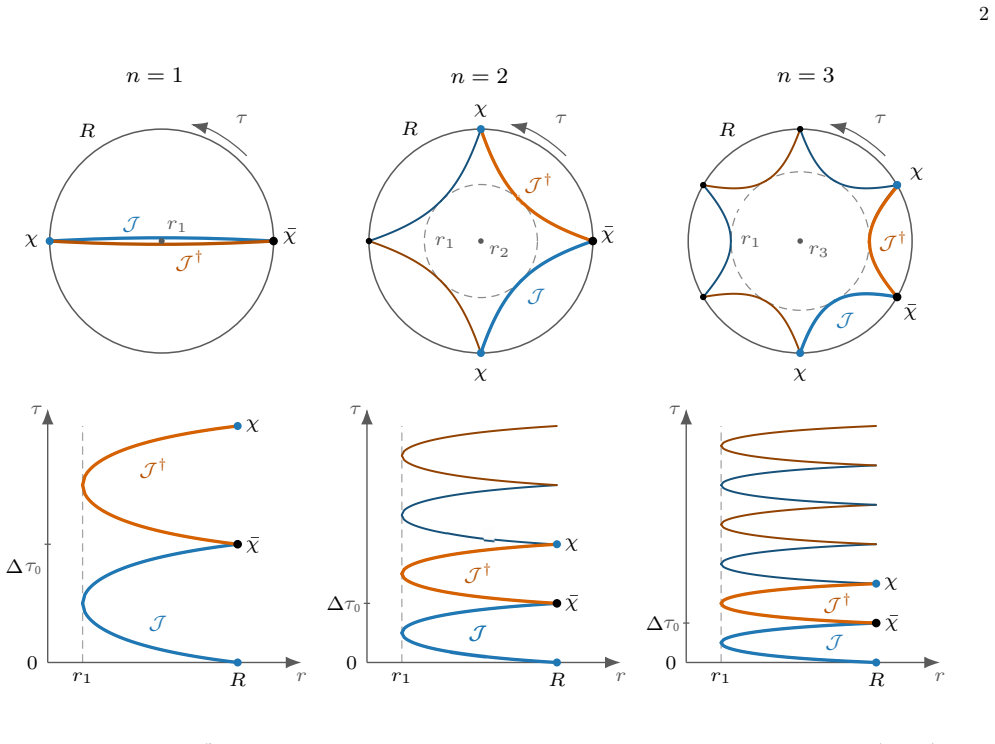
We propose that any compact d-manifold with elliptic data, J, prepares a quantum state |J> on its (d-1)-boundary σ. No asymptotic structure is required. Inner products and traces are evaluated by the gravitational path integral with closed boundary conditions obtained by gluing elliptic data manifolds. We give a prescription for the Rényi entropies S_n of a subregion of σ. In examples, S_n is nonnegative and nonincreasing with n. The von Neumann entropy by analytic continuation agrees with the minimal surface prescription.
What carries the argument
Elliptic data J on a compact manifold preparing the state |J> with path integral inner products from gluing.
If this is right
- Rényi entropies are nonnegative and decrease with n in the examples considered.
- Von Neumann entropy agrees with the minimal surface prescription of Bousso and Penington.
- The state preparation requires no asymptotic structure.
- Traces are evaluated with closed boundary conditions.
Where Pith is reading between the lines
- This could extend quantum information tools to regions in cosmological spacetimes.
- Testing the prescription on more examples like de Sitter space could reveal limitations.
- The gluing procedure might connect to other path integral definitions in quantum gravity.
Load-bearing premise
Inner products and traces are evaluated by the gravitational path integral with closed boundary conditions obtained by gluing elliptic data manifolds.
What would settle it
A specific computation where the continued von Neumann entropy for a subregion differs from the minimal surface area in a solvable gravitational model.
Figures

read the original abstract
We propose that any compact $d$-manifold with elliptic data, $\mathcal{J}$, prepares a quantum state $|\mathcal{J}\rangle$ on its $(d-1)$-boundary $\sigma$. Elliptic data consists of metric and field values, or their conjugates, but not both. No asymptotic structure is required. Inner products and traces are evaluated by the gravitational path integral with closed boundary conditions obtained by gluing elliptic data manifolds. In particular, we give a prescription for the R\'enyi entropies $S_n$ of a subregion of $\sigma$. In a class of examples, we find that $S_n$ is nonnegative and nonincreasing with $n$, as required for consistency. We obtain the von Neumann entropy by analytic continuation and find agreement with the minimal surface prescription of Bousso and Penington.
Editorial analysis
A structured set of objections, weighed in public.
Referee Report
Summary. The manuscript proposes that any compact d-manifold equipped with elliptic data J prepares a quantum state |J> on its (d-1)-boundary σ. Inner products and traces are defined via the gravitational path integral with closed boundary conditions obtained by gluing such manifolds. A prescription for the Rényi entropies Sn of a subregion of σ is given; these are verified to be nonnegative and nonincreasing in a class of examples. The von Neumann entropy is obtained by analytic continuation and stated to agree with the minimal-surface prescription of Bousso and Penington.
Significance. If the gluing construction can be shown to yield a genuine Hilbert space whose reduced density matrices satisfy the required Rényi properties for arbitrary elliptic data, the proposal would supply a general, non-asymptotic definition of quantum states in gravitational systems. The explicit consistency checks performed in the checked examples constitute a concrete strength of the current manuscript.
major comments (1)
- [Abstract] Abstract: the claim that Sn is nonnegative and nonincreasing is supported only by verification 'in a class of examples.' The subsequent analytic continuation to the von Neumann entropy, and the asserted agreement with the Bousso-Penington minimal-surface formula, both presuppose that these inequalities hold for the full state space defined by the gluing construction. No general argument establishing this is supplied.
Simulated Author's Rebuttal
We thank the referee for their careful reading and constructive comments on the manuscript. We address the major comment point by point below.
read point-by-point responses
-
Referee: [Abstract] Abstract: the claim that Sn is nonnegative and nonincreasing is supported only by verification 'in a class of examples.' The subsequent analytic continuation to the von Neumann entropy, and the asserted agreement with the Bousso-Penington minimal-surface formula, both presuppose that these inequalities hold for the full state space defined by the gluing construction. No general argument establishing this is supplied.
Authors: We agree that the manuscript supplies no general proof that the Rényi entropies are nonnegative and nonincreasing for arbitrary elliptic data under the gluing construction. The verification and the subsequent analytic continuation to the von Neumann entropy, together with the comparison to the Bousso-Penington formula, are performed only within the class of examples where the inequalities hold. To prevent any implication that these results extend beyond the verified cases, we will revise the abstract to state explicitly that both the consistency checks and the agreement with the minimal-surface prescription are established in the class of examples considered. A general demonstration remains an open question. revision: yes
Circularity Check
No significant circularity; proposal and checks are independent of self-citation
full rationale
The paper proposes that compact d-manifolds with elliptic data prepare states |J> on the boundary, with inner products via gravitational path integral on glued manifolds. Rényi entropies Sn are prescribed for subregions and verified to be nonnegative and nonincreasing in a class of examples; von Neumann entropy follows by analytic continuation. The noted agreement with the minimal surface prescription of Bousso and Penington is a computed consistency check, not an input or assumption used to derive the state or entropy formula. No equation or step reduces by construction to a fitted parameter, self-defined quantity, or unverified self-citation chain. The self-citation is normal for comparison and does not justify the central premise. Limitation to examples is a scope issue, not circularity.
Axiom & Free-Parameter Ledger
axioms (2)
- domain assumption Inner products and traces are given by the gravitational path integral over manifolds obtained by gluing elliptic data.
- domain assumption Rényi entropies admit analytic continuation to von Neumann entropy that matches the minimal-surface formula.
invented entities (1)
-
Quantum state |J> prepared by compact manifold with elliptic data J
no independent evidence
Forward citations
Cited by 1 Pith paper
-
Pure states for subregions in gravity and their entanglement entropy
A construction assigns pure states to subregions in quantum gravity via partially frozen path integrals and gives a holographic prescription for their entanglement entropy that satisfies consistency conditions and rec...
Reference graph
Works this paper leans on
-
[1]
Dirichlet
The von Neumann entropy changes discontinuously between πr1/(2G) and 0. Mixed-conformal data We consider the same time- reflection-symmetric slice Σ. Instead of keeping its in- trinsic metric hab, Eq. 4, we now retain the trace K of the extrinsic curvature and the conformal class [hab] in the interior of Σ. The conformal class of an annulus has only one m...
-
[2]
G. W. Gibbons and S. W. Hawking, Action Integrals and Partition Functions in Quantum Gravity, Phys. Rev. D 15, 2752 (1977)
1977
-
[3]
J. M. Maldacena, The Large N limit of superconformal field theories and supergravity, Adv. Theor. Math. Phys. 2, 231 (1998) , arXiv:hep-th/9711200
work page internal anchor Pith review Pith/arXiv arXiv 1998
-
[4]
S. S. Gubser, I. R. Klebanov, and A. M. Polyakov, Gauge theory correlators from noncritical string theory, Phys. Lett. B 428, 105 (1998) , arXiv:hep-th/9802109
work page internal anchor Pith review Pith/arXiv arXiv 1998
-
[5]
Anti De Sitter Space And Holography
E. Witten, Anti-de Sitter space and holography, Adv. Theor. Math. Phys. 2, 253 (1998), arXiv:hep-th/9802150
work page internal anchor Pith review Pith/arXiv arXiv 1998
-
[6]
R. Bousso and G. Penington, Entanglement wedges for gravitating regions, Phys. Rev. D 107, 086002 (2023) , arXiv:2208.04993 [hep-th]
-
[7]
R. Bousso and G. Penington, Holograms in our world, Phys. Rev. D 108, 046007 (2023) , arXiv:2302.07892 [hep- th]
-
[8]
We will discuss apparent violations of positivity [ 28–30] in a companion paper
As in all applications of the GPI, positivity properties are not guaranteed; thus the positivity and monotonicity of the Rényi entropies we compute furnish a nontrivial consistency check. We will discuss apparent violations of positivity [ 28–30] in a companion paper
-
[9]
S. W. Hawking and D. N. Page, Thermodynamics of Black Holes in anti-De Sitter Space, Commun. Math. Phys. 87, 577 (1983)
1983
-
[10]
Anti-de Sitter Space, Thermal Phase Transition, And Confinement In Gauge Theories
E. Witten, Anti-de Sitter Space, Thermal Phase Transi- tion, And Confinement In Gauge Theories, Adv. Theor. Math. Phys. 2, 505 (1998) , arXiv:hep-th/9803131
work page internal anchor Pith review Pith/arXiv arXiv 1998
-
[11]
Generalized gravitational entropy
A. Lewkowycz and J. Maldacena, Generalized gravita- tional entropy, JHEP 08 (2013), 090, arXiv:1304.4926 [hep-th]
work page internal anchor Pith review Pith/arXiv arXiv 2013
-
[12]
D. Marolf and H. Maxfield, Transcending the ensemble: baby universes, spacetime wormholes, and the order and disorder of black hole information, JHEP 08 (2020), 044, arXiv:2002.08950 [hep-th]
-
[13]
G. Araujo-Regado, R. Khan, and A. C. Wall, Cauchy slice holography: a new AdS/CFT dictionary, JHEP 03 (2023), 026, arXiv:2204.00591 [hep-th]
- [14]
-
[15]
Our state preparation is not asymptotic [ 10, 11] but finite
Our perspective is distinct from each of these works. Our state preparation is not asymptotic [ 10, 11] but finite. Our interest is not primarily in closed universes [ 11, 13]. We do not presume any dual theory, such as the T ¯T - deformed CFT [ 31, 32] that might be relevant in certain 6 limiting settings [ 12]. In particular, we compute exclu- sively us...
-
[16]
J. W. York, Role of Conformal Three-Geometry in the Dynamics of Gravitation, Phys. Rev. Lett. 28, 1082 (1972)
1972
-
[17]
Hayward, Gravitational action for space-times with nonsmooth boundaries, Phys
G. Hayward, Gravitational action for space-times with nonsmooth boundaries, Phys. Rev. D 47, 3275 (1993)
1993
-
[18]
The Black Hole in Three Dimensional Space Time
M. Banados, C. Teitelboim, and J. Zanelli, The Black Hole in Three-Dimensional Space-Time, Phys. Rev. Lett. 69, 1849 (1992) , arXiv:hep-th/9204099
work page internal anchor Pith review Pith/arXiv arXiv 1992
-
[19]
[ 12], for small r1, indicating that even global Cauchy slice holography may not be compatible with using Dirichlet data
The thermal AdS-dominated regime at n = 1 intersects with the R → ∞ limit studied in Ref. [ 12], for small r1, indicating that even global Cauchy slice holography may not be compatible with using Dirichlet data
-
[20]
Bousso, S
R. Bousso, S. Kaya, G. Lin, and A. Shahbazi- Moghaddam, Companion paper (2026), in preparation
2026
-
[21]
Witten, A note on boundary conditions in Eu- clidean gravity, Rev
E. Witten, A note on boundary conditions in Eu- clidean gravity, Rev. Math. Phys. 33, 2140004 (2021) , arXiv:1805.11559 [hep-th]
-
[22]
A. C. Wall, Maximin Surfaces, and the Strong Sub- additivity of the Covariant Holographic Entanglement Entropy, Class. Quant. Grav. 31, 225007 (2014) , arXiv:1211.3494 [hep-th]
work page internal anchor Pith review Pith/arXiv arXiv 2014
-
[23]
R. Bousso and E. Tabor, Discrete Max-Focusing, JHEP 06 (2025), 240, arXiv:2410.18192 [hep-th]
-
[24]
R. Bousso and S. Kaya, Fundamental complement of a gravitating region, Gen. Rel. Grav. 57, 124 (2025) , arXiv:2505.15886 [hep-th]
-
[25]
Holographic Derivation of Entanglement Entropy from AdS/CFT
S. Ryu and T. Takayanagi, Holographic derivation of en- tanglement entropy from AdS/CFT, Phys. Rev. Lett. 96, 181602 (2006) , arXiv:hep-th/0603001
work page internal anchor Pith review Pith/arXiv arXiv 2006
-
[26]
V. E. Hubeny, M. Rangamani, and T. Takayanagi, A Covariant holographic entanglement entropy proposal, JHEP 07 (2007), 062, arXiv:0705.0016 [hep-th]
work page internal anchor Pith review Pith/arXiv arXiv 2007
-
[27]
Quantum Extremal Surfaces: Holographic Entanglement Entropy beyond the Classical Regime
N. Engelhardt and A. C. Wall, Quantum Extremal Sur- faces: Holographic Entanglement Entropy beyond the Classical Regime, JHEP 01 (2015), 073, arXiv:1408.3203 [hep-th]
work page internal anchor Pith review Pith/arXiv arXiv 2015
-
[28]
input region
In general, the elliptic data manifold J for the Rényi calculation should be extracted from a Cauchy slice Σ of a′, the spacelike complement of the “input region” a of Ref. [ 6]. The input region itself does not appear in the calculation. This viewpoint is distinct from Refs. [ 34, 35]
-
[29]
Quantum Gravity Partition Functions in Three Dimensions
A. Maloney and E. Witten, Quantum Gravity Partition Functions in Three Dimensions, JHEP 02 (2010), 029, arXiv:0712.0155 [hep-th]
work page internal anchor Pith review Pith/arXiv arXiv 2010
-
[30]
C. A. Keller and A. Maloney, Poincare Series, 3D Gravity and CFT Spectroscopy, JHEP 02 (2015), 080, arXiv:1407.6008 [hep-th]
work page internal anchor Pith review Pith/arXiv arXiv 2015
- [31]
-
[32]
Moving the CFT into the bulk with $T\bar T$
L. McGough, M. Mezei, and H. Verlinde, Moving the CFT into the bulk with T T , JHEP 04 (2018), 010, arXiv:1611.03470 [hep-th]
work page internal anchor Pith review Pith/arXiv arXiv 2018
-
[33]
Holography at finite cutoff with a $T^2$ deformation
T. Hartman, J. Kruthoff, E. Shaghoulian, and A. Tajdini, Holography at finite cutoff with a T 2 deformation, JHEP 03 (2019), 004, arXiv:1807.11401 [hep-th]
work page internal anchor Pith review Pith/arXiv arXiv 2019
- [34]
-
[35]
V. Balasubramanian and C. Cummings, The entropy of finite gravitating regions (2023), arXiv:2312.08434 [hep- th]
- [36]
discussion (0)
Sign in with ORCID, Apple, or X to comment. Anyone can read and Pith papers without signing in.