The evolution and internal structure of Neptunes and sub-Neptunes II. Convective mixing and thermal conductivity
Pith reviewed 2026-06-29 00:20 UTC · model grok-4.3
The pith
Convective mixing in hot-forming planets with broad composition gradients leads to converging radii after billions of years.
A machine-rendered reading of the paper's core claim, the machinery that carries it, and where it could break.
Core claim
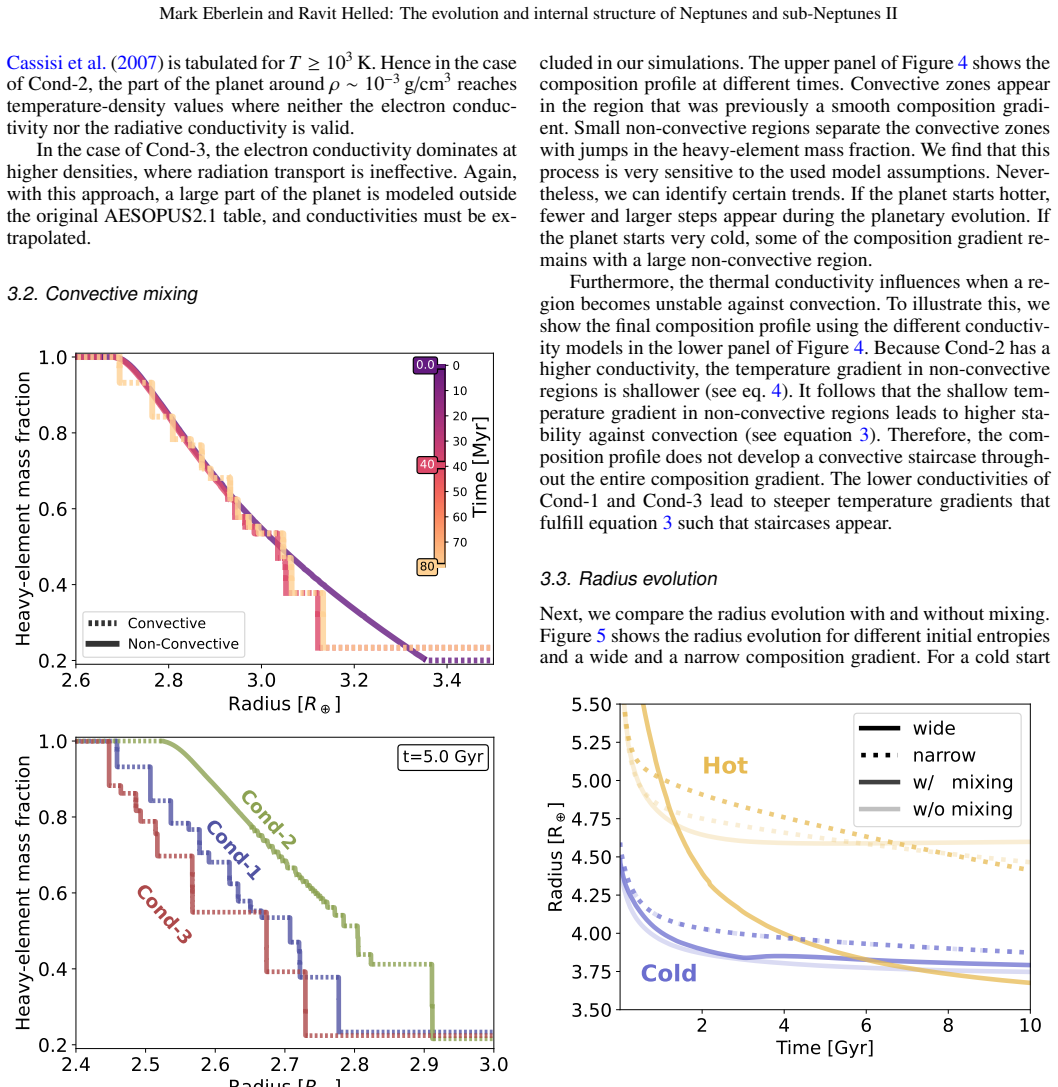
For hot forming planets with a large composition gradient where the heavy-element mass fraction changes gradually from the core to the envelope, convective mixing has a large impact on the radius evolution and the radii converge to similar values after billions of years. The thermal conductivity is less relevant in this case. For cold forming planets or narrow composition gradients, convective mixing is less efficient and the thermal conductivity becomes critical in determining the energy transport and radius.
What carries the argument
Convective mixing eroding composition gradients, as implemented in evolutionary calculations that also vary thermal conductivity between pure water, fully ionized matter, and constant electron conductivity models.
If this is right
- For hot-forming cases with large gradients, radii become similar after several billion years independent of conductivity.
- High thermal conductivity can inhibit convection for intermediate initial entropies if the profile is not mixed.
- Radii evolution depends on whether the composition profile is altered significantly by mixing.
- Constraints on initial entropy and composition profile can reduce degeneracy in radius-time relations.
Where Pith is reading between the lines
- Observed radii of mature sub-Neptunes may not retain memory of their formation entropy if mixing occurred.
- Models ignoring mixing could predict larger spreads in radii than actually occur for hot formation scenarios.
- Determining conductivity in realistic mixtures would mainly matter for planets that avoid significant mixing.
Load-bearing premise
The three thermal conductivity models apply to the high-density, high-temperature mixtures in sub-Neptune and Neptune interiors.
What would settle it
Finding that old planets formed with hot initial conditions and gradual composition gradients have radii that differ substantially according to their conductivity would falsify the dominance of mixing.
Figures




read the original abstract
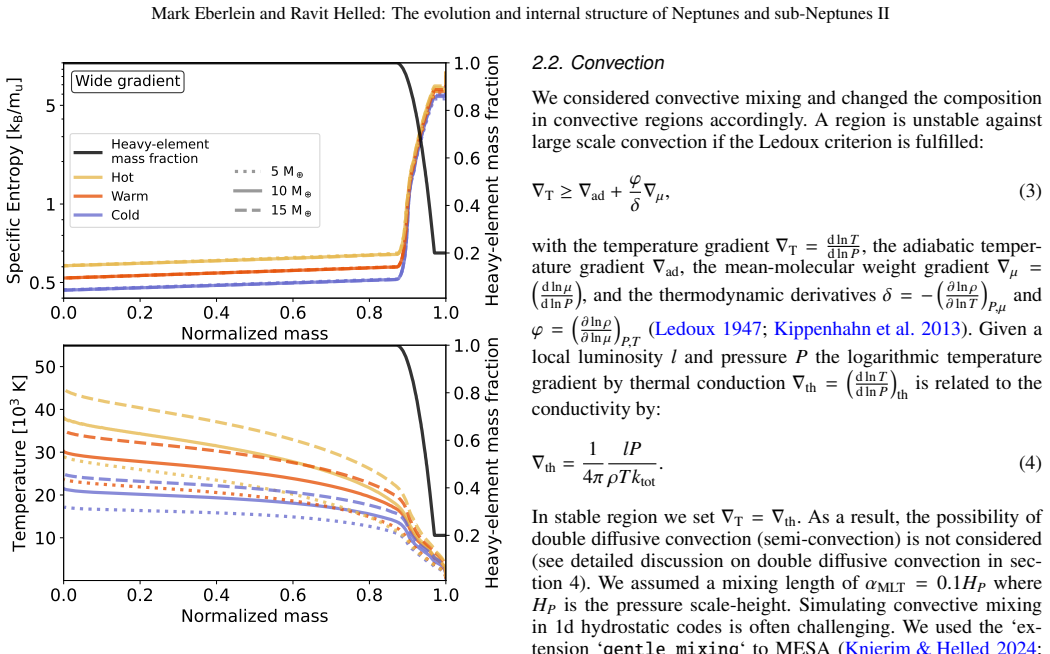
Sub-Neptunes and Neptunes are often modeled with distinct, fully convective layers. Yet, there are several arguments for compositions gradients that can inhibit convection. In these regions, energy transport depends on the thermal conductivity and radiative opacity. We compare three thermal conductivity models and investigate their impact on planetary evolution accounting for the possibility of convective mixing eroding composition gradients. Using a modified version of MESA, we model the evolution of planets with masses of Mp=5, 10, 15 Mearth and three initial entropies. We implement thermal conductivities for: pure water, fully ionized matter, and constant electron conductivity. Convective mixing complicates the relation between conductivity, evolution, and radius. For hot forming planets with a large composition gradient, where the heavy-element mass fraction changes gradually from the core to the envelope, convective mixing has a large impact on the radius evolution. In this case, the thermal conductivity is less relevant and the radii converge to similar values after billions of years. For cold forming planets or narrow composition gradients, convective mixing is less efficient. If the composition profile is not altered significantly, the thermal conductivity becomes critical. It determines how much energy can be trapped beneath stable composition gradients. For intermediate initial entropies, high thermal conductivity inhibits convection. Further work is required to determine the thermal conductivity for various mixtures expected in sub-Neptune and Neptunes at high densities and temperatures. In addition, further constraints on the entropy and composition profile after formation can reduce the degeneracy of the planetary evolution, in particular, the dependence of the radius with time.
Editorial analysis
A structured set of objections, weighed in public.
Referee Report
Summary. The paper models the thermal evolution of 5-15 M_earth sub-Neptunes and Neptunes that form with composition gradients using a modified MESA code. It compares three thermal-conductivity prescriptions (pure water, fully ionized matter, constant electron conductivity) and includes convective mixing that can erode the gradients. The central result is that, for hot initial entropies and broad gradients, mixing dominates radius evolution and radii converge after a few Gyr regardless of conductivity; for cold initial conditions or narrow gradients, conductivity controls energy trapping beneath stable layers and therefore the radius-time relation.
Significance. If the numerical results hold, the work demonstrates that convective mixing can erase much of the dependence on uncertain microphysical conductivities for a plausible subset of formation conditions, thereby reducing one source of degeneracy in sub-Neptune radius evolution. The use of a standard stellar-evolution code (MESA) with explicit mixing is a methodological strength that allows direct comparison with other interior models.
major comments (2)
- [Abstract / conductivity implementation] Abstract and model-description section: the three conductivity prescriptions are stated to be applicable to the high-density, high-temperature mixtures inside sub-Neptunes, yet the text itself concludes that “further work is required to determine the thermal conductivity for various mixtures.” Because the claim that “thermal conductivity is less relevant” when mixing dominates rests on these three models being at least order-of-magnitude representative inside the stable layers, the lack of validation or sensitivity tests to plausible alternative conductivities is load-bearing for the mixing-versus-conductivity regime distinction.
- [Results / radius-evolution figures] Evolution results (implicit in the abstract’s description of radius convergence): no quantitative radius values, time scales, or error estimates are supplied in the abstract, and the reader’s report notes the absence of verification that the reported convergence is robust to the chosen initial entropies and gradients. Without these numbers it is impossible to judge whether the claimed convergence after “billions of years” is statistically distinguishable from the no-mixing case.
minor comments (1)
- [Abstract] The abstract lists planet masses (5, 10, 15 M_earth) and three initial entropies but does not specify the numerical values of those entropies or the functional form of the initial composition gradients; these should be stated explicitly for reproducibility.
Simulated Author's Rebuttal
We thank the referee for the constructive and detailed report. The comments highlight important points about the presentation of conductivity models and the need for quantitative details on radius evolution. We address each major comment below and indicate the revisions we will make.
read point-by-point responses
-
Referee: [Abstract / conductivity implementation] Abstract and model-description section: the three conductivity prescriptions are stated to be applicable to the high-density, high-temperature mixtures inside sub-Neptunes, yet the text itself concludes that “further work is required to determine the thermal conductivity for various mixtures.” Because the claim that “thermal conductivity is less relevant” when mixing dominates rests on these three models being at least order-of-magnitude representative inside the stable layers, the lack of validation or sensitivity tests to plausible alternative conductivities is load-bearing for the mixing-versus-conductivity regime distinction.
Authors: We agree that the three prescriptions are simplified and that the paper already notes the need for further microphysical work on mixture conductivities. The main result—that mixing can dominate and reduce sensitivity to conductivity choice—is shown by the convergence of radii across the three models for hot, broad-gradient cases. To strengthen the claim, we will add a short sensitivity discussion (e.g., scaling one prescription by a factor of 3) and revise the abstract and model section to emphasize that the models are intended as order-of-magnitude brackets rather than precise predictions. This directly supports the regime distinction while acknowledging the limitation. revision: partial
-
Referee: [Results / radius-evolution figures] Evolution results (implicit in the abstract’s description of radius convergence): no quantitative radius values, time scales, or error estimates are supplied in the abstract, and the reader’s report notes the absence of verification that the reported convergence is robust to the chosen initial entropies and gradients. Without these numbers it is impossible to judge whether the claimed convergence after “billions of years” is statistically distinguishable from the no-mixing case.
Authors: We accept that quantitative anchors improve clarity. In the revised manuscript we will update the abstract with specific examples (e.g., “radii converge to within ~0.2 R_earth after ~3 Gyr for hot broad-gradient cases”). We will also add a direct comparison panel or table contrasting mixing and no-mixing runs, including approximate spreads from the three conductivity choices and the three initial entropies, to demonstrate that the convergence is distinguishable from the no-mixing evolution on Gyr timescales. revision: yes
Circularity Check
No circularity; results follow from MESA integrations with external conductivity inputs
full rationale
The paper performs numerical planetary evolution calculations in a modified MESA framework. It adopts three distinct thermal-conductivity prescriptions (pure water, fully ionized matter, constant electron conductivity) as external model inputs and evolves planets under specified initial entropies and composition gradients. The reported radius convergence for hot-forming cases with broad gradients is an output of those integrations once convective mixing is enabled; no fitted parameter is relabeled as a prediction, no self-citation supplies a load-bearing uniqueness theorem, and no ansatz is smuggled in. The explicit statement that further work is required on conductivity for realistic mixtures treats the conductivity models as provisional inputs rather than derived results. The derivation chain is therefore self-contained against the stated numerical setup.
Axiom & Free-Parameter Ledger
free parameters (2)
- initial entropy
- planet mass =
5,10,15 M_earth
axioms (2)
- domain assumption Composition gradients inhibit convection allowing conductivity to control energy transport
- domain assumption Convective mixing can erode composition gradients over time
Reference graph
Works this paper leans on
-
[1]
H., Jermyn, A
Anders, E. H., Jermyn, A. S., Lecoanet, D., et al. 2022, ApJ, 928, L10 Astropy Collaboration, Price-Whelan, A. M., Lim, P. L., et al. 2022, ApJ, 935, 167 Astropy Collaboration, Price-Whelan, A. M., Sip˝ocz, B. M., et al. 2018, AJ, 156, 123 Astropy Collaboration, Robitaille, T. P., Tollerud, E. J., et al. 2013, A&A, 558, A33 Cano Amoros, M., Nettelmann, N....
2022
-
[2]
Y ., Pietrinferni, A., Catelan, M., & Salaris, M
Cassisi, S., Potekhin, A. Y ., Pietrinferni, A., Catelan, M., & Salaris, M. 2007, ApJ, 661, 1094
2007
-
[3]
& Debras, F
Chabrier, G. & Debras, F. 2021, ApJ, 917, 4
2021
-
[4]
& Hansen, U
Dude, S. & Hansen, U. 2025, Geophysical Journal International, 240, 696
2025
-
[5]
& Helled, R
Eberlein, M. & Helled, R. 2025, A&A, 703, A72
2025
-
[6]
& Helled, R
Eberlein, M. & Helled, R. 2026, A&A, 708, C2
2026
-
[7]
W., Alexander, D
Ferguson, J. W., Alexander, D. R., Allard, F., et al. 2005, ApJ, 623, 585
2005
-
[8]
S., Lustig-Yaeger, J., Fortney, J
Freedman, R. S., Lustig-Yaeger, J., Fortney, J. J., et al. 2014, ApJS, 214, 25
2014
-
[9]
2019, New Journal of Physics, 21, 023007
French, M. 2019, New Journal of Physics, 21, 023007
2019
-
[10]
& Nettelmann, N
French, M. & Nettelmann, N. 2019, ApJ, 881, 81
2019
-
[11]
& Redmer, R
French, M. & Redmer, R. 2017, Physics of Plasmas, 24, 092306
2017
-
[12]
Fuentes, J. R. 2025, ApJ, 982, 44
2025
-
[13]
R., Cumming, A., & Anders, E
Fuentes, J. R., Cumming, A., & Anders, E. H. 2022, Physical Review Fluids, 7, 124501
2022
-
[14]
2018, Annual Review of Fluid Mechanics, 50, 275
Garaud, P. 2018, Annual Review of Fluid Mechanics, 50, 275
2018
-
[15]
Granger, B. E. & Pérez, F. 2021, Computing in Science and Engineering, 23, 7
2021
-
[16]
1995, Science, 269, 1697
Guillot, T. 1995, Science, 269, 1697
1995
-
[17]
& Havel, M
Guillot, T. & Havel, M. 2011, A&A, 527, A20
2011
-
[18]
R., Millman, K
Harris, C. R., Millman, K. J., van der Walt, S. J., et al. 2020, Nature, 585, 357
2020
-
[19]
2025, A&A, 704, A253
Helled, R., Müller, S., & Knierim, H. 2025, A&A, 704, A253
2025
-
[20]
& Stevenson, D
Helled, R. & Stevenson, D. 2017, ApJ, 840, L4
2017
-
[21]
W., Vazan, A., Chariton, S., Prakapenka, V
Horn, H. W., Vazan, A., Chariton, S., Prakapenka, V . B., & Shim, S.-H. 2025, Nature, 646, 1069
2025
-
[22]
2025, A&A, 703, A154
Howard, S., Helled, R., Bergermann, A., & Redmer, R. 2025, A&A, 703, A154
2025
-
[23]
Hunter, J. D. 2007, Computing in Science and Engineering, 9, 90
2007
-
[24]
S., Bauer, E
Jermyn, A. S., Bauer, E. B., Schwab, J., et al. 2023, ApJS, 265, 15
2023
-
[25]
2013, Stellar Structure and Evolution (Springer Berlin, Heidelberg)
Kippenhahn, R., Weigert, A., & Weiss, A. 2013, Stellar Structure and Evolution (Springer Berlin, Heidelberg)
2013
-
[26]
2016, in Positioning and Power in Academic Publishing: Players, Agents and Agendas (IOS Press), 87–90
Kluyver, T., Ragan-Kelley, B., Pérez, F., et al. 2016, in Positioning and Power in Academic Publishing: Players, Agents and Agendas (IOS Press), 87–90
2016
-
[27]
& Helled, R
Knierim, H. & Helled, R. 2024, ApJ, 977, 227
2024
-
[28]
& Inutsuka, S.-i
Kurokawa, H. & Inutsuka, S.-i. 2015, ApJ, 815, 78
2015
-
[29]
& Chabrier, G
Leconte, J. & Chabrier, G. 2012, A&A, 540, A20
2012
-
[30]
1947, ApJ, 105, 305
Ledoux, P. 1947, ApJ, 105, 305
1947
-
[31]
S., Soubiran, F., Holtgrewe, N., et al
Lobanov, S. S., Soubiran, F., Holtgrewe, N., et al. 2021, Earth and Planetary Science Letters, 562, 116871
2021
-
[32]
2024, Nature Astronomy, 8, 1399
Luo, H., Dorn, C., & Deng, J. 2024, Nature Astronomy, 8, 1399
2024
-
[33]
2024, ApJ, 976, 39
Marigo, P., Addari, F., Bossini, D., et al. 2024, ApJ, 976, 39
2024
-
[34]
& Aringer, B
Marigo, P. & Aringer, B. 2009, A&A, 508, 1539
2009
-
[35]
2022, A&A, 665, A12
Markham, S., Guillot, T., & Stevenson, D. 2022, A&A, 665, A12
2022
-
[36]
M., Garaud, P., Stellmach, S., Traxler, A
Mirouh, G. M., Garaud, P., Stellmach, S., Traxler, A. L., & Wood, T. S. 2012, ApJ, 750, 61
2012
-
[37]
M., Warren, K
More, R. M., Warren, K. H., Young, D. A., & Zimmerman, G. B. 1988, Physics of Fluids, 31, 3059
1988
-
[38]
& Helled, R
Morf, L. & Helled, R. 2025, A&A, 704, A183 Müller, S., Ben-Yami, M., & Helled, R. 2020a, ApJ, 903, 147 Müller, S. & Helled, R. 2021, MNRAS, 507, 2094 Müller, S. & Helled, R. 2024, ApJ, 967, 7 Müller, S., Helled, R., & Cumming, A. 2020b, A&A, 638, A121
2025
-
[39]
W., Vazan, A., & Brouwers, M
Ormel, C. W., Vazan, A., & Brouwers, M. G. 2021, A&A, 647, A175
2021
-
[40]
2011, ApJS, 192, 3
Paxton, B., Bildsten, L., Dotter, A., et al. 2011, ApJS, 192, 3
2011
-
[41]
2013, ApJS, 208, 4
Paxton, B., Cantiello, M., Arras, P., et al. 2013, ApJS, 208, 4
2013
-
[42]
2015, ApJS, 220, 15
Paxton, B., Marchant, P., Schwab, J., et al. 2015, ApJS, 220, 15
2015
-
[43]
B., et al
Paxton, B., Schwab, J., Bauer, E. B., et al. 2018, ApJS, 234, 34
2018
-
[44]
2019, ApJS, 243, 10
Paxton, B., Smolec, R., Schwab, J., et al. 2019, ApJS, 243, 10
2019
-
[45]
A window for water-hydrogen demixing on warm metal-rich sub-Neptunes
Piaulet-Ghorayeb, C., Thorngren, D. P., Kempton, E. M.-R., et al. 2025, arXiv e-prints, accepted for publication in ApJ, arXiv:2512.01805
work page internal anchor Pith review Pith/arXiv arXiv 2025
-
[46]
Poser, A. J. & Redmer, R. 2024, MNRAS, 529, 2242
2024
-
[47]
2011, ApJ, 731, 66
Rosenblum, E., Garaud, P., Traxler, A., & Stellmach, S. 2011, ApJ, 731, 66
2011
-
[48]
G., Andersson, P., Sundqvist, B., & Backstrom, G
Ross, R. G., Andersson, P., Sundqvist, B., & Backstrom, G. 1984, Reports on Progress in Physics, 47, 1347
1984
-
[49]
2021, A&A, 650, A200 Stamenkovi´c, V ., Breuer, D., & Spohn, T
Scheibe, L., Nettelmann, N., & Redmer, R. 2021, A&A, 650, A200 Stamenkovi´c, V ., Breuer, D., & Spohn, T. 2011, Icarus, 216, 572
2021
-
[50]
Stevenson, D. J. & Salpeter, E. E. 1977, ApJS, 35, 239
1977
-
[51]
J., Spohn, T., & Schubert, G
Stevenson, D. J., Spohn, T., & Schubert, G. 1983, Icarus, 54, 466 Tejada Arevalo, R., Gupta, A., Burrows, A., et al. 2026, ApJ, 1001, 243 Tejada Arevalo, R., Sur, A., Su, Y ., & Burrows, A. 2025, ApJ, 979, 243
1983
-
[52]
Tulekeyev, A., Garaud, P., Idini, B., & Fortney, J. J. 2024, PSJ, 5, 190
2024
-
[53]
& Helled, R
Valletta, C. & Helled, R. 2022, ApJ, 931, 21
2022
-
[54]
2018, A&A, 610, L14
Vazan, A., Helled, R., & Guillot, T. 2018, A&A, 610, L14
2018
-
[55]
2013, MNRAS, 434, 3283
Vazan, A., Kovetz, A., Podolak, M., & Helled, R. 2013, MNRAS, 434, 3283
2013
-
[56]
S., Garaud, P., & Stellmach, S
Wood, T. S., Garaud, P., & Stellmach, S. 2013, ApJ, 768, 157 Article number, page 9 A&A proofs:manuscript no. aa59532-26 Appendix A: Extension of the radiative opacity tables In Paper I we created a set of Rosseland mean opacity tables for planetary evolution simulations, using the AESOPUS2.1 code Marigo & Aringer (2009); Marigo et al. (2024). The tables ...
2013
discussion (0)
Sign in with ORCID, Apple, or X to comment. Anyone can read and Pith papers without signing in.