BijectiveRemesh: Maintaining Bijective Mappings for Data Transfer Across Remeshed Manifolds
Pith reviewed 2026-06-28 20:43 UTC · model grok-4.3
The pith
A composite map of local bijective atlases maintains exact mappings across any sequence of remeshing operations.
A machine-rendered reading of the paper's core claim, the machinery that carries it, and where it could break.
Core claim
BijectiveRemesh constructs a mathematically rigorous composite map from the input mesh to the output mesh by chaining local bijective atlases defined for each primitive remeshing operation, representing the overall mapping as a composition that preserves bijectivity on both 2D triangle surfaces and 3D tetrahedral meshes.
What carries the argument
The composition of local bijective atlases, one per remeshing primitive, enforced by the Shared Scaffold in 2D and by Steinitz's Theorem with Maxwell-Cremona lifting in 3D.
Load-bearing premise
Local bijective atlases can be constructed for each remeshing primitive and their composition preserves global bijectivity.
What would settle it
A concrete remeshing sequence on a simple mesh where no local bijective atlas exists for one operation or the composed map overlaps or reverses orientation.
Figures





read the original abstract
We introduce BijectiveRemesh, a robust algorithm for maintaining a continuous, bijective mapping across complex remeshing sequences on both 2D triangle surfaces and 3D tetrahedral meshes. Unlike traditional data transfer methods that rely on interpolation or projection, our approach constructs a mathematically rigorous composite map from the input mesh to the output mesh by chaining local bijective atlases defined for each primitive remeshing operation. Our framework represents the overall mapping as a composition of local bijective atlases, one per remeshing operation. Building upon successive self-parameterization, we introduce a Shared Scaffold structure for 2D triangle meshes that enforces global bijectivity through local orientation preservation. We extend this approach to handle edge splits, edge swaps, and vertex smoothing beyond the original edge collapses. For 3D tetrahedral meshes, we generalize the local atlas construction using Steinitz's Theorem and Maxwell-Cremona lifting to ensure valid embeddings. This enables exact tracking of geometric entities, including points, curves, and surfaces, across remeshing, with applications from texture transfer to volumetric simulations.
Editorial analysis
A structured set of objections, weighed in public.
Referee Report
Summary. The paper claims to introduce BijectiveRemesh, an algorithm that maintains continuous bijective mappings across remeshing sequences on 2D triangle surfaces and 3D tetrahedral meshes by constructing a composite map from chaining local bijective atlases for each primitive remeshing operation, using a Shared Scaffold for 2D to enforce global bijectivity through local orientation preservation, and Steinitz's Theorem and Maxwell-Cremona lifting for 3D. This enables exact tracking of points, curves, and surfaces for applications including texture transfer and volumetric simulations.
Significance. If the local atlas constructions and composition steps hold, the work would provide a rigorous alternative to interpolation-based transfer methods, with clear utility in adaptive geometry processing and simulation pipelines. The constructive algorithmic framing and invocation of classical embedding theorems constitute a positive aspect of the approach.
major comments (1)
- [Abstract] Abstract: the central claim that the method 'constructs a mathematically rigorous composite map' via chaining of local bijective atlases is load-bearing for the entire contribution, yet the manuscript provides no derivations, proofs, or explicit verification that such atlases exist for every listed primitive (edge collapse, split, swap, smoothing) or that the Shared Scaffold (2D) and Steinitz/Maxwell-Cremona steps (3D) preserve global bijectivity under composition.
Simulated Author's Rebuttal
We thank the referee for the careful reading and for identifying the need for stronger substantiation of the central bijectivity claims. We address the comment below and will revise the manuscript to incorporate additional formal derivations and verifications.
read point-by-point responses
-
Referee: [Abstract] Abstract: the central claim that the method 'constructs a mathematically rigorous composite map' via chaining of local bijective atlases is load-bearing for the entire contribution, yet the manuscript provides no derivations, proofs, or explicit verification that such atlases exist for every listed primitive (edge collapse, split, swap, smoothing) or that the Shared Scaffold (2D) and Steinitz/Maxwell-Cremona steps (3D) preserve global bijectivity under composition.
Authors: We agree that the abstract's claim of a mathematically rigorous composite map requires explicit supporting derivations and verifications to be fully substantiated. The manuscript describes the algorithmic construction of local bijective atlases for each primitive operation and invokes the Shared Scaffold for 2D (via orientation preservation) together with Steinitz's Theorem and Maxwell-Cremona lifting for 3D. However, it does not currently contain detailed mathematical derivations or step-by-step verification that each local atlas is bijective and that the composition preserves global bijectivity. In the revised manuscript we will add these elements, including explicit proofs of local bijectivity for edge collapse, split, swap, and smoothing, together with an argument showing that the scaffold and theorem-based embeddings ensure the composite map remains bijective. These additions will appear in an expanded methods section. revision: yes
Circularity Check
No significant circularity; constructive algorithm using external theorems
full rationale
The paper describes an algorithmic construction that chains local bijective atlases for remeshing primitives, relying on the Shared Scaffold (2D) and Steinitz's Theorem plus Maxwell-Cremona lifting (3D) to enforce bijectivity. These are standard external mathematical results, not self-citations or internal fits. No equation or step reduces by construction to its own inputs; the central claim is a procedural composition rather than a derived equality that collapses to a parameter or prior self-result. The derivation is therefore self-contained against external benchmarks.
Axiom & Free-Parameter Ledger
axioms (1)
- standard math Steinitz's Theorem and Maxwell-Cremona lifting ensure valid embeddings for tetrahedral meshes
invented entities (1)
-
Shared Scaffold structure
no independent evidence
Reference graph
Works this paper leans on
-
[1]
Mario Botsch, Leif Kobbelt, Mark Pauly, Pierre Alliez, and Bruno Lévy
Tutte Embeddings of Tetrahedral Meshes.Discrete & Computational Geometry73 (2023), 197–207. Mario Botsch, Leif Kobbelt, Mark Pauly, Pierre Alliez, and Bruno Lévy. 2010.Polygon mesh processing. CRC press. Marcel Campen, Cláudio T. Silva, and Denis Zorin
2023
-
[2]
David Coeurjolly, Jaques-Olivier Lachaud, Konstantinos Katrioplas, Sébastien Loriot, Ivan Paden, Mael Rouxel-Labbé, Hossam Saeed, Jane Tournois, Sébastien Valette, and Ilker O
Bijective maps from simplicial foliations.ACM Transactions on Graphics35, 4 (2016), 74:1–74:15. David Coeurjolly, Jaques-Olivier Lachaud, Konstantinos Katrioplas, Sébastien Loriot, Ivan Paden, Mael Rouxel-Labbé, Hossam Saeed, Jane Tournois, Sébastien Valette, and Ilker O. Yaz
2016
-
[3]
Xingyi Du, Noam Aigerman, Qingnan Zhou, Shahar Z Kovalsky, Yajie Yan, Danny M Kaufman, and Tao Ju
Robust fairing via conformal curvature flow.ACM Transactions on Graphics (TOG)32, 4 (2013), 1–10. Xingyi Du, Noam Aigerman, Qingnan Zhou, Shahar Z Kovalsky, Yajie Yan, Danny M Kaufman, and Tao Ju
2013
-
[4]
Lifting simplices to find injectivity.ACM Trans. Graph. 39, 4 (2020),
2020
-
[5]
Michael S
Reversible Harmonic Maps between Discrete Surfaces.ACM Transactions on Graphics38, 2 (2019). Michael S. Floater
2019
-
[6]
One-to-one piecewise linear mappings over triangulations. Math. Comp.72, 242 (2003), 685–696. Michael S. Floater and Valérie Pham-Trong
2003
-
[7]
Xiao-Ming Fu, Yang Liu, and Baining Guo
Convex combination maps over trian- gulations, tilings, and tetrahedral meshes.Advances in Computational Mathematics 25, 4 (2006), 347–356. Xiao-Ming Fu, Yang Liu, and Baining Guo
2006
-
[8]
Yixin Hu, Qingnan Zhou, Xifeng Gao, Alec Jacobson, Denis Zorin, and Daniele Panozzo
Computing locally injective mappings by advanced MIPS.ACM Transactions on Graphics (TOG)34, 4 (2015), 1–12. Yixin Hu, Qingnan Zhou, Xifeng Gao, Alec Jacobson, Denis Zorin, and Daniele Panozzo
2015
-
[9]
Graph.37, 4, Article 60 (July 2018), 14 pages
Tetrahedral Meshing in the Wild.ACM Trans. Graph.37, 4, Article 60 (July 2018), 14 pages. doi:10.1145/3197517.3201353 Zhongshi Jiang, Scott Schaefer, and Daniele Panozzo
-
[10]
Zhongshi Jiang, Teseo Schneider, Denis Zorin, and Daniele Panozzo
Simplicial complex aug- mentation framework for bijective maps.ACM Transactions on Graphics36, 6 (2017), 186:1–186:9. Zhongshi Jiang, Teseo Schneider, Denis Zorin, and Daniele Panozzo
2017
-
[11]
Zhongshi Jiang, Ziyi Zhang, Yixin Hu, Teseo Schneider, Denis Zorin, and Daniele Panozzo
Bijective Projection in a Shell.ACM Transactions on Graphics39, 6 (2020). Zhongshi Jiang, Ziyi Zhang, Yixin Hu, Teseo Schneider, Denis Zorin, and Daniele Panozzo
2020
-
[12]
Leif Kobbelt, Swen Campagna, Jens Vorsatz, and Hans-Peter Seidel
Bijective and Coarse High-Order Tetrahedral Meshes.ACM Transac- tions on Graphics40, 4 (2021). Leif Kobbelt, Swen Campagna, Jens Vorsatz, and Hans-Peter Seidel
2021
-
[13]
Vladislav Kraevoy and Alla Sheffer
Interactive multi-resolution modeling on arbitrary meshes.SIGGRAPH(1998), 105–114. Vladislav Kraevoy and Alla Sheffer
1998
-
[14]
Cross-parameterization and compatible remeshing of 3D models.ACM Transactions on Graphics (TOG)23, 3 (2004), 861–
2004
-
[15]
Hsueh-Ti Derek Liu, Jiayi Eris Zhang, Mirela Ben-Chen, and Alec Jacobson
Bijective Mappings of Meshes with Boundary and the Degree in Mesh Processing.SIAM Journal on Imaging Sciences7, 2 (2014), 1263–1283. Hsueh-Ti Derek Liu, Jiayi Eris Zhang, Mirela Ben-Chen, and Alec Jacobson
2014
-
[16]
Graph.40, 4, Article 80 (jul 2021), 13 pages
Surface multigrid via intrinsic prolongation.ACM Trans. Graph.40, 4, Article 80 (jul 2021), 13 pages. doi:10.1145/3450626.3459768 Filippo Maggioli, Daniele Baieri, Emanuele Rodolà, and Simone Melzi
-
[17]
183–200 pages
Rematching: Low-resolution representations for scalable shape correspondence. 183–200 pages. James R. Munkres. 2018.Elements of Algebraic Topology. CRC Press. doi:10.1201/ 9780429493911 11 Valentin Z. Nigolian, Marcel Campen, and David Bommes
2018
-
[18]
Valentin Z
Expansion Cones: A Progressive Volumetric Mapping Framework.ACM Transactions on Graphics42, 4 (2023). Valentin Z. Nigolian, Marcel Campen, and David Bommes
2023
-
[19]
ACM Transactions on Graphics43, 6 (2024)
A Progressive Em- bedding Approach to Bijective Tetrahedral Maps driven by Cluster Mesh Topology. ACM Transactions on Graphics43, 6 (2024). Michael Rabinovich, Roi Poranne, Daniele Panozzo, and Olga Sorkine-Hornung
2024
-
[20]
Ares Ribó Mor, Günter Rote, and André Schulz
Scalable Locally Injective Mappings.ACM Transactions on Graphics36, 2 (2017). Ares Ribó Mor, Günter Rote, and André Schulz
2017
-
[21]
Pedro V Sander, John Snyder, Steven J Gortler, and Hugues Hoppe
Small grid embeddings of 3- polytopes.Discrete & Computational Geometry45, 1 (2011), 65–87. Pedro V Sander, John Snyder, Steven J Gortler, and Hugues Hoppe
2011
-
[22]
Jason Smith and Scott Schaefer
Surface Maps via Adaptive Triangulations.Computer Graphics Forum42, 2 (2023). Jason Smith and Scott Schaefer
2023
-
[23]
ACM Transactions on Graphics (TOG)34, 4 (2015), 1–9
Bijective parameterization with free boundaries. ACM Transactions on Graphics (TOG)34, 4 (2015), 1–9. Olga Sorkine and Marc Alexa
2015
-
[24]
2025.CGAL User and Reference Manual(6.1 ed.)
The CGAL Project. 2025.CGAL User and Reference Manual(6.1 ed.). CGAL Editorial Board. https://doc.cgal.org/6.1/Manual/packages.html William T. Tutte
2025
-
[25]
Jakob Wasserthal, Hanns-Christian Breit, Manfred T Meyer, Maurice Pradella, Daniel Hinck, Alexander W Sauter, Tobias Heye, Daniel T Boll, Joshy Cyriac, Shan Yang, et al
How to Draw a Graph.Proceedings of the London Mathematical Society13, 1 (1963), 743–767. Jakob Wasserthal, Hanns-Christian Breit, Manfred T Meyer, Maurice Pradella, Daniel Hinck, Alexander W Sauter, Tobias Heye, Daniel T Boll, Joshy Cyriac, Shan Yang, et al
1963
-
[26]
Qingnan Zhou and Alec Jacobson
TotalSegmentator: robust segmentation of 104 anatomic structures in CT images.Radiology: Artificial Intelligence5, 5 (2023), e230024. Qingnan Zhou and Alec Jacobson
2023
-
[27]
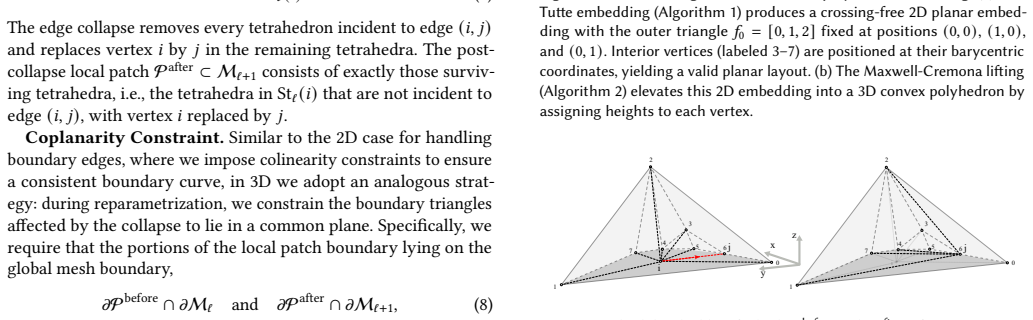
Thingi10K: A Dataset of 10,000 3D-Printing Models.arXiv preprint arXiv:1605.04797(2016). A Appendix A.1 Constructive Algorithms for Convex Polyhedra Embedding The following two algorithms describe the constructive procedure for embedding a planar graph as a convex polyhedron, as referenced in Section 3.1.3. Algorithm 1 computes a crossing-free planar em- ...
work page internal anchor Pith review Pith/arXiv arXiv 2016
discussion (0)
Sign in with ORCID, Apple, or X to comment. Anyone can read and Pith papers without signing in.