Pure Spin Photocurrent in Altermagnetic Photovoltaic Battery
Pith reviewed 2026-06-28 21:32 UTC · model grok-4.3
The pith
A semiconductor layer between two altermagnets with opposite Néel vectors generates pure spin photocurrent under light.
A machine-rendered reading of the paper's core claim, the machinery that carries it, and where it could break.
Core claim
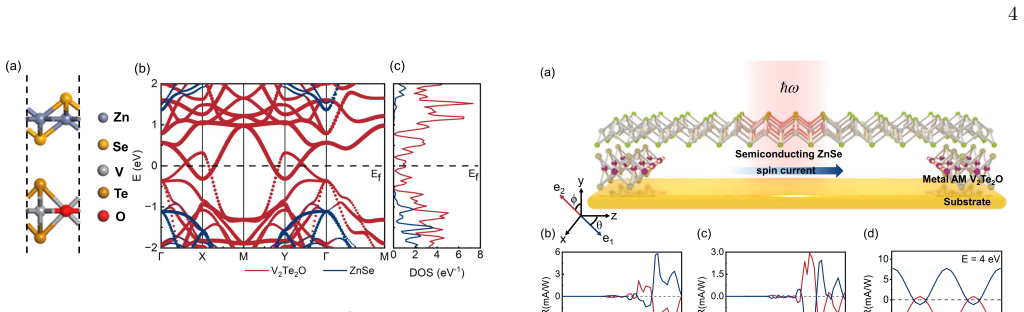
The V2Te2O/ZnSe/V2Te2O junction supports a pure spin photocurrent when the two altermagnetic electrodes have opposite Néel vectors, with spin-up and spin-down photocurrents equal in magnitude and opposite in sign. First-principles quantum-transport simulations establish that the effect survives illumination by both linearly and circularly polarized light and remains tunable by photon energy and polarization angle.
What carries the argument
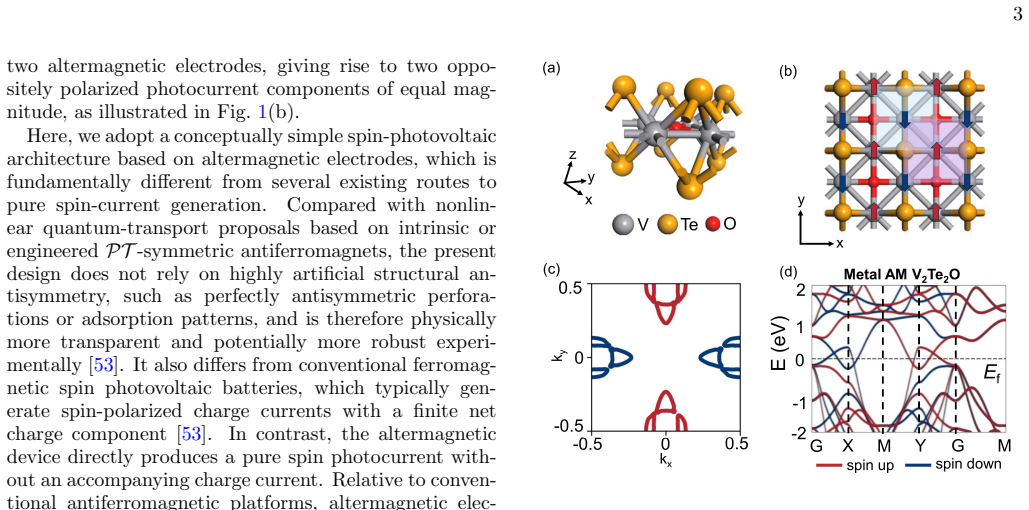
The altermagnetic photovoltaic battery: two altermagnetic electrodes with opposite Néel vectors separated by a nonmagnetic semiconductor layer, whose momentum-dependent spin splitting converts absorbed photons into pure spin current.
If this is right
- Pure spin current is generated without accompanying net charge current.
- The photocurrent remains present under both linear and circular light polarization.
- Photon energy and polarization angle provide external knobs to tune the spin current magnitude.
- The absence of net magnetization in the electrodes removes the need for external magnetic fields to set the spin direction.
Where Pith is reading between the lines
- Devices built on this principle could be integrated with existing semiconductor fabrication lines that already use ZnSe.
- The same electrode geometry might allow optical writing of spin information without Joule heating from charge currents.
- Extension to other altermagnetic compounds with larger spin splittings could increase the photocurrent density at room temperature.
Load-bearing premise
The first-principles quantum-transport simulations accurately capture the momentum-dependent spin splitting and transport properties of the real V2Te2O and ZnSe materials under illumination without significant errors from exchange-correlation functionals or interface modeling.
What would settle it
Fabrication and illumination of a V2Te2O/ZnSe/V2Te2O junction with opposite Néel vectors that shows either zero photocurrent or unequal magnitudes for the two spin channels.
Figures

read the original abstract
Altermagnets, featuring momentum-dependent spin splitting without net magnetization, provide a promising platform for spintronic functionalities beyond conventional ferromagnets and antiferromagnets. Here, we propose an altermagnetic spin photovoltaic battery consisting of a nonmagnetic semiconducting layer sandwiched between two altermagnetic electrodes. Using first-principles quantum-transport simulations, we show that a V2Te2O/ZnSe/V2Te2O junction supports a pure spin photocurrent for opposite N\'eel vectors in the two altermagnetic electrodes, with spin-up and spin-down photocurrents equal in magnitude and opposite in sign. The effect persists under both linearly and circularly polarized light and remains tunable with photon energy and polarization angle. Our results establish a realistic route toward light-driven pure spin-current generation in altermagnetic junctions.
Editorial analysis
A structured set of objections, weighed in public.
Referee Report
Summary. The manuscript proposes an altermagnetic photovoltaic battery based on a V2Te2O/ZnSe/V2Te2O junction. Using first-principles quantum-transport simulations, it claims that opposite Néel vectors in the two altermagnetic electrodes produce a pure spin photocurrent (equal-magnitude, opposite-sign spin-up and spin-down components with vanishing net charge current) that persists for both linearly and circularly polarized light and can be tuned by photon energy and polarization angle.
Significance. If the reported photocurrents are accurate, the work supplies a concrete, materials-specific platform for generating light-driven pure spin currents in altermagnetic heterostructures without net magnetization. The application of standard quantum-transport methods to a realistic three-layer junction geometry is a positive feature; the absence of any machine-checked proofs or parameter-free analytic limits is noted but does not diminish the potential device relevance if the numerics hold.
major comments (2)
- [Computational methods / Results] Computational methods / Results: The central claim of exact cancellation between spin-up and spin-down photocurrents (yielding zero charge current) rests on first-principles transmission matrices whose numerical accuracy is not quantified. No error bars, k-point or energy-cutoff convergence data, or validation against known limits of V2Te2O or ZnSe are provided, making it impossible to assess whether the reported cancellation survives typical DFT uncertainties in altermagnetic spin splitting or interface potentials.
- [Results] Results section: The persistence of pure spin photocurrent is stated to hold for both linear and circular polarization, yet no quantitative comparison of the spin-current magnitude or residual charge-current leakage between the two polarization cases is given; without such data it is unclear whether the cancellation is robust or an artifact of a particular light-coupling implementation.
minor comments (2)
- [Methods] Notation for the Néel-vector orientation and the definition of the photocurrent operator should be stated explicitly in the methods to allow direct reproduction.
- [Figures] Figure captions should include the specific exchange-correlation functional and the atomic relaxation criteria used for the V2Te2O/ZnSe interface.
Simulated Author's Rebuttal
We thank the referee for the constructive comments and positive overall assessment of the work. We address each major comment below and have revised the manuscript to incorporate additional numerical validation and quantitative comparisons.
read point-by-point responses
-
Referee: [Computational methods / Results] Computational methods / Results: The central claim of exact cancellation between spin-up and spin-down photocurrents (yielding zero charge current) rests on first-principles transmission matrices whose numerical accuracy is not quantified. No error bars, k-point or energy-cutoff convergence data, or validation against known limits of V2Te2O or ZnSe are provided, making it impossible to assess whether the reported cancellation survives typical DFT uncertainties in altermagnetic spin splitting or interface potentials.
Authors: We agree that explicit convergence tests and validation strengthen the numerical claims. In the revised manuscript we have added a dedicated supplementary section reporting k-point and energy-cutoff convergence for the transmission functions, together with comparisons of the calculated magnetic moments, band gaps, and spin splittings of bulk V2Te2O and ZnSe against published reference values. The symmetry-enforced cancellation of charge current remains exact within the computational model; the added tests show that the spin photocurrent magnitude varies by less than 6% under the converged parameter ranges, indicating robustness against typical DFT uncertainties. revision: yes
-
Referee: [Results] Results section: The persistence of pure spin photocurrent is stated to hold for both linear and circular polarization, yet no quantitative comparison of the spin-current magnitude or residual charge-current leakage between the two polarization cases is given; without such data it is unclear whether the cancellation is robust or an artifact of a particular light-coupling implementation.
Authors: We have added a new figure (Fig. 4 in the revised manuscript) and associated discussion that directly compares the spin and charge photocurrent spectra for linearly and circularly polarized light at multiple photon energies. The data confirm that the pure-spin character (vanishing charge current within numerical precision and equal-magnitude opposite spin components) is preserved in both polarization cases, with the spin-current magnitude differing by at most 15% between the two polarizations at the energies examined. This comparison is now included to demonstrate robustness. revision: yes
Circularity Check
No circularity: results are direct outputs of standard first-principles quantum transport on proposed junction
full rationale
The paper's central result (pure spin photocurrent with equal-magnitude opposite-sign spin-up/down components for opposite Néel vectors) is obtained by applying standard DFT-based quantum-transport methods to the V2Te2O/ZnSe/V2Te2O geometry under illumination. No equations or claims reduce by construction to fitted parameters, self-definitions, or self-citation chains; the outcome is presented as a computed property of the new structure. The provided abstract and reader's assessment confirm the absence of load-bearing self-referential steps, making the derivation self-contained against external benchmarks.
Axiom & Free-Parameter Ledger
Reference graph
Works this paper leans on
-
[1]
ˇZuti´ c, J
I. ˇZuti´ c, J. Fabian, and S. Das Sarma, Rev. Mod. Phys. 76, 323 (2004)
2004
-
[2]
Baltz, A
V. Baltz, A. Manchon, M. Tsoi, T. Moriyama, T. Ono, and Y. Tserkovnyak, Rev. Mod. Phys.90, 015005 (2018)
2018
-
[3]
B. Wu, S. Fang, J. Yang, S. Liu, Y. Peng, Q. Li, Z. Lin, J. Shi, W. Yang, Z. Luo, C. Wang, J. Yang, J. Lu, and H. Du, Phys. Rev. Appl.19, 024037 (2023)
2023
-
[4]
B. Wu, J. Yang, S. Liu, S. Fang, Z. Liu, Z. Lin, J. Shi, W. Yang, Z. Luo, C. Wang, H. Du, J. Yang, and J. Lu, Phys. Rev. Appl.19, 064008 (2023)
2023
-
[5]
Z. Guo, S. Qian, X. Zhou, W. Wang, Z. Cheng, and X. Wang, Nat. Commun.17, 549 (2026)
2026
-
[6]
Y. Bai, B. Yuan, Z. Chen, Y. Dai, B. Huang, X. Wang, and C. Niu, Phys. Rev. Lett.136, 046602 (2026)
2026
-
[7]
S. Fang, B. Wu, Q. Li, Z. Yang, H. Du, J. Yang, Z. Luo, and J. Lu, Phys. Rev. B109, 085201 (2024)
2024
-
[8]
R. Fei, W. Song, L. Pusey-Nazzaro, and L. Yang, Phys. Rev. Lett.127, 207402 (2021)
2021
-
[9]
Shao, Y.-Y
D.-F. Shao, Y.-Y. Jiang, J. Ding, S.-H. Zhang, Z.-A. Wang, R.-C. Xiao, G. Gurung, W. J. Lu, Y. P. Sun, and E. Y. Tsymbal, Phys. Rev. Lett.130, 216702 (2023)
2023
-
[10]
Shao and E
D.-F. Shao and E. Y. Tsymbal, npj Spintron.2, 13 (2024)
2024
-
[11]
C. Song, R. Zhang, L. Liao, Y. Zhou, X. Zhou, R. Chen, Y. You, X. Chen, and F. Pan, Prog. Mater. Sci.118, 100761 (2021)
2021
-
[12]
Nguyen, S
V. Nguyen, S. Rao, K. Wostyn, and S. Couet, npj Spin- tron.2, 48 (2024)
2024
-
[13]
X. Han, X. Wang, C. Wan, G. Yu, and X. Lv, Appl. Phys. Lett.118, 120502 (2021)
2021
-
[14]
Dai and A
Z. Dai and A. M. Rappe, Chem. Phys. Rev.4, 011303 (2023)
2023
-
[15]
R. Fei, S. Yu, Y. Lu, L. Zhu, and L. Yang, Nano Lett. 21, 2265 (2021)
2021
-
[16]
S. Fang, M. Wang, X. Yang, Z. Yang, Q. Li, Z. Luo, and J. Lu, Phys. Rev. B109, 195202 (2024)
2024
-
[17]
H. Zhu, J. Li, X. Chen, Y. Yu, and Q. Liu, Nat. Commun. 16, 4882 (2025)
2025
-
[18]
H. Yang, Y. S. Ang, S. Meng, and X. Jiang, J. Phys. Chem. Lett.17, 267 (2025)
2025
-
[19]
R. Dong, Y. Xiao, and R. Fei, Phys. Rev. Lett.136, 216702 (2026)
2026
-
[20]
R. Fei, W. Song, and L. Yang, Phys. Rev. B102, 035440 (2020)
2020
-
[21]
Q. Li, S. Fang, X. Yang, Z. Yang, Q. Li, W. Zhou, D. Ren, X. Sun, and J. Lu, ACS Appl. Mater. Interfaces16, 63786 (2024)
2024
-
[22]
Tengdin, C
P. Tengdin, C. Gentry, A. Blonsky, D. Zusin, M. Gerrity, L. Hellbr¨ uck, M. Hofherr, J. Shaw, Y. Kvashnin, E. K. Delczeg-Czirjak, M. Arora, H. Nembach, T. J. Silva, S. Mathias, M. Aeschlimann, H. C. Kapteyn, D. Thonig, K. Koumpouras, O. Eriksson, and M. M. Murnane, Sci. Adv.6, eaaz1100 (2020)
2020
-
[23]
Y. S. Ang, S. Sultan, and C. Zhang, Appl. Phys. Lett. 97, 243110 (2010)
2010
-
[24]
J. Yang, B. Wu, S. Zhao, S. Liu, J. Lu, S. Li, and J. Yang, Phys. Rev. Appl.22, 014017 (2024)
2024
-
[25]
P.-H. Fu, S. Mondal, J.-F. Liu, and J. Cayao, , arXiv:2506.10590 (2025). 6
arXiv 2025
-
[26]
Kotegawa, H
H. Kotegawa, H. Tanaka, Y. Takeuchi, H. Tou, H. Sug- awara, J. Hayashi, and K. Takeda, Phys. Rev. Lett.133, 106301 (2024)
2024
-
[27]
H. Xu, H. Wang, J. Zhou, and J. Li, Nat. Commun.12, 4330 (2021)
2021
-
[28]
Zhang, Z.-A
S.-S. Zhang, Z.-A. Wang, B. Li, W.-J. Lu, M. Tian, Y.- P. Sun, H. Du, and D.-F. Shao, Phys. Rev. Lett.136, 096702 (2026)
2026
-
[29]
J. Wang, Y. Han, S. Qian, Z. Cheng, W. Wang, Z.-M. Yu, and X. Wang, Adv. Sci.13, e23285 (2026)
2026
-
[30]
Zhou and C
J. Zhou and C. Zhang, Phys. Rev. Lett.134, 176902 (2025)
2025
-
[31]
Y. Fang, J. Cano, and S. A. A. Ghorashi, Phys. Rev. Lett.133, 106701 (2024)
2024
-
[32]
Jungwirth, J
T. Jungwirth, J. Sinova, R. M. Fernandes, Q. Liu, H. Watanabe, S. Murakami, S. Nakatsuji, and L.ˇSmejkal, Nature649, 837 (2026)
2026
-
[33]
Z. Guo, X. Wang, W. Wang, G. Zhang, X. Zhou, and Z. Cheng, Adv. Mater.37, 2505779 (2025)
2025
-
[34]
X. Duan, J. Zhang, Z. Zhu, Y. Liu, Z. Zhang, I. ˇZuti´ c, and T. Zhou, Phys. Rev. Lett.134, 106801 (2025)
2025
-
[35]
Z. Zhu, R. Huang, X. Chen, Z. Cui, X. Duan, J. Zhang, I. ˇZuti´ c, and T. Zhou, Phys. Rev. Lett. , (2026)
2026
-
[36]
ˇSmejkal, J
L. ˇSmejkal, J. Sinova, and T. Jungwirth, Phys. Rev. X 12, 040501 (2022)
2022
-
[38]
C. Song, H. Bai, Z. Zhou, L. Han, H. Reichlova, J. H. Dil, J. Liu, X. Chen, and F. Pan, Nat. Rev. Mater.10, 473 (2025)
2025
-
[39]
H.-Y. Ma, M. Hu, N. Li, J. Liu, W. Yao, J.-F. Jia, and J. Liu, Nat. Commun.12, 2846 (2021)
2021
-
[40]
M. Hu, X. Cheng, Z. Huang, and J. Liu, Phys. Rev. X 15, 021083 (2025)
2025
-
[41]
S. Fang, J. Wang, Z. Guo, J. Gong, H. Meng, W. Wang, Z. Cheng, X. Wang, and Y. S. Ang, Alter- electricity: Electrical analogue of altermagnetism (2026), arXiv:2604.07112 [cond-mat.mtrl-sci]
Pith/arXiv arXiv 2026
-
[42]
R. Peng, S. Fang, P. Ho, F. Liu, T. Zhou, J. Liu, and Y. S. Ang, npj Quantum Mater.11, 5 (2025)
2025
-
[43]
R. Dong, R. Cao, D. Tan, and R. Fei, Phys. Rev. B111, 195210 (2025)
2025
-
[44]
S. Fang, Z. Yang, J. Wang, X. Yang, J. Lu, C. H. Lee, X. Wang, and Y. S. Ang, , arXiv:2508.10451 (2025)
Pith/arXiv arXiv 2025
-
[45]
J. Wang, X. Yang, Z. Yang, J. Lu, P. Ho, W. Wang, Y. S. Ang, Z. Cheng, and S. Fang, Adv. Funct. Mater. 36, 2505145
-
[46]
Ezawa, Phys
M. Ezawa, Phys. Rev. B111, L201405 (2025)
2025
-
[47]
M. Choi, C. Munley, J. E. Fr¨ och, R. Chen, and A. Ma- jumdar, Nano Lett.24, 3150 (2024)
2024
-
[48]
L. Han, X. Fu, R. Peng, X. Cheng, J. Dai, L. Liu, Y. Li, Y. Zhang, W. Zhu, H. Bai, Y. Zhou, S. Liang, C. Chen, Q. Wang, X. Chen, L. Yang, Y. Zhang, C. Song, J. Liu, and F. Pan, Sci. Adv.10, eadn0479 (2024)
2024
-
[49]
Luo, X.-Y
Q.-Q. Luo, X.-Y. Guo, H. Zhou, G. Gurung, J.-M. Xu, W.-J. Lu, Y.-P. Sun, E. Y. Tsymbal, and D.-F. Shao, Phys. Rev. B111, 144417 (2025)
2025
-
[50]
Z. Yang, X. Yang, J. Wang, Q. Li, R. Peng, C. H. Lee, L. K. Ang, J. Lu, Y. S. Ang, and S. Fang, Phys. Rev. B 112, 205202 (2025)
2025
-
[51]
X. Yang, S. Fang, Z. Yang, P. Ho, J. Lu, and Y. S. Ang, Adv. Funct. Mater. , e31921 (2026)
2026
-
[52]
C. Mao, S. Liu, S. Li, J. Yang, and J. Yang, Phys. Rev. B (2026)
2026
-
[53]
Y. Xie, M. Chen, Z. Wu, Y. Hu, Y. Wang, J. Wang, and H. Guo, Phys. Rev. Appl.10, 034005 (2018)
2018
-
[54]
S. Fang, Q. Li, C. Yang, B. Wu, S. Liu, J. Yang, J. Ma, Z. Yang, K. Tang, and J. Lu, Phys. Rev. Mater.7, 084412 (2023)
2023
-
[55]
L. Liu, Y. Xie, Y. Yang, J. Mao, and X. Ye, Phys. Rev. B113, 094449 (2026)
2026
-
[56]
Kresse and D
G. Kresse and D. Joubert, Phys. Rev. B59, 1758 (1999)
1999
-
[57]
Smidstrup, T
S. Smidstrup, T. Markussen, P. Vancraeyveld, J. Wellen- dorff, J. Schneider, T. Gunst, B. Verstichel, D. Stradi, P. A. Khomyakov, U. G. Vej-Hansen, M.-E. Lee, S. T. Chill, F. Rasmussen, G. Penazzi, F. Corsetti, A. Ojanper¨ a, K. Jensen, M. L. N. Palsgaard, U. Mar- tinez, A. Blom, M. Brandbyge, and K. Stokbro, J. Phys.:Condens. Matter32, 015901 (2020)
2020
-
[58]
Smidstrup, D
S. Smidstrup, D. Stradi, J. Wellendorff, P. A. Khomyakov, U. G. Vej-Hansen, M. E. Lee, T. Ghosh, E. J´ onsson, H. J´ onsson, and K. Stokbro, Phys. Rev. B 96, 195309 (2017)
2017
-
[59]
Stradi, U
D. Stradi, U. Martinez, A. Blom, M. Brandbyge, and K. Stokbro, Phys. Rev. B93, 155302 (2016)
2016
-
[60]
M. J. van Setten, M. Giantomassi, E. Bousquet, M. J. Verstraete, D. R. Hamann, X. Gonze, and G. M. Rig- nanese, Comput. Phys. Commun.226, 39 (2018)
2018
-
[61]
J. Chen, Y. Hu, and H. Guo, Phys. Rev. B85, 155441 (2012)
2012
-
[62]
L. E. Henrickson, J. Appl. Phys.91, 6273 (2002)
2002
-
[63]
Zhang, K
L. Zhang, K. Gong, J. Chen, L. Liu, Y. Zhu, D. Xiao, and H. Guo, Phys. Rev. B90, 195428 (2014)
2014
-
[64]
X. Liu, L. Xiang, Y. Yang, F. Xu, J. Chen, L. Zhang, and J. Wang, Phys. Rev. Lett.135, 166702 (2025)
2025
-
[65]
R. Xu, Y. Gao, and J. Liu, Natl. Sci. Rev.13, nwaf528 (2026)
2026
-
[66]
Jiang, M
B. Jiang, M. Hu, J. Bai, Z. Song, C. Mu, G. Qu, W. Li, W. Zhu, H. Pi, Z. Wei, Y.-J. Sun, Y. Huang, X. Zheng, Y. Peng, L. He, S. Li, J. Luo, Z. Li, G. Chen, H. Li, H. Weng, and T. Qian, Nat. Phys.21, 754 (2025)
2025
-
[67]
J. Gong, Y. Wang, Y. Han, Z. Cheng, X. Wang, Z.-M. Yu, and Y. Yao, Adv. Mater.36, 2402232 (2024)
2024
-
[68]
X. Xuan, W. Guo, and Z. Zhang, Phys. Rev. Lett.129, 047602 (2022)
2022
-
[69]
See Supplementary Material at [], which includes for computational details, a detailed description of the Electronic band structure and Optical absorp- tion spectrum of monolayer ZnSe, Local density of device states (LDDOS) of the V 2Te2O/ZnSe/V2Te2O device, and Spin-resolved photoresponsivity of the V2Te2O(110)/ZnSe/V2Te2O(110) device as a function of ph...
discussion (0)
Sign in with ORCID, Apple, or X to comment. Anyone can read and Pith papers without signing in.