Neural-network excited states of A=4 nuclei and hypernuclei
Pith reviewed 2026-06-28 20:38 UTC · model grok-4.3
The pith
Neural-network quantum states compute excited states of A=4 nuclei and hypernuclei with benchmark agreement and yield first ab initio M1 transition for ^{4}_ΛH
A machine-rendered reading of the paper's core claim, the machinery that carries it, and where it could break.
Core claim
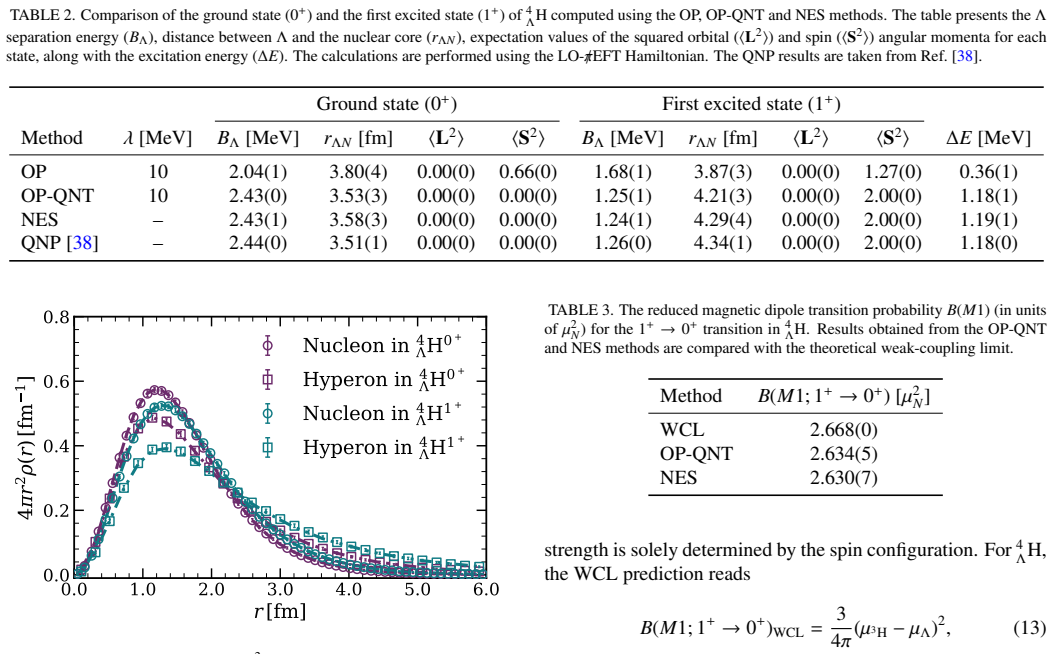
Both the OP-QNT and NES methods can reproduce diagonal observables, such as energies and spatial structures, in excellent agreement with rigorous benchmarks. We further provide, to our knowledge, the first ab initio calculation of the M1 transition strength for ^{4}_ΛH. The calculated transition strength is consistent with the weak-coupling limit, exhibiting a ∼1.3% suppression. This work demonstrates that NQS can be elevated from ground-state solvers to practical tools for nuclear and hypernuclear spectroscopy.
What carries the argument
The overlap penalty quantum number targeting (OP-QNT) and natural excited state (NES) methods within neural-network quantum states to isolate and compute low-lying excited states while handling spin contamination.
If this is right
- OP-QNT and NES methods accurately match benchmark energies and structures for excited states.
- The M1 transition strength for ^{4}_ΛH is calculated ab initio for the first time with ~1.3% suppression.
- NQS framework can be used for practical nuclear and hypernuclear spectroscopy.
Where Pith is reading between the lines
- This success in A=4 systems suggests potential applicability to slightly larger nuclei where exact methods are still feasible for validation.
- The small suppression in the transition strength may indicate subtle effects in hypernuclear wave functions that could be probed in other observables.
- If the methods prove robust, they could reduce reliance on traditional basis expansions in nuclear structure calculations.
Load-bearing premise
The neural network representation combined with the overlap penalty quantum number targeting and natural excited state methods is assumed to accurately isolate and describe the desired low-lying excited states without residual spin contamination or variational bias that would invalidate the benchmark agreement or the new M1 prediction.
What would settle it
A calculation using a different high-accuracy method, such as Green's function Monte Carlo, that finds an M1 transition strength for ^{4}_ΛH differing substantially from the ~1.3% suppression would falsify the result.
Figures


read the original abstract
We present the first variational Monte Carlo study of nuclear and hypernuclear excited states within the neural-network quantum states (NQS) framework. We implement both the overlap penalty (OP) and natural excited state (NES) methods to compute low-lying excitation spectra. To address the spin contamination in hypernuclear calculations, we propose a quantum number targeting (QNT) technique for the OP method. Both the OP-QNT and NES methods can reproduce diagonal observables, such as energies and spatial structures, in excellent agreement with rigorous benchmarks. We further provide, to our knowledge, the first \textit{ab initio} calculation of the $M1$ transition strength for $^{4}_{\Lambda}\mathrm{H}$. The calculated transition strength is consistent with the weak-coupling limit, exhibiting a $\sim$1.3\% suppression. This work demonstrates that NQS can be elevated from ground-state solvers to practical tools for nuclear and hypernuclear spectroscopy.
Editorial analysis
A structured set of objections, weighed in public.
Referee Report
Summary. The manuscript presents the first variational Monte Carlo study of excited states in A=4 nuclei and hypernuclei using neural-network quantum states. It implements overlap penalty with quantum number targeting (OP-QNT) and natural excited state (NES) methods to compute low-lying spectra while addressing spin contamination. The methods are reported to reproduce energies and spatial structures in excellent agreement with rigorous benchmarks. The work also claims the first ab initio M1 transition strength for ^{4}_ΛH, finding consistency with the weak-coupling limit and a ∼1.3% suppression.
Significance. If the central results hold, the work is significant for extending NQS methods from ground states to practical spectroscopy in nuclear and hypernuclear systems. It provides a new ab initio prediction for an M1 transition in a hypernucleus and introduces the QNT technique to mitigate spin contamination. Credit is due for the benchmark comparisons on diagonal observables and for delivering the first such transition calculation within this framework.
major comments (2)
- [Abstract] Abstract: the claim that OP-QNT and NES wavefunctions yield the M1 transition strength with ∼1.3% suppression rests on an untested extrapolation; only diagonal observables (energies, spatial structures) are stated to agree with benchmarks, but no equivalent validation, error analysis, or cross-check is described for the off-diagonal matrix element. This is load-bearing for the new prediction, as variational bias or residual contamination could affect the small correction without altering diagonal quantities.
- [Abstract] The description of the OP-QNT technique (to address spin contamination in hypernuclei) does not specify how the targeting preserves the fidelity needed for transition matrix elements; without this, the consistency with the weak-coupling limit cannot be assessed as robust rather than an artifact of the variational optimization.
Simulated Author's Rebuttal
We thank the referee for the careful reading of our manuscript and the constructive comments. We address the major comments point by point below, agreeing to revisions that strengthen the presentation of our results on the M1 transition and the OP-QNT method.
read point-by-point responses
-
Referee: [Abstract] Abstract: the claim that OP-QNT and NES wavefunctions yield the M1 transition strength with ∼1.3% suppression rests on an untested extrapolation; only diagonal observables (energies, spatial structures) are stated to agree with benchmarks, but no equivalent validation, error analysis, or cross-check is described for the off-diagonal matrix element. This is load-bearing for the new prediction, as variational bias or residual contamination could affect the small correction without altering diagonal quantities.
Authors: We acknowledge the validity of this concern: the manuscript validates the wavefunctions primarily through diagonal observables, and no dedicated cross-check or error analysis is provided specifically for the off-diagonal M1 matrix element. While the variational optimization targets accurate energies and structures, this does not automatically ensure equivalent precision for the small transition correction. In the revised manuscript we will add a new subsection discussing the expected accuracy of the computed M1 strength (including a quantitative estimate of residual variational bias), report statistical uncertainties from the Monte Carlo sampling, and include an explicit consistency check against the weak-coupling limit beyond the single quoted percentage. revision: yes
-
Referee: [Abstract] The description of the OP-QNT technique (to address spin contamination in hypernuclei) does not specify how the targeting preserves the fidelity needed for transition matrix elements; without this, the consistency with the weak-coupling limit cannot be assessed as robust rather than an artifact of the variational optimization.
Authors: We agree that the current description of OP-QNT is insufficiently detailed on this point. The quantum-number penalty is constructed to project out components with incorrect total angular momentum and isospin while leaving the physical subspace unconstrained; because the penalty is applied only during optimization and vanishes for correctly targeted states, the resulting wavefunctions retain the symmetries required for accurate off-diagonal matrix elements. In the revision we will expand the methods section with a step-by-step description of the penalty implementation, demonstrate that the penalty term does not bias the transition operator, and show that the observed 1.3 % suppression is stable under variations of the penalty strength. revision: yes
Circularity Check
No circularity; diagonal results benchmarked externally and M1 is independent new output
full rationale
The paper applies neural-network quantum states with OP-QNT and NES targeting to compute A=4 spectra. Diagonal observables (energies, structures) are stated to match external rigorous benchmarks, while the M1 transition strength for ^{4}_ΛH is reported as a first ab initio result. No equation or method reduces by construction to a fitted parameter, self-citation chain, or renamed input; the variational procedure and state isolation are independent of the reported M1 value, which is not forced by the diagonal fits.
Axiom & Free-Parameter Ledger
Reference graph
Works this paper leans on
-
[1]
U.-G. Meißner, S. Shen, S. Elhatisari, D. Lee, Ab initio calculation of the alpha-particle monopole transition form factor, Phys. Rev. Lett. 132 (2024) 062501. URL:https://link.aps. org/doi/10.1103/PhysRevLett.132.062501. doi:10.1103/PhysRevLett.132.062501
-
[2]
A. Gal, E. V . Hungerford, D. J. Millener, Strangeness in nuclear physics, Rev. Mod. Phys. 88 (2016) 035004. URL:https://link.aps. org/doi/10.1103/RevModPhys.88.035004. doi:10.1103/RevModPhys.88.035004
-
[3]
M. Bedjidian, A. Filipkowski, J. Grossiord, A. Guichard, M. Gusakow, S. Majewski, H. Piekarz, J. Piekarz, J. Pizzi, Observation of aγtransition in the λ 4hhy- pernucleus, Physics Letters B 62 (1976) 467–470. URL:https://www.sciencedirect.com/science/ article/pii/0370269376906869. doi:https://doi. org/10.1016/0370-2693(76)90686-9
-
[4]
A. Esser, S. Nagao, F. Schulz, P. Achenbach, C. Ayerbe Gayoso, R. Böhm, O. Borodina, D. Bosnar, V . Bozkurt, L. Debenjak, M. O. Distler, I. Friš ˇci´c, Y . Fujii, T. Gogami, O. Hashimoto, S. Hirose, H. Kanda, M. Kaneta, E. Kim, Y . Kohl, J. Kusaka, A. Margaryan, H. Merkel, M. Mihovilovi ˇc, U. Müller, S. N. Naka- mura, J. Pochodzalla, C. Rappold, J. Reinh...
-
[5]
T. O. Yamamoto, M. Agnello, Y . Akazawa, N. Amano, K. Aoki, E. Botta, N. Chiga, H. Ekawa, P. Evtoukhovitch, A. Feliciello, M. Fujita, T. Gogami, S. Hasegawa, S. H. Hayakawa, T. Hayakawa, R. Honda, K. Ho- somi, S. H. Hwang, N. Ichige, Y . Ichikawa, M. Ikeda, K. Imai, S. Ishimoto, S. Kanatsuki, M. H. Kim, S. H. Kim, S. Kinbara, T. Koike, J. Y . Lee, S. Marc...
-
[6]
G. Carleo, I. Cirac, K. Cranmer, L. Daudet, M. Schuld, N. Tishby, L. V ogt-Maranto, L. Zdeborová, Machine learning and the physical sciences, Rev. Mod. Phys. 91 (2019) 045002. URL:https://link.aps.org/ doi/10.1103/RevModPhys.91.045002. doi:10.1103/ RevModPhys.91.045002
-
[7]
A. Boehnlein, M. Diefenthaler, N. Sato, M. Schram, V . Ziegler, C. Fanelli, M. Hjorth-Jensen, T. Horn, M. P. Kuchera, D. Lee, W. Nazarewicz, P. Ostroumov, K. Orginos, A. Poon, X.-N. Wang, A. Scheinker, M. S. Smith, L.-G. Pang, Colloquium: Ma- chine learning in nuclear physics, Rev. Mod. Phys. 94 (2022) 031003. URL:https://link.aps.org/ doi/10.1103/RevModP...
- [8]
-
[9]
A. Giri, J. Kim, C. Drischler, C. Elster, R. J. Furnstahl, Active learning emulators for nuclear two-body scattering in momentum space, Phys. Rev. C 113 (2026) 044001. doi:10.1103/s6my-pqs9.arXiv:2512.17842
-
[10]
C.-X. Wang, T. Naito, J. Li, H.-Z. Liang, A neural network approach for two-body systems with spin and isospin degrees of freedom, Nuclear Sci- ence and Techniques 37 (2026) 114. URL:https: //doi.org/10.1007/s41365-026-01946-x. doi:10. 1007/s41365-026-01946-x
-
[11]
Y . Yang, E. Epelbaum, J. Meng, L. Meng, P. Zhao, Chiral symmetry and peripheral neutron-αscattering, Phys. Rev. Lett. 135 (2025) 172502. URL:https: //link.aps.org/doi/10.1103/45g7-bmp6. doi:10. 1103/45g7-bmp6
-
[12]
R. Wang, Y .-G. Ma, R. Wada, L.-W. Chen, W.-B. He, H.-L. Liu, K.-J. Sun, Nuclear liquid-gas phase transition with machine learning, Phys. Rev. Res. 2 (2020) 043202. URL:https://link.aps.org/doi/ 10.1103/PhysRevResearch.2.043202. doi:10.1103/ PhysRevResearch.2.043202
-
[13]
R. Y . Cheng, K. Godbey, Y . B. Niu, W. B. He, S. M. Wang, Reduced-basis method for few-body bound-state emula- tion, Phys. Rev. C 111 (2025) 064315. URL:https: //link.aps.org/doi/10.1103/4ccs-66c6. doi:10. 1103/4ccs-66c6
-
[14]
X. H. Wu, Z. X. Ren, P. W. Zhao, Nuclear energy den- sity functionals from machine learning, Phys. Rev. C 105 (2022) L031303. URL:https://link.aps.org/ doi/10.1103/PhysRevC.105.L031303. doi:10.1103/ PhysRevC.105.L031303
-
[15]
Y . Huang, J. Chen, J. Jia, L.-M. Liu, Y .-G. Ma, C. Zhang, Validation and extrapolation of atomic masses with a physics-informed fully connected neural network, Phys. Rev. C 111 (2025) 034329. URL:https://link. aps.org/doi/10.1103/PhysRevC.111.034329. doi:10.1103/PhysRevC.111.034329
-
[16]
H. Wu, Y . Wang, Y . Wang, X. Deng, X. Cao, D. Fang, W. Ma, W. He, C. Fu, Y . Ma, Machine learning method for 12C event classification and reconstruction in the active target time-projection chamber, Nucl. Instrum. Meth. A 1055 (2023) 168528. doi:10.1016/j.nima. 2023.168528.arXiv:2304.13233
-
[17]
W. He, Q. Li, Y . Ma, Z. Niu, J. Pei, Y . Zhang, Machine learning in nuclear physics at low and in- termediate energies, Sci. China Phys. Mech. Astron. 66 (2023) 282001. doi:10.1007/s11433-023-2116-0. arXiv:2301.06396
- [18]
-
[19]
D. Liu, A. N. A, Z.-Z. Qin, Y . Lei, Neural net- work study of the nuclear ground-state spin distribu- tion within a random interaction ensemble, Nuclear Science and Techniques 35 (2024) 64. URL:https: //doi.org/10.1007/s41365-024-01424-2. doi:10. 1007/s41365-024-01424-2
-
[20]
G. Carleo, M. Troyer, Solving the quantum many-body problem with artificial neural net- works, Science 355 (2017) 602–606. URL: https://www.science.org/doi/abs/10.1126/ science.aag2302. doi:10.1126/science.aag2302. arXiv:https://www.science.org/doi/pdf/10.1126/science.aag2302
-
[21]
D. Pfau, J. S. Spencer, A. G. D. G. Matthews, W. M. C. Foulkes, Ab initio solution of the many-electron schrödinger equation with deep neural networks, Phys. Rev. Res. 2 (2020) 033429. URL:https://link.aps. org/doi/10.1103/PhysRevResearch.2.033429. doi:10.1103/PhysRevResearch.2.033429
-
[22]
D. Pfau, S. Axelrod, H. Sutterud, I. von Glehn, J. S. Spencer, Accurate computation of quantum excited states with neural networks, Science 385 (2024) eadn0137. URL:https://www.science.org/ doi/abs/10.1126/science.adn0137. doi:10.1126/ science.adn0137
-
[23]
J. Hermann, Z. Schätzle, F. Noé, Deep-neural- network solution of the electronic Schrödinger equa- tion, Nature Chemistry 12 (2020) 891–897. URL: https://doi.org/10.1038/s41557-020-0544-y. doi:10.1038/s41557-020-0544-y
-
[24]
R. Li, H. Ye, D. Jiang, X. Wen, C. Wang, Z. Li, X. Li, D. He, J. Chen, W. Ren, L. Wang, A com- putational framework for neural network-based varia- tional Monte Carlo with Forward Laplacian, Nature Machine Intelligence 6 (2024) 209–219. URL:https: //doi.org/10.1038/s42256-024-00794-x. doi:10. 1038/s42256-024-00794-x
-
[25]
J. Han, L. Zhang, W. E, Solving many-electron schrödinger equation using deep neural networks, Journal of Computational Physics 399 (2019) 108929. URL:https://www.sciencedirect.com/science/ article/pii/S0021999119306345. doi:https: //doi.org/10.1016/j.jcp.2019.108929
-
[26]
M. T. Entwistle, Z. Schätzle, P. A. Erdman, J. Hermann, F. Noé, Electronic excited states in deep variational monte carlo, Nature Communications 14 (2023) 274. URL: https://doi.org/10.1038/s41467-022-35534-5. doi:10.1038/s41467-022-35534-5. 7
-
[27]
W. A. Wheeler, K. G. Kleiner, L. K. Wagner, En- semble variational monte carlo for optimization of cor- related excited state wave functions, Electronic Struc- ture 6 (2024) 025001. URL:https://doi.org/10. 1088/2516-1075/ad38f8. doi:10.1088/2516-1075/ ad38f8
-
[28]
Z. Li, Z. Lu, R. Li, X. Wen, X. Li, L. Wang, J. Chen, W. Ren, Spin-symmetry-enforced solution of the many- body Schrödinger equation with a deep neural network, Nature Computational Science 4 (2024) 910–919. URL: https://doi.org/10.1038/s43588-024-00730-4. doi:10.1038/s43588-024-00730-4
-
[29]
C. Adams, G. Carleo, A. Lovato, N. Rocco, Varia- tional monte carlo calculations ofA≤4 nuclei with an artificial neural-network correlator ansatz, Phys. Rev. Lett. 127 (2021) 022502. URL:https://link. aps.org/doi/10.1103/PhysRevLett.127.022502. doi:10.1103/PhysRevLett.127.022502
-
[30]
A. Lovato, C. Adams, G. Carleo, N. Rocco, Hidden- nucleons neural-network quantum states for the nu- clear many-body problem, Phys. Rev. Res. 4 (2022) 043178. URL:https://link.aps.org/doi/ 10.1103/PhysRevResearch.4.043178. doi:10.1103/ PhysRevResearch.4.043178
-
[31]
A. Gnech, C. Adams, N. Brawand, G. Carleo, A. Lovato, N. Rocco, Nuclei with up to a=6 nucleons with artificial neural network wave func- tions, Few-Body Systems 63 (2021) 7. URL:https: //doi.org/10.1007/s00601-021-01706-0. doi:10. 1007/s00601-021-01706-0
-
[32]
Y . L. Yang, P. W. Zhao, Deep-neural-network approach to solving the ab initio nuclear structure problem, Phys. Rev. C 107 (2023) 034320. URL:https://link.aps.org/ doi/10.1103/PhysRevC.107.034320. doi:10.1103/ PhysRevC.107.034320
-
[33]
A. Gnech, B. Fore, A. J. Tropiano, A. Lovato, Dis- tilling the essential elements of nuclear binding via neural-network quantum states, Phys. Rev. Lett. 133 (2024) 142501. URL:https://link.aps. org/doi/10.1103/PhysRevLett.133.142501. doi:10.1103/PhysRevLett.133.142501
-
[34]
Y .-L. Yang, P.-W. Zhao, Reconciling light nu- clei and nuclear matter: Relativistic ab ini- tio calculations, Chin. Phys. Lett. 42 (2025) 051201. URL:http://cpl.iphy.ac.cn/en/ article/doi/10.1088/0256-307X/42/5/051201. doi:10.1088/0256-307X/42/5/051201
-
[35]
E. Parnes, N. Barnea, G. Carleo, A. Lovato, N. Rocco, X. Zhang, Nuclear responses with neural-network quan- tum states, Phys. Rev. Lett. 136 (2026) 032501. URL: https://link.aps.org/doi/10.1103/tlqz-nw28. doi:10.1103/tlqz-nw28
-
[36]
P. Wen, A. Gezerlis, J. W. Holt, Neural quantum states for light nuclei with chiral two- and three-body interac- tions, Phys. Rev. Lett. 136 (2026) 172502. URL:https: //link.aps.org/doi/10.1103/ygkf-llyp. doi:10. 1103/ygkf-llyp
- [37]
-
[38]
Z.-X. Zhang, Y .-L. Yang, W.-B. He, P.-W. Zhao, B.-N. Lu, Y .-G. Ma, Machine learning the single- λhypernuclei with neural-network quantum states, Physics Letters B 874 (2026) 140285. URL: https://www.sciencedirect.com/science/ article/pii/S0370269326001395. doi:https: //doi.org/10.1016/j.physletb.2026.140285
-
[39]
A. Di Donna, L. Contessi, A. Lovato, F. Pederiva, Hy- pernuclei with neural network quantum states, Phys. Rev. Res. 8 (2026) 013160. URL:https://link.aps.org/ doi/10.1103/wmxg-cnrg. doi:10.1103/wmxg-cnrg
-
[40]
W.-L. Wu, L. Meng, S.-L. Zhu, Deepquark: A deep- neural-network approach to multiquark bound states, Phys. Rev. Lett. 136 (2026) 071901. URL:https: //link.aps.org/doi/10.1103/ckpr-s876. doi:10. 1103/ckpr-s876
-
[41]
J. Kim, G. Pescia, B. Fore, J. Nys, G. Carleo, S. Gandolfi, M. Hjorth-Jensen, A. Lovato, Neural- network quantum states for ultra-cold fermi gases, Communications Physics 7 (2024) 148. URL:https: //doi.org/10.1038/s42005-024-01613-w. doi:10. 1038/s42005-024-01613-w
-
[42]
W. T. Lou, H. Sutterud, G. Cassella, W. M. C. Foulkes, J. Knolle, D. Pfau, J. S. Spencer, Neural wave functions for superfluids, Phys. Rev. X 14 (2024) 021030. URL: https://link.aps.org/doi/10.1103/PhysRevX. 14.021030. doi:10.1103/PhysRevX.14.021030
-
[43]
B. Fore, J. M. Kim, G. Carleo, M. Hjorth-Jensen, A. Lovato, M. Piarulli, Dilute neutron star matter from neural-network quantum states, Phys. Rev. Res. 5 (2023) 033062. URL:https://link.aps.org/doi/ 10.1103/PhysRevResearch.5.033062. doi:10.1103/ PhysRevResearch.5.033062
-
[44]
B. Fore, J. Kim, M. Hjorth-Jensen, A. Lovato, Investigat- ing the crust of neutron stars with neural-network quan- tum states, Communications Physics 8 (2025) 108. URL: https://doi.org/10.1038/s42005-025-02015-2. doi:10.1038/s42005-025-02015-2
-
[45]
S. Sorella, L. Capriotti, Green function monte carlo with stochastic reconfiguration: An effective remedy for the sign problem, Phys. Rev. B 61 (2000) 2599–2612. URL:https://link.aps. 8 org/doi/10.1103/PhysRevB.61.2599. doi:10.1103/ PhysRevB.61.2599
-
[46]
J. Stokes, J. Izaac, N. Killoran, G. Carleo, Quan- tum Natural Gradient, Quantum 4 (2020) 269. URL: https://doi.org/10.22331/q-2020-05-25-269. doi:10.22331/q-2020-05-25-269
-
[47]
M. Gattobigio, A. Kievsky, M. Viviani, Embedding nu- clear physics inside the unitary-limit window, Phys. Rev. C 100 (2019) 034004. URL:https://link.aps.org/ doi/10.1103/PhysRevC.100.034004. doi:10.1103/ PhysRevC.100.034004
-
[48]
R. Vein, P. Dale, Determinants and their applications in mathematical physics, volume 134, Springer, 1999
1999
-
[49]
von Glehn, J
I. von Glehn, J. S. Spencer, D. Pfau, A self- attention ansatz for ab-initio quantum chemistry,
- [50]
-
[51]
J.-H. Chen, F.-K. Guo, Y .-G. Ma, C.-P. Shen, Q.-Y . Shou, Q. Shou, Q. Wang, J.-J. Wu, B.-S. Zou, Pro- duction of exotic hadrons in pp and nuclear colli- sions, Nucl. Sci. Tech. 36 (2025) 55. doi:10.1007/ s41365-025-01664-w.arXiv:2411.18257
-
[52]
J.-H. Chen, L.-S. Geng, E. Hiyama, Z.-W. Liu, J. Pochodzalla, Perspectives for Hyperon and Hy- pernuclei Physics, Chin. Phys. Lett. 42 (2025) 100101. doi:10.1088/0256-307X/42/10/100101. arXiv:2506.00864
-
[53]
K.-J. Sun, D.-N. Liu, Y .-P. Zheng, J.-H. Chen, C. M. Ko, Y .-G. Ma, Deciphering Hypertriton and Antihyper- triton Spins from Their Global Polarizations in Heavy- Ion Collisions, Phys. Rev. Lett. 134 (2025) 022301. doi:10.1103/PhysRevLett.134.022301
-
[54]
R.-Q. Wang, X.-L. Hou, Y .-H. Li, J. Song, F.- L. Shao, Production characteristics of light nu- clei, hypertritons, andω-hypernuclei in pb+pb collisions at √sNN =5.02tev, Nuclear Sci- ence and Techniques 36 (2025) 185. URL: https://doi.org/10.1007/s41365-025-01750-z. doi:10.1007/s41365-025-01750-z
-
[55]
R. H. Dalitz, A. Gal, The formation of, and theγ-radiation from, thep-shell hypernuclei, An- nals of Physics 116 (1978) 167–243. URL:https:// doi.org/10.1016/0003-4916(78)90008-8. doi:10. 1016/0003-4916(78)90008-8
-
[56]
A. Nogga, H. Kamada, W. Glöckle, The hy- pernuclei 4 ΛHe and 4 ΛH: Challenges for mod- ern hyperon-nucleon forces, Phys. Rev. Lett. 88 (2002) 172501. URL:https://link.aps. org/doi/10.1103/PhysRevLett.88.172501. doi:10.1103/PhysRevLett.88.172501
-
[57]
A. A. Usmani, F. C. Khanna, Behaviour of theλn andλnn potential strengths in the λ 5he hypernucleus, Journal of Physics G: Nuclear and Particle Physics 35 (2008) 025105. URL:https://doi.org/10.1088/ 0954-3899/35/2/025105. doi:10.1088/0954-3899/ 35/2/025105
-
[59]
D. Lonardoni, F. Pederiva, S. Gandolfi, Aux- iliary field diffusion monte carlo study of the hyperon–nucleon interaction inλ-hypernuclei, Nuclear Physics A 914 (2013) 243–247. URL: https://www.sciencedirect.com/science/ article/pii/S0375947412003247. doi:https: //doi.org/10.1016/j.nuclphysa.2012.12.001, xI International Conference on Hypernuclear and Stra...
-
[60]
Reconstructing the impact parameter of proton-nucleus and nucleus-nucleus collisions
D. Lonardoni, F. Pederiva, S. Gandolfi, Accurate determination of the interaction betweenΛhyperons and nucleons from auxiliary field diffusion monte carlo calculations, Phys. Rev. C 89 (2014) 014314. URL: https://link.aps.org/doi/10.1103/PhysRevC. 89.014314. doi:10.1103/PhysRevC.89.014314
-
[61]
Nemura, Y
H. Nemura, Y . Suzuki, Y . Fujiwara, C. Nakamoto, Study of lightΛ- andΛΛ-hypernuclei with the stochastic variational method and effectiveΛNpotentials, Progress of Theoretical Physics 103 (1999) 929–958. URL: https://api.semanticscholar.org/CorpusID: 119020525
1999
-
[62]
M. Schäfer, N. Barnea, A. Gal, In-mediumΛ isospin impurity from charge symmetry breaking in the 4 ΛH−4 ΛHe mirror hypernuclei, Phys. Rev. C 106 (2022) L031001. URL:https://link.aps.org/ doi/10.1103/PhysRevC.106.L031001. doi:10.1103/ PhysRevC.106.L031001
-
[63]
L. Contessi, N. Barnea, A. Gal, Resolving theΛhypernuclear overbinding problem in pi- onless effective field theory, Phys. Rev. Lett. 121 (2018) 102502. URL:https://link.aps. org/doi/10.1103/PhysRevLett.121.102502. doi:10.1103/PhysRevLett.121.102502
-
[64]
L. Contessi, M. Schäfer, N. Barnea, A. Gal, J. Mareš, The onset ofΛΛ-hypernuclear binding, Phys. Lett. B 797 (2019) 134893. doi:10.1016/j.physletb.2019. 134893.arXiv:1905.06775
-
[65]
M. Schäfer, B. Bazak, N. Barnea, J. Mareš, Nature of theΛnn(J π =1/2 +,I=1) and 3 ΛH∗(J π =3/2 +,I=0) states, Phys. Rev. C 103 (2021) 025204. doi:10.1103/ PhysRevC.103.025204.arXiv:2007.10264. 9
-
[66]
Schäfer, B
M. Schäfer, B. Bazak, N. Barnea, A. Gal, J. Mareš, Consequences of increased hypertriton binding for s- shellλ-hypernuclear systems, Physical Review C (2021). URL:https://api.semanticscholar.org/ CorpusID:237364151
2021
-
[67]
H. Nemura, Y . Akaishi, Y . Suzuki, Ab ini- tio approach tos-shell hypernuclei 3 ΛH, 4 ΛH, 4 ΛHe, and 5 ΛHe with aΛn−Σninteraction, Phys. Rev. Lett. 89 (2002) 142504. URL:https://link.aps. org/doi/10.1103/PhysRevLett.89.142504. doi:10. 1103/PhysRevLett.89.142504
-
[68]
R. Wirth, R. Roth, Light neutron-rich hypernu- clei from the importance-truncated no-core shell model, Physics Letters B 779 (2018) 336–341. URL:https://www.sciencedirect.com/science/ article/pii/S0370269318301230. doi:https: //doi.org/10.1016/j.physletb.2018.02.021
-
[69]
D. Gazda, T. Yadanar Htun, C. Forssén, Nuclear physics uncertainties in light hypernuclei, Phys. Rev. C 106 (2022) 054001. URL:https://link.aps.org/ doi/10.1103/PhysRevC.106.054001. doi:10.1103/ PhysRevC.106.054001
-
[70]
H. Le, J. Haidenbauer, U.-G. Meißner, A. Nogga, LightΛhypernuclei studied with chiral hyperon- nucleon and hyperon-nucleon-nucleon forces, Phys. Rev. Lett. 134 (2025) 072502. URL:https://link. aps.org/doi/10.1103/PhysRevLett.134.072502. doi:10.1103/PhysRevLett.134.072502
-
[71]
H. Le, J. Haidenbauer, H. Kamada, M. Kohno, U. G. Meiß ner, K. Miyagawa, A. Nogga, Benchmark- ingΛNNthree - body forces and first predictions for A=3−5 hypernuclei, The European Physical Journal A 61 (2025) 21. URL:https://doi.org/ 10.1140/epja/s10050-024-01474-5. doi:10.1140/ epja/s10050-024-01474-5
-
[72]
X. Li, N. Michel, J. Li, X.-R. Zhou, Gamow shell model description of neutron-rich he hyper- isotopes, Physics Letters B 868 (2025) 139708. URL:https://www.sciencedirect.com/science/ article/pii/S0370269325004691. doi:https: //doi.org/10.1016/j.physletb.2025.139708
-
[73]
D. K. Frame, T. A. Lähde, D. Lee, U.-G. Meissner, Im- purity lattice monte carlo for hypernuclei, The Euro- pean Physical Journal A 56 (2020). URL:https://api. semanticscholar.org/CorpusID:220496392
2020
-
[74]
F. Hildenbrand, S. Elhatisari, T. A. Lähde, D. Lee, U.- G. Meißner, Lattice Monte Carlo simulations with two impurity worldlines, The European Physical Journal A 58 (2022) 167. URL:https://doi.org/ 10.1140/epja/s10050-022-00821-8. doi:10.1140/ epja/s10050-022-00821-8
-
[75]
F. Hildenbrand, S. Elhatisari, Z. Ren, U. G. Meißner, Towards hypernuclei from nuclear lat- tice effective field theory, The European Phys- ical Journal A 60 (2024) 215. URL:https: //doi.org/10.1140/epja/s10050-024-01427-y. doi:10.1140/epja/s10050-024-01427-y
-
[76]
H. Tong, S. Elhatisari, U.-G. Meißner, Ab initio cal- culation of hyper-neutron matter, Science Bulletin 70 (2025) 825–828. URL:https://www.sciencedirect. com/science/article/pii/S2095927325000210. doi:https://doi.org/10.1016/j.scib.2025.01. 008
- [77]
-
[78]
H. Tong, S. Elhatisari, U.-G. Meißner, Z. Ren, Multi-strangeness matter from ab initio calculations,
- [79]
-
[80]
Neural-network excited states of A= 4nuclei and hypernuclei
E. Hiyama, M. Kamimura, K. Miyazaki, T. Mo- toba,γtransitions inA=7 hypernuclei and a possible derivation of hypernuclear size, Phys. Rev. C 59 (1999) 2351–2360. URL:https://link.aps. org/doi/10.1103/PhysRevC.59.2351. doi:10.1103/ PhysRevC.59.2351. 10 Supplementary Material for “Neural-network excited states of A= 4nuclei and hypernuclei” Zi-Xiao Zhang, 1...
-
[81]
Gattobigio, A
M. Gattobigio, A. Kievsky, and M. Viviani, Embedding nuclear physics inside the unitary-limit window, Phys. Rev. C100, 034004 (2019)
2019
discussion (0)
Sign in with ORCID, Apple, or X to comment. Anyone can read and Pith papers without signing in.