CJ26 Global QCD Analysis with Large-x Jefferson Lab 6 and 12 GeV Data
Pith reviewed 2026-06-28 21:46 UTC · model grok-4.3
The pith
JLab 12 GeV data disentangles higher-twist effects from off-shell corrections to sharpen large-x n/p and d/u ratios.
A machine-rendered reading of the paper's core claim, the machinery that carries it, and where it could break.
Core claim
The CJ26 analysis shows that the increased Q2 leverage of JLab 12 GeV data enables unique disentanglement of higher-twist effects from off-shell nucleon corrections, yielding a highly accurate determination of the n/p structure function ratio with uncertainties reduced by 30-50 percent and the d/u valence quark ratio with uncertainties reduced by 5-10 percent.
What carries the argument
The JLab 12 GeV DIS measurements provide the Q2 leverage needed to separate higher-twist effects from off-shell nucleon corrections at large x.
If this is right
- The n/p structure function ratio is obtained with 30-50% smaller uncertainties than prior fits.
- The d/u valence quark ratio is obtained with 5-10% smaller uncertainties than prior fits.
- The resulting NLO PDFs and structure functions are released in LHAPDF format for external use.
- Accounting for correlated systematic uncertainties is required to reach the stated precision.
Where Pith is reading between the lines
- Improved large-x valence distributions could tighten predictions for high-x observables at the LHC or future electron-ion colliders.
- The separation technique may extend to other data sets once sufficient Q2 lever arm becomes available.
- More precise d/u constraints could help test models of nucleon flavor structure at high momentum fractions.
Load-bearing premise
The chosen functional forms for higher-twist and off-shell corrections are flexible enough to allow the 12 GeV data to separate them from leading-twist PDFs without leftover model dependence.
What would settle it
A new analysis or data set that produces n/p or d/u ratios differing by more than the quoted uncertainty bands when alternate functional forms for the corrections are substituted would falsify the claim of unique disentanglement.
Figures



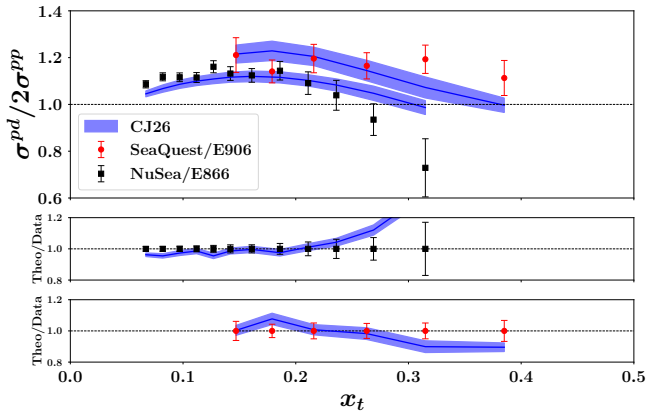
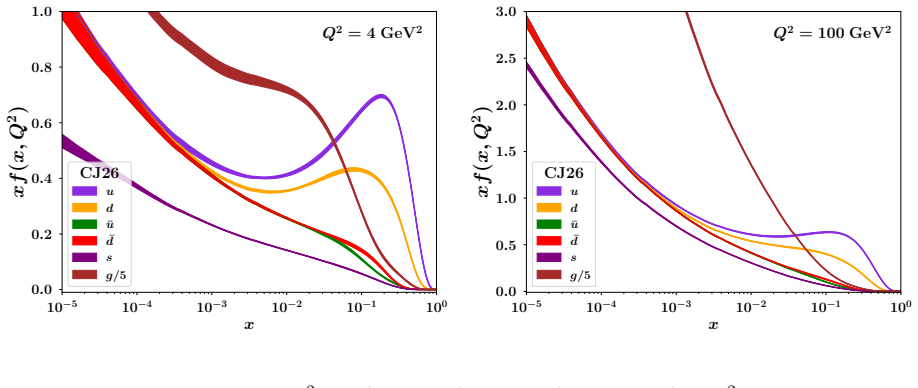
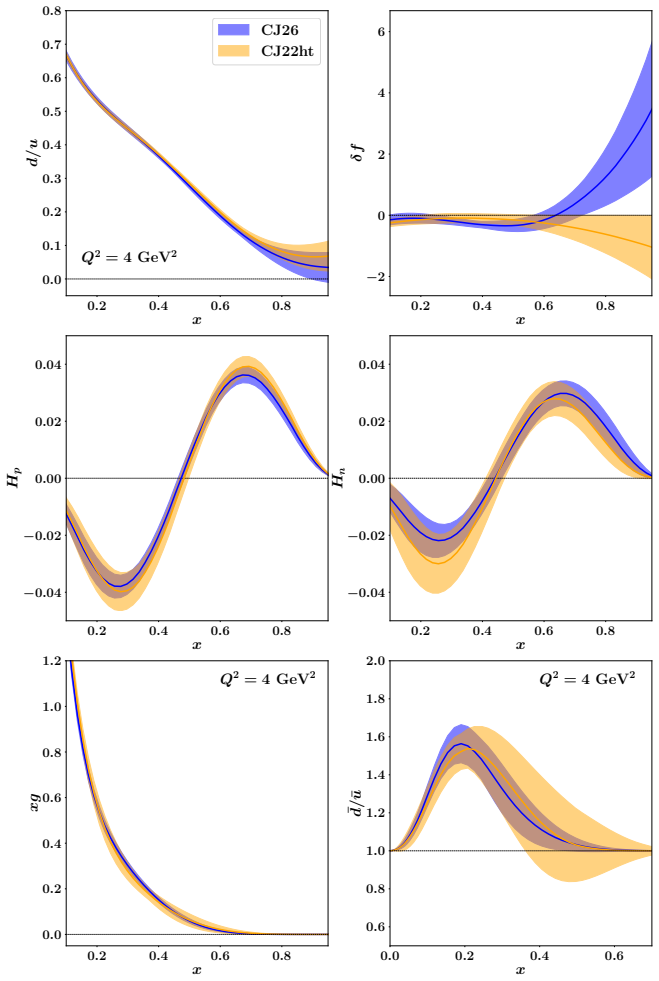


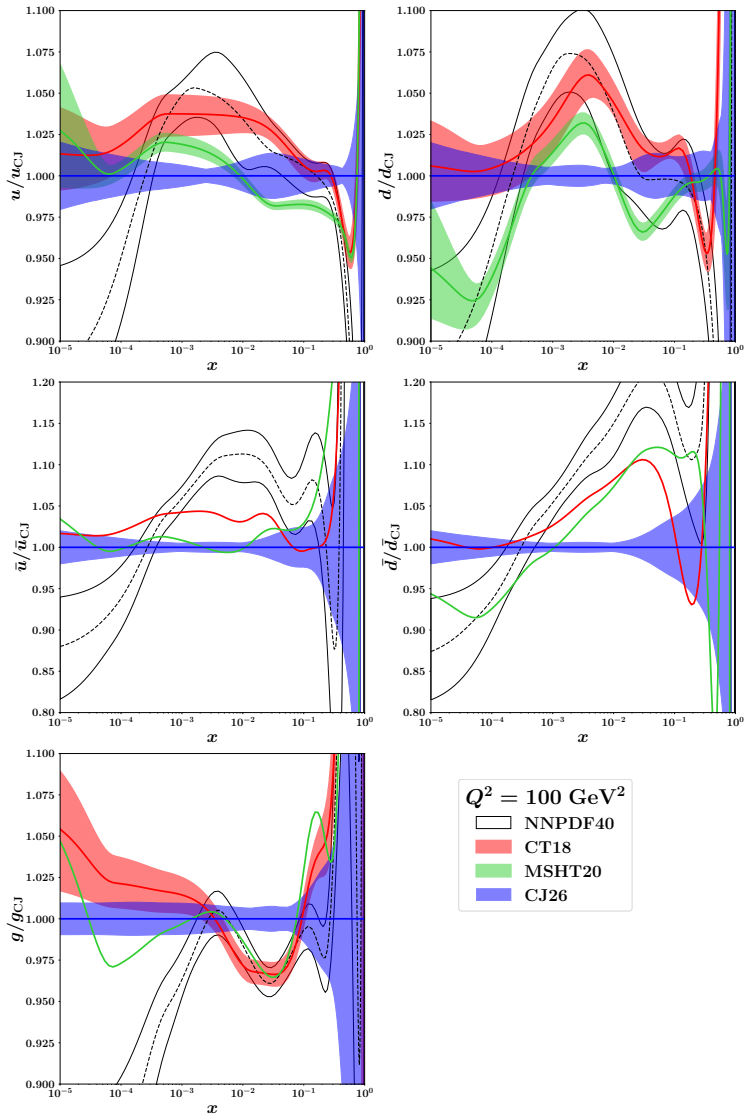




read the original abstract
We present CJ26, the new CTEQ-JLab global QCD analysis that incorporates for the first time the complete suite of JLab 6 GeV DIS measurements and the first published JLab 12 GeV measurements. Focused on the large-$x$ region, the analysis utilizes the increased $Q^2$ leverage of the 12 GeV data to uniquely disentangle higher-twist effects from off-shell nucleon corrections. This leads to a highly accurate determination of the $n/p$ structure function ratio and the $d/u$ valence quark ratio, with uncertainties reduced by 30-50% and 5-10%, respectively. We highlight the critical role of experimental correlated systematic uncertainties in achieving this precision and provide the resulting NLO PDFs and structure functions in LHAPDF format for general use.
Editorial analysis
A structured set of objections, weighed in public.
Referee Report
Summary. The manuscript presents CJ26, a new global NLO QCD analysis incorporating the full set of JLab 6 GeV DIS data plus the first published JLab 12 GeV measurements. Focused on the large-x region, the central claim is that the increased Q² reach of the 12 GeV data permits unique separation of higher-twist and off-shell nucleon corrections from leading-twist PDFs, yielding 30-50% smaller uncertainties on the n/p structure-function ratio and 5-10% smaller uncertainties on the d/u valence ratio. The paper stresses the role of correlated experimental systematics and releases the resulting PDFs and structure functions in LHAPDF format.
Significance. If the disentanglement procedure is robust against parametrization choices, the work would deliver improved large-x constraints that are directly relevant for LHC phenomenology and for interpreting future JLab and EIC data. The release of public grids is a clear positive. However, the quoted precision gains are obtained entirely from a fit to the same data used to determine the corrections, so independent cross-checks would be needed to establish that the reductions reflect genuine new information rather than internal fit constraints.
major comments (2)
- [Abstract and §3] Abstract and §3 (methodology): the assertion that the 12 GeV data 'uniquely disentangle' higher-twist from off-shell corrections is load-bearing for the 30-50% and 5-10% uncertainty reductions, yet the text provides no explicit sensitivity tests to the chosen functional forms of the higher-twist (typically 1/Q²) or off-shell (x-dependent multiplicative) terms. Without such tests or alternative parametrizations, it remains possible that part of the correction uncertainty is absorbed into the PDFs, artificially tightening the reported errors on the ratios.
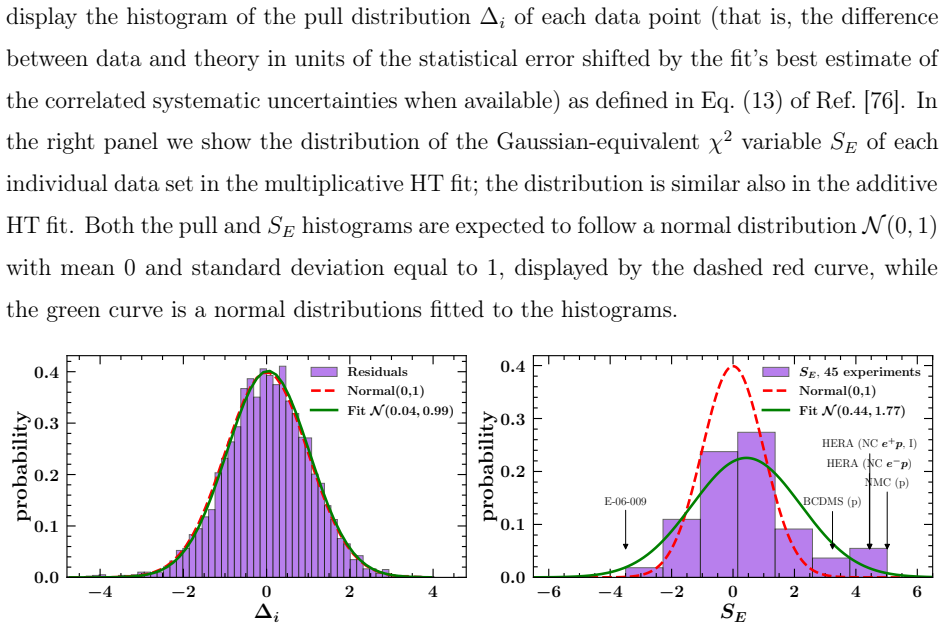
- [§4] §4 (data selection and systematics): the abstract highlights the importance of correlated systematic uncertainties, but the manuscript does not detail the data-selection cuts, the treatment of normalization uncertainties across experiments, or any validation (e.g., pull distributions or closure tests) of the procedure used to propagate those systematics into the final PDF errors. These choices directly affect whether the claimed precision is reproducible.
minor comments (2)
- [Table 1] Table 1: the breakdown of χ² per data set would benefit from an additional column showing the number of points after cuts, to allow readers to assess the effective weight of the new 12 GeV measurements.
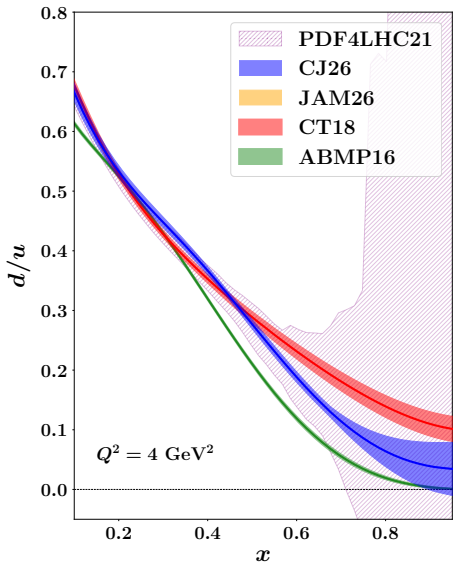
- [Figure 3] Figure 3: the plotted uncertainty bands on the d/u ratio should be accompanied by a brief statement of whether they include only statistical or also systematic variations from the correction terms.
Simulated Author's Rebuttal
We thank the referee for the constructive comments on our manuscript. We address each major comment below and will incorporate revisions to improve clarity and robustness.
read point-by-point responses
-
Referee: [Abstract and §3] Abstract and §3 (methodology): the assertion that the 12 GeV data 'uniquely disentangle' higher-twist from off-shell corrections is load-bearing for the 30-50% and 5-10% uncertainty reductions, yet the text provides no explicit sensitivity tests to the chosen functional forms of the higher-twist (typically 1/Q²) or off-shell (x-dependent multiplicative) terms. Without such tests or alternative parametrizations, it remains possible that part of the correction uncertainty is absorbed into the PDFs, artificially tightening the reported errors on the ratios.
Authors: We agree that explicit sensitivity tests to the functional forms would strengthen the presentation. The increased Q² reach of the 12 GeV data supplies the primary kinematic lever arm that enables separation of higher-twist and off-shell effects from the leading-twist PDFs; however, we will add in the revised §3 a set of alternative fits that vary the higher-twist parametrization (including 1/Q⁴ terms) and the x-dependence of the off-shell correction. The resulting variations in the n/p and d/u uncertainty bands will be shown explicitly to demonstrate that the quoted reductions are stable against these choices. revision: yes
-
Referee: [§4] §4 (data selection and systematics): the abstract highlights the importance of correlated systematic uncertainties, but the manuscript does not detail the data-selection cuts, the treatment of normalization uncertainties across experiments, or any validation (e.g., pull distributions or closure tests) of the procedure used to propagate those systematics into the final PDF errors. These choices directly affect whether the claimed precision is reproducible.
Authors: We acknowledge that additional documentation is required for reproducibility. In the revised §4 we will specify the kinematic cuts applied to the JLab 6 GeV and 12 GeV datasets, describe the treatment of normalization uncertainties (including any floating normalizations between experiments), and report validation results in the form of pull distributions and closure-test outcomes. These additions will make the propagation of correlated systematics into the final PDF uncertainties fully transparent. revision: yes
Circularity Check
Uncertainty reductions on n/p and d/u ratios are outputs of the same global fit that incorporates the new data and correction parametrizations
specific steps
-
fitted input called prediction
[Abstract]
"the analysis utilizes the increased Q^2 leverage of the 12 GeV data to uniquely disentangle higher-twist effects from off-shell nucleon corrections. This leads to a highly accurate determination of the n/p structure function ratio and the d/u valence quark ratio, with uncertainties reduced by 30-50% and 5-10%, respectively."
The quoted uncertainty reductions and 'highly accurate determination' are direct outputs of fitting the leading-twist PDFs together with the chosen higher-twist (~1/Q^2) and off-shell correction parametrizations to the same JLab 6+12 GeV data set; the improvements are therefore internal to the fit rather than independent predictions.
full rationale
The paper's strongest claim is that 12 GeV data plus chosen HT and off-shell forms allow unique disentanglement, yielding 30-50% and 5-10% uncertainty reductions. These percentages are obtained by fitting the PDF parametrization plus correction terms directly to the JLab data set; no external validation or parameter-free derivation is shown. This matches the fitted_input_called_prediction pattern. The functional-form assumption is load-bearing but not shown to be general enough to guarantee uniqueness, producing partial circularity (score 6). No self-citation chain or renaming of known results is required for the central claim.
Axiom & Free-Parameter Ledger
free parameters (2)
- PDF parametrization coefficients
- higher-twist and off-shell correction parameters
axioms (2)
- standard math QCD collinear factorization applies at the scales and x values of the included data
- domain assumption The chosen parametrizations for higher-twist and off-shell corrections capture the dominant physics without large missing terms
Reference graph
Works this paper leans on
-
[1]
Finally, the PDF4LHC21 set provides a representative combination of the CT18, NNPDF3.1, and MSHT20 analyses, that include higher-energy data from the LHC
In all other analyses thed/uquark is forced to go to 0 or±∞whenx→1by the chosen parametrization. Finally, the PDF4LHC21 set provides a representative combination of the CT18, NNPDF3.1, and MSHT20 analyses, that include higher-energy data from the LHC. We observe good compatibility between CJ26 and JAM26 up tox= 0.8where the latter’s uncertainty band diver...
-
[2]
J. F. Owens, A. Accardi, and W. Melnitchouk, Phys. Rev. D87, 094012 (2013)
2013
-
[3]
Accardi, L
A. Accardi, L. T. Brady, W. Melnitchouk, J. F. Owens, and N. Sato, Phys. Rev. D93, 114017 (2016)
2016
-
[4]
Accardi, X
A. Accardi, X. Jing, J. F. Owens, and S. Park, Phys. Rev. D107, 113005 (2023)
2023
-
[5]
Cerutti, A
M. Cerutti, A. Accardi, I. P. Fernando, S. Li, J. F. Owens, and S. Park, Phys. Rev. D111, 094013 (2025)
2025
-
[6]
Georgi and H
H. Georgi and H. D. Politzer, Phys. Rev. D14, 1829 (1976)
1976
-
[7]
De Rujula, H
A. De Rujula, H. Georgi, and H. D. Politzer, Annals Phys.103, 315 (1977)
1977
-
[8]
M. A. G. Aivazis, F. I. Olness, and W.-K. Tung, Phys. Rev. D50, 3085 (1994)
1994
-
[9]
Kretzer and M
S. Kretzer and M. H. Reno, Phys. Rev. D66, 113007 (2002)
2002
-
[10]
Accardi and J.-W
A. Accardi and J.-W. Qiu, JHEP07, 090 (2008)
2008
-
[11]
F. M. Steffens, M. D. Brown, W. Melnitchouk, and S. Sanches, Phys. Rev. C86, 065208 (2012)
2012
-
[12]
Schienbein et al., J
I. Schienbein et al., J. Phys. G35, 053101 (2008)
2008
-
[13]
L. T. Brady, A. Accardi, T. J. Hobbs, and W. Melnitchouk, Phys. Rev. D84, 074008 (2011), [Erratum: Phys.Rev.D 85, 039902 (2012)]
2011
-
[14]
Ruiz et al., Prog
R. Ruiz et al., Prog. Part. Nucl. Phys.136, 104096 (2024)
2024
-
[15]
Virchaux and A
M. Virchaux and A. Milsztajn, Phys. Lett. B274, 221 (1992)
1992
-
[16]
S. I. Alekhin, S. A. Kulagin, and S. Liuti, Phys. Rev. D69, 114009 (2004)
2004
-
[17]
Blumlein, H
J. Blumlein, H. Bottcher, and A. Guffanti, Nucl. Phys. B774, 182 (2007)
2007
-
[18]
S. Alekhin, S. A. Kulagin, and R. Petti, in 16th International Workshop on Deep Inelastic Scattering and Related Subjects (2008), p. 43, arXiv:0810.4893 [hep-ph]
Pith/arXiv arXiv 2008
-
[19]
Blumlein and H
J. Blumlein and H. Bottcher, Phys. Lett. B662, 336 (2008). 45
2008
-
[20]
Accardi, M
A. Accardi, M. E. Christy, C. E. Keppel, W. Melnitchouk, P. Monaghan, J. G. Morfín, and J. F. Owens, Phys. Rev. D81, 034016 (2010)
2010
-
[21]
J. Blumlein and H. Bottcher, in 20th International Workshop on Deep-Inelastic Scattering and Related Subjects (2012), pp. 237–241, arXiv:1207.3170 [hep-ph]
Pith/arXiv arXiv 2012
-
[22]
Alekhin, J
S. Alekhin, J. Blumlein, and S. Moch, Phys. Rev. D86, 054009 (2012)
2012
-
[23]
Cocuzza, C
C. Cocuzza, C. E. Keppel, H. Liu, W. Melnitchouk, A. Metz, N. Sato, and A. W. Thomas (Jefferson Lab Angular Momentum (JAM)), Phys. Rev. Lett.127, 242001 (2021)
2021
-
[24]
Alekhin, J
S. Alekhin, J. Blümlein, S. Moch, and R. Placakyte, Phys. Rev. D96, 014011 (2017)
2017
-
[25]
Alekhin, S
S. Alekhin, S. Kulagin, and R. Petti, Phys. Rev. D96, 054005 (2017)
2017
-
[26]
S. I. Alekhin, S. A. Kulagin, and R. Petti, Phys. Rev. D105, 114037 (2022)
2022
-
[27]
S. I. Alekhin, S. A. Kulagin, and R. Petti, Phys. Rev. D107, L051506 (2023)
2023
-
[28]
S. A. Kulagin, Nucl. Phys. A500, 653 (1989)
1989
-
[29]
S. A. Kulagin, G. Piller, and W. Weise, Phys. Rev. C50, 1154 (1994)
1994
-
[30]
S. A. Kulagin and R. Petti, Nucl. Phys. A765, 126 (2006)
2006
-
[31]
S. A. Kulagin and W. Melnitchouk, Phys. Rev. C77, 015210 (2008)
2008
-
[32]
Y. Kahn, W. Melnitchouk, and S. A. Kulagin, Phys. Rev. C79, 035205 (2009)
2009
-
[33]
Del Dotto, E
A. Del Dotto, E. Pace, G. Salmè, and S. Scopetta, Phys. Rev. C95, 014001 (2017)
2017
-
[34]
Fornetti, E
F. Fornetti, E. Pace, M. Rinaldi, G. Salmè, S. Scopetta, and M. Viviani, Phys. Lett. B851, 138587 (2024)
2024
-
[35]
V. M. Abazov et al. (D0), Phys. Rev. Lett.112, 151803 (2014), [Erratum: Phys.Rev.Lett. 114, 049901 (2015)]
2014
-
[36]
Adam et al
J. Adam et al. (STAR), Phys. Rev. D103, 012001 (2021)
2021
-
[37]
Cerutti, A
M. Cerutti, A. Accardi, I. P. Fernando, and S. Li, PoSDIS2024, 031 (2024)
2024
-
[38]
W. Ma, S. Yang, M. Xie, M. Liu, L. Han, and C. P. Yuan (2025), arXiv:2510.08941 [hep-ex]
arXiv 2025
-
[39]
M. Xie, S. Yang, Y. Fu, M. Liu, L. Han, T.-J. Hou, S. Dulat, and C. P. Yuan, Phys. Rev. D 107, 054008 (2023)
2023
-
[40]
Cocuzza, W
C. Cocuzza, W. Melnitchouk, A. Metz, and N. Sato (Jefferson Lab Angular Momentum (JAM)), Phys. Rev. D104, 074031 (2021)
2021
-
[41]
R. D. Ball et al. (NNPDF), Eur. Phys. J. C82, 428 (2022)
2022
-
[42]
T.-J. Hou, M. Yan, J. Liang, K.-F. Liu, and C. P. Yuan, Phys. Rev. D106, 096008 (2022)
2022
-
[43]
Ablat et al., Eur
A. Ablat et al., Eur. Phys. J. Plus139, 1063 (2024). 46
2024
-
[44]
L. A. Harland-Lang, T. Cridge, M. Reader, and R. S. Thorne, Eur. Phys. J. C86, 115 (2026)
2026
-
[45]
C. Cocuzza, W. Melnitchouk, N. Sato, and A. W. Thomas (2026), arXiv:2605.00666 [hep-ph]
Pith/arXiv arXiv 2026
-
[46]
R. D. Ball, A. Chiefa, and R. Stegeman, Eur. Phys. J. C86, 281 (2026)
2026
-
[47]
Wang et al
D. Wang et al. (PVDIS), Nature506, 67 (2014)
2014
-
[48]
Arrington et al
J. Arrington et al. (Jefferson Lab SoLID), J. Phys. G50, 110501 (2023)
2023
-
[49]
Boughezal, F
R. Boughezal, F. Petriello, and D. Wiegand, Phys. Rev. D104, 016005 (2021)
2021
-
[50]
Bacchetta, M
A. Bacchetta, M. Cerutti, L. Manna, M. Radici, and X. Zheng, Phys. Lett. B849, 138455 (2024)
2024
- [51]
-
[52]
Accardi, PoSDIS2015, 001 (2015)
A. Accardi, PoSDIS2015, 001 (2015)
2015
-
[53]
Accardi et al., Eur
A. Accardi et al., Eur. Phys. J. C76, 471 (2016)
2016
-
[54]
Accardi, T
A. Accardi, T. J. Hobbs, X. Jing, and P. M. Nadolsky, Eur. Phys. J. C81, 603 (2021)
2021
-
[55]
R. D. Ball, A. Candido, S. Forte, F. Hekhorn, E. R. Nocera, J. Rojo, and C. Schwan, Eur. Phys. J. C82, 1160 (2022)
2022
- [56]
-
[57]
L. T. Brady, A. Accardi, W. Melnitchouk, and J. F. Owens, JHEP06, 019 (2012)
2012
-
[58]
Willis, R
C. Willis, R. Brock, D. Hayden, T.-J. Hou, J. Isaacson, C. Schmidt, and C.-P. Yuan, Phys. Rev. D99, 054004 (2019)
2019
-
[59]
Y. Fu, R. Brock, D. Hayden, and C.-P. Yuan (2025), arXiv:2511.15683 [hep-ph]
arXiv 2025
-
[60]
A.Greljo, S.Iranipour, Z.Kassabov, M.Madigan, J.Moore, J.Rojo, M.Ubiali, andC.Voisey, JHEP07, 122 (2021)
2021
-
[61]
Hammou, Z
E. Hammou, Z. Kassabov, M. Madigan, M. L. Mangano, L. Mantani, J. Moore, M. M. Alvarado, and M. Ubiali, JHEP11, 090 (2023)
2023
- [62]
-
[63]
E. Cole, M. N. Costantini, E. Hammou, L. Mantani, F. Merlotti, M. Morales-Alvarado, and M. Ubiali (2026), arXiv:2602.20235 [hep-ph]
arXiv 2026
-
[64]
Buckley, J
A. Buckley, J. Ferrando, S. Lloyd, K. Nordström, B. Page, M. Rüfenacht, M. Schönherr, and G. Watt, Eur. Phys. J. C75, 132 (2015)
2015
-
[65]
Krämer, F
M. Krämer, F. I. Olness, and D. E. Soper, Phys. Rev. D62, 096007 (2000)
2000
-
[66]
Carli, D
T. Carli, D. Clements, A. Cooper-Sarkar, C. Gwenlan, G. P. Salam, F. Siegert, P. Starovoitov, and M. Sutton, Eur. Phys. J. C66, 503 (2010). 47
2010
-
[67]
R. L. Jaffe and M. Soldate, Phys. Rev. D26, 49 (1982)
1982
-
[68]
R. K. Ellis, W. Furmanski, and R. Petronzio, Nucl. Phys. B207, 1 (1982)
1982
-
[69]
R. K. Ellis, W. Furmanski, and R. Petronzio, Nucl. Phys. B212, 29 (1983)
1983
-
[70]
Qiu, Phys
J.-W. Qiu, Phys. Rev. D42, 30 (1990)
1990
-
[71]
Corcella and L
G. Corcella and L. Magnea, Phys. Rev. D72, 074017 (2005)
2005
-
[72]
Accardi, D
A. Accardi, D. P. Anderle, and F. Ringer, Phys. Rev. D91, 034008 (2015)
2015
-
[73]
Bonvini, S
M. Bonvini, S. Marzani, J. Rojo, L. Rottoli, M. Ubiali, R. D. Ball, V. Bertone, S. Carrazza, and N. P. Hartland, JHEP09, 191 (2015)
2015
-
[74]
A. Simonelli, A. Accardi, M. Cerutti, C. S. R. Costa, and A. Signori (2025), arXiv:2502.15033 [hep-ph]
arXiv 2025
-
[75]
S. A. Kulagin, W. Melnitchouk, G. Piller, and W. Weise, Phys. Rev. C52, 932 (1995)
1995
-
[76]
Pumplin, D
J. Pumplin, D. Stump, R. Brock, D. Casey, J. Huston, J. Kalk, H. L. Lai, and W. K. Tung, Phys. Rev. D65, 014013 (2001)
2001
-
[77]
Pumplin, D
J. Pumplin, D. R. Stump, J. Huston, H. L. Lai, P. M. Nadolsky, and W. K. Tung, JHEP07, 012 (2002)
2002
-
[78]
S. Li, A. Accardi, M. Cerutti, I. P. Fernando, C. E. Keppel, W. Melnitchouk, P. Monaghan, G. Niculescu, M. I. Niculescu, and J. F. Owens, Phys. Rev. D109, 074036 (2024)
2024
-
[79]
Stump, J
D. Stump, J. Pumplin, R. Brock, D. Casey, J. Huston, J. Kalk, H. L. Lai, and W. K. Tung, Phys. Rev. D65, 014012 (2001)
2001
-
[80]
N. T. Hunt-Smith, A. Accardi, W. Melnitchouk, N. Sato, A. W. Thomas, and M. J. White, Phys. Rev. D106, 036003 (2022)
2022
discussion (0)
Sign in with ORCID, Apple, or X to comment. Anyone can read and Pith papers without signing in.