Cascading amplification of gravitational waves triggered by environment in dynamical Chern-Simons gravity
Pith reviewed 2026-06-28 21:34 UTC · model grok-4.3
The pith
An external oscillating environment triggers resonant amplification of gravitational waves in dynamical Chern-Simons gravity even at ultraweak coupling.
A machine-rendered reading of the paper's core claim, the machinery that carries it, and where it could break.
Core claim
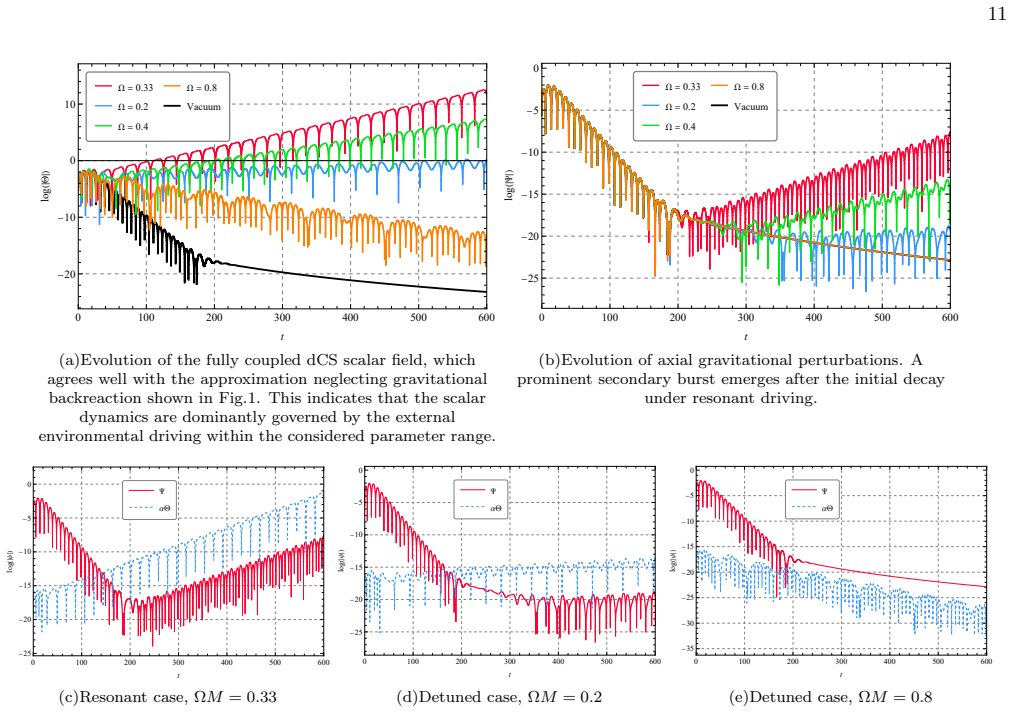
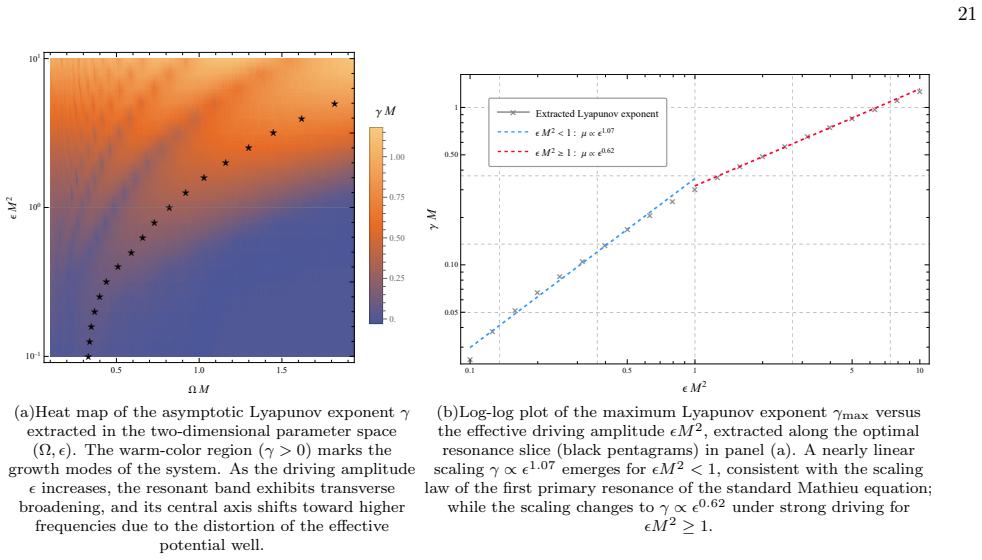
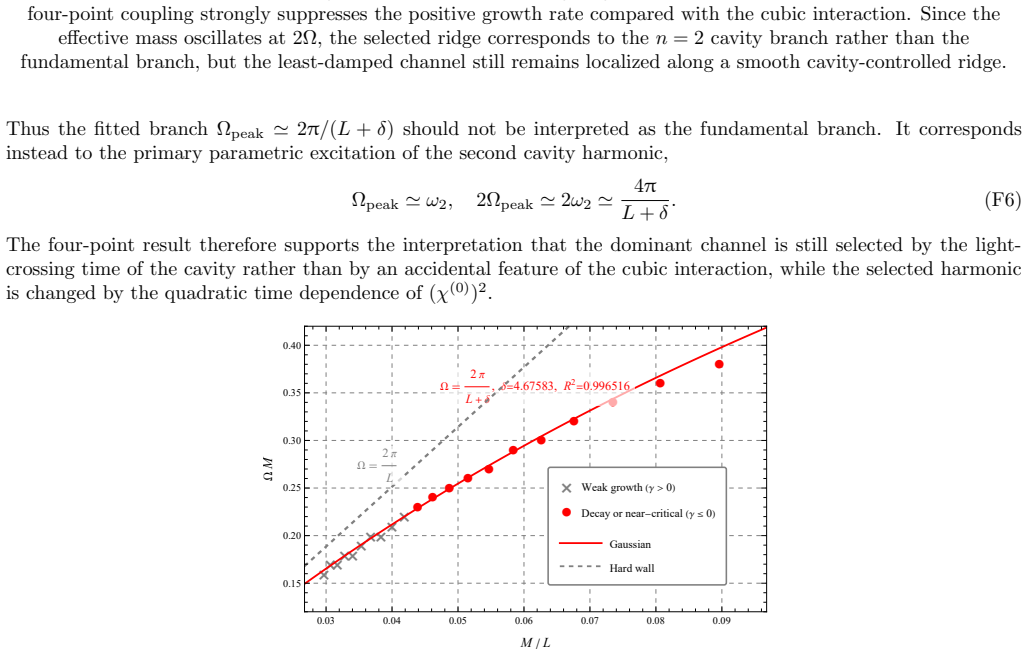
Within dynamical Chern-Simons gravity, the black hole barrier and external oscillating shell form an effective resonant cavity that triggers Mathieu instability in the dCS scalar sector. The optimal driving frequency is set by cavity length, while proximity to the horizon can suppress growth via leakage. In the frequency domain scalar perturbations show Floquet sidebands; in the time domain the amplified scalar sources axial gravitational perturbations and generates a delayed secondary burst. This establishes that dCS corrections at ultraweak coupling accumulate via long-term parametric amplification in a dynamical environment.
What carries the argument
The effective resonant cavity formed by the black hole barrier and external oscillating shell, which drives Mathieu instability in the pseudoscalar sector and cascades to gravitational waves.
If this is right
- The optimal driving frequency for the instability equals the resonant cavity length.
- Scalar perturbations develop Floquet sideband structures in the frequency domain.
- Amplified scalars drive a delayed secondary burst in axial gravitational perturbations.
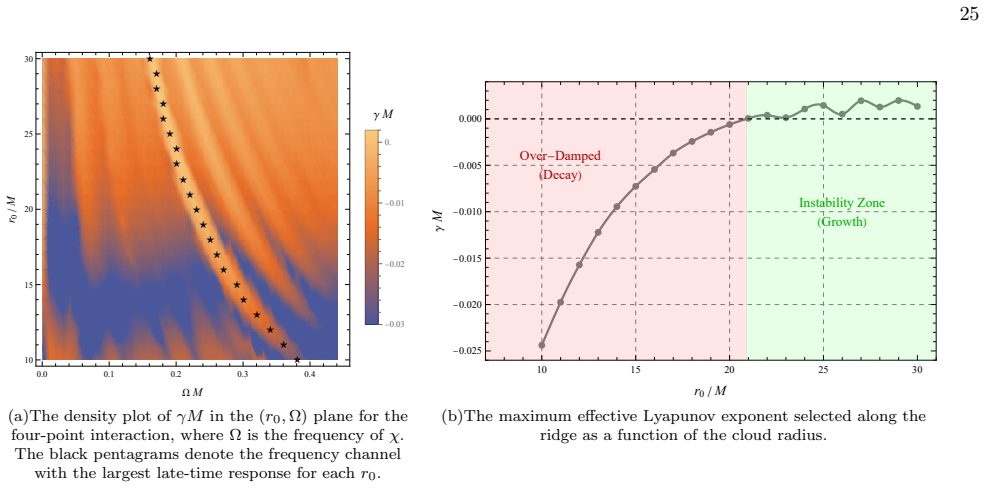
- Leakage to the horizon creates a dynamical threshold when the environment lies too close to the black hole.
Where Pith is reading between the lines
- The resonance mechanism suggests searching for sideband patterns or delayed bursts in gravitational wave data from black holes in oscillating environments such as accretion flows.
- Similar cavity-like amplification could appear in other scalar-tensor theories when environmental oscillations are included.
- Numerical relativity runs with explicit oscillating shells could directly test the predicted growth rates and thresholds.
Load-bearing premise
The external environment can be modeled as an oscillating shell that forms a resonant cavity with the black hole while linear perturbation theory remains valid without significant backreaction.
What would settle it
A simulation or observation showing absence of scalar growth, Floquet sidebands, or a delayed secondary gravitational wave burst when an oscillating shell is placed near a black hole would falsify the mechanism.
Figures
read the original abstract
Within the effective field theory framework of dynamical Chern-Simons (dCS) gravity, we investigate the cascading amplification mechanism of gravitational waves driven by an external dynamical environment. Considering the interaction between the environmental field and the dCS pseudoscalar, we find that the black hole barrier and the external oscillating shell collectively form an effective resonant cavity, which triggers Mathieu instability in the dCS scalar sector. Numerical results show that the optimal driving frequency is set by the length of the resonant cavity. When the environmental field lies too close to the black hole, leakage toward the event horizon suppresses the resonant growth, thus giving a dynamical threshold for the existence of the instability. In the frequency domain, scalar perturbations display the Floquet sideband structures. In the time domain, the amplified scalar field further acts as a source term to drive axial gravitational perturbations, generating a delayed secondary burst. This mechanism reveals that dCS corrections at ultraweak coupling can still accumulate via long-term parametric amplification in a dynamical environment, leaving discernible signatures in gravitational wave signals.
Editorial analysis
A structured set of objections, weighed in public.
Referee Report
Summary. The manuscript examines parametric amplification of the dCS pseudoscalar in the presence of a black hole and an external oscillating shell, which together form an effective resonant cavity. It reports that this setup triggers Mathieu instability, with numerical evolution yielding an optimal driving frequency set by cavity length, a leakage threshold near the horizon, Floquet sideband structure in the frequency domain, and a delayed secondary burst in axial gravitational perturbations sourced by the amplified scalar. The central claim is that ultraweak dCS couplings can accumulate observable signatures in GW signals via long-term environmental amplification.
Significance. If the linear-regime assumption holds, the work identifies a concrete mechanism by which small dCS corrections can be resonantly amplified in dynamical astrophysical environments, potentially producing detectable secondary GW features. The numerical demonstration of Floquet sidebands and the secondary burst constitutes a tangible advance in exploring modified-gravity effects beyond the weak-field limit.
major comments (2)
- [Numerical results (discussion of growth rate and leakage threshold)] The numerical results section does not compare the e-folding time of the reported Mathieu instability to the dynamical timescale of the shell or the metric; without this bound the fixed-background resonant-cavity assumption used to derive the instability remains unverified against backreaction.
- [Setup of the oscillating-shell model and linear perturbation equations] The perturbation equations are evolved on a fixed shell background; no estimate is given for the scalar energy density at which the sourced metric perturbations would alter the shell motion or invalidate the linear treatment, which is load-bearing for the claim that the instability persists long enough to produce a secondary burst.
minor comments (2)
- [Abstract] The abstract refers to 'cascading amplification' without a one-sentence definition; adding a brief parenthetical would improve readability.
- [Figures showing scalar perturbations] Figure captions for the frequency-domain plots should explicitly label the expected Floquet sideband spacing in terms of the driving frequency.
Simulated Author's Rebuttal
We thank the referee for their careful reading of the manuscript and for highlighting the importance of verifying the linear-regime and fixed-background assumptions. We address each major comment below and have revised the manuscript to incorporate the requested comparisons and estimates.
read point-by-point responses
-
Referee: [Numerical results (discussion of growth rate and leakage threshold)] The numerical results section does not compare the e-folding time of the reported Mathieu instability to the dynamical timescale of the shell or the metric; without this bound the fixed-background resonant-cavity assumption used to derive the instability remains unverified against backreaction.
Authors: We agree that a direct comparison of timescales is required to substantiate the fixed-background assumption. In the revised manuscript we have added a dedicated paragraph in Section IV that extracts the e-folding time from the numerical growth curves and compares it to both the shell oscillation period and the light-crossing time of the resonant cavity. For the parameter values at which the instability is observed, the e-folding time is several shell periods, confirming that multiple amplification cycles occur before backreaction on the metric is expected to become appreciable. This addition directly addresses the concern. revision: yes
-
Referee: [Setup of the oscillating-shell model and linear perturbation equations] The perturbation equations are evolved on a fixed shell background; no estimate is given for the scalar energy density at which the sourced metric perturbations would alter the shell motion or invalidate the linear treatment, which is load-bearing for the claim that the instability persists long enough to produce a secondary burst.
Authors: We acknowledge the need for an explicit linearity threshold. The revised manuscript now contains an order-of-magnitude estimate, placed in the discussion of the secondary burst, for the scalar energy density at which the sourced metric perturbations would reach the scale of the background shell energy. Using the numerically obtained scalar amplitude and the resulting axial gravitational-wave energy, we show that the delayed secondary burst occurs at densities well below this threshold for the ultraweak couplings considered. This estimate supports the persistence of the linear regime throughout the reported evolution. revision: yes
Circularity Check
No circularity: results from direct numerical evolution of dCS perturbation equations
full rationale
The paper derives its claims via numerical integration of the linearized perturbation equations for the dCS pseudoscalar and axial gravitational modes in the presence of a fixed oscillating shell background. The Mathieu instability, Floquet sidebands, and secondary GW burst are outputs of that evolution; no parameter is fitted to data and then relabeled as a prediction, no self-citation supplies a load-bearing uniqueness theorem, and no ansatz is smuggled in. The derivation chain is therefore self-contained against the stated equations of motion.
Axiom & Free-Parameter Ledger
free parameters (2)
- driving frequency of external shell
- dCS coupling strength
axioms (2)
- domain assumption The effective field theory framework of dynamical Chern-Simons gravity is valid at the scales and couplings considered.
- domain assumption Linear perturbation theory applies and backreaction from the amplified scalar field remains negligible during the instability growth.
Reference graph
Works this paper leans on
-
[1]
B. P. Abbottet al.(LIGO Scientific, Virgo), Phys. Rev. X6, 041015 (2016), [Erratum: Phys.Rev.X 8, 039903 (2018)], arXiv:1606.04856 [gr-qc]
work page internal anchor Pith review Pith/arXiv arXiv 2016
-
[2]
Constraining alternative theories of gravity using GW$150914$ and GW$151226$
M. De Laurentis, O. Porth, L. Bovard, B. Ahmedov, and A. Abdujabbarov, Phys. Rev. D94, 124038 (2016), arXiv:1611.05766 [gr-qc]
work page internal anchor Pith review Pith/arXiv arXiv 2016
-
[3]
B. P. Abbottet al.(LIGO Scientific, Virgo), Phys. Rev. D100, 104036 (2019), arXiv:1903.04467 [gr-qc]
work page internal anchor Pith review Pith/arXiv arXiv 2019
- [4]
-
[5]
Tests of General Relativity with GWTC-3
R. Abbottet al.(LIGO Scientific, VIRGO, KAGRA), Phys. Rev. D112, 084080 (2025), arXiv:2112.06861 [gr-qc]
work page internal anchor Pith review Pith/arXiv arXiv 2025
- [6]
- [7]
-
[8]
A. G. Abacet al.(LIGO Scientific, Virgo, KAGRA), Phys. Rev. Lett.136, 041403 (2026), arXiv:2509.08099 [gr-qc]
work page internal anchor Pith review Pith/arXiv arXiv 2026
-
[9]
C. M. Will, Living Rev. Rel.4, 4 (2001), arXiv:gr-qc/0103036
work page internal anchor Pith review Pith/arXiv arXiv 2001
-
[10]
Bertotti, L
B. Bertotti, L. Iess, and P. Tortora, Nature425, 374 (2003)
2003
-
[11]
C. M. Will, Living Rev. Rel.17, 4 (2014), arXiv:1403.7377 [gr-qc]
work page internal anchor Pith review Pith/arXiv arXiv 2014
-
[12]
A. Ghosh, N. K. Johnson-Mcdaniel, A. Ghosh, C. K. Mishra, P. Ajith, W. Del Pozzo, C. P. L. Berry, A. B. Nielsen, and L. London, Class. Quant. Grav.35, 014002 (2018), arXiv:1704.06784 [gr-qc]
work page internal anchor Pith review Pith/arXiv arXiv 2018
-
[13]
R. Abbottet al.(LIGO Scientific, Virgo), Phys. Rev. D103, 122002 (2021), arXiv:2010.14529 [gr-qc]
work page internal anchor Pith review Pith/arXiv arXiv 2021
- [14]
- [15]
-
[16]
B. P. Abbottet al.(LIGO Scientific, Virgo), Phys. Rev. Lett.116, 221101 (2016), [Erratum: Phys.Rev.Lett. 121, 129902 (2018)], arXiv:1602.03841 [gr-qc]
work page internal anchor Pith review Pith/arXiv arXiv 2016
-
[17]
A. G. Abacet al.(LIGO Scientific, VIRGO, KAGRA), (2026), arXiv:2603.19019 [gr-qc]
work page internal anchor Pith review Pith/arXiv arXiv 2026
-
[18]
A. G. Abacet al.(LIGO Scientific, VIRGO, KAGRA), (2026), arXiv:2603.19020 [gr-qc]
work page internal anchor Pith review Pith/arXiv arXiv 2026
-
[19]
A. G. Abacet al.(LIGO Scientific, VIRGO, KAGRA), (2026), arXiv:2603.19021 [gr-qc]
work page internal anchor Pith review Pith/arXiv arXiv 2026
-
[20]
The US Program in Ground-Based Gravitational Wave Science: Contribution from the LIGO Laboratory
D. Reitzeet al., Bull. Am. Astron. Soc.51, 141 (2019), arXiv:1903.04615 [astro-ph.IM]
work page internal anchor Pith review Pith/arXiv arXiv 2019
-
[21]
Chern-Simons Modification of General Relativity
R. Jackiw and S. Y. Pi, Phys. Rev. D68, 104012 (2003), arXiv:gr-qc/0308071
work page internal anchor Pith review Pith/arXiv arXiv 2003
-
[22]
A gravitational-wave probe of effective quantum gravity
S. Alexander, L. S. Finn, and N. Yunes, Phys. Rev. D78, 066005 (2008), arXiv:0712.2542 [gr-qc] . 27
work page internal anchor Pith review Pith/arXiv arXiv 2008
-
[23]
Dynamical Chern-Simons Modified Gravity I: Spinning Black Holes in the Slow-Rotation Approximation
N. Yunes and F. Pretorius, Phys. Rev. D79, 084043 (2009), arXiv:0902.4669 [gr-qc]
work page internal anchor Pith review Pith/arXiv arXiv 2009
-
[24]
The Initial Value Formulation of Dynamical Chern-Simons Gravity
T. Delsate, D. Hilditch, and H. Witek, Phys. Rev. D91, 024027 (2015), arXiv:1407.6727 [gr-qc]
work page internal anchor Pith review Pith/arXiv arXiv 2015
- [25]
-
[26]
Chern-Simons Modified General Relativity
S. Alexander and N. Yunes, Phys. Rept.480, 1 (2009), arXiv:0907.2562 [hep-th]
work page internal anchor Pith review Pith/arXiv arXiv 2009
-
[27]
Gravitational signature of Schwarzschild black holes in dynamical Chern-Simons gravity
C. Molina, P. Pani, V. Cardoso, and L. Gualtieri, Phys. Rev. D81, 124021 (2010), arXiv:1004.4007 [gr-qc]
work page internal anchor Pith review Pith/arXiv arXiv 2010
- [28]
-
[29]
Double Binary Pulsar Test of Dynamical Chern-Simons Modified Gravity
N. Yunes and D. N. Spergel, Phys. Rev. D80, 042004 (2009), arXiv:0810.5541 [gr-qc]
work page internal anchor Pith review Pith/arXiv arXiv 2009
-
[30]
Gravitational Wave Tests of General Relativity with Ground-Based Detectors and Pulsar Timing Arrays
N. Yunes and X. Siemens, Living Rev. Rel.16, 9 (2013), arXiv:1304.3473 [gr-qc]
work page internal anchor Pith review Pith/arXiv arXiv 2013
-
[31]
Extreme Gravity Tests with Gravitational Waves from Compact Binary Coalescences: (II) Ringdown
E. Berti, K. Yagi, H. Yang, and N. Yunes, Gen. Rel. Grav.50, 49 (2018), arXiv:1801.03587 [gr-qc]
work page internal anchor Pith review Pith/arXiv arXiv 2018
- [32]
- [33]
- [34]
-
[35]
Perturbations of Schwarzschild black holes in Dynamical Chern-Simons modified gravity
V. Cardoso and L. Gualtieri, Phys. Rev. D80, 064008 (2009), [Erratum: Phys.Rev.D 81, 089903 (2010)], arXiv:0907.5008 [gr-qc]
work page internal anchor Pith review Pith/arXiv arXiv 2009
-
[36]
Evolving Metric Perturbations in dynamical Chern-Simons Gravity
M. Okounkova, M. A. Scheel, and S. A. Teukolsky, Phys. Rev. D99, 044019 (2019), arXiv:1811.10713 [gr-qc]
work page internal anchor Pith review Pith/arXiv arXiv 2019
- [37]
-
[38]
P. T. Leung, Y. T. Liu, W. M. Suen, C. Y. Tam, and K. Young, Phys. Rev. Lett.78, 2894 (1997), arXiv:gr-qc/9903031
work page internal anchor Pith review Pith/arXiv arXiv 1997
-
[39]
A. J. M. Medved, D. Martin, and M. Visser, Class. Quant. Grav.21, 2393 (2004), arXiv:gr-qc/0310097
work page internal anchor Pith review Pith/arXiv arXiv 2004
-
[40]
Can environmental effects spoil precision gravitational-wave astrophysics?
E. Barausse, V. Cardoso, and P. Pani, Phys. Rev. D89, 104059 (2014), arXiv:1404.7149 [gr-qc]
work page internal anchor Pith review Pith/arXiv arXiv 2014
- [41]
- [42]
- [43]
- [44]
-
[45]
Akiyamaet al.(Event Horizon Telescope), Astrophys
K. Akiyamaet al.(Event Horizon Telescope), Astrophys. J. Lett.910, L12 (2021), arXiv:2105.01169 [astro-ph.HE]
-
[46]
Dark matter annihilation at the galactic center
P. Gondolo and J. Silk, Phys. Rev. Lett.83, 1719 (1999), arXiv:astro-ph/9906391
work page internal anchor Pith review Pith/arXiv arXiv 1999
- [47]
-
[48]
S. Kazempour, S. Sun, and C. Yu, Phys. Rev. D110, 043034 (2024), arXiv:2404.11333 [hep-ph]
-
[49]
R. Ranjbar and H. R. Olivares-S´ anchez, Astron. Astrophys.701, A27 (2025), arXiv:2502.12072 [astro-ph.HE]
- [50]
- [51]
- [52]
-
[53]
G. Caneva Santoro, S. Roy, R. Vicente, M. Haney, O. J. Piccinni, W. Del Pozzo, and M. Martinez, Phys. Rev. Lett.132, 251401 (2024), arXiv:2309.05061 [gr-qc]
- [54]
- [55]
-
[56]
V. Cardoso, S. Kastha, and R. Panosso Macedo, Phys. Rev. D110, 024016 (2024), arXiv:2404.01374 [gr-qc]
- [57]
- [58]
-
[59]
Black hole spectroscopy: from theory to experiment
J. Abediet al., (2025), arXiv:2505.23895 [gr-qc]
work page internal anchor Pith review Pith/arXiv arXiv 2025
- [60]
- [61]
- [62]
- [63]
- [64]
-
[65]
G. R. Dvali, (1995), arXiv:hep-ph/9505253
work page internal anchor Pith review Pith/arXiv arXiv 1995
-
[66]
P. Svrcek and E. Witten, JHEP06, 051 (2006), arXiv:hep-th/0605206
work page internal anchor Pith review Pith/arXiv arXiv 2006
-
[67]
D. J. E. Marsh, Phys. Rept.643, 1 (2016), arXiv:1510.07633 [astro-ph.CO]
work page internal anchor Pith review Pith/arXiv arXiv 2016
- [68]
-
[69]
S. Alexander, H. Bernardo, and C. Creque-Sarbinowski, Phys. Rev. D110, 025015 (2024), arXiv:2403.15657 [hep-th]
-
[70]
S. Alexander, G. Gabadadze, L. Jenks, and N. Yunes, (2025), arXiv:2512.00154 [hep-ph]
-
[71]
H. O. Silva, J. Sakstein, L. Gualtieri, T. P. Sotiriou, and E. Berti, Phys. Rev. Lett.120, 131104 (2018), arXiv:1711.02080 [gr-qc]
work page internal anchor Pith review Pith/arXiv arXiv 2018
-
[72]
C. A. R. Herdeiro, E. Radu, N. Sanchis-Gual, and J. A. Font, Phys. Rev. Lett.121, 101102 (2018), arXiv:1806.05190 [gr-qc]
work page internal anchor Pith review Pith/arXiv arXiv 2018
-
[73]
Are black holes a serious threat to scalar field dark matter models?
J. Barranco, A. Bernal, J. C. Degollado, A. Diez-Tejedor, M. Megevand, M. Alcubierre, D. Nunez, and O. Sarbach, Phys. Rev. D84, 083008 (2011), arXiv:1108.0931 [gr-qc]
work page internal anchor Pith review Pith/arXiv arXiv 2011
-
[74]
Schwarzschild black holes can wear scalar wigs
J. Barranco, A. Bernal, J. C. Degollado, A. Diez-Tejedor, M. Megevand, M. Alcubierre, D. Nunez, and O. Sarbach, Phys. Rev. Lett.109, 081102 (2012), arXiv:1207.2153 [gr-qc] . 28
work page internal anchor Pith review Pith/arXiv arXiv 2012
-
[75]
B. Wang, C. Molina, and E. Abdalla, Phys. Rev. D63, 084001 (2001), arXiv:hep-th/0005143
work page internal anchor Pith review Pith/arXiv arXiv 2001
-
[76]
B. Wang, C.-Y. Lin, and C. Molina, Phys. Rev. D70, 064025 (2004), arXiv:hep-th/0407024
work page internal anchor Pith review Pith/arXiv arXiv 2004
- [77]
-
[78]
Late-Time Behavior of Stellar Collapse and Explosions: I. Linearized Perturbations
C. Gundlach, R. H. Price, and J. Pullin, Phys. Rev. D49, 883 (1994), arXiv:gr-qc/9307009
work page internal anchor Pith review Pith/arXiv arXiv 1994
-
[79]
Z.-Z. Peng, Z.-M. Zeng, C. Fu, and Z.-K. Guo, Phys. Rev. D106, 124044 (2022), arXiv:2209.10374 [gr-qc]
-
[80]
W. H. Press and S. A. Teukolsky, Nature238, 211 (1972)
1972
discussion (0)
Sign in with ORCID, Apple, or X to comment. Anyone can read and Pith papers without signing in.