The sound of dynamical dark energy and modified gravity
Pith reviewed 2026-06-28 20:45 UTC · model grok-4.3
The pith
In modified gravity models the preference for dynamical dark energy correlates with deviations from general relativity at redshifts below 2.
A machine-rendered reading of the paper's core claim, the machinery that carries it, and where it could break.
Core claim
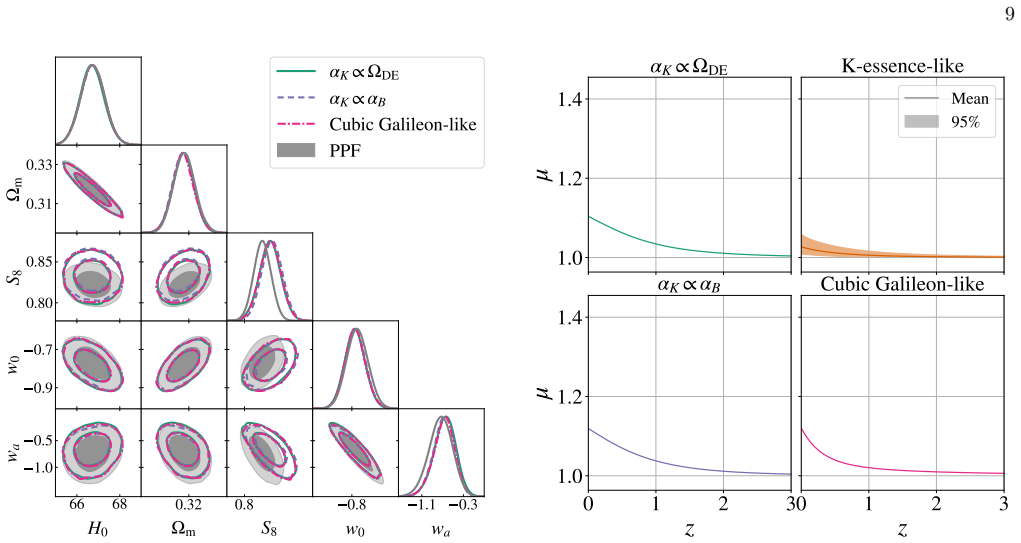
In modified gravity scenarios in which the dark energy equation of state and sound speed determine modifications to matter clustering, the preference for dynamical dark energy is correlated with deviations from GR over redshifts z less than 2 at over 95 percent . The significance of these deviations is not degraded when a dynamical or superluminal sound speed is considered, but vanishes if a cosmological constant is assumed. Inclusion of cosmic shear and CMB lensing data shifts the constraints toward GR.
What carries the argument
The effective dark energy sound speed c_s^2(k,a) that controls perturbative behavior in the tested modified gravity models.
If this is right
- The correlation between dynamical dark energy and modified gravity deviations holds for both constant and varying sound speeds.
- Assuming a cosmological constant removes any indication of modified gravity deviations in the data.
- Cosmic shear and CMB lensing measurements favor general relativity over the modified gravity scenarios.
- The sound speed can be used as a free parameter to explore perturbative signatures in modified gravity without degrading the dynamical dark energy signal.
Where Pith is reading between the lines
- Structure growth data appear necessary to break the degeneracy between dynamical dark energy and modified gravity effects that distance measurements alone cannot resolve.
- Future surveys sensitive to both expansion history and perturbation growth could test whether the sound speed remains a useful discriminator between models.
- If the correlation persists, distance-only analyses may systematically favor modified gravity when dynamical dark energy is allowed.
Load-bearing premise
The dark energy equation of state and sound speed directly determine the modifications to matter clustering in the modified gravity scenarios that are tested.
What would settle it
A data combination in which the preference for dynamical dark energy shows no correlation with modified gravity deviations when the sound speed is varied, or in which constraints remain away from general relativity even after assuming a cosmological constant.
Figures


read the original abstract
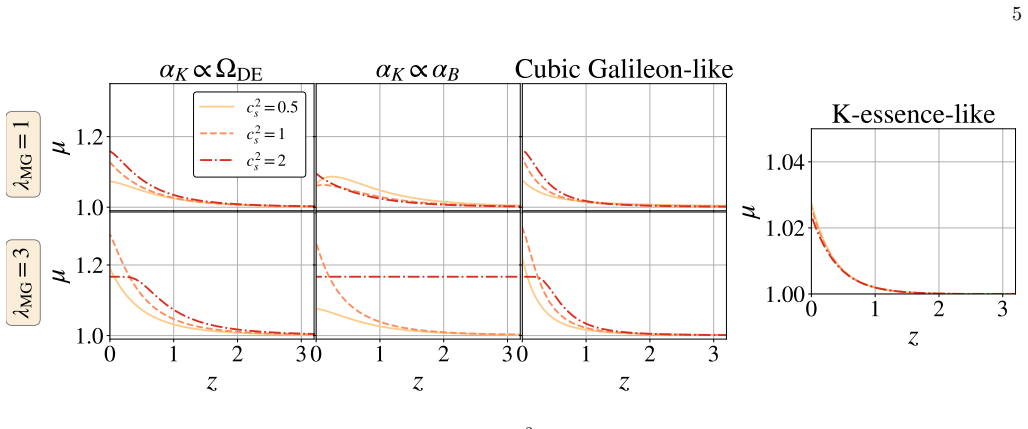
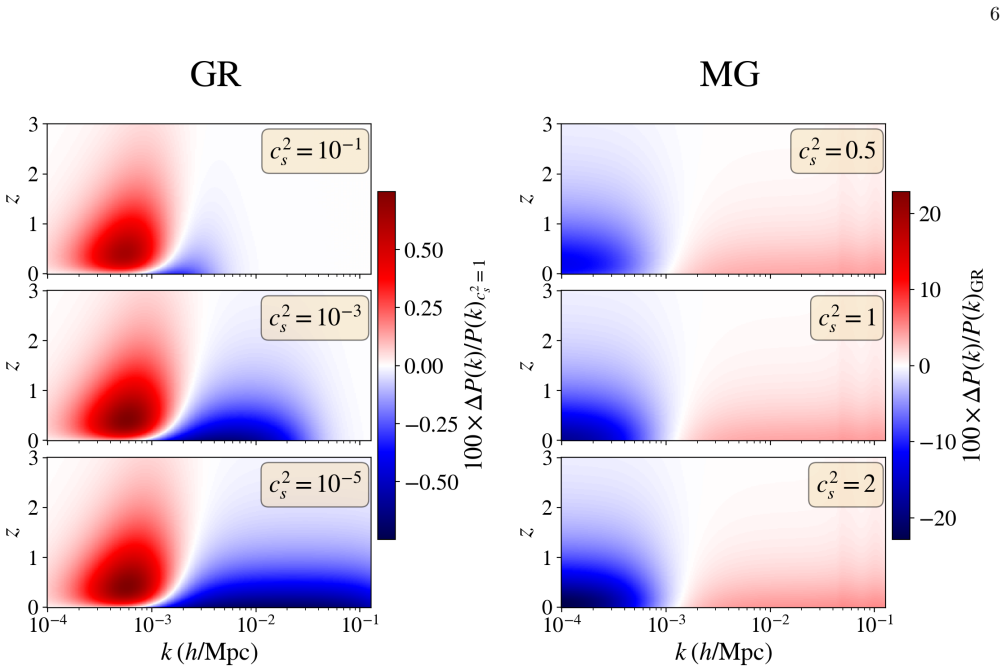
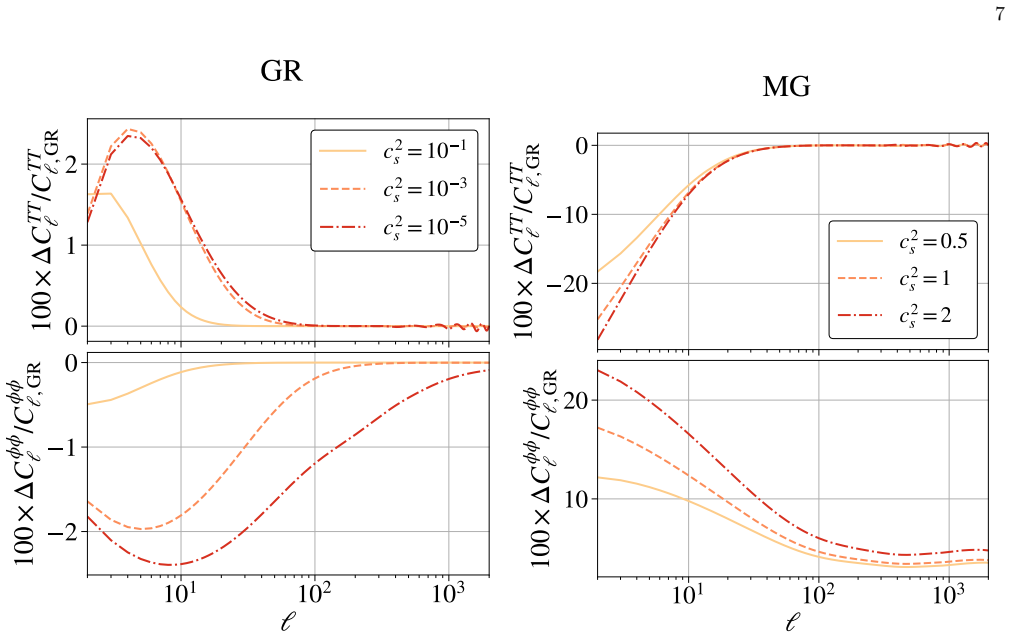
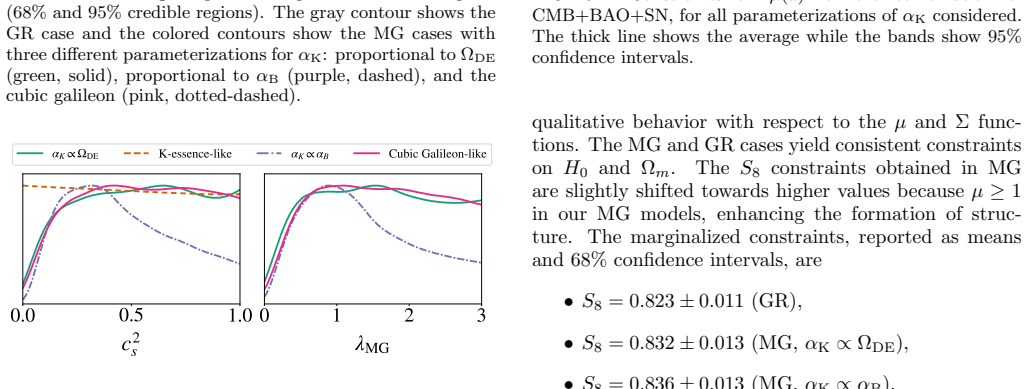
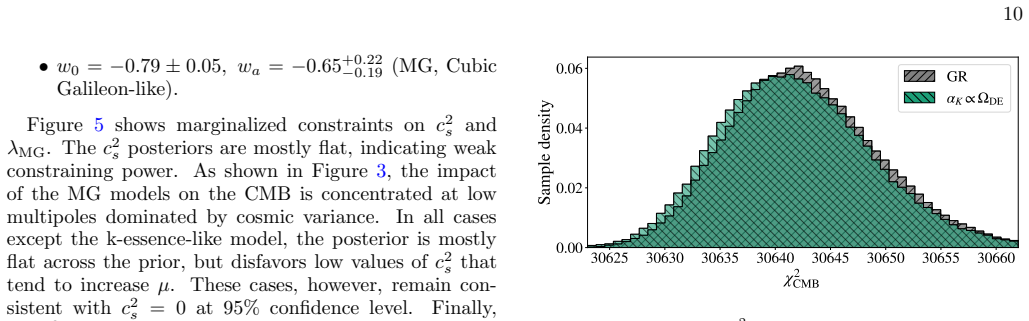
Different candidate models are able to reproduce the dynamical dark energy signal preferred by combinations of recent distance measurements. These models may be distinguished by the behavior of their perturbations, which are controlled by the effective sound speed $c_s^2(k,a)$. To explore correlations between the dark energy sound speed and perturbative behavior, we test modified gravity (MG) scenarios in which the dark energy equation of state and sound speed determine modifications to the clustering of matter. We investigate the impact of varying the dark energy sound speed on several cosmological quantities in both General Relativity (GR) and MG. We constrain the dark energy and modified gravity parameters using measurements of the Cosmic Microwave Background (CMB) from Planck PR4, type Ia supernova luminosity distances (SN) from Pantheon+, Baryon Acoustic Oscillations (BAO) from DESI DR2, and cosmic shear from DES-Y3. Using the combination of CMB+BAO+SN, we find that, in the MG scenarios, the preference for dynamical dark energy is correlated with deviations from GR over redshifts $z < 2$ at over 95\% confidence level. The significance of these deviations is not degraded when considering a dynamical or superluminal sound speed, but vanishes if we assume a cosmological constant. The inclusion of cosmic shear and CMB lensing data significantly shifts the constraints towards GR. Our framework enables the exploration of modified gravity models using the dark energy sound speed as a physically meaningful free parameter.
Editorial analysis
A structured set of objections, weighed in public.
Referee Report
Summary. The paper claims that in modified gravity (MG) scenarios constructed such that the dark energy equation of state w(a) and sound speed cs²(k,a) determine modifications to matter clustering, combinations of Planck PR4 CMB, Pantheon+ SN, and DESI DR2 BAO data show a preference for dynamical dark energy that correlates with deviations from GR at z<2 at >95% CL. This correlation is robust to dynamical or superluminal cs² but vanishes under a cosmological constant assumption; adding DES-Y3 cosmic shear and CMB lensing shifts constraints toward GR. The framework treats cs² as a physically meaningful free parameter for exploring MG effects.
Significance. If the central mapping from (w, cs²) to MG perturbative effects holds without additional independent degrees of freedom, the work offers a concrete parametrization for linking dark energy perturbations to modified gravity clustering, using recent public datasets. The finding that lensing data degrades the GR deviation signal is a useful consistency check. However, the significance is limited by the lack of explicit verification that the tested MG scenarios are not reducible to a special case of standard MG parametrizations.
major comments (2)
- [MG scenarios construction (abstract and model definition sections)] The central claim (dynamical DE preference correlates with GR deviations at >95% CL in MG scenarios, robust to cs variations) rests on the construction in which w(a) and cs²(k,a) fully determine the modifications to matter clustering. The manuscript states the scenarios explicitly in the abstract but provides no perturbation equations or explicit reduction showing how cs² serves as the sole control parameter (e.g., whether independent μ(k,a) and η(k,a) functions are eliminated by construction). Without this, the reported correlation and its robustness to superluminal cs² risk being parametrization-specific rather than general.
- [Results section on parameter constraints] Table or figure reporting the 95% CL constraints on MG parameters with CMB+BAO+SN (and the shift upon adding lensing): the error budgets, full analysis pipeline, and covariance treatment are not detailed enough to verify whether post-hoc model choices affect the central claim that deviations vanish for Lambda but persist for dynamical DE. This is load-bearing for the robustness statement.
minor comments (2)
- [Model parameters] Notation for cs²(k,a) should be clarified early: is the k-dependence functional form specified, or is it assumed scale-independent in the reported runs?
- [Introduction or results] The abstract mentions 'several cosmological quantities' affected by varying cs²; a brief summary table or reference to the relevant figure would improve readability.
Simulated Author's Rebuttal
We thank the referee for the constructive comments on our manuscript. We address each major comment below and will revise the manuscript to improve clarity and completeness.
read point-by-point responses
-
Referee: [MG scenarios construction (abstract and model definition sections)] The central claim (dynamical DE preference correlates with GR deviations at >95% CL in MG scenarios, robust to cs variations) rests on the construction in which w(a) and cs²(k,a) fully determine the modifications to matter clustering. The manuscript states the scenarios explicitly in the abstract but provides no perturbation equations or explicit reduction showing how cs² serves as the sole control parameter (e.g., whether independent μ(k,a) and η(k,a) functions are eliminated by construction). Without this, the reported correlation and its robustness to superluminal cs² risk being parametrization-specific rather than general.
Authors: We agree that the explicit perturbation equations and the reduction showing how w(a) and cs²(k,a) determine the MG modifications (eliminating independent μ(k,a) and η(k,a)) are not presented in sufficient detail. In the revised manuscript we will add the relevant equations in the model definition section, making clear that the MG effects on clustering are fully specified by the DE parameters by construction. This addition will also note that the reported correlation is a feature of this specific parametrization, as intended. revision: yes
-
Referee: [Results section on parameter constraints] Table or figure reporting the 95% CL constraints on MG parameters with CMB+BAO+SN (and the shift upon adding lensing): the error budgets, full analysis pipeline, and covariance treatment are not detailed enough to verify whether post-hoc model choices affect the central claim that deviations vanish for Lambda but persist for dynamical DE. This is load-bearing for the robustness statement.
Authors: We acknowledge that additional detail on the analysis pipeline, error budgets, and covariance treatment would strengthen the presentation. In the revised version we will expand the relevant subsection to include these elements, ensuring the robustness of the constraints (including the vanishing of deviations under a cosmological constant) can be verified directly from the text. revision: yes
Circularity Check
No significant circularity; constraints from external datasets with independent parameters
full rationale
The paper constrains dark energy and MG parameters using external public datasets (Planck PR4, Pantheon+, DESI DR2, DES-Y3) and introduces cs^2(k,a) as an independent free parameter within explicitly defined MG scenarios. No load-bearing self-citations, self-definitional reductions, or fitted inputs renamed as predictions are present. The central correlation claim follows from fitting these independent observables rather than reducing to internal definitions by construction.
Axiom & Free-Parameter Ledger
free parameters (1)
- dark energy sound speed cs^2(k,a)
axioms (1)
- domain assumption Cosmological perturbation theory applies to the MG models with DE equation of state and sound speed setting matter clustering modifications
Reference graph
Works this paper leans on
-
[1]
TheHiLLiPoP likelihood contains TT, TE and EE angular power spec- tra from multipolesℓ= 30 up toℓ= 2500 (for TT) and ℓ= 2000 (for TE and EE)
Planck PR4 CMB We use data from Planck PR4, implemented in the HiLLiPoPandLoLLiPoPlikelihoods [2]. TheHiLLiPoP likelihood contains TT, TE and EE angular power spec- tra from multipolesℓ= 30 up toℓ= 2500 (for TT) and ℓ= 2000 (for TE and EE). TheLoLLiPoPlikelihood con- tains EE angular power spectra for multipoles ranging fromℓ∈[2,29]. For the large-scale T...
2000
-
[2]
The ef- fective redshifts of the tracers samples span the redshift range 0.30< z <2.33
DESI DR2 BAO The DESI collaboration has measured the Baryon Acoustic Oscillation scale relative to the baryon drag epoch for several tracers of the large-scale structure, such as galaxies, quasars and the Lyman-αforest. The ef- fective redshifts of the tracers samples span the redshift range 0.30< z <2.33. In the following, this dataset will be simply ref...
-
[3]
In particular, we use the updated mag- nitudes published by DES-Dovekie, a recalibration of the photometric redshifts of the DES-Y5 supernovae cata- log [20]
DES-Dovekie We use luminosity distances from≈1600 type Ia su- pernovae catalogued by the DES collaboration in 5 years of observations. In particular, we use the updated mag- nitudes published by DES-Dovekie, a recalibration of the photometric redshifts of the DES-Y5 supernovae cata- log [20]. While this recalibration has reduced the sta- tistical signific...
-
[4]
In the following, this dataset will be referred to as CS
DES-Y3 Cosmic Shear We use cosmic shear real-space angular correlation functionsξ ±(θ) calculated from the Dark Energy Sur- vey Year 3 dataset [88, 89]. In the following, this dataset will be referred to as CS. The correlations are measured from themetacalibrationshape catalog [90], consist- ing of approximately 100 million galaxies, with an effec- tive n...
-
[5]
Planck 2018 results. VI. Cosmological parameters
Planck Collaboration, N. Aghanim, Y. Akrami, M. Ash- down, J. Aumont,et al., Planck 2018 results. VI. Cosmological parameters, Astron. Astrophys.641, A6 (2020), arXiv:1807.06209 [astro-ph.CO]
work page internal anchor Pith review Pith/arXiv arXiv 2018
-
[6]
M. Tristram, A. J. Banday, M. Douspis, X. Garrido, K. M. G´ orski,et al., Cosmological parameters derived from the final Planck data release (PR4), Astronomy & Astrophysics682, A37 (2024), arXiv:2309.10034 [astro- ph.CO]
-
[7]
S. Aiola, E. Calabrese, L. Maurin, S. Naess, B. L. Schmitt,et al., The Atacama Cosmology Telescope: DR4 maps and cosmological parameters, Journal of Cosmology and Astroparticle Physics2020(12), 047, arXiv:2007.07288 [astro-ph.CO]
-
[8]
The Atacama Cosmology Telescope: DR6 Power Spectra, Likelihoods and $\Lambda$CDM Parameters
T. Louis, A. La Posta, Z. Atkins, H. T. Jense, I. Abril- Cabezas,et al., The Atacama Cosmology Telescope: DR6 power spectra, likelihoods and ΛCDM parameters, Journal of Cosmology and Astroparticle Physics2025, 062 (2025), arXiv:2503.14452 [astro-ph.CO]
work page internal anchor Pith review Pith/arXiv arXiv 2025
-
[9]
L. Balkenhol, D. Dutcher, A. Spurio Mancini, A. Dous- sot, K. Benabed,et al., Measurement of the CMB tem- perature power spectrum and constraints on cosmology from the SPT-3G 2018 T T , T E , and E E dataset, Phys. Rev. D108, 023510 (2023), arXiv:2212.05642 [astro-ph.CO]
-
[10]
E. Camphuis, W. Quan, L. Balkenhol, A. R. Khal- ife, F. Ge,et al., SPT-3G D1: CMB temperature and polarization power spectra and cosmology from 2019 and 2020 observations of the SPT-3G Main field, arXiv e-prints , arXiv:2506.20707 (2025), arXiv:2506.20707 [astro-ph.CO]
work page internal anchor Pith review Pith/arXiv arXiv 2019
-
[11]
B. St¨ olzner, A. H. Wright, M. Asgari, C. Heymans, H. Hildebrandt,et al., KiDS-Legacy: Consistency of cosmic shear measurements and joint cosmological con- straints with external probes, Astronomy & Astro- physics702, A169 (2025), arXiv:2503.19442 [astro- ph.CO]
-
[12]
A. G. Adame, J. Aguilar, S. Ahlen, S. Alam, D. M. Alexander,et al., DESI 2024 VI: cosmological con- straints from the measurements of baryon acoustic oscil- lations, Journal of Cosmology and Astroparticle Physics 2025, 021 (2025), arXiv:2404.03002 [astro-ph.CO]
work page internal anchor Pith review Pith/arXiv arXiv 2024
-
[13]
DESI DR2 Results II: Measurements of Baryon Acoustic Oscillations and Cosmological Constraints
M. Abdul Karim, J. Aguilar, S. Ahlen, S. Alam, L. Allen,et al., DESI DR2 results. II. Measure- ments of baryon acoustic oscillations and cosmolog- ical constraints, Phys. Rev. D112, 083515 (2025), arXiv:2503.14738 [astro-ph.CO]
work page internal anchor Pith review Pith/arXiv arXiv 2025
-
[14]
A. G. Adame, J. Aguilar, S. Ahlen, S. Alam, D. M. Alexander,et al., DESI 2024 V: Full-Shape galaxy clustering from galaxies and quasars, Journal of Cos- mology and Astroparticle Physics2025, 008 (2025), arXiv:2411.12021 [astro-ph.CO]
work page internal anchor Pith review Pith/arXiv arXiv 2024
-
[15]
T. M. C. Abbott, F. B. Abdalla, A. Alarcon, J. Aleksi´ c, S. Allam,et al., Dark Energy Survey year 1 re- sults: Cosmological constraints from galaxy clustering and weak lensing, Phys. Rev. D98, 043526 (2018), arXiv:1708.01530 [astro-ph.CO]
work page internal anchor Pith review Pith/arXiv arXiv 2018
-
[16]
T. M. C. Abbott, M. Aguena, A. Alarcon, S. Al- lam, O. Alves,et al., Dark Energy Survey Year 3 re- sults: Cosmological constraints from galaxy clustering and weak lensing, Phys. Rev. D105, 023520 (2022), arXiv:2105.13549 [astro-ph.CO]
work page internal anchor Pith review Pith/arXiv arXiv 2022
-
[17]
DES Collaboration, T. M. C. Abbott, M. Adamow, M. Aguena, A. Alarcon,et al., Dark Energy Sur- vey Year 6 Results: Cosmological Constraints from Galaxy Clustering and Weak Lensing, arXiv e-prints , arXiv:2601.14559 (2026), arXiv:2601.14559 [astro- ph.CO]. 14 66 68 H0 0.1 0.1 wa 0.96 0.90 0.84 w0 0.77 0.80 0.83 S8 0.30 0.32 m 0.31 m 0.78 0.82 S8 0.9 w0 0 wa...
-
[18]
Asgariet al., A&A645, A104 (2021), arXiv:2007.15633 [astro-ph.CO]
M. Asgari, C.-A. Lin, B. Joachimi, B. Giblin, C. Hey- mans,et al., KiDS-1000 cosmology: Cosmic shear con- straints and comparison between two point statistics, Astron. Astrophys.645, A104 (2021), arXiv:2007.15633 [astro-ph.CO]
- [19]
-
[20]
D. M. Scolnic, D. O. Jones, A. Rest, Y. C. Pan, R. Chornock,et al., The Complete Light-curve Sam- ple of Spectroscopically Confirmed SNe Ia from Pan- STARRS1 and Cosmological Constraints from the Com- bined Pantheon Sample, Astrophys. J.859, 101 (2018), arXiv:1710.00845 [astro-ph.CO]
work page internal anchor Pith review Pith/arXiv arXiv 2018
-
[21]
The Pantheon+ Analysis: The Full Dataset and Light-Curve Release
D. Scolnic, D. Brout, A. Carr, A. G. Riess, T. M. Davis, et al., The Pantheon+ Analysis: The Full Data Set and Light-curve Release, Astrophys. J.938, 113 (2022), arXiv:2112.03863 [astro-ph.CO]
work page internal anchor Pith review Pith/arXiv arXiv 2022
-
[22]
A. M¨ oller, M. Smith, M. Sako, M. Sullivan, M. Vin- cenzi,et al., The dark energy survey 5-yr photomet- rically identified type Ia supernovae, Mon. Not. Roy. Astron. Soc.514, 5159 (2022), arXiv:2201.11142 [astro- ph.CO]
-
[23]
DES Collaboration, T. M. C. Abbott, M. Acevedo, M. Aguena, A. Alarcon,et al., The Dark Energy Survey: Cosmology Results With ˜1500 New High-redshift Type Ia Supernovae Using The Full 5-year Dataset, arXiv e-prints , arXiv:2401.02929 (2024), arXiv:2401.02929 [astro-ph.CO]
work page internal anchor Pith review Pith/arXiv arXiv 2024
-
[24]
B. Popovic, P. Shah, W. D. Kenworthy, R. Kessler, T. M. Davis,et al., The Dark Energy Survey Su- pernova Program: A Reanalysis Of Cosmology Re- sults And Evidence For Evolving Dark Energy With An Updated Type Ia Supernova Calibration, arXiv e-prints , arXiv:2511.07517 (2025), arXiv:2511.07517 [astro-ph.CO]
work page internal anchor Pith review Pith/arXiv arXiv 2025
-
[25]
Union Through UNITY: Cosmology with 2,000 SNe Using a Unified Bayesian Framework
D. Rubin, G. Aldering, M. Betoule, A. Fruchter, X. Huang,et al., Union Through UNITY: Cos- mology with 2,000 SNe Using a Unified Bayesian Framework, arXiv e-prints , arXiv:2311.12098 (2023), arXiv:2311.12098 [astro-ph.CO]
work page internal anchor Pith review Pith/arXiv arXiv 2023
- [26]
-
[27]
L. Galbany, T. de Jaeger, A. G. Riess, T. E. M¨ uller- Bravo, S. Dhawan,et al., An updated measurement of the Hubble constant from near-infrared observations of Type Ia supernovae, Astron. Astrophys.679, A95 (2023), arXiv:2209.02546 [astro-ph.CO]
-
[28]
H0DN Collaboration, S. Casertano, G. Anand, R. I. Anderson, R. Beaton,et al., The Local Distance Net- work: a community consensus report on the measure- ment of the Hubble constant at 1% precision, arXiv e-prints , arXiv:2510.23823 (2025), arXiv:2510.23823 [astro-ph.CO]
work page internal anchor Pith review Pith/arXiv arXiv 2025
-
[29]
E. Abdalla, G. F. Abell´ an, A. Aboubrahim, A. Agnello, ¨O. Akarsu,et al., Cosmology intertwined: A review of the particle physics, astrophysics, and cosmology asso- ciated with the cosmological tensions and anomalies, Journal of High Energy Astrophysics34, 49 (2022), arXiv:2203.06142 [astro-ph.CO]
work page internal anchor Pith review Pith/arXiv arXiv 2022
-
[30]
A. Amon and G. Efstathiou, A non-linear solution to the S 8 tension?, Mon. Not. of the Roy. Astron. Soc. 516, 5355 (2022), arXiv:2206.11794 [astro-ph.CO]. 15
- [31]
- [32]
-
[33]
E. V. Linder, Exploring the Expansion History of the Universe, Phys. Rev. Lett.90, 091301 (2003), arXiv:astro-ph/0208512 [astro-ph]
work page internal anchor Pith review Pith/arXiv arXiv 2003
-
[34]
Accelerating Universes with Scaling Dark Matter
M. Chevallier and D. Polarski, Accelerating Universes with Scaling Dark Matter, International Journal of Modern Physics D10, 213 (2001), arXiv:gr-qc/0009008 [gr-qc]
work page internal anchor Pith review Pith/arXiv arXiv 2001
-
[35]
R. Calderon, K. Lodha, A. Shafieloo, E. Linder, W. Sohn,et al., DESI 2024: Reconstructing Dark Energy using Crossing Statistics with DESI DR1 BAO data, arXiv e-prints , arXiv:2405.04216 (2024), arXiv:2405.04216 [astro-ph.CO]
-
[36]
J. Rebou¸ cas, D. H. F. de Souza, K. Zhong, V. Miranda, and R. Rosenfeld, Investigating late-time dark energy and massive neutrinos in light of DESI Y1 BAO, Jour- nal of Cosmology and Astroparticle Physics2025, 024 (2025), arXiv:2408.14628 [astro-ph.CO]
-
[37]
Extended Dark Energy analysis using DESI DR2 BAO measurements
K. Lodha, R. Calderon, W. L. Matthewson, A. Shafieloo, M. Ishak,et al., Extended dark en- ergy analysis using DESI DR2 BAO measurements, Phys. Rev. D112, 083511 (2025), arXiv:2503.14743 [astro-ph.CO]
work page internal anchor Pith review Pith/arXiv arXiv 2025
-
[38]
M. Cortˆ es and A. R. Liddle, On data set tensions and signatures of new cosmological physics, Mon. Not. Roy. Astron. Soc.531, L52 (2024), arXiv:2309.03286 [astro- ph.CO]
- [39]
-
[40]
New constraints on interacting dark energy from DESI DR2 BAO obser- vations
E. Silva, M. A. Sabogal, M. Scherer, R. C. Nunes, E. Di Valentino, and S. Kumar, New constraints on interact- ing dark energy from DESI DR2 BAO observations, Phys. Rev. D111, 123511 (2025), arXiv:2503.23225 [astro-ph.CO]
-
[41]
A. Chakraborty, P. Chanda, S. Das, and K. Dutta, DESI results: hint towards coupled dark matter and dark energy, Journal of Cosmology and Astroparti- cle Physics2025, 047 (2025), arXiv:2503.10806 [astro- ph.CO]
- [42]
- [43]
-
[44]
A. Chudaykin and M. Kunz, Modified gravity interpre- tation of the evolving dark energy in light of DESI data, Phys. Rev. D110, 123524 (2024), arXiv:2407.02558 [astro-ph.CO]
-
[45]
S. Goldstein, M. Celoria, and F. Schmidt, Monodromic dark energy and DESI, Phys. Rev. D113, 023532 (2026), arXiv:2507.16970 [astro-ph.CO]
- [46]
-
[47]
Y. Tada and T. Terada, Quintessential interpretation of the evolving dark energy in light of DESI observations, Phys. Rev. D109, L121305 (2024), arXiv:2404.05722 [astro-ph.CO]
-
[48]
M. G¨ ok¸ cen,¨O. Akarsu, and E. Di Valentino, Revisit- ing CPL with sign-switching density: To cross or not to cross the NECB, Physics of the Dark Universe52, 102273 (2026), arXiv:2602.21169 [astro-ph.CO]
-
[49]
Ratra and P
B. Ratra and P. J. E. Peebles, Cosmological conse- quences of a rolling homogeneous scalar field, Phys. Rev. D37, 3406 (1988)
1988
-
[50]
R. R. Caldwell, R. Dave, and P. J. Steinhardt, Cosmo- logical Imprint of an Energy Component with General Equation of State, Phys. Rev. Lett.80, 1582 (1998), arXiv:astro-ph/9708069 [astro-ph]
work page internal anchor Pith review Pith/arXiv arXiv 1998
-
[51]
Kinetically Driven Quintessence
T. Chiba, T. Okabe, and M. Yamaguchi, Kinetically driven quintessence, Phys. Rev. D62, 023511 (2000), arXiv:astro-ph/9912463 [astro-ph]
work page internal anchor Pith review Pith/arXiv arXiv 2000
-
[52]
Y.-F. Cai, E. N. Saridakis, M. R. Setare, and J.- Q. Xia, Quintom cosmology: Theoretical implica- tions and observations, Physics Reports493, 1 (2010), arXiv:0909.2776 [hep-th]
work page internal anchor Pith review Pith/arXiv arXiv 2010
-
[53]
Vikman, Can dark energy evolve to the phan- tom?, Phys
A. Vikman, Can dark energy evolve to the phan- tom?, Phys. Rev. D71, 023515 (2005), arXiv:astro- ph/0407107 [astro-ph]
-
[55]
The Effective Theory of Quintessence: the w<-1 Side Unveiled
P. Creminelli, G. D’Amico, J. Nore˜ na, and F. Vernizzi, The effective theory of quintessence: the w ¡ -1 side un- veiled, Journal of Cosmology and Astroparticle Physics 2009, 018 (2009), arXiv:0811.0827 [astro-ph]
work page internal anchor Pith review Pith/arXiv arXiv 2009
-
[56]
The Effective Field Theory of Dark Energy
G. Gubitosi, F. Piazza, and F. Vernizzi, The ef- fective field theory of dark energy, Journal of Cos- mology and Astroparticle Physics2013, 032 (2013), arXiv:1210.0201 [hep-th]
work page internal anchor Pith review Pith/arXiv arXiv 2013
-
[57]
N. Frusciante and L. Perenon, Effective field theory of dark energy: A review, Physics Reports857, 1 (2020), arXiv:1907.03150 [astro-ph.CO]
-
[58]
Horndeski, Second-Order Scalar-Tensor Field Equa- tions in a Four-Dimensional Space, International Jour- nal of Theoretical Physics10, 363 (1974)
G. Horndeski, Second-Order Scalar-Tensor Field Equa- tions in a Four-Dimensional Space, International Jour- nal of Theoretical Physics10, 363 (1974)
1974
-
[59]
Maximal freedom at minimum cost: linear large-scale structure in general modifications of gravity
E. Bellini and I. Sawicki, Maximal freedom at minimum cost: linear large-scale structure in general modifica- tions of gravity, Journal of Cosmology and Astroparti- cle Physics2014, 050 (2014), arXiv:1404.3713 [astro- ph.CO]
work page internal anchor Pith review Pith/arXiv arXiv 2014
-
[60]
Hu, Structure Formation with Generalized Dark Matter, Astrophys
W. Hu, Structure Formation with Generalized Dark Matter, Astrophys. J.506, 485 (1998), arXiv:astro- ph/9801234 [astro-ph]
-
[61]
Kodama and M
H. Kodama and M. Sasaki, Cosmological Perturbation Theory, Prog. Theor. Phys. Suppl.78, 1 (1984)
1984
-
[62]
F. Hassani, J. Adamek, M. Kunz, and F. Vernizzi, k- evolution: a relativistic N-body code for clustering dark energy, Journal of Cosmology and Astroparticle Physics 2019, 011 (2019), arXiv:1910.01104 [astro-ph.CO]
- [63]
- [64]
- [65]
-
[66]
Dark energy with non-adiabatic sound speed: initial conditions and detectability
G. Ballesteros and J. Lesgourgues, Dark energy with non-adiabatic sound speed: initial conditions and detectability, JCAP10, 014, arXiv:1004.5509 [astro- ph.CO]
work page internal anchor Pith review Pith/arXiv arXiv
-
[67]
R. Bean and O. Dor´ e, Probing dark energy perturba- tions: The dark energy equation of state and speed of sound as measured by WMAP, Phys. Rev. D69, 083503 (2004), arXiv:astro-ph/0307100 [astro-ph]
work page internal anchor Pith review Pith/arXiv arXiv 2004
-
[68]
Future CMB Constraints on Early, Cold, or Stressed Dark Energy
E. Calabrese, R. de Putter, D. Huterer, E. V. Linder, and A. Melchiorri, Future CMB constraints on early, cold, or stressed dark energy, Phys. Rev. D83, 023011 (2011), arXiv:1010.5612 [astro-ph.CO]
work page internal anchor Pith review Pith/arXiv arXiv 2011
-
[69]
J. Xia, Y. Cai, T. Qiu, G.-B. Zhao, and X. Zhang, Con- straints on the sound speed of dynamical dark energy, International Journal of Modern Physics D17, 1229 (2007)
2007
-
[70]
Hannestad, Constraints on the sound speed of dark energy, Physical Review D71, 103519 (2005)
S. Hannestad, Constraints on the sound speed of dark energy, Physical Review D71, 103519 (2005)
2005
-
[71]
R. D. Putter, D. Huterer, and E. Linder, Measuring the speed of dark: Detecting dark energy perturbations, Physical Review D81, 103513 (2010)
2010
- [72]
-
[74]
Imperfect Dark Energy from Kinetic Gravity Braiding
C. Deffayet, O. Pujolas, I. Sawicki, and A. Vikman, Imperfect Dark Energy from Kinetic Gravity Braiding, JCAP10, 026, arXiv:1008.0048 [hep-th]
work page internal anchor Pith review Pith/arXiv arXiv
-
[75]
M. Cataneo and K. Koyama, Non-parametric explo- ration of minimally coupled gravity with phantom crossing, arXiv e-prints , arXiv:2512.13691 (2025), arXiv:2512.13691 [astro-ph.CO]
-
[76]
W. Fang, W. Hu, and A. Lewis, Crossing the phantom divide with parametrized post-Friedmann dark energy, Phys. Rev. D78, 087303 (2008), arXiv:0808.3125 [astro- ph]
work page internal anchor Pith review Pith/arXiv arXiv 2008
- [77]
-
[78]
Cosmology of a covariant Galileon field
A. de Felice and S. Tsujikawa, Cosmology of a Covariant Galileon Field, Phys. Rev. Lett.105, 111301 (2010), arXiv:1007.2700 [astro-ph.CO]
work page internal anchor Pith review Pith/arXiv arXiv 2010
-
[79]
The observational status of Galileon gravity after Planck
A. Barreira, B. Li, C. M. Baugh, and S. Pascoli, The observational status of Galileon gravity after Planck, Journal of Cosmology and Astroparticle Physics2014, 059 (2014), arXiv:1406.0485 [astro-ph.CO]
work page internal anchor Pith review Pith/arXiv arXiv 2014
-
[80]
H. A. Buchdahl, Non-linear lagrangians and cosmological theory, Monthly Notices of the Royal Astronomical Society150, 1 (1970), https://academic.oup.com/mnras/article- pdf/150/1/1/8075909/mnras150-0001.pdf
1970
-
[81]
Models of f(R) Cosmic Acceleration that Evade Solar-System Tests
W. Hu and I. Sawicki, Models of f(R) cosmic acceler- ation that evade solar system tests, Phys. Rev. D76, 064004 (2007), arXiv:0705.1158 [astro-ph]
work page internal anchor Pith review Pith/arXiv arXiv 2007
-
[82]
C. D. Kreisch and E. Komatsu, Cosmological con- straints on Horndeski gravity in light of GW170817, Journal of Cosmology and Astroparticle Physics2018, 030 (2018), arXiv:1712.02710 [astro-ph.CO]
work page internal anchor Pith review Pith/arXiv arXiv 2018
discussion (0)
Sign in with ORCID, Apple, or X to comment. Anyone can read and Pith papers without signing in.