Multicast Capacity of XL-RIS Assisted Hybrid Near- and Far-Field mmWave Communications
Pith reviewed 2026-06-28 16:44 UTC · model grok-4.3
The pith
XL-RIS multicast capacity in hybrid near- and far-field mmWave scales as Θ(log₂(MN)) with antennas M and elements N.
A machine-rendered reading of the paper's core claim, the machinery that carries it, and where it could break.
Core claim
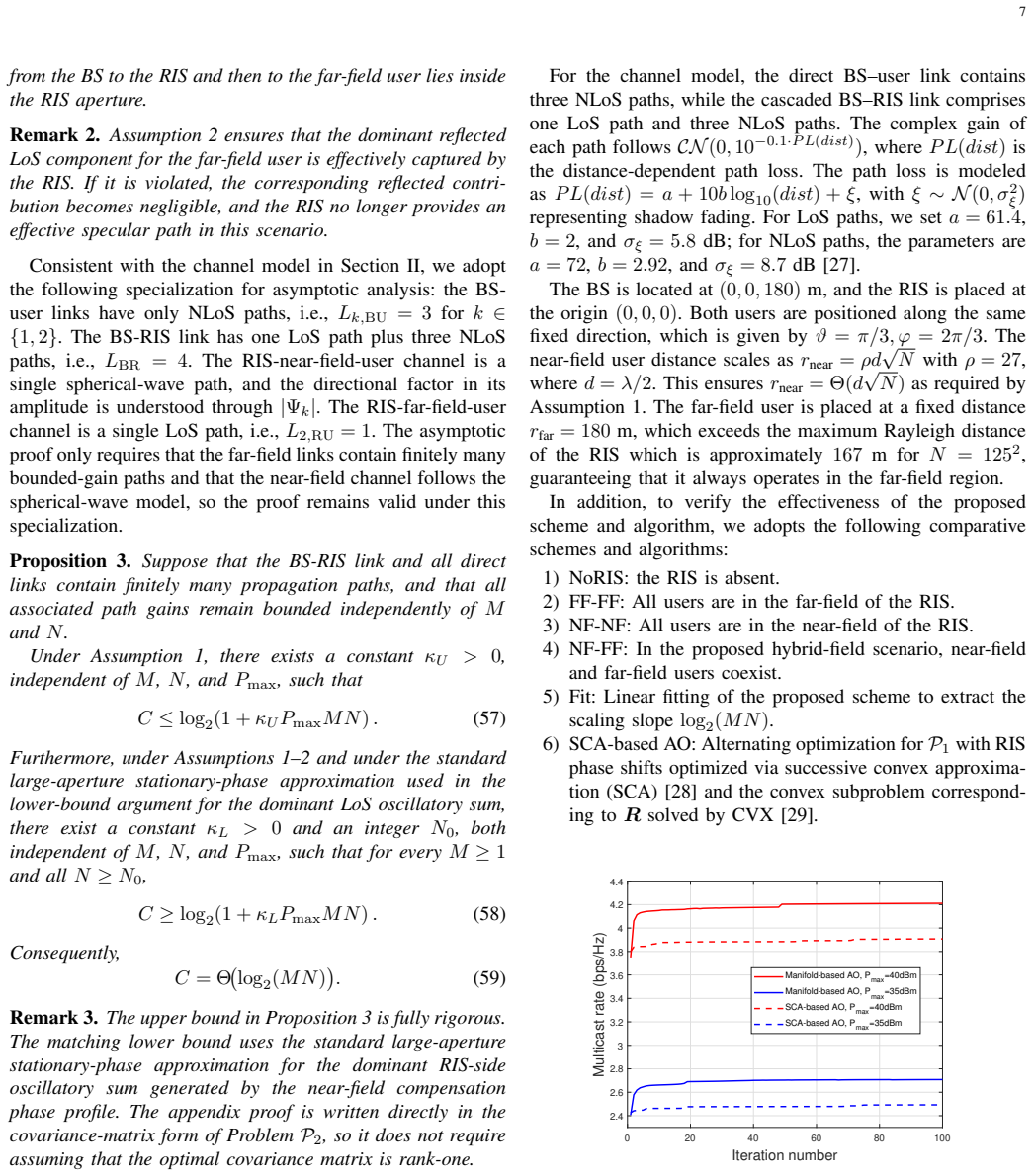
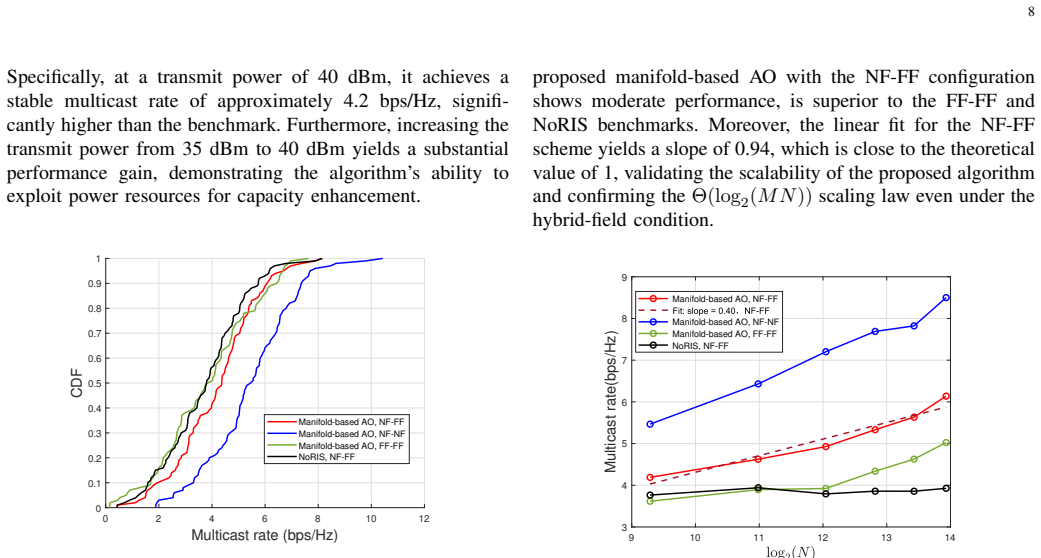
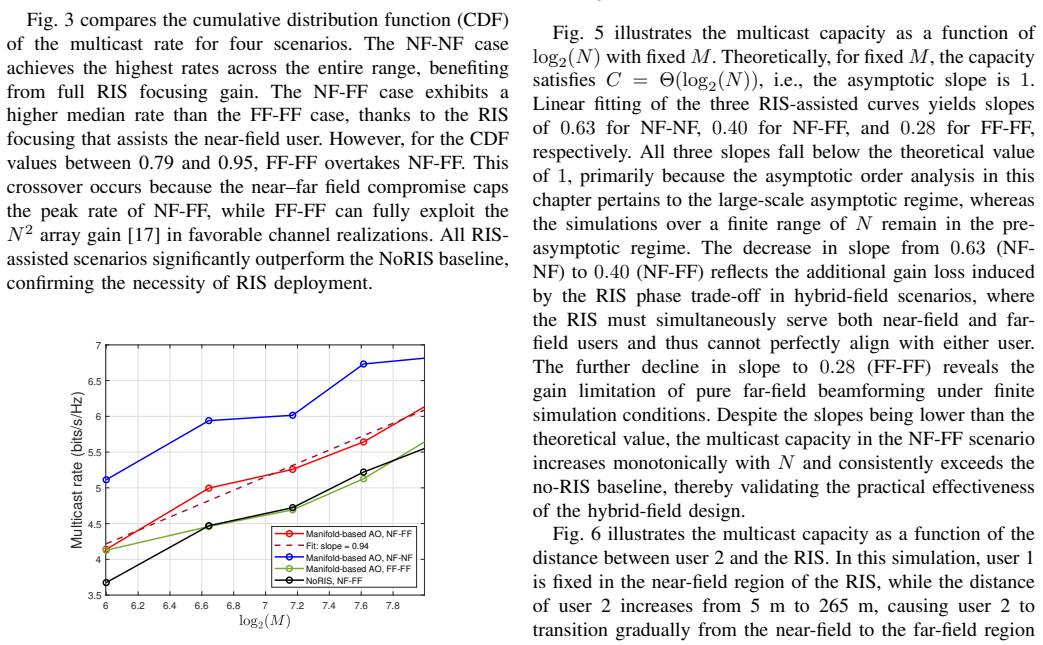
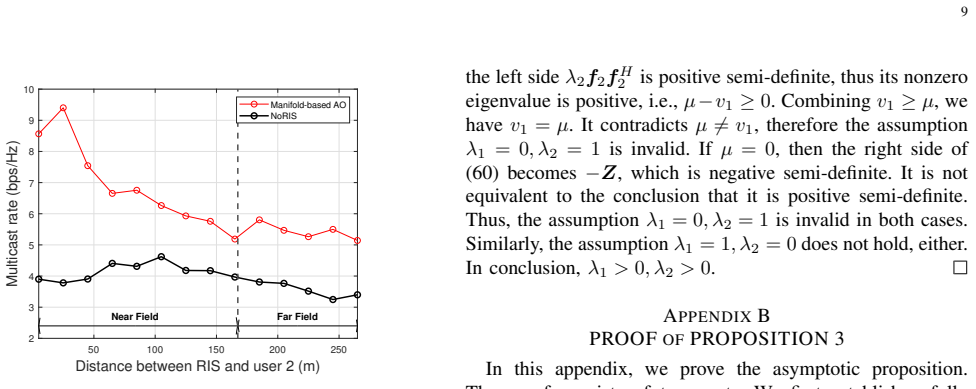
For the fundamental two-user hybrid-field multicast case consisting of one near-field and one far-field user, the optimal closed-form covariance matrix is derived and the RIS phase shifts are optimized via manifold optimization. The multicast capacity scales as Θ(log₂(MN)) as the number of transmit antennas M and/or RIS elements N grow large, and this scaling is proven order-tight.
What carries the argument
Hybrid near- and far-field channel models together with manifold optimization over RIS phase shifts, which enable closed-form covariance derivation and the subsequent scaling-law proof.
If this is right
- Multicast rate grows logarithmically with the number of transmit antennas M.
- Multicast rate grows logarithmically with the number of RIS elements N.
- The derived covariance matrix and manifold-optimized phases achieve the order-tight bound.
- Blockage mitigation in multicast improves steadily with larger M or N under the hybrid-field model.
Where Pith is reading between the lines
- The same logarithmic scaling may extend to more than two users if the weakest link still dominates.
- Approximate low-complexity phase-shift methods could be tested to see whether they preserve the scaling.
- Deployment guidelines could favor larger surfaces when users are at mixed distances.
Load-bearing premise
The two-user hybrid near/far-field setup with standard channel models captures the essential capacity limit, and manifold optimization reaches the global optimum for phase shifts.
What would settle it
A simulation or measurement in which multicast rate fails to increase proportionally to log(MN) when M or N is scaled in a two-user hybrid-field mmWave setup with one near-field and one far-field user would falsify the scaling claim.
Figures

read the original abstract
Multicast transmission in millimeter-wave (mmWave) networks is fundamentally limited by the weakest user, and blockages further exacerbate this problem. Large-scale reconfigurable intelligent surfaces (XL-RIS) offer a promising solution by providing high array gain to overcome blockages. However, the large aperture of XL-RIS significantly expands the near-field region, creating a hybrid-field scenario where some users lie in the near-field while others remain in the far-field. Existing hybrid-field studies on XL-RIS have primarily focused on channel estimation and deployment optimization, leaving multicast capacity analysis unexplored. This paper investigates the fundamental capacity limits of XL-RIS-assisted multicast communications in hybrid-field scenarios. For the fundamental two-user case consisting of one near-field and one far-field user, we derive the optimal closed-form covariance matrix and optimize the RIS phase shifts via manifold optimization. We establish that the multicast capacity scales as $\Theta(\log_2(MN))$ as the number of transmit antennas M and/or RIS elements N grow large, and prove this scaling is order-tight. Numerical results validate the bounds and show the impact of M, $N$, and distance on the multicast rate.
Editorial analysis
A structured set of objections, weighed in public.
Referee Report
Summary. The manuscript investigates the multicast capacity limits of XL-RIS-assisted hybrid near- and far-field mmWave communications. Focusing on the fundamental two-user case (one near-field user and one far-field user), it derives a closed-form optimal covariance matrix for the transmit signal and applies manifold optimization to the RIS phase shifts. The central claim is that the multicast capacity scales as Θ(log₂(MN)) as the number of transmit antennas M and/or RIS elements N grow large, with this scaling proven order-tight via matching upper and lower bounds. Numerical results are presented to validate the bounds and examine parameter effects.
Significance. If the order-tight scaling holds, the result would provide useful theoretical guidance on capacity scaling in large-aperture RIS systems operating in hybrid-field regimes, a setting relevant to blockage mitigation in mmWave networks. The closed-form covariance derivation is a concrete strength that supports analytical tractability.
major comments (2)
- [Phase-shift optimization and scaling analysis] The order-tightness of the Θ(log₂(MN)) scaling rests on a lower bound constructed from the rate achieved after manifold optimization of the RIS phases. Manifold optimization on the non-convex unit-modulus manifold provides no global optimality guarantee. If the numerically obtained phases are strictly suboptimal, the resulting lower bound cannot establish that the capacity scaling is order-tight even if an analytical upper bound of the same order exists. An analytical lower bound independent of the numerical optimizer, or a proof that the manifold solution is globally optimal for this objective, is required to support the central claim.
- [Channel model and capacity derivation] The hybrid near/far-field channel models are used to derive the two-user capacity expression, but the transition between near-field spherical-wave and far-field planar-wave regimes is not shown to preserve the exact log(MN) scaling when the boundary distance varies with M and N. The proof of order-tightness should explicitly account for how the near-field distance threshold (which grows with aperture size) affects the covariance and phase design.
minor comments (1)
- [System model] Notation for the near-field and far-field channel vectors should be introduced with explicit dependence on the distance parameter to clarify the hybrid regime.
Simulated Author's Rebuttal
We thank the referee for the constructive comments. We address each major comment below and will revise the manuscript accordingly to strengthen the claims.
read point-by-point responses
-
Referee: [Phase-shift optimization and scaling analysis] The order-tightness of the Θ(log₂(MN)) scaling rests on a lower bound constructed from the rate achieved after manifold optimization of the RIS phases. Manifold optimization on the non-convex unit-modulus manifold provides no global optimality guarantee. If the numerically obtained phases are strictly suboptimal, the resulting lower bound cannot establish that the capacity scaling is order-tight even if an analytical upper bound of the same order exists. An analytical lower bound independent of the numerical optimizer, or a proof that the manifold solution is globally optimal for this objective, is required to support the central claim.
Authors: We agree that reliance on manifold optimization for the lower bound leaves open the possibility of suboptimality, which weakens the order-tightness claim. In the revision we will add an analytical construction of RIS phases (based on a deterministic phase alignment that exploits the hybrid-field structure) yielding a closed-form achievable rate of Ω(log₂(MN)). This analytical lower bound will replace the numerical one for the scaling proof, while the manifold results will be retained only for numerical validation. revision: yes
-
Referee: [Channel model and capacity derivation] The hybrid near/far-field channel models are used to derive the two-user capacity expression, but the transition between near-field spherical-wave and far-field planar-wave regimes is not shown to preserve the exact log(MN) scaling when the boundary distance varies with M and N. The proof of order-tightness should explicitly account for how the near-field distance threshold (which grows with aperture size) affects the covariance and phase design.
Authors: We acknowledge that the Fresnel distance grows quadratically with aperture size. The revised proof will explicitly parameterize the near/far-field boundary as a function of M and N and show that, for any fixed user distances, the optimal covariance (derived in closed form) and the analytically constructed phases continue to deliver Θ(log₂(MN)) scaling once M or N is large enough that one user remains near-field and the other far-field. A short appendix will detail the boundary dependence. revision: yes
Circularity Check
No circularity; derivation uses closed-form covariance and analytical bounds
full rationale
The paper derives a closed-form optimal covariance matrix for the two-user hybrid-field case and applies manifold optimization to the phase shifts, then proves the multicast capacity scales as Θ(log₂(MN)) with matching upper and lower bounds. No step reduces by construction to a fitted parameter, self-definition, or unverified self-citation chain; the scaling proof is independent of the numerical optimizer output and relies on standard mmWave channel models. The analysis is self-contained against external benchmarks.
Axiom & Free-Parameter Ledger
Reference graph
Works this paper leans on
-
[1]
IRS-Assisted Joint Broadcast/Multicast Resource Allocation and Cooperative Perception Op- timization for 6G V2X Networks,
F. Qi, Q. Huang, Y . Wang, P. Lin, C. Hu and X. Shi, “IRS-Assisted Joint Broadcast/Multicast Resource Allocation and Cooperative Perception Op- timization for 6G V2X Networks,” in IEEE Transactions on Broadcasting, vol. 72, no. 1, pp. 106-116, March 2026
2026
-
[2]
When Virtual Reality Meets Rate Splitting Multiple Access: A Joint Communication and Computation Approach,
N. Q. Hieu, D. N. Nguyen, D. T. Hoang and E. Dutkiewicz, “When Virtual Reality Meets Rate Splitting Multiple Access: A Joint Communication and Computation Approach,” in IEEE Journal on Selected Areas in Communications, vol. 41, no. 5, pp. 1536-1548, May 2023
2023
-
[3]
Models, Methods, and Solutions for Multicasting in 5G/6G mmWave and Sub-THz Systems,
N. Chukhno et al., “Models, Methods, and Solutions for Multicasting in 5G/6G mmWave and Sub-THz Systems,” in IEEE Communications Surveys & Tutorials, vol. 26, no. 1, pp. 119-159, Firstquarter 2024
2024
-
[5]
Near- Field Communications: A Tutorial Review,
Y . Liu, Z. Wang, J. Xu, C. Ouyang, X. Mu and R. Schober, “Near- Field Communications: A Tutorial Review,” in IEEE Open Journal of the Communications Society, vol. 4, pp. 1999-2049, 2023
1999
-
[6]
Sensing-Based Channel Estimation for Extremely Large-Scale RIS-Assisted Millimeter- Wave Communication Systems,
R. Li, L. Zhao, M. Li, M. -M. Zhao and D. W. K. Ng, “Sensing-Based Channel Estimation for Extremely Large-Scale RIS-Assisted Millimeter- Wave Communication Systems,” in IEEE Internet of Things Journal, vol. 12, no. 23, pp. 50732-50746, 1 Dec.1, 2025
2025
-
[7]
Coverage Prob- ability and Ergodic Capacity of Intelligent Reflecting Surface-Enhanced Communication Systems,
T. Van Chien, L. T. Tu, S. Chatzinotas and B. Ottersten, “Coverage Prob- ability and Ergodic Capacity of Intelligent Reflecting Surface-Enhanced Communication Systems,” in IEEE Communications Letters, vol. 25, no. 1, pp. 69-73, Jan. 2021
2021
-
[8]
Beamforming Design for the Performance Optimization of Intelligent Reflecting Surface Assisted Multicast MIMO Networks,
S. Zhang, Z. Yang, M. Chen, D. Liu, K. -K. Wong and H. V . Poor, “Beamforming Design for the Performance Optimization of Intelligent Reflecting Surface Assisted Multicast MIMO Networks,” in IEEE Trans- actions on Wireless Communications, vol. 23, no. 3, pp. 2325-2339, March 2024
2024
-
[9]
Channel Estima- tion for XL-RIS-Aided Millimeter-Wave Systems,
X. Yu, W. Shen, R. Zhang, C. Xing and T. Q. S. Quek, “Channel Estima- tion for XL-RIS-Aided Millimeter-Wave Systems,” in IEEE Transactions on Communications, vol. 71, no. 9, pp. 5519-5533, Sept. 2023
2023
-
[10]
A Sparse-Based Channel Estimation Scheme for XL-RIS-Assisted Wireless Communications With Low Pilot Overheads,
X. Bian, W. Xu, Y . Wang, C. Yuen and Z. Cai, “A Sparse-Based Channel Estimation Scheme for XL-RIS-Assisted Wireless Communications With Low Pilot Overheads,” in IEEE Transactions on Communications, vol. 74, pp. 367-380, 2026
2026
-
[11]
Near-Field Channel Estimation for XL-RIS Assisted Multi-User XL-MIMO Systems: Hybrid Beamforming Architectures,
J. Lee, H. Chung, Y . Cho, S. Kim and S. Hong, “Near-Field Channel Estimation for XL-RIS Assisted Multi-User XL-MIMO Systems: Hybrid Beamforming Architectures,” in IEEE Transactions on Communications, vol. 73, no. 3, pp. 1560-1574, March 2025
2025
-
[12]
Convolutional Dictionary Learning-Based Hybrid-Field Channel Estimation for XL-RIS-Aided Massive MIMO Systems,
P. Zheng, X. Lyu, Y . Wang and Y . Gong, “Convolutional Dictionary Learning-Based Hybrid-Field Channel Estimation for XL-RIS-Aided Massive MIMO Systems,” in IEEE Transactions on Wireless Commu- nications, vol. 24, no. 11, pp. 9085-9098, Nov. 2025. 13
2025
-
[13]
XL-RIS Placement Strategies for Beam Focusing in Coexisting Near- Field and Far-Field mmWave Communications,
A. S. Gharagezlou, M. Rasti, S. Ali, S. K. Taskooh and M. Latva-aho, “XL-RIS Placement Strategies for Beam Focusing in Coexisting Near- Field and Far-Field mmWave Communications,” 2025 IEEE Wireless Communications and Networking Conference (WCNC), Milan, Italy, 2025, pp. 1-6
2025
-
[14]
Resource Scheduling for High-Capacity Multicast Service in Ultra-Dense LEO Satellite Networks,
T. Ma, B. Qian, X. Qin, X. Zhang, L. X. Cai and H. Zhou, “Resource Scheduling for High-Capacity Multicast Service in Ultra-Dense LEO Satellite Networks,” in IEEE Transactions on Vehicular Technology, vol. 73, no. 2, pp. 2468-2481, Feb. 2024
2024
-
[15]
Capacity Limits of Multiple Antenna Multicast,
N. Jindal and Z. -q. Luo, “Capacity Limits of Multiple Antenna Multicast,” 2006 IEEE International Symposium on Information Theory, Seattle, W A, USA, 2006, pp. 1841-1845
2006
-
[16]
Capacity Limits of Multiple Antenna Multicasting Using Antenna Subset Selection,
S. Y . Park and D. J. Love, “Capacity Limits of Multiple Antenna Multicasting Using Antenna Subset Selection,” in IEEE Transactions on Signal Processing, vol. 56, no. 6, pp. 2524-2534, June 2008
2008
-
[17]
Capacity Char- acterization for Reconfigurable Intelligent Surfaces Assisted Multiple- Antenna Multicast,
L. Du, S. Shao, G. Yang, J. Ma, Q. Liang and Y . Tang, “Capacity Char- acterization for Reconfigurable Intelligent Surfaces Assisted Multiple- Antenna Multicast,” in IEEE Transactions on Wireless Communications, vol. 20, no. 10, pp. 6940-6953, Oct. 2021
2021
-
[18]
Channel Capacity of Near- Field Line-of-Sight Multiuser Communications,
B. Zhao, C. Ouyang, X. Zhang and Y . Liu, “Channel Capacity of Near- Field Line-of-Sight Multiuser Communications,” in IEEE Transactions on Wireless Communications, vol. 24, no. 5, pp. 4392-4409, May 2025
2025
-
[19]
Channel Estimation for Extremely Large-Scale MIMO: Far-Field or Near-Field?,
M. Cui and L. Dai, “Channel Estimation for Extremely Large-Scale MIMO: Far-Field or Near-Field?,” in IEEE Transactions on Communica- tions, vol. 70, no. 4, pp. 2663-2677, April 2022
2022
-
[20]
RIS-Assisted Joint Near-Field Channel Estimation and Beamforming Design Based on Deep Unfolding,
X. He, H. Xu, G. Zhang, Y . Xia and Z. Wang, “RIS-Assisted Joint Near-Field Channel Estimation and Beamforming Design Based on Deep Unfolding,” in IEEE Transactions on Vehicular Technology, vol. 75, no. 3, pp. 4411-4423, March 2026
2026
-
[21]
Codebook design and beam training for extremely large-scale RIS: Far-field or near-field?,
X. Wei, L. Dai, Y . Zhao, G. Yu and X. Duan, “Codebook design and beam training for extremely large-scale RIS: Far-field or near-field?,” in China Communications, vol. 19, no. 6, pp. 193-204, June 2022
2022
-
[22]
Performance Analysis and Low-Complexity Design for XL-MIMO With Near-Field Spatial Non-Stationarities,
K. Zhi et al., “Performance Analysis and Low-Complexity Design for XL-MIMO With Near-Field Spatial Non-Stationarities,” in IEEE Journal on Selected Areas in Communications, vol. 42, no. 6, pp. 1656-1672, June 2024
2024
-
[23]
Communicating With Extremely Large-Scale Array/Surface: Unified Modeling and Performance Analysis,
H. Lu and Y . Zeng, “Communicating With Extremely Large-Scale Array/Surface: Unified Modeling and Performance Analysis,” in IEEE Transactions on Wireless Communications, vol. 21, no. 6, pp. 4039-4053, June 2022
2022
-
[24]
Boyd, S., Vandenberghe, L. (2004). Convex Optimization Cambridge: Cambridge University Press
2004
-
[25]
Unified Manifold Optimization for Double-IRS-Aided MIMO Communication,
Y . Geng, T. Hiang Cheng, K. Zhong and K. Chan Teh, “Unified Manifold Optimization for Double-IRS-Aided MIMO Communication,” in IEEE Communications Letters, vol. 28, no. 7, pp. 1713-1717, July 2024
2024
-
[26]
E. M. Stein, Harmonic Analysis: Real-Variable Methods, Orthogonality, and Oscillatory Integrals . Princeton, NJ, USA: Princeton Univ. Press, 1993
1993
-
[27]
Millimeter Wave Channel Modeling and Cellular Capacity Evaluation,
M. R. Akdeniz et al., “Millimeter Wave Channel Modeling and Cellular Capacity Evaluation,” in IEEE Journal on Selected Areas in Communi- cations, vol. 32, no. 6, pp. 1164-1179, June 2014
2014
-
[28]
A Novel SCA-Based Method for Beamforming Optimization in IRS/RIS-Assisted MU-MISO Downlink,
V . Kumar, R. Zhang, M. D. Renzo and L. -N. Tran, “A Novel SCA-Based Method for Beamforming Optimization in IRS/RIS-Assisted MU-MISO Downlink,” in IEEE Wireless Communications Letters, vol. 12, no. 2, pp. 297-301, Feb. 2023
2023
-
[29]
CVX: Matlab software for disciplined convex programming, version 2.1
Michael Grant and Stephen Boyd (2014). CVX: Matlab software for disciplined convex programming, version 2.1
2014
discussion (0)
Sign in with ORCID, Apple, or X to comment. Anyone can read and Pith papers without signing in.