Polymer-Regulated Freezing of Water Droplets Revealed by Synchrotron X-ray Imaging and Raman Spectroscopy
Pith reviewed 2026-06-28 16:26 UTC · model grok-4.3
The pith
Freeze-induced segregation of polyvinyl alcohol redistributes the polymer unevenly in solidifying water droplets, blunting the freezing tip and suppressing bubble entrapment.
A machine-rendered reading of the paper's core claim, the machinery that carries it, and where it could break.
Core claim
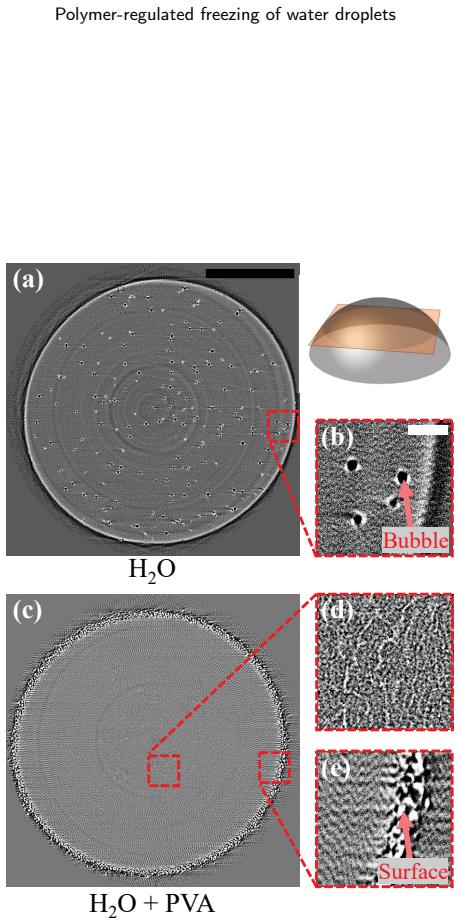
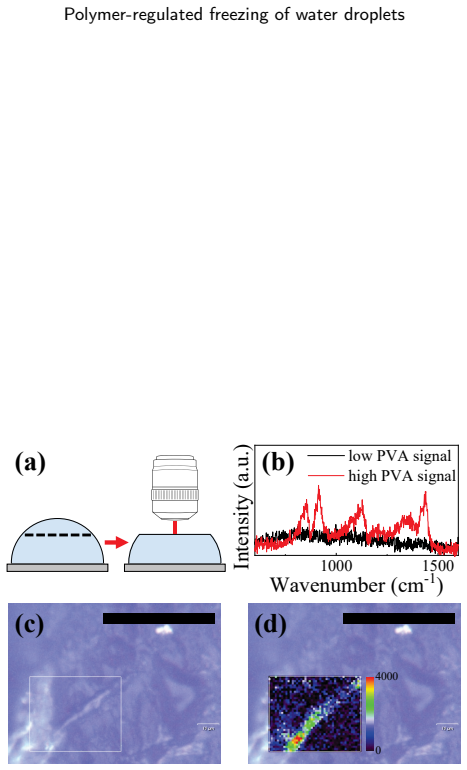
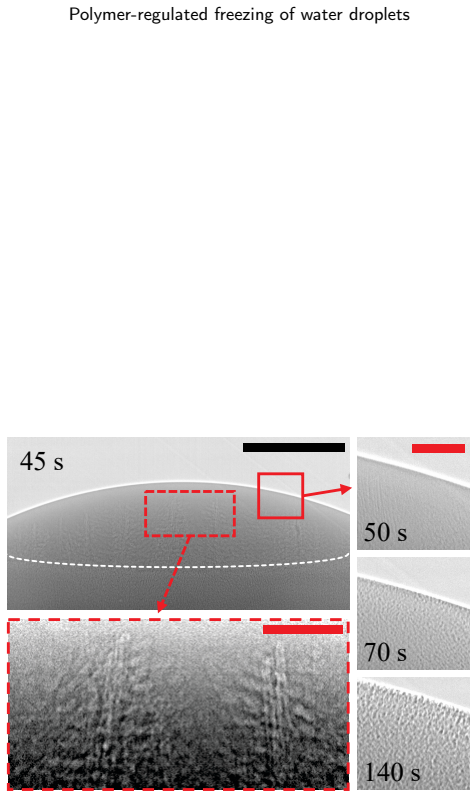
As the polymer concentration increases, frozen PVA droplets exhibit slower freezing-front propagation, reduced bubble entrapment, and a progressively more rounded apex. X-ray tomography identifies low-transmittance domains in the interiors and at the surfaces of these frozen droplets, while Raman spectral mapping confirms that the domains correspond to PVA-enriched regions. This demonstrates that PVA undergoes freeze-induced segregation rather than homogeneous redistribution during water solidification.
What carries the argument
freeze-induced polymer segregation, the process by which dissolved PVA concentrates into spatially distinct regions during ice formation rather than remaining uniformly mixed.
If this is right
- Higher PVA concentrations produce more rounded freezing apices and fewer trapped bubbles.
- The freezing front advances more slowly as polymer concentration rises.
- Low X-ray transmittance domains inside and on the surface of frozen droplets correspond to localized PVA enrichment.
- Heterogeneous polymer redistribution supplies a spatially resolved account of tip blunting and bubble suppression.
Where Pith is reading between the lines
- The same segregation process could be tested in other water-soluble polymers to determine whether tip rounding and bubble reduction generalize beyond PVA.
- Mapping polymer locations during controlled freezing rates might reveal how segregation strength depends on cooling speed.
- The internal PVA-enriched domains could affect mechanical strength or porosity in materials made by freeze-casting.
Load-bearing premise
The low X-ray transmittance domains seen in tomography match PVA-enriched zones identified by Raman mapping without major contributions from density changes or imaging artifacts.
What would settle it
Raman spectral maps of multiple frozen droplets showing uniform PVA distribution across regions that X-ray tomography identifies as low-transmittance domains would falsify the segregation mechanism.
Figures

read the original abstract
Adding a polymer to a sessile water droplet not only lowers its freezing point but also suppresses the tip singularity that forms during its freezing on cold substrates. Here, we employ synchrotron X-ray and Raman imaging to elucidate the spatiotemporal mechanism underlying tip suppression in an aqueous polyvinyl alcohol (PVA) solution, a model polymer solution. As the polymer concentration increases, we observe slower propagation of the freezing front, reduced bubble entrapment, and a progressively more rounded apex across the volumes and molecular weights examined. X-ray tomography reveals that frozen PVA droplets retain low X-ray transmittance domains in their interiors and at the surface, and Raman spectral mapping confirms that these domains correspond to PVA-enriched regions, providing direct evidence of freeze-induced polymer segregation. These findings indicate that PVA is redistributed heterogeneously during water solidification rather than shifting bulk properties homogeneously, providing a spatially resolved framework for interpreting the observed tip blunting and the suppression of discrete bubble entrapment. Our work identifies freeze-induced polymer segregation as a pathway by which a dissolved polymer regulates both the external shape and the internal structure of a freezing droplet, and these findings shed light on potential applications in freezing-based processes such as freeze-casting and cryopreservation.
Editorial analysis
A structured set of objections, weighed in public.
Referee Report
Summary. The manuscript uses synchrotron X-ray tomography and Raman spectral mapping to examine freezing of sessile PVA-water droplets. It reports slower freezing fronts, rounded apices, and reduced bubble entrapment with increasing polymer concentration or molecular weight, and attributes these to heterogeneous PVA redistribution that creates polymer-enriched domains visible as low X-ray transmittance regions, rather than a uniform change in bulk solution properties.
Significance. If the observations hold, the work supplies direct, spatially resolved evidence that freeze-induced polymer segregation regulates both external morphology and internal structure of freezing droplets. The dual-modality approach (X-ray tomography plus Raman confirmation of PVA enrichment) strengthens the central claim and offers a mechanistic framework relevant to freeze-casting and cryopreservation. The experimental grounding in independent imaging techniques is a clear asset.
minor comments (3)
- The abstract states that Raman mapping confirms low-transmittance domains as PVA-enriched, but the main text should include quantitative metrics (e.g., correlation coefficients or spectral peak intensities) showing how well the two modalities align across multiple droplets.
- Details on sample numbers, statistical tests for front-speed and apex-roundness trends, and explicit exclusion criteria for droplets showing artifacts should be expanded to support the reported trends across concentrations and molecular weights.
- Figure captions and methods should clarify the X-ray energy, exposure times, and any corrections applied for beam hardening or density contrast to strengthen the interpretation that low-transmittance regions are polymer-rich rather than density-driven.
Simulated Author's Rebuttal
We thank the referee for their positive assessment of our manuscript, including the recognition of the value of the synchrotron X-ray tomography combined with Raman mapping in demonstrating freeze-induced PVA segregation. We appreciate the recommendation for minor revision.
Circularity Check
No significant circularity
full rationale
This is a purely experimental study relying on synchrotron X-ray tomography and Raman spectral mapping as independent modalities. The central claim of heterogeneous PVA redistribution during freezing is established by direct spatial correspondence between low-transmittance domains and polymer-enriched regions, with no equations, fitted parameters, predictions, or self-citation chains that reduce the result to its inputs by construction. All observations are externally falsifiable via the reported imaging data.
Axiom & Free-Parameter Ledger
axioms (1)
- domain assumption Low X-ray transmittance domains indicate higher polymer concentration when corroborated by Raman spectra
Reference graph
Works this paper leans on
-
[1]
F. Chu, S. Li, C. Zhao, Y. Feng, Y. Lin, X. Wu, X. Yan, N. Miljkovic, Interfacial ice sprouting during salty water droplet freezing, Nature Communications 15 (2024) 2249
2024
-
[2]
J. Zhu, Z. Wang, Z. Dai, Y. Wang, M. Wang, Burr-like structures growth and diffuse freezing front during saltwater droplet impact freezing, Journal of Colloid and Interface Science 699 (2025) 138227
2025
-
[3]
F. Wang, L. Chen, Y. Li, P. Huo, X. Gu, M. Hu, D. Deng, Self-lifting droplet driven by the solidification-induced solutal marangoni flow, Physical Review Letters 132 (2024) 014002
2024
-
[4]
F.Shen,W.-Z.Fang,S.Zhang,D.Zhang,W.-Q.Tao, Freezingpatternsofsupercooledbinarydropletsoncoldhydrophobicsurfaces, Langmuir 41 (2025) 26705–26714
2025
-
[5]
J. H. Snoeijer, P. Brunet, Pointy ice-drops: How water freezes into a singular shape, American Journal of Physics 80 (2012) 764–771
2012
-
[6]
A. G. Marin, O. R. Enriquez, P. Brunet, P. Colinet, J. H. Snoeijer, Universality of tip singularity formation in freezing water drops, Physical Review Letters 113 (2014) 054301
2014
-
[7]
F. Chu, X. Zhang, S. Li, H. Jin, J. Zhang, X. Wu, D. Wen, Bubble formation in freezing droplets, Physical Review Fluids 4 (2019) 071601
2019
-
[8]
Y. Li, M. Li, C. Dang, X. Liu, Effects of dissolved gas on the nucleation and growth of ice crystals in freezing droplets, International Journal of Heat and Mass Transfer 184 (2022) 122334
2022
-
[9]
J. G. Meijer, D. Rocha, A. M. Linnenbank, C. Diddens, D. Lohse, Enhanced bubble growth near an advancing solidification front, Journal of Fluid Mechanics 996 (2024) A22
2024
-
[10]
K. Shao, M. Song, J. Shen, X. Zhang, L. Pekař, Experimental study on the distribution and growth characteristics of trapped air bubbles in ice slices at different freezing temperatures, Applied Thermal Engineering 244 (2024) 122600
2024
-
[11]
K.Shao,M.Song,X.Zhang,L.Zhang, Growthanddistributioncharacteristicsoftrappedairbubblesiniceslices, PhysicsofFluids35(2023) 113319
2023
-
[12]
Snels, N
L. Snels, N. M. Sarkari, J. Soete, A. Maes, C. Antonini, M. Wevers, T. Maitra, D. Seveno, Internal and interfacial microstructure characterization of ice droplets on surfaces by X-ray computed tomography, Journal of Colloid and Interface Science 637 (2023) 500–512
2023
-
[13]
V.Thiévenaz,J.G.Meijer,D.Lohse,A.Sauret, Ontheshapeofairbubblestrappedinice, ProceedingsoftheNationalAcademyofSciences 122 (2025) e2415027122
2025
-
[14]
J. K. Im, H. An, S.-G. Kim, J.-H. Lim, J. Jeong, X-ray microscopy study of freezing sessile droplets, arXiv preprint (2025)
2025
-
[15]
Budke, T
C. Budke, T. Koop, Ice recrystallization inhibition and molecular recognition of ice faces by poly (vinyl alcohol), ChemPhysChem 7 (2006) 2601–2606
2006
-
[16]
P.M.Naullage,Y.Qiu,V.Molinero, Whatcontrolsthelimitofsupercoolingandsuperheatingofpinnedicesurfaces?, TheJournalofPhysical Chemistry Letters 9 (2018) 1712–1720
2018
-
[17]
P. M. Naullage, V. Molinero, Slow propagation of ice binding limits the ice-recrystallization inhibition efficiency of PVA and other flexible polymers, Journal of the American Chemical Society 142 (2020) 4356–4366
2020
-
[18]
F.Bachtiger,T.R.Congdon,C.Stubbs,M.I.Gibson,G.C.Sosso, TheatomisticdetailsoftheicerecrystallisationinhibitionactivityofPVA, Nature Communications 12 (2021) 1323
2021
-
[19]
L. Weng, S. L. Stott, M. Toner, Molecular dynamics at the interface between ice and poly(vinyl alcohol) and ice recrystallization inhibition, Langmuir 34 (2018) 5116–5123. H. An et al.:Preprint submitted to ElsevierPage 5 of 10 Polymer-regulated freezing of water droplets
2018
-
[20]
Zhang, L
T. Zhang, L. Wang, Z. Wang, J. Li, J. Wang, Single ice crystal growth with controlled orientation during directional freezing, The Journal of Physical Chemistry B 125 (2021) 970–979
2021
-
[21]
T.Zhang,Z.Wang,L.Wang,J.Li,J.Wang, Tiltingbehavioroflamellaricetipduringunidirectionalfreezingofaqueoussolutions, Langmuir 37 (2021) 10579–10587
2021
-
[22]
Z. Piao, J. K. Park, M. Patel, H. J. Lee, B. Jeong, Poly (L-ala-co-L-lys) exhibits excellent ice recrystallization inhibition activity, ACS Macro Letters 10 (2021) 1436–1442
2021
-
[23]
S. P. Kharal, J.-F. Louf, Unidirectional freezing of polymer solution droplets, Langmuir 40 (2024) 118–124
2024
-
[24]
N. G. Ulrich, J.-F. Louf, Interfacial mechanisms in the freezing of polymer solutions, Nanoscale 18 (2026) 3453–3471
2026
-
[25]
U.G.K.Wegst,M.Schecter,A.E.Donius,P.M.Hunger, Biomaterialsbyfreezecasting, PhilosophicalTransactionsoftheRoyalSocietyA: Mathematical, Physical and Engineering Sciences 368 (2010) 2099–2121
2010
-
[26]
K. Yin, P. Divakar, U. G. K. Wegst, Plant-derived nanocellulose as structural and mechanical reinforcement of freeze-cast chitosan scaffolds for biomedical applications, Biomacromolecules 20 (2019) 3733–3745
2019
-
[27]
K.Yin,K.Ji,L.S.Littles,R.Trivedi,A.Karma,U.G.K.Wegst, Hierarchicalstructureformationbycrystalgrowth-frontinstabilitiesduring ice templating, Proceedings of the National Academy of Sciences 120 (2023) e2210242120
2023
-
[28]
N. G. Ulrich, P. P. Aravindhan, O. Berger, B. S. Beckingham, J.-F. Louf, Universal scaling of freezing morphodynamics in polymer solution droplets, arXiv preprint (2026)
2026
-
[29]
P.H.Kamm,K.Yin,T.R.Neu,C.M.Schlepütz,F.García-Moreno,U.G.K.Wegst, X-raytomoscopyrevealsthedynamicsoficetemplating, Advanced Functional Materials 33 (2023) 2304738
2023
-
[30]
P. A. Alpert, A. Boucly, S. Yang, H. Yang, K. Kilchhofer, Z. Luo, C. Padeste, S. Finizio, M. Ammann, B. Watts, Ice nucleation imaged with X-ray spectro-microscopy, Environmental Science: Atmospheres 2 (2022) 335–351
2022
-
[31]
Z. Wu, X. Gao, J. Jia, Y. Jiang, H. E. Huppert, L. Lei, Microscopic salt exclusion dynamics of directional freezing in brine, Journal of Fluid Mechanics 1021 (2025) A15
2025
-
[32]
J.Jin,E.J.Yurkow,D.Adler,T.-C.Lee, Anovelapproachtoimprovetheefficiencyofblockfreezeconcentrationusingicenucleationproteins with altered ice morphology, Journal of Agricultural and Food Chemistry 65 (2017) 2373–2382
2017
-
[33]
J.A.Seibert,J.M.Boone,K.K.Lindfors, Flat-fieldcorrectiontechniquefordigitaldetectors, in:MedicalImaging1998:PhysicsofMedical Imaging, volume 3336 ofProceedings of SPIE, 1998, pp. 348–354. doi:10.1117/12.317034
-
[34]
H. An, B. Kim, J. K. Im, M. W. Kim, S.-G. Kim, J.-H. Lim, K. Kim, J. Jeong, Polymer-regulated freezing of water droplets revealed by synchrotron x-ray imaging and raman spectroscopy [dataset], ZENODO (2026)
2026
-
[35]
K.Kim,G.Shin,K.D.Tran,Y.-Y.Ahn,B.Kim,J.Kim, Freezing-inducedoxidationofarsenitebynitritethroughachainreactionmechanism, Separation and Purification Technology 382 (2026) 135736
2026
-
[36]
Garncarzová, L
M. Garncarzová, L. Veselý, B. Kim, K. Kim, D. Heger, Spectroscopic characterization of phenol in frozen aqueous solution and on the ice surface, Spectrochimica Acta Part A: Molecular and Biomolecular Spectroscopy 335 (2025) 125948
2025
-
[37]
Hamciuc, T
C. Hamciuc, T. Vlad-Bubulac, D. Serbezeanu, E. Hamciuc, M. Aflori, G. Lisa, I. Anghel, I.-E. Şofran, A. Trofin, Tailoring thermal and flame retardant properties via synergistic effect in polyvinyl alcohol nanocomposites based on polyphosphonate and/or sio2 nanoparticles, Composites Part C: Open Access 3 (2020) 100063
2020
-
[38]
W. W. Mullins, R. F. Sekerka, Morphological stability of a particle growing by diffusion or heat flow, Journal of Applied Physics 34 (1963) 323–329
1963
-
[39]
W.W.Mullins,R.F.Sekerka, Stabilityofaplanarinterfaceduringsolidificationofadilutebinaryalloy, JournalofAppliedPhysics35(1964) 444–451
1964
-
[40]
Zhang, Z
T. Zhang, Z. Wang, L. Wang, J. Li, J. Wang, The planar instability during unidirectional freezing of a macromolecular polymer solution: Diffusion-controlled or not?, Physica B: Condensed Matter 610 (2021) 412923
2021
-
[41]
C. Wang, Z. Xu, H. Zhang, J. Zheng, P. Hao, F. He, X. Zhang, A new freezing model of sessile droplets considering ice fraction and ice distribution after recalescence, Physics of Fluids 34 (2022) 092115
2022
-
[42]
X.Zhang,X.Wu,J.Min,X.Liu, Modellingofsessilewaterdropletshapeevolutionduringfreezingwithconsiderationofsupercoolingeffect, Applied Thermal Engineering 125 (2017) 644–651
2017
-
[43]
Polymer-Regulated Freezing of Water Droplets Revealed by Synchrotron X-ray Imaging and Raman Spectroscopy
M. Tembely, A. Dolatabadi, A comprehensive model for predicting droplet freezing features on a cold substrate, Journal of Fluid Mechanics 859 (2019) 566–585. H. An et al.:Preprint submitted to ElsevierPage 6 of 10 Polymer-regulated freezing of water droplets H2O H2O + P VA α (a) (d) (b) (c) (e) (f) Figure 1:Comparison of optical and X-ray observations of ...
2019
discussion (0)
Sign in with ORCID, Apple, or X to comment. Anyone can read and Pith papers without signing in.