Altermagnetism in MnF₂: Band Splitting and Its Physical Consequences
Pith reviewed 2026-06-28 14:10 UTC · model grok-4.3
The pith
Altermagnetic splitting in MnF2 is suppressed in most magnetic properties by strong coupling but directly enhances magneto-optical response at energies around U.
A machine-rendered reading of the paper's core claim, the machinery that carries it, and where it could break.
Core claim
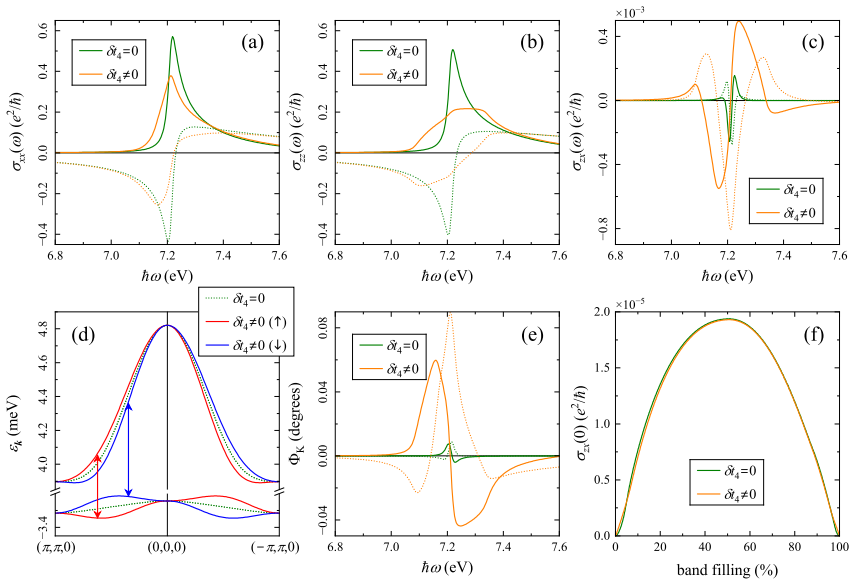
In MnF2 the altermagnetic hopping δt is small. Because the electronic system is in the strong-coupling regime, all exchange interactions scale as 1/U, so the altermagnetic exchange term is proportionally small. Upon doping the altermagnetic piece of the anomalous Hall effect is likewise suppressed by a factor of order δt/U relative to conventional contributions. In contrast, the conductivity tensor σ̂(ω) at ħω ∼ U is reshaped because δt modifies interband energies directly, leading to a dramatic enhancement of the magneto-optical response.
What carries the argument
The strong-coupling regime in which magnetic properties are governed by the ratio t/U, with the small altermagnetic hopping δt entering static observables only through the reduced factor δt/U but entering optical transition energies directly.
If this is right
- All exchange interactions, including altermagnetic ones, scale as 1/U and are therefore small when δt is small.
- The altermagnetic contribution to the anomalous Hall effect upon doping is suppressed by a factor of order δt/U compared with non-altermagnetic terms.
- The conductivity tensor at ħω ∼ U is qualitatively altered because δt shifts interband transition energies directly.
- This direct entry produces a dramatic enhancement of the magneto-optical response.
Where Pith is reading between the lines
- Optical probes at energies near U may therefore be more sensitive to altermagnetism than transport measurements in strongly correlated materials.
- The same distinction between reduced-ratio suppression and direct energy shifts could appear in other candidate altermagnets that lie deep in the strong-coupling regime.
- Doping strategies aimed at amplifying altermagnetic signals would need to target the optical rather than the dc response to be effective.
Load-bearing premise
The electronic system lies in the strong-coupling regime where magnetic properties are controlled by the ratio t/U.
What would settle it
A measurement of the frequency-dependent conductivity tensor in MnF2 that either confirms or rules out a strong reshaping and enhancement of the magneto-optical response specifically at photon energies near the on-site Coulomb repulsion U.
Figures

read the original abstract
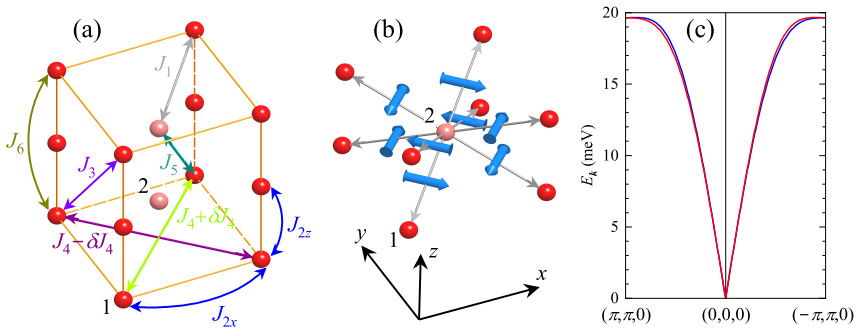
MnF$_2$ is widely regarded as a candidate altermagnet, but the magnitude and implications of its altermagnetic band splitting remain debated. Using electronic-structure calculations, we construct minimal models that capture the magnetic and electronic properties of MnF$_2$. These models show that the parameters governing the chiral magnon splitting and the spin splitting of the electronic bands are relatively small. Moreover, the electronic system lies in the strong-coupling regime, where most magnetic properties are controlled by the ratio $t/U$ between the characteristic hopping amplitude $t$ and the large on-site Coulomb repulsion $U$. Consequently, all exchange interactions scale as $1/U$, so a small altermagnetic hopping $\delta t$ produces only a proportionally small exchange term. Upon doping, the altermagnetic contribution to the anomalous Hall effect is likewise suppressed, being smaller than the conventional (non-altermagnetic) contribution by a factor of order $\delta t/U$. In contrast, the behavior of the conductivity tensor $\hat{\sigma}(\omega)$ at $\hbar \omega \sim U$ differs qualitatively, because $\delta t$ enters the energies of interband optical transitions \emph{directly} rather than through the reduced ratio $\delta t/U$. This contribution strongly reshapes $\hat{\sigma}(\omega)$, leading to a dramatic enhancement of the magneto-optical response.
Editorial analysis
A structured set of objections, weighed in public.
Referee Report
Summary. The manuscript performs electronic-structure calculations on MnF₂ to construct minimal tight-binding models capturing its altermagnetic properties. It reports that the altermagnetic hopping parameter δt is relatively small compared to the conventional hopping t, and that the system resides in the strong-coupling regime U ≫ t. From this, it concludes that exchange interactions scale as 1/U, so that altermagnetic contributions to the anomalous Hall effect upon doping are suppressed by a factor of order δt/U relative to conventional contributions; in contrast, the optical conductivity tensor σ̂(ω) at ħω ∼ U is directly reshaped by δt, producing a dramatic enhancement of the magneto-optical response.
Significance. If the minimal models are faithful, the work supplies a concrete scaling argument that separates low-energy transport signatures of altermagnetism (suppressed) from high-frequency optical signatures (enhanced) in the strong-coupling limit. The first-principles construction of the models is a positive feature that grounds the subsequent effective-theory analysis.
major comments (2)
- [Abstract] Abstract and the paragraph beginning 'Moreover, the electronic system lies in the strong-coupling regime': the claims that 'all exchange interactions scale as 1/U' and that the AHE contribution is suppressed by δt/U follow directly from the definition of the strong-coupling limit together with the decomposition of the hopping into conventional and altermagnetic parts. No independent derivation or numerical verification of the effective low-energy Hamiltonian is supplied, so the 'physical consequences' reduce to model assumptions rather than additional predictions.
- [Abstract] Abstract and §2 (electronic-structure calculations): no numerical values, error bars, or explicit fitting procedure are given for the parameters t, U, and δt extracted from the calculations. Without these quantities it is impossible to verify that δt is 'relatively small' or that the system is quantitatively in the U ≫ t regime, both of which are load-bearing for the central scaling statements.
Simulated Author's Rebuttal
We thank the referee for the careful reading and constructive comments on our manuscript. We respond to each major comment below.
read point-by-point responses
-
Referee: [Abstract] Abstract and the paragraph beginning 'Moreover, the electronic system lies in the strong-coupling regime': the claims that 'all exchange interactions scale as 1/U' and that the AHE contribution is suppressed by δt/U follow directly from the definition of the strong-coupling limit together with the decomposition of the hopping into conventional and altermagnetic parts. No independent derivation or numerical verification of the effective low-energy Hamiltonian is supplied, so the 'physical consequences' reduce to model assumptions rather than additional predictions.
Authors: The scaling of exchange interactions as 1/U is indeed a standard result of degenerate perturbation theory in the Hubbard model when U ≫ t. The manuscript's key advance is the first-principles construction of minimal tight-binding models from electronic-structure calculations on MnF₂ that determine the relative magnitude of the altermagnetic hopping δt. The stated physical consequences for doped AHE versus optical response at ħω ∼ U then follow directly from applying this model at the two energy scales. We will add a concise derivation of the effective low-energy Hamiltonian in the revised manuscript to make the connection explicit. revision: yes
-
Referee: [Abstract] Abstract and §2 (electronic-structure calculations): no numerical values, error bars, or explicit fitting procedure are given for the parameters t, U, and δt extracted from the calculations. Without these quantities it is impossible to verify that δt is 'relatively small' or that the system is quantitatively in the U ≫ t regime, both of which are load-bearing for the central scaling statements.
Authors: We agree that explicit numerical values for t, U, and δt (with error estimates) and a description of the fitting procedure are needed to substantiate the claims. These will be added to §2 in the revised manuscript, together with the relevant output from the underlying electronic-structure calculations. revision: yes
Circularity Check
No significant circularity identified
full rationale
The paper constructs minimal models from electronic-structure calculations, determines that the system is in the strong-coupling regime (U ≫ t) with small δt, and then derives the scaling of exchange interactions (~1/U) and the consequent suppression of altermagnetic AHE by ~δt/U upon doping, while noting direct entry of δt into interband energies for σ̂(ω) at ħω ~ U. These are explicit logical consequences of the accepted model assumptions and regime identification rather than reductions by definition, fitted inputs renamed as predictions, or load-bearing self-citations. No quoted step equates a claimed prediction to its input by construction, and the derivation remains self-contained against the stated benchmarks.
Axiom & Free-Parameter Ledger
free parameters (3)
- t
- U
- δt
axioms (2)
- domain assumption The electronic system lies in the strong-coupling regime where magnetic properties are controlled by t/U
- domain assumption Minimal models constructed from electronic-structure calculations capture the essential magnetic and electronic properties
Reference graph
Works this paper leans on
-
[1]
I. E. Dzyaloshinskii, Phys. Lett. A 155, 62 (1991)
1991
-
[2]
Dzyaloshinsky, J
I. Dzyaloshinsky, J. Chem. Phys. Solids 4, 241 (1958)
1958
-
[3]
I. E. Dzyaloshinskii, Zh. Eksp. Teor. Fiz. 33, 807 (1957) [JETP (USSR) 6, 621 (1958)]
1957
-
[4]
I. E. Dzyaloshinskii, Zh. Eksp. Teor. Fiz. 37, 881 (1959) [JETP (USSR) 10, 628 (1960)]
1959
-
[5]
E. A. Turov and V . G. Shavrov, Zh. Eksp. Teor. Fiz. 43, 2273 (1962) [JETP (USSR) 16, 1606 (1963)]
1962
-
[6]
E. A. Turov, Uspekhi Fizicheskikh Nauk 164, 325 (1994) [Physics-Uspekhi 37, 303 (1994)]. 8
1994
-
[7]
E. A. Turov, Kinetic, optical, and acoustic properties of antiferromag nets (Ural Division of Academy of Sciences of the USSR, Sverdlovsk, 1990)
1990
-
[8]
I. E. Dzyaloshinskii, Zh. Eksp. Teor. Fiz. 46, 1420 (1964) [JETP (USSR) 19, 960 (1964)]
1964
-
[9]
U. K. R¨ oßler, A. N. Bogdanov, and C. Pfleiderer, Nature (L ondon) 442, 797 (2006)
2006
-
[10]
I. V . Solovyev, arXiv:2509.00369
-
[11]
Moriya, Phys
T. Moriya, Phys. Rev. 120, 91 (1960)
1960
-
[12]
Solovyev, N
I. Solovyev, N. Hamada, and K. Terakura, Phys. Rev. Lett . 76, 4825 (1996)
1996
-
[13]
I. V . Solovyev, Phys. Rev. B 90, 024417 (2014)
2014
-
[14]
Szilva, Y
A. Szilva, Y . Kvashnin, E. A. Stepanov, L. Nordstr¨ om, O. Eriksson, A. I. Lichtenstein, and M. I. Katsnelson, Rev. Mod. Phys. 95, 035004 (2023)
2023
-
[15]
I. V . Solovyev, J. Phys.: Condens. Matter 36, 223001 (2024)
2024
-
[16]
I. V . Solovyev, Phys. Rev. B 55, 8060 (1997)
1997
-
[17]
Y . Noda, K. Ohno, and S. Nakamura, Phys. Chem. Chem. Phys . 18, 13294 (2016)
2016
-
[18]
Okugawa, K
T. Okugawa, K. Ohno, Y . Noda, and S. Nakamura, J. Phys.: C ondens. Matter 30, 075502 (2018)
2018
-
[19]
Hayami, Y
S. Hayami, Y . Y anagi, and H. Kusunose, J. Phys. Soc. Jpn 88, 123702 (2019)
2019
-
[20]
M. Naka, S. Hayami, H. Kusunose, Y . Y anagi, Y . Motome, and H. Seo, Nature Communications 10, 4305 (2019)
2019
-
[21]
M. Naka, Y . Motome, and H. Seo, npj Spintronics 3, 1 (2025)
2025
-
[22]
ˇSmejkal, J
L. ˇSmejkal, J. Sinova, and T. Jungwirth, Phys. Rev. X 12, 031042 (2022)
2022
-
[23]
Mazin, Phys
I. Mazin, Phys. Rev. X 12, 040002 (2022)
2022
-
[24]
L. Bai, W . Feng, S. Liu, L. ˇSmejkal, Y . Mokrousov, and Y . Y ao, Adv. Funct. Mater.34, 2409327 (2024)
2024
-
[25]
V . C. Morano, Z. Maesen, S. E. Nikitin, J. Lass, D. G. Mazz one, and O. Zaharko, Phys. Rev. Lett. 134, 226702 (2025)
2025
-
[26]
Jauch, G
W . Jauch, G. J. McIntyre, and A. J. Schultz, Acta Cryst. B 46, 739 (1990)
1990
-
[27]
I. V . Solovyev, J. Phys.: Condens. Matter 20, 293201 (2008)
2008
-
[28]
Marzari, A
N. Marzari, A. A. Mostofi, J. R. Y ates, I. Souza, and D. V an derbilt, Rev. Mod. Phys. 84, 1419 (2012)
2012
-
[29]
Aryasetiawan, M
F. Aryasetiawan, M. Imada, A. Georges, G. Kotliar, S. Bi ermann, and A. I. Lichtenstein, Phys. Rev. B 70, 195104 (2004)
2004
-
[30]
G. P . Felcher and R. Kleb, Europhys. Lett. 36, 455 (1996)
1996
-
[31]
Hoyer, R
R. Hoyer, R. Jaeschke-Ubiergo, K.-H. Ahn, L. ˇSmejkal, and A. Mook, Phys. Rev. B 111, L020412 (2025)
2025
-
[32]
M. Roig, A. Kreisel, Y . Y u, B. M. Andersen, and D. F. Agter berg, Phys. Rev. B 110, 144412 (2024)
2024
-
[33]
ˇSmejkal, R
L. ˇSmejkal, R. Gonz´ alez-Hern´ andez, T. Jungwirth, and J. Sinova, Sci. Adv. 6, eaaz8809 (2020)
2020
-
[34]
M. Naka, S. Hayami, H. Kusunose, Y . Y anagi, Y . Motome, and H. Seo, Phys. Rev. B 102, 075112 (2020)
2020
-
[35]
I. Solovyev, S. Nikolaev, and A. Tanaka, npj Quantum Mat er. (2026). https://doi.org/10.1038/s41535-026- 00900-9
-
[36]
L. M. Sandratskii, Adv. Phys. 47, 91 (1998)
1998
-
[37]
P . A. McClarty and J. G. Rau, Phys. Rev. Lett. 132, 176702 (2024)
2024
-
[38]
Bhowal and N
S. Bhowal and N. A. Spaldin, Phys. Rev. X 14, 011019 (2024)
2024
- [39]
-
[40]
¯Oik´ e, R
J. ¯Oik´ e, R. Peters, and K. Shinada, Phys. Rev. B112, 134412 (2025)
2025
-
[41]
P . M. Oppeneer, T. Maurer, J. Sticht, and J. K¨ ubler, Phys. Rev. B 45, 10924 (1992)
1992
-
[42]
Nagaosa, J
N. Nagaosa, J. Sinova, S. Onoda, A. H. MacDonald, and N. P . Ong, Rev. Mod. Phys. 82, 1539 (2010). 9
2010
discussion (0)
Sign in with ORCID, Apple, or X to comment. Anyone can read and Pith papers without signing in.