A 32-Channel 3.53-{μ}W Per Channel Brain-Machine Interface SoC Featuring Dual-Threshold Delta-modulation, In-Memory Spike Detection and Bi-SNN Based Motor Decoding
Pith reviewed 2026-06-28 13:23 UTC · model grok-4.3
The pith
A 32-channel brain-machine interface SoC achieves 3.53 μW per channel using dual-threshold delta modulation, in-memory spike detection, and a Bi-SNN decoder.
A machine-rendered reading of the paper's core claim, the machinery that carries it, and where it could break.
Core claim
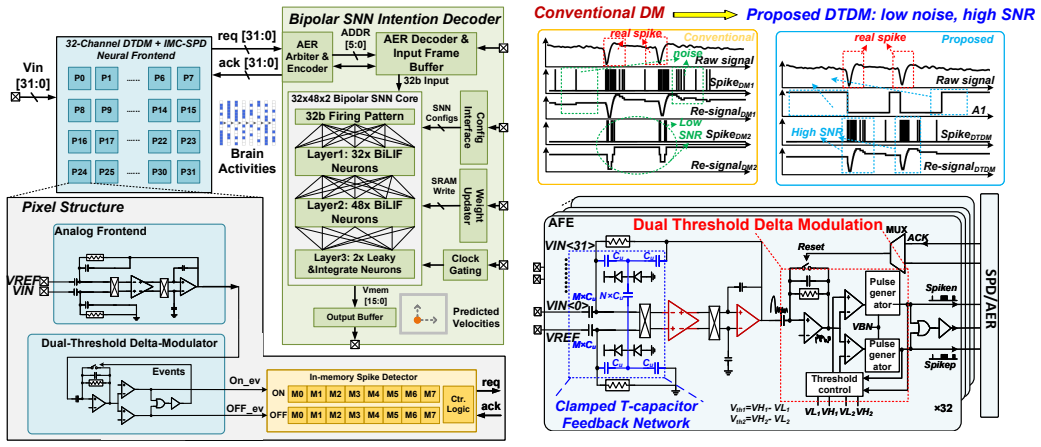
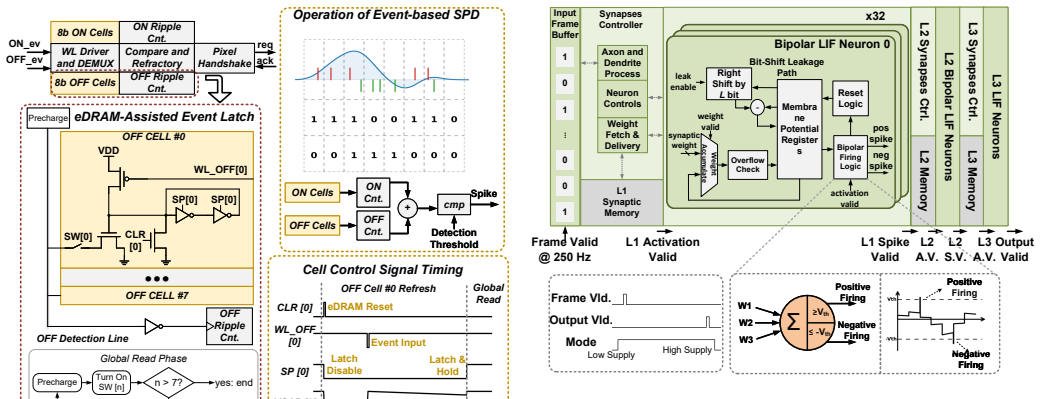
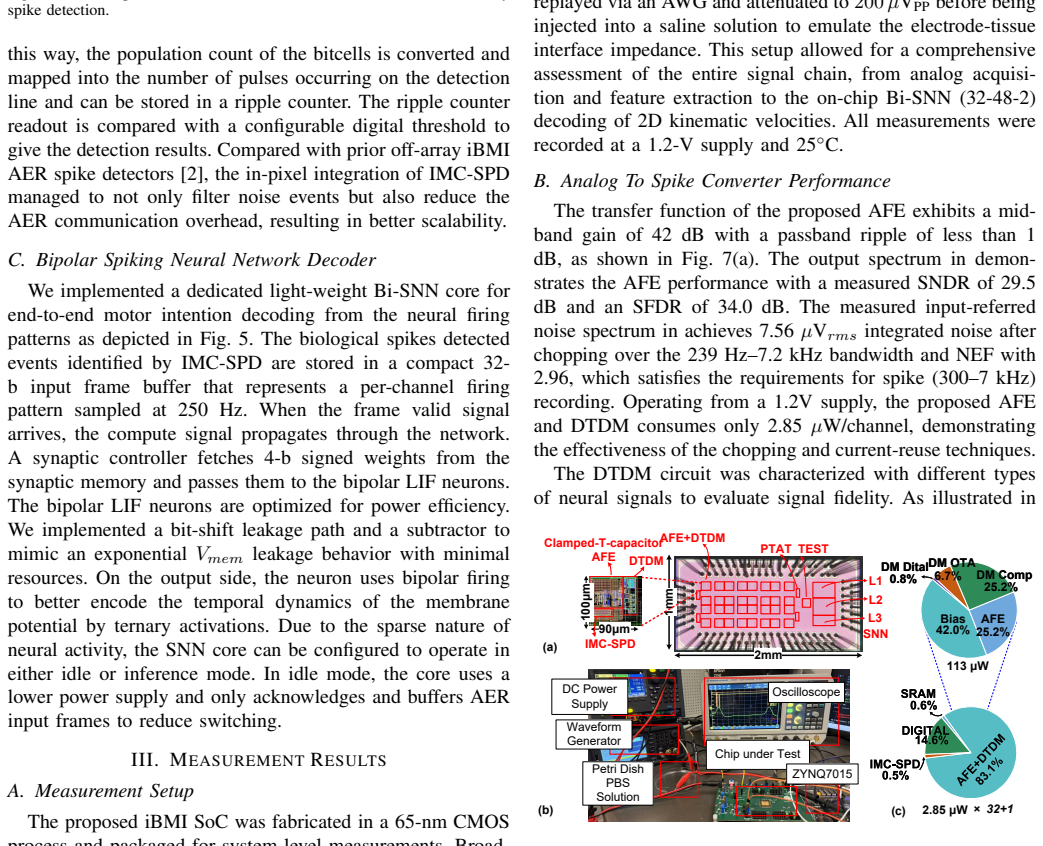
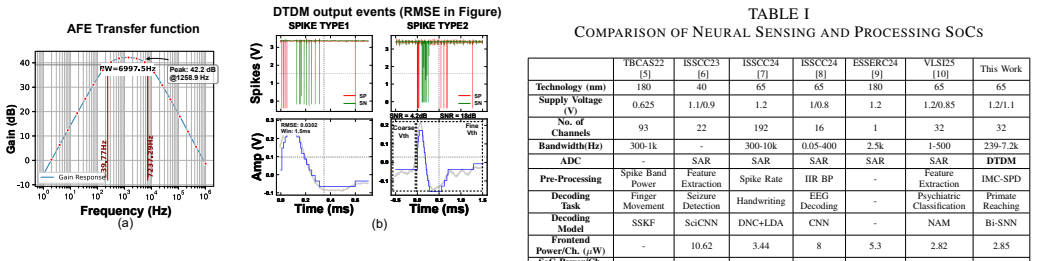
The 32-channel fully event-based iBMI SoC integrates a dual-threshold delta modulation frontend that provides up to 26x data compression, an in-memory computing spike detector for in-pixel spike detection, and a bipolar LIF-based spiking neural network decoder for on-chip motor intention decoding, all while consuming 3.53 μW per channel and achieving ~0.62 decoding R² with a compact 0.034 mm² per-channel area in 65nm CMOS.
What carries the argument
The dual-threshold delta modulation (DTDM) frontend array combined with in-memory computing spike detection and bipolar LIF-based SNN decoder, which together form the event-based neuromorphic signal processing pipeline.
If this is right
- The frontend achieves up to 26x data compression before any further processing.
- Spike detection occurs in-memory within each pixel without separate digital processing steps.
- Motor intention decoding runs on-chip using the Bi-SNN with 0.62 R² accuracy.
- Per-channel area remains 0.034 mm² while supporting 32 channels on a single chip.
- Total system power stays at 3.53 μW per channel for the full recording-to-decoding pipeline.
Where Pith is reading between the lines
- Higher channel counts become feasible without proportional increases in wireless transmission bandwidth or implant power budget.
- The event-driven architecture may extend to other neural signal modalities beyond motor decoding.
- In-memory spike detection could reduce latency compared to off-pixel digital detection in future scaled designs.
- The small per-channel area leaves room for additional on-chip features such as stimulation circuitry.
Load-bearing premise
The reported power, compression ratio, and decoding accuracy were measured under conditions representative of chronic human neural recordings.
What would settle it
Power consumption, compression factor, and decoding R² measured on long-term chronic human neural data that differ substantially from the test conditions used in the paper.
Figures


read the original abstract
With the scaling of sensor channel counts, systems confront challenges in frontend data sensing and on-implant data processing. This work presents a 32-channel fully event-based iBMI SoC in 65nm CMOS for an efficient neuromorphic signal processing pipeline. The SoC integrates a 32-channel dual-threshold delta modulation (DTDM) frontend array that provides up to 26x data compression at the frontend, an in-memory computing (IMC) spike detector (SPD) for efficient in-pixel spike detection, and a bipolar LIF-based spiking neural network (Bi-SNN) decoder for on-chip motor intention decoding (MID). Consuming only 3.53 {\mu}W per channel and achieving ~0.62 decoding R2 with a compact 0.034 mm2 per-channel area, the chip enables high-efficiency signal recording, processing, and decoding for implantable devices.
Editorial analysis
A structured set of objections, weighed in public.
Referee Report
Summary. The manuscript presents a 32-channel event-based implantable brain-machine interface (iBMI) SoC fabricated in 65 nm CMOS. It integrates a dual-threshold delta-modulation (DTDM) analog frontend achieving up to 26× data compression, an in-memory-computing spike detector (SPD), and a bipolar leaky-integrate-and-fire spiking neural network (Bi-SNN) for on-chip motor-intention decoding. Benchtop measurements on the fabricated die using synthetic and primate-recorded neural signals report 3.53 μW per channel, 0.034 mm² per-channel area, and ~0.62 decoding R².
Significance. If the reported power, area, and decoding metrics hold under the stated measurement conditions, the work provides a concrete, measured demonstration of a fully integrated neuromorphic pipeline that simultaneously addresses frontend compression, in-pixel detection, and on-chip decoding. The explicit tie of all figures to fabricated-silicon measurements and primate motor datasets strengthens the claim relative to simulation-only estimates common in the field.
minor comments (3)
- §3.2 and Fig. 7: the definition of the dual-threshold levels (V_th+ and V_th−) is given only in terms of the input-referred voltage; an explicit mapping to the comparator reference voltages used on-chip would clarify reproducibility.
- Table II: the R² values for the Bi-SNN are reported without the number of trials or cross-validation folds; adding these statistics would allow direct comparison with the offline baselines cited in the same table.
- §4.3: the power-breakdown pie chart aggregates digital and analog domains but does not separate the contribution of the IMC array from the Bi-SNN; a finer split would help readers assess scalability to higher channel counts.
Simulated Author's Rebuttal
We thank the referee for the positive summary, significance assessment, and recommendation of minor revision. No major comments were provided in the report.
Circularity Check
No significant circularity
full rationale
The manuscript reports measured performance of a fabricated 65 nm CMOS SoC (power, compression ratio, area, and R² on neural datasets) obtained from benchtop tests with synthetic and recorded signals. No equations, fitted parameters, or derivations appear; the central claims are direct experimental outcomes rather than quantities obtained by construction from inputs or self-citations. The architecture description maps to metrics via explicit measurement conditions without internal reduction.
Axiom & Free-Parameter Ledger
Reference graph
Works this paper leans on
-
[1]
2024 IEEE Custom Integrated Circuits Conference (CICC) , author =
A Neuron-Inspired. 2024 IEEE Custom Integrated Circuits Conference (CICC) , author =. 2024 , pages =
2024
-
[2]
2025 Symposium on VLSI Technology and Circuits (VLSI Symposium) , author =
A 32-Channel. 2025 Symposium on VLSI Technology and Circuits (VLSI Symposium) , author =. 2025 , pages =
2025
-
[3]
2024 , pages =
2024 IEEE International Solid-State Circuits Conference (ISSCC) , author =. 2024 , pages =
2024
-
[4]
2024 IEEE International Solid-State Circuits Conference (ISSCC) , author =
A Sub-. 2024 IEEE International Solid-State Circuits Conference (ISSCC) , author =. 2024 , pages =
2024
-
[5]
2025 IEEE International Solid-State Circuits Conference (ISSCC) , author =
Event-Based Spatially Zooming Neural Interface. 2025 IEEE International Solid-State Circuits Conference (ISSCC) , author =. 2025 , pages =
2025
-
[6]
A Power-Efficient Brain-Machine Interface System With a Sub-mw Feature Extraction and Decoding
An, Hyochan and others , journal =. A Power-Efficient Brain-Machine Interface System With a Sub-mw Feature Extraction and Decoding. 2022 , volume =
2022
-
[7]
2023 , pages =
Tsai, Chne-Wuen and others , booktitle =. 2023 , pages =
2023
-
[8]
A Power-Efficient Brain-Machine Interface System With a Sub-mw Feature Extraction and Decoding ASIC Demonstrated in Nonhuman Primates , year=
An, Hyochan and others , journal=. A Power-Efficient Brain-Machine Interface System With a Sub-mw Feature Extraction and Decoding ASIC Demonstrated in Nonhuman Primates , year=
-
[9]
A 1024-Channel 0.8V 23.9-nW/Channel Event-based Compute In-memory Neural Spike Detector , year=
Ke, Ye and others , journal=. A 1024-Channel 0.8V 23.9-nW/Channel Event-based Compute In-memory Neural Spike Detector , year=
-
[10]
SciCNN: A 0-Shot-Retraining Patient-Independent Epilepsy-Tracking SoC , year=
Tsai, Chne-Wuen and others , booktitle=. SciCNN: A 0-Shot-Retraining Patient-Independent Epilepsy-Tracking SoC , year=
-
[11]
and others , title =
O'Doherty, Joseph E. and others , title =. 2020 , publisher =
2020
-
[12]
Yik, Jason and others , journal =. The. 2025 , volume =
2025
-
[13]
A 1024-Channel
Ke, Ye and others , journal =. A 1024-Channel. 2025 , pages =
2025
-
[14]
A 5.3- W 80.8-dB SNDR LNA-Embedded EF-CIFF Third-Order Noise-Shaping SAR ADC for Closed-Loop Neural Recording , year=
Kim, Yegeun and others , booktitle=. A 5.3- W 80.8-dB SNDR LNA-Embedded EF-CIFF Third-Order Noise-Shaping SAR ADC for Closed-Loop Neural Recording , year=
discussion (0)
Sign in with ORCID, Apple, or X to comment. Anyone can read and Pith papers without signing in.