Lie Algebra-Based Quantum Optimal Controls Interpolation
Pith reviewed 2026-06-28 14:42 UTC · model grok-4.3
The pith
A neural network trained once on qubit hardware can generate optimal control pulses for any unitary in systems of matching dimension.
A machine-rendered reading of the paper's core claim, the machinery that carries it, and where it could break.
Core claim
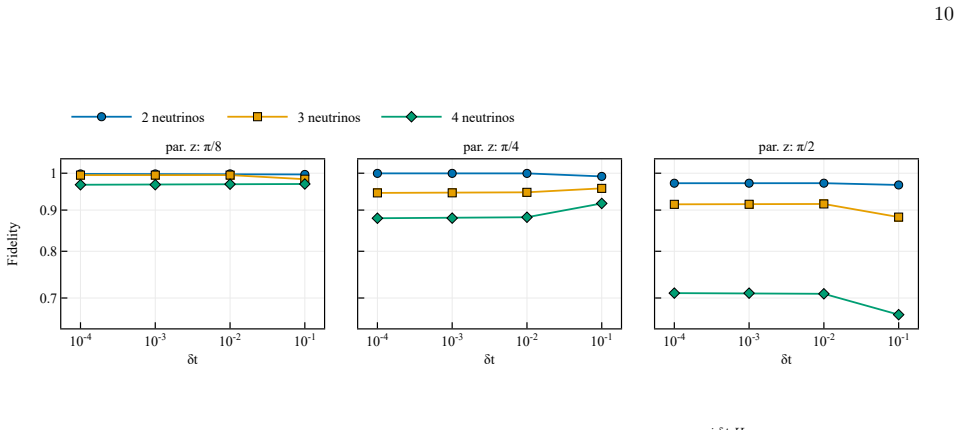
By pre-computing a representative set of control pulses via Lie group theory and training neural networks to map target propagators to their corresponding pulses, the method enables efficient generation of quantum optimal control pulses for arbitrary unitary operations without explicit optimization at inference time. High reconstruction fidelity is found for specific combinations of Lie algebra parameters on 2-, 3-, and 4-qubit superconducting systems. The same model, trained only on hardware-specific random propagators, reconstructs pulses for the Trotter propagators of a neutrino system undergoing collective flavor oscillations.
What carries the argument
Feed-forward neural network trained to interpolate Lie-group-theory-derived control pulses from target unitary propagators.
If this is right
- Large ensembles of distinct propagators in Trotterized quantum simulation can be processed without repeated optimization runs.
- A single model serves as a universal control-pulse generator for any target quantum system of compatible Hilbert space dimension.
- Control pulses for neutrino collective oscillation propagators can be obtained from a model trained exclusively on superconducting-qubit data.
- The exponential scaling bottleneck of standard optimal-control methods is bypassed at inference time for systems up to at least four qubits.
Where Pith is reading between the lines
- The same training procedure could be repeated on data from a different hardware platform to obtain a generator specialized to that platform's noise and control constraints.
- If the interpolation remains accurate at higher qubit numbers, the method would directly accelerate pulse design for many-body Trotter circuits beyond what explicit optimization currently allows.
- Testing the network on unitaries generated by Hamiltonians whose spectra lie far outside the training distribution would reveal the practical limits of the claimed universality.
Load-bearing premise
A representative set of pulses pre-computed via Lie group theory is dense enough for the neural network to accurately interpolate pulses for arbitrary target propagators, including those from physically distinct systems.
What would settle it
Record the reconstruction fidelity when the network is asked to produce pulses for a target propagator whose underlying Hamiltonian cannot be expressed as a linear combination of the Lie-algebra generators used in the pre-computed training set.
Figures

read the original abstract
We present a framework combining Lie group theory and feed-forward neural networks to efficiently generate quantum optimal control pulses for arbitrary unitary operations in superconducting qubit systems, bypassing the need for explicit optimization at inference time. The exponential scaling of the Hilbert space dimension with qubit number makes standard optimization approaches computationally prohibitive when large ensembles of distinct propagators must be processed, a bottleneck that is particularly acute in Trotterized quantum simulation. Our method addresses this limitation by pre-computing a representative set of control pulses via Lie group theory and training neural networks to map target propagators to their corresponding pulses. We demonstrate the approach on superconducting qubit systems of 2, 3, and 4 qubits, finding high reconstruction fidelity for specific combinations of Lie algebra parameters. As a physically motivated benchmark, we apply the methodology to reconstruct control pulses for the Trotter propagators of a neutrino system undergoing collective flavor oscillations. The successful generalization across system types demonstrates that a single model -- trained once on hardware-specific random propagators -- can serve as a universal control-pulse generator for any target quantum system of compatible Hilbert space dimension, offering a promising route toward scalable quantum simulation.
Editorial analysis
A structured set of objections, weighed in public.
Referee Report
Summary. The manuscript presents a framework combining Lie group theory to pre-compute representative control pulses for superconducting qubit systems with feed-forward neural networks trained to map arbitrary target unitary propagators to those pulses, thereby avoiding per-instance optimization at inference time. It reports demonstrations on 2-, 3-, and 4-qubit systems with high reconstruction fidelity for specific Lie-algebra parameter combinations, and applies the trained model to reconstruct pulses for Trotter propagators arising from collective neutrino flavor oscillations, asserting that a single model trained on hardware-specific random propagators constitutes a universal control-pulse generator for any target system of compatible Hilbert-space dimension.
Significance. If the quantitative performance and out-of-distribution generalization claims are substantiated, the approach could meaningfully reduce the computational cost of generating control pulses for large ensembles of unitaries in Trotterized quantum simulations, addressing a recognized scalability bottleneck in quantum optimal control.
major comments (2)
- [Abstract] Abstract: The abstract states that the method yields 'high reconstruction fidelity for specific combinations of Lie algebra parameters' yet supplies no numerical fidelity values, error bars, training-set sizes, validation metrics, or baseline comparisons for the 2-, 3-, or 4-qubit cases. Without these data the central performance claim cannot be evaluated.
- [Abstract] Abstract: The assertion of successful generalization to the neutrino-oscillation benchmark rests on the premise that a training distribution consisting of random propagators generated by superconducting-qubit control Hamiltonians is sufficiently dense in SU(2^n) to allow accurate interpolation for propagators generated by the physically distinct collective neutrino Hamiltonians. No supporting argument, density estimate, or out-of-distribution test is provided to substantiate this assumption, which is load-bearing for the universal-control claim.
Simulated Author's Rebuttal
We thank the referee for their constructive comments. We address the major comments point by point below.
read point-by-point responses
-
Referee: [Abstract] Abstract: The abstract states that the method yields 'high reconstruction fidelity for specific combinations of Lie algebra parameters' yet supplies no numerical fidelity values, error bars, training-set sizes, validation metrics, or baseline comparisons for the 2-, 3-, or 4-qubit cases. Without these data the central performance claim cannot be evaluated.
Authors: We agree that the abstract should contain quantitative details to support the claims. We will revise the abstract to include specific numerical fidelity values, error bars, training-set sizes, validation metrics, and baseline comparisons for the 2-, 3-, and 4-qubit cases. revision: yes
-
Referee: [Abstract] Abstract: The assertion of successful generalization to the neutrino-oscillation benchmark rests on the premise that a training distribution consisting of random propagators generated by superconducting-qubit control Hamiltonians is sufficiently dense in SU(2^n) to allow accurate interpolation for propagators generated by the physically distinct collective neutrino Hamiltonians. No supporting argument, density estimate, or out-of-distribution test is provided to substantiate this assumption, which is load-bearing for the universal-control claim.
Authors: The current manuscript provides an empirical demonstration of generalization but does not include an explicit argument or density estimate. We will revise the manuscript to add supporting discussion or analysis for the out-of-distribution generalization to the neutrino benchmark. revision: yes
Circularity Check
No circularity: sequential precomputation, training, and empirical generalization remain independent steps
full rationale
The paper's chain consists of (1) Lie-group precomputation of a representative pulse set for qubit Hamiltonians, (2) supervised training of an NN to learn the propagator-to-pulse map on that set, and (3) application of the trained NN to out-of-distribution targets including neutrino Trotter propagators. None of these steps is defined in terms of its own output, nor is any fitted parameter renamed as a prediction. The universal-control claim is presented as an empirical observation rather than a theorem that reduces to the training distribution by construction. No self-citation is invoked as a load-bearing uniqueness result. The derivation is therefore self-contained against external benchmarks.
Axiom & Free-Parameter Ledger
Reference graph
Works this paper leans on
-
[1]
The Hamiltonian takes the explicit form H= NqX ℓ=1 X i1<···<iℓ X a1,...,aℓ γ(i1···iℓ) a1···aℓ σ(i1) a1 ⊗ · · · ⊗σ (iℓ) aℓ ,(16) witha j ∈ {x, y, z}
Pauli Tensor Basis Decomposition The generatorsT k are all tensor products of Pauli ma- trices{I, σ x, σy, σz}⊗Nq excludingI ⊗Nq, and are natu- rally classified by theirlocalityℓ, i.e., the number of 4 qubits on which they act non-trivially [28, 29]. The Hamiltonian takes the explicit form H= NqX ℓ=1 X i1<···<iℓ X a1,...,aℓ γ(i1···iℓ) a1···aℓ σ(i1) a1 ⊗ ·...
-
[2]
We impose two successive, physically motivated restrictions on the gate set, each of which reduces the number of free pa- rameters while preserving universality
Simplifications in Qubits Chain Topology In this work, we consider superconducting qubits, which inherently support only nearest-neighbor interac- tions due to their physical implementation. We impose two successive, physically motivated restrictions on the gate set, each of which reduces the number of free pa- rameters while preserving universality. a. F...
-
[3]
As specified in Step 1 of the method, the Lie algebra coefficients{γ (i) a , γ (i,i+1) ZZ }enter- ing Eq
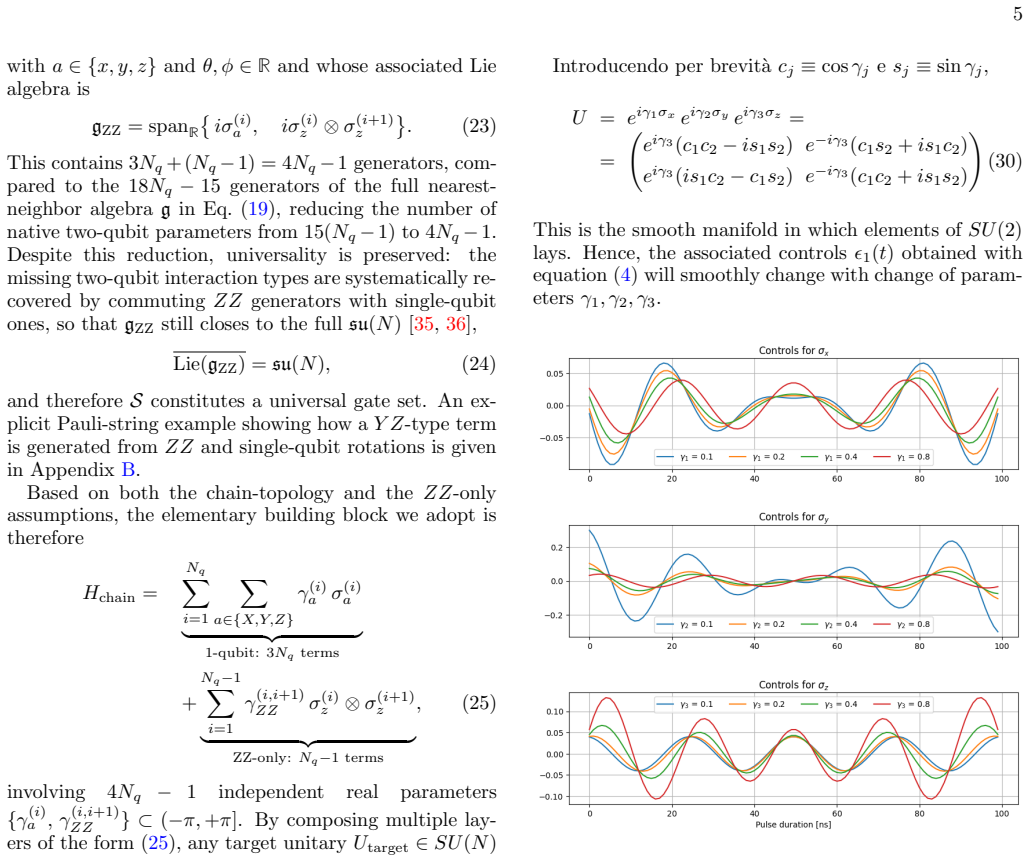
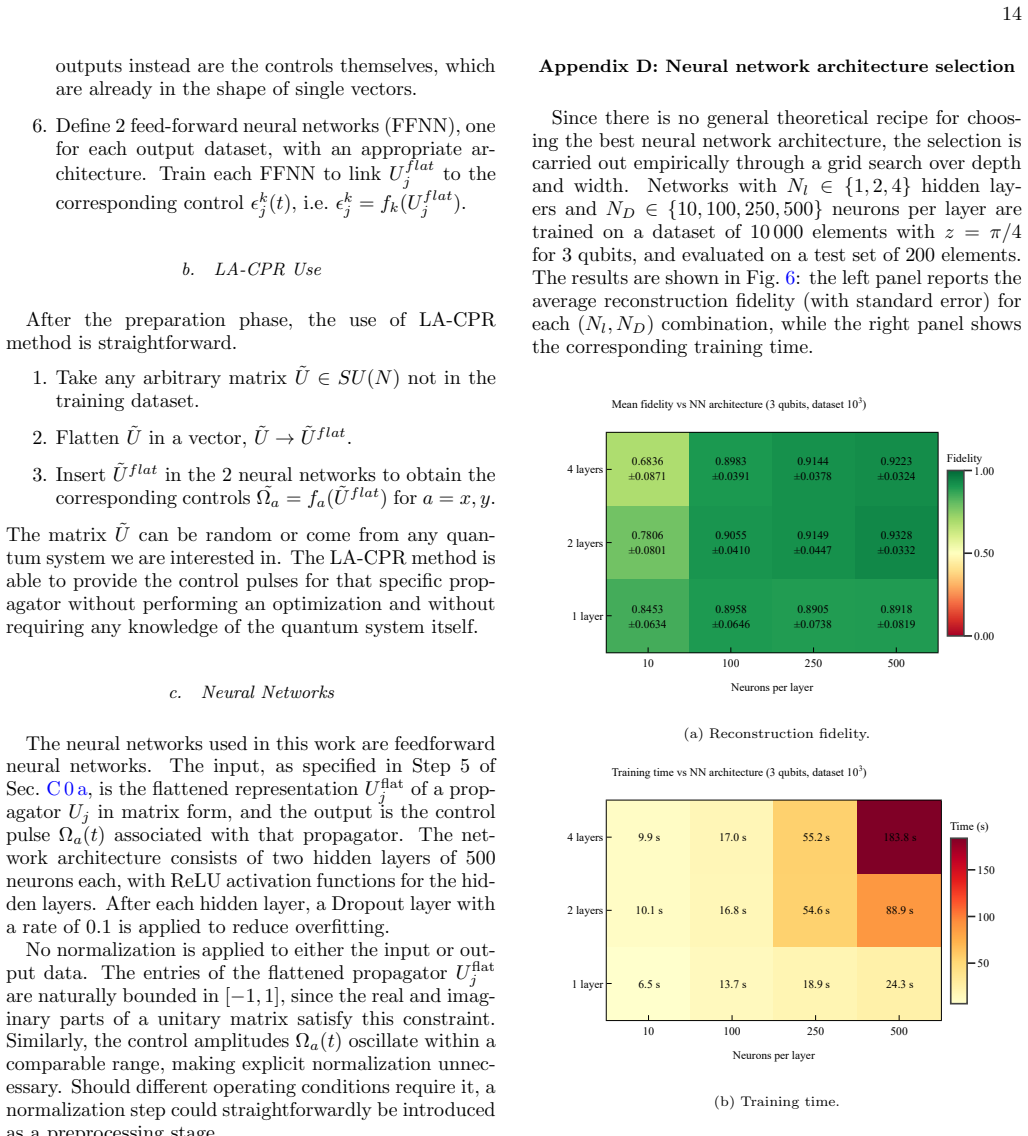
Datasets An appropriate dataset is essential for LA-CPR to have good performance. As specified in Step 1 of the method, the Lie algebra coefficients{γ (i) a , γ (i,i+1) ZZ }enter- ing Eq. (31) are drawn independently from a uniform dis- tribution on the interval [−z, z]. The choice ofzcontrols the region of the group manifold explored by the dataset: a wi...
-
[4]
Figure 2 shows an example of the control field Ωx(t) for a 3-qubit system withz=π/4
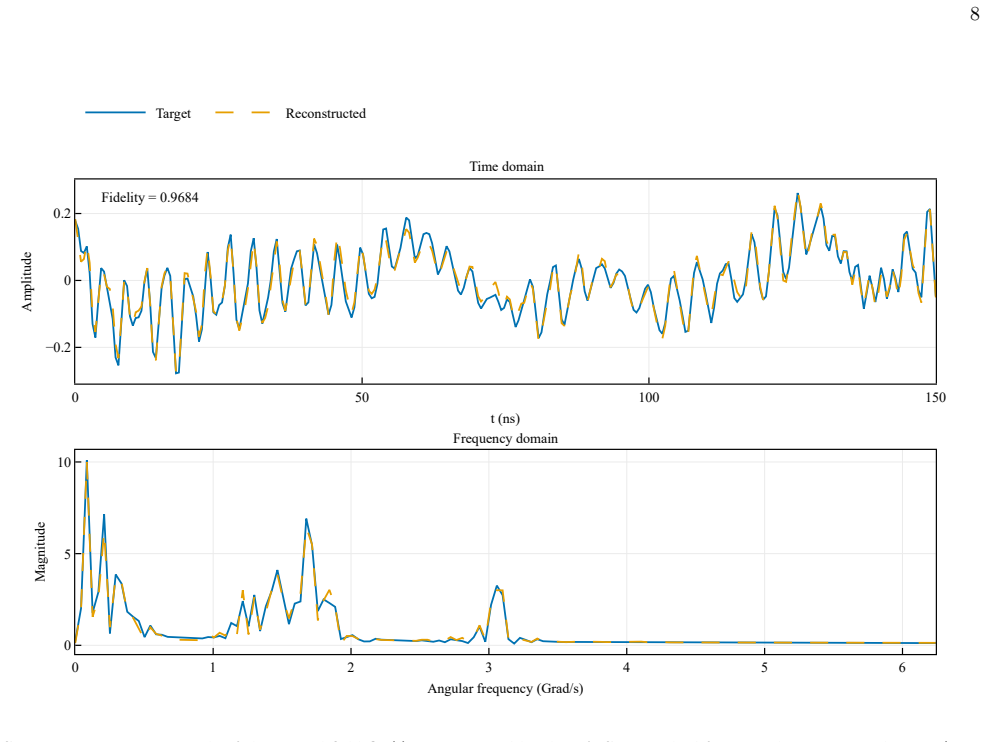
Graphical insight: control pulse and its spectrum Prior to the quantitative analysis of the LA-CPR method, we present a qualitative examination of a rep- resentative control pulse. Figure 2 shows an example of the control field Ωx(t) for a 3-qubit system withz=π/4. The upper panel displays the exact control in the time domain alongside its LA-CPR reconstr...
-
[5]
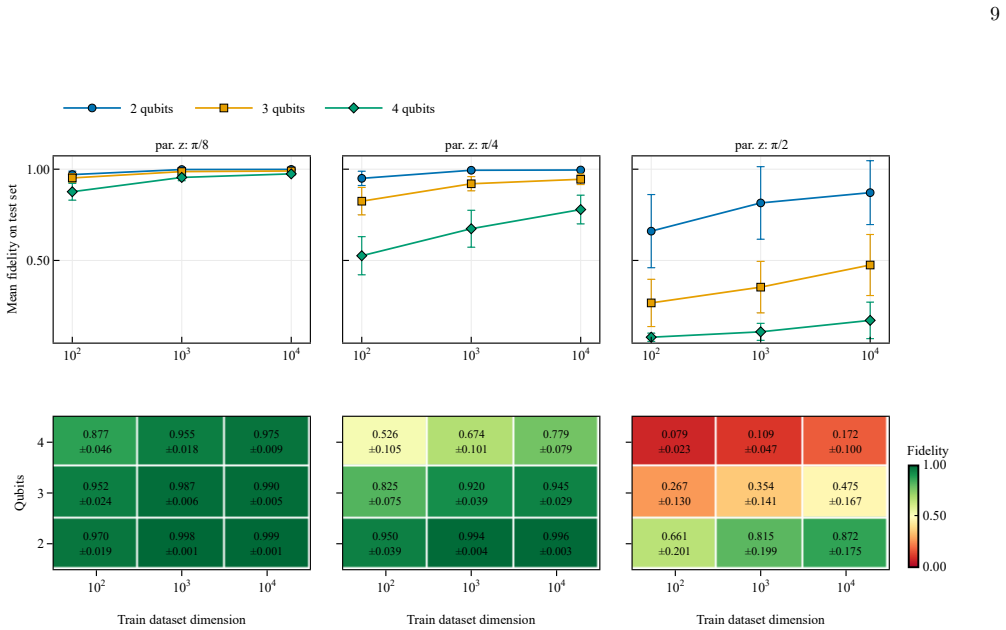
Fidelity and dataset dimension Figure 3 shows the average fidelity the LA-CPR method reach on test dataset as a function of the training dataset size on which is trained, of sampling parameterzand of systems number of qubitsN q. The upper row reports the fidelity curves with the corresponding standard deviations as function of the dataset size, while the ...
-
[6]
Locality Operators No
The Hamiltonian expands as H= 3X i=1 X a γ(i) a σ(i) a | {z } 1-qubits: 9 terms + X i<j X a,b γ(ij) ab σ(i) a ⊗σ (j) b | {z } 2-qubits: 27 terms + X a,b,c θabc σ(1) a ⊗σ (2) b ⊗σ (3) c | {z } 3-qubits: 27 terms .(A1) TABLE VI: Pauli basis forN q = 3, dimsu(8) = 63. Locality Operators No. of terms 1-qubitsσ (i) a ,i∈ {1,2,3}9 2-qubitsσ (i) a ⊗σ (j) b ,i < ...
-
[7]
(19) can gener- ate the missing direction ofsu(8) with commutators
Chain topology simplification We report here how the algebragof Eq. (19) can gener- ate the missing direction ofsu(8) with commutators. We illustrate this with an explicit Pauli-string computation. Consider the generators. A=i(σ z ⊗σ x ⊗I)∈su(4) 12, B=i(I⊗σ x ⊗σ z)∈su(4) 23.(B1) These correspond to nearest-neighbor interactions and are natively available....
-
[8]
The missing interaction types are recovered by commuting theZZgenerator with single-qubit rotations
ZZ coupling simplification We show here how the restricted algebra gZZ = spanR iσ(i) a , iσ (i) z ⊗σ (i+1) z (B4) still closes tosu(N) under iterated Lie brackets, even though only one of the fifteen two-qubit generators of su(4)i,i+1 is retained natively. The missing interaction types are recovered by commuting theZZgenerator with single-qubit rotations....
-
[9]
the specific qubits Hamiltonian of Eq
Provide the experimental parameters of the de- vice in use, i.e. the specific qubits Hamiltonian of Eq. (8)
-
[10]
Define the basis set{T p}ofsu(N) as described in Sec. II C
-
[11]
(31) sam- pling the parametersγ l from a uniform distribution in the interval [−z, z] withz∈(0, π]
Compute the set of matrices{U j}via Eq. (31) sam- pling the parametersγ l from a uniform distribution in the interval [−z, z] withz∈(0, π]
-
[12]
(7) for eachU j in the dataset
Compute the controlsϵ k j (t), using GRAPE algo- rithm, to solve the formal minimization problem of Eq. (7) for eachU j in the dataset. We thus obtain 2 datasets of controls representing Ω x(t) and Ωy(t) of the qubits systems Eq. (11)
-
[13]
Prepare the inputs and the outputs for the neu- ral network. Since the neural network can only take vectors as inputs, each matrixU j is flat- tened stacking the real and the imaginary part of the matrix in a single vector, i.e.U f lat j = [ReU 1,1 j , . . .ReU N,N j ,ImU 1,1 j , . . .ImU N,N j ]. The 14 outputs instead are the controls themselves, which ...
-
[14]
Train each FFNN to linkU f lat j to the corresponding controlϵ k j (t), i.e.ϵ k j =f k(U f lat j )
Define 2 feed-forward neural networks (FFNN), one for each output dataset, with an appropriate ar- chitecture. Train each FFNN to linkU f lat j to the corresponding controlϵ k j (t), i.e.ϵ k j =f k(U f lat j ). b. LA-CPR Use After the preparation phase, the use of LA-CPR method is straightforward
-
[15]
Take any arbitrary matrix ˜U∈SU(N) not in the training dataset
-
[16]
Flatten ˜Uin a vector, ˜U→ ˜U f lat
-
[17]
The matrix ˜Ucan be random or come from any quan- tum system we are interested in
Insert ˜U f lat in the 2 neural networks to obtain the corresponding controls ˜Ωa =f a( ˜U f lat) fora=x, y. The matrix ˜Ucan be random or come from any quan- tum system we are interested in. The LA-CPR method is able to provide the control pulses for that specific prop- agator without performing an optimization and without requiring any knowledge of the ...
-
[18]
Barenco, C
A. Barenco, C. H. Bennett, R. Cleve, D. P. DiVincenzo, N. Margolus, P. Shor, T. Sleator, J. A. Smolin, and H. Weinfurter, Elementary gates for quantum computa- tion, Phys. Rev. A52, 3457 (1995)
1995
-
[19]
Harrow and B
A. Harrow and B. Recht, Efficient discrete approxima- tions of quantum gates, Journal of Mathematical Physics 43(2001)
2001
-
[20]
Glaser, U
S. Glaser, U. Boscain, T. Calarco, C. Koch, W. K¨ ockenberger, R. Kosloff, I. Kuprov, B. Luy, S. Sher- mer, T. Schulte-Herbrueggen, D. Sugny, and F. Wilhelm, Training schr¨ odinger’s cat: quantum optimal control, The European Physical Journal D69(2015)
2015
-
[21]
Werschnik and E
J. Werschnik and E. Gross, Phd tutorial: Quantum op- timal control theory, Journal of Physics B-atomic Molec- ular and Optical Physics - J PHYS-B-AT MOL OPT PHYS40(2007)
2007
-
[22]
Lloyd, Universal quantum simulators, Science273, 1073 (1996)
S. Lloyd, Universal quantum simulators, Science273, 1073 (1996)
1996
-
[23]
A. M. Childs, Y. Su, M. C. Tran, N. Wiebe, and S. Zhu, Theory of Trotter error with commutator scaling, Phys. Rev. X11, 011020 (2021)
2021
-
[24]
Bukov, A
M. Bukov, A. G. R. Day, D. Sels, P. Weinberg, A. Polkovnikov, and P. Mehta, Reinforcement learning in different phases of quantum control, Phys. Rev. X8, 031086 (2018)
2018
-
[25]
M. Y. Niu, S. Boixo, V. N. Smelyanskiy, and H. Neven, Universal quantum control through deep reinforcement learning, npj Quantum Information5, 33 (2019)
2019
-
[26]
Khaneja, T
N. Khaneja, T. Reiss, C. Kehlet, T. Schulte-Herbr¨ uggen, and S. J. Glaser, Optimal control of coupled spin dy- namics: design of nmr pulse sequences by gradient as- cent algorithms, Journal of Magnetic Resonance172, 296 (2005)
2005
-
[27]
Rowland and J
B. Rowland and J. Jones, Implementing quantum logic gates with gradient ascent pulse engineering: Principles and practicalities, Philosophical transactions. Series A, Mathematical, physical, and engineering sciences370, 4636 (2012)
2012
-
[28]
Caneva, T
T. Caneva, T. Calarco, and S. Montangero, Chopped random-basis quantum optimization, Phys. Rev. A84, 022326 (2011)
2011
-
[29]
Sauvage and F
F. Sauvage and F. Mintert, Optimal control of families of quantum gates, Phys. Rev. Lett.129, 050507 (2022)
2022
-
[30]
A. B. Magann, C. Arenz, M. D. Grace, T.-S. Ho, R. L. Kosut, J. R. McClean, H. A. Rabitz, and M. Sarovar, From pulses to circuits and back again: A quantum op- timal control perspective on variational quantum algo- rithms, PRX Quantum2, 010101 (2021)
2021
-
[31]
B. Hall, A. Roggero, A. Baroni, and J. Carlson, Sim- ulation of collective neutrino oscillations on a quantum computer, Phys. Rev. D104, 063009 (2021)
2021
-
[32]
Amitrano, A
V. Amitrano, A. Roggero, P. Luchi, F. Turro, L. Vespucci, and F. Pederiva, Trapped-ion quantum sim- ulation of collective neutrino oscillations, Physical Re- view D107(2023)
2023
-
[33]
Luchi, F
P. Luchi, F. Turro, S. Quaglioni, X. Wu, V. Amitrano, K. Wendt, J. L. DuBois, and F. Pederiva, Control op- timization for parametric hamiltonians by pulse recon- struction, The European Physical Journal A59, 196 (2023)
2023
-
[34]
Turro, T
F. Turro, T. Chistolini, A. Hashim, Y. Kim, W. Liv- ingston, J. M. Kreikebaum, K. A. Wendt, J. L. Dubois, F. Pederiva, S. Quaglioni, D. I. Santiago, and I. Siddiqi, Demonstration of a quantum-classical coprocessing pro- tocol for simulating nuclear reactions, Phys. Rev. A108, 032417 (2023)
2023
-
[35]
Blais, A
A. Blais, A. L. Grimsmo, S. M. Girvin, and A. Wallraff, Circuit quantum electrodynamics, Rev. Mod. Phys.93, 025005 (2021)
2021
-
[36]
J. Koch, T. M. Yu, J. Gambetta, A. A. Houck, D. I. Schuster, J. Majer, A. Blais, M. H. Devoret, S. M. Girvin, and R. J. Schoelkopf, Charge-insensitive qubit design de- rived from the cooper pair box, Phys. Rev. A76, 042319 (2007)
2007
-
[37]
Blais, R.-S
A. Blais, R.-S. Huang, A. Wallraff, S. Girvin, and R. Schoelkopf, Cavity quantum electrodynamics for su- perconducting electrical circuits: An architecture for quantum computation, Phys. Rev. A69(2004)
2004
-
[38]
Wallraff, D
A. Wallraff, D. I. Schuster, A. Blais, L. Frunzio, R.-S. Huang, J. Majer, S. Kumar, S. M. Girvin, and R. J. Schoelkopf, Strong coupling of a single photon to a super- conducting qubit using circuit quantum electrodynamics, Nature431, 162 (2004)
2004
-
[39]
Tavis and F
M. Tavis and F. W. Cummings, Exact solution for anN- molecule—radiation-field Hamiltonian, Phys. Rev.170, 379 (1968)
1968
-
[40]
Majer, J
J. Majer, J. M. Chow, J. M. Gambetta, J. Koch, B. R. Johnson, J. A. Schreier, L. Frunzio, D. I. Schuster, A. A. Houck, A. Wallraff, A. Blais, M. H. Devoret, S. M. Girvin, and R. J. Schoelkopf, Coupling superconducting qubits via a cavity bus, Nature449, 443 (2007)
2007
-
[41]
Blais, J
A. Blais, J. Gambetta, A. Wallraff, D. I. Schuster, S. M. Girvin, M. H. Devoret, and R. J. Schoelkopf, Quantum- information processing with circuit quantum electrody- namics, Phys. Rev. A75, 032329 (2007)
2007
-
[42]
Krantz, M
P. Krantz, M. Kjaergaard, F. Yan, T. Orlando, S. Gus- tavsson, and W. Oliver, A quantum engineer’s guide to superconducting qubits, App. Phy. Rev.6, 021318 16 (2019)
2019
-
[43]
Das and S
A. Das and S. Okubo,Lie groups and Lie algebras for physicists(World Scientific, 2014)
2014
-
[44]
M. A. Nielsen and I. L. Chuang,Quantum Computation and Quantum Information(Cambridge University Press, Cambridge, 2000)
2000
-
[45]
K. Y. Chew, N. M. Shah, and K. T. Chan, Rep- resentation ofsu(8) in Pauli basis, arXiv preprint arXiv:2003.09192(2020), arXiv:2003.09192 [quant- ph]
arXiv 2003
-
[46]
N. M. Shah, K. Y. Chew, and K. T. Chan, Algebraic representation of three qubit quantum circuit problems, Malaysian Journal of Mathematical Sciences16, 559 (2022)
2022
-
[47]
Br¨ ocker and T
T. Br¨ ocker and T. tom Dieck,Representations of Com- pact Lie Groups(Springer, New York, 1985)
1985
-
[48]
Zhang, J
J. Zhang, J. Vala, S. Sastry, and K. B. Whaley, Geometric theory of nonlocal two-qubit operations, Physical Review A67, 042313 (2003)
2003
-
[49]
Khaneja and S
N. Khaneja and S. J. Glaser, Cartan decomposition of su(2n) and control of spin systems, Chemical Physics 267, 11 (2001)
2001
-
[50]
Zeier and T
R. Zeier and T. Schulte-Herbr¨ uggen, Symmetry princi- ples in quantum systems theory, Journal of Mathematical Physics52, 113510 (2011)
2011
-
[51]
D’Alessandro,Introduction to Quantum Control and Dynamics, 2nd ed
D. D’Alessandro,Introduction to Quantum Control and Dynamics, 2nd ed. (Chapman & Hall/CRC, 2021)
2021
-
[52]
Jurdjevic and H
V. Jurdjevic and H. J. Sussmann, Control systems on Lie groups, Journal of Differential Equations12, 313 (1972)
1972
-
[53]
Ramakrishna, M
V. Ramakrishna, M. V. Salapaka, M. Dahleh, H. Rab- itz, and A. Peirce, Controllability of molecular systems, Physical Review A51, 960 (1995)
1995
-
[54]
C. M. Dawson and M. A. Nielsen, The Solovay-Kitaev algorithm, Quantum Information & Computation6, 81 (2006), arXiv:quant-ph/0505030
Pith/arXiv arXiv 2006
-
[55]
Brylinski and R
J.-L. Brylinski and R. Brylinski, Universal quantum gates, inMathematics of Quantum Computation, edited by R. Brylinski and G. Chen (Chapman & Hall/CRC,
-
[56]
Georgi and K
H. Georgi and K. Jagannathan,Lie Algebras in Particle Physics, Vol. 50 (1982) pp. 1053–1053
1982
-
[57]
B. C. Hall,Lie Groups, Lie Algebras, and Representa- tions(Springer Chams, 2013)
2013
discussion (0)
Sign in with ORCID, Apple, or X to comment. Anyone can read and Pith papers without signing in.