Studies of rm ^(144,148)Sm+α potential for the p-process nucleosynthesis
Pith reviewed 2026-06-28 11:48 UTC · model grok-4.3
The pith
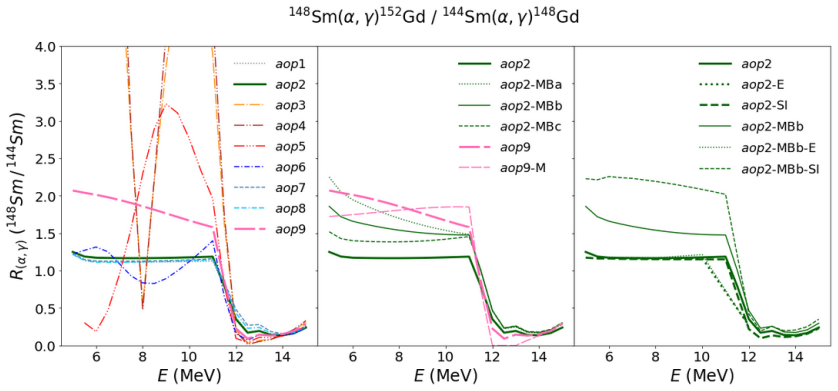
Including isotopic effects in the alpha optical model potential for samarium multiplies the (α,γ) cross section ratio by up to a factor of two.
A machine-rendered reading of the paper's core claim, the machinery that carries it, and where it could break.
Core claim
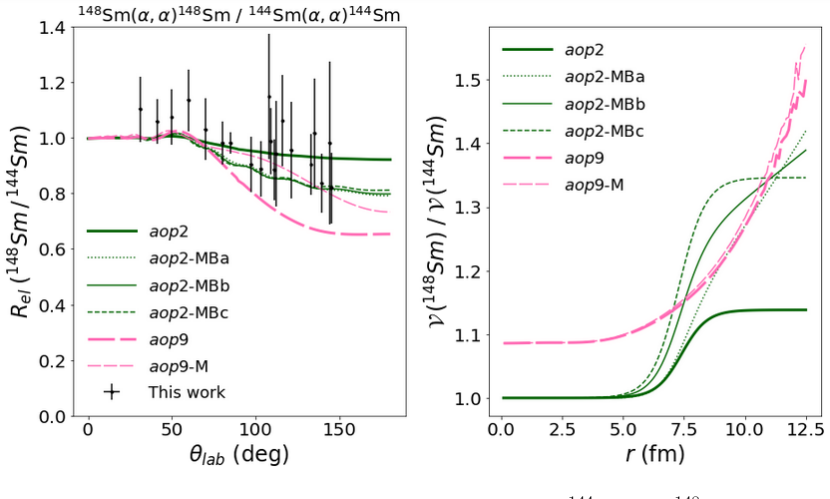
New experimental data on α elastic and inelastic scattering on 148Sm, combined with prior data on 144Sm, show that isotopic effects in the α optical model potential multiply the isotopic ratio for (α,γ) cross sections by up to a factor of two at astrophysical energies.
What carries the argument
The α optical model potential (AOMP) parametrized from elastic scattering distributions and extrapolated to compute low-energy reaction cross sections.
If this is right
- Alpha photodisintegration rates in p-process networks for these samarium isotopes must incorporate the isotopic AOMP variations.
- Branching points in the reaction networks at alpha capture or photodisintegration steps shift for 144Sm and 148Sm.
- Abundance predictions for p-nuclei near mass 144-148 change when the adjusted cross section ratios are used.
- Extrapolations of AOMP parameters to astrophysical energies must treat each isotope separately rather than assuming a common form.
Where Pith is reading between the lines
- Direct low-energy (α,γ) measurements on these isotopes would test whether the extrapolated potentials hold.
- Comparable isotopic studies on other p-nucleus pairs could reveal similar ratio adjustments in reaction networks.
- Updated rates could be inserted into full nucleosynthesis simulations to check effects on final p-nuclei yields.
Load-bearing premise
The optical model potential parameters fitted to scattering data at higher energies remain valid when extrapolated to the much lower astrophysical energies.
What would settle it
A direct measurement of (α,γ) cross sections on both 144Sm and 148Sm at energies below 10 MeV that finds their ratio does not increase by a factor of two when the isotopic potential is used.
Figures






read the original abstract
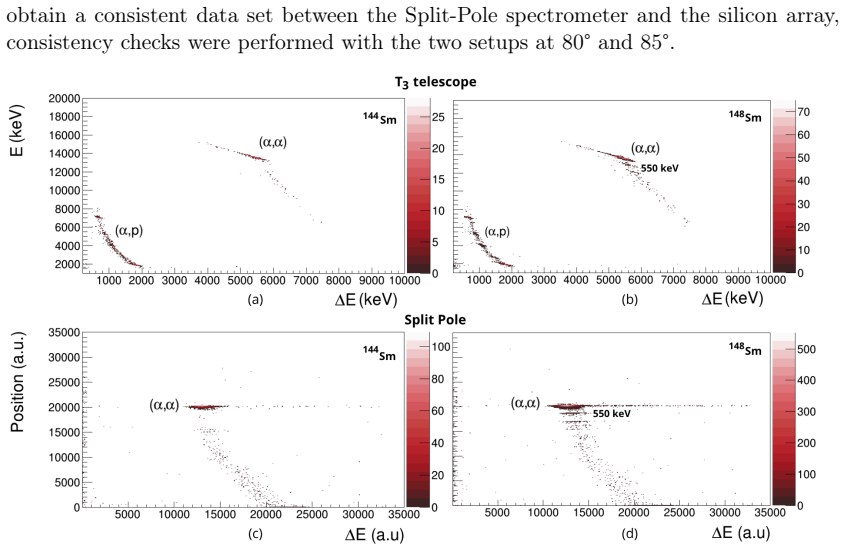
Nucleosynthesis reaction networks leading to $p$-nuclei involve a combination of different types of photodisintegration and capture reactions, as well as $\beta^+$ decays or electron captures. Photodisintegration reactions involving $\alpha$ particles present a particular interest as they serve as branching points of the reaction networks. The cross sections of these reactions depend crucially on the $\alpha$-nucleus interaction. The $\alpha$ optical model potential (AOMP) is determined mostly by means of experimental differential elastic scattering distributions. Several previous studies have focused on the case of $\rm ^{144}Sm$, an intriguing $p$-nucleus that is semi-magic with 82 neutrons. This work presents new experimental data on $\alpha$ elastic and inelastic scattering on $\rm ^{148}Sm$, its closest stable isotope. Isotopic effects on the description of the AOMP are studied, as well as their consequences on the prediction of $\alpha$-induced reaction cross sections at astrophysical energies. It is shown that the isotopic ratio for $(\alpha,\gamma)$ cross sections can be multiplied up to a factor of two when these effects are included.
Editorial analysis
A structured set of objections, weighed in public.
Referee Report
Summary. The manuscript reports new experimental measurements of α elastic and inelastic scattering on 148Sm, constrains the α-nucleus optical model potential (AOMP) from these data, examines isotopic differences relative to prior 144Sm results, and concludes that inclusion of these isotopic effects can alter the predicted 144Sm/148Sm (α,γ) cross-section ratio by up to a factor of two at astrophysical energies relevant to p-process nucleosynthesis.
Significance. If the low-energy extrapolation of the AOMP holds, the result demonstrates that isotopic variations in the potential can produce order-unity changes in key (α,γ) rates, which would affect branching points in p-process networks. The new scattering data themselves constitute a useful addition to the experimental database for AOMP studies.
major comments (1)
- [Section discussing (α,γ) predictions at astrophysical energies] The central claim that the isotopic ratio for (α,γ) cross sections can change by a factor of two rests on the validity of AOMP parameters fitted at the measured (higher) scattering energies when extrapolated to the much lower energies that govern p-process rates. No independent low-energy anchor (e.g., existing (α,γ) or (α,n) data on either isotope) is invoked to test whether the isotopic variation survives this extrapolation, where the imaginary part of the potential is poorly constrained by the Coulomb barrier.
minor comments (2)
- [Abstract] The abstract states a quantitative factor-of-two claim without reference to the precise energies, data quality, fitting procedure, or uncertainties; these details should be summarized to allow readers to assess the support for the result.
- Clarify the range of laboratory energies at which the new 148Sm scattering data were acquired and the precise functional form and free parameters of the AOMP used in the fits.
Simulated Author's Rebuttal
We thank the referee for the careful reading of our manuscript and the constructive comment. We address the major comment below.
read point-by-point responses
-
Referee: [Section discussing (α,γ) predictions at astrophysical energies] The central claim that the isotopic ratio for (α,γ) cross sections can change by a factor of two rests on the validity of AOMP parameters fitted at the measured (higher) scattering energies when extrapolated to the much lower energies that govern p-process rates. No independent low-energy anchor (e.g., existing (α,γ) or (α,n) data on either isotope) is invoked to test whether the isotopic variation survives this extrapolation, where the imaginary part of the potential is poorly constrained by the Coulomb barrier.
Authors: We agree that the extrapolation of the AOMP to astrophysical energies carries uncertainties, especially regarding the imaginary part, which is less constrained below the Coulomb barrier, and that no direct low-energy (α,γ) or (α,n) data exist for these isotopes to provide an independent anchor. The isotopic differences we report are driven by the elastic scattering angular distributions measured at higher energies, which constrain the real part of the potential; the imaginary part follows standard parametrizations used in the literature. Our analysis explores the sensitivity to reasonable variations in the imaginary potential. While direct low-energy anchors would be desirable, they are unavailable, and the extrapolation method is the standard approach in AOMP studies for p-process applications. We will revise the manuscript to add an explicit discussion of these extrapolation uncertainties and their implications for the predicted isotopic ratio. revision: partial
Circularity Check
No significant circularity; derivation uses new scattering data to fit AOMP then computes cross-section ratios
full rationale
The paper presents new elastic/inelastic scattering data on 148Sm, fits standard optical-model parameters to those data, and then uses the resulting potentials (compared against prior 144Sm fits) to compute (α,γ) cross sections at astrophysical energies. The reported factor-of-two change in the isotopic ratio is an output of that forward calculation rather than a quantity defined into the fit or recovered by construction. No load-bearing step reduces to a self-citation, an ansatz smuggled via prior work, or a fitted input relabeled as a prediction. The central claim therefore remains independent of its inputs.
Axiom & Free-Parameter Ledger
free parameters (1)
- AOMP parameters (depths, radii, diffuseness)
axioms (1)
- domain assumption The optical model potential fitted at measured energies can be extrapolated to astrophysical energies.
Reference graph
Works this paper leans on
-
[1]
Arnould and S
M. Arnould and S. Goriely, Physics Reports384, 1 (2003)
2003
-
[2]
Rauscheret al., Reports on Progress in Physics76, 066201 (2013)
T. Rauscheret al., Reports on Progress in Physics76, 066201 (2013)
2013
-
[3]
Käppeler, R
F. Käppeler, R. Gallino, S. Bisterzo, and W. Aoki, Rev. Mod. Phys.83, 157 (2011)
2011
-
[4]
Arnould, S
M. Arnould, S. Goriely, and K. Takahashi, Physics Reports450, 97 (2007)
2007
-
[5]
Rayetet al., Astronomy and Astrophysics298, 517 (1995)
M. Rayetet al., Astronomy and Astrophysics298, 517 (1995)
1995
-
[6]
Travaglioet al., The Astrophysical Journal799, 54 (2015)
C. Travaglioet al., The Astrophysical Journal799, 54 (2015)
2015
-
[7]
Hauser and H
W. Hauser and H. Feshbach, Physical Review87, 366 (1952)
1952
-
[8]
McFadden and G
L. McFadden and G. Satchler, Nuclear Physics84, 177 (1966)
1966
-
[9]
Somorjaiet al., Nuclear Physics A621, 293 (1997), nuclei in the Cosmos
E. Somorjaiet al., Nuclear Physics A621, 293 (1997), nuclei in the Cosmos. 27
1997
-
[10]
Demetriou, C
P. Demetriou, C. Grama, and S. Goriely, Nuclear Physics A707, 253 (2002)
2002
-
[11]
Avrigeanu and M
V. Avrigeanu and M. Avrigeanu, Physical Review C90, 044612 (2014)
2014
-
[12]
Mohret al., Phys
P. Mohret al., Phys. Rev. Lett.124, 252701 (2020)
2020
-
[13]
Audouze and D
J. Audouze and D. N. Schramm, Nature237, 447 (1972)
1972
-
[14]
Mohret al., Phys
P. Mohret al., Phys. Rev. C55, 1523 (1997)
1997
-
[15]
G. G. Kisset al., Phys. Rev. C106, 015802 (2022)
2022
-
[16]
Scholtzet al., Physical Review C102, 045811 (2020)
P. Scholtzet al., Physical Review C102, 045811 (2020)
2020
-
[17]
Gyürkyet al., Physical Review C107, 025803 (2023)
G. Gyürkyet al., Physical Review C107, 025803 (2023)
2023
-
[18]
Palumboet al., Physical Review C85, 035808 (2012)
A. Palumboet al., Physical Review C85, 035808 (2012)
2012
-
[19]
Badawyet al., Physical Review C17, 978 (1978)
I. Badawyet al., Physical Review C17, 978 (1978)
1978
-
[20]
Spencer and H
J. Spencer and H. Enge, Nuclear Instruments and Methods49, 181 (1967)
1967
-
[21]
Koning, S
A. Koning, S. Hilaire, and S. Goriely, Eur. Phys. J. A59, 131 (2023)
2023
-
[22]
Marshallet al., IEEE Transactions on Instrumentation and Measurement68, 533 (2018)
C. Marshallet al., IEEE Transactions on Instrumentation and Measurement68, 533 (2018)
2018
-
[23]
Camplan, R
J. Camplan, R. Meunier, and J. Sarrouy, Nuclear Instruments and Methods84, 37 (1970)
1970
-
[24]
R. H. Bernas and A. O. Nier, Review of Scientific Instruments19, 895 (1948)
1948
-
[25]
Bernaset al., Nuclear Instruments and Methods in Physics Research Section B: Beam Interactions with Materials and Atoms62, 416 (1992)
H. Bernaset al., Nuclear Instruments and Methods in Physics Research Section B: Beam Interactions with Materials and Atoms62, 416 (1992)
1992
-
[26]
Mayer,SIMNRA User’s Guide, Max-Planck-Institut für Plasmaphysik (1997)
M. Mayer,SIMNRA User’s Guide, Max-Planck-Institut für Plasmaphysik (1997)
1997
-
[27]
Brun and F
R. Brun and F. Rademakers, Nucl. Instrum. Meth. A389, 81 (1997)
1997
-
[28]
Mohret al., Atomic Data and Nuclear Data Tables142, 101453 (2021)
P. Mohret al., Atomic Data and Nuclear Data Tables142, 101453 (2021)
2021
-
[29]
Koning and J
A. Koning and J. Delaroche, Nuclear Physics A713, 231 (2003)
2003
-
[30]
Nolte, H
M. Nolte, H. Machner, and J. Bojowald, Phys. Rev. C36, 1312 (1987)
1987
-
[31]
Avrigeanu, P
V. Avrigeanu, P. E. Hodgson, and M. Avrigeanu, Phys. Rev. C49, 2136 (1994)
1994
-
[32]
S. L. Tabor, B. A. Watson, and S. S. Hanna, Phys. Rev. C14, 514 (1976)
1976
-
[33]
Nasriet al., The European physical journal
A. Nasriet al., The European physical journal. A, Hadrons and Nuclei57, 279 (2021). 28
2021
-
[34]
Raman, C
S. Raman, C. Nestor, and P. Tikkanen, Atomic Data and Nuclear Data Tables78, 1 (2001)
2001
-
[35]
Obiajlinwa, L
E. Obiajlinwa, L. Rosier, and J. V. D. Wiele, Nuclear Physics A500, 341 (1989)
1989
-
[36]
Goriely, N
S. Goriely, N. Chamel, and J. M. Pearson, Physical Review Letters102, 152503 (2009)
2009
-
[37]
Mölleret al., Atomic Data and Nuclear Data Tables109, 1 (2016)
P. Mölleret al., Atomic Data and Nuclear Data Tables109, 1 (2016)
2016
-
[38]
Gorielyet al., European Physical Journal A52, 202 (2016)
S. Gorielyet al., European Physical Journal A52, 202 (2016)
2016
-
[39]
P. Mohr, Z. Fülöp, and H. Utsunomiya, Eur. Phys. J. A32, 357 (2007)
2007
-
[40]
Iliadis,Nuclear Physics of Stars(Wiley-VCH, 2007)
C. Iliadis,Nuclear Physics of Stars(Wiley-VCH, 2007)
2007
-
[41]
Marshallet al., Physical Review C112, 045801 (2025)
C. Marshallet al., Physical Review C112, 045801 (2025)
2025
-
[42]
Arconeset al., The Astrophysical Journal731, 5 (2011)
A. Arconeset al., The Astrophysical Journal731, 5 (2011)
2011
-
[43]
Chalilet al., Physical Review C110(2024)
A. Chalilet al., Physical Review C110(2024). 29
2024
discussion (0)
Sign in with ORCID, Apple, or X to comment. Anyone can read and Pith papers without signing in.