Chutes and Ladders: Dynamical Automorphisms via the ZX-Calculus
Pith reviewed 2026-06-28 14:17 UTC · model grok-4.3
The pith
Closed loops of gauge-fixing steps implement logical Clifford gates via the ZX-calculus.
A machine-rendered reading of the paper's core claim, the machinery that carries it, and where it could break.
Core claim
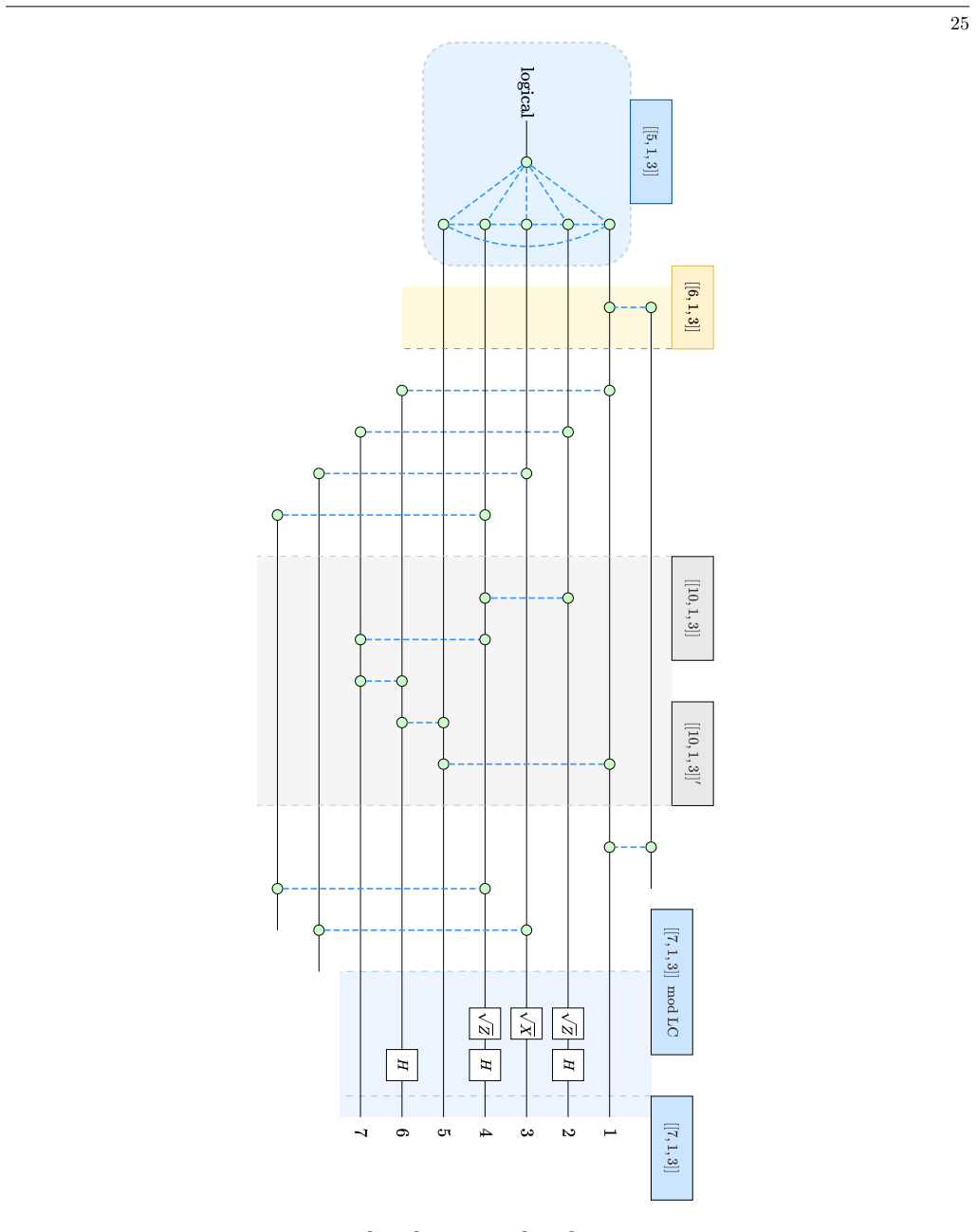
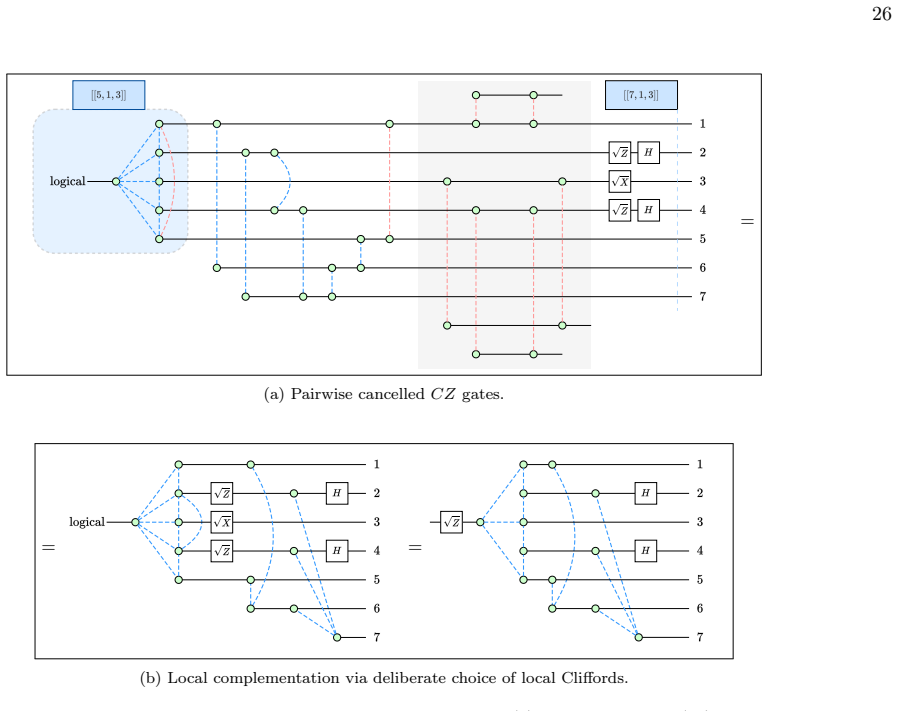
We combine gauge-fixing steps to implement a closed loop in the space of stabilizer codes, returning to the original codespace up to a logical Clifford gate. These measurement-based paths in the space of stabilizer codes can be viewed as shortcuts, or chutes and ladders, relative to single-qubit Clifford operations and qubit permutations. This yields a machine-interpretable method for constructing dynamical automorphisms. As an example, we implement a logical phase gate via distance-preserving code switching for the seven-qubit bare code, which has no non-trivial logical Clifford gates based on single-qubit Clifford operations and qubit permutations.
What carries the argument
Closed loops formed by combining gauge-fixing steps in the space of stabilizer codes, which realize dynamical automorphisms inside the ZX-calculus.
If this is right
- Logical Clifford gates become constructible for stabilizer codes that admit no such gates under single-qubit operations and permutations alone.
- The same loop-construction technique applies directly to Floquet and other dynamical codes.
- The graphical language makes systematic search for desired logical-gate implementations feasible.
- Dynamical automorphisms can be generated and verified by machine without manual circuit rewriting.
Where Pith is reading between the lines
- The method could be automated inside ZX software to enumerate gate sets for families of codes beyond the seven-qubit example.
- If the loops preserve distance, they might serve as building blocks for fault-tolerant gate teleportation protocols.
- Similar closed paths might be definable in other graphical calculi, connecting the construction to broader diagrammatic quantum computation.
- The approach reframes code switching as a computational primitive rather than solely an error-correction tool.
Load-bearing premise
The link between measurement-based code switching and gauge fixing permits gauge-fixing steps to be assembled into closed loops that apply non-trivial logical Clifford gates within the ZX-calculus.
What would settle it
A concrete counter-example would be a ZX-calculus diagram for the described gauge-fixing loop on the seven-qubit code that either fails to return to the original codespace or applies only the identity instead of the claimed logical phase gate.
Figures


read the original abstract
The ZX-calculus is a powerful graphical language for manipulating quantum circuits, which has recently found many applications in quantum error correction. We extend this language to handle Floquet and other dynamical stabilizer codes via the connection between measurement-based code switching and gauge fixing (arXiv:1810.10037). We combine gauge-fixing steps to implement a closed loop in the space of stabilizer codes, returning to the original codespace up to a logical Clifford gate. These measurement-based paths in the space of stabilizer codes can be viewed as shortcuts, or "chutes and ladders", relative to single-qubit Clifford operations and qubit permutations. This yields a machine-interpretable method for constructing dynamical automorphisms and facilitates the search for implementations of desired logical gates. As an example, we implement a logical phase gate via distance-preserving code switching for the seven-qubit code bare code (arXiv:1702.01155), which has no non-trivial logical Clifford gates based on single-qubit Clifford operations and qubit permutations (arXiv:2409.18175).
Editorial analysis
A structured set of objections, weighed in public.
Referee Report
Summary. The paper extends the ZX-calculus to Floquet and dynamical stabilizer codes by linking measurement-based code switching to gauge fixing. It shows how sequences of gauge-fixing steps can be composed into closed loops in the space of stabilizer codes that return to the original codespace up to a logical Clifford gate; these paths are presented as graphical 'chutes and ladders' shortcuts relative to single-qubit Cliffords and permutations. The central example constructs a logical phase gate on the seven-qubit bare code (which admits no non-trivial logical Cliffords from single-qubit operations and permutations) via distance-preserving code switching, yielding a machine-interpretable method for dynamical automorphisms.
Significance. If the constructions hold, the work supplies a concrete graphical calculus for discovering measurement-based implementations of logical gates that are inaccessible by standard Clifford methods, which is valuable for fault-tolerant architectures on codes with limited transversal gates. The emphasis on machine-interpretable ZX diagrams and the explicit 7-qubit example are strengths that could facilitate automated search for dynamical automorphisms.
major comments (2)
- [Section describing closed loops and the 7-qubit example] The central construction (abstract and the section combining gauge-fixing steps into closed loops) asserts that the composition returns to the original codespace up to a unitary logical Clifford; however, no explicit step-by-step computation of the overall codespace map or verification that the composite channel is deterministic and unitary (rather than a probabilistic mixture with residual logical errors) is supplied, leaving the required closure property unverified.
- [ZX-calculus extension and 7-qubit example] In the ZX-calculus extension for the seven-qubit bare code (the example implementing the logical phase gate), the manuscript provides no independent diagram reduction or check confirming that the extended rewrite rules preserve the claimed logical action, despite citing that single-qubit Cliffords and permutations are trivial for this code.
minor comments (2)
- Notation for the gauge operators and the precise mapping between measurement-based switching and the ZX diagrams could be clarified with an explicit dictionary or table.
- Figure captions for the chutes-and-ladders diagrams should explicitly label which segments correspond to which gauge-fixing measurements.
Simulated Author's Rebuttal
Thank you for the opportunity to respond to the referee's report. We address each major comment below, agreeing to make revisions to improve the explicit verification of our claims.
read point-by-point responses
-
Referee: [Section describing closed loops and the 7-qubit example] The central construction (abstract and the section combining gauge-fixing steps into closed loops) asserts that the composition returns to the original codespace up to a unitary logical Clifford; however, no explicit step-by-step computation of the overall codespace map or verification that the composite channel is deterministic and unitary (rather than a probabilistic mixture with residual logical errors) is supplied, leaving the required closure property unverified.
Authors: The referee correctly identifies that the current manuscript does not include an explicit step-by-step computation of the composite map. Although the ZX-calculus diagrams are designed to encode and verify the composition via established rewrite rules that preserve stabilizer semantics and ensure unitarity, we acknowledge that a more transparent verification would strengthen the presentation. We will add a detailed calculation of the overall codespace map (using both ZX semantics and an explicit operator representation) for the seven-qubit example in the revised manuscript. revision: yes
-
Referee: [ZX-calculus extension and 7-qubit example] In the ZX-calculus extension for the seven-qubit bare code (the example implementing the logical phase gate), the manuscript provides no independent diagram reduction or check confirming that the extended rewrite rules preserve the claimed logical action, despite citing that single-qubit Cliffords and permutations are trivial for this code.
Authors: We agree that an explicit diagram reduction sequence would provide a clearer independent check. The manuscript applies the standard ZX rewrite rules to the extended diagrams for the seven-qubit code, but does not display the full reduction steps. We will include the complete reduction sequence in the revised version, demonstrating that the diagram evaluates to the logical phase gate (and confirming that single-qubit Cliffords and permutations yield only the identity on this code). revision: yes
Circularity Check
No circularity: central construction combines external citations into new closed-loop method
full rationale
The derivation relies on the cited connection in arXiv:1810.10037 between measurement-based code switching and gauge fixing, plus standard facts about the seven-qubit code from arXiv:1702.01155 and the absence of certain gates from arXiv:2409.18175. These are external references whose content is not reproduced or redefined inside the paper. The novel step—composing gauge-fixing operations into closed paths that realize logical Cliffords, then rendering them in ZX-calculus—is presented as an independent construction rather than a renaming, fit, or self-referential definition. No equation or claim reduces by construction to its own inputs, and no load-bearing uniqueness theorem is imported from the authors' own prior work. The paper is therefore self-contained against external benchmarks.
Axiom & Free-Parameter Ledger
axioms (1)
- domain assumption ZX-calculus rules can be extended to dynamical stabilizer codes via gauge fixing and code switching.
Reference graph
Works this paper leans on
-
[1]
and [55, 67]. Research at Perimeter Institute is supported in part by the Government of Canada through the Department of Innovation, Science and Economic Development Canada and by the Province of Ontario through the Ministry of Colleges and Universities. MV was supported in part by Plan France 2030 through the project ANR-22- PETQ0006. SZB was supported b...
2030
-
[2]
Vuillot, L
C. Vuillot, L. Lao, B. Criger, C. García Almudéver, K. Bertels, and B. M. Terhal, Code deformation and lat- tice surgery are gauge fixing, New Journal of Physics21, 033028 (2019)
2019
-
[3]
M. Li, M. Gutiérrez, S. E. David, A. Hernandez, and K. R. Brown, Fault tolerance with bare ancillary qubits for a [[7,1,3]] code, Phys. Rev. A96, 032341 (2017)
2017
-
[4]
Sayginel, S
H. Sayginel, S. Koutsioumpas, M. Webster, A. Rajput, and D. E. Browne, Fault-tolerant logical clifford gates from code automorphisms, PRX Quantum6, 030343 (2025)
2025
-
[5]
M. A. Nielsen and I. L. Chuang,Quantum Computation and Quantum Information, 10th ed. (Cambridge Univer- sity Press, Cambridge ; New York, 2010)
2010
-
[6]
N. Ofek, A. Petrenko, R. Heeres, P. Reinhold, Z. Leghtas, B. Vlastakis, Y. Liu, L. Frunzio, S. M. Girvin, L. Jiang, M. Mirrahimi, M. H. Devoret, and R. J. Schoelkopf, Ex- tending the lifetime of a quantum bit with error correc- tion in superconducting circuits, Nature536, 441 (2016)
2016
-
[7]
Leroux, C
S.Krinner, N.Lacroix, A.Remm, A.DiPaolo, E.Genois, C. Leroux, C. Hellings, S. Lazar, F. Swiadek, J. Her- rmann, G.J.Norris, C.K.Andersen, M.Müller, A.Blais, C. Eichler, and A. Wallraff, Realizing repeated quantum error correction in a distance-three surface code, Nature 605, 669 (2022)
2022
-
[8]
Google Quantum AI, Suppressing quantum errors by scaling a surface code logical qubit, Nature614, 676 (2023)
2023
-
[9]
Google Quantum AI and Collaborators, Quantum error correction below the surface code threshold, Nature638, 920 (2025)
2025
-
[10]
Lacroix, A
N. Lacroix, A. Bourassa, F. J. H. Heras,et al., Scaling and logic in the colour code on a superconducting quan- tum processor, Nature645, 614 (2025)
2025
-
[11]
Ryan-Anderson, J
C. Ryan-Anderson, J. G. Bohnet, K. Lee, D. Gresh, A. Hankin, J. P. Gaebler, D. Francois, A. Chernogu- zov, D. Lucchetti, N. C. Brown, T. M. Gatterman, S. K. Halit, K. Gilmore, J. A. Gerber, B. Neyenhuis, D. Hayes, and R. P. Stutz, Realization of Real-Time Fault-Tolerant Quantum Error Correction, Physical Re- view X11, 041058 (2021)
2021
-
[12]
Postler, F
L. Postler, F. Butt, I. Pogorelov, C. D. Marciniak, S. Heußen, R. Blatt, P. Schindler, M. Rispler, M. Müller, and T. Monz, Demonstration of fault-tolerant steane quantum error correction, PRX Quantum5, 030326 (2024)
2024
-
[13]
Demonstration of logical qubits and repeated error correction with better-than-physical error rates
A. Paetznick, M. P. da Silva, C. Ryan-Anderson, J. M. Bello-Rivas, J. P. C. III, A. Chernoguzov, J. M. Dreil- ing, C. Foltz, F. Frachon, J. P. Gaebler, T. M. Gatter- man, L. Grans-Samuelsson, D. Gresh, D. Hayes, N. He- witt, C. Holliman, C. V. Horst, J. Johansen, D. Luc- chetti, Y.Matsuoka, M.Mills, S.A.Moses, B.Neyenhuis, A. Paz, J. Pino, P. Siegfried, A...
work page internal anchor Pith review Pith/arXiv arXiv doi:10.48550/arxiv.2404.02280 2024
-
[14]
B. W. Reichardt, D. Aasen, R. Chao, A. Chernogu- zov, W. van Dam, J. P. Gaebler, D. Gresh, D. Luc- chetti, M. Mills, S. A. Moses, B. Neyenhuis, A. Paet- znick, A. Paz, P. E. Siegfried, M. P. da Silva, K. M. Svore, Z. Wang, and M. Zanner, Demonstration of quan- tum computation and error correction with a tesseract code, arXiv preprint 10.48550/arXiv.2409.0...
-
[15]
C. Ryan-Anderson, N. C. Brown, C. H. Baldwin, J. M. Dreiling, C. Foltz, J. P. Gaebler, T. M. Gatterman, N. Hewitt, C. Holliman, C. V. Horst, J. Johansen, D. Lucchetti, T. Mengle, M. Matheny, Y. Matsuoka, K. Mayer, M. Mills, S. A. Moses, B. Neyenhuis, J. Pino, P. Siegfried, R. P. Stutz, J. Walker, and D. Hayes, High-fidelity and Fault-tolerant Teleportatio...
-
[16]
J. A. Muniz, D. Crow, H. Kim, J. M. Kindem, W. B. Cairncross, A. Ryou, T. C. Bohdanowicz, C.-A. Chen, Y.Ji, A.M.W.Jones, E.Megidish, C.Nishiguchi, M.Ur- banek, L. Wadleigh, T. Wilkason, D. Aasen, K. Barnes, J. M. Bello-Rivas, I. Bloomfield, G. Booth, A. Brown, M.O.Brown, K.Cassella, G.Cowan, J.Epstein, M.Feld- kamp, C. Griger, Y. Hassan, A. Heinz, E. Halp...
2025
-
[17]
doi:10.48550/arXiv.2506.20661 , url =
D. Bluvstein, A. A. Geim, S. H. Li, S. J. Evered, J. P. B. Ataides, G. Baranes, A. Gu, T. Manovitz, M. Xu, M. Kalinowski, S. Majidy, C. Kokail, N. Maskara, E. C. Trapp, L. M. Stewart, S. Hollerith, H. Zhou, M. J. Gullans, S. F. Yelin, M. Greiner, V. Vuletic, M. Cain, and M. D. Lukin, Architectural mechanisms of a uni- versal fault-tolerant quantum compute...
-
[18]
Gottesman,Stabilizer Codes and Quantum Error Cor- rection, Ph.D
D. Gottesman,Stabilizer Codes and Quantum Error Cor- rection, Ph.D. thesis, Caltech (1997)
1997
-
[19]
Eastin and E
B. Eastin and E. Knill, Restrictions on transversal en- coded quantum gate sets, Phys. Rev. Lett.102, 110502 (2009)
2009
-
[20]
Horsman, A
C. Horsman, A. G. Fowler, S. Devitt, and R. V. Meter, Surface code quantum computing by lattice surgery, New Journal of Physics14, 123011 (2012)
2012
-
[21]
D.Litinski,AGameofSurfaceCodes: Large-ScaleQuan- tum Computing with Lattice Surgery, Quantum3, 128 (2019)
2019
-
[22]
L. Z. Cohen, I. H. Kim, S. D. Bartlett, and B. J. Brown, Low-overhead fault-tolerant quantum computing using long-range connectivity, Science Advances8, eabn1717 (2022)
2022
-
[23]
B. Ide, M. G. Gowda, P. J. Nadkarni, and G. Dauphi- nais, Fault-Tolerant Logical Measurements via Homolog- ical Measurement, Physical Review X15, 021088 (2025)
2025
-
[24]
E. Swaroop, T. Jochym-O’Connor, and T. J. Yoder, Uni- versal adapters between quantum LDPC codes, arXiv preprint 10.48550/arXiv.2410.03628 (2024)
-
[25]
Z. He, A. Cowtan, D. J. Williamson, and T. J. Yoder, Ex- tractors: QLDPC Architectures for Efficient Pauli-Based Computation, arXiv preprint 10.48550/arXiv.2503.10390 (2025)
-
[26]
E. Knill, Fault-Tolerant Postselected Quantum Compu- tation: Schemes, arXiv preprint 10.48550/arXiv.quant- ph/0402171 (2004)
-
[27]
Bravyi and A
S. Bravyi and A. Kitaev, Universal quantum computa- tion with ideal Clifford gates and noisy ancillas, Physical Review A71, 022316 (2005)
2005
-
[28]
Bravyi and J
S. Bravyi and J. Haah, Magic-state distillation with low overhead, Phys. Rev. A86, 052329 (2012)
2012
-
[29]
Haah and M
J. Haah and M. B. Hastings, Codes and Protocols for DistillingT, controlled-S, and Toffoli Gates, Quantum 2, 71 (2018)
2018
-
[30]
Litinski, Magic State Distillation: Not as Costly as You Think, Quantum3, 205 (2019)
D. Litinski, Magic State Distillation: Not as Costly as You Think, Quantum3, 205 (2019)
2019
-
[31]
Paetznick and B
A. Paetznick and B. W. Reichardt, Universal fault- tolerant quantum computation with only transversal gates and error correction, Physical Review Letters111, 090505 (2013)
2013
-
[32]
H.Bombín,Gaugecolorcodes: Optimaltransversalgates and gauge fixing in topological stabilizer codes, New Journal of Physics17, 083002 (2015)
2015
-
[33]
Kubica and M
A. Kubica and M. E. Beverland, Universal transversal gates with color codes: A simplified approach, Phys. Rev. A91, 032330 (2015)
2015
-
[34]
Bombín, Dimensional jump in quantum error correc- tion, New Journal of Physics18, 043038 (2016)
H. Bombín, Dimensional jump in quantum error correc- tion, New Journal of Physics18, 043038 (2016)
2016
-
[35]
M. E. Beverland, A. Kubica, and K. M. Svore, Cost of universality: A comparative study of the overhead of state distillation and code switching with color codes, PRX Quantum2, 020341 (2021)
2021
-
[36]
M. B. Hastings and J. Haah, Dynamically generated log- ical qubits, Quantum5, 564 (2021)
2021
-
[37]
Davydova, N
M. Davydova, N. Tantivasadakarn, and S. Balasubra- manian, Floquet codes without parent subsystem codes, PRX Quantum4, 020341 (2023)
2023
-
[38]
M. S. Kesselring, J. C. Magdalena de la Fuente, F. Thom- sen, J. Eisert, S. D. Bartlett, and B. J. Brown, Anyon condensation and the color code, PRX Quantum5, 010342 (2024)
2024
-
[39]
Higgott and N
O. Higgott and N. P. Breuckmann, Constructions and performance of hyperbolic and semi-hyperbolic floquet codes, PRX Quantum5, 040327 (2024)
2024
-
[40]
Bombín, D
H. Bombín, D. Litinski, N. Nickerson, F. Pastawski, and S. Roberts, Unifying flavors of fault tolerance with the ZX calculus, Quantum8, 1379 (2024)
2024
-
[41]
Davydova, N
M. Davydova, N. Tantivasadakarn, S. Balasubramanian, and D. Aasen, Quantum computation from dynamic au- tomorphism codes, Quantum8, 1448 (2024)
2024
-
[42]
Coecke and R
B. Coecke and R. Duncan, Interacting Quantum Ob- servables: Categorical Algebra and Diagrammatics, New Journal of Physics13, 043016 (2011)
2011
-
[43]
Kissinger and J
A. Kissinger and J. van de Wetering,Picturing Quan- tum Software: An Introduction to the ZX-Calculus and Quantum Compilation(Book preprint, 2024)
2024
-
[44]
Townsend-Teague, J
A. Townsend-Teague, J. M. d. l. Fuente, and M. Kessel- ring, Floquetifying the Colour Code, Electronic Proceed- ings in Theoretical Computer Science384, 265 (2023)
2023
-
[45]
B. Rodatz, B. Poór, and A. Kissinger, Floquetifying stabiliser codes with distance-preserving rewrites, arXiv 7 preprint 10.48550/arXiv.2410.17240 (2024)
-
[46]
S. Jacoby, A. Retzker, and F. Pastawski, Stairway Codes: Floquetifying Bivariate Bicycle Codes and Beyond, arXiv preprint 10.48550/arXiv.2603.00228 (2026)
-
[47]
A. R. Calderbank, E. M. Rains, P. W. Shor, and N. J. Sloane, Quantum error correction and orthogonal geom- etry, Physical Review Letters78, 405 (1997)
1997
-
[48]
A.Kissinger,Phase-freeZXdiagramsareCSScodes(...or how to graphically grok the surface code), arXiv preprint 10.48550/arXiv.2204.14038 (2022)
-
[49]
A. B. Khesin, J. Z. Lu, and P. W. Shor, Universal graph representation of stabilizer codes, arXiv preprint 10.48550/arXiv.2411.14448 (2025)
-
[50]
Z. Wu, S. Cheng, and B. Zeng, A ZX-Calculus Approach for the Construction of Graph Codes, arXiv preprint 10.48550/arXiv.2304.08363 (2024)
-
[51]
Van den Nest, J
M. Van den Nest, J. Dehaene,and B. De Moor, Graphical description of the action of local Clifford transformations on graph states, Physical Review A69, 022316 (2004)
2004
-
[52]
Duncan and S
R. Duncan and S. Perdrix, Graph States and the Neces- sity of Euler Decomposition, inMathematical Theory and Computational Practice(Springer, 2009) pp. 167–177
2009
-
[53]
(2) should be √ X −1 = X √ X(see Theorem 3 of the SM)
Strictly speaking, the √ Xin Eq. (2) should be √ X −1 = X √ X(see Theorem 3 of the SM). Note however that Pauli operators are transversal gates, and thus come for free from a fault-tolerance perspective. As such we may work in the symplectic representation (see the SM section A), and from now on identify √ X= √ X −1 and √ Z=√ Z −1
-
[54]
Bouchet, Graphic presentations of isotropic systems, Journal of Combinatorial Theory, Series B45, 58 (1988)
A. Bouchet, Graphic presentations of isotropic systems, Journal of Combinatorial Theory, Series B45, 58 (1988)
1988
-
[55]
Duncan and S
R. Duncan and S. Perdrix, Pivoting makes the ZX- calculus complete for real stabilizers, Electronic Proceed- ings in Theoretical Computer Science171, 50 (2014)
2014
-
[56]
A. T. Hu and A. B. Khesin, Improved graph formalism for quantum circuit simulation, Physical Review A105, 022432 (2022)
2022
-
[57]
D.Kribs, R.Laflamme,andD.Poulin,Unifiedandgener- alized approach to quantum error correction, Phys. Rev. Lett.94, 180501 (2005)
2005
-
[58]
Kribs, R
D. Kribs, R. Laflamme, D. Poulin, and M. Lesosky, Op- erator quantum error correction, Quantum Information and Computation6, 382 (2006)
2006
-
[59]
Poulin, Stabilizer Formalism for Operator Quantum Error Correction, Physical Review Letters95, 230504 (2005)
D. Poulin, Stabilizer Formalism for Operator Quantum Error Correction, Physical Review Letters95, 230504 (2005)
2005
-
[60]
Backens, The ZX-calculus is complete for stabilizer quantum mechanics, New Journal of Physics16, 093021 (2014)
M. Backens, The ZX-calculus is complete for stabilizer quantum mechanics, New Journal of Physics16, 093021 (2014)
2014
-
[61]
In the normal form it is impossible for all wires to have an Hgate as some will necessarily be cancelled by pivoting
-
[62]
D. Aasen, J. Haah, Z. Li, and R. S. K. Mong, Measure- ment Quantum Cellular Automata and Anomalies in Flo- quet Codes, arXiv preprint 10.48550/arXiv.2304.01277 (2023)
-
[63]
Transversal switching between generic stabilizer codes
C. Huang and M. Newman, Transversal switch- ing between generic stabilizer codes, arXiv preprint 10.48550/arXiv.1709.09282 (2018)
work page internal anchor Pith review Pith/arXiv arXiv doi:10.48550/arxiv.1709.09282 2018
-
[64]
K. R. Colladay and E. J. Mueller, Rewiring Stabilizer Codes, New Journal of Physics20, 083030 (2018)
2018
-
[65]
A. Cross and D. Vandeth, Small Binary Stabilizer Sub- systemCodes,arXivpreprint10.48550/arXiv.2501.17447 (2025)
arXiv 2025
-
[66]
C. D. Hill, A. G. Fowler, D. S. Wang, and L. C. L. Hollen- berg, Fault-tolerant quantum error correction code con- version, Quantum Info. Comput.13, 439 (2013)
2013
-
[67]
Fault-tolerant conversion between stabilizer codes by Clifford operations
Y. Hwang, B.-S. Choi, Y.-c. Ko, and J. Heo, Fault- tolerant conversion between stabilizer codes by Clifford operations, arXiv preprint 10.48550/arXiv.1511.02596 (2015)
work page internal anchor Pith review Pith/arXiv arXiv doi:10.48550/arxiv.1511.02596 2015
-
[68]
A. B. Khesin and A. Li, Equivalence Classes of Quantum Error-Correcting Codes, arXiv preprint 10.48550/arXiv.2406.12083 (2024)
-
[69]
S. Yu, Q. Chen, and C. Oh, Graphical Quan- tum Error-Correcting Codes, arXiv preprint 10.48550/arXiv.0709.1780 (2007)
work page internal anchor Pith review Pith/arXiv arXiv doi:10.48550/arxiv.0709.1780 2007
-
[70]
Morley-Short, gsc (graph-state compass),https:// github.com/sammorley-short/gsc(2019)
S. Morley-Short, gsc (graph-state compass),https:// github.com/sammorley-short/gsc(2019)
2019
-
[71]
J. C. Adcock, S. Morley-Short, A. Dahlberg, and J. W. Silverstone, Mapping graph state orbits under local com- plementation, Quantum4, 305 (2020)
2020
-
[72]
Aaronson and D
S. Aaronson and D. Gottesman, Improved Simulation of Stabilizer Circuits, Physical Review A70, 052328 (2004)
2004
-
[73]
With mild abuse of notation, we will occasionally also identify single qubit Cliffords as local Cliffords,LC = Cl(1)
-
[74]
Duncan, A
R. Duncan, A. Kissinger, S. Perdrix, and J. v. d. Weter- ing, Graph-theoretic Simplification of Quantum Circuits with the ZX-calculus, Quantum4, 279 (2020)
2020
-
[75]
StrictlyspeakingitsufficestonotethatanyCliffordisom- etry (as a linear map) may be written as ZX-diagram in the Clifford fragment, but we include this step for ease of the reader
-
[76]
M. B. Elliott, B. Eastin, and C. M. Caves, Graphical de- scription of the action of Clifford operators on stabilizer states, Physical Review A77, 042307 (2008)
2008
-
[77]
Gross, Hudson’s theorem for finite-dimensional quan- tum systems, Journal of Mathematical Physics47, 122107 (2006)
D. Gross, Hudson’s theorem for finite-dimensional quan- tum systems, Journal of Mathematical Physics47, 122107 (2006)
2006
-
[78]
J.DehaeneandB.D.Moor,TheCliffordgroup, stabilizer states, and linear and quadratic operations over GF(2), Physical Review A68, 042318 (2003)
2003
-
[79]
Poór,A unique normal form for prime-dimensional qudit Clifford ZX-calculus, Master’s thesis, University of Oxford (2022)
B. Poór,A unique normal form for prime-dimensional qudit Clifford ZX-calculus, Master’s thesis, University of Oxford (2022)
2022
-
[80]
Since we work in the symplectic representation, the linear constraint will be always homogoneous
discussion (0)
Sign in with ORCID, Apple, or X to comment. Anyone can read and Pith papers without signing in.