Quintessential α-attractors fit DESI
Pith reviewed 2026-06-28 13:27 UTC · model grok-4.3
The pith
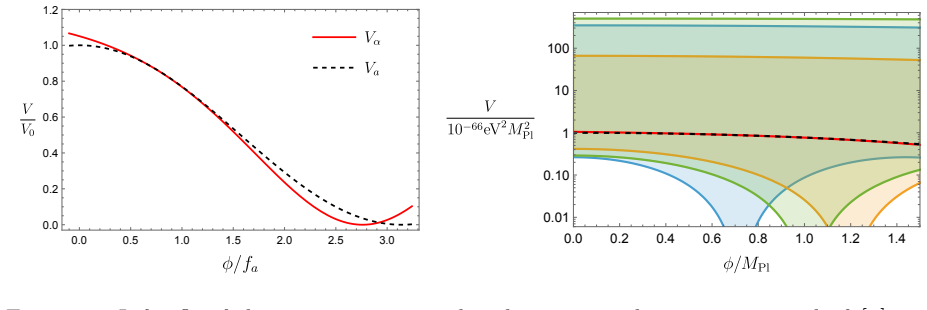
The knee of α-attractor potentials approximates axion-like quintessence, translating DESI constraints into a preference for α of order one.
A machine-rendered reading of the paper's core claim, the machinery that carries it, and where it could break.
Core claim
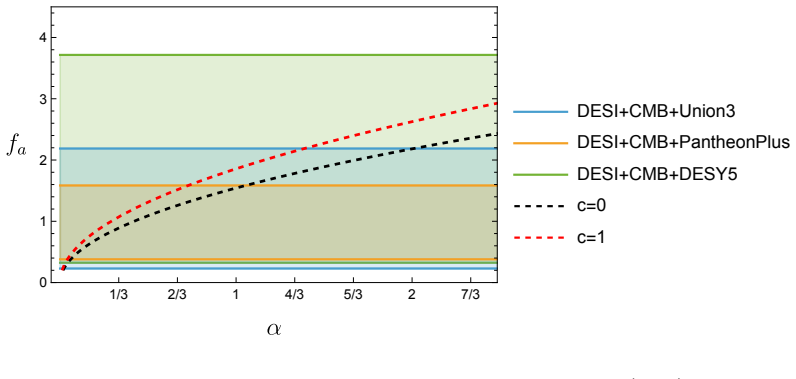
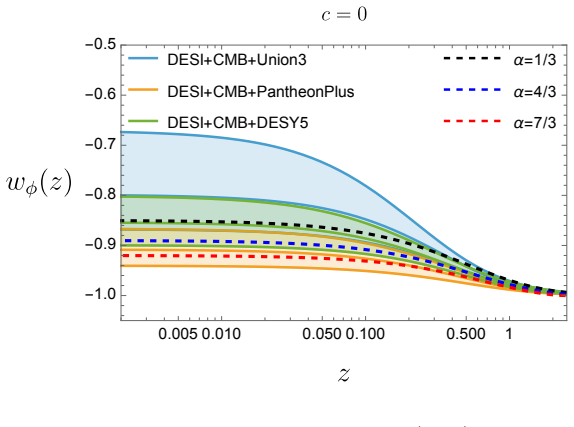
The knee of the α-attractor potential provides an excellent approximation to the axion-like quintessence model used as a DESI benchmark. This leads to a simple relation between the axion decay constant fa and the attractor parameter α, allowing the experimental constraints to be translated into a preference for α=O(1). Numerical solutions of the background dynamics find good agreement with the DESI-preferred w(z) up to z~O(1).
What carries the argument
The knee of the α-attractor potential, which approximates the axion-like quintessence potential and yields the relation between fa and α.
If this is right
- DESI data translate into a preference for α=O(1) in these models.
- The background dynamics agree with the DESI-preferred w(z) up to z~O(1).
- Both axion-like and attractor potentials must have today's energy and slope of order the Hubble scale in Planck units.
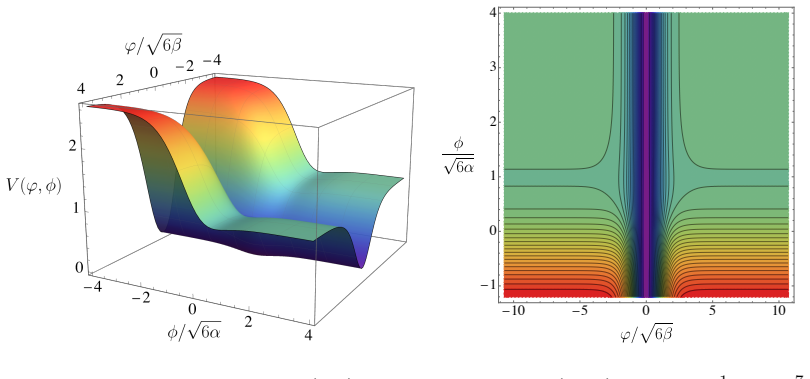
- The required initial conditions can arise naturally in multifield attractor scenarios.
Where Pith is reading between the lines
- The approximation may apply to other dynamical dark energy models with similarly shaped potentials at late times.
- Precision cosmology data could begin to test string-motivated values of α directly.
- Multifield dynamics that set the initial conditions may leave additional observable signatures at higher redshifts.
Load-bearing premise
The knee approximation between α-attractor and axion-like potentials holds accurately enough in the relevant parameter range to translate DESI constraints into a reliable preference for α=O(1).
What would settle it
A precise measurement of the dark energy equation of state showing significant deviation from the predicted w(z) curve at redshifts around one would falsify the claimed agreement.
Figures

read the original abstract
We study quintessence in $\alpha$-attractor models in light of recent DESI indications for dynamical dark energy. We show that the \emph{knee} of the attractor potential provides an excellent approximation to the axion-like quintessence model used as a DESI benchmark. This leads to a simple relation between the axion decay constant $f_a$ and the attractor parameter $\alpha$, allowing the experimental constraints to be translated into a preference for $\alpha=\mathcal{O}(1)$, in agreement with string-motivated expectations. We solve the background dynamics numerically and find good agreement with the DESI-preferred evolution of $w(z)$ up to $z\sim\mathcal{O}(1)$. More generally, we point out that the agreement between axion-like and attractor potentials reflects a common requirement imposed by the data: today's potential energy and slope are both of order the Hubble scale in Planck units. We finally comment on the origin of the required initial conditions, which can naturally arise in multifield attractor scenarios.
Editorial analysis
A structured set of objections, weighed in public.
Referee Report
Summary. The paper claims that the knee of the α-attractor potential provides an excellent approximation to the axion-like quintessence model used as a DESI benchmark. This yields a simple fa-α relation that translates DESI constraints into a preference for α=O(1), consistent with string expectations. Numerical solution of the background dynamics shows good agreement with the DESI-preferred w(z) up to z~O(1). The agreement is attributed to the data imposing that today's potential energy and slope are both O(H0) in Planck units, with initial conditions possibly arising naturally in multifield scenarios.
Significance. If the knee approximation is sufficiently accurate, the work provides a direct mapping from observational constraints on dynamical dark energy to string-motivated α-attractor parameters, highlighting a shared requirement on V and V' that explains the data preference without additional tuning.
major comments (2)
- [Abstract] Abstract: the assertion of an 'excellent approximation' between the knee of the α-attractor potential and the axion-like benchmark, and of 'good agreement' with DESI w(z), is not accompanied by any quantitative metric (maximum relative deviation in V(φ), Δw(z), or χ² comparison) at the relevant parameters where V and V' are both O(H0). This quantification is required to validate the fa-α relation and the resulting claim of a preference for α=O(1).
- [Numerical results section] The section on numerical integration of the background dynamics: while agreement with DESI-preferred w(z) up to z~O(1) is stated, no details are given on the integrator, step size, convergence tests, or direct comparison (e.g., point-by-point difference or integrated error) between the α-attractor and axion-like trajectories, which is load-bearing for the central claim that the models are interchangeable for the purpose of fitting DESI.
minor comments (2)
- Add a short table or plot inset showing w(z) for both the α-attractor and axion-like models at z=0, 0.5, 1.0 to make the agreement explicit.
- The phrase 'common requirement imposed by the data' would benefit from an explicit equation showing how V(φ0) ~ H0² and V'(φ0) ~ H0² follow from the DESI-preferred w(z) evolution.
Simulated Author's Rebuttal
We thank the referee for their careful reading and constructive suggestions. We address the two major comments point by point below and will revise the manuscript accordingly.
read point-by-point responses
-
Referee: [Abstract] Abstract: the assertion of an 'excellent approximation' between the knee of the α-attractor potential and the axion-like benchmark, and of 'good agreement' with DESI w(z), is not accompanied by any quantitative metric (maximum relative deviation in V(φ), Δw(z), or χ² comparison) at the relevant parameters where V and V' are both O(H0). This quantification is required to validate the fa-α relation and the resulting claim of a preference for α=O(1).
Authors: We agree that quantitative metrics would strengthen the presentation. In the revised manuscript we will report the maximum relative deviation between the knee of the α-attractor potential and the axion-like benchmark at the relevant parameters (where V and V' are both O(H0) in Planck units), together with the maximum |Δw(z)| and any χ² comparison between the two models' w(z) trajectories and the DESI-preferred evolution. These additions will directly support the fa-α relation and the preference for α=O(1). revision: yes
-
Referee: [Numerical results section] The section on numerical integration of the background dynamics: while agreement with DESI-preferred w(z) up to z~O(1) is stated, no details are given on the integrator, step size, convergence tests, or direct comparison (e.g., point-by-point difference or integrated error) between the α-attractor and axion-like trajectories, which is load-bearing for the central claim that the models are interchangeable for the purpose of fitting DESI.
Authors: We acknowledge that the numerical section lacks the requested technical details. The revised manuscript will specify the integrator, step size or adaptive tolerances, convergence tests performed, and will include quantitative direct comparisons (maximum point-by-point |Δw(z)| and integrated error) between the α-attractor and axion-like trajectories. These additions will substantiate the claim that the models are interchangeable for fitting DESI. revision: yes
Circularity Check
No significant circularity detected
full rationale
The paper's chain proceeds from an asserted knee approximation between α-attractor and axion-like potentials to a derived fa-α relation, followed by numerical integration of background equations and direct comparison to DESI w(z) data. The observation that both models satisfy V, V' ~ H0 is presented as a post-hoc remark on why the potentials agree, not as a load-bearing derivation step or fitted input renamed as prediction. No self-citations, uniqueness theorems, or ansatzes imported from prior author work are invoked to force the result; the preference for α=O(1) is obtained by mapping external data constraints through the approximation. The derivation remains self-contained against the DESI benchmark and does not reduce any claimed prediction to its inputs by construction.
Axiom & Free-Parameter Ledger
free parameters (1)
- α =
O(1)
axioms (1)
- domain assumption The knee of the α-attractor potential provides an excellent approximation to the axion-like quintessence model used as a DESI benchmark
Reference graph
Works this paper leans on
-
[1]
The Cosmological Constant Problem
S. Weinberg, “The Cosmological Constant Problem”, Rev. Mod. Phys.61, edited by J.-P. Hsu and D. Fine, 1–23 (1989)
1989
-
[2]
DESI DR2 results. II. Measurements of baryon acous- tic oscillations and cosmological constraints
M. Abdul Karim et al., “DESI DR2 results. II. Measurements of baryon acous- tic oscillations and cosmological constraints”, Phys. Rev. D112, 083515 (2025), arXiv:2503.14738 [astro-ph.CO]
Pith/arXiv arXiv 2025
-
[3]
The Pantheon+ Analysis: Cosmological Constraints
D. Brout et al., “The Pantheon+ Analysis: Cosmological Constraints”, Astrophys. J.938, 110 (2022), arXiv:2202.04077 [astro-ph.CO]
Pith/arXiv arXiv 2022
-
[4]
Union Through UNITY: Cosmology with 2,000 SNe Using a Unified Bayesian Framework
D. Rubin et al., “Union Through UNITY: Cosmology with 2,000 SNe Using a Unified Bayesian Framework”, (2023), arXiv:2311.12098 [astro-ph.CO]. 17
Pith/arXiv arXiv 2023
-
[5]
T. M. C. Abbott et al., “The Dark Energy Survey: Cosmology Results with∼1500 New High-redshift Type Ia Supernovae Using the Full 5 yr Data Set”, Astrophys. J. Lett.973, L14 (2024), arXiv:2401.02929 [astro-ph.CO]
Pith/arXiv arXiv 2024
-
[6]
M. A. Sabogal and R. C. Nunes, “Robust Evidence for Dynamical Dark En- ergy from DESI Galaxy-CMB Lensing Cross-Correlation and Geometric Probes”, (2025), arXiv:2505.24465 [astro-ph.CO]
arXiv 2025
-
[7]
Cosmological Consequences of a Rolling Homoge- neous Scalar Field
B. Ratra and P. J. E. Peebles, “Cosmological Consequences of a Rolling Homoge- neous Scalar Field”, Phys. Rev. D37, 3406 (1988)
1988
-
[8]
Cosmological imprint of an energy component with general equation of state
R. R. Caldwell, R. Dave, and P. J. Steinhardt, “Cosmological imprint of an energy component with general equation of state”, Phys. Rev. Lett.80, 1582–1585 (1998), arXiv:astro-ph/9708069
Pith/arXiv arXiv 1998
-
[9]
S. Tsujikawa, “Quintessence: A Review”, Class. Quant. Grav.30, 214003 (2013), arXiv:1304.1961 [gr-qc]
Pith/arXiv arXiv 2013
-
[10]
Cosmology with a Time Variable Cosmological Constant
P. J. E. Peebles and B. Ratra, “Cosmology with a Time Variable Cosmological Constant”, Astrophys. J. Lett.325, L17 (1988)
1988
-
[11]
The Cosmon model for an asymptotically vanishing time dependent cosmological ’constant’
C. Wetterich, “The Cosmon model for an asymptotically vanishing time dependent cosmological ’constant’”, Astron. Astrophys.301, 321–328 (1995), arXiv:hep - th/9408025
arXiv 1995
-
[12]
D. Baumann, “Inflation”, in Theoretical Advanced Study Institute in Elemen- tary Particle Physics: Physics of the Large and the Small (2011), pp. 523–686, arXiv:0907.5424 [hep-th]
Pith/arXiv arXiv 2011
-
[13]
Encyclopædia Inflationaris: Opiparous Edition
J. Martin, C. Ringeval, and V. Vennin, “Encyclopædia Inflationaris: Opiparous Edition”, Phys. Dark Univ.5-6, 75–235 (2014), arXiv:1303.3787 [astro-ph.CO]
arXiv 2014
-
[14]
Superconformal inflationaryα-attractors
R. Kallosh, A. Linde, and D. Roest, “Superconformal inflationaryα-attractors”, Journal of High Energy Physics2013,10.1007/jhep11(2013)198(2013)
-
[15]
Cosmological attractors fromα-scale supergravity
D. Roest and M. Scalisi, “Cosmological attractors fromα-scale supergravity”, Phys. Rev. D92, 043525 (2015), arXiv:1503.07909 [hep-th]
Pith/arXiv arXiv 2015
-
[16]
Cosmologicalα-attractors and de Sitter landscape
M. Scalisi, “Cosmologicalα-attractors and de Sitter landscape”, JHEP12, 134 (2015), arXiv:1506.01368 [hep-th]
Pith/arXiv arXiv 2015
-
[17]
Swampland distance conjecture, inflation andα- attractors
M. Scalisi and I. Valenzuela, “Swampland distance conjecture, inflation andα- attractors”, JHEP08, 160 (2019), arXiv:1812.07558 [hep-th]
arXiv 2019
-
[18]
Polynomialα-attractors
R. Kallosh and A. Linde, “Polynomialα-attractors”, JCAP04, 017 (2022), arXiv:2202. 06492 [astro-ph.CO]
2022
-
[19]
R. Kallosh and A. Linde, “Attractors in Supergravity”, (2025), arXiv:2503.13682 [hep-th]
arXiv 2025
-
[20]
On the Present Status of Inflationary Cosmology
R. Kallosh and A. Linde, “On the Present Status of Inflationary Cosmology”, (2025), arXiv:2505.13646 [hep-th]. 18
arXiv 2025
-
[21]
R. Kallosh and A. Linde, “Escher in the Sky”, Comptes Rendus Physique16, 914–927 (2015), arXiv:1503.06785 [hep-th]
Pith/arXiv arXiv 2015
-
[22]
Hyperbolic geometry of cosmological attractors
J. J. M. Carrasco, R. Kallosh, A. Linde, and D. Roest, “Hyperbolic geometry of cosmological attractors”, Phys. Rev. D92, 041301 (2015), arXiv:1504.05557 [hep-th]
Pith/arXiv arXiv 2015
-
[23]
Superconformal Inflationaryα-Attractors
R. Kallosh, A. Linde, and D. Roest, “Superconformal Inflationaryα-Attractors”, JHEP11, 198 (2013), arXiv:1311.0472 [hep-th]
Pith/arXiv arXiv 2013
-
[24]
Quintessential Inflation withα-attractors
K. Dimopoulos and C. Owen, “Quintessential Inflation withα-attractors”, JCAP 06, 027 (2017), arXiv:1703.00305 [gr-qc]
Pith/arXiv arXiv 2017
-
[25]
DESI constraints on α-attractor inflationary models
G. Alestas, M. Caldarola, S. Kuroyanagi, and S. Nesseris, “DESI constraints on α-attractor inflationary models”, Phys. Rev. D111, [Erratum: Phys.Rev.D 111, 089904 (2025)], 083506 (2025), arXiv:2410.00827 [astro-ph.CO]
arXiv 2025
-
[26]
String cosmology: From the early universe to today
M. Cicoli, J. P. Conlon, A. Maharana, S. Parameswaran, F. Quevedo, and I. Zavala, “String cosmology: From the early universe to today”, Phys. Rept.1059, 1–155 (2024), arXiv:2303.04819 [hep-th]
arXiv 2024
-
[27]
Dark energy from string theory: an introductory review
D. Andriot, “Dark energy from string theory: an introductory review”, (2026), arXiv:2603.25797 [hep-th]
Pith/arXiv arXiv 2026
-
[28]
Extended dark energy analysis using DESI DR2 BAO measure- ments
K. Lodha et al., “Extended dark energy analysis using DESI DR2 BAO measure- ments”, Phys. Rev. D112, 083511 (2025), arXiv:2503.14743 [astro-ph.CO]
Pith/arXiv arXiv 2025
-
[29]
Assessing observational constraints on dark energy
D. Shlivko and P. J. Steinhardt, “Assessing observational constraints on dark energy”, Phys. Lett. B855, 138826 (2024), arXiv:2405.03933 [astro-ph.CO]
Pith/arXiv arXiv 2024
-
[30]
S-dual quintessence, the Swamp- land, and the DESI DR2 results
L. A. Anchordoqui, I. Antoniadis, and D. Lust, “S-dual quintessence, the Swamp- land, and the DESI DR2 results”, Phys. Lett. B868, 139632 (2025), arXiv:2503. 19428 [hep-th]
2025
-
[31]
Bulk/boundary modular quintessence and DESI
L. A. Anchordoqui, I. Antoniadis, N. Cribiori, A. Hasar, D. Lust, J. Masias, and M. Scalisi, “Bulk/boundary modular quintessence and DESI”, JHEP09, 128 (2025), arXiv:2506.02731 [hep-th]
arXiv 2025
-
[32]
G. Shiu, F. Tonioni, and H. V. Tran, “Bounding axion dark energy”, (2026), arXiv:2604.09141 [astro-ph.CO]
Pith/arXiv arXiv 2026
-
[33]
Optimal parameterizations for observational constraints on thawing dark energy
D. Shlivko, P. J. Steinhardt, and C. L. Steinhardt, “Optimal parameterizations for observational constraints on thawing dark energy”, (2025), arXiv:2504.02028 [astro-ph.CO]
arXiv 2025
-
[34]
Updated cosmological constraints on axion dark energy with DESI
L. A. Ure˜ na L´ opez et al., “Updated cosmological constraints on axion dark energy with DESI”, (2025), arXiv:2503.20178 [astro-ph.CO]
arXiv 2025
-
[35]
Bounds on Field Range for Slowly Varying Positive Potentials
D. van de Heisteeg, C. Vafa, M. Wiesner, and D. H. Wu, “Bounds on Field Range for Slowly Varying Positive Potentials”, (2023), arXiv:2305.07701 [hep-th]
arXiv 2023
-
[36]
The N=8 Supergravity Theory. 1. The Lagrangian
E. Cremmer and B. Julia, “The N=8 Supergravity Theory. 1. The Lagrangian”, Phys. Lett. B80, edited by A. Salam and E. Sezgin, 48 (1978). 19
1978
-
[37]
The SO(8) Supergravity
E. Cremmer and B. Julia, “The SO(8) Supergravity”, Nucl. Phys. B159, 141–212 (1979)
1979
-
[38]
N=8 Supergravity
B. de Wit and H. Nicolai, “N=8 Supergravity”, Nucl. Phys. B208, 323 (1982)
1982
-
[39]
Seven-disk manifold,α-attractors, andBmodes
S. Ferrara and R. Kallosh, “Seven-disk manifold,α-attractors, andBmodes”, Phys. Rev. D94, 126015 (2016), arXiv:1610.04163 [hep-th]
Pith/arXiv arXiv 2016
-
[40]
M. J. Duff and S. Ferrara, “Four curious supergravities”, Phys. Rev. D83, 046007 (2011), arXiv:1010.3173 [hep-th]
Pith/arXiv arXiv 2011
-
[41]
Hierarchies from fluxes in string compactifications
S. B. Giddings, S. Kachru, and J. Polchinski, “Hierarchies from fluxes in string compactifications”, Phys. Rev. D66, 106006 (2002), arXiv:hep-th/0105097
Pith/arXiv arXiv 2002
-
[42]
De Sitter vacua in string theory
S. Kachru, R. Kallosh, A. D. Linde, and S. P. Trivedi, “De Sitter vacua in string theory”, Phys. Rev. D68, 046005 (2003), arXiv:hep-th/0301240
Pith/arXiv arXiv 2003
-
[43]
Systematics of moduli stabilisation in Calabi-Yau flux compactifications
V. Balasubramanian, P. Berglund, J. P. Conlon, and F. Quevedo, “Systematics of moduli stabilisation in Calabi-Yau flux compactifications”, JHEP03, 007 (2005), arXiv:hep-th/0502058
Pith/arXiv arXiv 2005
-
[44]
The Effective action of N = 1 Calabi-Yau orien- tifolds
T. W. Grimm and J. Louis, “The Effective action of N = 1 Calabi-Yau orien- tifolds”, Nucl. Phys. B699, 387–426 (2004), arXiv:hep-th/0403067
Pith/arXiv arXiv 2004
-
[45]
Accelerating universes with scaling dark matter
M. Chevallier and D. Polarski, “Accelerating universes with scaling dark matter”, Int. J. Mod. Phys. D10, 213–224 (2001), arXiv:gr-qc/0009008
Pith/arXiv arXiv 2001
-
[46]
Exploring the expansion history of the universe
E. V. Linder, “Exploring the expansion history of the universe”, Phys. Rev. Lett. 90, 091301 (2003), arXiv:astro-ph/0208512
Pith/arXiv arXiv 2003
-
[47]
R. R. Caldwell and E. V. Linder, “The Limits of quintessence”, Phys. Rev. Lett. 95, 141301 (2005), arXiv:astro-ph/0505494
Pith/arXiv arXiv 2005
-
[48]
Dark energy,α-attractors, and large-scale structure surveys
Y. Akrami, R. Kallosh, A. Linde, and V. Vardanyan, “Dark energy,α-attractors, and large-scale structure surveys”, Journal of Cosmology and Astroparticle Physics 2018, 041–041 (2018)
2018
-
[49]
Introduction to Effective Field Theory
C. P. Burgess, “Introduction to Effective Field Theory”, Ann. Rev. Nucl. Part. Sci.57, 329–362 (2007), arXiv:hep-th/0701053. 20
Pith/arXiv arXiv 2007
discussion (0)
Sign in with ORCID, Apple, or X to comment. Anyone can read and Pith papers without signing in.