IterInt: Evaluating iterated integrals via differential equations
Pith reviewed 2026-06-28 13:17 UTC · model grok-4.3
The pith
IterInt converts iterated integrals into systems of first-order linear differential equations that standard solvers can evaluate numerically with high precision.
A machine-rendered reading of the paper's core claim, the machinery that carries it, and where it could break.
Core claim
The central claim is that by transforming iterated integrals into a system of first-order linear differential equations, IterInt enables efficient and high-precision numerical evaluation of integrals involving arbitrary integration kernels, including those requiring shuffle-regularisation.
What carries the argument
The transformation of the iterated integrals, defined by user-specified kernels, into a closed system of first-order linear differential equations.
If this is right
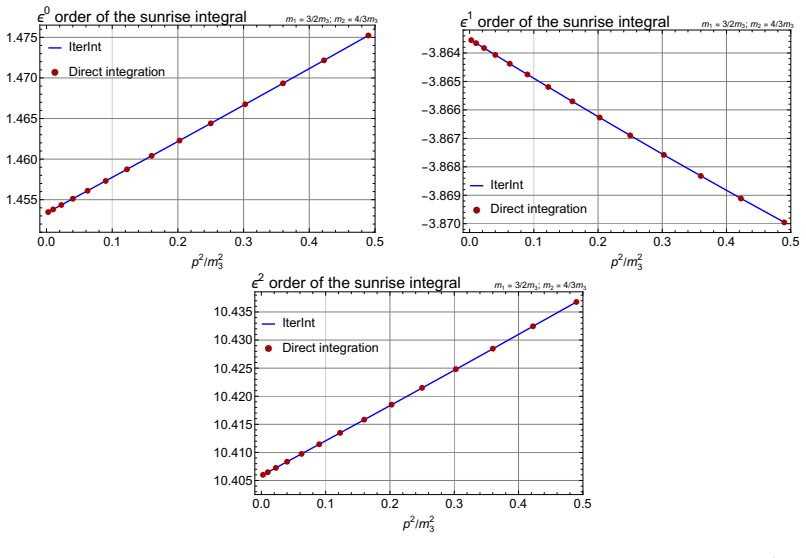
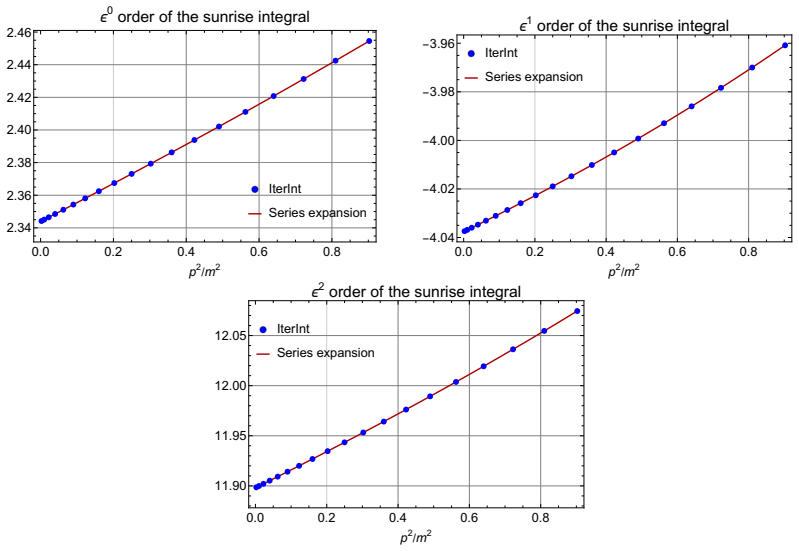
- Comparison with GiNaC shows agreement for ordinary and elliptic multiple polylogarithms.
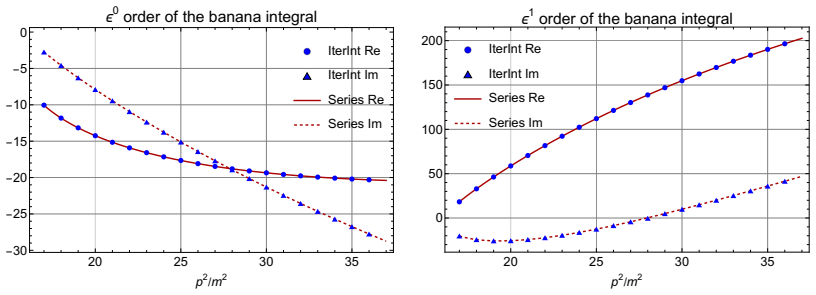
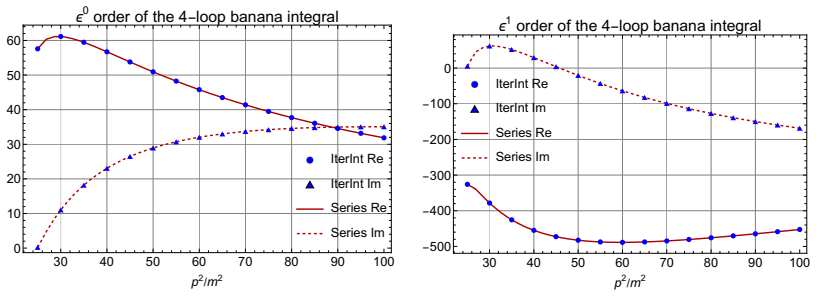
- Validation against known results for banana integrals up to four loops.
- Supports evaluation where the integrand has a pole at the starting point via automatic regularisation.
Where Pith is reading between the lines
- This method could allow users to define custom kernels for integrals not covered by existing special functions.
- Integration with other computational physics tools might enable broader applications in multi-loop calculations.
Load-bearing premise
Any user-defined integration kernels can be transformed into a finite closed system of first-order linear differential equations that remains numerically stable.
What would settle it
Finding an iterated integral with arbitrary kernels for which no finite system of first-order linear differential equations can be constructed or where the numerical solution becomes unstable.
Figures

read the original abstract
We introduce IterInt, a novel package implemented in both Mathematica and C++ for the numerical evaluation of iterated integrals involving arbitrary integration kernels. After the user has defined the integration kernels, IterInt transforms the iterated integrals into a system of first-order linear differential equations which can be solved efficiently and with high precision using well established libraries. IterInt is also able to automatically perform shuffle-regularisation. This makes it possible to evaluate also integrals where the integrand has a pole at the starting point of the integration path. As an illustration of our code, and also to validate it and gauge its performance, we compare the output of IterInt to the results obtained by GiNaC for ordinary and elliptic multiple polylogarithms, and also to existing results for the first few orders for banana integrals with up to four loops.
Editorial analysis
A structured set of objections, weighed in public.
Referee Report
Summary. The paper introduces IterInt, a package implemented in both Mathematica and C++ for the numerical evaluation of iterated integrals with arbitrary user-defined kernels. The method transforms the integrals into a system of first-order linear differential equations solved using established libraries, with automatic shuffle regularisation to handle cases with poles at the integration starting point. Validation consists of direct numerical comparisons to GiNaC results for ordinary and elliptic multiple polylogarithms, as well as to published results for banana integrals up to four loops.
Significance. If the implementation is correct, IterInt supplies a general-purpose numerical tool for iterated integrals appearing in multi-loop calculations, extending beyond libraries limited to specific classes such as MPLs. The dual-language implementation and the reported agreement with independent codes constitute concrete strengths that support potential utility in the field.
major comments (1)
- [method description (paragraph following abstract)] The manuscript states that the transformation to a closed first-order linear DE system is always possible for arbitrary kernels, but provides no explicit algorithm, basis construction, or closure proof in the method description; this is load-bearing for the generality claim even though the finite-dimensionality argument is standard.
minor comments (2)
- [validation section] The validation paragraphs report agreement with GiNaC and banana results but do not tabulate achieved relative precision, CPU times, or the specific integration paths and weight values used; adding such a table would improve reproducibility.
- [implementation and solver paragraph] No discussion of numerical stability, step-size control, or error estimation in the DE solver is included, which would clarify the 'high precision' claim.
Simulated Author's Rebuttal
We thank the referee for the positive assessment of IterInt and the recommendation for minor revision. We address the single major comment below.
read point-by-point responses
-
Referee: [method description (paragraph following abstract)] The manuscript states that the transformation to a closed first-order linear DE system is always possible for arbitrary kernels, but provides no explicit algorithm, basis construction, or closure proof in the method description; this is load-bearing for the generality claim even though the finite-dimensionality argument is standard.
Authors: We agree that an expanded description of the basis construction and closure procedure would strengthen the presentation of the generality claim. In the revised manuscript we will add a concise subsection (or short appendix) outlining the algorithmic steps: (i) the finite-dimensional vector space spanned by the iterated integrals with the user-supplied kernels, (ii) the explicit construction of a basis via repeated differentiation and reduction using the shuffle product, and (iii) the resulting closed linear system of first-order DEs. This will make the standard finite-dimensionality argument fully explicit without altering the existing code or validation results. revision: yes
Circularity Check
No significant circularity identified
full rationale
The paper describes a software package that converts user-specified iterated integrals into a first-order linear DE system via the finite-dimensional vector space of weight-n integrals under differentiation. This is a direct algebraic construction, not a fitted or self-referential prediction. Validation is performed against independent external codes (GiNaC) and published banana-integral results, providing external benchmarks. No self-citations, ansatze, or renamings of known results serve as load-bearing steps in the central claim. The method is self-contained against external checks.
Axiom & Free-Parameter Ledger
axioms (2)
- standard math Linear first-order ODE systems derived from iterated integrals admit unique solutions given appropriate boundary conditions.
- domain assumption Shuffle regularization preserves the value of the iterated integral when a pole is present at the lower limit.
Forward citations
Cited by 1 Pith paper
-
CHESS: CHEbyshev pSeudo-Spectral transport for Feynman integral differential equations
CHESS package implements Chebyshev-Lobatto spectral collocation for transporting epsilon-factorized differential equations of Feynman master integrals with benchmarks showing rapid convergence and shorter wall times t...
Reference graph
Works this paper leans on
-
[1]
Chen,Iterated path integrals,Bull
K.-T. Chen,Iterated path integrals,Bull. Am. Math. Soc.83(1977) 831
1977
-
[2]
’t Hooft and M.J.G
G. ’t Hooft and M.J.G. Veltman,regularisation and Renormalization of Gauge Fields,Nucl. Phys. B44(1972) 189
1972
-
[3]
Bollini and J.J
C.G. Bollini and J.J. Giambiagi,Dimensional Renormalization: The Number of Dimensions as a Regularizing Parameter,Nuovo Cim. B12(1972) 20
1972
-
[4]
Kotikov,Differential equations method: New technique for massive Feynman diagrams calculation,Phys
A.V. Kotikov,Differential equations method: New technique for massive Feynman diagrams calculation,Phys. Lett. B254(1991) 158
1991
-
[5]
Kotikov,Differential equations method: The Calculation of vertex type Feynman diagrams,Phys
A.V. Kotikov,Differential equations method: The Calculation of vertex type Feynman diagrams,Phys. Lett. B259(1991) 314. 41
1991
-
[6]
Kotikov,Differential equation method: The Calculation of N point Feynman diagrams,Phys
A.V. Kotikov,Differential equation method: The Calculation of N point Feynman diagrams,Phys. Lett. B267(1991) 123
1991
-
[7]
T. Gehrmann and E. Remiddi,Differential equations for two-loop four-point functions,Nucl. Phys. B580(2000) 485 [hep-ph/9912329]
Pith/arXiv arXiv 2000
-
[8]
Henn,Multiloop integrals in dimensional regularisation made simple,Phys
J. Henn,Multiloop integrals in dimensional regularisation made simple,Phys. Rev. Lett.110(2013) 251601 [1304.1806]
Pith/arXiv arXiv 2013
-
[9]
J.L. Bourjaily et al.,Functions Beyond Multiple Polylogarithms for Precision Collider Physics, inSnowmass 2021, 3, 2022 [2203.07088]
arXiv 2021
-
[10]
Goncharov,Multiple polylogarithms, cyclotomy and modular complexes, Math
A.B. Goncharov,Multiple polylogarithms, cyclotomy and modular complexes, Math. Res. Lett.5(1998) 497 [1105.2076]
Pith/arXiv arXiv 1998
-
[11]
T. Gehrmann and E. Remiddi,Two loop master integrals for gamma* —>3 jets: The Planar topologies,Nucl. Phys. B601(2001) 248 [hep-ph/0008287]
Pith/arXiv arXiv 2001
-
[12]
E. Remiddi and J.A.M. Vermaseren,Harmonic polylogarithms,Int. J. Mod. Phys. A15(2000) 725 [hep-ph/9905237]
Pith/arXiv arXiv 2000
-
[13]
A.B. Goncharov, M. Spradlin, C. Vergu and A. Volovich,Classical Polylogarithms for Amplitudes and Wilson Loops,Phys. Rev. Lett.105(2010) 151605 [1006.5703]
Pith/arXiv arXiv 2010
-
[14]
F.C. Brown,Multiple zeta values and periods of moduli spacesM0,n,Annales Sci.Ecole Norm.Sup.42(2009) 371 [math/0606419]
Pith/arXiv arXiv 2009
-
[15]
C. Duhr, H. Gangl and J.R. Rhodes,From polygons and symbols to polylogarithmic functions,JHEP10(2012) 075 [1110.0458]
Pith/arXiv arXiv 2012
-
[16]
C. Duhr,Hopf algebras, coproducts and symbols: an application to Higgs boson amplitudes,JHEP08(2012) 043 [1203.0454]
Pith/arXiv arXiv 2012
-
[17]
C. Duhr,Mathematical aspects of scattering amplitudes, inTheoretical Advanced Study Institute in Elementary Particle Physics: Journeys Through the Precision Frontier: Amplitudes for Colliders, pp. 419–476, 2015, DOI [1411.7538]
Pith/arXiv arXiv 2015
-
[18]
S. Weinzierl,Feynman Integrals. A Comprehensive Treatment for Students and Researchers, UNITEXT for Physics, Springer (2022), 10.1007/978-3-030-99558-4, [2201.03593]
-
[19]
T. Gehrmann and E. Remiddi,Numerical evaluation of harmonic polylogarithms, Comput. Phys. Commun.141(2001) 296 [hep-ph/0107173]
Pith/arXiv arXiv 2001
-
[20]
T. Gehrmann and E. Remiddi,Numerical evaluation of two-dimensional harmonic polylogarithms,Comput. Phys. Commun.144(2002) 200 [hep-ph/0111255]
Pith/arXiv arXiv 2002
-
[21]
J. Vollinga and S. Weinzierl,Numerical evaluation of multiple polylogarithms, Comput. Phys. Commun.167(2005) 177 [hep-ph/0410259]. 42
Pith/arXiv arXiv 2005
-
[22]
S. Buehler and C. Duhr,CHAPLIN - Complex Harmonic Polylogarithms in Fortran,Comput. Phys. Commun.185(2014) 2703 [1106.5739]
Pith/arXiv arXiv 2014
-
[23]
H. Frellesvig, D. Tommasini and C. Wever,On the Reduction and Evaluation of Generalized Polylogarithms,PoSLL2016(2016) 040 [1609.00148]
Pith/arXiv arXiv 2016
-
[24]
L. Naterop, A. Signer and Y. Ulrich,handyG —Rapid numerical evaluation of generalised polylogarithms in Fortran,Comput. Phys. Commun.253(2020) 107165 [1909.01656]
arXiv 2020
- [25]
-
[26]
J. Broedel, C.R. Mafra, N. Matthes and O. Schlotterer,Elliptic multiple zeta values and one-loop superstring amplitudes,JHEP07(2015) 112 [1412.5535]
Pith/arXiv arXiv 2015
-
[27]
J. Broedel, C. Duhr, F. Dulat and L. Tancredi,Elliptic polylogarithms and iterated integrals on elliptic curves. Part I: general formalism,JHEP05(2018) 093 [1712.07089]
Pith/arXiv arXiv 2018
-
[28]
Enriquez and F
B. Enriquez and F. Zerbini,Elliptic hyperlogarithms,Canadian Journal of Mathematics(2023)
2023
-
[29]
M. Walden and S. Weinzierl,Numerical evaluation of iterated integrals related to elliptic Feynman integrals,Comput. Phys. Commun.265(2021) 108020 [2010.05271]
arXiv 2021
-
[30]
C. Duhr, F. Lorkowski, R. Marzucca, S. Mauc and S. Weinzierl,Elliptic Multiple Polylogarithms with Arbitrary Arguments inGiNaC,2602.09956
-
[31]
C. Duhr and F. Brown,A double integral of dlog forms which is not polylogarithmic,PoSMA2019(2022) 005 [2006.09413]
arXiv 2022
-
[32]
Y.I. Manin,Iterated integrals of modular forms and noncommutative modular symbols, inAlgebraic geometry and number theory, vol. 253 ofProgr. Math., (Boston), pp. 565–597, Birkhäuser Boston, 2006 [math/0502576]
Pith/arXiv arXiv 2006
-
[33]
Brown,Multiple Modular Values and the relative completion of the fundamental group ofM1,1,1407.5167
F. Brown,Multiple Modular Values and the relative completion of the fundamental group ofM1,1,1407.5167
-
[34]
Matthes,Iterated primitives of meromorphic quasimodular forms for sl2(Z), Transactions of the American Mathematical Society375(2022) 1443
N. Matthes,Iterated primitives of meromorphic quasimodular forms for sl2(Z), Transactions of the American Mathematical Society375(2022) 1443
2022
-
[35]
J. Broedel, C. Duhr and N. Matthes,Meromorphic modular forms and the three-loop equal-mass banana integral,JHEP02(2022) 184 [2109.15251]
arXiv 2022
-
[36]
K. Bönisch, C. Duhr, F. Fischbach, A. Klemm and C. Nega,Feynman integrals in dimensional regularisation and extensions of Calabi-Yau motives,JHEP09 (2022) 156 [2108.05310]. 43
arXiv 2022
- [37]
- [38]
- [39]
-
[40]
C. Duhr, S. Maggio, C. Nega, B. Sauer, L. Tancredi and F.J. Wagner,Aspects of canonical differential equations for Calabi-Yau geometries and beyond,JHEP06 (2025) 128 [2503.20655]
arXiv 2025
- [41]
-
[42]
M. Driesse, G.U. Jakobsen, A. Klemm, G. Mogull, C. Nega, J. Plefka et al., Emergence of Calabi–Yau manifolds in high-precision black-hole scattering,Nature 641(2025) 603 [2411.11846]
Pith/arXiv arXiv 2025
- [43]
-
[44]
R. Huang and Y. Zhang,On Genera of Curves from High-loop Generalized Unitarity Cuts,JHEP04(2013) 080 [1302.1023]
Pith/arXiv arXiv 2013
-
[45]
J.D. Hauenstein, R. Huang, D. Mehta and Y. Zhang,Global Structure of Curves from Generalized Unitarity Cut of Three-loop Diagrams,JHEP02(2015) 136 [1408.3355]
Pith/arXiv arXiv 2015
-
[46]
R. Marzucca, A.J. McLeod, B. Page, S. Pögel and S. Weinzierl,Genus drop in hyperelliptic Feynman integrals,Phys. Rev. D109(2024) L031901 [2307.11497]
arXiv 2024
-
[47]
C. Duhr, F. Porkert and S.F. Stawinski,Canonical differential equations beyond genus one,JHEP02(2025) 014 [2412.02300]
arXiv 2025
-
[48]
P. Bargiela, H. Frellesvig, R. Marzucca, R. Morales, F. Seefeld, M. Wilhelm et al., The spectrum of Feynman-integral geometries at two loops,JHEP05(2026) 057 [2512.13794]
Pith/arXiv arXiv 2026
-
[49]
F. Yang, J. Gong and Y. Zhang,Genus drop involving non-hyperelliptic curves in Feynman integrals,2605.07729. 44
-
[50]
E. D’Hoker, M. Hidding and O. Schlotterer,Constructing polylogarithms on higher-genus Riemann surfaces,Commun. Num. Theor. Phys.19(2025) 355 [2306.08644]
arXiv 2025
-
[51]
E. D’Hoker and O. Schlotterer,Fay identities for polylogarithms on higher-genus Riemann surfaces,2407.11476
- [52]
- [53]
-
[54]
E. D’Hoker, B. Enriquez, O. Schlotterer and F. Zerbini,Relating Flat Connections and Polylogarithms on Higher Genus Riemann Surfaces,Commun. Math. Phys.407(2026) 43 [2501.07640]
arXiv 2026
-
[55]
E. D’Hoker and O. Schlotterer,Meromorphic higher-genus integration kernels via convolution over homology cycles,J. Phys. A58(2025) 33LT01 [2502.14769]
arXiv 2025
- [56]
-
[57]
E. D’Hoker and O. Schlotterer,Single-valued flat connections in several variables on arbitrary Riemann surfaces,2602.01461
-
[58]
E. D’Hoker and O. Schlotterer,Equivalence of flat connections and Fay identities on arbitrary Riemann surfaces,2602.09108
-
[59]
M. Berger and J. Broedel,Translating auxiliary symmetries between Schottky uniformization and Jacobi parametrization,2602.04715
-
[60]
M. Prausa and J. Usovitsch,The analytic leading color contribution to the Higgs-gluon form factor in QCD at NNLO,JHEP03(2021) 127 [2008.11641]
arXiv 2021
- [61]
-
[62]
F. Forner, C.C. Mella, C. Nega, L. Tancredi and F.J. Wagner,Integrand Analysis, Leading Singularities and Canonical Bases beyond Polylogarithms,2604.25270
-
[63]
C.W. Bauer, A. Frink and R. Kreckel,Introduction to the GiNaC framework for symbolic computation within the C++ programming language,J. Symb. Comput. 33(2002) 1 [cs/0004015]
Pith/arXiv arXiv 2002
-
[64]
D. Gaiotto, J. Maldacena, A. Sever and P. Vieira,Pulling the straps of polygons, JHEP12(2011) 011 [1102.0062]. 45
Pith/arXiv arXiv 2011
-
[65]
Deligne,Le groupe fondamental de la droite projective moins trois points, in Galois Groups overQ, Y
P. Deligne,Le groupe fondamental de la droite projective moins trois points, in Galois Groups overQ, Y. Ihara, K. Ribet and J.-P. Serre, eds., vol. 16 of Mathematical Sciences Research Institute Publications, (New York), pp. 79–297, Springer (1989), DOI
1989
-
[66]
Brown,The Massless higher-loop two-point function,Commun
F. Brown,The Massless higher-loop two-point function,Commun. Math. Phys. 287(2009) 925 [0804.1660]
Pith/arXiv arXiv 2009
-
[67]
Runge,Ueber die numerische Auflösung von Differentialgleichungen,Math
C. Runge,Ueber die numerische Auflösung von Differentialgleichungen,Math. Ann.46(1895) 167
-
[68]
Kutta,Beitrag zur näherungsweisen integration totaler differentialgleichungen, Zeitschrift für Mathematik und Physik(1901) 435
W. Kutta,Beitrag zur näherungsweisen integration totaler differentialgleichungen, Zeitschrift für Mathematik und Physik(1901) 435
1901
-
[69]
The C++ Alliance,The Boost C++ Libraries,https://www.boost.org/
-
[70]
The GNU Project,GSL - GNU Scientific Library, https://www.gnu.org/software/gsl/
-
[71]
Fousse, G
L. Fousse, G. Hanrot, V. Lefèvre, P. Pélissier and P. Zimmermann,Mpfr: A multiple-precision binary floating-point library with correct rounding,ACM Trans. Math. Softw.33(2007) 13
2007
-
[72]
A. Enge, M. Gastineau, P. Théveny and P. Zimmermann,mpc — A library for multiprecision complex arithmetic with exact rounding. INRIA, 1.3.0 ed., Dec., 2022
2022
-
[73]
Maddock and C
J. Maddock and C. Kormanyos,Boost.Multiprecision documentation, https://www.boost.org/doc/libs/latest/libs/multiprecision/doc/html/index.html (2020)
2020
-
[74]
Ahnert and M
K. Ahnert and M. Mulansky,Boost.Numeric.Odeint documentation, https://www.boost.org/doc/libs/latest/libs/numeric/odeint/doc/html/index.html (2015)
2015
-
[75]
Bartels,Numerical Mathematics 3 x 9, Springer (2025)
S. Bartels,Numerical Mathematics 3 x 9, Springer (2025)
2025
-
[76]
Hanke-Bourgeois,Grundlagen der numerischen Mathematik und des wissenschaftlichen Rechnens, Springer (2006)
M. Hanke-Bourgeois,Grundlagen der numerischen Mathematik und des wissenschaftlichen Rechnens, Springer (2006)
2006
-
[77]
Galassi et al.,GNU Scientific Library Reference Manual (3rd Ed.)(2009)
M. Galassi et al.,GNU Scientific Library Reference Manual (3rd Ed.)(2009)
2009
-
[78]
Lappo-Danilevskij,Mémoires sur la théorie des systèmes des équations différentielles linéaires
J.A. Lappo-Danilevskij,Mémoires sur la théorie des systèmes des équations différentielles linéaires. Vol. II,Travaux de l’Institut Physico-Mathématique Stekloff7(1935) 5
1935
-
[79]
J. Broedel, N. Matthes, G. Richter and O. Schlotterer,Twisted elliptic multiple zeta values and non-planar one-loop open-string amplitudes,J. Phys. A51(2018) 285401 [1704.03449]. 46
Pith/arXiv arXiv 2018
-
[80]
O.V. Tarasov,Connection between Feynman integrals having different values of the space-time dimension,Phys. Rev. D54(1996) 6479 [hep-th/9606018]
Pith/arXiv arXiv 1996
discussion (0)
Sign in with ORCID, Apple, or X to comment. Anyone can read and Pith papers without signing in.