Vector Magnetometry with Broadband Microwave Fields in Nitrogen-Vacancy Centers in Diamond
Pith reviewed 2026-06-28 13:55 UTC · model grok-4.3
The pith
Two broadband microwave pulses transmitted through nitrogen-vacancy centers enable full vector magnetometry with sensitivities from 5 to 100 pT per square root hertz.
A machine-rendered reading of the paper's core claim, the machinery that carries it, and where it could break.
Core claim
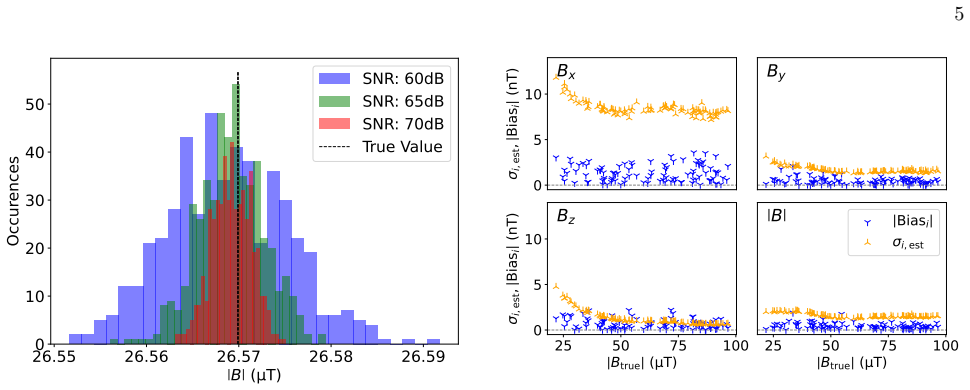
By transmitting two distinct broadband microwave pulses through the NV sensor medium and measuring them after transmission, the method captures the line splitting of the ground state triplet due to the Zeeman effect. Two orthogonally polarized pulses resolve all magnetic field components independently by reading out differently oriented NV centers. Simulated data analyzed with deep neural networks yields sensitivities between 5 pT/√Hz and 100 pT/√Hz across components, nT accuracy at 70 dB SNR, and accurate measurements down to 25 μT without requiring a bias field beyond Earth's magnetic field.
What carries the argument
Transmission of two orthogonally polarized broadband microwave pulses through the NV medium, with Zeeman splittings extracted via deep neural networks from the output signals.
If this is right
- Sensitivities between 5 pT/√Hz and 100 pT/√Hz are obtained for different magnetic field vector components.
- Approximately nT accuracy is reached at a signal-to-noise ratio of 70 dB.
- Magnetic fields can be measured accurately down to 25 μT.
- No bias field beyond Earth's magnetic field is needed for operation.
Where Pith is reading between the lines
- The transmission readout could be adapted to other spin-based sensors for vector field measurements in low-field environments.
- Real-time hardware implementation of the neural network might support portable applications such as navigation or geophysical surveying.
- Experimental tests of DNN performance under laboratory noise conditions would clarify the gap between simulation and practice.
Load-bearing premise
Deep neural networks trained on simulated transmission data will translate effectively to real experimental measurements from NV centers.
What would settle it
Apply the trained DNN to actual experimental transmission data collected from NV centers in a calibrated magnetic field near 25 μT and verify whether the recovered vector components achieve the claimed nT accuracy.
Figures
read the original abstract
We present a novel method for full vector magnetometry using nitrogen-vacancy (NV) centers. In contrast to conventional optically detected magnetic resonance techniques, our method employs two distinct broadband microwave pulses and measures them after transmission through the NV sensor medium, thus capturing the line splitting of the ground state triplet due to the Zeeman effect. Two orthogonally polarized microwave pulses allow resolving all magnetic field components independently by reading out differently oriented NV centers. Simulated data is analyzed using deep neural networks, whose efficacy we expect to translate very well to experiments. Our method yields sensitivities between $5~\mathrm{pT}/\sqrt{\mathrm{Hz}}$ and $100~\mathrm{pT}/\sqrt{\mathrm{Hz}}$ across different magnetic field vector components, while achieving approximately $\mathrm{nT}$ accuracy at a signal-to-noise (SNR) ratio of $70~\mathrm{dB}$. By being capable of accurately measuring magnetic fields down to $25~\mathrm{\mu T}$, the need for a bias field beyond Earth's magnetic field is eliminated.
Editorial analysis
A structured set of objections, weighed in public.
Referee Report
Summary. The manuscript proposes a vector magnetometry technique for NV centers in diamond that transmits two orthogonally polarized broadband microwave pulses through the ensemble and extracts all three magnetic-field components from the resulting transmission spectra via deep neural networks. All quantitative results—sensitivities of 5–100 pT/√Hz, ~nT accuracy at 70 dB SNR, and operation down to 25 μT—are obtained exclusively from DNNs trained and evaluated on simulated spectra; the authors state that the networks’ efficacy is expected to translate to experiment but supply no measured data.
Significance. If the simulation-to-real transfer holds, the approach would remove the requirement for an auxiliary bias field beyond Earth’s field while providing vector resolution through a single transmission measurement, which could benefit applications needing compact, high-sensitivity magnetometers. The work demonstrates a clean separation of Zeeman components via orthogonal polarizations and shows that DNN regression can invert the composite spectra, but these strengths remain conditional on untested transfer assumptions.
major comments (1)
- [Abstract] Abstract: All reported performance figures (5–100 pT/√Hz sensitivities, nT accuracy at 70 dB SNR, 25 μT minimum field) rest on DNNs trained solely on simulated transmission spectra. No experimental spectra, no simulated-versus-measured line-shape comparison, and no robustness tests against unmodeled effects (microwave standing waves, NV orientation disorder, optical inhomogeneity) are presented, rendering the simulation-to-real transfer assumption load-bearing for the central claims.
minor comments (2)
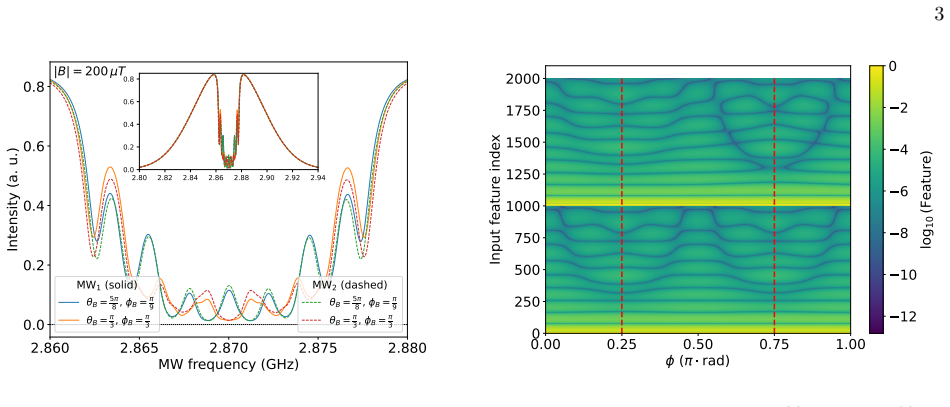
- The abstract and main text omit error bars, confidence intervals, and the precise ranges of simulation parameters (field strengths, SNR values, pulse bandwidths) used to generate the training data.
- Details of the DNN architecture, training hyperparameters, loss function, and validation split are not provided, making it difficult to assess the reported regression accuracy.
Simulated Author's Rebuttal
We thank the referee for the detailed review. We respond point-by-point to the major comment below, noting that the work is explicitly a simulation study.
read point-by-point responses
-
Referee: [Abstract] Abstract: All reported performance figures (5–100 pT/√Hz sensitivities, nT accuracy at 70 dB SNR, 25 μT minimum field) rest on DNNs trained solely on simulated transmission spectra. No experimental spectra, no simulated-versus-measured line-shape comparison, and no robustness tests against unmodeled effects (microwave standing waves, NV orientation disorder, optical inhomogeneity) are presented, rendering the simulation-to-real transfer assumption load-bearing for the central claims.
Authors: The manuscript is presented as a simulation study. The abstract states that 'Simulated data is analyzed using deep neural networks, whose efficacy we expect to translate very well to experiments,' and all quantitative results are derived from DNNs trained and evaluated exclusively on simulated spectra. We do not claim or present experimental data, line-shape comparisons, or robustness tests against unmodeled effects; the simulations establish baseline performance under ideal conditions to demonstrate the core principles (orthogonal-polarization separation of Zeeman components and DNN inversion of composite spectra). The simulation-to-real transfer is acknowledged as an assumption for future experimental validation rather than a claim of the current work. This scope is standard for numerical proposals of new sensing techniques and is already disclosed, so the central claims remain appropriately limited to the simulated results. revision: no
Circularity Check
No circularity: claims rest on external simulation of standard Zeeman physics
full rationale
The paper derives vector magnetometry sensitivities from DNN analysis of simulated transmission spectra generated via standard Zeeman splitting of the NV ground-state triplet under two broadband microwave pulses. No equation or result is obtained by fitting a parameter to a data subset and then re-presenting a closely related quantity as a prediction; the reported 5–100 pT/√Hz figures and nT accuracy are direct outputs of the trained networks on the simulated ensemble, not self-referential re-labelings. No self-citation chain, uniqueness theorem, or ansatz imported from prior author work is invoked to close the derivation. The simulation-to-real transfer is stated as an expectation rather than a derived equality, leaving the central claims independent of any internal redefinition.
Axiom & Free-Parameter Ledger
axioms (2)
- standard math The Zeeman effect produces line splitting in the NV ground-state triplet that is captured by broadband microwave transmission measurements.
- ad hoc to paper Deep neural networks trained on simulated transmission data will perform comparably on real experimental data.
Reference graph
Works this paper leans on
-
[1]
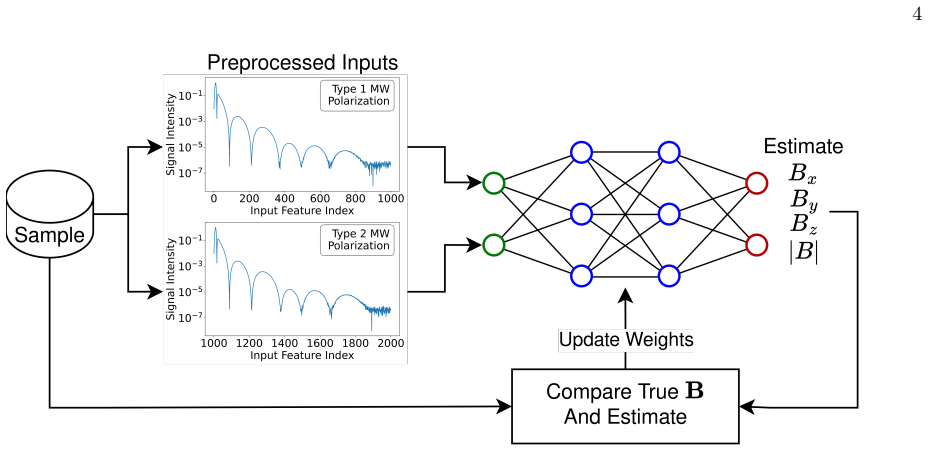
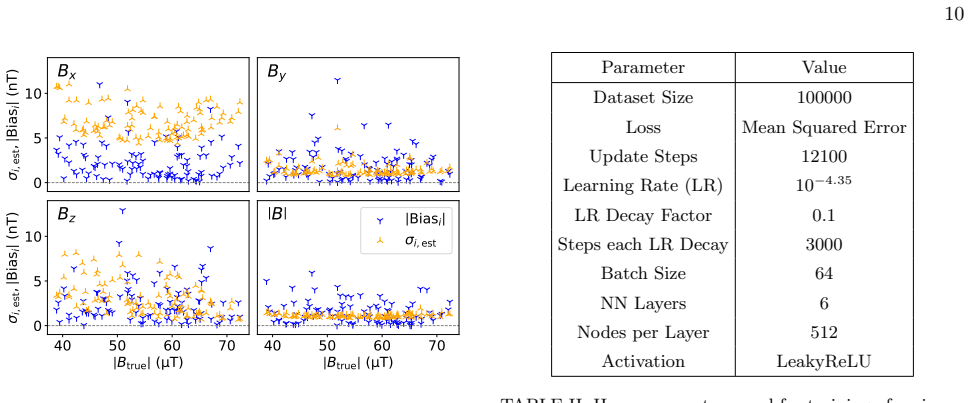
on the mean square error (MSE) loss L= 1 4|D| DX k X i (Bi,true −B i,est)2 (5) withi={x, y, z,abs}.Drepresents a mini-batch of the total training set. We use a feedforward NN to perform the estima- tion due to its simplicity and the fact that, when we tested other structures, they performed at best sim- ilarly while requiring longer training times. The ex...
-
[2]
Balasubramanian, I
G. Balasubramanian, I. Y. Chan, R. Kolesov, M. Al- Hmoud, J. Tisler, C. Shin, C. Kim, A. Wojcik, P. R. Hemmer, A. Krueger, T. Hanke, A. Leitenstor- fer, R. Bratschitsch, F. Jelezko, and J. Wrachtrup, Nanoscale imaging magnetometry with diamond spins under ambient conditions, Nature455, 648 (2008)
2008
-
[3]
J. S. Bennett, B. E. Vyhnalek, H. Greenall, E. M. Bridge, F. Gotardo, S. Forstner, G. I. Harris, F. A. Miranda, and W. P. Bowen, Precision magnetometers for aerospace applications: A review, Sensors21, 5568 (2021)
2021
-
[4]
Le Sage, K
D. Le Sage, K. Arai, D. R. Glenn, S. J. DeVience, L. M. Pham, L. Rahn-Lee, M. D. Lukin, A. Yacoby, A. Komeili, and R. L. Walsworth, Optical magnetic imaging of living cells, Nature496, 486 (2013)
2013
-
[5]
Rondin, J.-P
L. Rondin, J.-P. Tetienne, T. Hingant, J.-F. Roch, P. Maletinsky, and V. Jacques, Magnetometry with nitrogen-vacancy defects in diamond, Reports on Progress in Physics77, 056503 (2014)
2014
-
[6]
Nowodzinski, M
A. Nowodzinski, M. Chipaux, L. Toraille, V. Jacques, J.-F. Roch, and T. Debuisschert, Nitrogen-vacancy centers in diamond for current imaging at the redis- tributive layer level of integrated circuits, Microelec- tronics Reliability55, 1549 (2015)
2015
-
[7]
E. Boto, N. Holmes, J. Leggett, G. Roberts, V. Shah, S. S. Meyer, L. D. Mu˜ noz, K. J. Mullinger, T. M. Tierney, S. Bestmann, G. R. Barnes, R. Bowtell, and M. J. Brookes, Moving magnetoencephalography to- wards real-world applications with a wearable system, Nature555, 657 (2018)
2018
-
[8]
Garsi, R
M. Garsi, R. St¨ ohr, A. Denisenko, F. Shagieva, N. Trautmann, U. Vogl, B. Sene, F. Kaiser, A. Zappe, R. Reuter, and J. Wrachtrup, Three-dimensional imaging of integrated-circuit activity using quantum defects in diamond, Phys. Rev. Appl.21, 014055 (2024)
2024
-
[9]
M. W. Doherty, N. B. Manson, P. Delaney, F. Jelezko, J. Wrachtrup, and L. C. Hollenberg, The nitrogen- vacancy colour centre in diamond, Physics Reports 528, 1 (2013)
2013
-
[10]
Y. Xu, W. Zhang, and C. Tian, Recent advances on applications of nv− magnetometry in condensed mat- ter physics, Photon. Res.11, 393 (2023)
2023
-
[11]
J. M. Taylor, P. Cappellaro, L. Childress, L. Jiang, D. Budker, P. R. Hemmer, A. Yacoby, R. Walsworth, and M. D. Lukin, High-sensitivity diamond magne- tometer with nanoscale resolution, Nature Physics4, 810 (2008)
2008
-
[12]
Steinert, F
S. Steinert, F. Dolde, P. Neumann, A. Aird, B. Naydenov, G. Balasubramanian, F. Jelezko, and J. Wrachtrup, High sensitivity magnetic imaging us- ing an array of spins in diamond, Review of Scientific Instruments81, 043705 (2010)
2010
-
[13]
Clevenson, M
H. Clevenson, M. E. Trusheim, C. Teale, T. Schr¨ oder, D. Braje, and D. Englund, Broadband magnetometry and temperature sensing with a light-trapping dia- mond waveguide, Nature Physics11, 393 (2015)
2015
-
[14]
Chipaux, A
M. Chipaux, A. Tallaire, J. Achard, S. Pezzagna, J. Meijer, V. Jacques, J.-F. Roch, and T. Debuiss- chert, Magnetic imaging with an ensemble of nitrogen- vacancy centers in diamond, The European Physical Journal D69, 166 (2015)
2015
-
[15]
J. M. Schloss, J. F. Barry, M. J. Turner, and R. L. Walsworth, Simultaneous broadband vector magne- tometry using solid-state spins, Phys. Rev. Appl.10, 034044 (2018)
2018
-
[16]
F. M¨ unzhuber, J. Kleinlein, T. Kiessling, and L. W. Molenkamp, Polarization-assisted vector magnetome- try in zero bias field with an ensemble of nitrogen- vacancy centers in diamond (2017), arXiv:1701.01089 [cond-mat.mes-hall]
Pith/arXiv arXiv 2017
-
[17]
C. L. Degen, F. Reinhard, and P. Cappellaro, Quan- tum sensing, Rev. Mod. Phys.89, 035002 (2017)
2017
-
[18]
A. Afshar, A. Proppe, N. Lupu-Gladstein, L. Chil- dress, A. Z. Goldberg, and K. Heshami, Magnetom- etry with broadband microwave fields in nitrogen- vacancy centers in diamond (2025), arXiv:2510.11720 [cond-mat.mes-hall]
Pith/arXiv arXiv 2025
-
[19]
A. Mongelos-Martinez, J. T. Francis, J. Bertero- DiTella, G. Giedke, G. Molina-Terriza, and R. Pellicer-Guridi, Unconditional full vector magnetometry using spin selectivity in nitrogen vacancy centers in diamond (2026), arXiv:2602.12090 [quant-ph]
arXiv 2026
-
[20]
S. G. Worswick, J. A. Spencer, G. Jeschke, and I. Kuprov, Deep neural network processing of deer data, Science Advances4, eaat5218 (2018)
2018
-
[21]
Stielow and S
T. Stielow and S. Scheel, Reconstruction of nanoscale particles from single-shot wide-angle free-electron- laser diffraction patterns with physics-informed neu- ral networks, Phys. Rev. E103, 053312 (2021)
2021
-
[22]
Z. A. Ali, J. Mutschler, and O. Waldmann, Determi- nation of ligand field parameters of single-molecule magnets from magnetic susceptibility using deep learning based inverse models, Phys. Rev. B112, 064403 (2025)
2025
-
[23]
Schr¨ oder, C
A. Schr¨ oder, C. Rathje, L. van Velzen, M. Kelder, and S. Sch¨ afer, Improving the temporal resolution of event-based electron detectors using neural network cluster analysis, Ultramicroscopy256, 113881 (2024)
2024
-
[24]
X. Meng, Y. Zhang, X. Zhang, S. Jin, T. Wang, L. Jiang, L. Xiao, S. Jia, and Y. Xiao, Machine learning assisted vector atomic magnetometry, Nature Communications14, 6105 (2023)
2023
-
[25]
Y. Chen, Y. Ban, R. He, J.-M. Cui, Y.-F. Huang, C.- F. Li, G.-C. Guo, and J. Casanova, A neural network assisted 171yb+ quantum magnetometer, npj Quan- tum Information8, 152 (2022)
2022
-
[26]
Y. Zhu, E. Losero, C. Galland, and V. Goblot, Sim- ulation of odmr spectra from nitrogen-vacancy en- sembles in diamond for electric field sensing (2023), arXiv:2301.04106 [quant-ph]
arXiv 2023
-
[27]
Kitazawa, Y
S. Kitazawa, Y. Matsuzaki, S. Saijo, K. Kakuyanagi, S. Saito, and J. Ishi-Hayase, Vector-magnetic-field sensing via multifrequency control of nitrogen- vacancy centers in diamond, Phys. Rev. A96, 042115 (2017)
2017
-
[28]
Yahata, Y
K. Yahata, Y. Matsuzaki, S. Saito, H. Watanabe, and J. Ishi-Hayase, Demonstration of vector magnetic field sensing by simultaneous control of nitrogen-vacancy centers in diamond using multi-frequency microwave pulses, Applied Physics Letters114, 022404 (2019). 8 [28]AK09940A: Ultrahigh Precision 3-axis Electronic Magnetometer, Asahi Kasei Microdevices Cor...
2019
-
[29]
C. M. Bishop and H. Bishop,Deep Learning: Foun- dations and Concepts(Springer Nature, 2023)
2023
-
[30]
D. P. Kingma and J. Ba, Adam: A method for stochastic optimization (2017), arXiv:1412.6980 [cs.LG]
Pith/arXiv arXiv 2017
-
[31]
E. R. Eisenach, J. F. Barry, M. F. O’Keeffe, J. M. Schloss, M. H. Steinecker, D. R. Englund, and D. A. Braje, Cavity-enhanced microwave readout of a solid- state spin sensor, Nature Communications12, 1357 (2021)
2021
-
[32]
R. T. Q. Chen, Y. Rubanova, J. Bettencourt, and D. K. Duvenaud, Neural ordinary differential equa- tions, inAdvances in Neural Information Processing Systems, Vol. 31, edited by S. Bengio, H. Wallach, H. Larochelle, K. Grauman, N. Cesa-Bianchi, and R. Garnett (Curran Associates, Inc., 2018). Appendix A: Simulation Parameters and Experimental Consideration...
2018
-
[33]
In all simulations, the pulse bandwidth is fixed toσ= 85 MHz
Broadband MW Input Pulse The incident MW field is modeled as a Gaussian pulse in the frequency domain, b0(ω) = 1 σ √ 2π exp h − (ω−ω 0)2 2σ2 i ,(A1) centered at the NV zero-field splitting ofω 0 = 2.87 GHz. In all simulations, the pulse bandwidth is fixed toσ= 85 MHz. This bandwidth is sufficient to simultaneously address all magnetically sensitive spin t...
-
[34]
Two distinct linear MW polarizations can be implemented using two orthogonal striplines
Polarization Control Experimentally, the broadband MW field pulse can be delivered to the diamond via a 50 Ω stripline waveg- uide, producing a MW magnetic field that couples to the NV spins. Two distinct linear MW polarizations can be implemented using two orthogonal striplines. To distinguish the scalar spectral amplitude of the pulse from its polarizat...
-
[35]
NV Density and MW Absorption The simulations assume a dense NV ensemble rep- resentative of commercially available diamonds such as E6 B14, with a total NV concentration of approxi- mately 4.5 ppm. Accounting for realistic experimental conditions, namely,∼70% occupancy of the nega- tively charged NV − state and∼80% optical polar- ization into the|m s = 0⟩...
-
[36]
Over a 9 detection bandwidth matching the pulse bandwidth ∆f≈85 MHz, the root-mean-square noise voltage at room temperature is VJN = p 4kBT R∆f≈8.4µV, forT= 300 K andR= 50 Ω
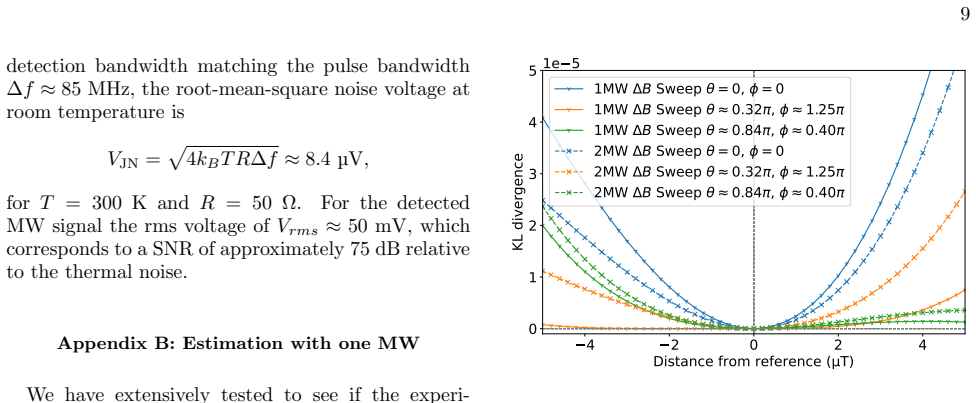
Noise Model The dominant noise source in the MW detection is assumed to be Johnson-Nyquist noise [31]. Over a 9 detection bandwidth matching the pulse bandwidth ∆f≈85 MHz, the root-mean-square noise voltage at room temperature is VJN = p 4kBT R∆f≈8.4µV, forT= 300 K andR= 50 Ω. For the detected MW signal the rms voltage ofV rms ≈50 mV, which corresponds to...
discussion (0)
Sign in with ORCID, Apple, or X to comment. Anyone can read and Pith papers without signing in.