TransportBench: A Comprehensive Benchmark for Non-Equilibrium Flow Transport
Pith reviewed 2026-06-28 08:06 UTC · model grok-4.3
The pith
Neural network performance on non-equilibrium flows varies sharply with flow regime and no single architecture dominates all tasks.
A machine-rendered reading of the paper's core claim, the machinery that carries it, and where it could break.
Core claim
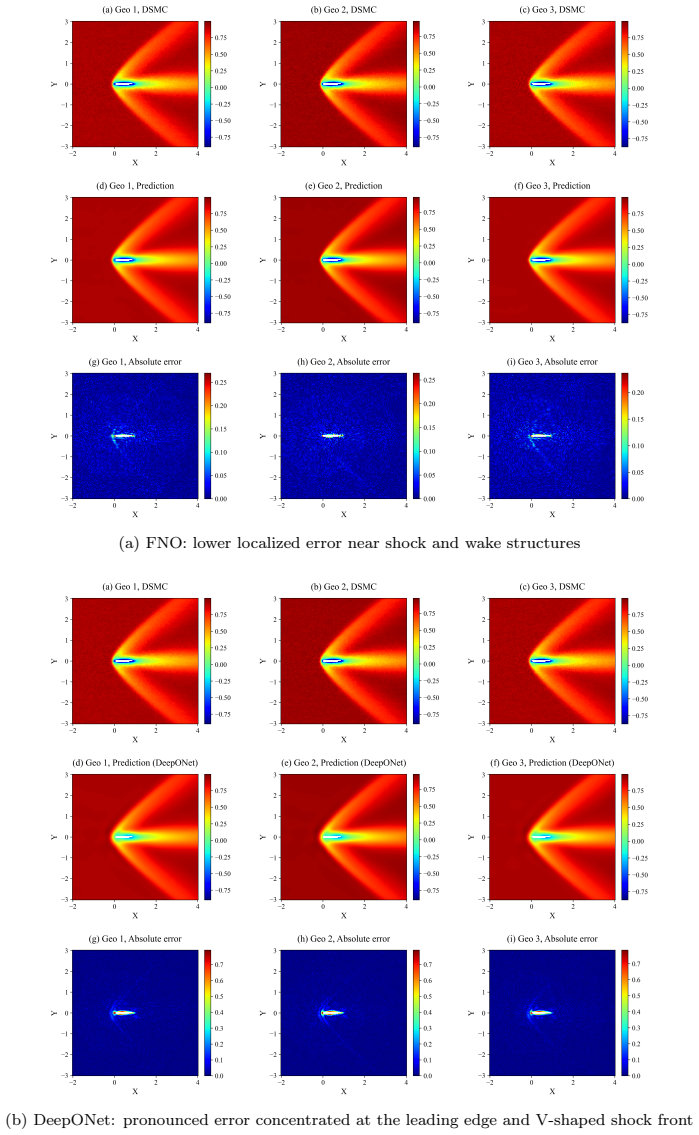
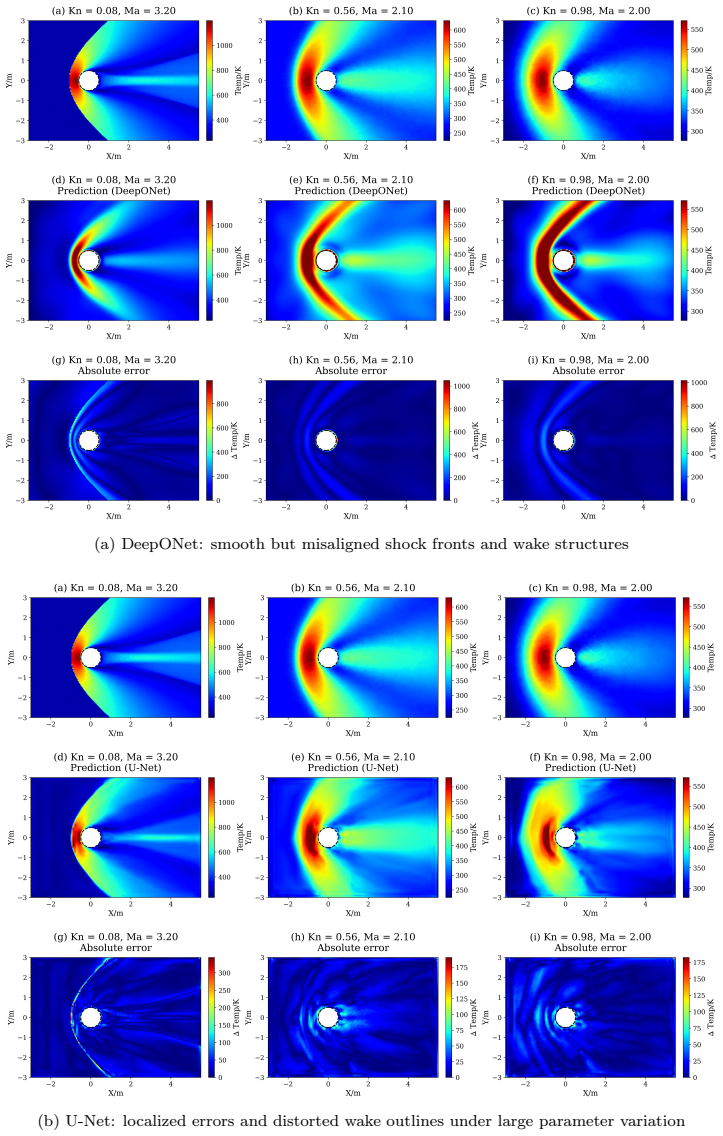
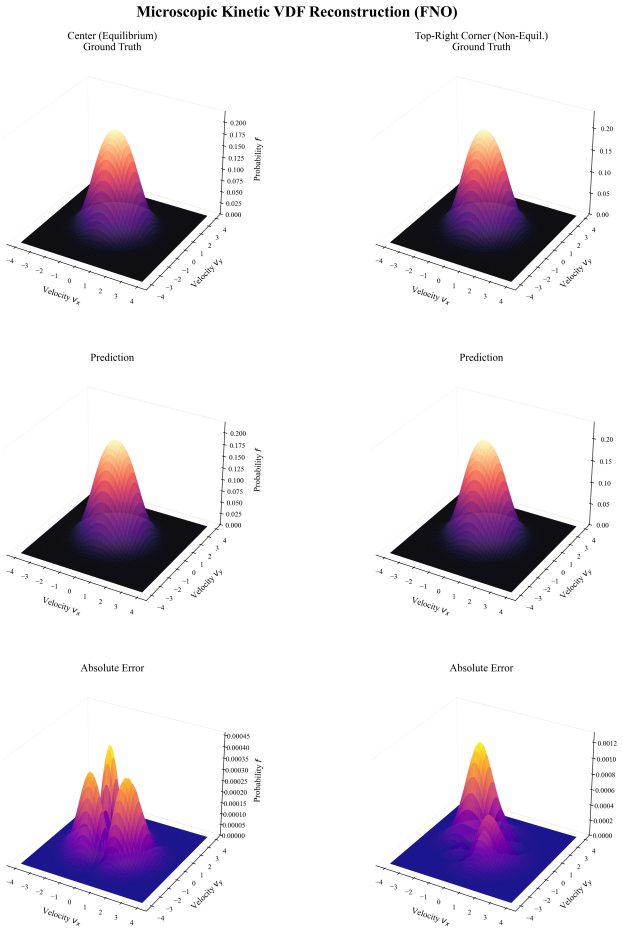
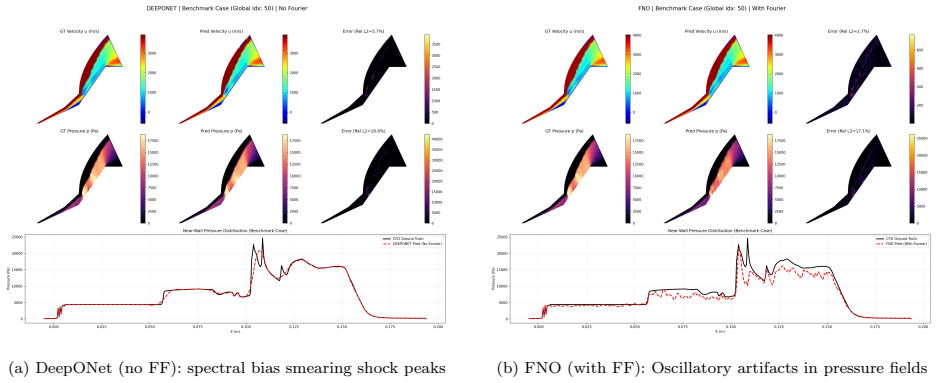
TransportBench shows that model performance exhibits a pronounced dependence upon the specific flow characteristics. No single architecture consistently performs best for all the tasks. Instead, different architectural inductive biases provide distinct advantages in capturing smooth flow fields, shock-induced discontinuities, and high-order non-equilibrium statistics.
What carries the argument
The TransportBench dataset spanning continuum/rarefied, inert/reactive, and translational/internal non-equilibrium regimes, together with unified evaluation protocols that test robustness to discontinuities, multi-scale effects, and parameter generalization.
If this is right
- Different neural architectures are better matched to smooth flow fields than to shock discontinuities or high-order statistics.
- Model selection for non-equilibrium transport must account for the dominant flow features rather than assume general applicability.
- The benchmark enables systematic diagnosis of where current scientific machine learning methods fail outside Navier-Stokes hydrodynamics.
Where Pith is reading between the lines
- Hybrid models that combine multiple inductive biases might reduce the observed performance gaps across regimes.
- Extending the benchmark to include experimental measurements would test whether the simulation-based advantages persist in real data.
- The findings imply that architecture search for fluid problems should be conditioned on the target flow spectrum rather than performed in a single setting.
Load-bearing premise
The dataset built from the described physical spectrum combined with the unified protocols is sufficient to reveal the true strengths and limitations of the tested neural architectures.
What would settle it
A single neural architecture that achieves the best score on every task and every metric in the benchmark would falsify the reported dependence on flow characteristics.
Figures





read the original abstract
Scientific machine learning models, as versatile tools for numerical simulation and analysis, are increasingly transforming the landscape of fluid mechanics research. However, existing datasets and benchmarks are primarily limited to continuum fluids and provide limited support for non-equilibrium transport phenomena. To address this gap, we present TransportBench, a high-fidelity dataset and standardized benchmark for non-equilibrium flow transport, designed to reveal the strengths and limitations of neural network models across diverse flow regimes. Specifically, the dataset encompasses a broad physical spectrum, covering continuum and rarefied regimes, low-speed and hypersonic flows, inert and chemically reactive gases, and both translational and internal-energy non-equilibrium effects. Built upon this dataset, we systematically benchmark representative neural architectures using unified evaluation protocols to probe key challenges in learning non-equilibrium flows, including robustness to shock-dominated discontinuities and multi-scale effects, as well as generalization across geometry and physical parameters. Numerical results demonstrate that model performance exhibits a pronounced dependence upon the specific flow characteristics. No single architecture consistently performs best for all the tasks. Instead, different architectural inductive biases provide distinct advantages in capturing smooth flow fields, shock-induced discontinuities, and high-order non-equilibrium statistics. By jointly providing the non-equilibrium flow dataset and model benchmark, TransportBench offers a new testbed for the development, evaluation, and diagnosis of scientific machine learning methods for fluid transport beyond the Navier-Stokes hydrodynamics. The benchmark datasets and implementation codes are available under the MIT license.
Editorial analysis
A structured set of objections, weighed in public.
Referee Report
Summary. The manuscript introduces TransportBench, a high-fidelity dataset and standardized benchmark for non-equilibrium flow transport in scientific machine learning. It spans a broad physical spectrum including continuum/rarefied regimes, low-speed/hypersonic flows, inert/reactive gases, and translational/internal non-equilibrium effects. Using unified evaluation protocols, the authors benchmark representative neural architectures and report that performance exhibits pronounced dependence on flow characteristics, with no single architecture best across all tasks and different inductive biases suiting smooth fields, shock discontinuities, and high-order non-equilibrium statistics. The dataset, protocols, and MIT-licensed code are released to serve as a testbed beyond Navier-Stokes hydrodynamics.
Significance. If the reported numerical results hold under the described construction and protocols, the work supplies a much-needed resource for diagnosing SciML model limitations in non-equilibrium transport. Strengths include the release of the dataset, unified protocols, and MIT-licensed code, which enable reproducible evaluation across the specified physical spectrum (continuum/rarefied, inert/reactive, translational/internal). This could accelerate development of architectures robust to multi-scale effects and discontinuities.
minor comments (1)
- [Abstract / §1] The abstract and introduction would benefit from an explicit statement of the number of flow cases, grid resolutions, and exact neural architectures tested to allow readers to assess coverage without consulting the supplementary material.
Simulated Author's Rebuttal
We thank the referee for their positive evaluation of the manuscript and the recommendation to accept. We are pleased that the significance of the dataset release, unified protocols, and code availability was recognized as a resource for diagnosing SciML limitations in non-equilibrium transport.
Circularity Check
No significant circularity; benchmark paper with empirical results only
full rationale
The paper is a benchmark release that constructs a dataset spanning continuum/rarefied, inert/reactive, and non-equilibrium regimes, then reports empirical performance rankings of neural architectures under unified protocols. No derivation chain, parameter fitting, or predictive claim is present that reduces to its own inputs by construction. The central claim (performance dependence on flow characteristics, with architecture-specific inductive biases) follows directly from the supplied dataset and code without self-referential reduction or load-bearing self-citation. This is the expected non-finding for a dataset/benchmark paper.
Axiom & Free-Parameter Ledger
Reference graph
Works this paper leans on
-
[1]
Sziroczak, H
D. Sziroczak, H. Smith, A review of design issues specific to hypersonic flight vehicles, Progress in Aerospace Sciences 84 (2016) 1–28
2016
-
[2]
Gad-el Hak, The MEMS handbook, CRC press, 2001
M. Gad-el Hak, The MEMS handbook, CRC press, 2001
2001
-
[3]
Cercignani, The Boltzmann Equation and Its Applications, Springer, 1988
C. Cercignani, The Boltzmann Equation and Its Applications, Springer, 1988
1988
-
[4]
G. A. Bird, Molecular gas dynamics and the direct simulation of gas flows, Oxford university press, 1994
1994
-
[5]
S. L. Brunton, B. R. Noack, P. Koumoutsakos, Machine learning for fluid mechanics, Annual review of fluid mechanics 52 (2020) 477–508
2020
-
[6]
G. E. Karniadakis, I. G. Kevrekidis, L. Lu, P. Perdikaris, S. Wang, L. Yang, Physics- informed machine learning, Nature Reviews Physics 3 (6) (2021) 422–440
2021
-
[7]
Takamoto, T
M. Takamoto, T. Praditia, R. Leiteritz, D. MacKinlay, F. Alesiani, D. Pflüger, M. Niepert, PDEBench: An Extensive Benchmark for Scientific Machine Learning, in: Advances in Neural Information Processing Systems (NeurIPS), Vol. 35, 2022, pp. 1596–1611
2022
- [8]
-
[9]
H. Wang, R. Li, F. Xu, F. Sun, et al., FD-Bench: A Modular and Fair Benchmark for Data-driven Fluid Simulation, arXiv preprint (2025)
2025
-
[10]
Rahaman, A
N. Rahaman, A. Baratin, D. Arpit, F. Draxler, M. Lin, F. Hamprecht, Y. Bengio, A. Courville, On the spectral bias of neural networks, in: International Conference on Machine Learning (ICML), PMLR, 2019, pp. 5301–5310
2019
-
[11]
T. Xiao, M. Frank, Using neural networks to accelerate the solution of the Boltzmann equation, Journal of Computational Physics 443 (2021) 110521
2021
-
[12]
T. Xiao, M. Frank, RelaxNet: A structure-preserving neural network to approximate the Boltzmann collision operator, Journal of Computational Physics 490 (2023) 112317
2023
-
[13]
Ronneberger, P
O. Ronneberger, P. Fischer, T. Brox, U-net: Convolutional networks for biomedical image segmentation, in: International Conference on Medical image computing and computer-assisted intervention, Springer, 2015, pp. 234–241
2015
-
[14]
J. Zhai, S. Zhang, J. Chen, Q. He, Autoencoder and its various variants, in: 2018 IEEE international conference on systems, man, and cybernetics (SMC), IEEE, 2018, pp. 415–419. 37
2018
-
[15]
L. Lu, P. Jin, G. Pang, Z. Zhang, G. E. Karniadakis, Learning nonlinear operators via DeepONet based on the universal approximation theorem of operators, Nature machine intelligence 3 (3) (2021) 218–229
2021
-
[16]
Z. Li, N. Kovachki, K. Azizzadenesheli, B. Liu, K. Bhattacharya, A. Stuart, A. Anand- kumar, Fourier neural operator for parametric partial differential equations, arXiv preprint arXiv:2010.08895 (2020)
work page internal anchor Pith review Pith/arXiv arXiv 2010
-
[17]
K. Han, Y. Wang, H. Chen, X. Chen, J. Guo, Z. Liu, Y. Tang, A. Xiao, C. Xu, Y. Xu, et al., A survey on vision transformer, IEEE transactions on pattern analysis and machine intelligence 45 (1) (2022) 87–110
2022
-
[18]
H. Zhao, L. Jiang, J. Jia, P. H. Torr, V. Koltun, Point transformer, in: Proceedings of the IEEE/CVF international conference on computer vision, 2021, pp. 16259–16268
2021
-
[19]
Z. Hao, et al., PINNacle: A comprehensive benchmark of physics-informed neural net- works for solving PDEs, arXiv preprint arXiv:2306.08827 (2023)
- [20]
-
[21]
31, 2018
A.Jacot, F.Gabriel, C.Hongler, Neuraltangentkernel: Convergenceandgeneralization in neural networks, in: Advances in neural information processing systems (NeurIPS), Vol. 31, 2018
2018
-
[22]
Tancik, P
M. Tancik, P. Srinivasan, B. Mildenhall, S. Fridovich-Keil, N. Raghavan, U. Singhal, R. Ramamoorthi, J. Barron, R. Ng, Fourier features let networks learn high frequency functions in low dimensional domains, in: Advances in Neural Information Processing Systems (NeurIPS), Vol. 33, 2020, pp. 7537–7547
2020
-
[23]
Nompelis, G
I. Nompelis, G. Candler, M. Holden, Computational investigation of hypersonic vis- cous/inviscid interactions in high enthalpy flows, in: 36th AIAA Thermophysics Con- ference, 2003, p. 3642
2003
-
[24]
X. Wang, J. Guo, Q. Hong, S. Li, High-fidelity state-to-state modeling of hypersonic flow over a double cone, Physics of Fluids 35 (11) (2023)
2023
-
[25]
I. D. Boyd, T. E. Schwartzentruber, Nonequilibrium Gas Dynamics and Molecular Simulation, Cambridge Aerospace Series, Cambridge University Press, 2017
2017
-
[26]
S. J. Plimpton, S. G. Moore, A. Borner, A. K. Stagg, T. P. Koehler, M. A. Gallis, Direct simulation Monte Carlo on petaflop supercomputers and beyond, Physics of Fluids 31 (8) (2019) 086101
2019
-
[27]
T. Xiao, C. Liu, K. Xu, Q. Cai, A velocity-space adaptive unified gas kinetic scheme for continuum and rarefied flows, Journal of Computational Physics 415 (2020) 109535. 38
2020
-
[28]
Xiao, Kinetic
T. Xiao, Kinetic. jl: A portable finite volume toolbox for scientific and neural comput- ing, Journal of Open Source Software 6 (62) (2021) 3060
2021
-
[29]
X. Wang, Q. Hong, Y. Hu, Q. Sun, On the accuracy of two-temperature models for hypersonic nonequilibrium flow, Acta Mechanica Sinica 39 (2) (2023) 122193
2023
-
[30]
L. N. Smith, A disciplined approach to neural network hyper-parameters: Part 1–learning rate, batch size, momentum, and weight decay, arXiv preprint arXiv:1803.09820 (2018). 39 Appendix A. Numerical Implementation and Hyperparameters To ensure complete reproducibility of the TransportBench evaluation, we detail the ex- act hyperparameter configurations an...
work page internal anchor Pith review Pith/arXiv arXiv 2018
discussion (0)
Sign in with ORCID, Apple, or X to comment. Anyone can read and Pith papers without signing in.