Chiral Quark Soliton Model And Nucleon Parton Distribution Functions
Pith reviewed 2026-06-28 09:48 UTC · model grok-4.3
The pith
The chiral quark soliton model predicts nucleon parton distributions by handling non-local quark correlations impossible in meson theories.
A machine-rendered reading of the paper's core claim, the machinery that carries it, and where it could break.
Core claim
In the chiral quark soliton model baryons are treated as rotating hedgehog objects built from quarks that incorporate spontaneous chiral symmetry breaking and the associated Nambu-Goldstone pions, allowing direct evaluation of the light-cone separated quark operators needed for parton distribution functions and thereby realistic results for flavor asymmetries in the nucleon sea.
What carries the argument
The chiral quark soliton model, an effective quark model of baryons that retains explicit quark fields inside a hedgehog soliton to encode non-local quark-quark correlations.
If this is right
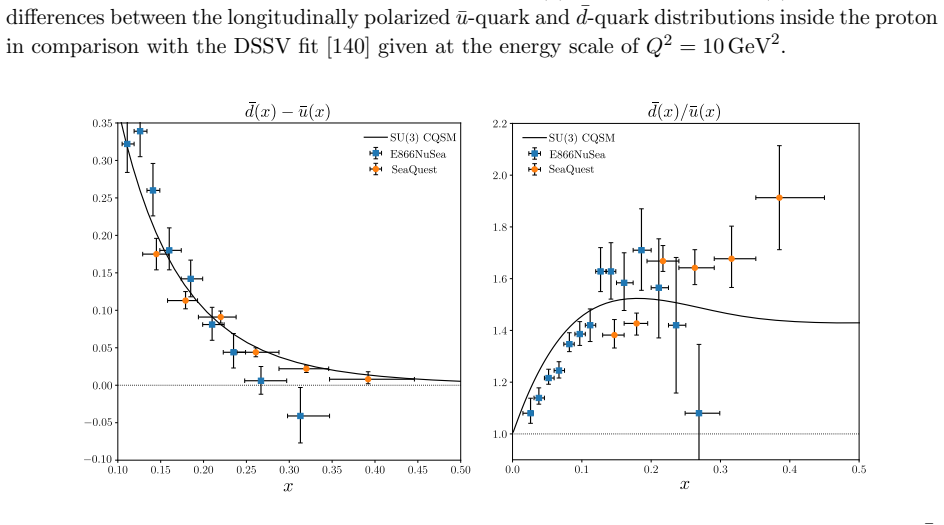
- The model gives realistic predictions for the flavor asymmetry of unpolarized sea-quark distributions in the nucleon.
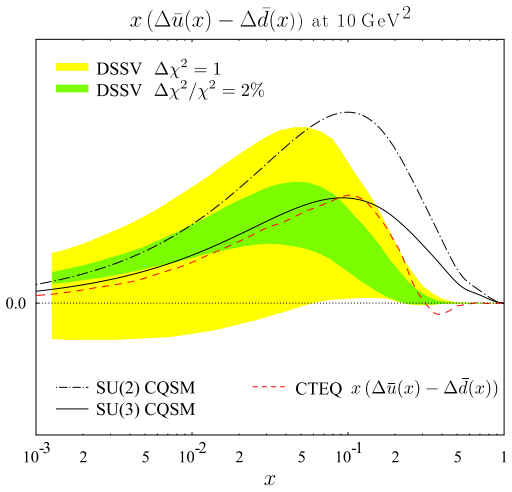
- The model gives realistic predictions for the flavor asymmetry of longitudinally polarized sea-quark distributions in the nucleon.
- Non-local quark-quark correlations become accessible, which effective meson theories cannot treat.
- Baryon observables overall are more realistic than those obtained from Skyrme-like models.
Where Pith is reading between the lines
- Effective models of nucleon structure that integrate out quarks entirely are likely to miss essential features of parton distributions.
- The same non-local correlation mechanism could be tested by direct comparison with lattice calculations of light-cone matrix elements.
- The framework may extend naturally to other light-cone observables such as generalized parton distributions.
Load-bearing premise
The chiral quark soliton model incorporates spontaneous chiral symmetry breaking and Nambu-Goldstone pions in a way that produces realistic baryon observables including the non-local correlations required for parton distributions.
What would settle it
Deep-inelastic scattering measurements that show sea-quark flavor asymmetries in clear disagreement with the numerical predictions of the chiral quark soliton model would falsify its central claim.
Figures



read the original abstract
The chiral quark soliton model (CQSM) is an effective quark model of baryons maximally taking account of the most important feature of low-energy QCD, i.e., the spontaneous chiral symmetry breaking of the QCD vacuum and the associated appearance of Nambu--Goldstone pions. It shares many common features with the famous Skyrme model in that the baryons are viewed as rotating hedgehog objects in both models. Despite many similarities, it turned out that the CQSM can give more realistic predictions on most baryon observables. Above all, a decisive advantage of the CQSM over the Skyrme-like models is that it can handle non-local quark--quark correlations in baryons, which is absolutely impossible within the framework of effective meson theories. This feature is decisively important for making theoretical predictions on the quark distribution functions inside the nucleon, which are defined as nucleon matrix elements of bilinear quark operators with light-cone separation. In the present paper, we try to elucidate why and how the CQSM can give successful predictions for a variety of types of nucleon quark distribution functions, especially for the flavor asymmetry of the unpolarized and longitudinally polarized sea-quark (anti-quark) distribution functions in the nucleon.
Editorial analysis
A structured set of objections, weighed in public.
Referee Report
Summary. The manuscript reviews the chiral quark soliton model (CQSM) as an effective quark model of baryons that incorporates spontaneous chiral symmetry breaking and Nambu-Goldstone pions. It contrasts CQSM with Skyrme-like models, arguing that the presence of explicit quark fields enables treatment of non-local quark-quark correlations, which in turn permits calculations of nucleon matrix elements of bilinear operators at light-cone separation and thereby successful predictions for flavor asymmetries in unpolarized and longitudinally polarized sea-quark distributions.
Significance. The structural distinction that CQSM retains explicit quark degrees of freedom while Skyrme models do not is correctly identified as enabling light-cone separated operators; if the subsequent explanations and comparisons hold, the work supplies a clear rationale for preferring CQSM in PDF phenomenology.
minor comments (1)
- [Abstract] Abstract, paragraph 2: the phrase 'successful predictions' is used without citing the specific observables or quantitative benchmarks that are being explained; a brief parenthetical reference to the relevant figures or tables would improve clarity.
Simulated Author's Rebuttal
We thank the referee for the careful reading of the manuscript, the accurate summary of its main points, and the positive recommendation to accept.
Circularity Check
No significant circularity; structural distinction is model-intrinsic
full rationale
The paper's core claim—that CQSM permits non-local quark bilinear operators at light-cone separation while Skyrme-like models cannot—follows directly from the explicit presence of quark fields in CQSM versus their absence in pure meson effective theories. This is a definitional property of the model frameworks, not a prediction or derivation that reduces to fitted parameters or self-citations. The abstract states the advantage without invoking equations that equate outputs to inputs by construction, and no load-bearing steps are shown to collapse via self-citation chains or ansatz smuggling. The derivation chain is self-contained against the stated model construction.
Axiom & Free-Parameter Ledger
axioms (2)
- domain assumption Spontaneous chiral symmetry breaking of the QCD vacuum produces Nambu-Goldstone pions that dominate low-energy baryon structure
- domain assumption Baryons can be modeled as rotating hedgehog objects
Reference graph
Works this paper leans on
-
[1]
Here, the variablexis supposed to take positive values in the range 0< x <1. On the other hand, the unpolarized antiquark distribution is defined as ¯q(x) = Z ∞ − ∞ dz0 e i xMN z0 ⟨N| ¯ψc(0)γ + ψc(z)|N⟩ z+=z⊥=0 ,(107) which is also given in the domain 0< x <1. In the above equation,ψ c is the anti-particle field ofψgiven as ψc =C ¯ψT ,(108) whereCis the f...
-
[23]
Ring, P.; Schuck, P.The Nuclear Many-Body Problem; Springer: New York, NY, USA; Heidelberg, Germany; Berlin, Germany, 1980. 37
1980
-
[46]
Airapetian, A. et al. Precise determination of the spin structure functiong 1 of the proton, 38 deuteron and neutron.Phys. Rev. D2007,75, 012007
-
[67]
Is gauge-invariant complete decomposition of the nucleon spin possible?Int
Wakamatsu, M. Is gauge-invariant complete decomposition of the nucleon spin possible?Int. J. Mod. Phys. A2014,29, 1430012. 39
-
[87]
Baryons as non-topological chiral solitons.Prog
Christov, C.V.; Blotz, A.; Kim, H.-C.; Pobylitsa, P.; Watabe, T.; Meissner, T.; Ruiz Arriola, 40 E.; Goeke, K. Baryons as non-topological chiral solitons.Prog. Part. Nucl. Phys.1996,37, 91
1996
-
[91]
Nucleon parton distributions at low normalization point in the largeN c limit.Nucl
Diakonov, D.; Petrov, V.; Pobylitsa, P.; Polyakov, M.; Weiss, C. Nucleon parton distributions at low normalization point in the largeN c limit.Nucl. Phys. B1996,480, 341–378
-
[110]
More on a holographic dual of QCD.Prog
Sakai, T.; Sugimoto, S. More on a holographic dual of QCD.Prog. Theor. Phys.2005,114, 1083. 41
2005
-
[114]
Theg A problem in the Skyrme model and fermion-boson non- correspondence.Prog
Wakamatsu, M. Theg A problem in the Skyrme model and fermion-boson non- correspondence.Prog. Theor. Phys. Suppl.1995,120, 313
1995
-
[133]
The SU(3) 42 Nambu-Jona-Lasinio soliton in the collective quantization formulation.Nucl
Blotz, A.; Diakonov, D.; Goeke, K.; Park, N.W.; Petrov, V.; Pobylitsa, P.V. The SU(3) 42 Nambu-Jona-Lasinio soliton in the collective quantization formulation.Nucl. Phys. A1993, 555, 765
-
[136]
I.; Rojo, J.; Ubiali, M
NNPDF Collaboration; Ball, R.D.; Del Debbio, L.; Forte, S.; Gufanti, A.; Latorre, J. I.; Rojo, J.; Ubiali, M. A first unbiased global NLO determination of parton distributions and their uncertainties.Nucl. Phys. B2010,832, 136
-
[154]
Physical symmetries and gauge choices in the Landau problem
Wakamatsu, M.; Hayashi, A. Physical symmetries and gauge choices in the Landau problem. Eur. Phys. J. A2022,58, 121. 43
-
[157]
forgotten
Konstantinou, G.; Moulopoulos, K. The “forgotten” pseudomomenta and gauge changes in generalized Landau level problems: Spatially nonuniform magnetic and temporally varying electric fields.Int. J. Theor. Phys.2017,56, 1484
2017
-
[169]
Constantinou, M. et al. Parton distributions and lattice-QCD calculations: Toward 3D struc- ture.Prog. Part. Nucl. Phys.2021,121, 103908
2021
-
[170]
I.; Petrov, V
Diakonov, D. I.; Petrov, V. Yu.; Pobylitsa, P. V. A chiral theory of nucleons.Nucl. Phys. B 1988,306, 809
1988
-
[171]
Baryons as non-topological chiral solitons.Prog
Christov, C.V.; Blotz, A.; Kim, H.-C.; Pobylitsa, P.; Watabe, T.; Meissner, T.; Ruiz Arriola, E.; Goeke, K. Baryons as non-topological chiral solitons.Prog. Part. Nucl. Phys.1996,37, 91
1996
-
[172]
Baryons as chiral solitons in the Nambu-Jona-Lasinio model.Phys
Alkofer, R.; Reinhardt, H.; Weigel, H. Baryons as chiral solitons in the Nambu-Jona-Lasinio model.Phys. Rep.1996,265, 139
1996
-
[173]
Weigel, H.Chiral Soliton Models for Baryons; Lecture Notes in Physics; Springer: Berlin/Heidelberg, Germany, 2008; Volume 743
2008
-
[174]
Current algebra, baryons, and quark confinement.Nucl
Witten, E. Current algebra, baryons, and quark confinement.Nucl. Phys. B1983,223, 422; 433
-
[175]
Nucleon parton distributions 44 at low normalization point in the largeN c limit.Nucl
Diakonov, D.; Petrov, V.; Pobylitsa, P.; Polyakov, M.; Weiss, C. Nucleon parton distributions 44 at low normalization point in the largeN c limit.Nucl. Phys. B1996,480, 341–378
-
[176]
Unpolarized and polarized quark distributions in the largeN c limit.Phys
Diakonov, D.; Petrov, V.; Pobylitsa, P.; Polyakov, M.; Weiss, C. Unpolarized and polarized quark distributions in the largeN c limit.Phys. Rev. D1997,56, 4069–4083
-
[177]
Nucleon structure functions from a chiral soliton
Weigel, H.; Gamberg, L.; Reinhardt, H. Nucleon structure functions from a chiral soliton. Phys. Lett. B1997,399, 287–296
-
[178]
Polarized nucleon structure functions within a chiral soliton model.Phys
Weigel, H.; Gamberg, L.; Reinhardt, H. Polarized nucleon structure functions within a chiral soliton model.Phys. Rev. D1997,55, 6910–6923
-
[179]
Chiral Symmetry and the nucleon structure functions.Phys
Wakamatsu, M.; Kubota, T. Chiral Symmetry and the nucleon structure functions.Phys. Rev. D1998,57, 5755
-
[180]
Chiral Symmetry and the nucleon spin structure functions
Wakamatsu, M.; Kubota, T. Chiral Symmetry and the nucleon spin structure functions. Phys. Rev. D1999,60, 034020
-
[181]
Light-flavor sea-quark distributions in the nucleon in the SU(3) chiral quark soliton model
Wakamatsu, M. Light-flavor sea-quark distributions in the nucleon in the SU(3) chiral quark soliton model. I. Phenomenological predictions.Phys. Rev. D2003,67, 034005
-
[182]
Light-flavor sea-quark distributions in the nucleon in the SU(3) chiral quark soliton model
Wakamatsu, M. Light-flavor sea-quark distributions in the nucleon in the SU(3) chiral quark soliton model. II. Theoretical formalism.Phys. Rev. D2003,67, 034006
-
[183]
Gauge-invariant decomposition of nucleon spin.Phys
Ji, X. Gauge-invariant decomposition of nucleon spin.Phys. Rev. Lett.1997,78, 610
1997
-
[184]
J.; Roberts, C
Brodsky, S. J.; Roberts, C. D.; Shrock, R.; Tandy, P. C. New perspective on the quark condensate.Phys. Rev. C2010,82, 022201
-
[185]
Baryon density of quarks coupled to a chiral field.Nucl
Kahana, S.; Ripka, G. Baryon density of quarks coupled to a chiral field.Nucl. Phys. A 1984,429, 462
1984
-
[186]
Soliton with valence quarks in the chiral invariantσ-model
Kahana, S.; Ripka, G.; Soni, V. Soliton with valence quarks in the chiral invariantσ-model. Nucl. Phys. A1984,415, 351
-
[187]
A Chiral Quark Model of the Nucleon.Nucl
Wakamatsu, M.; Yoshiki, H. A Chiral Quark Model of the Nucleon.Nucl. Phys. A1991, 524, 561–600
-
[188]
Chiral quark soliton model with Pauli-Villars regularization.Phys
Kubota, T.; Wakamatsu, M.; Watabe, T. Chiral quark soliton model with Pauli-Villars regularization.Phys. Rev. D1999,60, 014018
-
[189]
Static properties of nucleons in the Skyrme model
Adkins, G.S.; Nappi, C.R.; Witten, E. Static properties of nucleons in the Skyrme model. Nucl. Phys. B1983,228, 552
-
[190]
Skyrme model with pion mass.Nucl
Adkins, G.S.; Nappi, C.R. Skyrme model with pion mass.Nucl. Phys. B1984,233, 109
-
[191]
Ring, P.; Schuck, P.The Nuclear Many-Body Problem; Springer: New York, NY, USA; Heidelberg, Germany; Berlin, Germany, 1980
1980
-
[192]
How Dirac-sea quarks affect the neutron charge distribution.Phys
Wakamatsu, M. How Dirac-sea quarks affect the neutron charge distribution.Phys. Lett. B 1991,269, 394
1991
-
[193]
Low energy hadron physics in holographic QCD.Prog
Sakai, T.; Sugimoto, S. Low energy hadron physics in holographic QCD.Prog. Theor. Phys. 2005,113, 843
2005
-
[194]
More on a holographic dual of QCD.Prog
Sakai, T.; Sugimoto, S. More on a holographic dual of QCD.Prog. Theor. Phys.2005,114, 1083
2005
-
[195]
Holographic baryons: Static properties and form factors from gauge/string duality.Prog
Hashimoto, K.; Sakai, T.; Sugimoto, S. Holographic baryons: Static properties and form factors from gauge/string duality.Prog. Theor. Phys.2008,120, 1093
2008
-
[196]
Theg A problem in hedgehog soliton model revisited.Phys
Wakamatsu, M.; Watabe, T. Theg A problem in hedgehog soliton model revisited.Phys. Lett. B1993,312, 184
-
[197]
1/N−Crotational corrections tog A and isovector magnetic moment of the nucleon.Phys
Christov, C.V.; Blotz, A.; Goeke, K.; Pobilitsa, P.; Petrov, V.; Wakamatsu, M.; Watabe, T. 1/N−Crotational corrections tog A and isovector magnetic moment of the nucleon.Phys. Lett. B1994,325, 467
-
[198]
Theg A problem in the Skyrme model and fermion-boson non- correspondence.Prog
Wakamatsu, M. Theg A problem in the Skyrme model and fermion-boson non- correspondence.Prog. Theor. Phys. Suppl.1995,120, 313. 45
1995
-
[199]
Tracing the origin of theg A problem in the Skyrme model.Prog
Wakamatsu, M. Tracing the origin of theg A problem in the Skyrme model.Prog. Theor. Phys.1996,95, 143
1996
-
[200]
Vacuum nature of the QCD condensates.Phys
Reinhardt, H.; Weigel, H. Vacuum nature of the QCD condensates.Phys. Rev. D2012,85, 074029
-
[201]
The chirally-odd twist-3 distribution functione(x) in the chiral quark-soliton model.Phys
Schweitzer, P. The chirally-odd twist-3 distribution functione(x) in the chiral quark-soliton model.Phys. Rev. D2003,67, 114010
-
[202]
Nonperturbative origin of the delta-function singularity in the chirally odd twist-3 distributio functione(x).Phys
Wakamatsu, M.; Ohnishi, Y. Nonperturbative origin of the delta-function singularity in the chirally odd twist-3 distributio functione(x).Phys. Rev. D2003,67, 114011
-
[203]
Ohnishi, Y.; Wakamatsu, M.πNsigma term and chiral-odd twist-3 distribution function e(x) of the nucleon in the chiral quark soliton model.Phys. Rev. D2004,69, 114002
-
[204]
Extraordinary nature of the nucleon scalar charge and its densities as a signal of nontrivial vacuum structure of QCD.Symmetry2024,16, 1481
Wakamatsu, M. Extraordinary nature of the nucleon scalar charge and its densities as a signal of nontrivial vacuum structure of QCD.Symmetry2024,16, 1481
-
[205]
Numerical solution ofQ 2 evolution equations in a brute-force method.Comput
Miyama, M.; Kumano, S. Numerical solution ofQ 2 evolution equations in a brute-force method.Comput. Phys. Commun.1996,94, 38
1996
-
[206]
Numerical solution ofQ 2 evolution equations for polar- ized structure functions.Comput
Hirai, M.; Kumano, S.; Miyama, M. Numerical solution ofQ 2 evolution equations for polar- ized structure functions.Comput. Phys. Commun.1998,108, 38
1998
-
[207]
Ackerstaff, K. et al. Flavor asymmetry of the light quark sea from semi-inclusive deep- inelastic scattering.Phys. Rev. Lett.1998,81, 5519
1998
-
[208]
Hawker, E.A. et al. Measurement of the light antiquark flavor asymmetry in the nucleon sea. Phys. Rev. Lett.1998,80, 3715
1998
-
[209]
Flavor asymmetry of antiquark distributions in the nucleon.Phys
Kumano, S. Flavor asymmetry of antiquark distributions in the nucleon.Phys. Rep.1998, 303, 183
1998
-
[210]
COMPASS Collaboration; Ageev, E.S. et al. Measurement of the spin structure of the deuteron in the DIS region.Phys. Lett. B2005,612, 54
-
[211]
COMPASS Collaboration; Alexakhin, V.Y. et al. The deuteron spin-dependent structure functoing d 1 and its first moment.Phys. Lett. B2007,647, 8–17
-
[212]
Generalized form factors, generalized parton distributions, and the spin contents of the nucleon.Phys
Wakamatsu, M.; Nakakoji, Y. Generalized form factors, generalized parton distributions, and the spin contents of the nucleon.Phys. Rev. D2006,74, 054006
-
[213]
Phenomenological analysis of the nucleon spincontents and their scale dependence.Phys
Wakamatsu, M.; Nakakoji, Y. Phenomenological analysis of the nucleon spincontents and their scale dependence.Phys. Rev. D2008,77, 074011
-
[214]
Airapetian, A. et al. Precise determination of the spin structure functiong 1 of the proton, deuteron and neutron.Phys. Rev. D2007,75, 012007
-
[215]
Adeva, B. et al. Spin asymmetryA 1 and structure functionsg 1 nof the proton and the deuteron from polarized high energy muon scattering.Phys. Rev. D1998,58, 112001
-
[216]
Transverse momentum distributions of quarks in the nucleon.Phys
Wakamatsu, M. Transverse momentum distributions of quarks in the nucleon.Phys. Rev. D 2009,79, 094028
2009
-
[217]
The SU(3) Nambu-Jona-Lasinio soliton in the collective quantization formulation.Nucl
Blotz, A.; Diakonov, D.; Goeke, K.; Park, N.W.; Petrov, V.; Pobylitsa, P.V. The SU(3) Nambu-Jona-Lasinio soliton in the collective quantization formulation.Nucl. Phys. A1993, 555, 765
-
[218]
One-pion exchange and deep-inelastic electron-nucleon scattering.Phys
Sullivan, J.D. One-pion exchange and deep-inelastic electron-nucleon scattering.Phys. Rev. D1971,5, 1732
-
[219]
Possible strength of the non-perturbative strange sea of the nucleon.Phys
Signal, A.I.; Thomas, A.W. Possible strength of the non-perturbative strange sea of the nucleon.Phys. Lett. B1987,191, 205
-
[220]
I.; Rojo, J.; Ubiali, M
NNPDF Collaboration; Ball, R.D.; Del Debbio, L.; Forte, S.; Gufanti, A.; Latorre, J. I.; Rojo, J.; Ubiali, M. A first unbiased global NLO determination of parton distributions and their uncertainties.Nucl. Phys. B2010,832, 136. 46
-
[221]
I.; Rojo, J.; Ubiali, M
NNPDF Collaboration; Ball, R.D.; Bertone, V.; Cerutti, F.; Del Debbio, L.; Forte, S.; Gufanti, A.; Latorre, J. I.; Rojo, J.; Ubiali, M. Unbiased global determination of parton distributions and their uncertainties at NNLO and at LO.Nucl. Phys. B2012,855, 153
-
[222]
The quark–antiquark asymmetry of the nucleon sea.Phys
Brodsky, S.; Ma, B.-Q. The quark–antiquark asymmetry of the nucleon sea.Phys. Lett. B 1996,381, 317
1996
-
[223]
Role of higher twist in polarized deep inelastic scattering.Phys
Leader, E.; Sidorov, A.V.; Stamenov, D.B. Role of higher twist in polarized deep inelastic scattering.Phys. Rev. D2003,67, 074017
-
[224]
Longitudinal polarized parton densities updated
Leader, E.; Sidorov, A.V.; Stamenov, D.B. Longitudinal polarized parton densities updated. Phys. Rev. D2006,73, 034023
-
[225]
Extraction of spin-dependent parton densities and thir uncertainties.Phys
de Floian, D.; Sassot, R.; Strattmann, M.; Vogelsang, W. Extraction of spin-dependent parton densities and thir uncertainties.Phys. Rev. D2009,80, 034030
- [226]
-
[227]
Theg 1 problem: Deep inelastic electron scattering and the spin of the nucleon.Nucl
Jaffe, R.L.; Manohar, A. Theg 1 problem: Deep inelastic electron scattering and the spin of the nucleon.Nucl. Phys. B1990,337, 509
-
[228]
Gauge-invariant decomposition of nucleon spin.Phys
Wakamatsu, M. Gauge-invariant decomposition of nucleon spin.Phys. Rev. D2010,81, 114010
-
[229]
Gauge- and frame-independent decomposition of nucleon spin.Phys
Wakamatsu, M. Gauge- and frame-independent decomposition of nucleon spin.Phys. Rev. D2011,83, 014012
-
[230]
Spin and orbital angular momen- tum in gauge theories: Nucleon spin structure and multipole radiation revisited.Phys
Chen, X.S.; Lu, X.F.; Sun, W.M.; Wang, F.; Goldman, T. Spin and orbital angular momen- tum in gauge theories: Nucleon spin structure and multipole radiation revisited.Phys. Rev. Lett.2008,100, 232002
2008
-
[231]
Do gluons carry half of the nucleon momentum?Phys
Chen, X.S.; Sun, W.M.; Lu, X.F.; Wang, F.; Goldman,T. Do gluons carry half of the nucleon momentum?Phys. Rev. Lett.2009,103, 062001
2009
-
[232]
Gluon polarization in the nucleon demystified.Phys
Hatta, Y. Gluon polarization in the nucleon demystified.Phys. Rev. D2011,84, 041701
-
[233]
Gauge-covariant canonical formalism revisited with application to the proton spin decomposition.Phys
Lorce, C. Gauge-covariant canonical formalism revisited with application to the proton spin decomposition.Phys. Rev. D2013,88, 044037
-
[234]
The angular momentum controversy?: What’s it all about and does it matter?Phys
Leader, E.; Lorce, C. The angular momentum controversy?: What’s it all about and does it matter?Phys. Rep.2014,541, 163
2014
-
[235]
Is gauge-invariant complete decomposition of the nucleon spin possible?Int
Wakamatsu, M. Is gauge-invariant complete decomposition of the nucleon spin possible?Int. J. Mod. Phys. A2014,29, 1430012
-
[236]
Gluon spin, canonical momentum, and gauge symmetry.J
Ji, X.; Xu, Y.; Zhao, Y. Gluon spin, canonical momentum, and gauge symmetry.J. High Energy Phys.2012,08, 082
2012
discussion (0)
Sign in with ORCID, Apple, or X to comment. Anyone can read and Pith papers without signing in.