Thermodynamical phase structures and particle emission rate of charged AdS black hole surrounded by string cloud and quintessence via shadow formalism
Pith reviewed 2026-06-28 09:12 UTC · model grok-4.3
The pith
Shadow radius of charged AdS black holes with string cloud and quintessence reproduces the same thermodynamic phase transitions as the event horizon radius.
A machine-rendered reading of the paper's core claim, the machinery that carries it, and where it could break.
Core claim
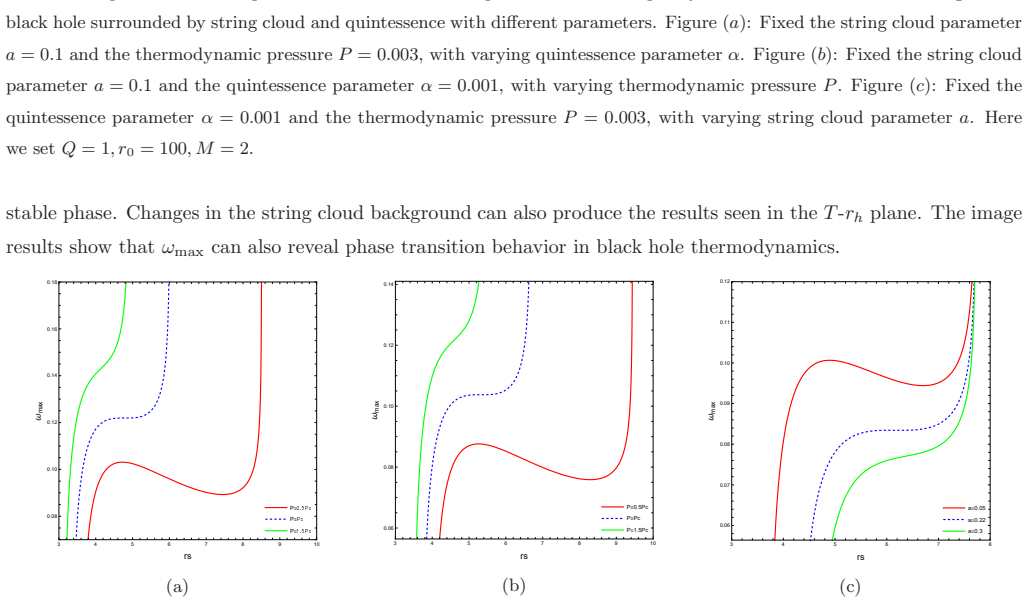
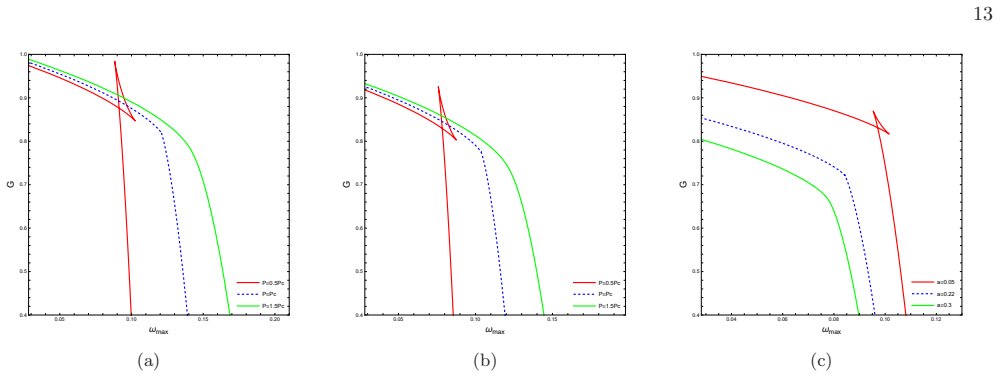
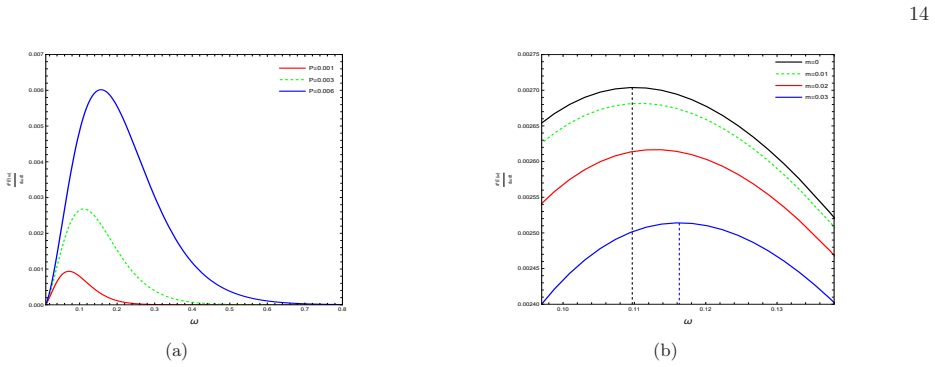
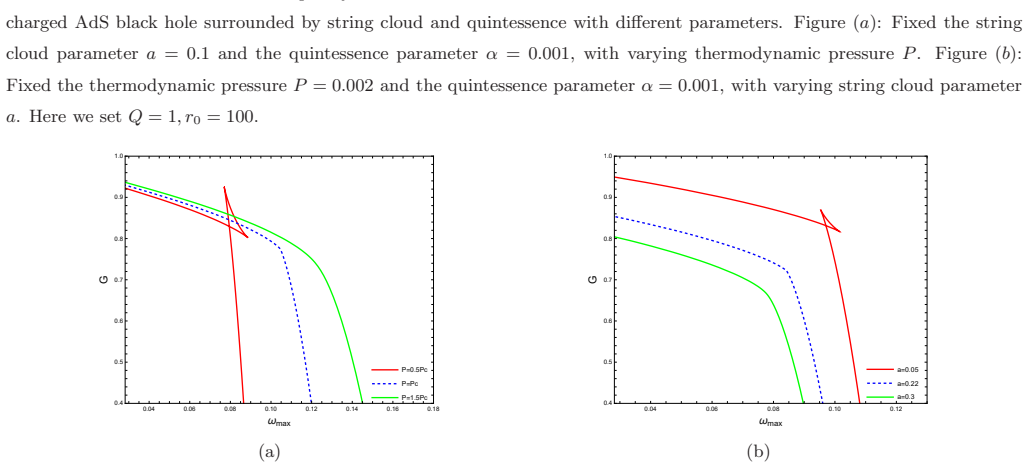
The shadow radius shows a strictly monotonic and invertible correlation with the event horizon radius. Thermodynamical phase structures obtained with the shadow radius as the variable replicate the phase transitions found when the event horizon radius is used as the variable. The energy emission rates for massless and massive particles are presented, and the maximum emission frequency is shown to serve as a useful tool for thermodynamic analysis. This establishes shadow thermodynamics under the background of string cloud and quintessence, revealing the independent regulatory mechanism of dark components on phase transitions as well as the universal topological invariance of the phase transit
What carries the argument
The shadow radius, which maintains a strictly monotonic and invertible correlation with the event horizon radius and is substituted as the thermodynamic variable.
If this is right
- Phase transitions remain accessible through observable shadow properties even when the horizon radius is not directly measurable.
- The peak frequency of the particle energy emission spectrum functions as an independent observable marker of thermodynamic phase changes.
- String cloud and quintessence parameters each exert separate control over the location and character of phase transitions.
- The topological character of the phase transition structure stays unchanged regardless of the specific dark-component parameters.
Where Pith is reading between the lines
- If astronomical observations can resolve black-hole shadows with sufficient precision, thermodynamic phase information could be extracted from real astrophysical systems containing dark-energy-like fields.
- The same substitution of shadow radius for horizon radius may apply to other black-hole solutions where direct horizon measurements are inaccessible.
- Numerical ray-tracing simulations for boundary values of the string-cloud and quintessence parameters would directly test whether the monotonicity assumption holds outside analytically tractable regimes.
Load-bearing premise
The shadow radius maintains a strictly monotonic and invertible relationship with the event horizon radius for all values of the string-cloud and quintessence parameters.
What would settle it
A numerical computation of the shadow radius as a function of event horizon radius that shows non-monotonic behavior or loss of invertibility for some string-cloud or quintessence parameter values, or phase diagrams that fail to match when the shadow radius replaces the horizon radius.
Figures

read the original abstract
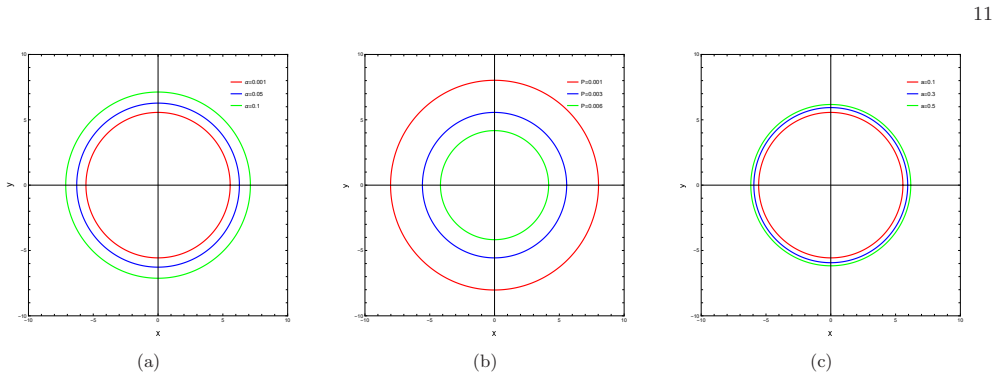
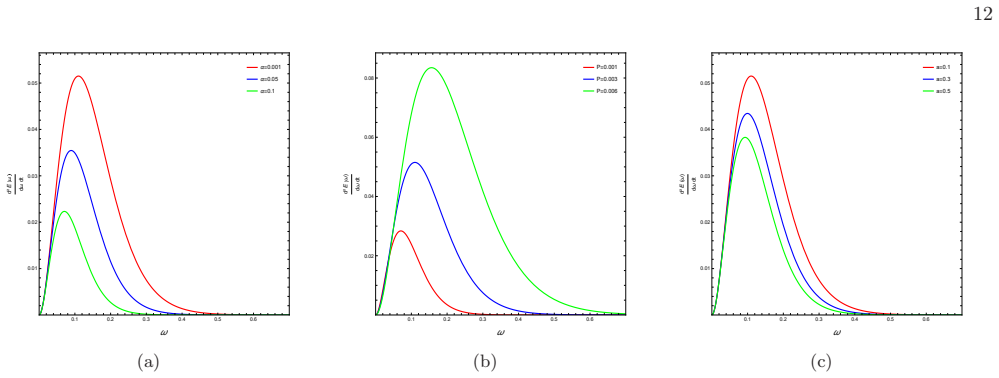
In this paper, the shadow of the four-dimensional charged AdS black hole surrounded by string cloud and quintessence is derived. The shadow radius shows a strictly monotonic and invertible correlation with the event horizon radius. The phase structures of the black hole for different parameters are reproduced through traditional thermodynamic geometry, which are similar to a van der Waals system. By analyzing the phase structure of the black hole in the context of shadows, thermodynamical phase structures with the shadow radius as the variable replicate the phase transition with the event horizon radius as the variable. We present the energy emission rates for massless and massive particles and discover that the maximum emission frequency can also serve as a useful tool for thermodynamic analysis. We firstly study and systematically establish shadow thermodynamics under the background of string cloud and quintessence, and our results reveal the independent regulatory mechanism of dark components on phase transitions as well as the universal topological invariance of the phase transition structure.
Editorial analysis
A structured set of objections, weighed in public.
Referee Report
Summary. The paper derives the shadow of a four-dimensional charged AdS black hole surrounded by string cloud and quintessence. It asserts that the shadow radius exhibits a strictly monotonic and invertible correlation with the event horizon radius. This relation is used to reproduce van der Waals-like phase structures via traditional thermodynamic geometry when the shadow radius replaces the horizon radius as the thermodynamic variable. The work also computes energy emission rates for massless and massive particles, suggesting that the maximum emission frequency serves as a thermodynamic diagnostic. It claims to establish shadow thermodynamics in this setting, revealing independent regulatory effects of the dark components on phase transitions and a universal topological invariance of the phase structure.
Significance. If the asserted monotonicity is rigorously established across the full parameter ranges, the results would link observable shadow properties directly to black-hole thermodynamics in the presence of string clouds and quintessence, offering a potential observational probe of phase transitions and the separate roles of these dark-energy-like components. The claimed universal topological invariance would constitute a nontrivial result if demonstrated.
major comments (1)
- [Abstract] Abstract: The central claim that phase structures replicate when the shadow radius is substituted for the event horizon radius rests on the assertion of a strictly monotonic and invertible relation between the two radii for all values of the string-cloud parameter a and quintessence parameters (c, ω_q). No explicit derivative, plot, or proof of monotonicity is supplied in the text, so it is impossible to verify that dr_s/dr_h never changes sign or vanishes inside the physical domain explored in the thermodynamics sections.
Simulated Author's Rebuttal
We thank the referee for the careful reading and constructive comments on our manuscript. We address the major comment point by point below.
read point-by-point responses
-
Referee: [Abstract] Abstract: The central claim that phase structures replicate when the shadow radius is substituted for the event horizon radius rests on the assertion of a strictly monotonic and invertible relation between the two radii for all values of the string-cloud parameter a and quintessence parameters (c, ω_q). No explicit derivative, plot, or proof of monotonicity is supplied in the text, so it is impossible to verify that dr_s/dr_h never changes sign or vanishes inside the physical domain explored in the thermodynamics sections.
Authors: We agree that the manuscript asserts the strictly monotonic and invertible relation between shadow radius r_s and horizon radius r_h but does not supply an explicit derivative, plot, or formal proof. In the revised version we will add an analytical computation of dr_s/dr_h together with a demonstration that this derivative remains strictly positive throughout the physical parameter domain (a, c, ω_q) used in the thermodynamic sections. We will also include representative plots of r_s versus r_h for several values of these parameters to visually confirm monotonicity and invertibility. These additions will make the substitution of shadow radius as thermodynamic variable fully verifiable. revision: yes
Circularity Check
Shadow radius phase replication follows tautologically from asserted monotonic mapping
specific steps
-
self definitional
[Abstract]
"The shadow radius shows a strictly monotonic and invertible correlation with the event horizon radius. [...] By analyzing the phase structure of the black hole in the context of shadows, thermodynamical phase structures with the shadow radius as the variable replicate the phase transition with the event horizon radius as the variable."
Once a strictly monotonic invertible map r_s(r_h) is asserted, the phase diagram expressed in r_s is identical (up to coordinate relabeling) to the diagram in r_h; the replication is therefore true by construction and adds no new information beyond the mapping itself.
full rationale
The abstract states the shadow radius r_s has a strictly monotonic invertible correlation with event horizon radius r_h, then presents the replication of van der Waals-like phase transitions when r_s replaces r_h as a result. Because any bijective reparametrization preserves the topological structure of the phase diagram, the claimed replication is automatic once the mapping is granted and does not supply independent content. The text provides no separate derivation or external check that would break this equivalence. No self-citations, ansatze, or fitted predictions appear in the supplied sections.
Axiom & Free-Parameter Ledger
Reference graph
Works this paper leans on
-
[1]
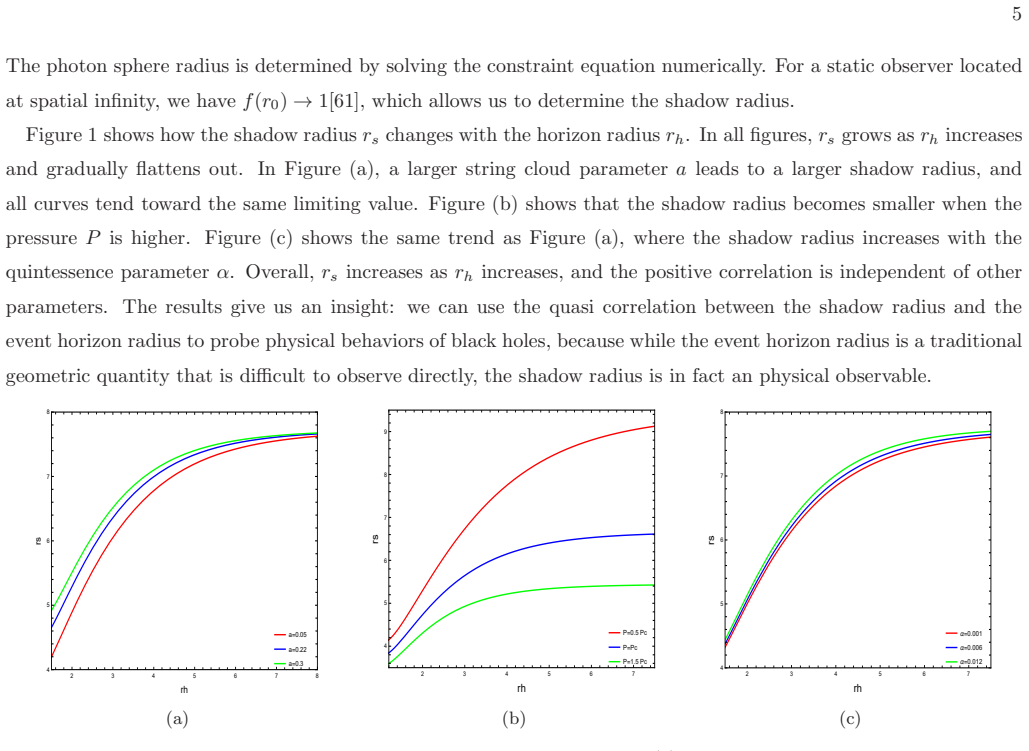
001, with varying string cloud parameter a
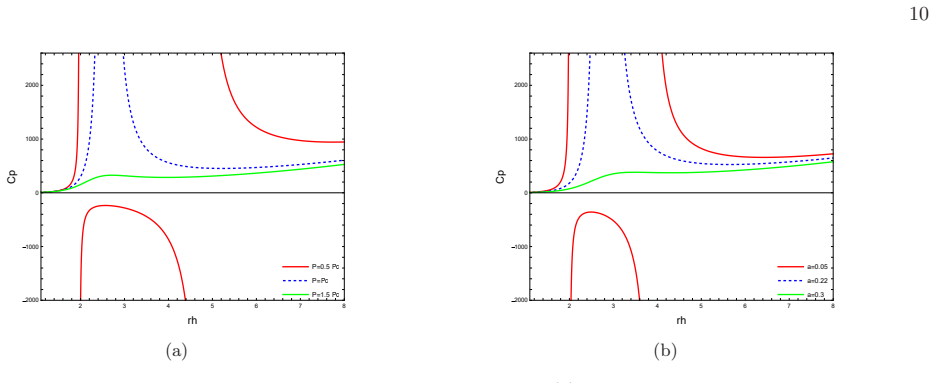
002 and the quintessence parameter α = 0 . 001, with varying string cloud parameter a. Figure ( b): Fixed the string cloud parameter a = 0. 1 and the quintessence parameter α = 0. 001, with varying thermodynamic pressure P . Figure ( c): Fixed the thermodynamic pressure P = 0 . 002 and the string cloud parameter a = 0 . 1, with varying quintessence parame...
-
[2]
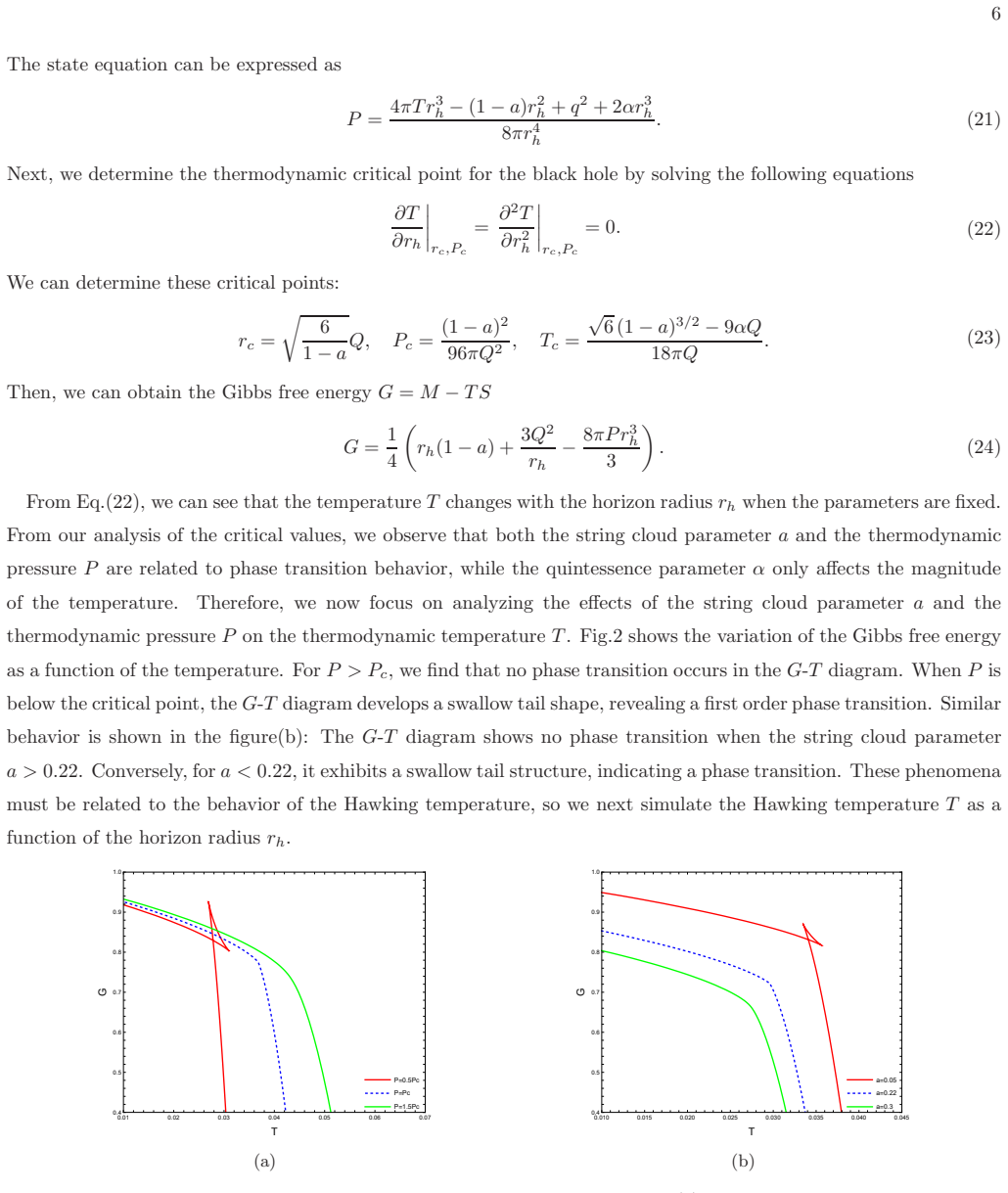
001, with varying thermodynamic pressure P
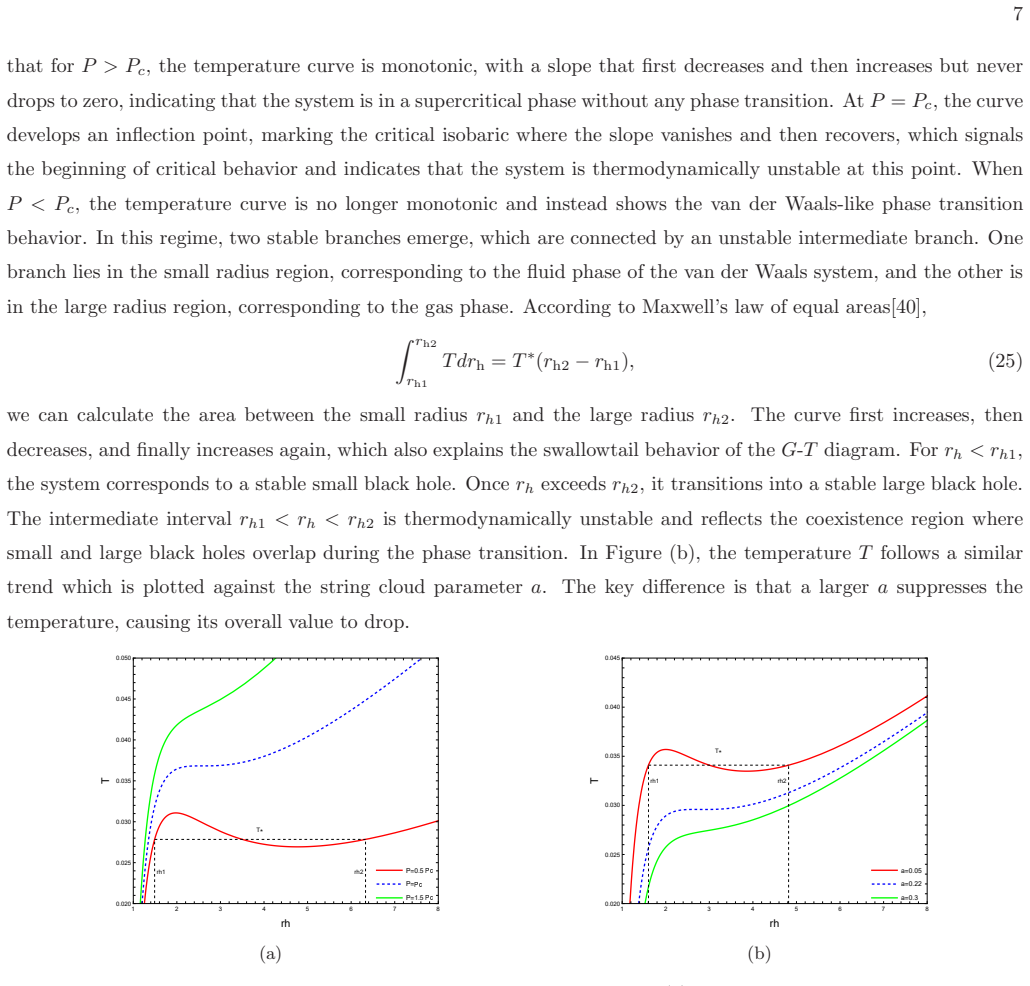
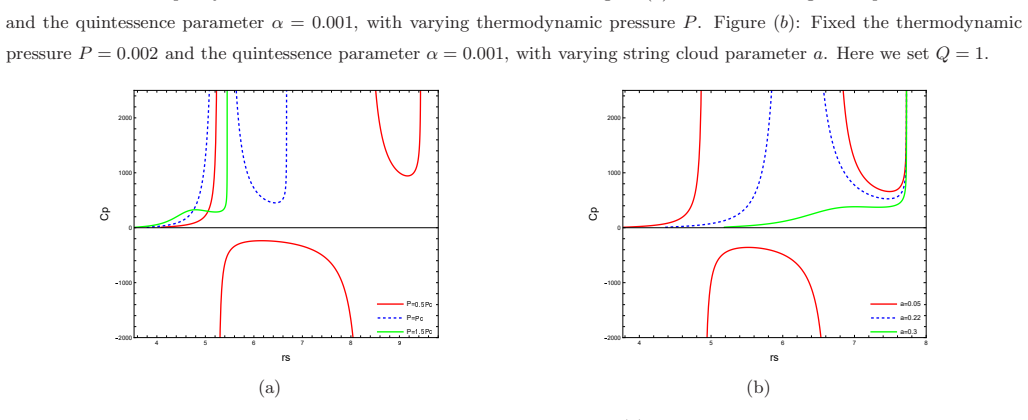
1 and the quintessence parameter α = 0. 001, with varying thermodynamic pressure P . Figure ( b): Fixed the thermodynamic pressure P = 0. 002 and the quintessence parameter α = 0. 001, with varying string cloud parameter a. Here we set Q = 1. Based on Eq.(20), the T -rh diagrams for three different pressure values are presented in Fig.3 (a) , where the the...
2000
-
[3]
001, with varying thermodynamic pressure P
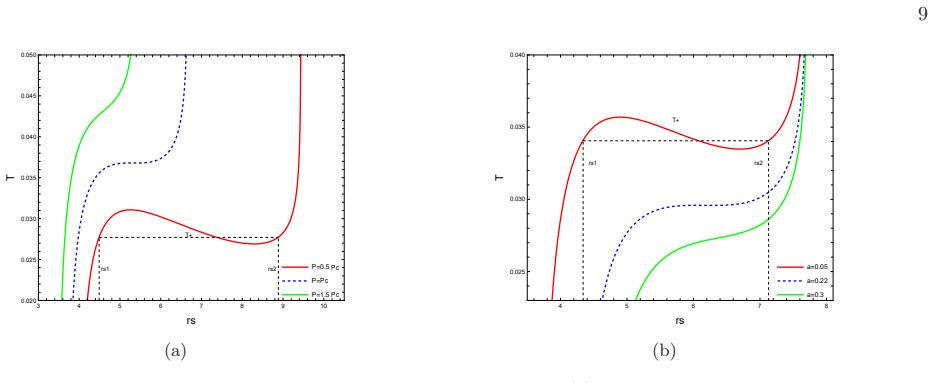
1 and the quintessence parameter α = 0. 001, with varying thermodynamic pressure P . Figure ( c): Fixed the thermodynamic pressure P = 0. 002 and the quintessence parameter α = 0. 001, with varying string cloud parameter a. Here we set Q = 1, r 0 = 100. them. Since a black hole absorbs massive particles, we take the horiz on area as an approximation for t...
-
[4]
94 T 3 H )1/ 3
37 m3 + 0. 94 T 3 H )1/ 3 . (42) When m = 0, the classical Wien’s law is recovered and ω max returns to 2 . 82TH. Finally, we plot the variation of the maximum emission frequency ω max with the event horizon radius rh in the massive field (Fig. 12), and the Gibbs free energy G versus the maximum emission frequency ω max (Fig. 13). Similar to the case of ph...
-
[5]
Abbott B P et al., Phys. Rev. Lett. 116, 061102 (2016)
2016
-
[6]
Abbott B P et al., Phys. Rev. Lett. 116, 241102 (2016)
2016
-
[7]
Abbott B P et al., Phys. Rev. Lett. 116, 241103 (2016)
2016
-
[8]
Akiyama K et al., Astrophys. J. Lett. 875, L1-L6 (2019)
2019
-
[9]
Akiyama K et al., Astrophys. J. Lett. 930, L12-L16 (2022)
2022
-
[10]
B 119, 489–519 (2004)
Vazquez S E and Esteban E P, Nuovo Cim. B 119, 489–519 (2004)
2004
-
[11]
Shaikh R, Kocherlakota P, Narayan R, and Joshi P S, Mon. Not. Roy. Astron. Soc. 482, 52 (2019)
2019
-
[12]
07, 015 (2018)
Hou X, Xu Z, Zhou M, and Wang J, JCAP 1807 no. 07, 015 (2018)
2018
-
[13]
Cunha P V P, Herdeiro C A R, and Rodriguez M J, Phys. Rev. D 97 no. 8, 084020 (2018)
2018
-
[14]
Tsukamoto N, Phys. Rev. D 97 no. 6, 064021 (2018)
2018
-
[15]
Wald R M, General Relativity (The University of Chicago Press, 1984)
1984
-
[16]
In: Proceedings, Ecole d’Ete de Physique The orique: Les Astres Occlus, Les Houches, France, August 1972 , pp
Bardeen J M, in black holes. In: Proceedings, Ecole d’Ete de Physique The orique: Les Astres Occlus, Les Houches, France, August 1972 , pp. 215–240 (1973)
1972
-
[17]
Chandrasekhar S, The Mathematical Theory of Black Holes (Oxford: Oxford University Press, 1984)
1984
-
[18]
Bambi C and Freese K, Phys. Rev. D 79, 043002 (2009)
2009
-
[19]
Bambi C and Yoshida N, Class. Quant. Grav. 27, 205006 (2010)
2010
-
[20]
Atamurotov F, Abdujabbarov A and Ahmedov B, Phys. Rev. D 88 no. 6, 064004 (2013)
2013
-
[21]
Papnoi U, Atamurotov F, Ghosh S G and Ahmedov B, Phys. Rev. D 90 no. 2, 024073 (2014)
2014
-
[22]
Atamurotov F and Ahmedov B, Phys. Rev. D 92, 084005 (2015)
2015
-
[23]
Wang M, Chen S and Jing J, Phys. Rev. D 97 no. 6, 064029 (2018)
2018
-
[24]
Guo M, Obers N A and Yan H, Phys. Rev. D 98 no. 8, 084063 (2018). 17
2018
-
[25]
Yan H, Phys. Rev. D 99 no. 8, 084050 (2019)
2019
-
[26]
Konoplya R A, Phys. Lett. B 795, 1-6 (2019)
2019
-
[27]
Perlick V and Tsupko O Y, Phys. Rept. 947, 1 (2022)
2022
-
[28]
Synge J L, Mon. Not. R. Astron. Soc. 131 no. 3, 463-466 (1966)
1966
-
[29]
Amarilla L, Eiroa E F and Giribet G, Phys. Rev. D 81, 124045 (2010)
2010
-
[30]
Astrophys
Luminet J P, Astron. Astrophys. 75, 228-235 (1979)
1979
-
[31]
Afrin M, Kumar R and Ghosh S G, Mon. Not. Roy. Astron. Soc. 504, 5927-5940 (2021)
2021
-
[32]
Khodadi M, Lambiase G, Mota D F, J. Cosmol. Astropart. Phys. 2021, 028 (2021)
2021
-
[33]
Ghosh S G, Afrin M, Phys. Rev. D 106, 024029 (2022)
2022
-
[34]
Cunha P V P, Herdeiro C A R, Radu E, Phys. Rev. D 106, 024029 (2022)
2022
-
[35]
Hawking S W, Commun. Math. Phys. 43, 199-220 (1975)
1975
-
[36]
Hawking S W and Page D N, Commun. Math. Phys. 87, 577 (1983)
1983
-
[37]
Hawking S W, Nature 248, 30-31 (1974)
1974
-
[38]
Bekenstein J D, Phys. Rev. D 7, 2333 (1973)
1973
-
[39]
Bekenstein J D, Lettere al Nuovo Cimento 4, 737 (1972)
1972
-
[40]
Bekenstein J D, Phys. Rev. D 7, 949 (1973)
1973
-
[41]
Bekenstein J D, Phys. Rev. D 9, 3292 (1974)
1974
-
[42]
Bekenstein J D, Phys. Rev. D 12, 3077 (1975)
1975
-
[43]
Bardeen J M, Carter B and Hawking S W, Commun. Math. Phys. 31, 161 (1973)
1973
-
[44]
Kubiznak D and Mann R B, JHEP 07, 033 (2012)
2012
-
[45]
Cai R G, Cao L M, Li L and Yang R Q, JHEP 09, 005 (2013)
2013
-
[46]
Kastor D, Ray S and Traschen J, Class. Quant. Grav. 26, 195011 (2009)
2009
-
[47]
Quantum Grav
Dolan B P, Class. Quantum Grav. 28, 235017 (2011)
2011
-
[48]
Page D N, Phys. Rev. D 13, 198-206 (1976)
1976
-
[49]
Emparan R, Horowitz G T and Myers R C, Phys. Rev. Lett. 85, 499-502 (2000)
2000
-
[50]
Magueijo J, Smolin L, Classical Quantum Gravity 21, 1725-1736 (2004)
2004
-
[51]
de Rham C, Gabadadze G, Phys. Rev. D 82, 044020 (2010)
2010
-
[52]
de Rham C, Gabadadze G and Tolley A J, Phys. Rev. Lett. 106, 231101 (2011)
2011
-
[53]
Letelier P S, Phys. Rev. D 20 no. 6, 1294 (1979)
1979
-
[54]
Perlmutter S, Aldering G, Goldhaber G, Knop R, Nugent P, Castro P, Deustua S, Fabbro S, Goobar A, Groom D E et al., Astrophys. J. 517 no. 2, 565 (1999)
1999
-
[55]
Kiselev V V, Class. Quant. Grav. 20 no. 6, 1187 (2003)
2003
-
[56]
Maldacena J M, Adv. Theor. Math. Phys. 2, 231-252 (1998)
1998
-
[57]
Witten E, Adv. Theor. Math. Phys. 2, 253-291 (1998)
1998
-
[58]
Gubser S S, Klebanov I R and Polyakov A M, Phys. Lett. B 428, 105-114 (1998)
1998
-
[59]
Cvetic M, Gibbons G W, Kubiznak D and Pope C N, Phys. Rev. D 84, 024037 (2011)
2011
-
[60]
Chamblin A, Emparan R, Johnson C V and Myers R C, Phys. Rev. D 60, 064018 (1999)
1999
-
[61]
Chamblin A, Emparan R, Johnson C V and Myers R C, Phys. Rev. D 60, 104026 (1999)
1999
-
[62]
Caldarelli M M, Cognola G and Klemm D, Class. Quant. Grav. 17, 399-420 (2000)
2000
-
[63]
Toledo J M and Bezerra V B, Int. J. Mod. Phys. D 28, 1950023 (2019)
2019
-
[64]
Li X Q, Yan H P, Xing L L and Zhou S W, Phys. Rev. D 107 no. 10, 104055 (2023)
2023
-
[65]
Zhang M and Guo M, Eur. Phys. J. C 80 no. 8, 790 (2020)
2020
-
[66]
Belhaj A, Chakhchi L, El Moumni H, Khalloufi J and Masmar K , Int. J. Mod. Phys. A 35 no. 27, 2050170 (2020). 18
2020
-
[67]
Cai X C and Miao Y G, arXiv:2107.08352 [gr-qc] (2021)
arXiv 2021
-
[68]
Wang C, Wu B, Xu Z M and Yang W L, Nucl. Phys. B 976, 115698 (2022)
2022
-
[69]
Shaikh R, Phys. Rev. D 100 no. 2, 024028 (2019)
2019
-
[70]
Xu Z, Hou X and Wang J, JCAP 10, 046 (2018)
2018
-
[71]
Dark Univ
Hamil B and Lu /dieresis.ts1tfu/dieresis.ts1o/breve.ts1glu B C, Phys. Dark Univ. 42, 101293 (2023)
2023
-
[72]
Wei S W and Liu Y X, J. Cosmol. Astrop. Phys. 11, 063 (2013)
2013
-
[73]
Belhaj A, Benali M, El Balali A, El Moumni H and Ennadifi S E , arXiv:2006.01078 (2020)
arXiv 2006
-
[74]
Belhaj A, Benali M, El Balali A, El Hadri W and El Moumni H, arXiv:2007.09058 (2020)
arXiv 2007
-
[75]
Eslam Panah B, Jafarzade K and Hendi S H, Nucl. Phys. B 961, 115269 (2020)
2020
-
[76]
O /dieresis.ts1vgu/dieresis.ts1n A, Sakallı ˙I, Saavedra J and Leiva C, Mod. Phys. Lett. A 35 no. 20, 2050163 (2020)
2020
discussion (0)
Sign in with ORCID, Apple, or X to comment. Anyone can read and Pith papers without signing in.