Precursor Solitons in Plasma Flow Past Charged Obstacles: Role of Obstacle Bias and Ion Temperature Anisotropy
Pith reviewed 2026-06-28 07:52 UTC · model grok-4.3
The pith
Ion temperature anisotropy enables precursor soliton formation in plasma flows past charged obstacles where isotropic cases fail due to damping.
A machine-rendered reading of the paper's core claim, the machinery that carries it, and where it could break.
Core claim
Temperature anisotropy in the 2D drifting flow along the x-direction, arising from a reduction in the transverse thermal velocity (y-direction) relative to the parallel thermal velocity (x-direction), favors the generation of coherent upstream structures whose effectiveness increases with stronger anisotropy, enabling precursor solitons in regimes where isotropic plasmas cannot sustain them due to Landau damping. A negatively biased plate produces only a wake-like response, whereas a positively biased plate generates upstream density pulses.
What carries the argument
Ion-temperature anisotropy (reduced transverse thermal velocity relative to parallel in x-directed flow) acting on electrostatic ion-acoustic precursor solitons in 2D PIC simulations of plasma past an absorbing charged obstacle.
If this is right
- A positively biased plate generates upstream density pulses.
- A negatively biased plate produces only a wake-like response.
- Coherent upstream structures form more effectively with stronger anisotropy.
- Precursor formation occurs in regimes inaccessible to isotropic plasmas due to Landau damping.
Where Pith is reading between the lines
- Laboratory setups could deliberately impose controlled anisotropy to test soliton formation thresholds.
- The mechanism may inform models of plasma interactions with small objects such as orbital debris.
- Three-dimensional or magnetized extensions of the simulations would reveal whether the anisotropy dependence persists.
- Similar temperature anisotropy could influence other nonlinear wave structures in drifting plasmas beyond ion-acoustic modes.
Load-bearing premise
The 2D electrostatic PIC simulations accurately capture the ion dynamics and damping behavior under the stated anisotropy without significant contributions from unmodeled three-dimensional effects, magnetic fields, or boundary conditions.
What would settle it
A direct comparison simulation with identical flow speed, densities, and obstacle bias but with isotropic ion temperatures (equal parallel and perpendicular components) showing complete suppression of upstream precursors.
Figures




read the original abstract
We investigate electrostatic ion-acoustic precursor solitons in a plasma flow past an absorbing charged obstacle using two-dimensional (2D) electrostatic PIC simulations. A key outcome of the present formulation is that ion-temperature anisotropy can enable precursor formation even in regimes where isotropic plasmas, due to Landau damping, cannot sustain such structures. Specifically, temperature anisotropy in the 2D drifting flow along the x-direction, arising from a reduction in the transverse thermal velocity (y-direction) relative to the parallel thermal velocity (x-direction), favors the generation of coherent upstream structures whose effectiveness increases with stronger anisotropy. Both positive and negative obstacle polarities are considered to identify the conditions for upstream nonlinear structure formation. A negatively biased plate produces only a wake-like response, whereas a positively biased plate generates upstream density pulses. This study offers physical insight into nonlinear wave formation in streaming plasmas over charged objects and could be useful for plasma-based debris detection in the low Earth orbit (LEO) region.
Editorial analysis
A structured set of objections, weighed in public.
Referee Report
Summary. The paper uses 2D electrostatic PIC simulations to study electrostatic ion-acoustic precursor solitons in plasma flow past an absorbing charged obstacle. It claims that ion-temperature anisotropy (T_y < T_x) enables formation of coherent upstream structures by mitigating Landau damping that suppresses them in isotropic cases; positive obstacle bias produces upstream density pulses while negative bias yields only wake-like responses.
Significance. If the central attribution to anisotropy-reduced damping holds, the work supplies useful parameter-space insight into nonlinear wave formation in streaming anisotropic plasmas and potential relevance to space-plasma applications such as LEO debris detection. The simulation study is exploratory and does not claim parameter-free derivations or machine-checked proofs.
major comments (1)
- [Abstract and simulation results] The load-bearing claim that anisotropy enables precursors specifically by reducing ion Landau damping (versus isotropic cases) requires explicit verification. The manuscript should compare simulated damping rates or structure persistence against the analytic anisotropic ion-acoustic dispersion relation for the reported T_y/T_x values; without this, numerical artifacts in 2D electrostatic PIC (finite-particle noise, artificial transverse constraints) cannot be ruled out as the source of the observed difference.
minor comments (1)
- [Abstract] The abstract would be strengthened by including at least one quantitative diagnostic (e.g., measured damping length or amplitude ratio between isotropic and anisotropic runs) to support the stated effectiveness of anisotropy.
Simulated Author's Rebuttal
We thank the referee for the detailed and constructive review. We address the major comment below and will incorporate the suggested verification in the revised manuscript.
read point-by-point responses
-
Referee: [Abstract and simulation results] The load-bearing claim that anisotropy enables precursors specifically by reducing ion Landau damping (versus isotropic cases) requires explicit verification. The manuscript should compare simulated damping rates or structure persistence against the analytic anisotropic ion-acoustic dispersion relation for the reported T_y/T_x values; without this, numerical artifacts in 2D electrostatic PIC (finite-particle noise, artificial transverse constraints) cannot be ruled out as the source of the observed difference.
Authors: We agree that an explicit comparison to the analytic anisotropic ion-acoustic dispersion relation would strengthen the central claim and help rule out numerical artifacts. Our simulations demonstrate a clear qualitative difference: coherent upstream structures form only when T_y < T_x, while isotropic cases show suppression consistent with stronger Landau damping. To address the referee's concern directly, the revised manuscript will include a new subsection comparing key simulated quantities (phase speed, inferred damping from structure lifetime, and wave number) against the analytic dispersion relation evaluated at the reported T_y/T_x ratios. This comparison will be performed for the relevant flow speeds and will be used to confirm that the observed anisotropy dependence aligns with reduced ion Landau damping rather than simulation-specific effects. revision: yes
Circularity Check
No significant circularity in exploratory simulation study
full rationale
The paper reports results from 2D electrostatic PIC simulations exploring how ion-temperature anisotropy affects precursor soliton formation in plasma flow past charged obstacles. No mathematical derivations, fitted parameters, or self-citations are described that reduce any reported outcome to a tautology, self-definition, or input renamed as prediction. The central claim is presented as a comparative simulation finding between isotropic and anisotropic cases, which remains independent of the enumerated circularity patterns and is self-contained against external benchmarks.
Axiom & Free-Parameter Ledger
Reference graph
Works this paper leans on
-
[1]
Compared with the isotropic temperature case, the ion distribution is now more collimated, which enhances the upstream com- pression in front of the positively biased plate
Weak anisotropy: vth,iy/vth,ix = 0.1 To assess the role of velocity-space anisotropy, we first consider the case vth,iy/vth,ix = 0 .1. Compared with the isotropic temperature case, the ion distribution is now more collimated, which enhances the upstream com- pression in front of the positively biased plate. As seen in Fig. 5, the initial state is shown in...
-
[2]
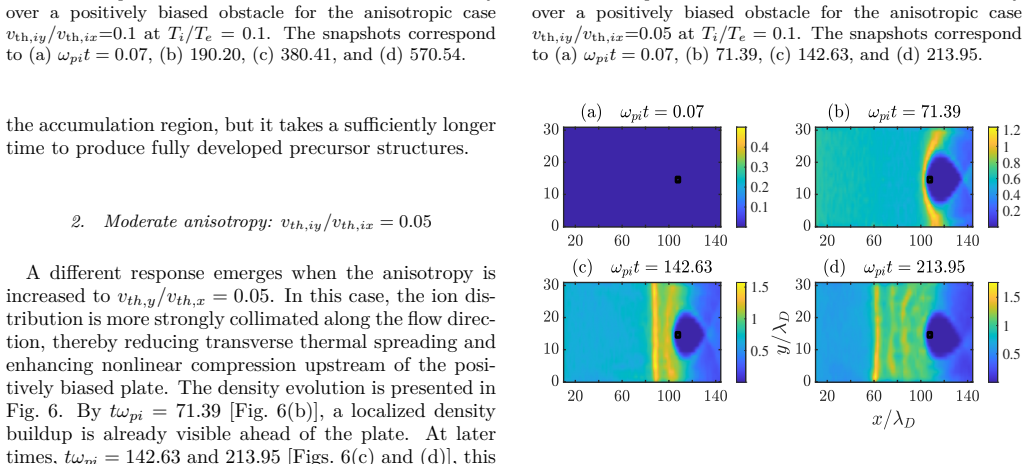
Moderate anisotropy: vth,iy/vth,ix = 0.05 A different response emerges when the anisotropy is increased to vth,y/vth,x = 0 .05. In this case, the ion dis- tribution is more strongly collimated along the flow direc- tion, thereby reducing transverse thermal spreading and enhancing nonlinear compression upstream of the posi- tively biased plate. The density...
-
[3]
Strong anisotropy: vth,iy/vth,ix = 0.01 A sustained precursor formation is obtained for the larger anisotropy, i.e., considered here as vth,y/vth,x = 0.01. In this case, the ion distribution is highly col- limated along the flow direction, strongly suppressing transverse thermal spreading and allowing the obstacle- induced compression to remain coherent o...
-
[4]
Leal Filho, I
W. Leal Filho, I. R. Abubakar, J. D. Hunt, and M. A. P. Dinis, Sustainable Futures 10, 100849 (2025)
2025
-
[5]
F. E. Öcal and S. Torun, International Journal of Disaster Risk Management 6, 61 (2024). 10
2024
-
[6]
Reynaud, M
F. Reynaud, M. Abrate, A. G. Coretti, M. E. Bertaina, A. Frasson, A. Montanaro, R. Bonino, and R. Sirovich, Journal of Space Safety Engineering (2026)
2026
-
[7]
McDonnell, S
J. McDonnell, S. Deshpande, D. Niblett, M. Neish, and P. Newman, Advances in Space Research 13, 87 (1993)
1993
-
[8]
Christiansen, J
E. Christiansen, J. Hyde, and R. Bernhard, Advances in Space Research 34, 1097 (2004)
2004
-
[9]
A. Sen, S. Tiwari, S. Mishra, and P. Kaw, Advances in Space Research 56, 429 (2015)
2015
-
[10]
P. A. Bernhardt, L. Scott, A. Howarth, and G. J. Morales, Physics of Plasmas 30 (2023)
2023
-
[11]
Hughes, I
J. Hughes, I. Collett, C. Nasr, A. Newheart, R. Kelly, S. Thaller, R. Patel, C. Johnstone, E. Vance, H. Wang, et al. , Advances in Space Research (2025)
2025
-
[12]
A. S. Truitt and C. M. Hartzell, Journal of Spacecraft and Rockets 58, 848 (2021)
2021
-
[13]
A. S. Truitt and C. M. Hartzell, Journal of Spacecraft and Rockets 57, 876 (2020)
2020
-
[14]
Arora, P
G. Arora, P. Bandyopadhyay, M. Hariprasad, and A. Sen, Physical Review E 103, 013201 (2021)
2021
-
[15]
Bandyopadhyay and A
P. Bandyopadhyay and A. Sen, Reviews of Modern Plasma Physics 6, 28 (2022)
2022
-
[16]
Jaiswal, P
S. Jaiswal, P. Bandyopadhyay, and A. Sen, Physical Re- view E 93, 041201 (2016)
2016
-
[18]
Ganguli, C
G. Ganguli, C. Crabtree, A. Fletcher, and A. Sen, Physics of Plasmas 32 (2025)
2025
-
[19]
Kumar and A
A. Kumar and A. Sen, New Journal of Physics 22, 073057 (2020)
2020
-
[20]
A. Sen, R. Mukherjee, S. K. Yadav, C. Crabtree, and G. Ganguli, Physics of Plasmas 30 (2023)
2023
-
[21]
P. A. Resendiz Lira, G. L. Delzanno, D. Svyatsky, and O. Koshkarov, Journal of Spacecraft and Rockets 61, 1640 (2024)
2024
-
[22]
Dharodi, K
V. Dharodi, K. Kumar, A. Sen, and E. Scime, Physics of Plasmas 33 (2026)
2026
-
[23]
Sam and S
A. Sam and S. Elschot, Computer Physics Communica- tions 314, 109680 (2025)
2025
-
[24]
A. Sam, C. Crabtree, and S. Elschot, Physics of Plasmas 33 (2026)
2026
-
[25]
Lockwood, I
M. Lockwood, I. McCrea, G. Millward, R. Moffett, and H. Rishbeth, Journal of atmospheric and terrestrial physics 55, 895 (1993)
1993
-
[26]
Lomidze, J
L. Lomidze, J. Burchill, D. Knudsen, and J. Huba, Earth and Space Science 8, e2021EA001925 (2021)
2021
-
[27]
Balmforth, R
H. Balmforth, R. Moffett, and A. Rodger, in Annales Geophysicae, Vol. 17 (Springer, 1999) pp. 455–462
1999
-
[28]
Guio and H
P. Guio and H. Pécseli, Geophysical research letters 31 (2004)
2004
-
[29]
R. J. Goldston, Introduction to plasma physics (CRC Press, 2020)
2020
-
[30]
A. Mir, A. Sen, P. Bandyopadhyay, S. Tiwari, C. Crab- tree, and G. Ganguli, Physics of Plasmas 33, 022114 (2026)
2026
discussion (0)
Sign in with ORCID, Apple, or X to comment. Anyone can read and Pith papers without signing in.