Space-like Sachs electric and magnetic form factors of the baryons in the asymmetric nuclear medium
Pith reviewed 2026-06-28 09:06 UTC · model grok-4.3
The pith
Sachs electric and magnetic form factors of baryons receive modifications from isospin asymmetric nuclear matter at finite temperature.
A machine-rendered reading of the paper's core claim, the machinery that carries it, and where it could break.
Core claim
Within the vector meson dominance model the photon couples to baryons through the rho, omega and phi mesons; when the masses of these mesons are replaced by their medium-modified values the resulting isoscalar and isovector Dirac and Pauli form factors yield Sachs electric and magnetic form factors that differ from their vacuum values, with additional effective magnetic moments supplied by the chiral SU(3) quark mean field model.
What carries the argument
Vector meson dominance model that expresses the electromagnetic current of baryons through intermediary vector mesons whose masses are shifted by the nuclear medium.
If this is right
- Electric and magnetic charge radii of the baryons change with density and isospin asymmetry.
- The effective magnetic moments of nucleons and hyperons acquire density-dependent corrections.
- Form factor behavior splits between protons and neutrons because of the explicit isospin asymmetry.
- The modifications are larger at higher densities and remain visible even at moderate temperatures.
Where Pith is reading between the lines
- The altered form factors would affect electromagnetic response functions inside neutron-rich nuclei or the outer layers of neutron stars.
- Similar medium modifications could be applied to time-like form factors relevant for dilepton production in heavy-ion collisions.
- Direct comparison with electron-nucleus scattering data at finite temperature would test the size of the predicted shifts.
Load-bearing premise
All in-medium changes to the form factors are captured by the altered masses of the vector mesons alone.
What would settle it
An experimental measurement or lattice calculation showing that the Sachs form factors remain identical to their vacuum values inside asymmetric nuclear matter at finite temperature would falsify the modification mechanism.
Figures






read the original abstract
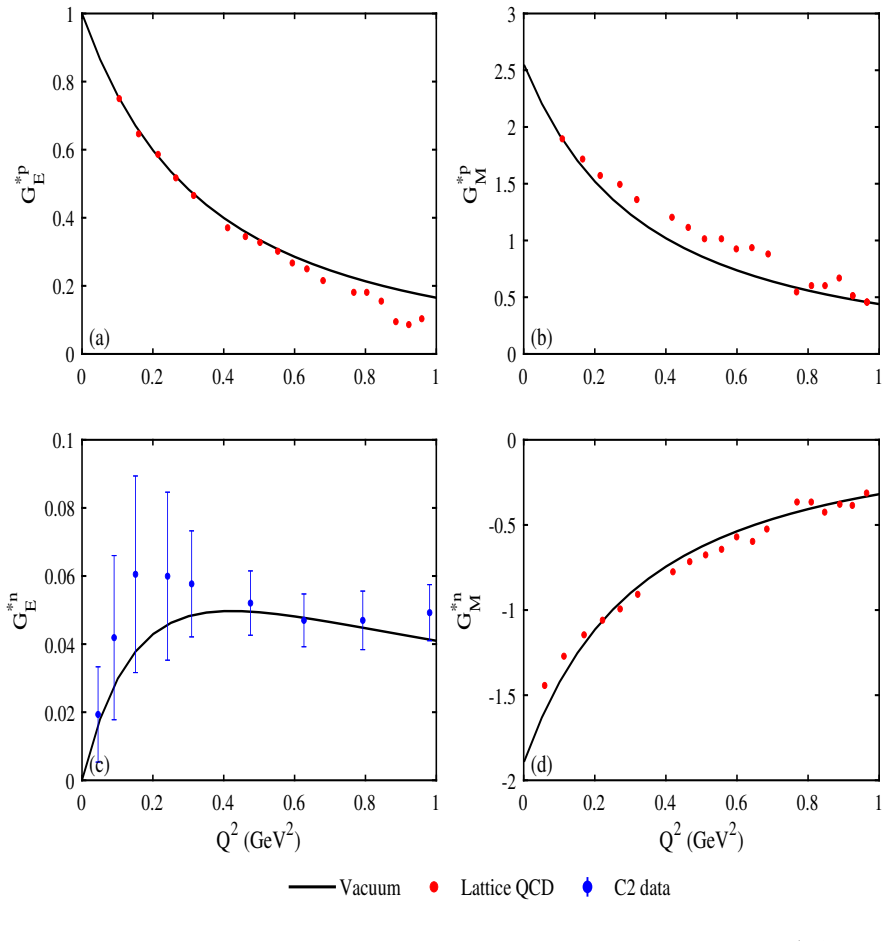
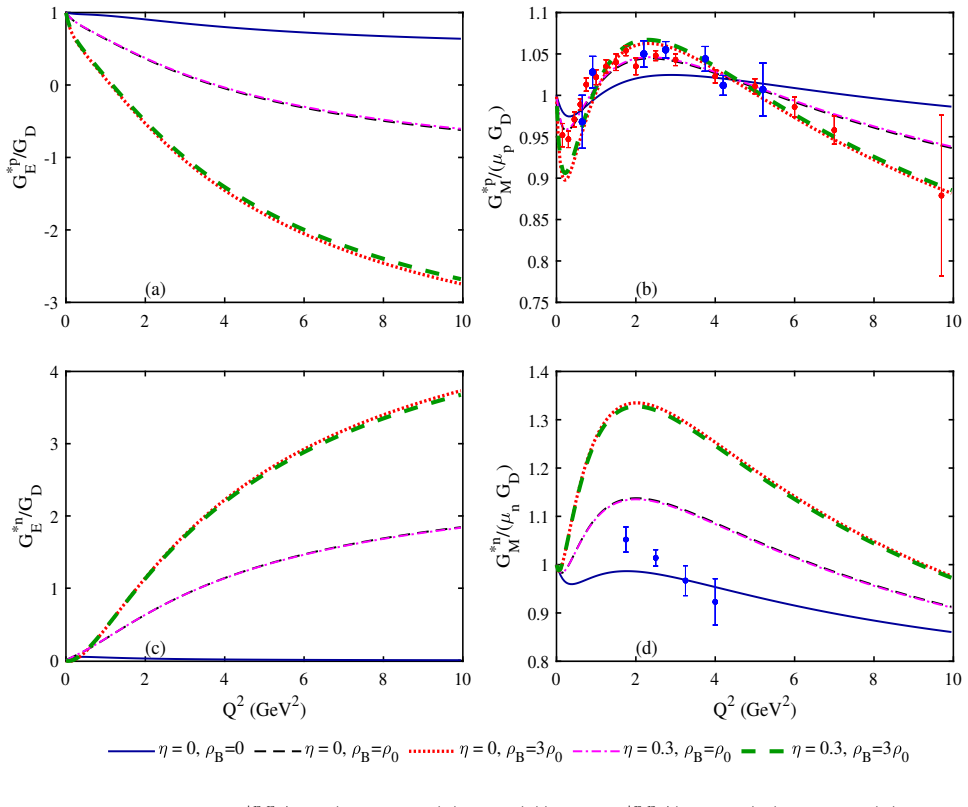
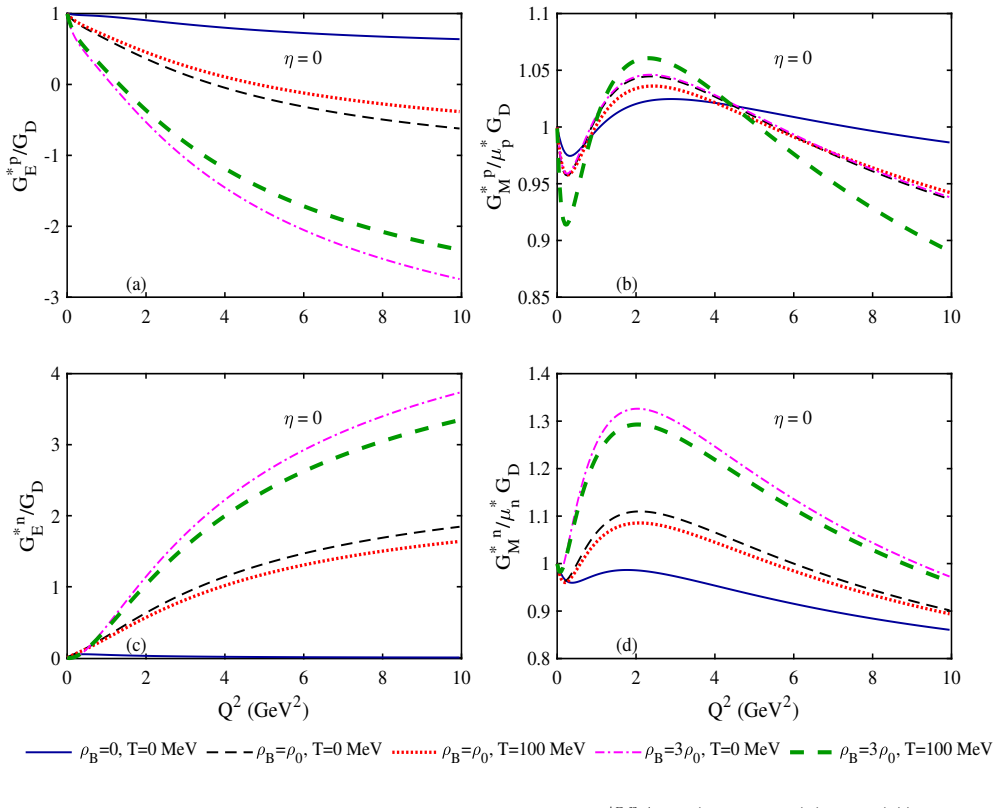
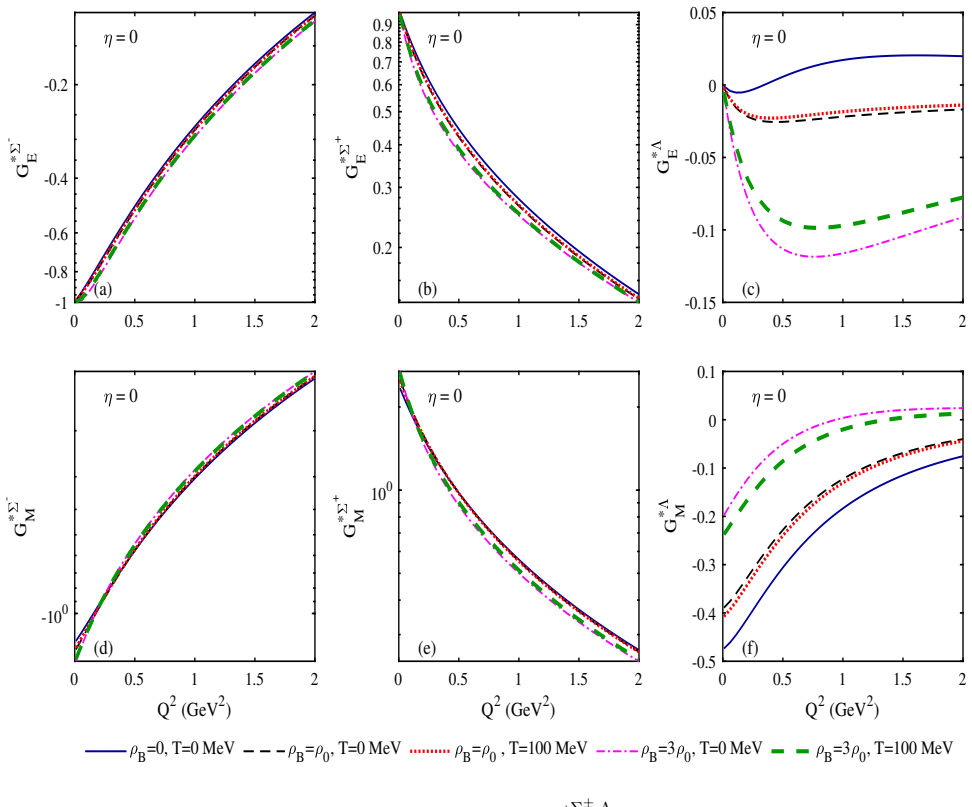
In the present work, we have studied the space-like baryon Sachs form factors in the isospin asymmetric nuclear medium using the vector meson dominance (VMD) model. The in-medium effects are incorporated through the medium-modified masses of vector mesons which are calculated using the QCD sum rule approach taking density dependent scalar quark and gluon condensates as inputs from chiral SU(3) quark mean field (CQMF) model. The effective magnetic moments of the baryons are also calculated in the CQMF model. In the framework of VMD model, the photon couples to the nucleons through intermediary vector mesons with the same quantum number as that of a photon. This coupling leads to the relation of isoscalar and isovector Dirac and Pauli form factors which are then used to calculate the Sachs electric and magnetic form factors, which provide physically measurable quantities that represent the electric and magnetic distributions of the baryons. The present work aims to study the effects of asymmetric nuclear matter at finite temperature on the Sachs form factors of baryons in the space-like region. The electric and magnetic charge radii have also been calculated for the baryons in free space and dense asymmetric nuclear matter. The results obtained have been compared with other available phenomenological models, lattice simulations, and experimental data.
Editorial analysis
A structured set of objections, weighed in public.
Referee Report
Summary. The manuscript computes the space-like Sachs electric and magnetic form factors of baryons in isospin-asymmetric nuclear matter at finite temperature within the vector-meson-dominance (VMD) framework. In-medium modifications enter exclusively through density- and temperature-dependent vector-meson pole masses obtained from QCD sum rules whose only medium input is the density-dependent scalar quark and gluon condensates supplied by the chiral SU(3) quark mean-field (CQMF) model; effective magnetic moments are evaluated directly in the CQMF model. The resulting isoscalar and isovector Dirac and Pauli form factors are converted to Sachs form factors, from which electric and magnetic charge radii are extracted. Numerical results are compared with other phenomenological models, lattice simulations, and experimental data.
Significance. If the central assumptions hold, the calculation supplies concrete predictions for the modification of baryon electromagnetic structure in asymmetric dense matter, a quantity relevant to the interpretation of heavy-ion collision data and to the modeling of neutron-star interiors. The consistent use of the same CQMF framework for both the condensates that enter the sum rules and the magnetic moments constitutes a methodological strength that reduces the number of independent parameter sets.
major comments (1)
- [Abstract and §2] Abstract and §2 (method description): the central claim that the Sachs form factors are modified solely by the medium-induced shifts in vector-meson masses rests on the unstated assumption that the VMD couplings g_VNN and the vector-meson widths remain unchanged in the medium. No justification or sensitivity study is supplied for this assumption, which is load-bearing because fractional changes in the couplings of comparable size to the reported mass shifts would alter or reverse the predicted Q² dependence of G_E and G_M while leaving the mass shifts themselves unaltered.
minor comments (1)
- [Abstract] The abstract states that results are compared with 'other available phenomenological models, lattice simulations, and experimental data,' but the manuscript does not indicate in which section or figure these comparisons are presented; explicit cross-references would improve readability.
Simulated Author's Rebuttal
We thank the referee for the careful reading and constructive feedback on our manuscript. We respond to the single major comment below.
read point-by-point responses
-
Referee: [Abstract and §2] Abstract and §2 (method description): the central claim that the Sachs form factors are modified solely by the medium-induced shifts in vector-meson masses rests on the unstated assumption that the VMD couplings g_VNN and the vector-meson widths remain unchanged in the medium. No justification or sensitivity study is supplied for this assumption, which is load-bearing because fractional changes in the couplings of comparable size to the reported mass shifts would alter or reverse the predicted Q² dependence of G_E and G_M while leaving the mass shifts themselves unaltered.
Authors: We agree that the assumption of medium-independent VMD couplings g_VNN and widths is implicit and unstated in the original text. In our framework the couplings are fixed to vacuum values (standard in VMD matching to nucleon form factors) while the CQMF model supplies only the condensates that enter the QCD sum rules for the masses; widths are omitted under the pole approximation appropriate for space-like Q². This is a common simplification when the dominant medium effect is the condensate-driven mass shift. We acknowledge that a sensitivity study would strengthen the robustness claim. In the revised manuscript we will add an explicit statement and short justification of the assumption in Section 2, together with a note that it constitutes a limitation of the present calculation. revision: yes
Circularity Check
No circularity: forward model chain from CQMF condensates to VMD form factors
full rationale
The derivation proceeds as a standard forward calculation: density-dependent scalar condensates are taken as input from the CQMF model, inserted into QCD sum-rule expressions to obtain medium-modified vector-meson masses, and those masses are then substituted into the conventional VMD relations for the isoscalar/isovector Dirac and Pauli form factors that define the Sachs G_E and G_M. No equation equates an output quantity to one of its own inputs by definition, no fitted parameter is relabeled as a prediction, and no load-bearing premise rests solely on a self-citation whose content is unverified. The resulting form-factor modifications are therefore genuine model outputs rather than tautological restatements of the chosen inputs.
Axiom & Free-Parameter Ledger
free parameters (1)
- density dependent scalar quark and gluon condensates
axioms (2)
- domain assumption The vector meson dominance model holds in the nuclear medium.
- domain assumption QCD sum rule approach with CQMF inputs accurately gives medium-modified masses.
Reference graph
Works this paper leans on
-
[1]
H. W. Hammer, eConf C010430, W08 (2001)
2001
-
[2]
Kubon et al
G. Kubon et al. , Phys. Lett. B 524, 26 (2002)
2002
-
[3]
C. E. Hyde and K. de Jager, Ann. Rev. Nucl. Part. Sci. 54, 217 (2004)
2004
-
[4]
Warren et al
G. Warren et al. , Phys. Rev. Lett. 92, 042301 (2004)
2004
-
[5]
Punjabi et al
V. Punjabi et al. , Eur. Phys. J. A 51, 79 (2015)
2015
-
[6]
Y. H. Lin, H. W. Hammer and U. G. Meißner, Phys. Rev. Lett. 128, 052002 (2022)
2022
- [7]
-
[8]
Ramalho, K
G. Ramalho, K. Tsushima and J. P. B. C. de Melo, PoS P ANIC2021, 210 (2022)
2022
-
[9]
Janssens et al
T. Janssens et al. , Phys. Rev. 142, 922 (1966)
1966
-
[10]
E. M. Riordan, Science 256, 1287 (1992)
1992
-
[11]
Seely et al
J. Seely et al. , Phys. Rev. Lett. 103, 202301 (2009)
2009
-
[12]
Atac et al., Nature Commun
H. Atac et al., Nature Commun. 12, 1759 (2021) [erratum: Nature Commun. 12, 3290 (2021)]
2021
-
[13]
Xia et al
L. Xia et al. , Symmetry 14, 231 (2022)
2022
-
[14]
Sasaki and T
S. Sasaki and T. Yamazaki, Phys. Rev. D 78, 014510 (2008)
2008
-
[15]
Alvarado et al
F. Alvarado et al. , Phys. Rev. D 108, 114021 (2023)
2023
-
[16]
H. C. Kim, P. Schweitzer and U. Yakhshiev, Phys. Lett. B 718, 625 (2012)
2012
-
[17]
Eichmann, Phys
G. Eichmann, Phys. Rev. D 84, 014014 (2011)
2011
-
[18]
Guidal et al
M. Guidal et al. , Phys. Rev. D 72, 054013 (2005)
2005
-
[19]
Ghasemzadeh et al
L. Ghasemzadeh et al. , Phys. Rev. C 111, 025203 (2025)
2025
-
[20]
D. N. Kim et al. , Phys. Rev. C 111, 065201 (2025)
2025
-
[21]
W. Y. Liu and I. Zahed, Phys. Rev. D 112, 094048 (2025)
2025
-
[22]
J. Wang, D. Fu and Y. Dong, Eur. Phys. J. C 85, 1254 (2025)
2025
-
[23]
Z. Q. Yao et al. , Eur. Phys. J. A 61, 92 (2025)
2025
-
[24]
Mamedov and S
S. Mamedov and S. Taghiyeva, J. Korean Phys. Soc. 85, 541 (2024)
2024
-
[25]
Zolfagharpour and M
F. Zolfagharpour and M. Aslanzadeh, Nucl. Phys. A 1000, 121784 (2020)
2020
-
[26]
Z. Y. Gao, P. Wang and M. Y. Yang, Chin. Phys. C 47, 023106 (2023). 32
2023
-
[27]
I. I. Ataev and S. A. Mamedov, Russ. Phys. J. 64, 2271 (2022)
2022
-
[28]
A. N. Sissakian et al. (NICA Collaboration), J. Phys. G 36, 064069 (2009)
2009
-
[29]
V. D. Kekelidze et al. (NICA Collaboration), Phys. Atom. Nucl. 75, 542 (2012)
2012
-
[30]
Ramalho, K
G. Ramalho, K. Tsushima and M. K. Cheoun, Symmetry 17, 681 (2025)
2025
-
[31]
M. E. Carrillo-Serrano et al. , Phys. Lett. B 759, 178 (2016)
2016
-
[32]
H. W. Lin and K. Orginos, Phys. Rev. D 79, 074507 (2009)
2009
-
[33]
Yang and P
M. Yang and P. Wang, Phys. Rev. D 102, 056024 (2020)
2020
-
[34]
Keiner, Z
V. Keiner, Z. Phys. A 354, 87 (1996)
1996
-
[35]
Liu and C
L. Liu and C. S. Fischer, Eur. Phys. J. A 60, 84 (2024)
2024
-
[36]
W. R. B. de Ara´ ujo et al. , PoS XVHadronPhysics, 074 (2022)
2022
-
[37]
Y. Yang, D. Y. Chen and Z. Lu, Phys. Rev. D 100, 073007 (2019)
2019
-
[38]
Ramalho, M
G. Ramalho, M. T. Pe˜ na and K. Tsushima, Phys. Rev. D 101, 014014 (2020)
2020
-
[39]
Ablikim et al
M. Ablikim et al. , Phys. Lett. B 814, 136110 (2021)
2021
-
[40]
Haidenbauer, U
J. Haidenbauer, U. G. Meißner and L. Y. Dai, Phys. Rev. D 103, 014028 (2021)
2021
-
[41]
Y. L. Liu and M. Q. Huang, Phys. Rev. D 79, 114031 (2009)
2009
-
[42]
Kubis and U
B. Kubis and U. G. Meißner, Eur. Phys. J. C 18, 747 (2001)
2001
-
[43]
Schildknecht, Acta Phys
D. Schildknecht, Acta Phys. Polon. B 37, 595 (2006)
2006
-
[44]
Hatsuda, H
T. Hatsuda, H. Shiomi and H. Kuwabara, Prog. Theor. Phys . 95, 1009 (1996)
1996
-
[45]
Belyaev et al
I. Belyaev et al. , Eur. Phys. J. H 46, 3 (2021)
2021
- [46]
-
[47]
Bijker, Rev
R. Bijker, Rev. Mex. Fis. Suppl. 52, 0117 (2006)
2006
-
[48]
Mishra, Phys
A. Mishra, Phys. Rev. C 91, 035201 (2015)
2015
-
[49]
Singh, A
H. Singh, A. Kumar and H. Dahiya, Eur. Phys. J. Plus 135, 422 (2020)
2020
-
[50]
Kumar, S
A. Kumar, S. Dutt and H. Dahiya, Eur. Phys. J. A 60, 4 (2024)
2024
-
[51]
Papazoglou et al
P. Papazoglou et al. , Phys. Rev. C 59, 411 (1999)
1999
-
[52]
Weinberg, Phys
S. Weinberg, Phys. Rev. 166, 1568 (1968)
1968
-
[53]
P. Wang, Z. Y. Zhang and Y. W. Yu, Commun. Theor. Phys. 36, 71 (2001)
2001
-
[54]
Singh, A
H. Singh, A. Kumar and H. Dahiya, Eur. Phys. J. Plus 134, 128 (2019)
2019
-
[55]
Barik, B
N. Barik, B. K. Dash and M. Das, Phys. Rev. D 31, 1652 (1985)
1985
-
[56]
Barik et al
N. Barik et al. , Phys. Rev. C 88, 015206 (2013)
2013
-
[57]
Zschocke, O
S. Zschocke, O. P. Pavlenko and B. Kampfer, Eur. Phys. J. A 15, 529 (2002). 33
2002
-
[58]
Hatsuda, Y
T. Hatsuda, Y. Koike and S. H. Lee, Nucl. Phys. B 394, 221 (1993)
1993
-
[59]
Y. Kwon, M. Procura and W. Weise, Phys. Rev. C 78, 055203 (2008)
2008
-
[60]
Klingl, N
F. Klingl, N. Kaiser and W. Weise, Nucl. Phys. A 624, 527 (1997)
1997
-
[61]
M. A. Shifman, A. I. Vainshtein and V. I. Zakharov, Nucl. Phys. B 147, 448 (1979)
1979
-
[62]
Iachello, A
F. Iachello, A. D. Jackson and A. Lande, Phys. Lett. B 43, 191 (1973)
1973
-
[63]
S. J. Brodsky and G. R. Farrar, Phys. Rev. Lett. 31, 1153 (1973)
1973
-
[64]
S. J. Brodsky and G. R. Farrar, Phys. Rev. D 11, 1309 (1975)
1975
-
[65]
Bijker and F
R. Bijker and F. Iachello, Phys. Rev. C 69, 068201 (2004)
2004
-
[66]
Singh, A
H. Singh, A. Kumar and H. Dahiya, Chin. Phys. C 41, 094104 (2017)
2017
-
[67]
W. R. Frazer and J. R. Fulco, Phys. Rev. 117, 1609 (1960)
1960
-
[68]
Zschiesche et al
D. Zschiesche et al. , Phys. Rev. C 70, 045202 (2004)
2004
-
[69]
Kumar and H
A. Kumar and H. Dahiya, Proc. DAE Symp. Nucl. Phys. 65, 207 (2021)
2021
-
[70]
Z. Y. Li and J. J. Xie, Commun. Theor. Phys. 73, 055201 (2021)
2021
-
[71]
S. J. Brodsky et al. , Phys. Rev. D 69, 054022 (2004)
2004
-
[72]
A. V. Belitsky, X. d. Ji and F. Yuan, Phys. Rev. Lett. 91, 092003 (2003)
2003
-
[73]
Schiavilla and I
R. Schiavilla and I. Sick, Phys. Rev. C 64, 041002 (2001)
2001
-
[74]
S. P. Klevansky, Rev. Mod. Phys. 64, 649 (1992)
1992
-
[75]
Ramalho, K
G. Ramalho, K. Tsushima and A. W. Thomas, J. Phys. G 40, 015102 (2013)
2013
-
[76]
R. C. Walker et al. , Phys. Rev. D 49, 5671 (1994)
1994
-
[77]
M. E. Christy et al. , Phys. Rev. C 70, 015206 (2004)
2004
-
[78]
Lung et al
A. Lung et al. , Phys. Rev. Lett. 70, 718 (1993)
1993
-
[79]
Alexandrou et al
C. Alexandrou et al. , Phys. Rev. D 100, 014509 (2019)
2019
-
[80]
Ramalho et al
G. Ramalho et al. , PoS HADRON2025, 238 (2026)
2026
discussion (0)
Sign in with ORCID, Apple, or X to comment. Anyone can read and Pith papers without signing in.