Influence of Aspect ratio in the Convection in Rotating Annulus In the Presence of Localized Heating
Pith reviewed 2026-06-28 07:54 UTC · model grok-4.3
The pith
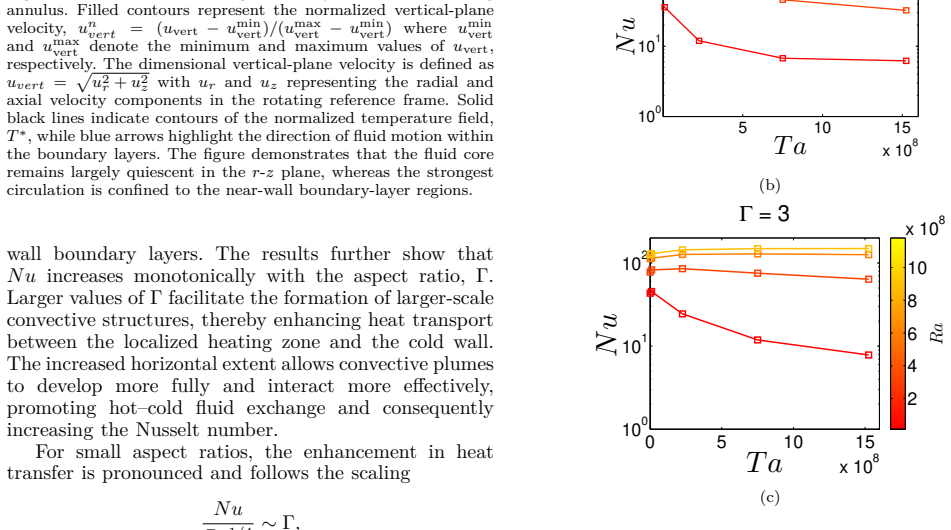
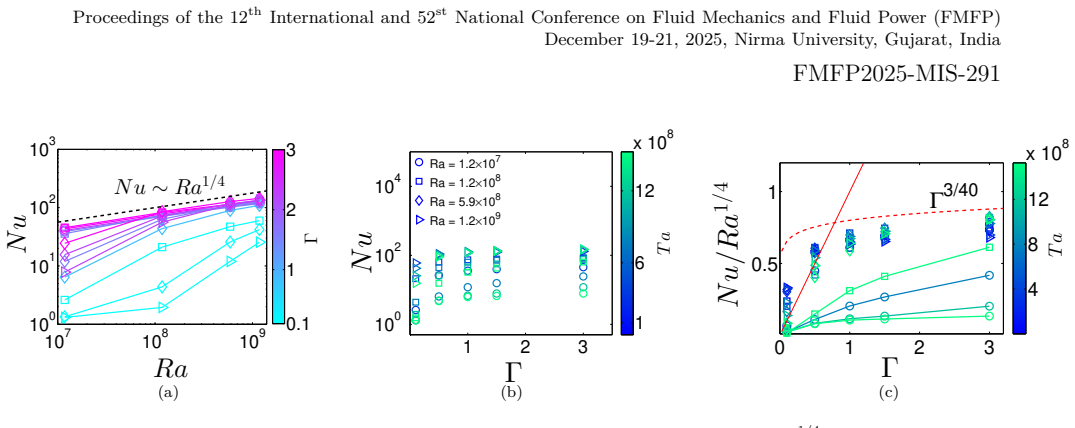
In rotating annular convection with localized heating, Nu scales as Ra^{1/4} for moderate and high Ra with weak rotation influence, while aspect ratio increases heat transfer up to Gamma of 1.
A machine-rendered reading of the paper's core claim, the machinery that carries it, and where it could break.
Core claim
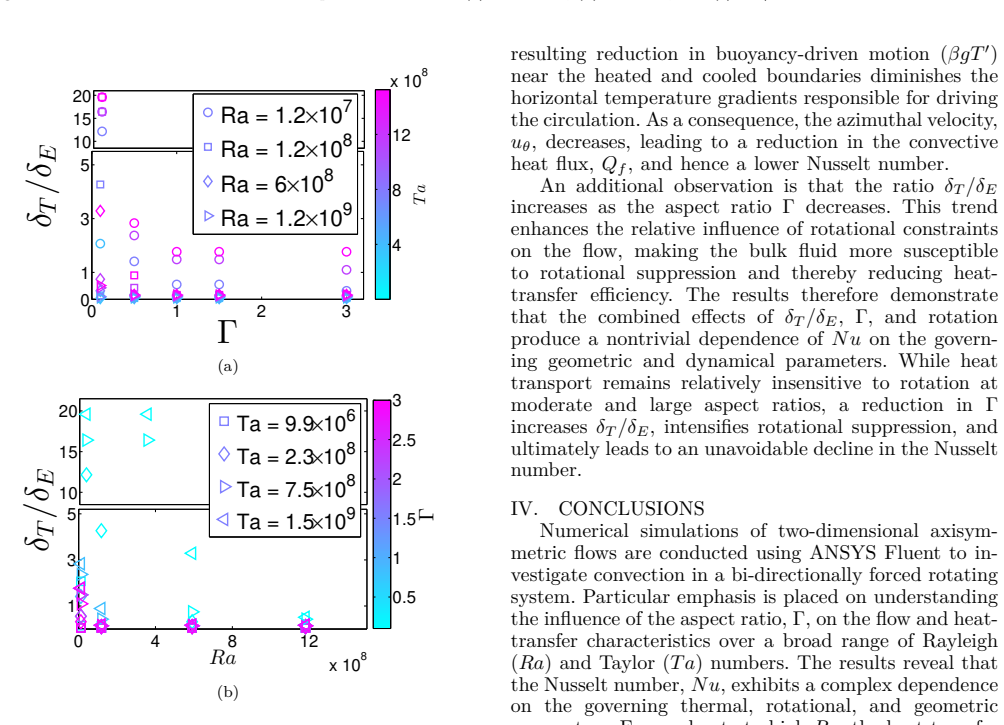
For moderate and high Ra the Nusselt number follows Nu ∼ Ra^{1/4} and is only weakly influenced by rotation. At low Ra and high Ta rotational suppression of buoyancy reduces Nu significantly. Increasing Gamma enhances heat transfer although the growth rate diminishes for Gamma > 1. The relative thicknesses of the thermal and Ekman boundary layers govern the sensitivity of heat transfer to rotation.
What carries the argument
The relative thermal and Ekman boundary-layer thicknesses that control how strongly rotation affects the overall heat transfer rate.
If this is right
- Nu follows the Ra^{1/4} scaling with only weak Ta dependence once Ra is moderate or high.
- At low Ra and high Ta, rotation reduces Nu through suppression of buoyancy.
- Nu rises with increasing Gamma, but the increase slows for Gamma greater than 1.
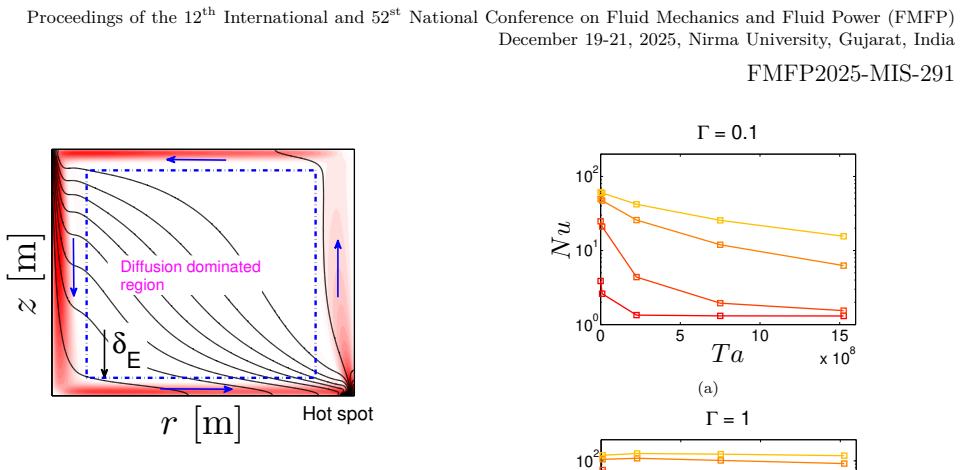
- Convection stays inside thin boundary layers while the fluid interior remains diffusion-dominated.
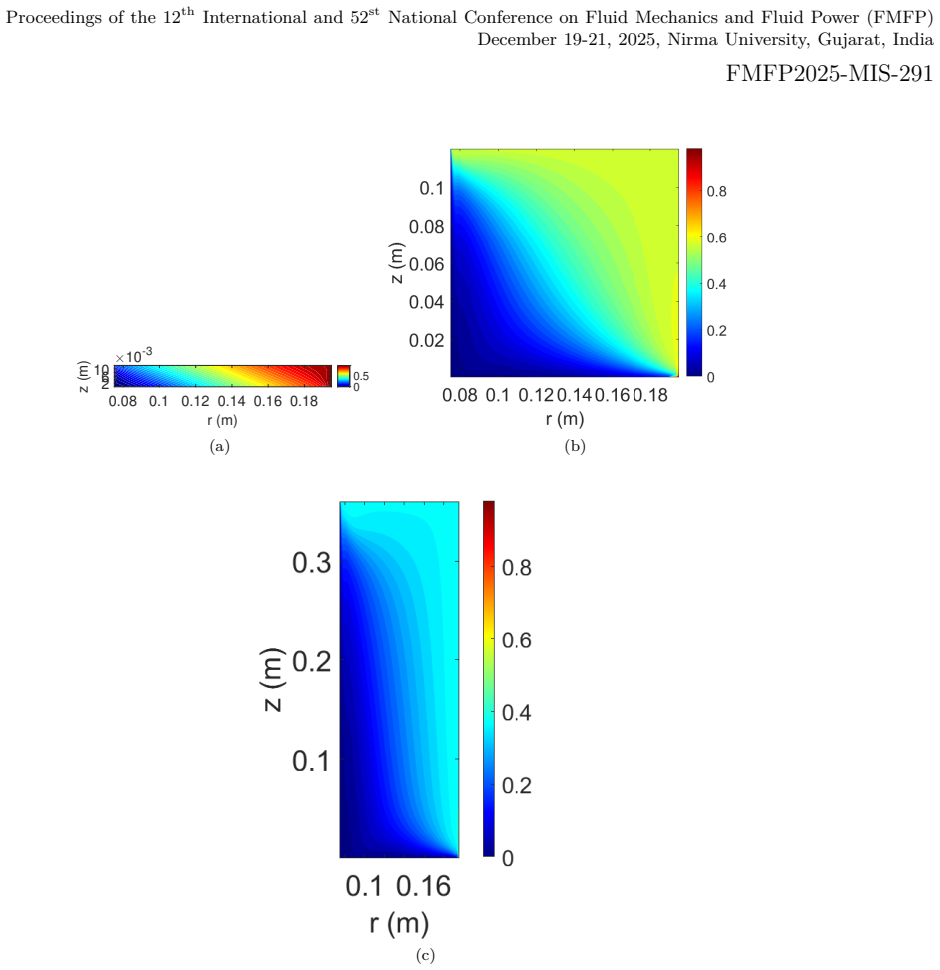
- Rotation shifts the temperature field from nearly horizontal isotherms to ones that penetrate deeper via geostrophic balance.
Where Pith is reading between the lines
- The boundary-layer control suggests that similar scaling might appear in other rotating stratified systems once the Ekman and thermal layers are comparable.
- The diminishing return for Gamma > 1 implies an optimal geometry range for maximizing heat transport in annular devices.
- The weak rotation effect at high Ra indicates that non-rotating models could still give useful first-order estimates in that regime.
- Testing the same parameters in a full 3D geometry would check whether azimuthal motions change the reported Nu values.
Load-bearing premise
The 2D axisymmetric approximation is sufficient to capture the essential convection dynamics and heat transfer under the given localized heating and cooling boundary conditions.
What would settle it
A laboratory experiment or 3D simulation that measures Nu at the same Ra, Ta, and Gamma values and finds a scaling exponent different from 1/4 or a stronger dependence on Ta would falsify the central scaling claims.
Figures
read the original abstract
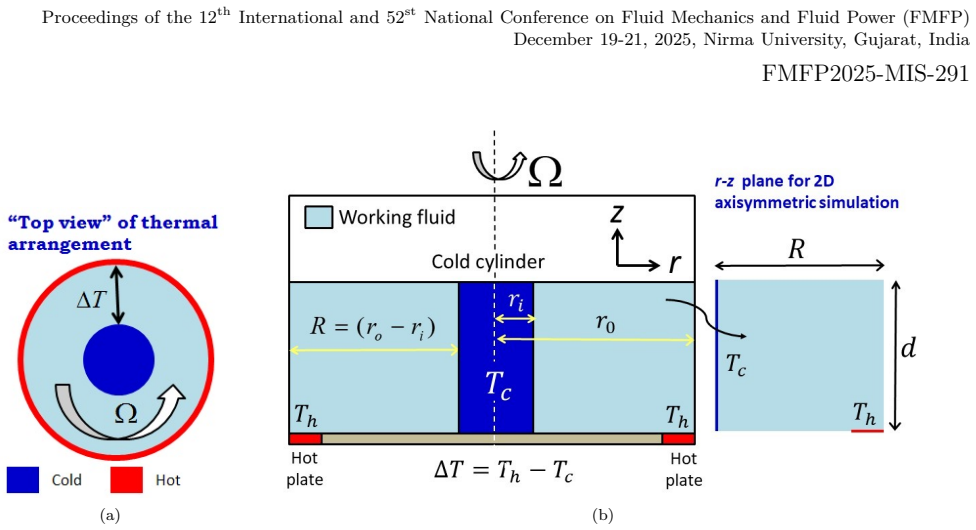
Two-dimensional (2D) axisymmetric simulations are conducted to investigate convection in a rotating cylindrical annulus with localized heating at the outer bottom edge and uniform cooling at the inner cylindrical wall. The resulting radial and vertical temperature gradients generate buoyancy-driven motion and produce a stratification pattern relevant to atmospheric circulation. The effects of aspect ratio (\(\Gamma\)), Rayleigh number (\(Ra = 2.4 \times 10^{7}\)--\(1.2 \times 10^{9}\)), and Taylor number (\(Ta = 1.6 \times 10^{7}\)--\(1.2 \times 10^{9}\)), including the non-rotating limit (\(Ta=0\)), are examined. Convection is largely confined to thin boundary layers, while the fluid interior remains diffusion dominated. Without rotation, the temperature field exhibits nearly horizontal isotherms. Rotation establishes quasi-hydrostatic and geostrophic balances that redistribute heat and promote deeper penetration of isotherms into the interior. Heat transfer, quantified by the Nusselt number (\(Nu\)), depends strongly on \(Ra\), \(Ta\), and \(\Gamma\). For moderate and high \(Ra\), \(Nu\) follows the scaling \(Nu \sim Ra^{1/4}\) and is only weakly influenced by rotation. At low \(Ra\) and high \(Ta\), rotational suppression of buoyancy reduces \(Nu\) significantly. Increasing \(\Gamma\) enhances heat transfer, although the growth rate diminishes for \(\Gamma > 1\). The relative thermal and Ekman boundary-layer thicknesses govern the sensitivity of heat transfer to rotation.
Editorial analysis
A structured set of objections, weighed in public.
Referee Report
Summary. The manuscript reports two-dimensional axisymmetric numerical simulations of buoyancy-driven convection in a rotating cylindrical annulus with localized heating at the outer bottom edge and uniform cooling at the inner cylindrical wall. It examines the effects of aspect ratio Γ, Rayleigh number Ra (2.4×10^7 to 1.2×10^9), and Taylor number Ta (1.6×10^7 to 1.2×10^9, including Ta=0) on flow structure, temperature distribution, and heat transfer via the Nusselt number Nu. Key results include convection largely confined to thin boundary layers with a diffusion-dominated interior, nearly horizontal isotherms without rotation, deeper isotherm penetration under rotation due to quasi-hydrostatic and geostrophic balances, Nu∼Ra^{1/4} scaling for moderate and high Ra with only weak rotational influence, significant Nu reduction at low Ra and high Ta due to rotational suppression of buoyancy, and increasing heat transfer with Γ that saturates for Γ>1, governed by relative thermal and Ekman boundary-layer thicknesses.
Significance. If the reported scalings and boundary-layer analysis hold under the stated conditions, the work contributes to understanding regime transitions in rotating annular convection relevant to atmospheric models, particularly the weak Ta dependence at higher Ra and the role of Γ in enhancing heat transfer. The explicit parameter ranges and mechanistic explanation via boundary-layer thicknesses are strengths. However, the exclusive reliance on 2D axisymmetric simulations limits the significance, as three-dimensional effects could alter the claimed scalings and rotation sensitivity.
major comments (2)
- [Abstract] Abstract (first sentence) and overall simulation approach: the headline claims (Nu∼Ra^{1/4} at moderate/high Ra with weak Ta dependence; strong suppression only at low Ra/high Ta; Γ enhancement saturating above 1) rest entirely on 2D axisymmetric runs. In a rotating annulus with radial buoyancy, the Taylor-Proudman constraint permits 3D baroclinic or azimuthal instabilities whose absence in 2D may artificially enforce the reported boundary-layer confinement and geostrophic interior, undermining the central scaling and rotation-sensitivity conclusions.
- [Abstract] Abstract (Nu scaling paragraph): the statement that Nu follows Nu∼Ra^{1/4} for moderate and high Ra is presented without reference to the number of data points, fitting procedure, or error bars on the exponent; this is load-bearing for the claim that rotation is only weakly influential, as the exponent could be influenced by the 2D restriction or post-hoc selection of the 'moderate/high Ra' regime.
minor comments (2)
- [Abstract] The abstract mentions 'the relative thermal and Ekman boundary-layer thicknesses' as governing sensitivity but does not define or derive their explicit expressions; adding these in the main text would improve clarity.
- No mention of grid resolution, convergence tests, or comparison to non-axisymmetric cases; these details are needed to assess the robustness of the reported boundary-layer confinement.
Simulated Author's Rebuttal
We thank the referee for their thorough review and insightful comments, which have helped us identify areas for clarification. We address each major comment below and will revise the manuscript accordingly where appropriate. Our responses focus on the substance of the concerns regarding the 2D approach and scaling details.
read point-by-point responses
-
Referee: [Abstract] Abstract (first sentence) and overall simulation approach: the headline claims (Nu∼Ra^{1/4} at moderate/high Ra with weak Ta dependence; strong suppression only at low Ra/high Ta; Γ enhancement saturating above 1) rest entirely on 2D axisymmetric runs. In a rotating annulus with radial buoyancy, the Taylor-Proudman constraint permits 3D baroclinic or azimuthal instabilities whose absence in 2D may artificially enforce the reported boundary-layer confinement and geostrophic interior, undermining the central scaling and rotation-sensitivity conclusions.
Authors: We acknowledge that three-dimensional effects, including possible baroclinic or azimuthal instabilities permitted by the Taylor-Proudman constraint, are not captured in our axisymmetric simulations and could influence the flow structure in a full 3D setting. The manuscript is explicitly framed as a 2D study to systematically explore the wide parameter space (Ra, Ta, Γ) at feasible computational cost, consistent with prior 2D investigations of annular convection. We will add a dedicated paragraph in the revised manuscript discussing the limitations of the 2D approximation, referencing relevant 3D studies on rotating convection, and noting that the reported boundary-layer confinement and scalings apply within this modeling framework. This does not claim universality beyond 2D but provides mechanistic insight via the boundary-layer analysis. revision: partial
-
Referee: [Abstract] Abstract (Nu scaling paragraph): the statement that Nu follows Nu∼Ra^{1/4} for moderate and high Ra is presented without reference to the number of data points, fitting procedure, or error bars on the exponent; this is load-bearing for the claim that rotation is only weakly influential, as the exponent could be influenced by the 2D restriction or post-hoc selection of the 'moderate/high Ra' regime.
Authors: We agree that additional details on the scaling analysis are required for transparency. The Nu∼Ra^{1/4} relation was obtained from least-squares fits to simulation data in the specified Ra range, using approximately 20–25 data points across the moderate-to-high Ra cases (with separate fits for different Ta and Γ). In the revised manuscript, we will report the exact number of points, the fitting method, the resulting exponent with 95% confidence intervals, and the criteria used to delineate the 'moderate/high Ra' regime (based on where the local slope in log-log space approaches 0.25 within a tolerance). This will strengthen the claim of weak rotational influence at higher Ra. revision: yes
- Full validation of the reported scalings and rotation sensitivity in three-dimensional simulations, which would require substantial additional computational resources beyond the present study.
Circularity Check
No circularity; results are direct outputs of numerical simulations
full rationale
The paper reports outcomes from 2D axisymmetric numerical simulations of convection under varying Ra, Ta, and Γ. Reported scalings such as Nu ∼ Ra^{1/4} for moderate/high Ra are presented as observed from the simulation data, not as predictions derived from fitted parameters or self-referential equations. No load-bearing derivations, self-citations, or ansatzes are invoked that reduce the central claims to their own inputs by construction. The work is self-contained as a simulation study against external benchmarks of heat transfer and flow regimes.
Axiom & Free-Parameter Ledger
axioms (2)
- standard math The Boussinesq approximation and incompressible Navier-Stokes equations govern the buoyancy-driven flow.
- domain assumption Two-dimensional axisymmetric geometry captures the dominant dynamics without significant three-dimensional effects.
Reference graph
Works this paper leans on
-
[1]
Deterministic nonperiodic flow,
E. N. Lorenz, “Deterministic nonperiodic flow,” J. Atmos. Sci., vol. 20, pp. 130–141, 1963
1963
-
[2]
Ghil and S
M. Ghil and S. Childress, Topics in Geophysical Fluid Dy- namics, Springer, New York, 1987
1987
-
[3]
A.K. Banerjee, Axisymmetric Study of Convection in Rotating Annulus in the Presence of Localized Heating, Physics of Fluids, Vol. 36, Issue 12, 126621, December 2024. doi: https: //doi.org/10.1063/5.0239746
-
[4]
A.K. Banerjee, A. Bhattacharya, S. Balasubramanian, Inves- tigation of Heat Transfer Characteristics in a Rotating Con- vection System with Bidirectional Thermal Gradients, ASME J. Heat Transfer, January 2021; 143(1):011802. doi: https: //doi.org/10.1115/1.4048825
-
[5]
A.K. Banerjee, A. Bhattacharya, S. Balasubramanian, Ex- perimental Study of Rotating Convection in the Presence of Bi-directional Thermal Gradients with Localized Forcing, AIP Advances, Vol. 8, Issue 11, 115324, 2018. doi: https: //doi.org/10.1063/1.5061808
-
[6]
S. Swarnakar, A.K. Banerjee, A. Bhattacharya, S. Balasub- ramanian, Numerical Investigation of Rotating Convection in a New Configuration with Bidirectional Thermal Gradients, in: T. Prabu, P. Viswanathan, A. Agrawal, J. Banerjee (eds.), Fluid Mechanics and Fluid Power, Lecture Notes in Mechanical Engineering, Springer, Singapore, 2021. doi: https: //doi....
-
[7]
Kaiser, Heat Transfer by Symmetrical Rotating An- nulus Convection, Journal of the Atmospheric Sciences, Vol
J. Kaiser, Heat Transfer by Symmetrical Rotating An- nulus Convection, Journal of the Atmospheric Sciences, Vol. 28, pp. 929–932, 1971. doi: https://doi.org/10.1175/ 1520-0469(1971)028<0929:HTBSRA>2.0.CO;2
1971
-
[8]
Hide and W
R. Hide and W. Fowlis, Thermal Convection in a Ro- tating Annulus of Liquid: Effect of Viscosity on the Transition Between Axisymmetric and Non-Axisymmetric Flow Regimes, Journal of the Atmospheric Sciences, Vol. 22, pp. 541–558, 1965. doi: https://doi.org/10.1175/ 1520-0469(1965)022<0541:TCIARA>2.0.CO;2
1965
-
[9]
R. Hide, P. Mason, and R. Plumb, Thermal Convection in a Rotating Fluid Subject to a Horizontal Temperature Gradient: Spatial and Temporal Characteristics of Fully De- veloped Baroclinic Waves, Journal of the Atmospheric Sci- ences, Vol. 34, pp. 930–950, 1977. doi: https://doi.org/10. 1175/1520-0469(1977)034<0930:TCIARF>2.0.CO;2
1977
-
[10]
Aspect ratio dependence in the convection in rotating annulus in the presence of localized heating,
A. K. Banerjee and S. Swarnakar, “Aspect ratio dependence in the convection in rotating annulus in the presence of localized heating,” in Recent Advances in Thermal and Fluid Science, A. K. Parwani, D. K. Gupta, V. M. Patel, and S. Ray, Eds., Lecture Notes in Mechanical Engineering, Springer, Singapore, 2026, doi: 10.1007/978-981-96-8508-0_1
-
[11]
A. K. Banerjee, “An integrated laboratory and axisymmetric numerical study of convection in a rotating annulus with bi- directional thermal forcings,” in Recent Advances in Thermal and Fluid Science, A. K. Parwani, D. K. Gupta, V. M. Patel, and S. Ray, Eds., Lecture Notes in Mechanical Engineering, Springer, Singapore, 2026, doi: 10.1007/978-981-96-8508-0_3
-
[12]
A.K. Banerjee, S. Tirodkar, A. Bhattacharya, S. Balasubra- manian, Convection in Rotating Flows with Simultaneous Im- position of Radial and Vertical Temperature Gradients, VIII th Intl. Symp. on Stratified Flows, August 29–September 1, 2016, San Diego, CA, USA. arXiv:1611.00807
Pith/arXiv arXiv 2016
-
[13]
H.T. Rossby, On thermal convection driven by non-uniform heating from below: an experimental study, Deep Sea Re- search and Oceanographic Abstracts, Vol. 12, pp. 9–16, 1965. doi: https://doi.org/10.1016/0011-7471(65)91336-7
-
[14]
Experimental study of rotating convection in a novel config- uration,
A. K. Banerjee, A. Bhattacharya, and S. Balasubramanian, “Experimental study of rotating convection in a novel config- uration,” in Proc. 5th Int. Conf. on Computational Methods for Thermal Problems (ThermaComp2018), Bangalore, India, Jul. 9–11, 2018, ISSN 2305-6924
2018
-
[15]
Effect of rotation and baroclinicity on heat transport and tur- bulent convection in annular flow,
A. K. Banerjee, A. Bhattacharya, and S. Balasubramanian, “Effect of rotation and baroclinicity on heat transport and tur- bulent convection in annular flow,” in Proc. 6th Int. Congress on Computational Mechanics and Simulation (ICCMS), IIT Bombay, India, Jun. 27–Jul. 1, 2016
2016
-
[16]
S. Balasubramanian, H. N. Mirajkar, and A. K. Banerjee, “Role of dispersed particles on the dynamics of an umbrella cloud of a forced plume in a linearly stratified environment,” Environmental Fluid Mechanics, vol. 18, no. 3, pp. 985–1006, 2018, doi: 10.1007/s10652-018-9585-9
-
[17]
J. Nandan V and A. K. Banerjee, “Linear stability anal- ysis of convective flows in rotating baroclinic annulus with localized peripheral heating: A Floquet–BiGlobal approach,” arXiv:2606.03258 [physics.flu-dyn], 2026
Pith/arXiv arXiv 2026
-
[18]
Reduced order model for a convective rotating annulus with localized forcing,
S. Suresh and A. K. Banerjee, “Reduced order model for a convective rotating annulus with localized forcing,” arXiv:2606.03275 [physics.flu-dyn], 2026
Pith/arXiv arXiv 2026
discussion (0)
Sign in with ORCID, Apple, or X to comment. Anyone can read and Pith papers without signing in.