A Deep Dive into Baryon Asymmetry -- the C2HDM
Pith reviewed 2026-06-28 08:52 UTC · model grok-4.3
The pith
A new BSMPT implementation computes baryon asymmetry using generalized transport equations with arbitrary moments in the C2HDM.
A machine-rendered reading of the paper's core claim, the machinery that carries it, and where it could break.
Core claim
The central discovery is a new implementation of baryon asymmetry computation in BSMPT based on the WKB ansatz that generalizes the transport equations to an arbitrary number of moments, with two truncation schemes implemented and the VEV profile derived from the equations of motion. Validation on a simple benchmark confirms the approach, and a detailed analysis in the C2HDM reveals dependencies on the number of moments, truncation scheme, wall velocity, VEV profile, phase transition strength, and CP violation, including an uncertainty analysis and connection to gravitational wave signals at LISA. The implementation applies to any extended Higgs sector with arbitrary VEV directions barring t
What carries the argument
The WKB ansatz generalized to an arbitrary number of moments in the transport equations, along with two truncation schemes and a VEV profile solved from the equations of motion.
If this is right
- Baryon asymmetry calculations become possible for Higgs sectors with more than two doublets or arbitrary VEV directions.
- The dependence of the asymmetry on the number of moments and truncation scheme can be systematically studied.
- The generated asymmetry can be correlated with the gravitational wave signal observable at LISA.
- Uncertainty estimates from the analysis provide a basis for constraining model parameters using cosmological data.
Where Pith is reading between the lines
- Future work could incorporate the collision term to improve accuracy in dense plasma regimes.
- The method might help identify which extended Higgs models can explain the observed baryon asymmetry while satisfying other constraints.
- Testing against full numerical solutions of the transport equations would quantify the approximation errors.
Load-bearing premise
The WKB ansatz and the chosen truncation schemes for the transport equations remain valid approximations when the collision term is omitted and the derived VEV profile accurately represents the phase transition dynamics.
What would settle it
A full numerical solution of the Boltzmann transport equations including the collision term that yields a significantly different baryon asymmetry value for the same C2HDM benchmark point would falsify the results.
Figures






read the original abstract
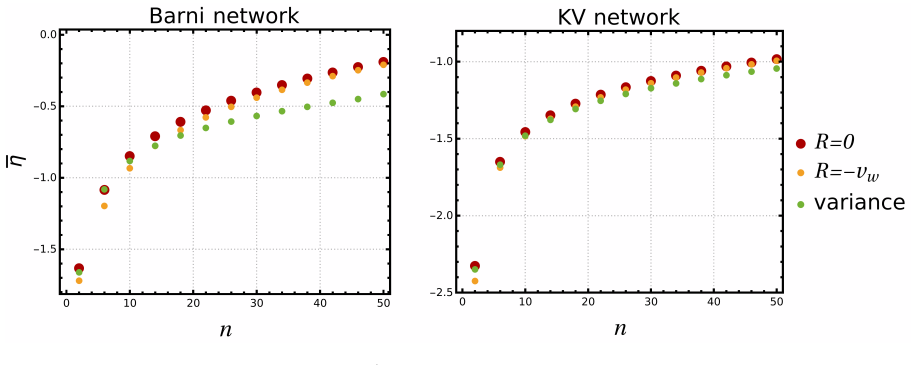
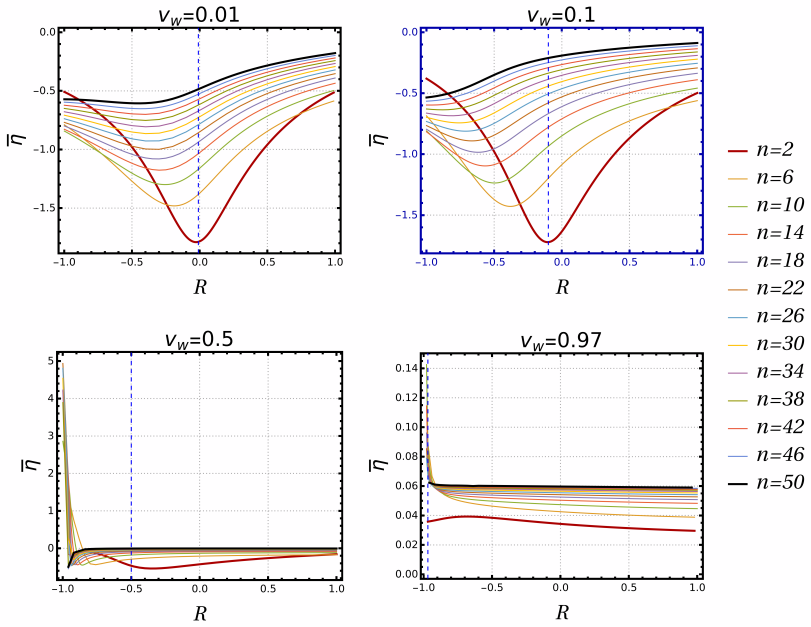
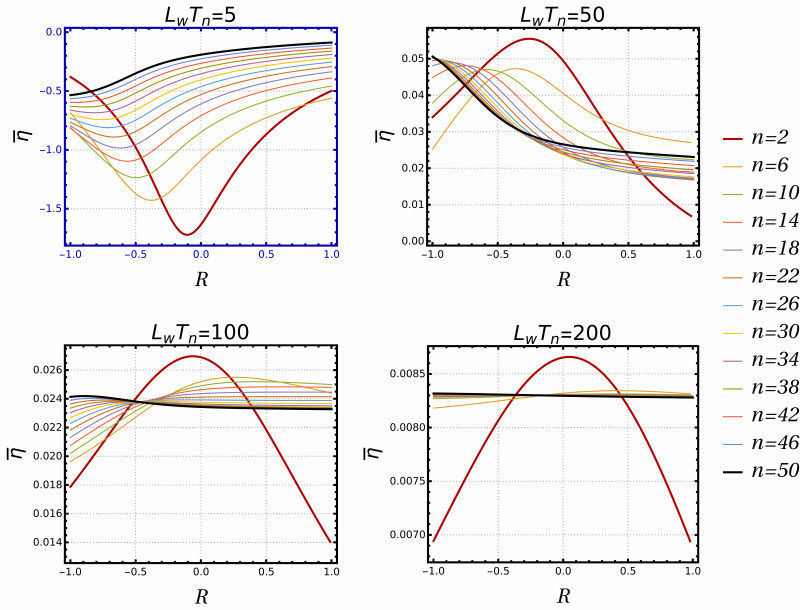
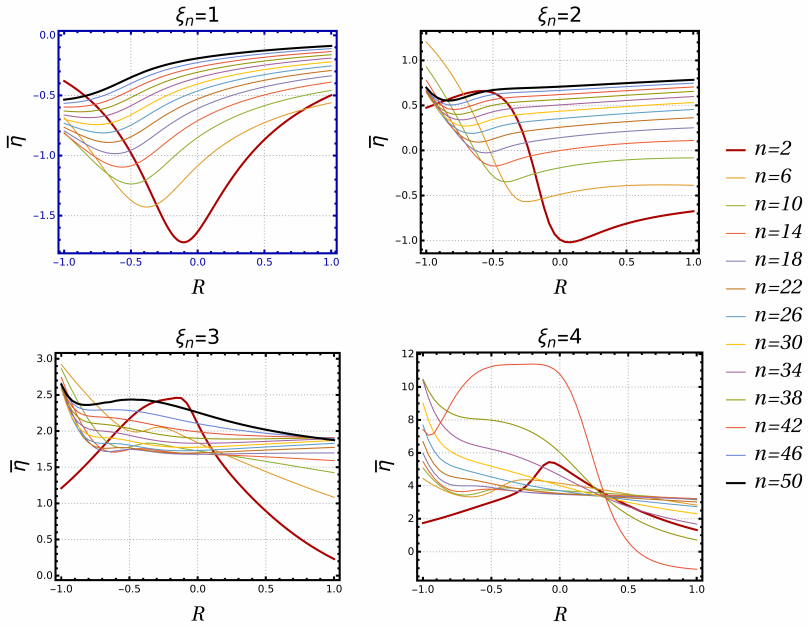
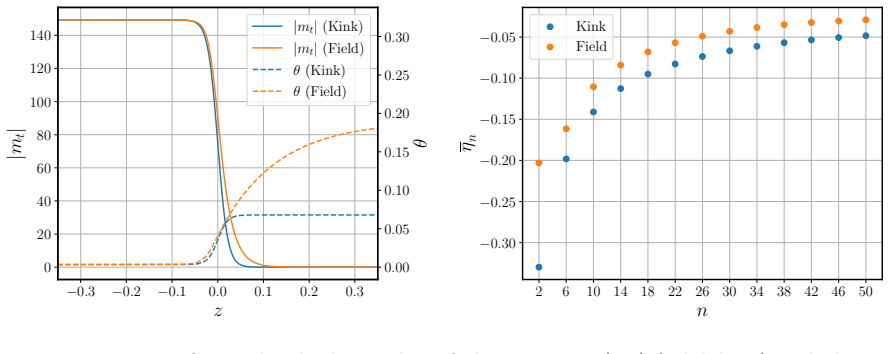
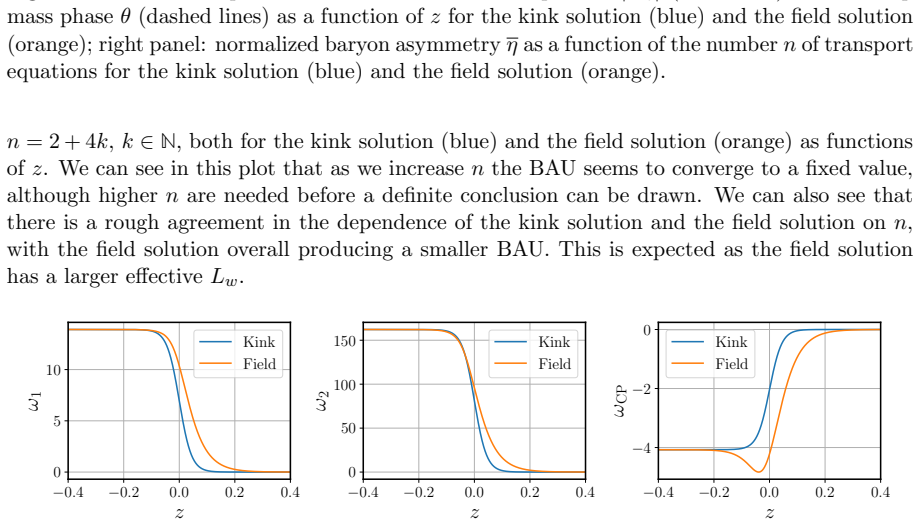
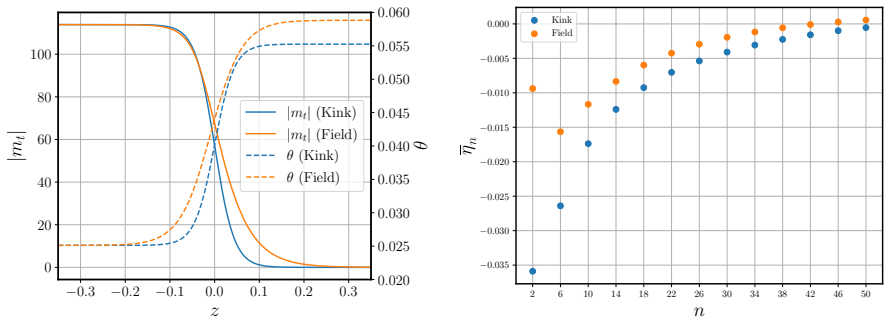
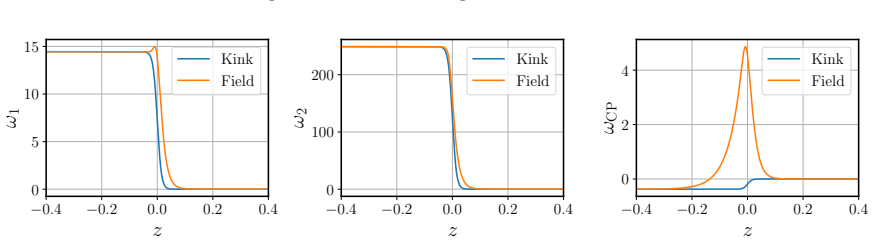
In this paper, we present our new implementation of the computation of the baryon asymmetry in the code BSMPT. It is based on the WKB ansatz generalizing the transport equations to an arbitrary number of moments. Two different truncation schemes are implemented, and the profile of the vacuum expectation value (VEV) is derived from the equations of motion in addition to the modeling with the kink profile. We validate our implementation with a simple benchmark model and perform a detailed analysis within the CP-violating 2-Higgs-Doublet Model (C2HDM). Barring the collision term, however, our implementation can readily be applied to any extended Higgs sector with an arbitrary number of VEV directions. We study in detail the dependencies of the baryon asymmetry on the number of moment equations, the applied truncation scheme, the wall velocity, the wall velocity times wall width, the VEV profile, the strength of the phase transition, and the amount of CP violation in the model and present a detailed uncertainty analysis. We investigate the interplay of the generated baryon asymmetry and the gravitational waves signal at LISA. Our results guide the way for future improvements in the computation of the baryon asymmetry and give directions for model building. The uncertainty analysis is the basis for any investigation aiming at deducing model parameters from cosmological processes.
Editorial analysis
A structured set of objections, weighed in public.
Referee Report
Summary. The manuscript presents a new implementation in the BSMPT code for calculating the baryon asymmetry using a WKB-based generalization of the transport equations to an arbitrary number of moments, with two truncation schemes and VEV profiles obtained from the equations of motion (in addition to the kink ansatz). It validates the code on a benchmark model, performs a detailed parameter study in the CP-violating 2HDM including dependencies on moment count, truncation, wall velocity, phase transition strength, and CP violation, provides an uncertainty analysis, and examines the interplay with gravitational wave signals at LISA. The implementation is stated to apply to arbitrary extended Higgs sectors barring the collision term.
Significance. If the underlying approximations remain controlled, the work supplies a flexible, extensible tool for baryon asymmetry computations in multi-scalar models together with systematic uncertainty quantification. The arbitrary-moment capability and EOM-derived VEV profiles, combined with the C2HDM exploration, could usefully guide model-building and future cosmological interpretations.
major comments (2)
- [Abstract] Abstract: the central claim that the implementation 'can readily be applied to any extended Higgs sector with an arbitrary number of VEV directions' (barring the collision term) rests on the assumption that the collisionless WKB moment hierarchy plus chosen truncations remains a controlled approximation to the full Boltzmann system; no quantitative estimate of truncation error or comparison to solutions that retain the collision term is supplied for the C2HDM benchmark.
- [Validation and C2HDM analysis sections] Validation and C2HDM analysis sections: because the baryon asymmetry is sourced at the wall and propagated through the moment hierarchy, the omission of the collision term directly scales the final result; the paper should demonstrate that the reported dependencies and uncertainty bands are robust under this approximation, for example by showing convergence with increasing moment number against a reference calculation that includes damping.
Simulated Author's Rebuttal
We thank the referee for the detailed and constructive report. Below we respond point-by-point to the two major comments. Our responses clarify the scope of the work while acknowledging where additional discussion can be added.
read point-by-point responses
-
Referee: [Abstract] Abstract: the central claim that the implementation 'can readily be applied to any extended Higgs sector with an arbitrary number of VEV directions' (barring the collision term) rests on the assumption that the collisionless WKB moment hierarchy plus chosen truncations remains a controlled approximation to the full Boltzmann system; no quantitative estimate of truncation error or comparison to solutions that retain the collision term is supplied for the C2HDM benchmark.
Authors: The abstract already qualifies the claim with the explicit caveat 'barring the collision term'. Within the collisionless WKB framework the truncation error is quantified by the explicit convergence studies versus moment number and the two truncation schemes presented in the C2HDM analysis. A direct numerical comparison to a calculation that retains the collision term lies outside the present implementation, which is deliberately restricted to the collisionless case. We will revise the abstract to make this limitation even more prominent. revision: partial
-
Referee: [Validation and C2HDM analysis sections] Validation and C2HDM analysis sections: because the baryon asymmetry is sourced at the wall and propagated through the moment hierarchy, the omission of the collision term directly scales the final result; the paper should demonstrate that the reported dependencies and uncertainty bands are robust under this approximation, for example by showing convergence with increasing moment number against a reference calculation that includes damping.
Authors: The reported dependencies and uncertainty bands are obtained and shown to converge inside the collisionless approximation; the moment-number scans already provide a quantitative handle on truncation error within that framework. Adding damping (collision) terms would require a substantial extension of the transport-equation solver that is beyond the scope of this work. We will insert a concise paragraph in the validation section that explicitly states the limitation, references the standard use of the collisionless approximation in the literature, and notes that the present results are to be understood within that controlled setting. revision: partial
Circularity Check
No circularity detected in WKB transport implementation
full rationale
The paper's derivation chain consists of a numerical implementation extending the standard WKB ansatz to arbitrary moment count and VEV directions, with two explicit truncation schemes and VEV solved from the equations of motion (or kink profile). Validation occurs on an external benchmark model, followed by parameter scans in the C2HDM. No equation or step reduces a claimed prediction to a fitted input by construction, nor does any load-bearing premise collapse to a self-citation whose content is itself unverified. Self-citations for the BSMPT framework are infrastructural and do not render the asymmetry computation tautological. The reported dependencies and uncertainty analysis are direct numerical outputs, not definitional identities.
Axiom & Free-Parameter Ledger
axioms (2)
- domain assumption WKB ansatz remains a valid approximation for the transport equations in the C2HDM
- domain assumption Two truncation schemes suffice to close the moment hierarchy
Reference graph
Works this paper leans on
-
[1]
Planck, N. Aghanim et al., Astron. Astrophys.641, A6 (2020), 1807.06209, [Erratum: Astron.Astrophys. 652, C4 (2021)]
Pith/arXiv arXiv 2020
-
[2]
V. A. Kuzmin, V. A. Rubakov, and M. E. Shaposhnikov, Phys. Lett.155B, 36 (1985)
1985
-
[3]
A. G. Cohen, D. B. Kaplan, and A. E. Nelson, Nucl. Phys.B349, 727 (1991)
1991
-
[4]
A. G. Cohen, D. B. Kaplan, and A. E. Nelson, Ann. Rev. Nucl. Part. Sci.43, 27 (1993), hep-ph/9302210
Pith/arXiv arXiv 1993
-
[5]
Quiros, Helv
M. Quiros, Helv. Phys. Acta67, 451 (1994)
1994
-
[6]
V. A. Rubakov and M. E. Shaposhnikov, Usp. Fiz. Nauk166, 493 (1996), hep-ph/9603208, [Phys. Usp.39,461(1996)]
Pith/arXiv arXiv 1996
- [7]
- [8]
-
[9]
W. Bernreuther, Lect. Notes Phys.591, 237 (2002), hep-ph/0205279, [,237(2002)]
Pith/arXiv arXiv 2002
-
[10]
D. E. Morrissey and M. J. Ramsey-Musolf, New J. Phys.14, 125003 (2012), 1206.2942
Pith/arXiv arXiv 2012
-
[11]
A. D. Sakharov, Pisma Zh. Eksp. Teor. Fiz.5, 32 (1967)
1967
-
[12]
L. Fromme, S. J. Huber, and M. Seniuch, JHEP11, 038 (2006), hep-ph/0605242
Pith/arXiv arXiv 2006
-
[13]
J. M. Cline, K. Kainulainen, and M. Trott, JHEP11, 089 (2011), 1107.3559
Pith/arXiv arXiv 2011
-
[14]
D. Gon¸ calves, A. Kaladharan, and Y. Wu, Phys. Rev. D108, 075010 (2023), 2307.03224
arXiv 2023
- [15]
-
[16]
M. Aiko, M. Endo, S. Kanemura, and Y. Mura, JHEP07, 236 (2025), 2504.07705
arXiv 2025
- [17]
- [18]
-
[19]
P. Basler and M. M¨ uhlleitner, Comput. Phys. Commun.237, 62 (2019), 1803.02846
Pith/arXiv arXiv 2019
-
[20]
R. Coimbra, M. O. P. Sampaio, and R. Santos, Eur. Phys. J. C73, 2428 (2013), 1301.2599
Pith/arXiv arXiv 2013
-
[21]
P. M. Ferreira, R. Guedes, M. O. P. Sampaio, and R. Santos, JHEP12, 067 (2014), 1409.6723
Pith/arXiv arXiv 2014
-
[22]
R. Costa, M. M¨ uhlleitner, M. O. P. Sampaio, and R. Santos, JHEP06, 034 (2016), 1512.05355
Pith/arXiv arXiv 2016
-
[23]
M. Muhlleitner, M. O. P. Sampaio, R. Santos, and J. Wittbrodt, JHEP03, 094 (2017), 1612.01309. 42
arXiv 2017
-
[24]
M. M¨ uhlleitner, M. O. P. Sampaio, R. Santos, and J. Wittbrodt, Eur. Phys. J. C82, 198 (2022), 2007.02985
arXiv 2022
-
[25]
P. Basler et al., Comput. Phys. Commun.316, 109766 (2025), 2404.19037
arXiv 2025
- [26]
- [27]
- [28]
- [29]
-
[30]
G. C. Branco and M. N. Rebelo, Phys. Lett. B160, 117 (1985)
1985
-
[31]
I. F. Ginzburg, M. Krawczyk, and P. Osland, p. 703 (2002), hep-ph/0211371
Pith/arXiv arXiv 2002
-
[32]
J. F. Gunion and H. E. Haber, Phys. Rev. D67, 075019 (2003), hep-ph/0207010
Pith/arXiv arXiv 2003
-
[33]
W. Khater and P. Osland, Nucl. Phys. B661, 209 (2003), hep-ph/0302004
Pith/arXiv arXiv 2003
-
[34]
I. F. Ginzburg and M. Krawczyk, Phys. Rev. D72, 115013 (2005), hep-ph/0408011
Pith/arXiv arXiv 2005
-
[35]
A. W. El Kaffas, W. Khater, O. M. Ogreid, and P. Osland, Nucl. Phys. B775, 45 (2007), hep-ph/0605142
Pith/arXiv arXiv 2007
-
[36]
A. Arhrib, E. Christova, H. Eberl, and E. Ginina, JHEP04, 089 (2011), 1011.6560
Pith/arXiv arXiv 2011
-
[37]
A. Barroso, P. M. Ferreira, R. Santos, and J. P. Silva, Phys. Rev. D86, 015022 (2012), 1205.4247
Pith/arXiv arXiv 2012
-
[38]
S. Inoue, M. J. Ramsey-Musolf, and Y. Zhang, Phys. Rev. D89, 115023 (2014), 1403.4257
Pith/arXiv arXiv 2014
-
[39]
D. Fontes, J. C. Rom˜ ao, and J. P. Silva, JHEP12, 043 (2014), 1408.2534
Pith/arXiv arXiv 2014
-
[40]
B. Grzadkowski, O. M. Ogreid, and P. Osland, JHEP11, 084 (2014), 1409.7265
Pith/arXiv arXiv 2014
-
[41]
Fontes et al., JHEP02, 073 (2018), 1711.09419
D. Fontes et al., JHEP02, 073 (2018), 1711.09419
Pith/arXiv arXiv 2018
-
[42]
Georgi and D
H. Georgi and D. V. Nanopoulos, Phys. Lett. B82, 95 (1979)
1979
-
[43]
J. F. Donoghue and L. F. Li, Phys. Rev. D19, 945 (1979)
1979
-
[44]
L. Lavoura and J. P. Silva, Phys. Rev. D50, 4619 (1994), hep-ph/9404276
Pith/arXiv arXiv 1994
-
[45]
F. J. Botella and J. P. Silva, Phys. Rev. D51, 3870 (1995), hep-ph/9411288
Pith/arXiv arXiv 1995
-
[46]
A. W. El Kaffas, P. Osland, and O. M. Ogreid, Nonlin. Phenom. Complex Syst.10, 347 (2007), hep-ph/0702097
Pith/arXiv arXiv 2007
-
[47]
F. A. de Souza, N. F. Castro, M. Crispim Rom˜ ao, and W. Porod, JHEP10, 116 (2025), 2505.08862
arXiv 2025
-
[48]
F. A. de Souza et al., JHEP07, 268 (2025), 2505.10625. 43
arXiv 2025
-
[49]
R. Boto, J. A. C. Matos, J. C. Rom˜ ao, and J. P. Silva, (2025), 2510.02445
arXiv 2025
-
[50]
S. L. Glashow and S. Weinberg, Phys. Rev. D15, 1958 (1977)
1958
-
[51]
E. A. Paschos, Phys. Rev. D15, 1966 (1977)
1966
-
[52]
J. M. Cline, M. Joyce, and K. Kainulainen, Phys. Lett. B417, 79 (1998), hep-ph/9708393, [Erratum: Phys.Lett.B 448, 321–321 (1999)]
Pith/arXiv arXiv 1998
-
[53]
J. M. Cline, M. Joyce, and K. Kainulainen, Journal of High Energy Physics2000, 018–018 (2000)
2000
-
[54]
Kainulainen, T
K. Kainulainen, T. Prokopec, M. G. Schmidt, and S. Weinstock, Journal of High Energy Physics2001, 031–031 (2001)
2001
-
[55]
Kainulainen, T
K. Kainulainen, T. Prokopec, M. G. Schmidt, and S. Weinstock, Physical Review D66 (2002)
2002
-
[56]
Fromme and S
L. Fromme and S. J. Huber, Journal of High Energy Physics2007, 049–049 (2007)
2007
-
[57]
J. M. Cline and K. Kainulainen, Phys. Rev. D101, 063525 (2020)
2020
-
[58]
G. D. Moore and T. Prokopec, Phys. Rev. D52, 7182 (1995), hep-ph/9506475
Pith/arXiv arXiv 1995
-
[59]
B.-H. Liu, L. D. McLerran, and N. Turok, Phys. Rev. D46, 2668 (1992)
1992
-
[60]
T. Gent, S. Huber, K. Mimasu, and J. M. No, (2025), 2512.22081
arXiv 2025
-
[61]
Hansen and A
N. Hansen and A. Ostermeier, Evolutionary Computation9, 159 (2001)
2001
-
[62]
N. Hansen, The CMA Evolution Strategy: A Tutorial, ArXiv e-prints, arXiv:1604.00772, 2016, pp.1-39, 2005
Pith/arXiv arXiv 2016
-
[63]
Goldstein and A
M. Goldstein and A. Dengel, Histogram-based outlier score (hbos): A fast unsupervised anomaly detection algorithm, 2012
2012
-
[64]
J. C. Rom˜ ao and M. Crispim Rom˜ a˜ o, Phys. Rev. D109, 095040 (2024), 2402.07661
arXiv 2024
-
[65]
J. T. Giblin and E. Thrane, (2014)
2014
- [66]
-
[67]
Caprini et al., JCAP2003, 024 (2020), 1910.13125
C. Caprini et al., JCAP2003, 024 (2020), 1910.13125
Pith/arXiv arXiv 2020
-
[68]
Amaro-Seoane et al., (2017), 1702.00786
P. Amaro-Seoane et al., (2017), 1702.00786
Pith/arXiv arXiv 2017
-
[69]
LISA Cosmology Working Group, P. Auclair et al., Living Rev. Rel.26, 5 (2023), 2204.05434
arXiv 2023
-
[70]
Huet and A
P. Huet and A. E. Nelson, Physical Review D53, 4578–4597 (1996)
1996
-
[71]
J. M. Cline and B. Laurent, Physical Review D104(2021)
2021
-
[72]
H. A. Weldon, Phys. Rev. D26, 2789 (1982)
1982
-
[73]
Peshier, K
A. Peshier, K. Schertler, and M. H. Thoma, Annals of Physics266, 162–177 (1998)
1998
-
[74]
Hahn, Computer Physics Communications168, 78–95 (2005)
T. Hahn, Computer Physics Communications168, 78–95 (2005). 44
2005
discussion (0)
Sign in with ORCID, Apple, or X to comment. Anyone can read and Pith papers without signing in.