Characterization of errors in photon-heralded quantum operations between non-interacting quantum emitters
Pith reviewed 2026-06-28 06:39 UTC · model grok-4.3
The pith
Perturbative framework yields closed-form solutions for errors in photon-heralded gates on quantum emitters.
A machine-rendered reading of the paper's core claim, the machinery that carries it, and where it could break.
Core claim
The authors derive analytic perturbative solutions that capture both ideal and noisy dynamics of photon-heralded operations conditioned on time-integrated photon counting, providing closed-form process matrices and Pauli error weights to leading order while covering imperfections from photon generation through optical manipulation.
What carries the argument
The perturbative extension of the Zero-Photon-Generation (ZPG) framework, which produces closed-form solutions for noisy conditioned gate dynamics.
If this is right
- Accurate modeling of source-induced noise in repeat-until-success CZ gates matches numerical simulations.
- Analysis of coherent phase-shifter miscalibrations quantifies optical-manipulation errors.
- Physics-informed parameter tuning optimizes gate designs.
- Tailored quantum error correction protocols become feasible for hybrid light-matter systems.
Where Pith is reading between the lines
- The same closed-form approach could apply to other heralded multi-qubit operations beyond the CZ example.
- Optimized parameters from this model might lower the resource overhead of error correction in emitter networks.
- The framework suggests experimental tests that directly measure leading-order Pauli weights versus physical error sources.
Load-bearing premise
The errors stay small enough that a low-order perturbative expansion remains accurate and no new non-Markovian effects invalidate the closed-form results.
What would settle it
Numerical simulation or experiment showing the observed process matrix or Pauli weights deviate substantially from the predicted leading-order expressions once error strengths exceed the perturbative regime.
Figures



read the original abstract
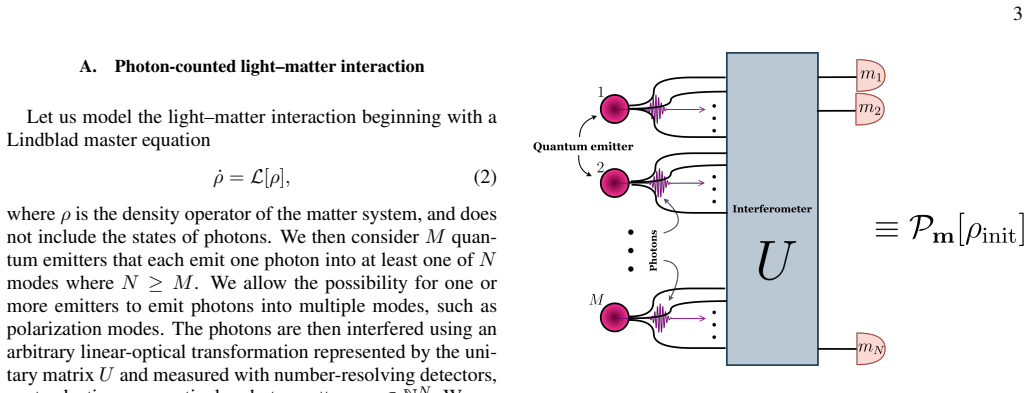
We develop an analytic perturbative framework that enables the analysis of small Markovian errors in probabilistic, photon-heralded quantum operations between non-interacting emitters. Building on and extending the Zero-Photon-Generation (ZPG) framework, we derive closed-form perturbative solutions that capture both ideal (zero-order) and noisy (low-order) gate dynamics conditioned on time-integrated photon counting. Our framework provides analytic solutions to process matrices and Pauli error weights up to leading order, bridging the gap between detailed physical imperfections of a system and its corresponding abstract Pauli noise models. Moreover, our framework captures imperfections across the full physical system stack, from photon generation to optical manipulation. We benchmark the resulting perturbative predictions on a repeat-until-success CZ gate against numerical simulations, demonstrating accurate modeling of source-induced noise, and then apply the same framework to analyze coherent phase-shifter miscalibrations as a representative example of optical-manipulation errors. The methods developed in this work enable physics-informed parameter tuning to optimize gate designs and develop tailored quantum error correction protocols toward fault-tolerant quantum computing using hybrid light--matter quantum systems.
Editorial analysis
A structured set of objections, weighed in public.
Referee Report
Summary. The paper develops an analytic perturbative framework extending the Zero-Photon-Generation (ZPG) model to characterize small Markovian errors in photon-heralded quantum operations between non-interacting emitters. It derives closed-form leading-order solutions for process matrices and Pauli error weights that map physical imperfections (from photon generation through optical manipulation) to abstract Pauli noise models. The framework is benchmarked on a repeat-until-success CZ gate against numerical simulations for source-induced noise and applied to coherent phase-shifter miscalibrations.
Significance. If the leading-order perturbative solutions remain accurate under realistic hardware parameters, the work provides a useful bridge between detailed physical error models and Pauli-channel descriptions, supporting physics-informed gate optimization and tailored error correction for hybrid light-matter systems. The analytic character of the expressions (when valid) is a clear strength for rapid parameter exploration.
major comments (2)
- [Benchmarking section] Benchmarking section: The numerical validation for the repeat-until-success CZ gate is performed only with artificially small error parameters; the manuscript provides no general radius of convergence, explicit error bound on the truncation, or demonstration that higher-order terms remain negligible when photon-generation inefficiency or phase-shifter miscalibration reach values typical of current experiments.
- [Derivation of perturbative process matrices] Derivation of perturbative process matrices: The closed-form expressions are stated to be obtained by extending the ZPG framework to time-integrated photon counting under Markovian noise, yet the text does not supply the explicit intermediate steps or the conditions under which non-Markovian effects from multi-attempt heralding protocols can be neglected.
minor comments (1)
- [Notation] Notation for the leading-order Pauli weights is introduced without a dedicated table summarizing the mapping from each physical error source to the corresponding weight; adding such a table would improve readability.
Simulated Author's Rebuttal
We thank the referee for their careful reading and constructive feedback on our manuscript. We address each major comment below, indicating the revisions we will make to improve clarity and strengthen the presentation of the perturbative framework.
read point-by-point responses
-
Referee: The numerical validation for the repeat-until-success CZ gate is performed only with artificially small error parameters; the manuscript provides no general radius of convergence, explicit error bound on the truncation, or demonstration that higher-order terms remain negligible when photon-generation inefficiency or phase-shifter miscalibration reach values typical of current experiments.
Authors: We agree that the presented benchmarking uses small error parameters to isolate the leading-order behavior. A general radius of convergence is not derived, as is common for perturbative methods where validity depends on the specific noise model and system parameters. In the revised manuscript we will expand the benchmarking section with additional numerical comparisons using realistic experimental values (e.g., photon-generation efficiencies of 80-90% and phase miscalibrations of 0.05-0.1 rad), include plots of the relative contribution of second-order terms, and add a discussion of the perturbative regime based on the magnitude of the first-order corrections relative to the ideal ZPG process matrix. revision: yes
-
Referee: The closed-form expressions are stated to be obtained by extending the ZPG framework to time-integrated photon counting under Markovian noise, yet the text does not supply the explicit intermediate steps or the conditions under which non-Markovian effects from multi-attempt heralding protocols can be neglected.
Authors: The derivation proceeds by inserting the first-order Markovian noise superoperators into the ZPG photon-counting integrals and retaining terms linear in the noise amplitudes. We acknowledge that the main text omits the intermediate algebraic steps. In revision we will insert a new subsection that explicitly shows the expansion of the time-integrated Kraus operators and the resulting process-matrix corrections. We will also state the operating regime in which non-Markovian effects from repeated heralding attempts can be neglected (attempt rate much larger than the inverse coherence time of the emitters), consistent with the Markovian noise assumption already used throughout the work. revision: yes
Circularity Check
No circularity; perturbative derivations are independently benchmarked
full rationale
The paper extends the prior ZPG framework with new closed-form perturbative solutions for process matrices and Pauli weights, then validates the leading-order expressions directly against numerical simulations on a repeat-until-success CZ gate for source-induced noise and phase-shifter errors. This constitutes external falsification rather than reduction to fitted inputs or self-citation chains. The derivation chain remains self-contained because the analytic results are derived from the extended model and checked numerically without the predictions being equivalent to the inputs by construction.
Axiom & Free-Parameter Ledger
Reference graph
Works this paper leans on
-
[1]
We restate the protocol using the terminol- ogy introduced in Section II, focusing on an idealized four- level emitter structure representative of a charged quantum dot
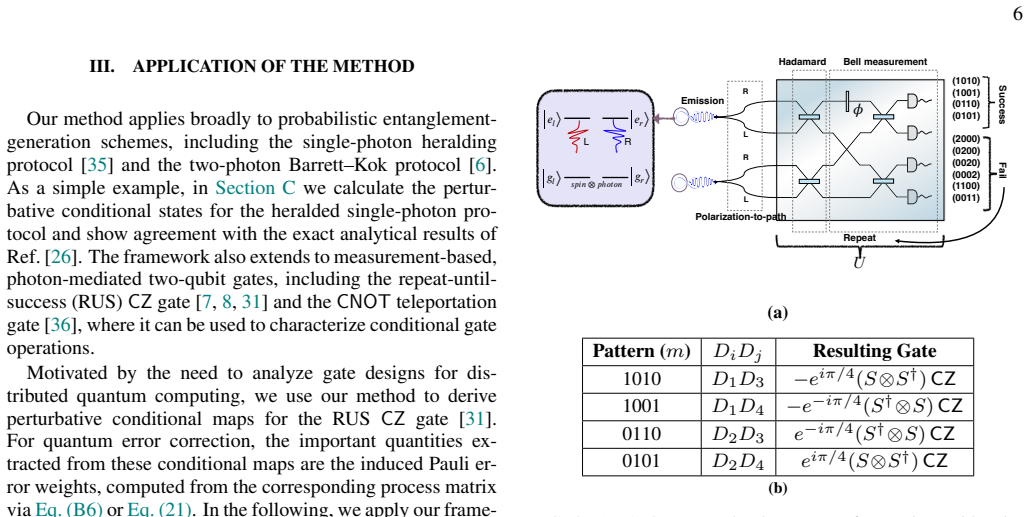
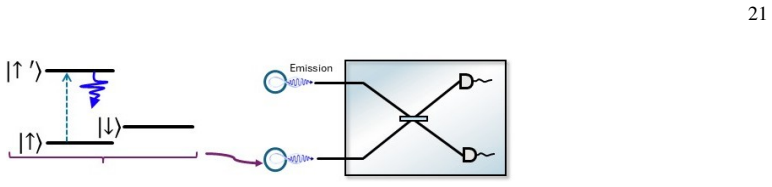
to realize a quasi-deterministicCZgate between non- interacting qubits. We restate the protocol using the terminol- ogy introduced in Section II, focusing on an idealized four- level emitter structure representative of a charged quantum dot. An implementation with two quantum emitters and the corresponding linear-optical entangling circuit is illustrated ...
2000
-
[2]
The corresponding error Lindbladian is Lerr 1 =D(|e ℓ⟩ ⟨er|) +D(|e r⟩ ⟨eℓ|),(25) acting independently on each quantum emitter
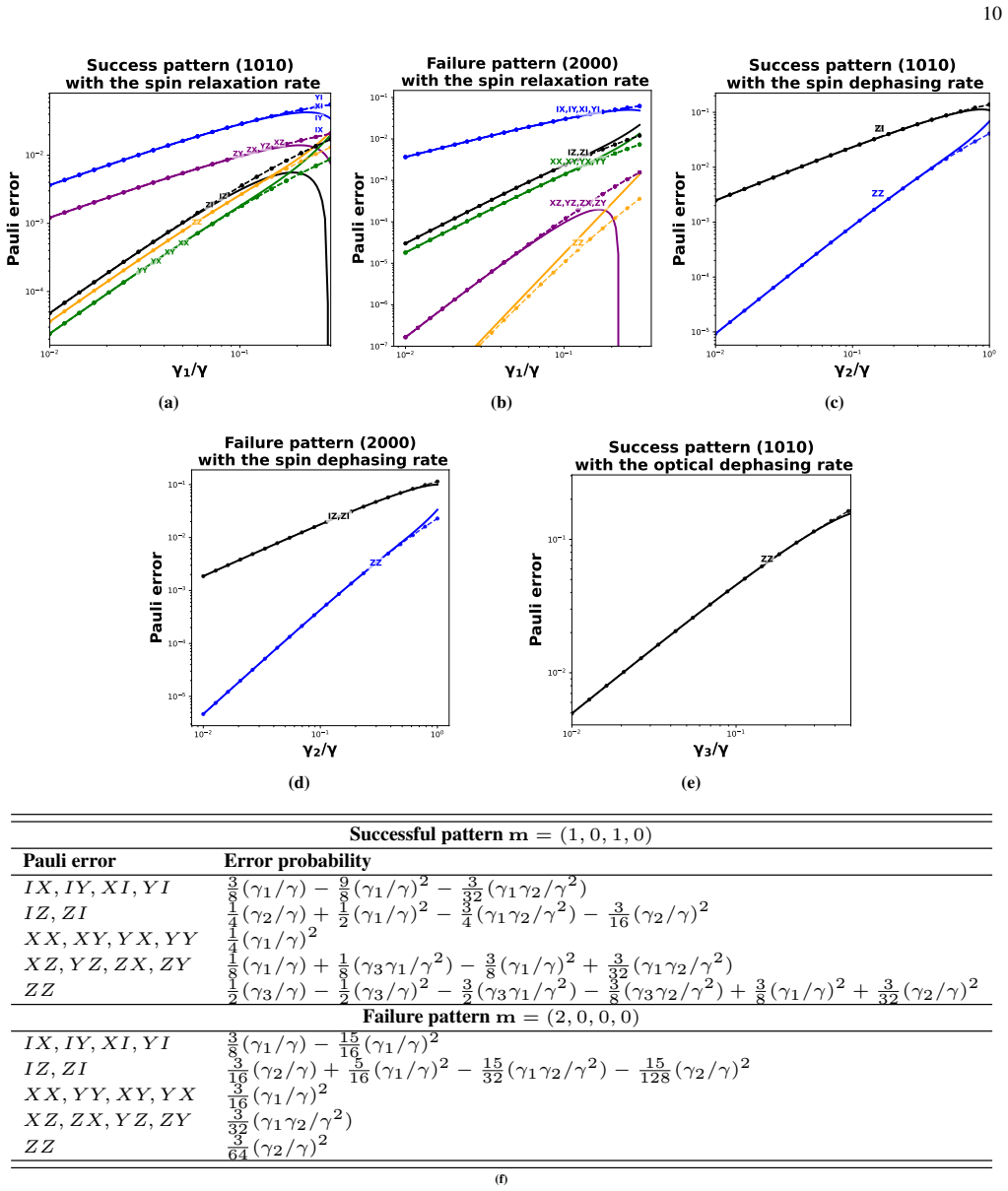
Excited state spin relaxation.We first consider excited- state spin flips occurring at rateγ 1. The corresponding error Lindbladian is Lerr 1 =D(|e ℓ⟩ ⟨er|) +D(|e r⟩ ⟨eℓ|),(25) acting independently on each quantum emitter. Substituting this error generator into the perturbative expansion Eq. (17), and then using the Choi-matrix construction in Eq. (B6), g...
-
[3]
The corresponding error generator is Lerr 2 =D(σ z),(26) whereσ z := 1 2 (|eℓ⟩ ⟨eℓ| − |er⟩ ⟨er|), acting independently on each emitter
Excited state spin dephasing.We next consider de- phasing within the excited-state manifold. The corresponding error generator is Lerr 2 =D(σ z),(26) whereσ z := 1 2 (|eℓ⟩ ⟨eℓ| − |er⟩ ⟨er|), acting independently on each emitter. Following the same procedure as for spin relax- ation, we compute the Pauli error weights and compare them with numerical simula...
-
[4]
This error model prohibits errors other than Z [8]
Pure optical dephasing.The error generator corre- sponding to the emitter optical dephasing rate ofγ 3 is Lerr 3 =D(|e r⟩ ⟨er|+|e ℓ⟩ ⟨eℓ|).(27) Using the perturbative expansion, we find that the Pauli error weights contain only one non-zero term, apart from the iden- tity contribution, provided as (χ(1010))ZZ = 1 2 γ3 γ − 1 2 γ3 γ 2 +O γ3 γ 3! (28) in the...
2000
-
[5]
As an example of this, we study the effects of phase shifter miscali- bration error (i.e.,ϕ= π 2 +δin Eq
Phase shifter error.The framework also captures coher- ent errors and errors that affect the emitted light only. As an example of this, we study the effects of phase shifter miscali- bration error (i.e.,ϕ= π 2 +δin Eq. (22)). Our treatment for 8 this error is different from the previous errors, since it comes as a perturbation toDoperators rather than the...
2000
-
[6]
R. P. Feynman, inFeynman and computation(cRc Press, 2018) pp. 133–153
2018
-
[7]
P. W. Shor, SIAM review41, 303 (1999)
1999
-
[8]
L. K. Grover, inProceedings of the twenty-eighth annual ACM symposium on Theory of computing(1996) pp. 212–219
1996
-
[9]
Preskill, Quantum2, 79 (2018)
J. Preskill, Quantum2, 79 (2018)
2018
-
[10]
Bluvstein, S
D. Bluvstein, S. J. Evered, A. A. Geim, S. H. Li, H. Zhou, T. Manovitz, S. Ebadi, M. Cain, M. Kalinowski, D. Hangleiter, et al., Nature626, 58 (2024)
2024
-
[11]
S. D. Barrett and P. Kok, Physical Review A—Atomic, Molec- ular, and Optical Physics71, 060310 (2005)
2005
-
[12]
Y . L. Lim, S. D. Barrett, A. Beige, P. Kok, and L. C. Kwek, Physical Review A—Atomic, Molecular, and Optical Physics 73, 012304 (2006)
2006
-
[13]
de Gliniasty, P
G. de Gliniasty, P. Hilaire, P.-E. Emeriau, S. C. Wein, A. Salavrakos, and S. Mansfield, Quantum8, 1423 (2024)
2024
-
[14]
M. T. Uysal, Ł. Dusanowski, H. Xu, S. P. Horvath, S. Ourari, R. J. Cava, N. P. De Leon, and J. D. Thompson, Physical Re- view X15, 011071 (2025)
2025
-
[15]
Ruskuc, C.-J
A. Ruskuc, C.-J. Wu, E. Green, S. L. Hermans, W. Pajak, J. Choi, and A. Faraon, Nature639, 54 (2025)
2025
-
[16]
Reiher, N
M. Reiher, N. Wiebe, K. M. Svore, D. Wecker, and M. Troyer, Proceedings of the national academy of sciences114, 7555 (2017)
2017
-
[17]
Aharonov and M
D. Aharonov and M. Ben-Or, inProceedings of the twenty-ninth annual ACM symposium on Theory of computing(1997) pp. 176–188
1997
- [18]
-
[19]
Franke, S
S. Franke, S. Hughes, M. K. Dezfouli, P. T. Kristensen, K. Busch, A. Knorr, and M. Richter, Physical review letters 122, 213901 (2019)
2019
-
[20]
M. R. Geller and Z. Zhou, arXiv preprint arXiv:1305.2021 (2013)
Pith/arXiv arXiv 2021
-
[21]
J. J. Wallman and J. Emerson, Physical Review A94, 052325 (2016)
2016
-
[22]
Dankert, R
C. Dankert, R. Cleve, J. Emerson, and E. Livine, Physical Re- view A—Atomic, Molecular, and Optical Physics80, 012304 (2009)
2009
-
[23]
Katabarwa and M
A. Katabarwa and M. R. Geller, Scientific reports5, 14670 (2015)
2015
- [24]
-
[25]
P. W. Shor, Physical review A52, R2493 (1995)
1995
-
[26]
Steane, Proceedings of the Royal Society of London
A. Steane, Proceedings of the Royal Society of London. Series A: Mathematical, Physical and Engineering Sciences452, 2551 (1996)
1996
-
[27]
Knill, R
E. Knill, R. Laflamme, and W. H. Zurek, Science279, 342 (1998)
1998
-
[28]
A. Y . Kitaev, Annals of physics303, 2 (2003)
2003
-
[29]
A. G. Fowler, M. Mariantoni, J. M. Martinis, and A. N. Cleland, Physical Review A—Atomic, Molecular, and Optical Physics86, 032324 (2012)
2012
-
[30]
Gidney, Quantum5, 497 (2021)
C. Gidney, Quantum5, 497 (2021)
2021
-
[31]
S. C. Wein, J.-W. Ji, Y .-F. Wu, F. Kimiaee Asadi, R. Ghobadi, and C. Simon, Physical Review A102, 033701 (2020)
2020
-
[32]
S. C. Wein, Physical Review A109, 023713 (2024)
2024
-
[33]
Karimi, F
M. Karimi, F. K. Asadi, S. C. Wein, and C. Simon, Quantum 10, 2075 (2026)
2075
-
[34]
Carmichael,An open systems approach to quantum optics: lectures presented at the Universit ´e Libre de Bruxelles October 28 to November 4, 1991(Springer, 1993)
H. Carmichael,An open systems approach to quantum optics: lectures presented at the Universit ´e Libre de Bruxelles October 28 to November 4, 1991(Springer, 1993)
1991
-
[35]
S. C. Wein, arXiv preprint arXiv:2105.06580 (2021)
arXiv 2021
-
[36]
Y . L. Lim, A. Beige, and L. C. Kwek, Physical review letters 95, 030505 (2005)
2005
-
[37]
C. W. Gardiner and M. J. Collett, Physical Review A31, 3761 (1985)
1985
-
[38]
K. A. Fischer, R. Trivedi, V . Ramasesh, I. Siddiqi, and J. Vuˇckovi´c, Quantum2, 69 (2018)
2018
-
[39]
M. A. Nielsen and I. L. Chuang,Quantum computation and quantum information(Cambridge university press, 2010)
2010
-
[40]
Cabrillo, J
C. Cabrillo, J. I. Cirac, P. Garcia-Fernandez, and P. Zoller, Physical Review A59, 1025 (1999)
1999
-
[41]
Simmons, PRX quantum5, 010102 (2024)
S. Simmons, PRX quantum5, 010102 (2024)
2024
-
[42]
ZPGenerator,
Quandela, “ZPGenerator,”https://github.com/ Quandela/ZPGenerator(2024), gitHub repository, accessed March 26, 2026
2024
-
[43]
M. L. Chan, A. A. Capatos, P. Lodahl, A. S. Sørensen, and S. Paesani, npj Quantum Information (2026)
2026
-
[44]
perturbative-zpg-code,
M. Karimi, “perturbative-zpg-code,”https://github. com/mahsakarimii/perturbative-ZPG-code (2026), gitHub repository, accessed March 8, 2026
2026
-
[45]
D. L. Moehring, P. Maunz, S. Olmschenk, K. C. Younge, D. N. Matsukevich, L.-M. Duan, and C. Monroe, Nature449, 68 (2007)
2007
-
[46]
Hofmann, M
J. Hofmann, M. Krug, N. Ortegel, L. G ´erard, M. Weber, W. Rosenfeld, and H. Weinfurter, Science337, 72 (2012)
2012
-
[47]
Watrous,The theory of quantum information(Cambridge uni- versity press, 2018)
J. Watrous,The theory of quantum information(Cambridge uni- versity press, 2018)
2018
-
[48]
M. A. Nielsen, Physics Letters A303, 249 (2002). 10 10 2 10 1 1/ 10 4 10 3 10 2 Pauli error IX IY XI YI XZYZZXZY IZ ZI ZZ XX XY YX YY Success pattern (1010) with the spin relaxation rate (a) 10 2 10 1 1/ 10 7 10 6 10 5 10 4 10 3 10 2 10 1 Pauli error Failure pattern (2000) with the spin relaxation rate IX,IY,XI,YI IZ,ZI XX,XY,YX,YY XZ,YZ,ZX,ZY ZZ (b) 10 2...
2002
-
[49]
We call each pair|g i⟩,|e i⟩an emission level-pair
We assume all ideal Hamiltonians are diagonal, with ground and excited states(|g i⟩,|e i⟩)i, where a photon is emitted from the transition|e i⟩ → |g i⟩. We call each pair|g i⟩,|e i⟩an emission level-pair. We allow multiple transitions for each emitter
-
[50]
This is satisfied so long as there is no cascade emissions i.e.,|e i⟩ ̸=|g j⟩for all emission level-pairsi, j
For each emission level-pair, we have the jump operatorσ i :=|g i⟩ ⟨ei|, and we assume[σ i, σj] = 0for alli, j. This is satisfied so long as there is no cascade emissions i.e.,|e i⟩ ̸=|g j⟩for all emission level-pairsi, j. Our condition excludes systems such as biexciton quantum dots, but includes all single-photon sources
-
[51]
Note that if this condition is not satisfied, we can readily go to the rotating frame of the emitters and ensure this is the case
Lastly, we assume that all emission level-pair have the same energy gap. Note that if this condition is not satisfied, we can readily go to the rotating frame of the emitters and ensure this is the case. We will now proceed to calculate zero-order solutions to arbitrary post-selection maps
-
[52]
We assume all excitations have the same energy i.e.,ω ei −ω gi = ∆for alli
Zero-order solutions Here we apply the ZPG framework to the zero-order case (i.e., ideal evolutions). We assume all excitations have the same energy i.e.,ω ei −ω gi = ∆for alli. If this is not the case, we can go to the rotating frame of the local emitters, making∆ = 0. We start from e−iHeff τ DieiHeff τ =e − γ 2 τ+i∆τ Di,(A6) 13 which would help us deriv...
-
[53]
Subsequently, we use the recursion relation Eq
First-order solutions We follow a standard approach similar to our previous work [28] to compute the first-order corrections to zero-photon map P0. Subsequently, we use the recursion relation Eq. (8) to calculate first-order corrections to other photon-counted maps. 14 Recall that the perturbed zero-photon generator is given by LZPG =L ideal ZPG + X k γkL...
-
[54]
Higher-order solutions In this section, our aim is to generalize our formulas to higher-order errors. Later in this section, we prove that for thek-th order perturbation P(k) m (t, t0) = X j1,···,j k Πk i=1γji X P i ni=m Z t t′ 1=t0 Z t t′ 2=t′ 1 · · · Z t t′ k=t′ k−1 P(0) nk+1(t, t′ k)Lerr jk P(0) nk (t′ k, t′ k−1) · · · P(0) n2 (t′ 2, t′ 1)Lerr j1 P(0) ...
-
[55]
However, as there are only a few photons generated in light–matter interaction-based schemes, we can use convolution ideas similar to [26] to capture detector inefficiencies
Detector inefficiency The detector efficiencyηis often far from perfect and cannot be treated perturbatively. However, as there are only a few photons generated in light–matter interaction-based schemes, we can use convolution ideas similar to [26] to capture detector inefficiencies. In other words, to account for loss, we take a classical distribution ov...
-
[56]
[28] has achieved simple and easy-to-calculate expressions for infidelity
Fidelity expansion to first order Ref. [28] has achieved simple and easy-to-calculate expressions for infidelity. Inspired by that, we simplify the fidelity formula that one gets from our framework. Let us consider a target conditional state|ψ m⟩with error Lindbladian Lerr =εD[L].(B7) For brievety we define jump operators Kr(t2, t1) := p fr(t2 −t 1)e−iHef...
-
[57]
LetA⊂N N be a subset of measurement patterns that correspond to a successful implementation of our gate
Pauli error expansion to first order In this section, we achieve an expansion for Pauli error weights corresponding to a noisy photon-heralded operation. LetA⊂N N be a subset of measurement patterns that correspond to a successful implementation of our gate. We use pA = P m pm to denote the success probability of achieving a successful outcome. Also, letR...
-
[58]
Subsequent spontaneous emission produces a single photon from each system, which are interfered on a 50:50 beam splitter located midway between the nodes
A resonantπ-pulse on the|↑⟩ ↔ |↑ ′⟩transition maps this to(|↓⟩+|↑ ′⟩)/ √ 2for each emitter. Subsequent spontaneous emission produces a single photon from each system, which are interfered on a 50:50 beam splitter located midway between the nodes. Conditioned on the photonic detection pattern at the beam-splitter outputs, the joint spin–photon state can be...
-
[59]
Letting P(0) (1010) denote the channel in the ideal case (i.e., whenδ= 0), we write the error channel asE err =P (0) (1010) −1 ◦ P(1010), and then by calculating the Choi matrix (sayJ) and looking at elements such as⟨ ⟨P|J|P⟩ ⟩we obtain Pauli errorPassociated with our phase errorδ. Doing so, we obtain that all Pauli error weights are zero, except for theZ...
2000
discussion (0)
Sign in with ORCID, Apple, or X to comment. Anyone can read and Pith papers without signing in.