Anisotropic Rabi Model as a Noise Biased Qubit
Pith reviewed 2026-06-28 06:22 UTC · model grok-4.3
The pith
The anisotropic Rabi model acts as a noise-biased qubit by tuning anisotropy to suppress decoherence.
A machine-rendered reading of the paper's core claim, the machinery that carries it, and where it could break.
Core claim
The quantum anisotropic Rabi model serves as a resource for a noise-biased qubit. Tuning the anisotropy parameter η biases the system-environment coupling, selectively suppressing dominant decoherence pathways. This enables a protected logical qubit in the ultrastrong and deep-strong coupling regimes, where the ground and first excited states exhibit enhanced coherence times compared to the isotropic case, and universal gate operations in the logical subspace are robust against external noise.
What carries the argument
The anisotropy parameter η that tunes the relative strengths of rotating-wave and counter-rotating-wave interactions to bias noise.
If this is right
- The logical states show increased coherence times.
- Gate operations are robust for different η values.
- Protection works in ultrastrong and deep-strong coupling regimes.
- Universal gates can be constructed within the logical subspace.
Where Pith is reading between the lines
- This approach might extend to other light-matter interaction models for similar noise biasing.
- Experimental realization in circuit quantum electrodynamics could test the predicted coherence enhancement.
- Combining with other bias techniques could further improve qubit performance.
Load-bearing premise
That selectively tuning the relative strengths of rotating-wave and counter-rotating-wave interactions via the anisotropy parameter will suppress the dominant decoherence pathways without introducing new dominant error channels.
What would settle it
An experiment measuring the coherence time of the logical states as a function of the anisotropy parameter η and comparing it to the isotropic case to check for enhancement without new decoherence sources.
Figures
read the original abstract
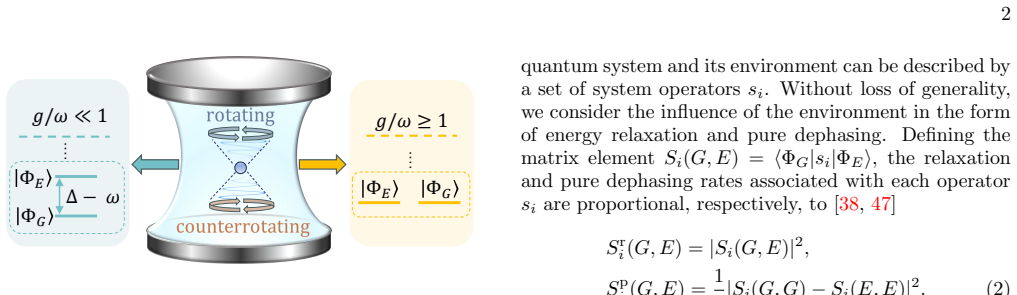
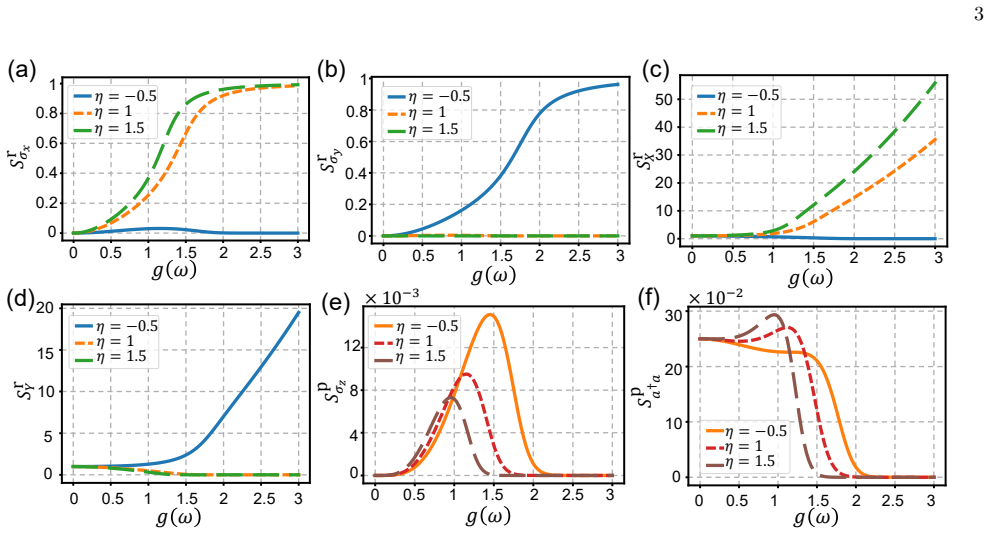
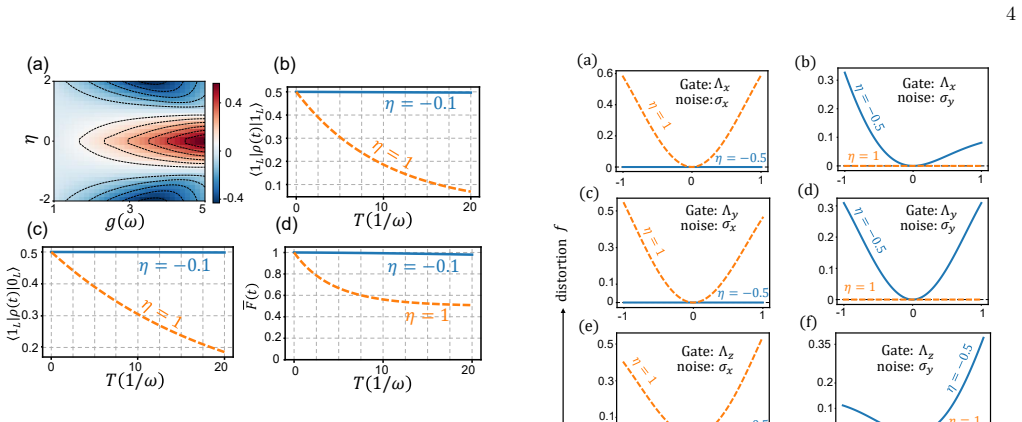
We present the quantum anisotropic Rabi model as a potential resource for a noise biased qubit. The system-environment coupling can be biased by tuning the relative strengths of the rotating-wave and counter-rotating-wave interactions, characterized by the anisotropy parameter $\eta$. This anisotropy selectively suppresses dominant decoherence pathways, thereby enabling the construction of a protected logical qubit in the ultrastrong and deep-strong coupling regimes. The logical states (formed by the ground and first excited states of the anisotropic Rabi model) possess coherence times that are enhanced compared to the isotropic case. Moreover, we construct a set of universal gate operations within the logical-state subspace and demonstrate that the gate operations associated with different values of $\eta$ exhibit robustness against external noise. These findings are expected to inspire applications and research directions for the anisotropic Rabi model with promising potential impacts.
Editorial analysis
A structured set of objections, weighed in public.
Referee Report
Summary. The paper proposes the anisotropic Rabi model, with tunable anisotropy parameter η controlling the relative strength of rotating-wave and counter-rotating-wave terms, as a platform for a noise-biased qubit. Logical states are identified with the ground and first excited eigenstates; the central claim is that η selectively suppresses dominant decoherence channels in the ultrastrong and deep-strong regimes, yielding longer coherence times than the isotropic case, while universal gates constructed in the logical subspace remain robust to external noise.
Significance. If the noise-biasing mechanism is rigorously established, the result would supply a concrete Hamiltonian-level route to protected qubits that exploits the ultrastrong-coupling regime rather than adding overhead. The approach is distinct from conventional bias-preserving codes and could be relevant to circuit-QED implementations, provided the coherence-time enhancement survives a first-principles noise model.
major comments (2)
- [Main text (effective master equation and coherence-time calculations)] The manuscript asserts that tuning η biases the system-environment coupling and suppresses dominant decoherence pathways, yet provides no explicit projection of a microscopic bath spectral density onto the η-dependent eigenstates to obtain the effective Lindblad rates. Without this derivation, it remains unclear whether counter-rotating terms open new dominant error channels whose matrix elements grow with g/ω.
- [Results on coherence times] The claim of enhanced coherence times relative to the isotropic Rabi model is load-bearing for the noise-biased-qubit proposal, but the abstract and available description give no numerical spectra, fitted T1/T2 values, or comparison against a standard photon-loss or dephasing model; the quantitative improvement therefore cannot be verified from the presented evidence.
minor comments (1)
- [Abstract] The abstract states that gates 'exhibit robustness against external noise' for different η; a brief statement of the noise model (e.g., photon loss via a, dephasing via σz) used in the gate-fidelity simulations would clarify the scope of this robustness.
Simulated Author's Rebuttal
We thank the referee for the detailed and constructive report. The two major comments highlight the need for a more rigorous microscopic derivation of the effective rates and for explicit numerical evidence of coherence-time improvement. Both points are valid, and we will revise the manuscript to address them directly.
read point-by-point responses
-
Referee: [Main text (effective master equation and coherence-time calculations)] The manuscript asserts that tuning η biases the system-environment coupling and suppresses dominant decoherence pathways, yet provides no explicit projection of a microscopic bath spectral density onto the η-dependent eigenstates to obtain the effective Lindblad rates. Without this derivation, it remains unclear whether counter-rotating terms open new dominant error channels whose matrix elements grow with g/ω.
Authors: We agree that an explicit projection of a microscopic bath spectral density onto the η-dependent eigenstates is required to obtain the effective Lindblad rates and to confirm that counter-rotating terms do not introduce stronger channels. The current manuscript relies on the structure of the eigenstates to argue for selective suppression but omits the full derivation. In the revised version we will add this calculation, showing the matrix elements for the dominant channels as functions of η and demonstrating that they remain suppressed in the ultrastrong and deep-strong regimes without new dominant pathways opening. revision: yes
-
Referee: [Results on coherence times] The claim of enhanced coherence times relative to the isotropic Rabi model is load-bearing for the noise-biased-qubit proposal, but the abstract and available description give no numerical spectra, fitted T1/T2 values, or comparison against a standard photon-loss or dephasing model; the quantitative improvement therefore cannot be verified from the presented evidence.
Authors: The referee is correct that the current version presents the coherence-time enhancement qualitatively through the eigenstate properties rather than through explicit numerical spectra or fitted T1/T2 values under standard noise models. We will include these quantitative results in the revision: numerical diagonalization of the master equation for representative values of η, comparison with the isotropic case (η = 1), and extracted coherence times under both photon-loss and pure-dephasing baths. revision: yes
Circularity Check
No circularity: proposal uses standard anisotropic Rabi Hamiltonian without self-referential definitions or fitted predictions
full rationale
The provided abstract and context describe a theoretical proposal that tunes the anisotropy parameter η in the anisotropic Rabi model to bias system-environment coupling and enhance coherence in the logical subspace. No equations, fitted parameters, or self-citations are exhibited that reduce any claimed prediction or logical state property to the inputs by construction. The claims about suppressed decoherence pathways and robust gates are presented as direct consequences of the model definition rather than derived via self-definition, renaming, or load-bearing self-citation loops. This matches the default case of a self-contained theoretical suggestion without the enumerated circularity patterns.
Axiom & Free-Parameter Ledger
free parameters (1)
- anisotropy parameter η
axioms (1)
- standard math Standard quantum mechanics and open-system master equation apply to the anisotropic Rabi Hamiltonian in the ultrastrong-coupling regime.
Reference graph
Works this paper leans on
-
[1]
M. O. Scully and M. S. Zubairy,Quantum Optics (Cambridge University Press, 1997)
1997
-
[2]
G. S. Agarwal,Quantum Optics(Cambridge University Press, 2012)
2012
-
[3]
Auff` eves, D
A. Auff` eves, D. Gerace, M. Richard, S. Portolan, M. Santos, and L. Kwek,Strong Light-Matter Coupling: From Atoms to Solid-State Systems(2013) pp. 1–292
2013
-
[4]
Zhang, Generalized squeezing rotating-wave ap- proximation to the isotropic and anisotropic Rabi model in the ultrastrong-coupling regime, Phys
Y.-Y. Zhang, Generalized squeezing rotating-wave ap- proximation to the isotropic and anisotropic Rabi model in the ultrastrong-coupling regime, Phys. Rev. A94, 063824 (2016)
2016
-
[5]
Q.-T. Xie, S. Cui, J.-P. Cao, L. Amico, and H. Fan, Anisotropic Rabi model, Phys. Rev. X4, 021046 (2014)
2014
-
[6]
Braak, Integrability of the Rabi model, Phys
D. Braak, Integrability of the Rabi model, Phys. Rev. Lett.107, 100401 (2011)
2011
-
[7]
L. Yu, S. Zhu, Q. Liang, G. Chen, and S. Jia, Analytical solutions for the Rabi model, Phys. Rev. A86, 015803 (2012)
2012
-
[8]
Crespi, S
A. Crespi, S. Longhi, and R. Osellame, Photonic realization of the quantum Rabi model, Phys. Rev. Lett. 108, 163601 (2012)
2012
-
[9]
Y.-H. Chen, W. Qin, X. Wang, A. Miranowicz, and F. Nori, Shortcuts to adiabaticity for the quantum Rabi model: Efficient generation of giant entangled cat states via parametric amplification, Phys. Rev. Lett.126, 023602 (2021)
2021
-
[10]
K.-X. Yan, Y. Qiu, Y. Xiao, Y.-H. Chen, and Y. Xia, Generating three-photon Rabi oscillations without a large-detuning condition, Phys. Rev. A110, 043711 (2024)
2024
-
[11]
X.-Y. Chen, L. Duan, D. Braak, and Q.-H. Chen, Multiple ground-state instabilities in the anisotropic 6 quantum Rabi model, Phys. Rev. A103, 043708 (2021)
2021
-
[12]
C. F. Lo, Spectral collapse in anisotropic two-photon Rabi model, Sci. Rep.11, 12401 (2021)
2021
-
[13]
H.-G. Xu, V. Montenegro, G. Xianlong, J. Jin, and G. D. d. M. Neto, Persisting quantum effects in the anisotropic Rabi model at thermal equilibrium, Phys. Rev. Res.6, 013001 (2024)
2024
-
[14]
J. Li, D. Braak, and Q.-H. Chen, Critical spectrum of the anisotropic two-photon quantum Rabi model, Phys. Rev. A111, 043706 (2025)
2025
-
[15]
Shen, Z.-B
L.-T. Shen, Z.-B. Yang, H.-Z. Wu, and S.-B. Zheng, Quantum phase transition and quench dynamics in the anisotropic Rabi model, Phys. Rev. A92, 013819 (2017)
2017
-
[16]
G. Lyu, K. Kottmann, M. B. Plenio, and M.-J. Hwang, Multicritical dissipative phase transitions in the anisotropic open quantum Rabi model, Phys. Rev. Res. 6, 033075 (2024)
2024
-
[17]
Y. Qiu, K.-X. Yan, J.-H. Lin, J. Song, Y.-H. Chen, and Y. Xia, Quantum phase transition in the anisotropic Rabi model induced by parametric amplification (2025), arXiv:2511.03207 [quant-ph]
Pith/arXiv arXiv 2025
-
[18]
Wei and X.-C
B.-B. Wei and X.-C. Lv, Fidelity susceptibility in the quantum Rabi model, Phys. Rev. A97, 013845 (2018)
2018
-
[19]
S. Wang, S. Chen, J. Jing, J. Wang, and H. Fan, Quantum signatures of chaos in anisotropic quantum Rabi model, Adv. Quantum Technol.8, 2400460 (2025)
2025
-
[20]
L. Cong, S. Felicetti, J. Casanova, L. Lamata, E. Solano, and I. Arrazola, Selective interactions in the quantum Rabi model, Phys. Rev. A101, 032350 (2020)
2020
-
[21]
Ballester, G
D. Ballester, G. Romero, J. J. Garc´ ıa-Ripoll, F. Deppe, and E. Solano, Quantum simulation of the ultrastrong- coupling dynamics in circuit quantum electrodynamics, Phys. Rev. X2, 021007 (2012)
2012
-
[22]
S. J. Bosman, M. F. Gely, V. Singh, A. Bruno, D. Bothner, and G. A. Steele, Multi-mode ultra- strong coupling in circuit quantum electrodynamics, npj Quantum Inf.3, 46 (2017)
2017
-
[23]
Yoshihara, T
F. Yoshihara, T. Fuse, S. Ashhab, K. Kakuyanagi, S. Saito, and K. Semba, Characteristic spectra of circuit quantum electrodynamics systems from the ultrastrong- to the deep-strong-coupling regime, Phys. Rev. A95, 053824 (2017)
2017
-
[24]
Yoshihara, T
F. Yoshihara, T. Fuse, S. Ashhab, K. Kakuyanagi, S. Saito, and K. Semba, Superconducting qubit–oscillator circuit beyond the ultrastrong-coupling regime, Nature Physics13, 44 (2017)
2017
-
[25]
G. Wang, R. Xiao, H. Z. Shen, C. Sun, and K. Xue, Simulating anisotropic quantum Rabi model via frequency modulation, Sci. Rep.9, 4569 (2019)
2019
-
[26]
N. K. Langford, R. Sagastizabal, M. Kounalakis, C. Dickel, A. Bruno, F. Luthi, D. J. Thoen, A. Endo, and L. DiCarlo, Experimentally simulating the dynamics of quantum light and matter at deep-strong coupling, Nat. Commun.8, 1715 (2017)
2017
-
[27]
D. Lv, S. An, Z. Liu, J.-N. Zhang, J. S. Pedernales, L. Lamata, E. Solano, and K. Kim, Quantum simulation of the quantum Rabi model in a trapped ion, Phys. Rev. X8, 021027 (2018)
2018
-
[28]
Garziano, R
L. Garziano, R. Stassi, V. Macr` ı, A. F. Kockum, S. Savasta, and F. Nori, Multiphoton quantum Rabi oscillations in ultrastrong cavity QED, Phys. Rev. A92, 063830 (2015)
2015
-
[29]
W. Qin, A. F. Kockum, C. S´ anchez Mu˜ noz, A. Miranow- icz, and F. Nori, Quantum amplification and simulation of strong and ultrastrong coupling of light and matter, Phys. Rep.1078, 1 (2024)
2024
-
[30]
Braum¨ uller, M
J. Braum¨ uller, M. Marthaler, A. Schneider, A. Stehli, H. Rotzinger, M. Weides, and A. V. Ustinov, Analog quantum simulation of the Rabi model in the ultra-strong coupling regime, Nat. Commun.8, 779 (2017)
2017
-
[31]
J. Koch, G. R. Hunanyan, T. Ockenfels, E. Rico, E. Solano, and M. Weitz, Quantum Rabi dynamics of trapped atoms far in the deep strong coupling regime, Nat. Commun.14, 954 (2023)
2023
-
[32]
I. C. Skogvoll, J. Lidal, J. Danon, and A. Kamra, Tunable anisotropic quantum Rabi model via a magnon–spin- qubit ensemble, Phys. Rev. Appl.16, 064008 (2021)
2021
-
[33]
Zhang and X.-Y
Y.-Y. Zhang and X.-Y. Chen, Analytical solutions by squeezing to the anisotropic Rabi model in the nonperturbative deep-strong-coupling regime, Phys. Rev. A96, 063821 (2017)
2017
-
[34]
Zueco and J
D. Zueco and J. Garc´ ıa-Ripoll, Ultrastrongly dissipative quantum Rabi model, Phys. Rev. A99, 013807 (2019)
2019
-
[35]
Y.-H. Chen, Y. Qiu, A. Miranowicz, N. Lambert, W. Qin, R. Stassi, Y. Xia, S.-B. Zheng, and F. Nori, Sudden change of the photon output field marks phase transitions in the quantum Rabi model, Commun. Phys.7, 5 (2024)
2024
-
[36]
Y.-H. Chen, Z.-C. Shi, Y.-R. Zhang, F. Nori, and Y. Xia, Suppressed energy relaxation in the quantum Rabi model at the critical point (2024), arXiv:2411.03710 [quant-ph]
arXiv 2024
-
[37]
Chen, Z.-C
Y.-H. Chen, Z.-C. Shi, F. Nori, and Y. Xia, Error-tolerant amplification and simulation of the ultrastrong-coupling quantum Rabi model, Phys. Rev. Lett.133, 033603 (2024)
2024
- [38]
-
[39]
Stassi, M
R. Stassi, M. Cirio, and F. Nori, Scalable quantum com- puter with superconducting circuits in the ultrastrong coupling regime, npj Quantum Inf.6, 67 (2020)
2020
-
[40]
Nataf and C
P. Nataf and C. Ciuti, Protected quantum computation with multiple resonators in ultrastrong coupling circuit QED, Phys. Rev. Lett.107, 190402 (2011)
2011
-
[41]
Y.-H. Chen, W. Qin, R. Stassi, X. Wang, and F. Nori, Fast binomial-code holonomic quantum computation with ultrastrong light-matter coupling, Phys. Rev. Res. 3, 033275 (2021)
2021
-
[42]
M. H. Devoret and R. J. Schoelkopf, Superconducting circuits for quantum information: An outlook, Science 339, 1169 (2013)
2013
-
[43]
Rasmussen, K
S. Rasmussen, K. Christensen, S. Pedersen, L. Kris- tensen, T. Bækkegaard, N. Loft, and N. Zinner, Superconducting circuit companion—an introduction with worked examples, PRX Quantum2, 040204 (2021)
2021
-
[44]
Blais, A
A. Blais, A. L. Grimsmo, S. M. Girvin, and A. Wallraff, Circuit quantum electrodynamics, Rev. Mod. Phys.93, 025005 (2021)
2021
-
[45]
Frisk Kockum, A
A. Frisk Kockum, A. Miranowicz, S. De Liberato, S. Savasta, and F. Nori, Ultrastrong coupling between light and matter, Nat. Rev. Phys.1, 19 (2019)
2019
-
[46]
Forn-D´ ıaz, L
P. Forn-D´ ıaz, L. Lamata, E. Rico, J. Kono, and E. Solano, Ultrastrong coupling regimes of light-matter interaction, Rev. Mod. Phys.91, 025005 (2019)
2019
-
[47]
Stassi and F
R. Stassi and F. Nori, Long-lasting quantum memories: Extending the coherence time of superconducting artificial atoms in the ultrastrong-coupling regime, Phys. 7 Rev. A97, 033823 (2018)
2018
-
[48]
Beaudoin, J
F. Beaudoin, J. M. Gambetta, and A. Blais, Dissipation and ultrastrong coupling in circuit qed, Phys. Rev. A84, 043832 (2011)
2011
-
[49]
See Supplemental Material, which includes some key references
-
[50]
Mercurio, S
A. Mercurio, S. Abo, F. Mauceri, E. Russo, V. Macr` ı, A. Miranowicz, S. Savasta, and O. Di Stefano, Pure dephasing of light-matter systems in the ultrastrong and deep-strong coupling regimes, Phys. Rev. Lett.130, 123601 (2023)
2023
-
[51]
Bravyi, A
S. Bravyi, A. W. Cross, J. M. Gambetta, D. Maslov, P. Rall, and T. J. Yoder, High-threshold and low- overhead fault-tolerant quantum memory, Nature627, 778 (2024)
2024
-
[52]
Bersin, M
E. Bersin, M. Sutula, Y. Q. Huan, A. Suleymanzade, D. R. Assumpcao, Y.-C. Wei, P.-J. Stas, C. M. Knaut, E. N. Knall, C. Langrock, N. Sinclair, R. Murphy, R. Riedinger, M. Yeh, C. Xin, S. Bandyopadhyay, D. D. Sukachev, B. Machielse, D. S. Levonian, M. K. Bhaskar, S. Hamilton, H. Park, M. Lonˇ car, M. M. Fejer, P. B. Dixon, D. R. Englund, and M. D. Lukin, T...
2024
-
[53]
F. m. c. Swiadek, R. Shillito, P. Magnard, A. Remm, C. Hellings, N. Lacroix, Q. Ficheux, D. C. Zanuz, G. J. Norris, A. Blais, S. Krinner, and A. Wallraff, Enhancing dispersive readout of superconducting qubits through dynamic control of the dispersive shift: Experiment and theory, PRX Quantum5, 040326 (2024)
2024
-
[54]
D. Sank, A. Opremcak, A. Bengtsson, M. Khezri, J. Chen, O. Naaman, and A. Korotkov, System characterization of dispersive readout in superconducting qubits, Phys. Rev. Appl.23, 024055 (2025)
2025
discussion (0)
Sign in with ORCID, Apple, or X to comment. Anyone can read and Pith papers without signing in.