Data Detection for Massive MIMO Systems with 1-Bit Quantized Dithered Linear Precoding
Pith reviewed 2026-06-28 04:30 UTC · model grok-4.3
The pith
Knowing the transmitter dither enables ML detectors that recover symbols directly from 1-bit DAC outputs and outperform binary ML baselines in massive MIMO.
A machine-rendered reading of the paper's core claim, the machinery that carries it, and where it could break.
Core claim
Assuming the dither vector is known at the receiver, a symbol-dependent linearization of the transmitted signal at the 1-bit DAC output allows derivation of ML-based detection methods that directly recover the data symbol vector from the received signal, for both full-resolution and 1-bit ADCs, along with low-complexity approximations that achieve significant symbol error rate gains over binary ML detection via a homotopy algorithm.
What carries the argument
Symbol-dependent linearization of the transmitted signal after the 1-bit DACs, which supplies the statistics needed to form the maximum-likelihood detector.
If this is right
- Dither power must be chosen carefully because it directly controls the achievable symbol error rate.
- Low-complexity approximations of the ML detectors remain effective when the number of streams grows large.
- Approximate ML detection remains possible for 1-bit ADCs by using the derived received-signal statistics without explicit dither removal.
- The same linearization approach supplies both exact and approximate ML rules for full-resolution and 1-bit receiver ADCs.
Where Pith is reading between the lines
- If the dither is generated from a shared pseudo-random seed, the perfect-knowledge assumption could be replaced by local regeneration at the receiver.
- The linearization step may extend to other low-resolution DAC levels or to multi-user downlink scenarios.
- Improved detection performance could allow further reduction of ADC/DAC bit widths while preserving target error rates.
Load-bearing premise
The dither vector applied at the transmitter is known at the receiver.
What would settle it
A simulation in which the proposed ML methods lose their symbol-error-rate advantage over the homotopy baseline when the dither vector at the receiver is replaced by an independent or noisy copy.
Figures


read the original abstract
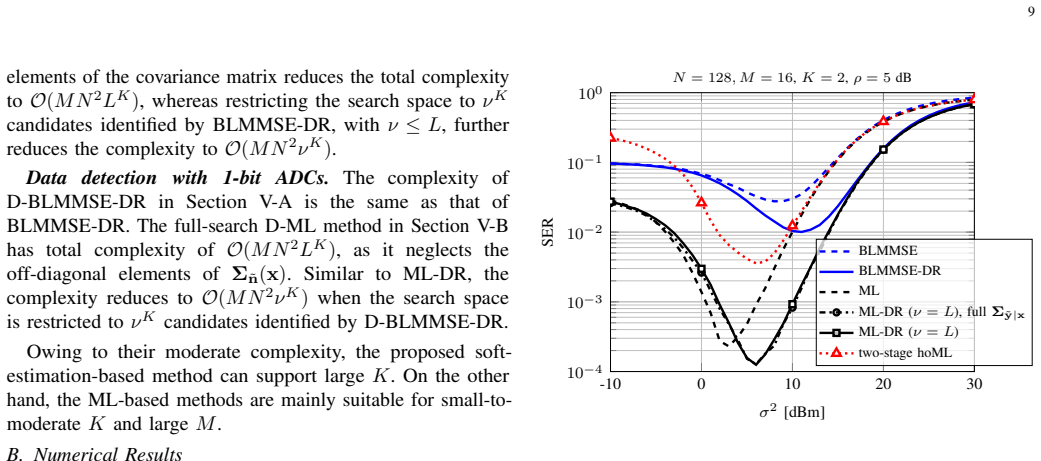
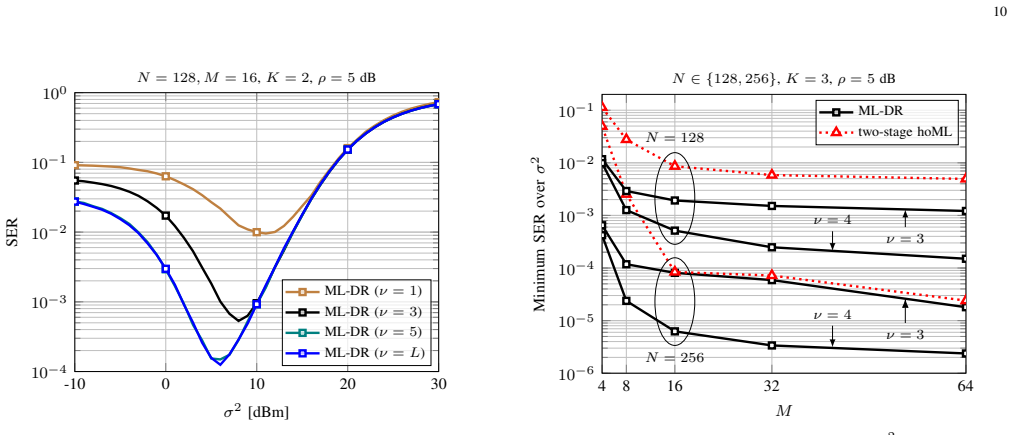
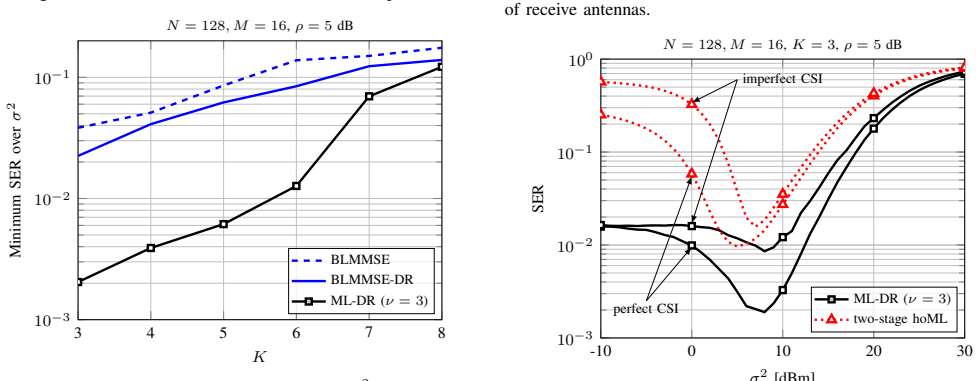
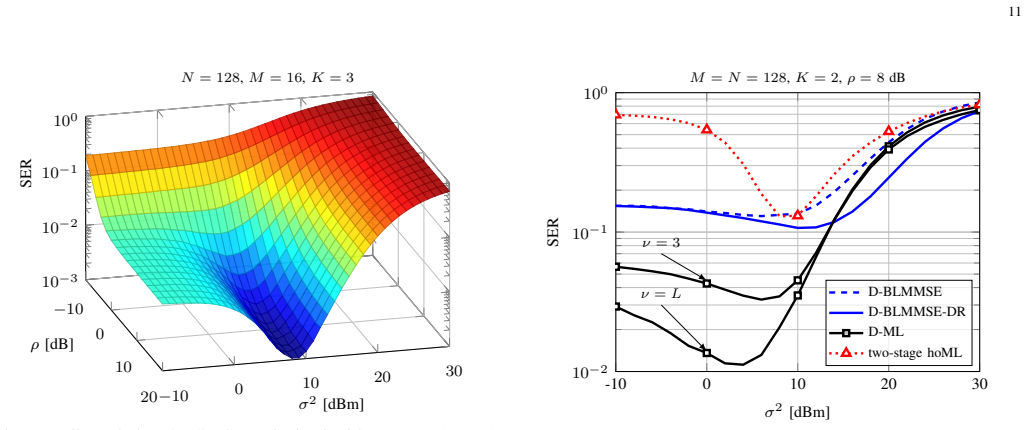
The power consumption of the analog-to-digital converters (ADCs) and digital-to-analog converters (DACs) in fully digital massive multiple-input multiple-output (MIMO) systems motivates the adoption of low-resolution architectures. In particular, 1-bit DACs reduce the power consumption and hardware complexity at the transmitter, but introduce severe transmit-side quantization distortion. In this paper, we investigate data detection for a point-to-point massive MIMO system with 1-bit DACs at the transmitter, where the linearly precoded signal is dithered prior to quantization, and either full-resolution or 1-bit ADCs at the receiver. Assuming that the dither vector applied at the transmitter is known at the receiver, we first develop softestimation-based data detection methods with symbol-independent dither removal for both full-resolution and 1-bit ADCs. We then introduce a new symbol-dependent linearization of the transmitted signal at the output of the 1-bit DACs and use it to derive maximum-likelihood (ML)-based data detection methods that directly recover the data symbol vector from the received signal. For full-resolution ADCs, this leads to an ML-based method with and without dither removal. For 1-bit ADCs, we develop an approximate ML-based method that exploits the derived statistics of the received signal without dither removal. We also propose low-complexity variants of the ML-based methods to mitigate the exponential complexity growth with the number of streams. Numerical results in terms of symbol error rate highlight the critical role of the dither power and demonstrate that the proposed ML-based methods (along with their low-complexity variants) achieve significant gains over a baseline based on binary ML detection via a homotopy algorithm.
Editorial analysis
A structured set of objections, weighed in public.
Referee Report
Summary. The paper addresses data detection in point-to-point massive MIMO systems employing 1-bit DACs at the transmitter with dithered linear precoding and either full-resolution or 1-bit ADCs at the receiver. Under the explicit assumption that the dither vector is known at the receiver, it derives soft-estimation-based detectors with symbol-independent dither removal, introduces a symbol-dependent linearization of the 1-bit DAC output to obtain ML detectors (with and without dither removal for full-resolution ADCs; an approximate ML exploiting received-signal statistics for 1-bit ADCs), and proposes low-complexity variants. Numerical SER results are used to illustrate the role of dither power and performance gains relative to a binary-ML homotopy baseline.
Significance. If the derivations and numerical claims hold, the work provides concrete, assumption-explicit algorithms for mitigating transmit-side quantization distortion in low-power massive MIMO via dithering when the dither is known at the receiver. The explicit statement of the known-dither premise, the derivation of both exact and approximate ML detectors from signal statistics, and the inclusion of low-complexity variants constitute strengths. No machine-checked proofs or open code are mentioned, but the conditional SER evaluation supplies falsifiable numerical evidence.
minor comments (3)
- The abstract states that the dither vector is known at the receiver and that all proposed methods rely on this; the manuscript should add an explicit sentence in the introduction or system model confirming that this knowledge is perfect and error-free, to avoid any ambiguity about the premise.
- Section headings and equation numbering are not visible in the provided abstract; ensure that the symbol-dependent linearization (introduced after the soft-estimation methods) receives a numbered equation and is cross-referenced in the complexity discussion of the low-complexity variants.
- The numerical results paragraph mentions 'significant gains' and 'critical role of the dither power'; add a sentence clarifying whether the reported SER curves include error bars or multiple Monte-Carlo realizations, and whether the dither-power sweep was chosen a priori or post-hoc.
Simulated Author's Rebuttal
We thank the referee for the detailed summary, positive assessment of the work's contributions, and recommendation of minor revision. The report contains no major comments requiring point-by-point response.
Circularity Check
No significant circularity; derivations rest on standard models
full rationale
The paper's derivations start from conventional massive MIMO channel and 1-bit quantization models, explicitly state the assumption that the dither vector is known at the receiver, and proceed to derive soft-estimation and ML detectors under that premise. No equations reduce a claimed prediction or uniqueness result to a fitted parameter or self-citation defined by the authors themselves; the numerical SER claims are conditional on the stated assumption but do not exhibit self-definitional or load-bearing circularity.
Axiom & Free-Parameter Ledger
Reference graph
Works this paper leans on
-
[1]
Massive MIMO with 1-bit DACs: Data detection for quantized linear precoding with dithering,
A. Radbord, I. Atzeni, and A. Tölli, “Massive MIMO with 1-bit DACs: Data detection for quantized linear precoding with dithering,” inProc. IEEE Int. Workshop Signal Process. Adv. in Wireless Commun. (SPA WC), 2025
2025
-
[2]
White paper on broadband connectivity in 6G,
N. Rajatheva, I. Atzeni, E. Björnsonet al., “White paper on broadband connectivity in 6G,” http://jultika.oulu.fi/files/isbn9789526226798.pdf, 2020
2020
-
[3]
Sub-THz communications: Perspective and results from the Hexa-X-II project,
I. Atzeniet al., “Sub-THz communications: Perspective and results from the Hexa-X-II project,”IEEE Open J. Commun. Soc., vol. 6, pp. 7495–7540, 2025
2025
-
[4]
Low-resolution massive MIMO under hardware power consumption constraints,
I. Atzeni, A. Tölli, and G. Durisi, “Low-resolution massive MIMO under hardware power consumption constraints,” inProc. Asilomar Conf. Signals, Syst., and Comput. (ASILOMAR), 2021
2021
-
[5]
Channel estimation and performance analysis of one-bit massive MIMO systems,
Y . Li, C. Tao, G. Seco-Granados, A. Mezghani, A. L. Swindlehurst, and L. Liu, “Channel estimation and performance analysis of one-bit massive MIMO systems,”IEEE Trans. Signal Process., vol. 65, no. 15, pp. 4075–4089, 2017
2017
-
[6]
Uplink performance of wideband massive MIMO with one-bit ADCs,
C. Mollén, J. Choi, E. G. Larsson, and R. W. Heath, “Uplink performance of wideband massive MIMO with one-bit ADCs,”IEEE Trans. Wireless Commun., vol. 16, no. 1, pp. 87–100, 2017
2017
-
[7]
Doubly 1-bit quantized massive MIMO,
I. Atzeni, A. Tölli, D. H. N. Nguyen, and A. L. Swindlehurst, “Doubly 1-bit quantized massive MIMO,” inProc. Asilomar Conf. Signals, Syst., and Comput. (ASILOMAR), 2023
2023
-
[8]
Analysis of one-bit quantized precoding for the multiuser massive MIMO downlink,
A. K. Saxena, I. Fijalkow, and A. L. Swindlehurst, “Analysis of one-bit quantized precoding for the multiuser massive MIMO downlink,”IEEE Trans. Signal Process., vol. 65, no. 17, pp. 4624–4634, 2017
2017
-
[9]
Massive MIMO 1-bit DAC transmission: A low-complexity symbol scaling approach,
A. Li, C. Masouros, F. Liu, and A. L. Swindlehurst, “Massive MIMO 1-bit DAC transmission: A low-complexity symbol scaling approach,” IEEE Trans. Wireless Commun., vol. 17, pp. 7559–7575, 2018
2018
-
[10]
An efficient design of one-bit DACs precoding for massive MU-MIMO downlink,
R. Liang, H. Li, and W. Zhang, “An efficient design of one-bit DACs precoding for massive MU-MIMO downlink,”IEEE Systems J., vol. 17, pp. 6368–6379, 2023
2023
-
[11]
Quantized precoding for massive MU-MIMO,
S. Jacobsson, G. Durisi, M. Coldrey, T. Goldstein, and C. Studer, “Quantized precoding for massive MU-MIMO,”IEEE Trans. Commun., vol. 65, no. 11, pp. 4670–4684, 2017
2017
-
[12]
Joint MMSE precoder and equalizer for massive MIMO using 1-bit quantization,
O. B. Usman, J. A. Nossek, C. A. Hofmann, and A. Knopp, “Joint MMSE precoder and equalizer for massive MIMO using 1-bit quantization,” in Proc. IEEE Int. Conf. Commun. (ICC), 2017
2017
-
[13]
Energy efficiency maximization precoding for quantized massive MIMO systems,
J. Choi, J. Park, and N. Lee, “Energy efficiency maximization precoding for quantized massive MIMO systems,”IEEE Trans. Wireless Commun., vol. 21, no. 9, pp. 6803–6817, 2022
2022
-
[14]
Performance analysis of massive MIMO relay systems with variable-resolution ADCs/DACs over spatially correlated channels,
Y . Xiong, S. Sun, N. Wei, L. Liu, and Z. Zhang, “Performance analysis of massive MIMO relay systems with variable-resolution ADCs/DACs over spatially correlated channels,”IEEE Trans. V eh. Technol., vol. 70, no. 3, pp. 2619–2634, 2021
2021
-
[15]
Linear transmit precoding with optimized dithering,
A. K. Saxena, A. Mezghani, R. W. Heath, and J. G. Andrews, “Linear transmit precoding with optimized dithering,” inProc. Asilomar Conf. Signals, Syst., and Comput. (ASILOMAR), 2019
2019
-
[16]
Linear CE and 1-bit quantized precoding with optimized dithering,
A. K. Saxena, A. Mezghani, and R. W. Heath, “Linear CE and 1-bit quantized precoding with optimized dithering,”IEEE Open J. Signal Process., vol. 1, pp. 310–325, 2020
2020
-
[17]
Estimation from quantized Gaussian measurements: When and how to use dither,
J. Rapp, R. M. A. Dawson, and V . K. Goyal, “Estimation from quantized Gaussian measurements: When and how to use dither,”IEEE Trans. Signal Process., vol. 67, no. 13, pp. 3424–3438, 2019
2019
-
[18]
Channel estimation and data detection analysis of massive MIMO with 1-bit ADCs,
I. Atzeni and A. Tölli, “Channel estimation and data detection analysis of massive MIMO with 1-bit ADCs,”IEEE Trans. Wireless Commun., vol. 21, no. 6, pp. 3850–3867, 2022
2022
-
[19]
Near maximum-likelihood detector and channel estimator for uplink multiuser massive MIMO systems with one-bit ADCs,
J. Choi, J. Mo, and R. W. Heath, “Near maximum-likelihood detector and channel estimator for uplink multiuser massive MIMO systems with one-bit ADCs,”IEEE Trans. Wireless Commun., vol. 64, no. 5, pp. 2005–2018, 2016
2005
-
[20]
Linear and deep neural network-based receivers for massive MIMO systems with one-bit ADCs,
L. V . Nguyen, A. L. Swindlehurst, and D. H. N. Nguyen, “Linear and deep neural network-based receivers for massive MIMO systems with one-bit ADCs,”IEEE Trans. Wireless Commun., vol. 20, no. 11, pp. 7333–7345, 2021
2021
-
[21]
Insights into maximum likelihood detection for 1-bit massive MIMO communications,
A. Sant and B. D. Rao, “Insights into maximum likelihood detection for 1-bit massive MIMO communications,”IEEE Trans. Wireless Commun., vol. 23, no. 11, pp. 16 275–16 289, 2024
2024
-
[22]
Data detection in 1-bit quantized MIMO systems,
K. Safa, R. Combes, R. de Lacerda, and S. Yang, “Data detection in 1-bit quantized MIMO systems,”IEEE Trans. Wireless Commun., vol. 72, no. 9, pp. 5396–5410, 2024
2024
-
[23]
Enhanced uplink data detection in massive MIMO with 1-bit ADCs: Analysis and joint detection,
A. Radbord, I. Atzeni, and A. Tölli, “Enhanced uplink data detection in massive MIMO with 1-bit ADCs: Analysis and joint detection,”IEEE Trans. Signal Process., pp. 1–16, 2026
2026
-
[24]
Binary MIMO detection via homotopy optimization and its deep adaptation,
M. Shao and W.-K. Ma, “Binary MIMO detection via homotopy optimization and its deep adaptation,”IEEE Trans. Signal Process., vol. 69, pp. 781–796, 2021
2021
-
[25]
On maximum-likelihood detection and the search for the closest lattice point,
M. Damen, H. El Gamal, and G. Caire, “On maximum-likelihood detection and the search for the closest lattice point,”IEEE Trans. Inf. Theory, vol. 49, no. 10, pp. 2389–2402, 2003
2003
-
[26]
Cheap semidefinite relaxation MIMO detection using row-by-row block coordinate descent,
H.-T. Wai, W.-K. Ma, and A. M.-C. So, “Cheap semidefinite relaxation MIMO detection using row-by-row block coordinate descent,” inProc. IEEE Int. Conf. Acoust., Speech, and Signal Process. (ICASSP), 2011
2011
-
[27]
On the convergence of approximate message passing with arbitrary matrices,
S. Rangan, P. Schniter, A. K. Fletcher, and S. Sarkar, “On the convergence of approximate message passing with arbitrary matrices,”IEEE Trans. Inf. Theory, vol. 65, no. 9, pp. 5339–5351, 2019
2019
-
[28]
Multiuser detection for uplink large-scale MIMO under one-bit quantization,
S. Wang, Y . Li, and J. Wang, “Multiuser detection for uplink large-scale MIMO under one-bit quantization,” inProc. IEEE Int. Conf. Commun. (ICC), 2014
2014
-
[29]
Bayes-optimal joint channel-and-data estimation for massive MIMO with low-precision ADCs,
C.-K. Wen, C.-J. Wang, S. Jin, K.-K. Wong, and P. Ting, “Bayes-optimal joint channel-and-data estimation for massive MIMO with low-precision ADCs,”IEEE Trans. Signal Process., vol. 64, no. 10, pp. 2541–2556, 2016
2016
-
[30]
The Bussgang decomposition of nonlinear systems: Basic theory and MIMO extensions [lecture notes],
Ö. T. Demir and E. Björnson, “The Bussgang decomposition of nonlinear systems: Basic theory and MIMO extensions [lecture notes],”IEEE Signal Process. Mag., vol. 38, no. 1, pp. 131–136, 2021
2021
-
[31]
Deconstructing multiantenna fading channels,
A. Sayeed, “Deconstructing multiantenna fading channels,”IEEE Trans. Signal Process., vol. 50, no. 10, pp. 2563–2579, 2002
2002
-
[32]
Zadoff-Chu sequence design for random access initial uplink synchronization in LTE-like systems,
M. Hyder and K. Mahata, “Zadoff-Chu sequence design for random access initial uplink synchronization in LTE-like systems,”IEEE Trans. Wireless Commun., vol. 16, no. 1, pp. 503–511, 2017
2017
discussion (0)
Sign in with ORCID, Apple, or X to comment. Anyone can read and Pith papers without signing in.