Pion structure in Holographic QCD
Pith reviewed 2026-06-28 01:05 UTC · model grok-4.3
The pith
A holographic model with modified background describes the pion's mass spectrum, electromagnetic form factors, and gravitational form factors in agreement with data.
A machine-rendered reading of the paper's core claim, the machinery that carries it, and where it could break.
Core claim
Employing a holographic model with a modified background that incorporates linear confinement and gluon condensation, the authors study the pion's mass spectrum, electromagnetic form factors, and gravitational form factors. The model simultaneously describes these observables and shows reasonable agreement with experimental data and lattice QCD calculations, suggesting it captures essential features of the pion's structure.
What carries the argument
The modified background geometry in the holographic model that encodes linear confinement and gluon condensation, used to compute the pion structure observables.
If this is right
- The model provides a consistent framework for multiple pion observables.
- It reaches agreement with both experimental measurements and lattice QCD results.
- The approach has potential as a tool for further investigations of pion properties.
Where Pith is reading between the lines
- If the background modification works for the pion, it may apply to other light mesons with similar success.
- Gravitational form factors from the model could be compared to those derived from the energy-momentum tensor in QCD.
- Future calculations of additional observables like the pion decay constant could further test the model.
Load-bearing premise
The specific modified background geometry chosen accurately encodes the essential non-perturbative QCD features of linear confinement and gluon condensation for the pion.
What would settle it
Disagreement between the model's predictions for the gravitational form factors and independent lattice QCD results would challenge the model's validity.
Figures

read the original abstract
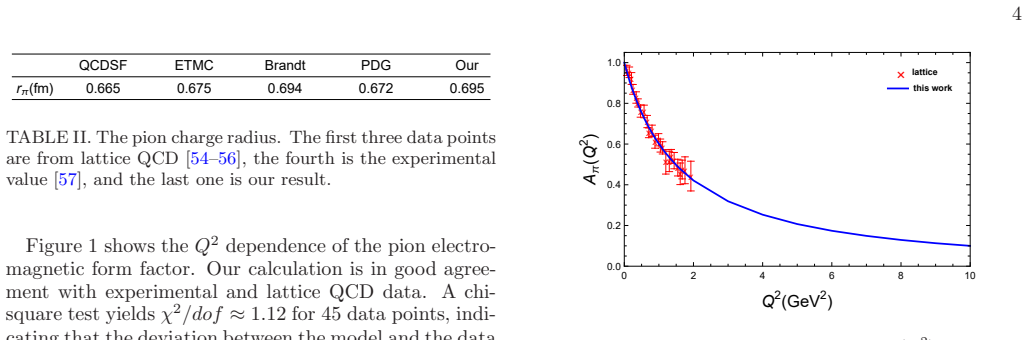
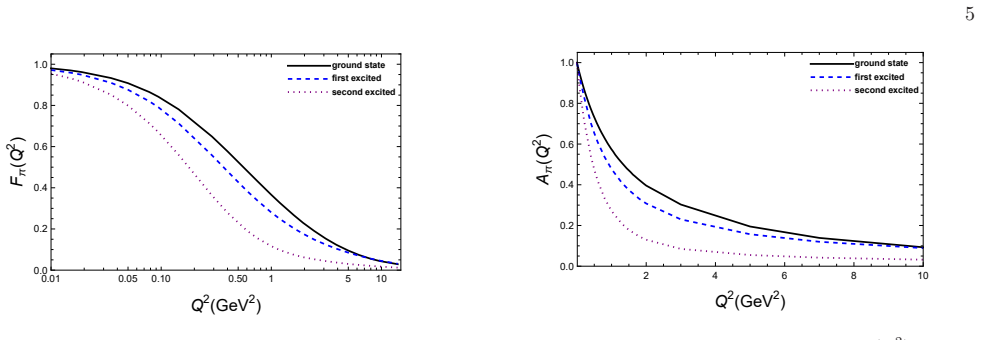
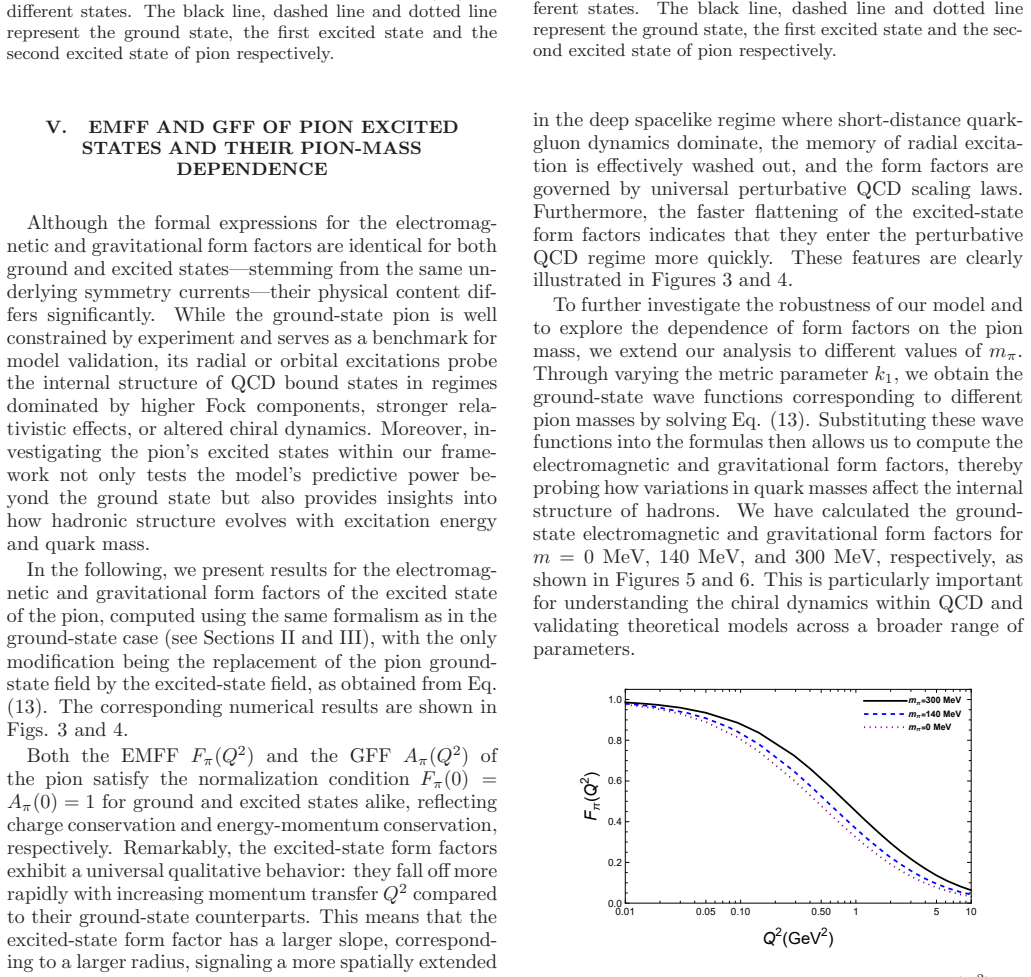
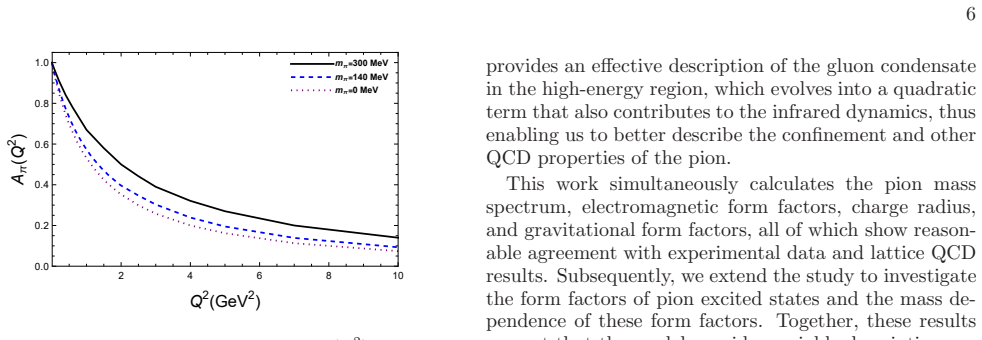
We employ a holographic model with a modified background that incorporates effective descriptions of key QCD features, including linear confinement and gluon condensation, to study the pion's internal structure, encompassing its mass spectrum as well as electromagnetic and gravitational form factors. This model is capable of simultaneously describing these diverse observables and reaches reasonable agreement with both experimental measurements and lattice QCD results. Our findings indicate that the model captures essential aspects of the pion. The description of multiple structure observables supports its potential as a useful tool for further investigations of pion properties.
Editorial analysis
A structured set of objections, weighed in public.
Referee Report
Summary. The manuscript presents a holographic QCD model employing a modified background geometry that incorporates effective descriptions of linear confinement and gluon condensation. It computes the pion mass spectrum together with electromagnetic and gravitational form factors, asserting that a single background ansatz simultaneously describes these observables and yields reasonable agreement with experimental data and lattice QCD results.
Significance. If the numerical results hold, the work supplies a unified holographic framework for multiple pion structure observables. Credit is due for applying the standard holographic dictionary consistently to one background across the spectrum and both classes of form factors, thereby testing the background ansatz non-trivially rather than introducing separate tunings for each observable.
major comments (2)
- [§2] §2 (background construction): the single free parameter controlling the modified warp factor and dilaton profile is stated to be fixed by the confinement scale; the manuscript must explicitly demonstrate that this same value is used without readjustment when computing the electromagnetic and gravitational form factors, so that the reported agreement constitutes a genuine prediction rather than a refit.
- [§4] §4 (form-factor results): the comparisons with lattice QCD and experiment for the gravitational form factors report only central values; without tabulated uncertainties propagated from the background parameter or from the numerical solution of the bulk equations, it is impossible to judge whether the claimed 'reasonable agreement' is statistically meaningful or merely qualitative.
minor comments (2)
- The abstract asserts agreement with data but supplies no numerical values, error estimates, or parameter values; a short table or set of benchmark numbers should be added to the abstract or a dedicated results subsection.
- [§2] Notation for the modified warp factor and dilaton profile should be collected in a single equation block early in §2 to improve readability when the same functions are reused in the form-factor calculations.
Simulated Author's Rebuttal
We thank the referee for the positive evaluation and the recommendation of minor revision. We address each major comment below and will incorporate the requested clarifications.
read point-by-point responses
-
Referee: [§2] §2 (background construction): the single free parameter controlling the modified warp factor and dilaton profile is stated to be fixed by the confinement scale; the manuscript must explicitly demonstrate that this same value is used without readjustment when computing the electromagnetic and gravitational form factors, so that the reported agreement constitutes a genuine prediction rather than a refit.
Authors: The parameter is fixed once by the confinement scale (via matching to the rho-meson mass and the slope of the linear Regge trajectories) and is then held fixed for all subsequent calculations. To make this explicit as requested, we will add a sentence in §2 stating the numerical value obtained from the confinement-scale fit together with a clear statement that this same value is used without readjustment for the electromagnetic and gravitational form factors. revision: yes
-
Referee: [§4] §4 (form-factor results): the comparisons with lattice QCD and experiment for the gravitational form factors report only central values; without tabulated uncertainties propagated from the background parameter or from the numerical solution of the bulk equations, it is impossible to judge whether the claimed 'reasonable agreement' is statistically meaningful or merely qualitative.
Authors: Because the single background parameter is fixed by a definite matching condition to the confinement scale, it carries no associated uncertainty to propagate. The bulk equations are solved numerically to high precision, with results stable under changes in integration tolerances and grid spacing. We will add a short paragraph in §4 documenting the numerical convergence criteria and noting that the reported central values are the model's unambiguous predictions under the fixed background. revision: yes
Circularity Check
No significant circularity identified
full rationale
The paper selects a modified holographic background to encode linear confinement and gluon condensation as an effective ansatz, then applies the standard holographic dictionary to compute the pion mass spectrum along with electromagnetic and gravitational form factors. These quantities are compared directly against independent experimental data and lattice QCD results. No equations or steps are shown that reduce a claimed prediction to a fitted input by construction, and no load-bearing self-citations or uniqueness theorems imported from the authors' prior work appear in the provided text. The multi-observable agreement with external benchmarks therefore constitutes an independent test of the background choice rather than a self-referential loop.
Axiom & Free-Parameter Ledger
free parameters (1)
- background modification parameters for confinement and gluon condensation
axioms (1)
- domain assumption The holographic duality continues to hold for the chosen modified background geometry when applied to pion observables
Reference graph
Works this paper leans on
-
[1]
T. Horn, C. D. Roberts, The pion: an enigma within the Standard Model, J. Phys. G 43 (7) (2016) 073001. arXiv:1602.04016, doi:10.1088/0954-3899/43/7/073001
work page internal anchor Pith review Pith/arXiv arXiv doi:10.1088/0954-3899/43/7/073001 2016
-
[2]
A. C. Aguilar, et al., Pion and Kaon Structure at the Electron-Ion Collider, Eur. Phys. J. A 55 (10) (2019) 190. arXiv:1907.08218, doi:10.1140/epja/i2019-12885-0
-
[3]
B. Ananthanarayan, Pions: the original Nambu–Goldstone bosons: An introduction and precision pion physics, Eur. Phys. J. ST 231 (2) (2022) 91–102. doi:10.1140/epjs/s11734-022-00443-7
-
[4]
R. J. Holt, C. D. Roberts, Distribution Functions of the Nucleon and Pion in the Valence Region, Rev. Mod. Phys. 82 (2010) 2991–3044. arXiv:1002.4666, doi:10.1103/RevModPhys.82.2991
work page internal anchor Pith review Pith/arXiv arXiv doi:10.1103/revmodphys.82.2991 2010
-
[5]
J. M. Maldacena, The Large N limit of supercon- formal field theories and supergravity, Adv. Theor. Math. Phys. 2 (1998) 231–252. arXiv:hep-th/9711200, doi:10.4310/ATMP.1998.v2.n2.a1
work page internal anchor Pith review Pith/arXiv arXiv doi:10.4310/atmp.1998.v2.n2.a1 1998
-
[6]
Anti De Sitter Space And Holography
E. Witten, Anti de Sitter space and holography, Adv. Theor. Math. Phys. 2 (1998) 253–291. arXiv:hep-th/9802150, doi:10.4310/ATMP.1998.v2.n2.a2
work page internal anchor Pith review Pith/arXiv arXiv doi:10.4310/atmp.1998.v2.n2.a2 1998
-
[7]
Hard Scattering and Gauge/String Duality
J. Polchinski, M. J. Strassler, Hard scatter- ing and gauge / string duality, Phys. Rev. Lett. 88 (2002) 031601. arXiv:hep-th/0109174, 7 doi:10.1103/PhysRevLett.88.031601
work page internal anchor Pith review Pith/arXiv arXiv doi:10.1103/physrevlett.88.031601 2002
-
[8]
Chiral Symmetry Breaking in Soft-Wall AdS/QCD
T. Gherghetta, J. I. Kapusta, T. M. Kelley, Chiral symmetry breaking in the soft-wall AdS/QCD model, Phys. Rev. D 79 (2009) 076003. arXiv:0902.1998, doi:10.1103/PhysRevD.79.076003
work page internal anchor Pith review Pith/arXiv arXiv doi:10.1103/physrevd.79.076003 2009
-
[9]
Linear Confinement and AdS/QCD
A. Karch, E. Katz, D. T. Son, M. A. Stephanov, Linear confinement and AdS/QCD, Phys. Rev. D 74 (2006) 015005. arXiv:hep-ph/0602229, doi:10.1103/PhysRevD.74.015005
work page internal anchor Pith review Pith/arXiv arXiv doi:10.1103/physrevd.74.015005 2006
-
[10]
E. Folco Capossoli, M. A. Mart ´ ın Contreras, D. Li, A. Vega, H. Boschi-Filho, Hadronic spec- tra from deformed AdS backgrounds, Chin. Phys. C 44 (6) (2020) 064104. arXiv:1903.06269, doi:10.1088/1674-1137/44/6/064104
-
[11]
J. Deng, D. Hou, Nucleon structure from an AdS/QCD model in the Veneziano limit, Phys. Rev. D 112 (3) (2025) 036011. arXiv:2502.00771, doi:10.1103/b9p6-pdwh
-
[12]
X. Chen, Y. Chen, K. Zhou, Data-driven Einstein-dilato n model for pure Yang-Mills thermodynamics and glue- ball spectrum, Phys. Rev. D 112 (12) (2025) 126025. arXiv:2507.06729, doi:10.1103/wyr3-2kc5
-
[13]
E. Folco Capossoli, M. A. Mart ´ ın Contreras, D. Li, A. Vega, H. Boschi-Filho, Proton structure functions from an AdS/QCD model with a deformed background, Phys. Rev. D 102 (8) (2020) 086004. arXiv:2007.09283, doi:10.1103/PhysRevD.102.086004
-
[14]
M. S. Tousi, K. Azizi, H. R. Moshfegh, Investiga- tion of the semileptonic decay Ξcc++ → Ξc+ ℓ/macron.ts1 νℓ within QCD sum rules, Phys. Rev. D 110 (11) (2024) 114001. arXiv:2409.00241, doi:10.1103/PhysRevD.110.114001
-
[15]
T. M. Aliev, S. Bilmis, M. Savci, Analysis of the light JP=3- mesons in QCD sum rules, Phys. Rev. D 108 (3) (2023) 034020. arXiv:2307.00577, doi:10.1103/PhysRevD.108.034020
-
[16]
G. F. de Teramond, S. J. Brodsky, Hadronic spec- trum of a holographic dual of QCD, Phys. Rev. Lett. 94 (2005) 201601. arXiv:hep-th/0501022, doi:10.1103/PhysRevLett.94.201601
work page internal anchor Pith review Pith/arXiv arXiv doi:10.1103/physrevlett.94.201601 2005
-
[17]
S. J. Brodsky, G. F. de Teramond, Hadronic spectra and light-front wavefunctions in holographic QCD, Phys. Rev. Lett. 96 (2006) 201601. arXiv:hep-ph/0602252, doi:10.1103/PhysRevLett.96.201601
work page internal anchor Pith review Pith/arXiv arXiv doi:10.1103/physrevlett.96.201601 2006
-
[18]
Mondal, Longitudinal dynamics in light- front holographic QCD and hadron spectroscopy, Rev
C. Mondal, Longitudinal dynamics in light- front holographic QCD and hadron spectroscopy, Rev. Mex. Fis. Suppl. 3 (3) (2022) 0308091. doi:10.31349/SuplRevMexFis.3.0308091
-
[19]
M. Ahmady, S. Kaur, C. Mondal, R. Sandapen, Pion spectroscopy and dynamics using the holographic light- front Schr¨ odinger equation and the ’t Hooft equation, Phys. Lett. B 836 (2023) 137628. arXiv:2208.08405, doi:10.1016/j.physletb.2022.137628
-
[20]
M. Ahmady, R. Sandapen, Predictions for pion and its excited states using light-front QCD holography and ’t Hooft equation, PoS ICHEP2024 (2025) 540. doi:10.22323/1.476.0540
-
[21]
A. P. Bakulev, K. Passek-Kumericki, W. Schroers, N. G. Stefanis, Pion form-factor in QCD: From non- local condensates to NLO analytic perturbation the- ory, Phys. Rev. D 70 (2004) 033014, [Erratum: Phys.Rev.D 70, 079906 (2004)]. arXiv:hep-ph/0405062, doi:10.1103/PhysRevD.70.033014
work page internal anchor Pith review Pith/arXiv arXiv doi:10.1103/physrevd.70.033014 2004
-
[22]
S. J. Brodsky, G. F. de Teramond, Light-Front Dy- namics and AdS/QCD Correspondence: The Pion Form Factor in the Space- and Time-Like Regions, Phys. Rev. D 77 (2008) 056007. arXiv:0707.3859, doi:10.1103/PhysRevD.77.056007
work page internal anchor Pith review Pith/arXiv arXiv doi:10.1103/physrevd.77.056007 2008
-
[23]
H. J. Kwee, R. F. Lebed, Pion form-factors in holo- graphic QCD, JHEP 01 (2008) 027. arXiv:0708.4054, doi:10.1088/1126-6708/2008/01/027
work page internal anchor Pith review Pith/arXiv arXiv doi:10.1088/1126-6708/2008/01/027 2008
-
[24]
Pion electromagnetic form factor at spacelike momenta
L. Chang, I. C. Clo¨ et, C. D. Roberts, S. M. Schmidt, P. C. Tandy, Pion electromagnetic form factor at spacelike momenta, Phys. Rev. Lett. 111 (14) (2013) 141802. arXiv:1307.0026, doi:10.1103/PhysRevLett.111.141802
work page internal anchor Pith review Pith/arXiv arXiv doi:10.1103/physrevlett.111.141802 2013
-
[25]
N. Nasibova, X. D. Arsiwalla, Pion phenomenology from the thermal soft-wall model of holographic QCD, Phys. Rev. D 112 (11) (2025) 116010. arXiv:2505.23455, doi:10.1103/m327-xs85
-
[26]
S. J. Brodsky, G. F. de Teramond, H. G. Dosch, J. Erlich, Light-Front Holographic QCD and Emerging Confine- ment, Phys. Rept. 584 (2015) 1–105. arXiv:1407.8131, doi:10.1016/j.physrep.2015.05.001
work page internal anchor Pith review Pith/arXiv arXiv doi:10.1016/j.physrep.2015.05.001 2015
-
[27]
X. Gao, N. Karthik, S. Mukherjee, P. Petreczky, S. Syritsyn, Y. Zhao, Pion form factor and charge ra- dius from lattice QCD at the physical point, Phys. Rev. D 104 (11) (2021) 114515. arXiv:2102.06047, doi:10.1103/PhysRevD.104.114515
-
[28]
M. Goharipour, M. H. Amiri, F. Irani, H. Hashamipour, K. Azizi, Determination of the pion generalized parton distributions at zero skewness, Phys. Rev. D 112 (11) (2025) 114046. arXiv:2508.15073, doi:10.1103/lyh6-727b
-
[29]
L.-B. Chen, W. Chen, F. Feng, Y. Jia, Next- to-Next-to-Leading-Order QCD Corrections to Pion Electromagnetic Form Factors, Phys. Rev. Lett. 132 (20) (2024) 201901, [Erratum: Phys.Rev.Lett. 134, 229901 (2025)]. arXiv:2312.17228, doi:10.1103/PhysRevLett.132.201901
-
[30]
S. Puhan, H. Dahiya, Scalar, vector, and tensor form factors of pion and kaon, Phys. Rev. D 111 (11) (2025) 114039. arXiv:2505.02507, doi:10.1103/2wpb-jgkc
-
[31]
S.-Q. Wang, Z.-F. Liao, J.-M. Shen, H. Zhou, J.- W. Zhang, J. Yan, X.-G. Wu, L. Di Giustino, Anal- ysis of the pion electromagnetic form factor with next-to-next-to-leading order QCD corrections, Eur. Phys. J. C 85 (12) (2025) 1435. arXiv:2507.20479, doi:10.1140/epjc/s10052-025-15174-x
-
[32]
S. J. Brodsky, G. F. de Teramond, Light-Front Dynamics and AdS/QCD Correspondence: Grav- itational Form Factors of Composite Hadrons, Phys. Rev. D 78 (2008) 025032. arXiv:0804.0452, doi:10.1103/PhysRevD.78.025032
work page internal anchor Pith review Pith/arXiv arXiv doi:10.1103/physrevd.78.025032 2008
-
[33]
Y.-Z. Xu, M. Ding, K. Raya, C. D. Roberts, J. Rodr ´ ıguez-Quintero, S. M. Schmidt, Pion and kaon electromagnetic and gravitational form factors, Eur. Phys. J. C 84 (2) (2024) 191. arXiv:2311.14832, doi:10.1140/epjc/s10052-024-12518-x
-
[34]
M. V. Polyakov, P. Schweitzer, Forces inside hadrons: pressure, surface tension, mechanical radius, and all that, Int. J. Mod. Phys. A 33 (26) (2018) 1830025. arXiv:1805.06596, doi:10.1142/S0217751X18300259
work page internal anchor Pith review Pith/arXiv arXiv doi:10.1142/s0217751x18300259 2018
-
[35]
W. Broniowski, E. Ruiz Arriola, Gravitational form factors of the pion and meson dominance, Phys. Lett. B 859 (2024) 139138. arXiv:2405.07815, doi:10.1016/j.physletb.2024.139138
-
[36]
X.-H. Cao, F.-K. Guo, Q.-Z. Li, B.-W. Wu, D.-L. Yao, Gravitational form factors of pions, kaons and nucleons from dispersion relations (7 2025). arXiv:2507.05375, doi:10.1140/epjs/s11734-025-02025-9 . 8
-
[37]
Y. Hatta, J. Schoenleber, Sullivan Process near Thresh - old and the Pion Gravitational Form Factors, Phys. Rev. Lett. 134 (25) (2025) 251901. arXiv:2502.12061, doi:10.1103/y9fq-y84c
-
[38]
Y. Choi, H.-D. Son, H.-M. Choi, Gravitational form factors of the pion in the self-consistent light-front quark model, Phys. Rev. D 112 (1) (2025) 014043. arXiv:2504.14997, doi:10.1103/h7gf-f7p4
-
[39]
K. K. Seth, S. Dobbs, Z. Metreveli, A. Tomaradze, T. Xiao, G. Bonvicini, Electromagnetic Struc- ture of the Proton, Pion, and Kaon by High- Precision Form Factor Measurements at Large Timelike Momentum Transfers, Phys. Rev. Lett. 110 (2) (2013) 022002. arXiv:1210.1596, doi:10.1103/PhysRevLett.110.022002
work page internal anchor Pith review Pith/arXiv arXiv doi:10.1103/physrevlett.110.022002 2013
-
[40]
D. Li, M. Huang, Dynamical holographic QCD model for glueball and light meson spectra, JHEP 11 (2013) 088. arXiv:1303.6929, doi:10.1007/JHEP11(2013)088
work page internal anchor Pith review Pith/arXiv arXiv doi:10.1007/jhep11(2013)088 2013
-
[41]
A. Vega, M. A. Martin Contreras, Melt- ing of scalar hadrons in an AdS/QCD model modified by a thermal dilaton, Nucl. Phys. B 942 (2019) 410–418. arXiv:1808.09096, doi:10.1016/j.nuclphysb.2019.03.014
work page internal anchor Pith review Pith/arXiv arXiv doi:10.1016/j.nuclphysb.2019.03.014 2019
-
[42]
A. Vega, M. A. Martin Contreras, Two-body light front wave functions from general AdS/QCD models, Phys. Rev. D 102 (3) (2020) 036017. arXiv:2005.04501, doi:10.1103/PhysRevD.102.036017
-
[43]
M. ´A. Mart ´ ın Contreras, A. Vega, S. Cort´ es, Light pseu- doscalar and axial spectroscopy using AdS/QCD modi- fied soft wall model, Chin. J. Phys. 66 (2020) 715–723. arXiv:1811.10731, doi:10.1016/j.cjph.2020.06.018
-
[44]
G. F. de Teramond, H. G. Dosch, S. J. Brodsky, Kinematical and Dynamical Aspects of Higher-Spin Bound-State Equations in Holographic QCD, Phys. Rev. D 87 (7) (2013) 075005. arXiv:1301.1651, doi:10.1103/PhysRevD.87.075005
work page internal anchor Pith review Pith/arXiv arXiv doi:10.1103/physrevd.87.075005 2013
-
[45]
H. G. Dosch, G. F. de Teramond, S. J. Brod- sky, Holographic light-front QCD, J. Subatomic Part. Cosmol. 5 (2026) 100339. arXiv:2510.20180, doi:10.1016/j.jspc.2026.100339
-
[46]
R. L. Workman, et al., Review of Particle Physics, PTEP 2022 (2022) 083C01. doi:10.1093/ptep/ptac097
-
[47]
M. Rinaldi, F. A. Ceccopieri, V. Vento, The pion in the graviton soft-wall model: phenomenological applications , Eur. Phys. J. C 82 (7) (2022) 626. arXiv:2204.09974, doi:10.1140/epjc/s10052-022-10538-z
-
[48]
Y. Li, J. P. Vary, Light-front holography with chiral symmetry breaking, Phys. Lett. B 825 (2022) 136860. arXiv:2103.09993, doi:10.1016/j.physletb.2021.136860
-
[49]
H.-T. Ding, X. Gao, A. D. Hanlon, S. Mukher- jee, P. Petreczky, Q. Shi, S. Syritsyn, R. Zhang, Y. Zhao, QCD Predictions for Meson Electromag- netic Form Factors at High Momenta: Testing Factorization in Exclusive Processes, Phys. Rev. Lett. 133 (18) (2024) 181902. arXiv:2404.04412, doi:10.1103/PhysRevLett.133.181902
-
[50]
S. R. Amendolia, et al., A Measurement of the Space - Like Pion Electromagnetic Form-Factor, Nucl. Phys. B 277 (1986) 168. doi:10.1016/0550-3213(86)90437-2
-
[51]
C. L. Arnold, B. P. Roe, D. Sinclair, Measurement of the form-factors in the decay k+ — > pi mu nu, Phys. Rev. D 9 (1974) 1221–1229. doi:10.1103/PhysRevD.9.1221
-
[52]
Measurement of the Charged Pion Electromagnetic Form Factor
J. Volmer, et al., Measurement of the Charged Pion Electromagnetic Form-Factor, Phys. Rev. Lett. 86 (2001) 1713–1716. arXiv:nucl-ex/0010009, doi:10.1103/PhysRevLett.86.1713
work page internal anchor Pith review Pith/arXiv arXiv doi:10.1103/physrevlett.86.1713 2001
-
[53]
Z. Dehghan, F. Almaksusi, K. Azizi, Mechanical prop- erties of proton using flavor-decomposed gravitational form factors, JHEP 06 (2025) 025. arXiv:2502.16689, doi:10.1007/JHEP06(2025)025
-
[54]
The pion form factor from lattice QCD with two dynamical flavours
D. Br¨ ommel, et al., The Pion form-factor from lat- tice QCD with two dynamical flavours, Eur. Phys. J. C 51 (2007) 335–345. arXiv:hep-lat/0608021, doi:10.1140/epjc/s10052-007-0295-6
work page internal anchor Pith review Pith/arXiv arXiv doi:10.1140/epjc/s10052-007-0295-6 2007
-
[55]
Electromagnetic form factor of the pion from twisted-mass lattice QCD at Nf=2
R. Frezzotti, V. Lubicz, S. Simula, Electromagnetic fo rm factor of the pion from twisted-mass lattice QCD at N(f) = 2, Phys. Rev. D 79 (2009) 074506. arXiv:0812.4042, doi:10.1103/PhysRevD.79.074506
work page internal anchor Pith review Pith/arXiv arXiv doi:10.1103/physrevd.79.074506 2009
-
[56]
B. B. Brandt, A. J¨ uttner, H. Wittig, The pion vector form factor from lattice QCD and NNLO chiral pertur- bation theory, JHEP 11 (2013) 034. arXiv:1306.2916, doi:10.1007/JHEP11(2013)034
work page internal anchor Pith review Pith/arXiv arXiv doi:10.1007/jhep11(2013)034 2013
-
[57]
Nakamura, et al., Review of parti- cle physics, J
K. Nakamura, et al., Review of parti- cle physics, J. Phys. G 37 (2010) 075021. doi:10.1088/0954-3899/37/7A/075021
-
[58]
D. C. Hackett, P. R. Oare, D. A. Pefkou, P. E. Shanahan, Gravitational form factors of the pion from lattice QCD, Phys. Rev. D 108 (11) (2023) 114504. arXiv:2307.11707, doi:10.1103/PhysRevD.108.114504
discussion (0)
Sign in with ORCID, Apple, or X to comment. Anyone can read and Pith papers without signing in.