A stochastic model for fog forecasting
Pith reviewed 2026-06-27 23:43 UTC · model grok-4.3
The pith
A stochastic model repurposed from the Ising model forecasts mean fog cover and matches observed horizontal structures in satellite data.
A machine-rendered reading of the paper's core claim, the machinery that carries it, and where it could break.
Core claim
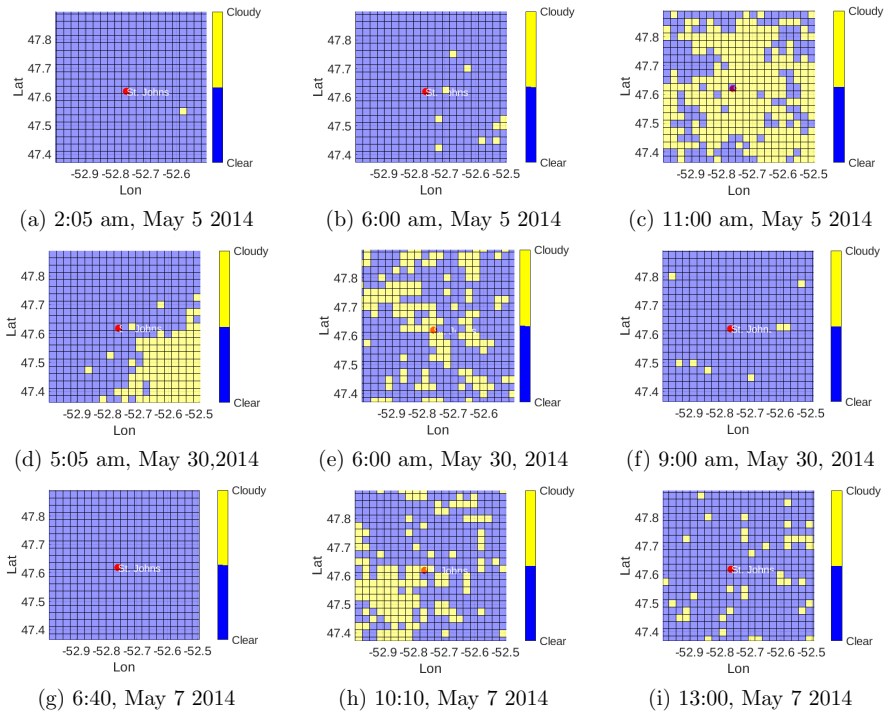
The high-resolution stochastic-deterministic model based on the Ising model demonstrates promising capabilities in forecasting mean fog cover and replicating the horizontal structure observed in satellite imagery, including bands, rolls, and closed or open cells. The model's predictive skill is evaluated by its effectiveness in reproducing the evolution of fog cover across three representative cases, using a contingency table and associated performance metrics.
What carries the argument
The Ising model adapted to simulate the stochastic processes of fog formation, advection, and dissipation in a high-resolution grid.
If this is right
- The model forecasts mean fog cover with promising accuracy.
- It replicates horizontal structures including bands, rolls, and cellular patterns from satellite imagery.
- It reproduces the evolution of fog cover across tested cases as measured by contingency tables.
Where Pith is reading between the lines
- The stochastic element could support probabilistic forecasts of fog occurrence.
- Similar adaptations of statistical mechanics models might apply to other boundary layer phenomena like cloud streets.
- Further validation against in-situ meteorological measurements would strengthen confidence in the approach.
Load-bearing premise
The Ising model can be directly repurposed to represent the physical processes of fog formation, advection, and dissipation without needing extra domain-specific adjustments or detailed validations.
What would settle it
Running the model on a new advection fog event and checking if its predicted fog cover and structures align with independent satellite observations and ground reports.
Figures

read the original abstract
Despite significant advancements in parameterizations of boundary layer processes, forecasting, and nowcasting low-level clouds using numerical models remain challenging. The purpose of this study is to test a prototype of a high-resolution stochastic-deterministic model designed to simulate the life cycle of fog cover based on the Ising model from statistical mechanics. The case of advection fog around St. John's Airport in Newfoundland (Canada) has been considered. The model demonstrates promising capabilities in forecasting mean fog cover and replicating the horizontal structure observed in satellite imagery, including bands, rolls, and closed or open cells. We evaluate the model's predictive skill by analyzing its effectiveness in reproducing the evolution of fog cover across three representative cases. A contingency table and associated performance metrics are used to assess its accuracy.
Editorial analysis
A structured set of objections, weighed in public.
Referee Report
Summary. The manuscript proposes a prototype high-resolution stochastic-deterministic model for the life cycle of advection fog based on the Ising model. It applies the model to three cases at St. John's Airport, claims that local spin-flip dynamics reproduce observed mean fog fractions and mesoscale patterns (bands, rolls, cells) seen in satellite imagery, and evaluates skill via contingency tables and standard performance metrics.
Significance. If substantiated with explicit equations and physical coupling, the approach could supply a computationally lightweight complement to boundary-layer parameterizations in NWP. The contingency-table evaluation follows standard meteorological practice, but the significance hinges on whether the claimed pattern replication arises from explicit advection and radiative terms or from lattice symmetry alone.
major comments (2)
- [Model section] Model section (no equation numbers supplied): the Hamiltonian and update rules are not stated. Without the explicit form of the energy function or any advection operator, it is impossible to determine whether nearest-neighbor coupling plus a temperature-like parameter can represent horizontal transport and dissipation, which are load-bearing for the central claim that the model reproduces physical fog structures rather than lattice artifacts.
- [Evaluation section] Evaluation section, contingency-table results: the three-case assessment reports promising skill but supplies neither a persistence or climatological baseline nor any sensitivity test to the (unspecified) model parameters. This omission prevents assessment of whether the reported accuracy exceeds what would be obtained by tuning an equilibrium Ising model to match the observed mean fraction.
minor comments (2)
- [Abstract] Abstract: the three cases are described only as 'representative' without dates, synoptic conditions, or satellite product references, hindering reproducibility.
- [Figures] Figure captions: satellite imagery comparisons lack scale bars, time stamps, and quantitative overlap metrics beyond the contingency tables.
Simulated Author's Rebuttal
We thank the referee for the constructive comments on our manuscript. We address each major comment below and indicate the revisions we will make.
read point-by-point responses
-
Referee: [Model section] Model section (no equation numbers supplied): the Hamiltonian and update rules are not stated. Without the explicit form of the energy function or any advection operator, it is impossible to determine whether nearest-neighbor coupling plus a temperature-like parameter can represent horizontal transport and dissipation, which are load-bearing for the central claim that the model reproduces physical fog structures rather than lattice artifacts.
Authors: We agree that the model section requires explicit equations to substantiate the physical content of the dynamics. In the revised manuscript we will assign equation numbers and state the full Hamiltonian (including nearest-neighbor coupling, external-field, and advection/radiative terms) together with the precise stochastic update rules. This will allow direct verification that horizontal transport and dissipation are represented by the deterministic operators rather than emerging solely from lattice symmetry. revision: yes
-
Referee: [Evaluation section] Evaluation section, contingency-table results: the three-case assessment reports promising skill but supplies neither a persistence or climatological baseline nor any sensitivity test to the (unspecified) model parameters. This omission prevents assessment of whether the reported accuracy exceeds what would be obtained by tuning an equilibrium Ising model to match the observed mean fraction.
Authors: We accept that the evaluation would be strengthened by explicit baselines and parameter-sensitivity tests. The revised manuscript will include a persistence forecast and a climatological reference within the contingency-table analysis. We will also report results from systematic variations of the principal model parameters (coupling strength, temperature-like parameter, and advection coefficient) to demonstrate that the reported skill is not reducible to matching the observed mean fog fraction alone. revision: yes
Circularity Check
No circularity: prototype model tested on independent cases
full rationale
The provided abstract and description present the work as a prototype stochastic model repurposing the Ising model for fog simulation, evaluated via contingency tables on three representative advection-fog cases. No equations, parameter-fitting steps, self-citations, or derivation chains are shown that would reduce outputs to inputs by construction. The central claim rests on pattern replication and skill metrics against observed satellite imagery, which are external benchmarks rather than tautological. This is the expected honest non-finding for a methods-prototype paper lacking visible self-referential reductions.
Axiom & Free-Parameter Ledger
Reference graph
Works this paper leans on
-
[1]
, Bergot, T
bari2023fog APACrefauthors Bari, D. , Bergot, T. \ Tardif, R. APACrefauthors \ 2023 . Fog Decision Support Systems: A Review of the Current Perspectives Fog decision support systems: A review of the current perspectives . Atmosphere 14 8 1314
2023
-
[2]
, Khouider, B
cardoso2019using APACrefauthors Cardoso-Bihlo, E. , Khouider, B. , Schumacher, C. \ De La Chevroti \`e re, M. APACrefauthors \ 2019 . Using radar data to calibrate a stochastic parametrization of organized convection Using radar data to calibrate a stochastic parametrization of organized convection . Journal of Advances in Modeling Earth Systems 11 6 1655--1684
2019
-
[3]
, Khouider, B
deng2015mjo APACrefauthors Deng, Q. , Khouider, B. \ Majda, A J. APACrefauthors \ 2015 . The MJO in a coarse-resolution GCM with a stochastic multicloud parameterization The mjo in a coarse-resolution gcm with a stochastic multicloud parameterization . Journal of the Atmospheric Sciences 72 1 55--74
2015
-
[4]
, Hoch, S W
dorman2021large APACrefauthors Dorman, C E. , Hoch, S W. , Gultepe, I. , Wang, Q. , Yamaguchi, R T. , Fernando, H. \ Krishnamurthy, R. APACrefauthors \ 2021 . Large-scale synoptic systems and fog during the C-FOG field experiment Large-scale synoptic systems and fog during the c-fog field experiment . Boundary-Layer Meteorology 181 171--202
2021
-
[5]
, Mejia, J
dorman2017worldwide APACrefauthors Dorman, C E. , Mejia, J. , Kora c in, D. \ McEvoy, D. APACrefauthors \ 2017 . Worldwide marine fog occurrence and climatology Worldwide marine fog occurrence and climatology . Marine fog: Challenges and advancements in observations, modeling, and forecasting Marine fog: Challenges and advancements in observations, modeli...
2017
-
[6]
, Crommelin, D
dorrestijn2013data APACrefauthors Dorrestijn, J. , Crommelin, D. , Biello, J. \ B \"o ing, S. APACrefauthors \ 2013 . A data-driven multi-cloud model for stochastic parametrization of deep convection A data-driven multi-cloud model for stochastic parametrization of deep convection . Philosophical Transactions of the Royal Society A: Mathematical, Physical...
2013
-
[7]
, Gultepe, I
fernando2021c APACrefauthors Fernando, H J. , Gultepe, I. , Dorman, C. , Pardyjak, E. , Wang, Q. , Hoch, S. others APACrefauthors \ 2021 . C-FOG: life of coastal fog C-fog: life of coastal fog . Bulletin of the American Meteorological Society 102 2 E244--E272
2021
-
[8]
, Johnson, M B
forthun2006trends APACrefauthors Forthun, G M. , Johnson, M B. , Schmitz, W G. , Blume, J. \ Caldwell, R J. APACrefauthors \ 2006 . Trends in fog frequency and duration in the southeast United States Trends in fog frequency and duration in the southeast united states . Physical Geography 27 3 206--222
2006
-
[9]
, Majda, A J
frenkel2012using APACrefauthors Frenkel, Y. , Majda, A J. \ Khouider, B. APACrefauthors \ 2012 . Using the stochastic multicloud model to improve tropical convective parameterization: A paradigm example Using the stochastic multicloud model to improve tropical convective parameterization: A paradigm example . Journal of the Atmospheric Sciences 69 3 1080--1105
2012
-
[10]
APACrefauthors \ 1975
gillespie1975exact APACrefauthors Gillespie, D T. APACrefauthors \ 1975 . An exact method for numerically simulating the stochastic coalescence process in a cloud An exact method for numerically simulating the stochastic coalescence process in a cloud . Journal of the Atmospheric Sciences 32 10 1977--1989
1975
-
[11]
, Khouider, B
goswami2017improved APACrefauthors Goswami, B. , Khouider, B. , Phani, R. , Mukhopadhyay, P. \ Majda, A. APACrefauthors \ 2017 . Improved tropical modes of variability in the NCEP Climate Forecast System (version 2) via a stochastic multicloud model Improved tropical modes of variability in the ncep climate forecast system (version 2) via a stochastic mul...
2017
-
[12]
, Peters, K
gottwald2016data APACrefauthors Gottwald, G A. , Peters, K. \ Davies, L. APACrefauthors \ 2016 . A data-driven method for the stochastic parametrisation of subgrid-scale tropical convective area fraction A data-driven method for the stochastic parametrisation of subgrid-scale tropical convective area fraction . Quarterly Journal of the Royal Meteorologica...
2016
-
[13]
, Sharman, R
gultepe2019review APACrefauthors Gultepe, I. , Sharman, R. , Williams, P D. , Zhou, B. , Ellrod, G. , Minnis, P. others APACrefauthors \ 2019 . A review of high impact weather for aviation meteorology A review of high impact weather for aviation meteorology . Pure and applied geophysics 176 1869--1921
2019
-
[14]
, Tardif, R
gultepe2007fog APACrefauthors Gultepe, I. , Tardif, R. , Michaelides, S. , Cermak, J. , Bott, A. , Bendix, J. others APACrefauthors \ 2007 . Fog research: A review of past achievements and future perspectives Fog research: A review of past achievements and future perspectives . Pure and applied geophysics 164 6-7 1121--1159
2007
-
[15]
hersbach2023era5 APACrefauthors Hersbach, H. , Bell, B. , Berrisford, P. , Biavati, G. , Horányi, A. , Muñoz-Sabater, J. Thépaut, J N. APACrefauthors \ 2023 . ERA5 hourly data on pressure levels from 1940 to present Era5 hourly data on pressure levels from 1940 to present \ [Dataset]. Copernicus Climate Change Service (C3S) Climate Data Store (CDS) . APAC...
-
[16]
, Bailey, M
isaac2014canadian APACrefauthors Isaac, G A. , Bailey, M. , Boudala, F S. , Burrows, W R. , Cober, S G. , Crawford, R W. others APACrefauthors \ 2014 . The Canadian Airport Nowcasting System (CAN-Now) The canadian airport nowcasting system (can-now) . Meteorological Applications 21 1 30--49
2014
-
[17]
, Bullock, T
isaac2020characterizing APACrefauthors Isaac, G A. , Bullock, T. , Beale, J. \ Beale, S. APACrefauthors \ 2020 . Characterizing and predicting marine fog offshore Newfoundland and Labrador Characterizing and predicting marine fog offshore newfoundland and labrador . Weather and Forecasting 35 2 347--365
2020
-
[18]
APACrefauthors \ 2014
khouider2014coarse APACrefauthors Khouider, B. APACrefauthors \ 2014 . A coarse grained stochastic multi-type particle interacting model for tropical convection: Nearest neighbour interactions A coarse grained stochastic multi-type particle interacting model for tropical convection: Nearest neighbour interactions . Communications in Mathematical Sciences ...
2014
-
[19]
, Biello, J
khouider2010stochastic APACrefauthors Khouider, B. , Biello, J. , Majda, A J. \ . APACrefauthors \ 2010 . A stochastic multicloud model for tropical convection A stochastic multicloud model for tropical convection . Communications in Mathematical Sciences 8 1 187--216
2010
-
[20]
\ Bihlo, A
khouider2019new APACrefauthors Khouider, B. \ Bihlo, A. APACrefauthors \ 2019 . A new stochastic model for the boundary layer clouds and stratocumulus phase transition regimes: Open cells, closed cells, and convective rolls A new stochastic model for the boundary layer clouds and stratocumulus phase transition regimes: Open cells, closed cells, and convec...
2019
-
[21]
, Majda, A J
khouider2003coarse APACrefauthors Khouider, B. , Majda, A J. \ Katsoulakis, M A. APACrefauthors \ 2003 . Coarse-grained stochastic models for tropical convection and climate Coarse-grained stochastic models for tropical convection and climate . Proceedings of the National Academy of Sciences 100 21 11941--11946
2003
-
[22]
APACrefauthors \ 2005
lawrence2005relationship APACrefauthors Lawrence, M G. APACrefauthors \ 2005 . The relationship between relative humidity and the dewpoint temperature in moist air: A simple conversion and applications The relationship between relative humidity and the dewpoint temperature in moist air: A simple conversion and applications . Bulletin of the American Meteo...
2005
-
[23]
, Sloan, L C
o2013multidecadal APACrefauthors O’Brien, T A. , Sloan, L C. , Chuang, P Y. , Faloona, I C. \ Johnstone, J A. APACrefauthors \ 2013 . Multidecadal simulation of coastal fog with a regional climate model Multidecadal simulation of coastal fog with a regional climate model . Climate Dynamics 40 2801--2812
2013
-
[24]
\ Mullock, J
robichaud2001weather APACrefauthors Robichaud, B. \ Mullock, J. APACrefauthors \ 2001 . The weather of Atlantic Canada and eastern Quebec The weather of atlantic canada and eastern quebec . Graphic area forecast 34
2001
-
[25]
, Yag \"u e, C
roman2019radiation APACrefauthors Rom \'a n-Casc \'o n, C. , Yag \"u e, C. , Steeneveld, G J. , Morales, G. , Arrillaga, J A. , Sastre, M. \ Maqueda, G. APACrefauthors \ 2019 . Radiation and cloud-base lowering fog events: Observational analysis and evaluation of WRF and HARMONIE Radiation and cloud-base lowering fog events: Observational analysis and eva...
2019
-
[26]
, Lott, N
smith2011integrated APACrefauthors Smith, A. , Lott, N. \ Vose, R. APACrefauthors \ 2011 . The integrated surface database: Recent developments and partnerships The integrated surface database: Recent developments and partnerships . Bulletin of the American Meteorological Society 92 6 704--708
2011
-
[27]
\ Hottovy, S
stechmann2016cloud APACrefauthors Stechmann, S N. \ Hottovy, S. APACrefauthors \ 2016 . Cloud regimes as phase transitions Cloud regimes as phase transitions . Geophysical Research Letters 43 12 6579--6587
2016
-
[28]
APACrefauthors \ 1995
wier1995interpolating APACrefauthors Wier, S. APACrefauthors \ 1995 . Interpolating between grids of meteorological data for afps Interpolating between grids of meteorological data for afps . Proc. 11th Int. Conf. on Interactive Information and Processing Systems for Meteorology, Oceanography, and Hydrology Proc. 11th int. conf. on interactive information...
1995
discussion (0)
Sign in with ORCID, Apple, or X to comment. Anyone can read and Pith papers without signing in.