Subarray based Wideband Beamforming and Variational Sparse CSI Estimation for Low-Resolution MU THz MIMO Systems
Pith reviewed 2026-06-28 00:15 UTC · model grok-4.3
The pith
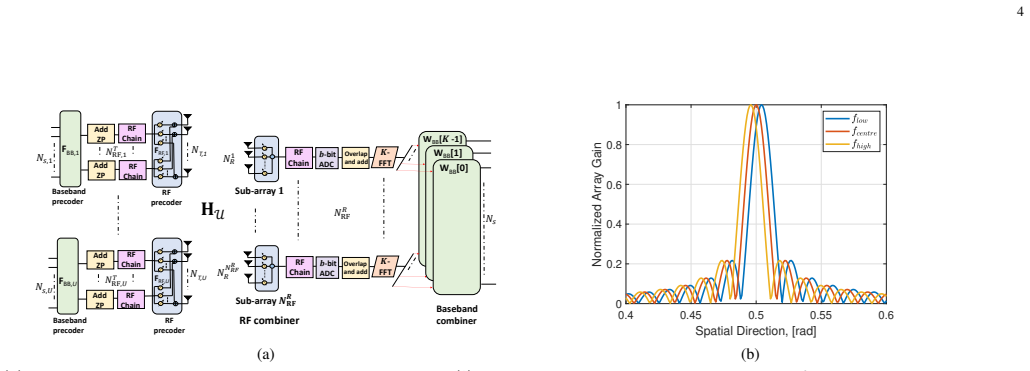
A variational Bayesian framework jointly estimates sparse channels and designs beamformers for low-resolution wideband THz MIMO systems while compensating beam squint via true time delays.
A machine-rendered reading of the paper's core claim, the machinery that carries it, and where it could break.
Core claim
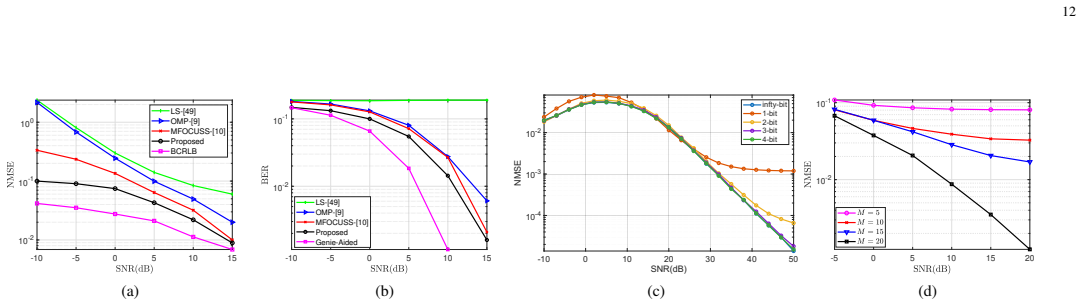
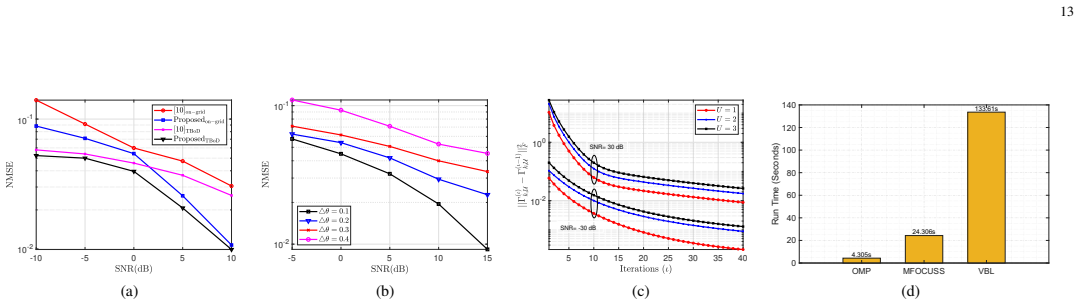
The paper claims that the variational Bayesian inference-based estimator combined with the TTD-enabled hybrid transceiver provides accurate directional alignment and robust sparse CSI recovery across all subcarriers in practical wideband THz conditions, with the estimator accommodating on-grid and off-grid domains and its performance benchmarked against the derived multi-user Bayesian CRLB.
What carries the argument
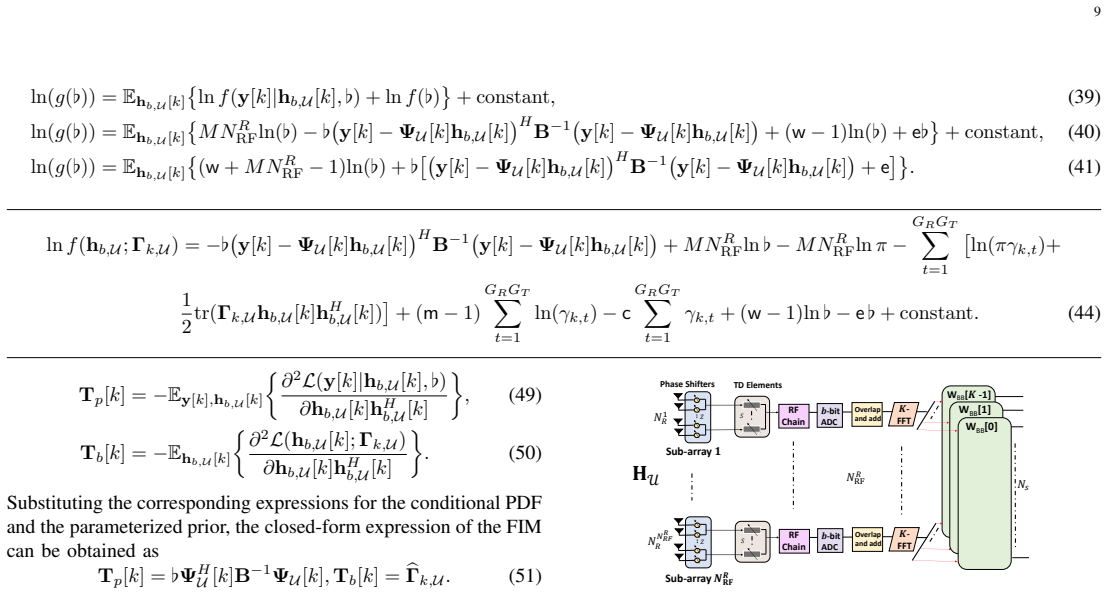
Variational Bayesian inference applied to a dual-wideband channel model linearized via Bussgang decomposition, integrated with a true time delay (TTD) hybrid beamforming architecture in subarray-based transceivers.
If this is right
- The TTD-based design ensures frequency-independent beam alignment across the entire bandwidth.
- The estimator recovers sparse CSI with higher resolution than grid-restricted methods by handling off-grid angles.
- Performance remains robust under the combined effects of wideband propagation and low-resolution quantization.
- The multi-user Bayesian CRLB serves as a tight benchmark for any competing estimator in the same setting.
Where Pith is reading between the lines
- The subarray-plus-TTD architecture could lower the number of RF chains needed in future THz deployments.
- The off-grid variational formulation might transfer to sparse recovery tasks outside THz communications.
- Combining the linearized Bussgang model with other inference methods could further reduce computational cost.
Load-bearing premise
The dual-wideband channel model with root-raised-cosine pulse shape accurately captures band-limited propagation effects, and Bussgang decomposition yields a tractable linear model for the distortions caused by low-resolution ADCs.
What would settle it
A measurement campaign or simulation in which the proposed estimator's mean-squared error fails to approach the derived multi-user Bayesian Cramér-Rao lower bound under the modeled THz channel and ADC conditions would falsify the performance claims.
Figures
read the original abstract
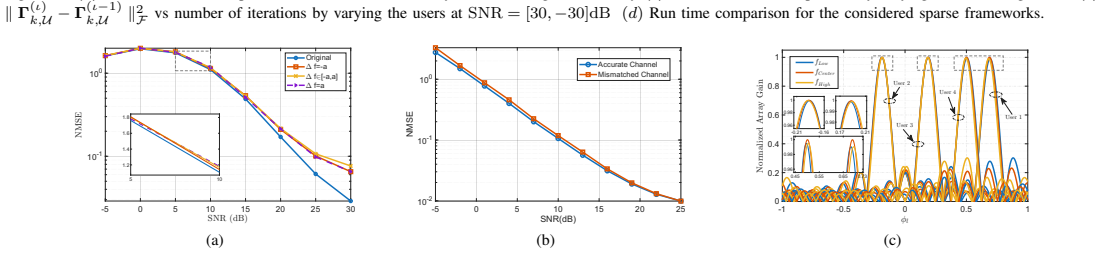
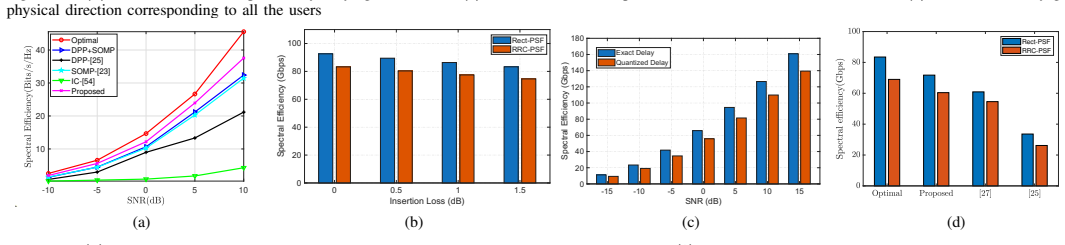
This work conceives a unified channel estimation and beamforming framework, formulated within the principles of variational Bayesian inference. Recognizing the limitations imposed by hardware constraints, frequency-dependent propagation effects, and the structural restrictions of partially connected architectures in the Terahertz (THz) band, we formulate a dual-wideband channel model incorporating root raised cosine (RRC) pulse shape to account its band-limited nature. To further address the nonlinear distortions introduced by low-resolution ADCs, Bussgang decomposition is employed, enabling a tractable linearized inference process. Unlike conventional techniques, the proposed method accommodates both on-grid and off-grid angular domains, capturing spatial sparsity with improved resolution and robustness. The multi-user (MU) Bayesian Cram\'er-Rao lower bound is also derived to benchmark the performance of the proposed estimator. Moreover, the framework incorporates a true time delay (TTD)-based hybrid transceiver design that inherently compensates for the beam-squint effect; a frequency-dependent angular deviation that arises due to the fixedphase nature of the conventional beamformer in wideband systems, thereby ensuring accurate directional alignment across all subcarriers. Extensive simulation results validate the effectiveness of the proposed variational Bayesian inference-based estimator and the TTD-enabled beamforming architecture, highlighting their robustness and performance gains under practical wideband THz system.
Editorial analysis
A structured set of objections, weighed in public.
Referee Report
Summary. The manuscript proposes a unified variational Bayesian inference framework for joint channel estimation and beamforming in low-resolution multi-user THz MIMO systems. It introduces a dual-wideband channel model that incorporates root-raised-cosine pulse shaping to capture band-limited effects, employs Bussgang decomposition to linearize the effect of low-resolution ADCs, accommodates both on-grid and off-grid angular sparsity, derives the multi-user Bayesian Cramér-Rao lower bound, and integrates a true-time-delay (TTD) hybrid transceiver architecture to mitigate beam squint. Extensive simulations are claimed to demonstrate robustness and performance gains under practical wideband THz conditions.
Significance. If the variational updates and TTD design deliver the reported gains while remaining stable under realistic propagation and quantization mismatch, the work would provide a concrete, implementable approach to two central practical obstacles in THz MIMO—frequency-dependent beam squint and low-resolution ADC distortion—thereby strengthening the case for partially connected hybrid architectures in the THz band.
major comments (1)
- [Abstract / simulation section] Abstract and § on simulation results: the central claim that the estimator and TTD architecture exhibit 'robustness … under practical wideband THz system' rests on simulations that, by the abstract’s own description, employ the identical dual-wideband RRC model and Bussgang-linearized observation model used to derive the inference algorithm. No evidence is presented that performance remains stable when these modeling assumptions are violated (e.g., different pulse shapes, non-Gaussian quantization noise, or measured THz channels). This directly undermines the robustness assertion.
minor comments (2)
- [System model] Notation for the dual-wideband channel model and the precise definition of the RRC pulse in the frequency-domain formulation should be stated explicitly before the variational update equations are derived.
- [Estimation algorithm] The manuscript should clarify whether the off-grid angular refinement is performed jointly with the variational updates or in a separate post-processing step.
Simulated Author's Rebuttal
We thank the referee for the constructive comment on the robustness claims. We address the concern point-by-point below and indicate planned revisions.
read point-by-point responses
-
Referee: [Abstract / simulation section] Abstract and § on simulation results: the central claim that the estimator and TTD architecture exhibit 'robustness … under practical wideband THz system' rests on simulations that, by the abstract’s own description, employ the identical dual-wideband RRC model and Bussgang-linearized observation model used to derive the inference algorithm. No evidence is presented that performance remains stable when these modeling assumptions are violated (e.g., different pulse shapes, non-Gaussian quantization noise, or measured THz channels). This directly undermines the robustness assertion.
Authors: We acknowledge that all reported simulations employ the dual-wideband RRC model and Bussgang-linearized observation model derived in the paper. These elements are included precisely to reflect key practical THz impairments (band-limited pulse shaping and low-resolution ADC distortion). The robustness claim is therefore scoped to performance under this realistic modeling framework rather than arbitrary model mismatches. To address the concern, we will revise the abstract and simulation section to explicitly qualify the scope of the robustness results. We will also add a short discussion (and, space permitting, one or two additional simulation curves) examining sensitivity to alternative pulse shapes and a Gaussian approximation to quantization noise. Results on measured THz channels cannot be added, as the work is simulation-based and no such datasets were available. revision: partial
- Results on measured THz channels cannot be provided without access to real-world measurement data, which is outside the scope of this simulation study.
Circularity Check
No circularity in derivation chain; self-contained variational estimator and BCRLB benchmark
full rationale
The abstract and available text describe a variational Bayesian estimator derived from the dual-wideband RRC model and Bussgang linearization, with an independent MU Bayesian CRLB derived as benchmark and TTD architecture for beam-squint compensation. No quoted equations reduce a claimed prediction or uniqueness result to a fitted input or self-citation by construction. Simulations are presented as validation under the stated model rather than as load-bearing derivations. The central claims rest on explicit modeling choices and standard variational inference techniques, not on self-referential reductions.
Axiom & Free-Parameter Ledger
Reference graph
Works this paper leans on
-
[1]
Channel modeling and capacity analysis for electromagnetic wireless nanonetworks in the TeraHertz band,
J. M. Jornet and I. F. Akyildiz, “Channel modeling and capacity analysis for electromagnetic wireless nanonetworks in the TeraHertz band,” IEEE Transactions on Wireless Communications , pp. 3211–3221, 2011
2011
-
[2]
Terahertz band communication: An old problem revisited and research directions for the next decade,
I. F. Akyildiz, C. Han, Z. Hu, S. Nie, and J. M. Jornet, “Terahertz band communication: An old problem revisited and research directions for the next decade,” IEEE Transactions on Communications , vol. 70, no. 6, pp. 4250–4285, 2022
2022
-
[3]
Scattering analysis for the modeling of THz communication systems,
R. Piesiewicz, C. Jansen, D. Mittleman, T. Kleine-Ostmann, M. Koch, and T. Kurner, “Scattering analysis for the modeling of THz communication systems,” IEEE Transactions on Antennas and Propagation , vol. 55, no. 11, pp. 3002–3009, 2007
2007
-
[4]
Properties of building and plastic materials in the THz range,
R. Piesiewicz, C. Jansen, S. Wietzke, D. Mittleman, M. Koch, and T. Kürner, “Properties of building and plastic materials in the THz range,” International Journal of Infrared and Millimeter Waves , vol. 28, pp. 363–371, 2007
2007
-
[5]
The effects of multipath delay spread on timing recovery,
J.-I. Chuang, “The effects of multipath delay spread on timing recovery,” IEEE Transactions on V ehicular Technology , pp. 135–140, 1987
1987
-
[6]
Spatial-and frequency- wideband effects in millimeter-wave massive MIMO systems,
B. Wang, F. Gao, S. Jin, H. Lin, and G. Y . Li, “Spatial-and frequency- wideband effects in millimeter-wave massive MIMO systems,” IEEE Trans- actions on Signal Processing , vol. 66, no. 13, pp. 3393–3406, 2018
2018
-
[7]
Compressed training for dual-wideband time-varying sub-Terahertz massive MIMO,
T.-H. Chou, N. Michelusi, D. J. Love, and J. V . Krogmeier, “Compressed training for dual-wideband time-varying sub-Terahertz massive MIMO,” IEEE Transactions on Communications , pp. 3559–3575, 2023
2023
-
[8]
Beam squint and channel estimation for wideband mmWave massive MIMO-OFDM systems,
B. Wang, M. Jian, F. Gao, G. Y . Li, and H. Lin, “Beam squint and channel estimation for wideband mmWave massive MIMO-OFDM systems,” IEEE Transactions on Signal Processing , vol. 67, no. 23, pp. 5893–5908, 2019
2019
-
[9]
Sparse channel estimation using orthogonal matching pursuit algorithm,
G. Z. Karabulut and A. Y ongacoglu, “Sparse channel estimation using orthogonal matching pursuit algorithm,” in IEEE 60th V ehicular Technology Conference. IEEE, 2004
2004
-
[10]
An empirical Bayesian strategy for solving the simultaneous sparse approximation problem,
D. P . Wipf and B. D. Rao, “An empirical Bayesian strategy for solving the simultaneous sparse approximation problem,” IEEE Transactions on Signal Processing, vol. 55, no. 7, pp. 3704–3716, 2007
2007
-
[11]
Block expectation propagation for downlink channel estimation in massive MIMO systems,
S. Wu, Z. Ni, X. Meng, and L. Kuang, “Block expectation propagation for downlink channel estimation in massive MIMO systems,” IEEE communica- tions letters , vol. 20, no. 11, pp. 2225–2228, 2016
2016
-
[12]
Learning with compressible priors,
V . Cevher, “Learning with compressible priors,” Advances in Neural Infor- mation Processing Systems , vol. 22, 2009
2009
-
[13]
Sparse solu- tions to linear inverse problems with multiple measurement vectors,
S. F. Cotter, B. D. Rao, K. Engan, and K. Kreutz-Delgado, “Sparse solu- tions to linear inverse problems with multiple measurement vectors,” IEEE Transactions on Signal Processing , pp. 2477–2488, 2005
2005
-
[14]
Sparse Bayesian learning and the relevance vector machine,
M. E. Tipping, “Sparse Bayesian learning and the relevance vector machine,” Journal of machine learning research , vol. 1, no. Jun, pp. 211–244, 2001
2001
-
[15]
Channel estimation for FDD multi-user massive MIMO: A variational Bayesian inference-based approach,
X. Cheng, J. Sun, and S. Li, “Channel estimation for FDD multi-user massive MIMO: A variational Bayesian inference-based approach,” IEEE Transactions on Wireless Communications , pp. 7590–7602, 2017
2017
-
[16]
Novel wideband DOA estimation based on sparse Bayesian learning with Dirichlet process priors,
L. Wang, L. Zhao, G. Bi, C. Wan, L. Zhang, and H. Zhang, “Novel wideband DOA estimation based on sparse Bayesian learning with Dirichlet process priors,” IEEE Transactions on Signal Processing , pp. 275–289, 2015
2015
-
[17]
Overcoming beam squint in mmWave MIMO channel estimation: A Bayesian multi-band sparsity approach,
L. Xu, L. Cheng, N. Wong, Y .-C. Wu, and H. V . Poor, “Overcoming beam squint in mmWave MIMO channel estimation: A Bayesian multi-band sparsity approach,” IEEE Transactions on Signal Processing , vol. 72, pp. 1219–1234, 2024
2024
-
[18]
Adaptive hybrid-field channel estimation in THz XL-MIMO systems,
J. Lu, J. Zhang, H. Lei, H. Xiao, and B. Ai, “Adaptive hybrid-field channel estimation in THz XL-MIMO systems,” IEEE Transactions on V ehicular Technology, 2025. 16 ˜Ωk = 1 N l R n 1 + ejπθ e−jπϑ kθk + · · · + ejπ(Z−1)θe−jπ(Z−1)ϑkθk + e−jπυ k 1 + · · · + ejπ(2Z−1)θe−jπ(2Z−1)ϑkθk + · · · + e−jπ(S−1)υk 1 + ejπ(S−1)Zθ e−jπ(S−1)Zϑkθk + · · · + ejπ(SZ −1)θe−jπ(...
2025
-
[19]
Modular XL-Array- Enabled Channel Estimation and Localization in Terahertz Systems,
Y . Zhang, R. Li, C. Pan, H. Ren, T. Wu, and C. Wang, “Modular XL-Array- Enabled Channel Estimation and Localization in Terahertz Systems,” IEEE Transactions on Cognitive Communications and Networking , 2025
2025
-
[20]
Adaptive beamforming with resource allocation for distance-aware multi-user indoor TeraHertz communications,
C. Lin and G. Y . Li, “Adaptive beamforming with resource allocation for distance-aware multi-user indoor TeraHertz communications,” IEEE Trans- actions on Communications , vol. 63, no. 8, pp. 2985–2995, 2015
2015
-
[21]
Channel estimation and hybrid precoding for frequency selective multiuser mmWave MIMO systems,
J. P . González-Coma, J. Rodriguez-Fernandez, N. González-Prelcic, L. Castedo, and R. W. Heath, “Channel estimation and hybrid precoding for frequency selective multiuser mmWave MIMO systems,” IEEE Journal of Selected Topics in Signal Processing , pp. 353–367, 2018
2018
-
[22]
Uplink achievable rate for massive MIMO systems with low-resolution ADC,
L. Fan, S. Jin, C.-K. Wen, and H. Zhang, “Uplink achievable rate for massive MIMO systems with low-resolution ADC,” IEEE Communications Letters , vol. 19, no. 12, pp. 2186–2189, 2015
2015
-
[23]
Spatially sparse precoding in millimeter wave MIMO systems,
O. El Ayach, S. Rajagopal, S. Abu-Surra, Z. Pi, and R. W. Heath, “Spatially sparse precoding in millimeter wave MIMO systems,” IEEE Transactions on Wireless Communications, pp. 1499–1513, 2014
2014
-
[24]
Channel estimation and hybrid combining for wideband Terahertz massive MIMO systems,
K. Dovelos, M. Matthaiou, H. Q. Ngo, and B. Bellalta, “Channel estimation and hybrid combining for wideband Terahertz massive MIMO systems,” IEEE Journal on selected Areas in communications , pp. 1604–1620, 2021
2021
-
[25]
Delay-phase precoding for wideband THz massive MIMO,
L. Dai, J. Tan, Z. Chen, and H. V . Poor, “Delay-phase precoding for wideband THz massive MIMO,” IEEE Transactions on Wireless Communications , vol. 21, no. 9, pp. 7271–7286, 2022
2022
-
[26]
Hybrid beamforming for wideband terahertz massive MIMO communications with low-resolution phase shifters and true- time-delay,
P .-H. Chang and T.-D. Chiueh, “Hybrid beamforming for wideband terahertz massive MIMO communications with low-resolution phase shifters and true- time-delay,” IEEE Transactions on Wireless Communications , vol. 23, no. 7, pp. 8000–8012, 2024
2024
-
[27]
Frequency-Dependent Beamforming and Beam Training for XL-MIMO With Practical TTDs,
M. Q. Khan, M. Parvini, P . Schulz, and G. Fettweis, “Frequency-Dependent Beamforming and Beam Training for XL-MIMO With Practical TTDs,” IEEE Wireless Communications Letters , vol. 15, pp. 1315–1319, 2026
2026
-
[28]
Channel estimation and equalization for terahertz receiver with RF impairments,
Z. Sha and Z. Wang, “Channel estimation and equalization for terahertz receiver with RF impairments,” IEEE Journal on Selected Areas in Com- munications, vol. 39, no. 6, pp. 1621–1635, 2021
2021
-
[29]
Channel estimation for hybrid architecture-based wideband millimeter wave systems,
K. V enugopal, A. Alkhateeb, N. G. Prelcic, and R. W. Heath, “Channel estimation for hybrid architecture-based wideband millimeter wave systems,” IEEE Journal on Selected Areas in Communications , vol. 35, no. 9, pp. 1996– 2009, 2017
1996
-
[30]
AoA, AoD and ToA characteristics scattered multipath clusters for THz indoor channel modeling,
S. Priebe, M. Jacob, and T. Kuerner, “AoA, AoD and ToA characteristics scattered multipath clusters for THz indoor channel modeling,” in 17th European Wireless Sustainable Wireless Technologies . VDE, 2011
2011
-
[31]
Hybrid precoding architecture for massive multiuser MIMO with dissipation: Sub-connected or fully con- nected structures?
J. Du, W. Xu, H. Shen, X. Dong, and C. Zhao, “Hybrid precoding architecture for massive multiuser MIMO with dissipation: Sub-connected or fully con- nected structures?” IEEE Transactions on Wireless Communications , vol. 17, no. 8, pp. 5465–5479, 2018
2018
-
[32]
Terahertz wireless communications for 2030 and beyond: A cutting-edge frontier,
Z. Chen, C. Han, Y . Wu, L. Li, C. Huang, Z. Zhang, G. Wang, and W. Tong, “Terahertz wireless communications for 2030 and beyond: A cutting-edge frontier,” IEEE Communications Magazine , vol. 59, no. 11, pp. 66–72, 2021
2030
-
[33]
The Bussgang decomposition of nonlinear systems: Basic theory and MIMO extensions [lecture notes],
O. T. Demir and E. Bjornson, “The Bussgang decomposition of nonlinear systems: Basic theory and MIMO extensions [lecture notes],” IEEE Signal Processing Magazine, vol. 38, no. 1, pp. 131–136, 2020
2020
-
[34]
Goldsmith, Wireless communications
A. Goldsmith, Wireless communications. Cambridge university press, 2005
2005
-
[35]
Capacity lower bound of MIMO channels with output quantization and correlated noise,
A. Mezghani and J. A. Nossek, “Capacity lower bound of MIMO channels with output quantization and correlated noise,” in Proc. IEEE Int. Symp. Inf. Theory, 2012, pp. 1–5
2012
-
[36]
Angularly sparse channel estimation in dual-wideband tera-hertz (THz) hybrid MIMO systems relying on Bayesian learning,
A. Garg, S. Srivastava, N. Y adav, A. K. Jagannatham, and L. Hanzo, “Angularly sparse channel estimation in dual-wideband tera-hertz (THz) hybrid MIMO systems relying on Bayesian learning,” IEEE Transactions on Communications , 2024
2024
-
[37]
Sparse channel estimation for interference limited OFDM systems and its convergence analysis,
A. Bishnu and V . Bhatia, “Sparse channel estimation for interference limited OFDM systems and its convergence analysis,” IEEE Access , vol. 5, pp. 17 781–17 794, 2017
2017
-
[38]
Sparse Bayesian learning approach for OTFS channel estimation with fractional Doppler,
Y . Zhang, Q. Zhang, C. He, L. Jing, T. Zheng, and C. Y uen, “Sparse Bayesian learning approach for OTFS channel estimation with fractional Doppler,” IEEE Transactions on V ehicular Technology , vol. 73, no. 11, pp. 16 846– 16 860, 2024
2024
-
[39]
Statistical signal processing: estimation theory,
S. M. Kay, “Statistical signal processing: estimation theory,” Prentice Hall , vol. 1, pp. Chapter–3, 1993
1993
-
[40]
Sparse Bayesian learning-based channel estimation in millimeter wave hybrid MIMO systems,
A. Mishra, A. Rajoriya, A. K. Jagannatham, and G. Ascheid, “Sparse Bayesian learning-based channel estimation in millimeter wave hybrid MIMO systems,” in 2017 IEEE 18th International Workshop on Signal Processing Advances in Wireless Communications . IEEE, 2017
2017
-
[41]
The variational approxi- mation for Bayesian inference,
D. G. Tzikas, A. C. Likas, and N. P . Galatsanos, “The variational approxi- mation for Bayesian inference,” IEEE Signal Processing Magazine , vol. 25, no. 6, pp. 131–146, 2008
2008
-
[42]
C. M. Bishop and N. M. Nasrabadi, Pattern recognition and machine learning. Springer, 2006, vol. 4, no. 4
2006
-
[43]
Codebook-based hybrid precoding for millimeter wave multiuser systems,
S. He, J. Wang, Y . Huang, B. Ottersten, and W. Hong, “Codebook-based hybrid precoding for millimeter wave multiuser systems,” IEEE Transactions on Signal Processing , vol. 65, no. 20, pp. 5289–5304, 2017
2017
-
[44]
V ariational bayes for joint channel estimation and data detection in few-bit massive MIMO systems,
L. V . Nguyen, A. L. Swindlehurst, and D. H. Nguyen, “V ariational bayes for joint channel estimation and data detection in few-bit massive MIMO systems,” IEEE Transactions on Signal Processing , 2024
2024
-
[45]
Energy-efficient dynamic-subarray with fixed true-time-delay design for terahertz wideband hybrid beamforming,
L. Y an, C. Han, and J. Y uan, “Energy-efficient dynamic-subarray with fixed true-time-delay design for terahertz wideband hybrid beamforming,” IEEE Journal on Selected Areas in Communications , pp. 2840–2854, 2022
2022
-
[46]
Off-grid direction of arrival estimation using sparse Bayesian inference,
Z. Y ang, L. Xie, and C. Zhang, “Off-grid direction of arrival estimation using sparse Bayesian inference,” IEEE Transactions on Signal Processing , vol. 61, no. 1, pp. 38–43, 2012
2012
-
[47]
IEEE 802.11 ad- based radar: An approach to joint vehicular communication-radar system,
P . Kumari, J. Choi, N. González-Prelcic, and R. W. Heath, “IEEE 802.11 ad- based radar: An approach to joint vehicular communication-radar system,” IEEE Transactions on V ehicular Technology , pp. 3012–3027, 2017
2017
-
[48]
C. Hill. (1999) HITRAN Online Interface to the HITRAN Database. [Online]. Available: https://hitran.org/
1999
-
[49]
Toeplitz compressed sensing matrices with applications to sparse channel estimation,
J. Haupt, W. U. Bajwa, G. Raz, and R. Nowak, “Toeplitz compressed sensing matrices with applications to sparse channel estimation,” IEEE Transactions on Information Theory , pp. 5862–5875, 2010
2010
-
[50]
Secure communication for spatially correlated massive MIMO with low-resolution DACs,
D. Y ang, J. Xu, W. Xu, N. Wang, B. Sheng, and A. L. Swindlehurst, “Secure communication for spatially correlated massive MIMO with low-resolution DACs,” IEEE Wireless Communications Letters , pp. 2120–2124, 2021
2021
-
[51]
Bayesian optimal data detector for mmWave OFDM system with low-resolution ADC,
H. Wang, C.-K. Wen, and S. Jin, “Bayesian optimal data detector for mmWave OFDM system with low-resolution ADC,” IEEE Journal on Selected Areas in Communications , vol. 35, no. 9, pp. 1962–1979, 2017
1962
-
[52]
Performance analysis of multi- cell millimeter-wave massive MIMO networks with low-precision ADCs,
J. Xu, W. Xu, H. Zhang, G. Y . Li, and X. Y ou, “Performance analysis of multi- cell millimeter-wave massive MIMO networks with low-precision ADCs,” IEEE Transactions on Communications , pp. 302–317, 2018
2018
-
[53]
Channel estimation for hybrid mmWave MIMO systems with CFO uncertainties,
J. Rodriguez-Fernandez and N. Gonzalez-Prelcic, “Channel estimation for hybrid mmWave MIMO systems with CFO uncertainties,” IEEE Transactions on Wireless Communications , vol. 18, no. 10, pp. 4636–4652, 2019
2019
-
[54]
Robust and low complexity hybrid beamforming for uplink multiuser mmWave MIMO systems,
J. Li, L. Xiao, X. Xu, and S. Zhou, “Robust and low complexity hybrid beamforming for uplink multiuser mmWave MIMO systems,” IEEE Commu- nications Letters , vol. 20, no. 6, pp. 1140–1143, 2016
2016
discussion (0)
Sign in with ORCID, Apple, or X to comment. Anyone can read and Pith papers without signing in.