A Surrogate Model for Proton Spectrum Prediction to Map Transitions in Laser-Ion Acceleration
Pith reviewed 2026-06-27 23:18 UTC · model grok-4.3
The pith
A decoupled dual-branch surrogate predicts full proton spectra and maps TNSA to RIT-BOA transitions from laser parameters.
A machine-rendered reading of the paper's core claim, the machinery that carries it, and where it could break.
Core claim
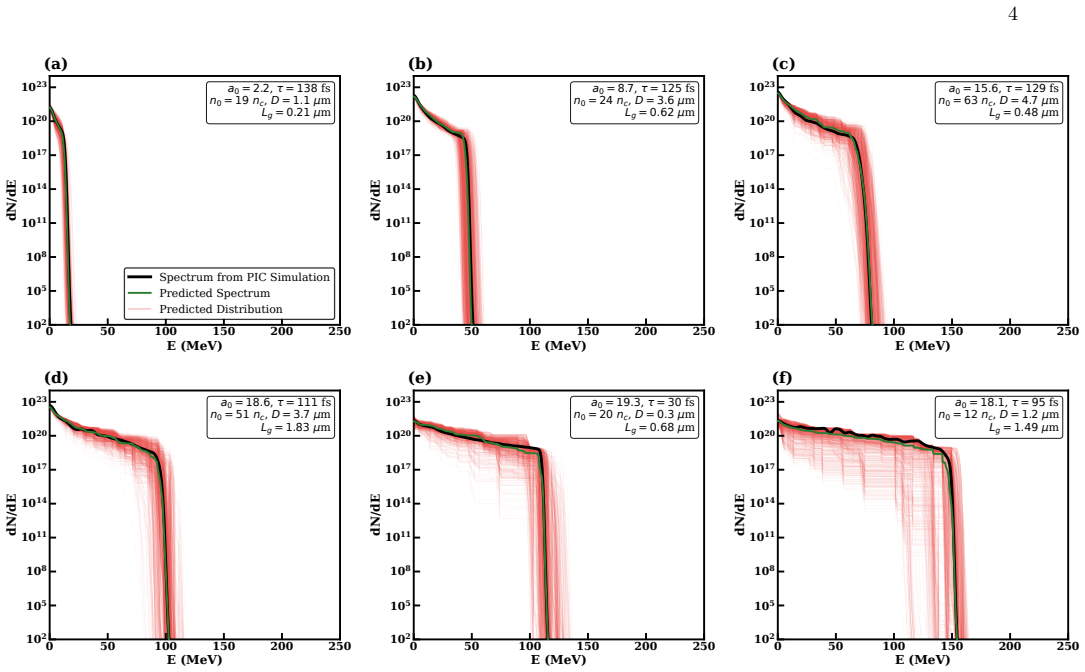
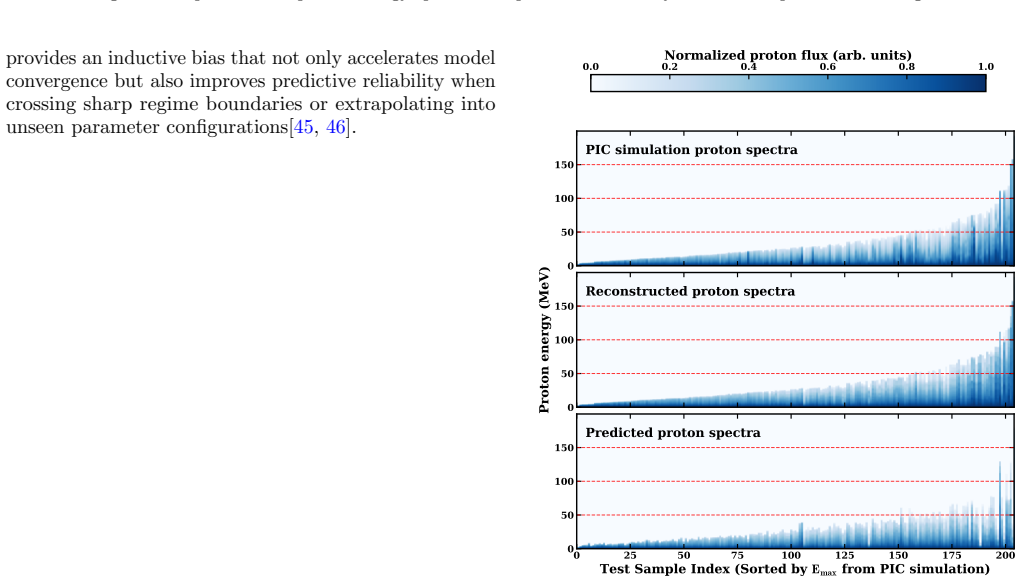
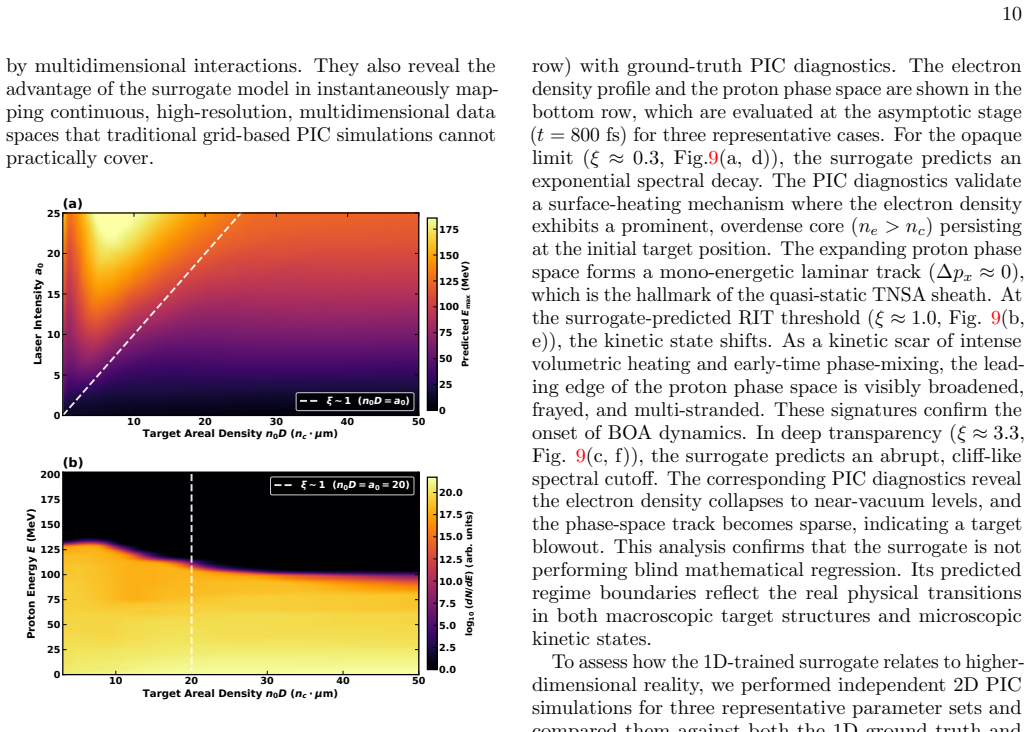
Within the 1D longitudinal framework, the surrogate reproduces spectral signatures consistent with the transition from Target Normal Sheath Acceleration (TNSA) to the volumetric heating dynamics of Relativistically Induced Transparency (RIT) and Breakout Afterburner (BOA) regimes, validated against kinetic diagnostics from 1D particle-in-cell simulations, while maintaining high predictive accuracy on key spectral quantities.
What carries the argument
decoupled dual-branch surrogate model integrating a β-VAE for spectral feature extraction with a parallel multi-layer perceptron for scalar boundary enforcement
If this is right
- The surrogate acts as a fast probabilistic diagnostic for mapping acceleration regime boundaries.
- It supplies a computationally cheap baseline for multi-fidelity optimization loops over laser intensity, pulse duration, and target thickness.
- Uncertainty estimates allow selective triggering of expensive simulations only where the model is least confident.
- The same architecture can support closed-loop feedback control at high-repetition-rate facilities.
Where Pith is reading between the lines
- Coupling the surrogate to real experimental diagnostics could enable on-the-fly parameter tuning without waiting for post-shot analysis.
- Extending the input space to include target material properties or pre-plasma scale length might expose previously unexplored optimum windows for maximum proton energy.
- If the 1D spectral signatures remain dominant in 2D or 3D geometries, the same model could serve as an initial filter before full multidimensional runs.
Load-bearing premise
The 1D particle-in-cell simulations used for training and validation capture the essential physics of the TNSA-RIT-BOA transitions without missing important three-dimensional effects.
What would settle it
A new set of 1D PIC runs or laser experiments at parameters outside the training distribution that produce proton spectra whose shape or cutoff deviates from the surrogate prediction by more than the reported 6.2 percent calibration error.
Figures



read the original abstract
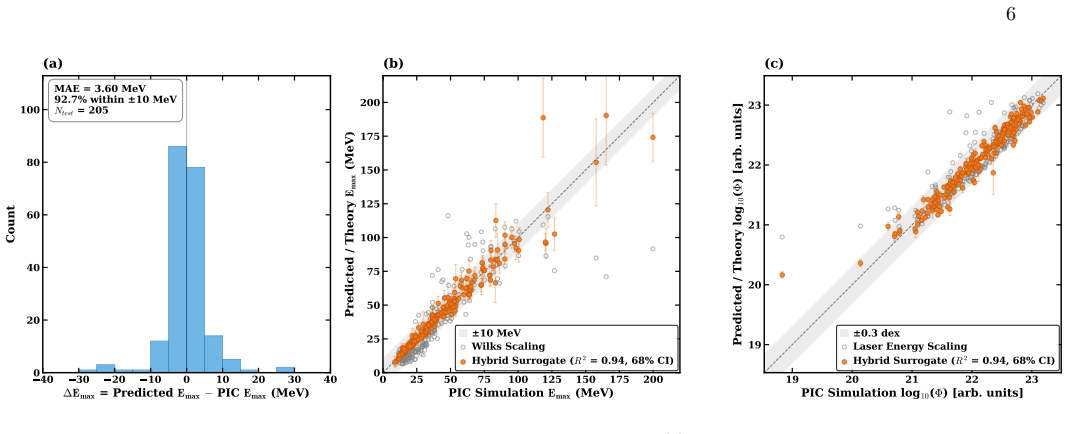
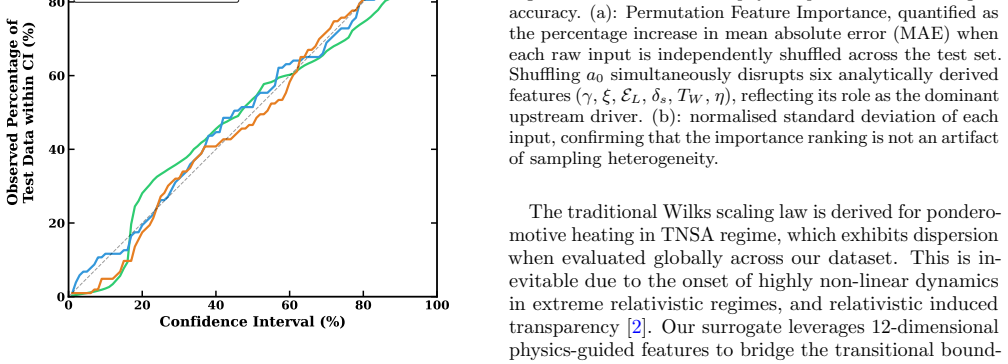
We present a physics-guided, decoupled dual-branch surrogate model to predict continuous proton energy spectra from laser-driven ion acceleration. Integrating a $\beta$-VAE for spectral feature extraction with a parallel multi-layer perceptron for scalar boundary enforcement, the framework achieves a predictive accuracy of $R^2 = 0.94$ for the maximum cutoff energy and $R^2 = 0.94$ for the total particle flux, with a median per-sample spectral $R^2 = 0.985$ (in $\log_{10}$ space) across the full 2000-bin energy distribution. The model incorporates uncertainty quantification via deep ensembles, serving as a quantitative probabilistic diagnostic tool with calibration errors below 6.2\%. Within the 1D longitudinal framework, the surrogate reproduces spectral signatures consistent with the transition from Target Normal Sheath Acceleration (TNSA) to the volumetric heating dynamics of Relativistically Induced Transparency (RIT) and Breakout Afterburner (BOA) regimes, as validated against kinetic diagnostics from 1D particle-in-cell simulations. This approach establishes a computationally efficient baseline for future multi-fidelity optimization and provides an engine for closed-loop parameter control in high-repetition-rate laser facilities.
Editorial analysis
A structured set of objections, weighed in public.
Referee Report
Summary. The paper introduces a physics-guided dual-branch surrogate model (β-VAE for spectral features + parallel MLP for scalar constraints) trained on 1D PIC simulation data to predict continuous proton energy spectra in laser-ion acceleration. It reports R² = 0.94 for maximum cutoff energy, R² = 0.94 for total flux, and median per-sample spectral R² = 0.985 (log10 space) across 2000 bins, with deep-ensemble uncertainty quantification (calibration error <6.2%). The central claim is that, within the 1D longitudinal framework, the surrogate reproduces spectral signatures of the TNSA-to-RIT/BOA regime transition as validated against the same class of 1D PIC kinetic diagnostics.
Significance. If the internal 1D validation holds without data leakage and the 1D PIC data faithfully represent the targeted transitions, the surrogate offers a fast, probabilistic tool for parameter-space exploration and closed-loop control in high-repetition-rate facilities. The decoupled architecture and explicit uncertainty quantification are positive features. However, the significance is reduced by the strictly in-distribution, 1D-only validation, which does not yet demonstrate generalization to multi-dimensional physics or experimental data.
major comments (2)
- [Abstract / validation] Abstract and validation section: The claim that the surrogate 'reproduces spectral signatures consistent with the transition from TNSA to ... RIT and BOA regimes' rests entirely on agreement with 1D PIC diagnostics generated inside the identical 1D longitudinal framework used for training. No out-of-distribution test, multi-dimensional simulation comparison, or experimental benchmark is provided to show that the learned mapping captures the physical mechanisms (transverse filamentation, off-axis sheath fields, 3D breakout) rather than pattern-matching within the training distribution.
- [Methods / results] Methods / results on data handling: The reported R² values (0.94 for cutoff and flux, 0.985 median spectral) cannot be assessed for robustness without explicit confirmation of train/validation/test splits, absence of leakage, and whether hyperparameter or architecture choices were made after seeing test performance. The deep-ensemble calibration error (<6.2%) is cited but the precise calibration metric and binning are not detailed enough to verify.
minor comments (1)
- [Abstract] Notation: The 2000-bin energy distribution is referenced in log10 space for the spectral R²; clarify whether the per-bin loss or the reported median is computed after the log transform or on the original counts.
Simulated Author's Rebuttal
We thank the referee for the constructive comments, which help clarify the scope and reproducibility of the work. We address each major point below and will incorporate clarifications in a revised manuscript.
read point-by-point responses
-
Referee: [Abstract / validation] Abstract and validation section: The claim that the surrogate 'reproduces spectral signatures consistent with the transition from TNSA to ... RIT and BOA regimes' rests entirely on agreement with 1D PIC diagnostics generated inside the identical 1D longitudinal framework used for training. No out-of-distribution test, multi-dimensional simulation comparison, or experimental benchmark is provided to show that the learned mapping captures the physical mechanisms (transverse filamentation, off-axis sheath fields, 3D breakout) rather than pattern-matching within the training distribution.
Authors: The manuscript already qualifies the central claim as holding 'within the 1D longitudinal framework' and validates exclusively against 1D PIC diagnostics. The work positions the surrogate as a computationally efficient baseline for 1D parameter-space exploration and closed-loop control, not as a model of multi-dimensional physics. We will revise the abstract, introduction, and discussion sections to more explicitly state the 1D-only scope, the absence of multi-D or experimental benchmarks, and that transverse effects would require a separate multi-dimensional training set. No additional validation data are available at this stage. revision: partial
-
Referee: [Methods / results] Methods / results on data handling: The reported R² values (0.94 for cutoff and flux, 0.985 median spectral) cannot be assessed for robustness without explicit confirmation of train/validation/test splits, absence of leakage, and whether hyperparameter or architecture choices were made after seeing test performance. The deep-ensemble calibration error (<6.2%) is cited but the precise calibration metric and binning are not detailed enough to verify.
Authors: We agree these details are necessary for assessment. The revised methods section will state: (i) a random 70/15/15 train/validation/test split on independently sampled input parameters (no leakage possible), (ii) all architecture and hyperparameter decisions were finalized using only the validation set, and (iii) the reported calibration error is the expected calibration error (ECE) computed over 10 equally spaced probability bins on the deep-ensemble predictive distributions. revision: yes
Circularity Check
No circularity; surrogate trained and validated on PIC data as standard ML practice
full rationale
The paper presents a machine-learning surrogate (β-VAE + MLP) trained on 1D PIC simulation outputs to predict proton spectra, with reported R² metrics evaluated on held-out samples from the same simulation ensemble. This is the conventional workflow for surrogate modeling and does not reduce any claimed prediction to its inputs by construction, nor does it invoke self-definitional equations, load-bearing self-citations, or ansatzes smuggled via prior work. The reproduction of TNSA-RIT-BOA signatures follows directly from the training distribution containing those regimes; no first-principles derivation is asserted that collapses to a fit. The central claim remains an empirical interpolation result within the stated 1D framework.
Axiom & Free-Parameter Ledger
free parameters (1)
- β-VAE and MLP network weights and hyperparameters
axioms (1)
- domain assumption 1D particle-in-cell simulations provide accurate kinetic diagnostics for TNSA, RIT, and BOA regimes
Reference graph
Works this paper leans on
-
[1]
and a 20% held-out test set ( Ntest = 205) using a fixed random seed. The final-state proton energy spectra were extracted after 800 fs of physical evolution to ensure the proton bunches have entered a ballistic drift phase and the spectra have converged to their asymptotic ter- minal states. The extracted continuous spectra were then discretized into 2,0...
2000
-
[2]
Daido, M
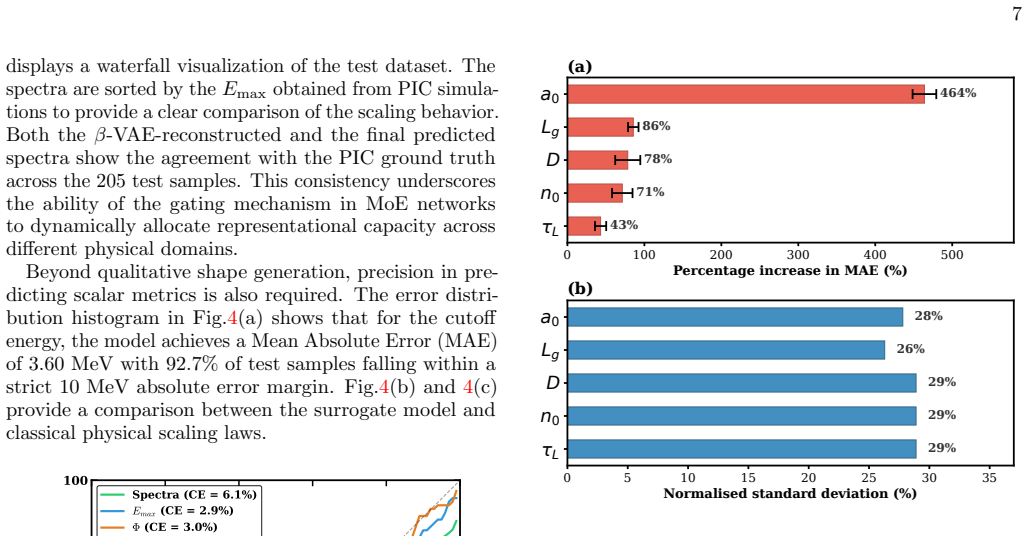
H. Daido, M. Nishiuchi, and A. S. Pirozhkov. Review of laser-driven ion sources and their applications.Reports on Progress in Physics, 75(5):056401, 2012
2012
-
[3]
Ion acceleration by superintense laser-plasma interaction
Andrea Macchi, Marco Borghesi, and Matteo Passoni. Ion acceleration by superintense laser-plasma interaction. Reviews of Modern Physics, 85(2):751–793, 2013
2013
-
[4]
Danson, Constantin Haefner, Jake Bromage, et al
Colin N. Danson, Constantin Haefner, Jake Bromage, et al. Petawatt and exawatt class lasers worldwide.High Power Laser Science and Engineering, 7:e54, 2019
2019
-
[5]
2020 roadmap on plasma accelerators.New Journal of Physics, 23(3):031101, 2021
F´ elicie Albert, Marie-Emmanuelle Couprie, Alexander Debus, Mike C Downer, J´ erˆ ome Faure, Alessandro Flacco, Leonida A Gizzi, Thomas Grismayer, Axel Huebl, Chan Joshi, et al. 2020 roadmap on plasma accelerators.New Journal of Physics, 23(3):031101, 2021
2020
-
[6]
R. A. Snavely, M. H. Key, S. P. Hatchett, T. E. Cowan, M. Roth, T. W. Phillips, M. A. Stoyer, E. A. Henry, T. C. Sangster, M. S. Singh, S. C. Wilks, A. MacKin- non, A. Offenberger, D. M. Pennington, K. Yasuike, A. B. Langdon, B. F. Lasinski, J. Johnson, M. D. Perry, and E. M. Campbell. Intense high-energy proton beams from petawatt-laser irradiation of so...
2000
-
[7]
S. V. Bulanov, T. Zh. Esirkepov, V. S. Khoroshkov, A. V. Kuznetsov, and F. Pegoraro. Oncological hadrontherapy with laser ion accelerators.Physics Letters A, 299(2– 3):240–247, 2002
2002
-
[8]
M. Roth, T. E. Cowan, M. H. Key, S. P. Hatchett, C. Brown, W. Fountain, J. Johnson, D. M. Penning- ton, R. A. Snavely, S. C. Wilks, K. Yasuike, H. Ruhl, F. Pegoraro, S. V. Bulanov, E. M. Campbell, M. D. Perry, and H. Powell. Fast ignition by intense laser-accelerated proton beams.Physical Review Letters, 86(3):436–439, 2001
2001
-
[9]
BF Bayanov, VP Belov, ED Bender, MV Bokhovko, GI Dimov, VN Kononov, OE Kononov, NK Kuksanov, VE Palchikov, VA Pivovarov, et al. Accelerator-based neutron source for the neutron-capture and fast neutron therapy at hospital.Nuclear Instruments and Methods in 13 Physics Research Section A: Accelerators, Spectrometers, Detectors and Associated Equipment, 413(...
1998
-
[10]
Spectral and spa- tial shaping of laser-driven proton beams using a pulsed high-field magnet beamline.Scientific reports, 10(1):9118, 2020
Florian-Emanuel Brack, Florian Kroll, Lennart Gaus, Constantin Bernert, Elke Beyreuther, Thomas E Cowan, Leonhard Karsch, Stephan Kraft, Leoni A Kunz- Schughart, Elisabeth Lessmann, et al. Spectral and spa- tial shaping of laser-driven proton beams using a pulsed high-field magnet beamline.Scientific reports, 10(1):9118, 2020
2020
-
[11]
S. C. Wilks, W. L. Kruer, M. Tabak, and A. B. Langdon. Absorption of ultra-intense laser pulses.Physical Review Letters, 69(9):1383–1386, 1992
1992
-
[12]
Target normal sheath acceleration: theory, comparison with experiments and future perspectives.New Journal of Physics, 12(4):045012, 2010
Matteo Passoni, Luca Bertagna, and Alessandro Zani. Target normal sheath acceleration: theory, comparison with experiments and future perspectives.New Journal of Physics, 12(4):045012, 2010
2010
-
[13]
L. Yin, B. J. Albright, K. J. Bowers, D. Jung, J. C. Fern´ andez, and B. M. Hegelich. Three-dimensional dy- namics of breakout afterburner ion acceleration using high- contrast short-pulse laser and nanoscale targets.Physical Review Letters, 107:045003, 2011
2011
-
[14]
Henig, S
A. Henig, S. Steinke, M. Schn¨ urer, T. Sokollik, R. H¨ orlein, D. Kiefer, D. Jung, J. Schreiber, B. M. Hegelich, X. Q. Yan, J. Meyer-ter Vehn, T. Tajima, P. V. Nickles, W. Sandner, and D. Habs. Enhanced laser-driven ion acceleration in the relativistic transparency regime.Phys- ical Review Letters, 103(4):045002, 2009
2009
-
[15]
Stable laser-acceleration of high- flux proton beams with plasma collimation.Nature Com- munications, 16(1):1004, 2025
MJV Streeter, GD Glenn, S DiIorio, F Treffert, B Loughran, H Ahmed, S Astbury, M Borghesi, N Bour- geois, CB Curry, et al. Stable laser-acceleration of high- flux proton beams with plasma collimation.Nature Com- munications, 16(1):1004, 2025
2025
-
[16]
Laser-to-hot-electron conversion limitations in relativistic laser matter interactions due to multi-picosecond dynamics.Physics of Plasmas, 22(4), 2015
Marius Schollmeier, Adam B Sefkow, Matthias Geissel, Alexey V Arefiev, Kirk A Flippo, Sandrine A Gaillard, Randy P Johnson, Mark W Kimmel, Dustin T Offermann, Patrick K Rambo, et al. Laser-to-hot-electron conversion limitations in relativistic laser matter interactions due to multi-picosecond dynamics.Physics of Plasmas, 22(4), 2015
2015
-
[17]
The scaling of proton energies in ultra- short pulse laser plasma acceleration.New Journal of Physics, 12(4):045015, 2010
K Zeil, SD Kraft, S Bock, M Bussmann, TE Cowan, T Kluge, J Metzkes, T Richter, R Sauerbrey, and U Schramm. The scaling of proton energies in ultra- short pulse laser plasma acceleration.New Journal of Physics, 12(4):045015, 2010
2010
-
[18]
Scaling of laser-driven electron and proton acceleration as a function of laser pulse dura- tion, energy, and intensity in the multi-picosecond regime
Raspberry A Simpson, GG Scott, D Mariscal, D Rusby, PM King, E Grace, A Aghedo, I Pagano, M Sinclair, C Armstrong, et al. Scaling of laser-driven electron and proton acceleration as a function of laser pulse dura- tion, energy, and intensity in the multi-picosecond regime. Physics of Plasmas, 28(1), 2021
2021
-
[19]
The particle-in-cell method
David Tskhakaya, Konstantin Matyash, Ralf Schneider, and Francesco Taccogna. The particle-in-cell method. Contributions to Plasma Physics, 47(8-9):563–594, 2007
2007
-
[20]
Machine learning accelerated particle-in-cell plasma simulations
R Kube, RM Churchill, and B Sturdevant. Machine learning accelerated particle-in-cell plasma simulations. arXiv preprint arXiv:2110.12444, 2021
-
[21]
A state of art techniques on machine learning algorithms: a perspective of supervised learning approaches in data classification
Renuka Saravanan and Pothula Sujatha. A state of art techniques on machine learning algorithms: a perspective of supervised learning approaches in data classification. In2018 Second international conference on intelligent computing and control systems (ICICCS), pages 945–949. IEEE, 2018
2018
-
[22]
Modeling laser-driven ion ac- celeration with deep learning.Physics of Plasmas, 28(4), 2021
BZ Djordjevi´ c, AJ Kemp, J Kim, RA Simpson, SC Wilks, T Ma, and DA Mariscal. Modeling laser-driven ion ac- celeration with deep learning.Physics of Plasmas, 28(4), 2021
2021
-
[23]
Deep learning approaches for modeling laser-driven proton beams via phase-stable ac- celeration.Physics of Plasmas, 31(1), 2024
Yao-Li Liu, Yen-Chen Chen, Chun-Sung Jao, Mao-Syun Wong, Chun-Han Huang, Han-Wei Chen, Shogo Isayama, and Yasuhiro Kuramitsu. Deep learning approaches for modeling laser-driven proton beams via phase-stable ac- celeration.Physics of Plasmas, 31(1), 2024
2024
-
[24]
Transfer learning and multi-fidelity modeling of laser-driven particle acceleration.Physics of Plasmas, 30(4), 2023
BZ Djordjevi´ c, J Kim, SC Wilks, J Ludwig, C Myers, AJ Kemp, KK Swanson, G Zeraouli, ES Grace, RA Simp- son, et al. Transfer learning and multi-fidelity modeling of laser-driven particle acceleration.Physics of Plasmas, 30(4), 2023
2023
-
[25]
Prac- tical bayesian optimization of machine learning algorithms
Jasper Snoek, Hugo Larochelle, and Ryan P Adams. Prac- tical bayesian optimization of machine learning algorithms. Advances in neural information processing systems, 25, 2012
2012
-
[26]
Multi-parameter bayesian optimisation of laser-driven ion acceleration in particle-in-cell simulations
EJ Dolier, Martin King, Robbie Wilson, RJ Gray, and Paul McKenna. Multi-parameter bayesian optimisation of laser-driven ion acceleration in particle-in-cell simulations. New Journal of Physics, 24(7):073025, 2022
2022
-
[27]
Automated control and optimization of laser-driven ion acceleration.High Power Laser Science and Engineering, 11:e35, 2023
Brendan Loughran, Matthew JV Streeter, Hamad Ahmed, Sam Astbury, M Balcazar, M Borghesi, N Bourgeois, CB Curry, SJD Dann, S DiIorio, et al. Automated control and optimization of laser-driven ion acceleration.High Power Laser Science and Engineering, 11:e35, 2023
2023
-
[28]
20-dimensional surrogate- assisted bayesian optimization of laser-driven proton beams.Applied Physics Letters, 126(25), 2025
Elias Catrix, Sylvain Fourmaux, Simon Valli` eres, Fran¸ cois Bianchi, Fran¸ cois Fillion-Gourdeau, Jo¨ el Maltais, Steve MacLean, and Patrizio Antici. 20-dimensional surrogate- assisted bayesian optimization of laser-driven proton beams.Applied Physics Letters, 126(25), 2025
2025
-
[29]
Physics and biology of ultrahigh dose- rate (flash) radiotherapy: a topical review.Physics in Medicine & Biology, 65(23):23TR03, 2020
Nolan Esplen, Marc S Mendonca, and Magdalena Bazalova-Carter. Physics and biology of ultrahigh dose- rate (flash) radiotherapy: a topical review.Physics in Medicine & Biology, 65(23):23TR03, 2020
2020
-
[30]
Ultra-high dose rate dosimetry: challenges and opportunities for flash radiation therapy.Medical physics, 49(7):4912–4932, 2022
Francesco Romano, Claude Bailat, Patrik Gon¸ calves Jorge, Michael Lloyd Franz Lerch, and Arash Daraf- sheh. Ultra-high dose rate dosimetry: challenges and opportunities for flash radiation therapy.Medical physics, 49(7):4912–4932, 2022
2022
-
[31]
Radiobiology of the flash effect.Medical Physics, 49(3):1993–2013, 2022
Anna A Friedl, Kevin M Prise, Karl T Butterworth, Pierre Montay-Gruel, and Vincent Favaudon. Radiobiology of the flash effect.Medical Physics, 49(3):1993–2013, 2022
1993
-
[32]
Deep learning, 2016
Ian Goodfellow. Deep learning, 2016
2016
-
[33]
Auto-Encoding Variational Bayes
Diederik P Kingma and Max Welling. Auto-encoding variational bayes.arXiv preprint arXiv:1312.6114, 2013
work page internal anchor Pith review Pith/arXiv arXiv 2013
-
[34]
Representation learning: A review and new perspectives
Yoshua Bengio, Aaron Courville, and Pascal Vincent. Representation learning: A review and new perspectives. IEEE transactions on pattern analysis and machine intel- ligence, 35(8):1798–1828, 2013
2013
-
[35]
Understanding disentangling in $\beta$-VAE
Christopher P Burgess, Irina Higgins, Arka Pal, Loic Matthey, Nick Watters, Guillaume Desjardins, and Alexander Lerchner. Understanding disentangling in β- VAE.arXiv preprint arXiv:1804.03599, 2018
work page internal anchor Pith review Pith/arXiv arXiv 2018
-
[36]
On information and sufficiency.The annals of mathematical statistics, 22(1):79–86, 1951
Solomon Kullback and Richard A Leibler. On information and sufficiency.The annals of mathematical statistics, 22(1):79–86, 1951
1951
-
[37]
Laser wakefield accel- erator modelling with variational neural networks.High Power Laser Science and Engineering, 11:e9, 2023
Matthew JV Streeter, C Colgan, Claudia C Cobo, C Ar- ran, EE Los, Robbie Watt, N Bourgeois, L Calvin, J Carderelli, N Cavanagh, et al. Laser wakefield accel- erator modelling with variational neural networks.High Power Laser Science and Engineering, 11:e9, 2023. 14
2023
-
[38]
Peat, et al
Christopher JG McQueen, Robbie Wilson, Timothy P Frazer, Martin King, Matthew Alderton, Ewan FJ Bacon, Ewan J Dolier, Thomas Dzelzainis, Jesel K Patel, Maia P. Peat, et al. A neural network-based synthetic diagnostic of laser-accelerated proton energy spectra.Communica- tions Physics, 8(1):66, 2025
2025
-
[39]
Distribution of points in a cube and ap- proximate evaluation of integrals.USSR Computational mathematics and mathematical physics, 7:86–112, 1967
Ilya M Sobol. Distribution of points in a cube and ap- proximate evaluation of integrals.USSR Computational mathematics and mathematical physics, 7:86–112, 1967
1967
-
[40]
Quasi-random sequences and their discrepancies.SIAM Journal on Scientific Computing, 15(6):1251–1279, 1994
William J Morokoff and Russel E Caflisch. Quasi-random sequences and their discrepancies.SIAM Journal on Scientific Computing, 15(6):1251–1279, 1994
1994
-
[41]
Contemporary particle-in-cell ap- proach to laser-plasma modelling.Plasma Physics and Controlled Fusion, 57(11):113001, 2015
Tony D Arber, Keith Bennett, Christopher S Brady, Al- istair Lawrence-Douglas, MG Ramsay, Nathan John Sir- combe, Paddy Gillies, Roger G Evans, Holger Schmitz, Anthony R Bell, et al. Contemporary particle-in-cell ap- proach to laser-plasma modelling.Plasma Physics and Controlled Fusion, 57(11):113001, 2015
2015
-
[42]
Rayleigh-taylor instability of an ultrathin foil accelerated by the radiation¡? format?¿ pressure of an intense laser
CAJ Palmer, J Schreiber, SR Nagel, NP Dover, C Bellei, FN Beg, S Bott, RJ Clarke, AE Dangor, SM Hassan, et al. Rayleigh-taylor instability of an ultrathin foil accelerated by the radiation¡? format?¿ pressure of an intense laser. Physical review letters, 108(22):225002, 2012
2012
-
[43]
Physical mech- anism of the transverse instability in radiation pressure ion acceleration.Physical review letters, 117(23):234801, 2016
Y Wan, C-H Pai, CJ Zhang, F Li, YP Wu, JF Hua, W Lu, YQ Gu, LO Silva, C Joshi, et al. Physical mech- anism of the transverse instability in radiation pressure ion acceleration.Physical review letters, 117(23):234801, 2016
2016
-
[44]
Discovering symbolic models from deep learning with in- ductive biases.Advances in neural information processing systems, 33:17429–17442, 2020
Miles Cranmer, Alvaro Sanchez Gonzalez, Peter Battaglia, Rui Xu, Kyle Cranmer, David Spergel, and Shirley Ho. Discovering symbolic models from deep learning with in- ductive biases.Advances in neural information processing systems, 33:17429–17442, 2020
2020
-
[45]
L Yin, BJ Albright, KJ Bowers, D Jung, JC Fern´ andez, and BM Hegelich. Three-dimensional dynamics of break- out afterburner ion acceleration¡? format?¿ using high- contrast short-pulse laser and nanoscale targets.Physical review letters, 107(4):045003, 2011
2011
-
[46]
Physics- informed machine learning.Nature Reviews Physics, 3(6):422–440, 2021
George Em Karniadakis, Ioannis G Kevrekidis, Lu Lu, Paris Perdikaris, Sifan Wang, and Liu Yang. Physics- informed machine learning.Nature Reviews Physics, 3(6):422–440, 2021
2021
-
[47]
Reliable extrapolation of deep neu- ral operators informed by physics or sparse observations
Min Zhu, Handi Zhang, Anran Jiao, George Em Karni- adakis, and Lu Lu. Reliable extrapolation of deep neu- ral operators informed by physics or sparse observations. Computer Methods in Applied Mechanics and Engineering, 412:116064, 2023
2023
-
[48]
TensorFlow: Large-Scale Machine Learning on Heterogeneous Distributed Systems
Mart´ ın Abadi, Ashish Agarwal, Paul Barham, Eugene Brevdo, Zhifeng Chen, Craig Citro, Greg S Corrado, Andy Davis, Jeffrey Dean, Matthieu Devin, et al. Tensorflow: Large-scale machine learning on heterogeneous distributed systems.arXiv preprint arXiv:1603.04467, 2016
work page internal anchor Pith review Pith/arXiv arXiv 2016
-
[49]
Deep sparse rectifier neural networks
Xavier Glorot, Antoine Bordes, and Yoshua Bengio. Deep sparse rectifier neural networks. InProceedings of the fourteenth international conference on artificial intelli- gence and statistics, pages 315–323. JMLR Workshop and Conference Proceedings, 2011
2011
-
[50]
The influence of the sig- moid function parameters on the speed of backpropagation learning
Jun Han and Claudio Moraga. The influence of the sig- moid function parameters on the speed of backpropagation learning. InInternational workshop on artificial neural networks, pages 195–201. Springer, 1995
1995
-
[51]
Searching for Activation Functions
Prajit Ramachandran, Barret Zoph, and Quoc V Le. Searching for activation functions.arXiv preprint arXiv:1710.05941, 2017
work page internal anchor Pith review Pith/arXiv arXiv 2017
-
[52]
Adam: A Method for Stochastic Optimization
Diederik P Kingma and Jimmy Ba. Adam: A method for stochastic optimization.arXiv preprint arXiv:1412.6980, 2014
work page internal anchor Pith review Pith/arXiv arXiv 2014
-
[53]
Adaptive mixtures of local experts
Robert A Jacobs, Michael I Jordan, Steven J Nowlan, and Geoffrey E Hinton. Adaptive mixtures of local experts. Neural computation, 3(1):79–87, 1991
1991
-
[54]
Self-normalizing neural networks
G¨ unter Klambauer, Thomas Unterthiner, Andreas Mayr, and Sepp Hochreiter. Self-normalizing neural networks. Advances in neural information processing systems, 30, 2017
2017
-
[55]
Rectifier nonlinearities improve neural network acoustic models
Andrew L Maas, Awni Y Hannun, Andrew Y Ng, et al. Rectifier nonlinearities improve neural network acoustic models. InProc. icml, volume 30, page 3. Atlanta, GA, 2013
2013
-
[56]
Fast and Accurate Deep Network Learning by Exponential Linear Units (ELUs)
Djork-Arn´ e Clevert, Thomas Unterthiner, and Sepp Hochreiter. Fast and accurate deep network learn- ing by exponential linear units (elus).arXiv preprint arXiv:1511.07289, 4(5):11, 2015
work page internal anchor Pith review Pith/arXiv arXiv 2015
-
[57]
Focal loss for dense object detection
Tsung-Yi Lin, Priya Goyal, Ross Girshick, Kaiming He, and Piotr Doll´ ar. Focal loss for dense object detection. InProceedings of the IEEE international conference on computer vision, pages 2980–2988, 2017
2017
-
[58]
Simple and scalable predictive uncertainty es- timation using deep ensembles
Balaji Lakshminarayanan, Alexander Pritzel, and Charles Blundell. Simple and scalable predictive uncertainty es- timation using deep ensembles. InAdvances in Neural Information Processing Systems, volume 30, 2017
2017
-
[59]
Accurate uncertainties for deep learning using calibrated regression
Volodymyr Kuleshov, Nathan Fenner, and Stefano Ermon. Accurate uncertainties for deep learning using calibrated regression. InProceedings of the 35th International Con- ference on Machine Learning, volume 80, pages 2796–2804. PMLR, 2018
2018
-
[60]
The earth mover’s distance as a metric for image retrieval
Yossi Rubner, Carlo Tomasi, and Leonidas J Guibas. The earth mover’s distance as a metric for image retrieval. International journal of computer vision, 40(2):99–121, 2000
2000
-
[61]
Random forests.Machine learning, 45(1):5– 32, 2001
Leo Breiman. Random forests.Machine learning, 45(1):5– 32, 2001
2001
-
[62]
Aaron Fisher, Cynthia Rudin, and Francesca Dominici. All models are wrong, but many are useful: Learning a variable’s importance by studying an entire class of prediction models simultaneously.Journal of Machine Learning Research, 20(177):1–81, 2019
2019
-
[63]
Laser-driven proton scaling laws and new paths towards energy increase
J Fuchs, Patrizio Antici, Emmanuel d’Humi` eres, E Lefeb- vre, Marco Borghesi, E Brambrink, CA Cecchetti, Malte Kaluza, Victor Malka, M Manclossi, et al. Laser-driven proton scaling laws and new paths towards energy increase. Nature physics, 2(1):48–54, 2006
2006
discussion (0)
Sign in with ORCID, Apple, or X to comment. Anyone can read and Pith papers without signing in.