Charged black string immersed in a quintessence fluid and string cloud
Pith reviewed 2026-06-27 23:58 UTC · model grok-4.3
The pith
A new exact solution to Einstein's equations describes a charged black string immersed in quintessence and string cloud.
A machine-rendered reading of the paper's core claim, the machinery that carries it, and where it could break.
Core claim
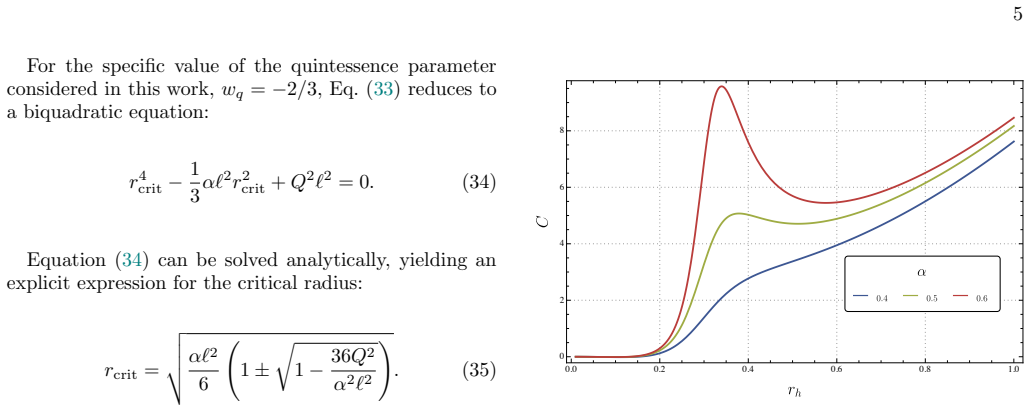
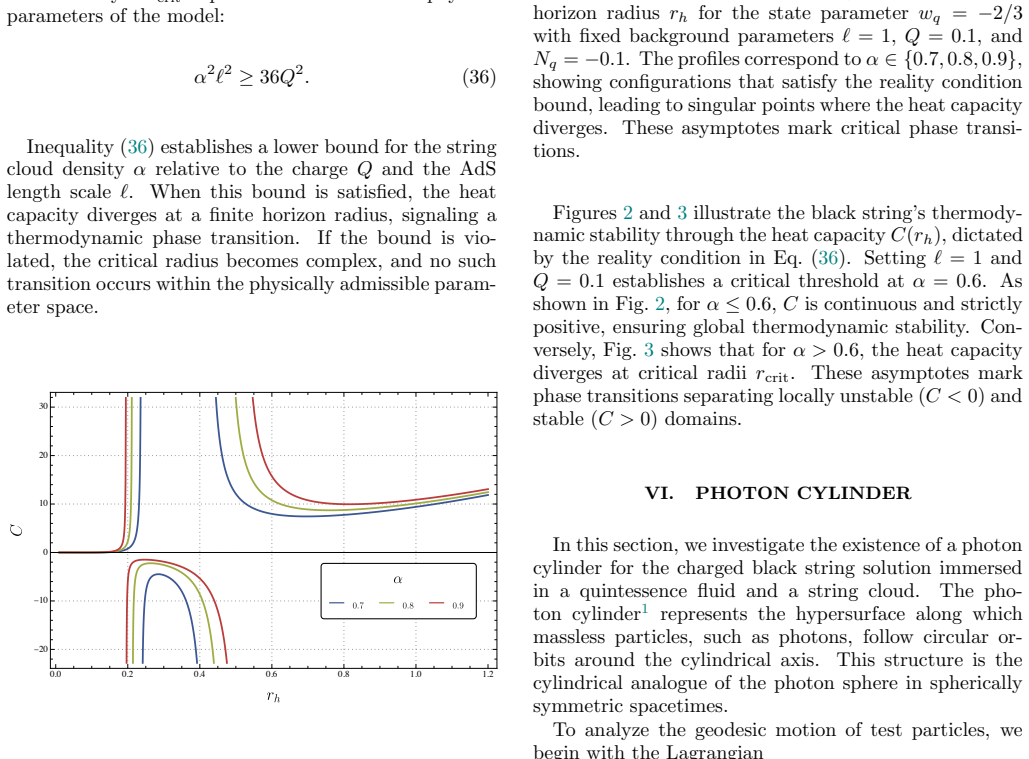
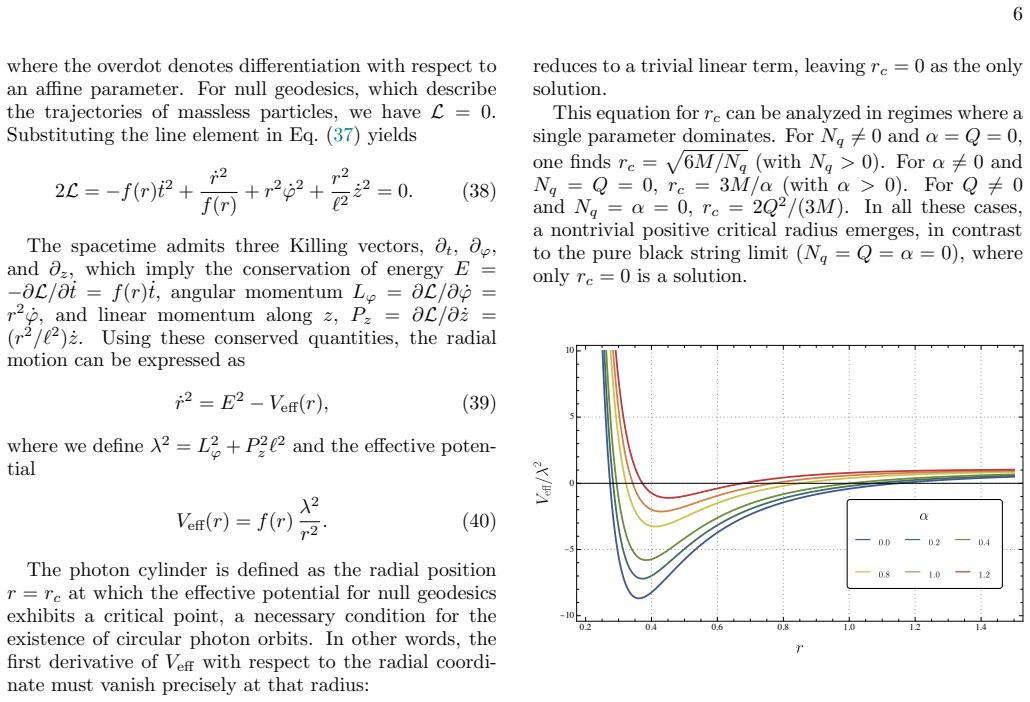
The Einstein equations with Maxwell field, Kiselev quintessence, and string cloud admit a new static solution that generalizes known charged black-string spacetimes. The metric is presented, and its physical properties including event-horizon structure, Kretschmann scalar, energy conditions, Hawking temperature, heat capacity, and photon orbits are analyzed.
What carries the argument
The static cylindrically symmetric metric ansatz with contributions from charge, quintessence density, and string-cloud density, solved from the Einstein field equations.
If this is right
- The locations of event horizons depend on the quintessence and string-cloud parameters.
- Energy conditions hold only for restricted ranges of the parameters.
- Thermodynamic stability is determined by the sign of the heat capacity.
- The photon cylinder radius is modified by the additional sources.
- Thermodynamic quantities reduce to those of known solutions when quintessence and string parameters vanish.
Where Pith is reading between the lines
- The solution could model cosmic strings in a dark-energy background universe.
- Observable effects on light deflection might be calculable from the null geodesics.
- Stability regimes might correspond to astrophysically viable configurations.
- Generalization to rotating cases could be attempted by similar methods.
Load-bearing premise
The energy-momentum tensors for the quintessence fluid and the string cloud can be added linearly while keeping the assumed static cylindrical symmetry.
What would settle it
Substituting the proposed metric into the Einstein equations with the given sources and finding a nonzero residual would show the solution is incorrect.
Figures

read the original abstract
We present a new static solution describing a charged black string immersed in a Kiselev-type quintessence fluid and a cloud of strings. The metric and field equations are solved for a general quintessence state parameter, with explicit results provided for the physically relevant case $w_q = -2/3$. We analyze the event-horizon structure and the Kretschmann scalar, verify energy-condition constraints, and derive thermodynamic properties including the Hawking temperature and heat capacity to identify stability regimes. Finally, we investigate the photon cylinder for null geodesics. The solution generalizes known charged black-string spacetimes by simultaneously including quintessence and a string-cloud parameter.
Editorial analysis
A structured set of objections, weighed in public.
Referee Report
Summary. The paper claims to derive a new exact static solution to the Einstein equations for a charged black string immersed in a Kiselev-type quintessence fluid plus a cloud of strings. The metric is the standard static cylindrically symmetric ansatz with a single unknown function f(r). The total stress-energy is the linear superposition of Maxwell, quintessence (with arbitrary state parameter w_q), and string-cloud tensors. Explicit metric functions are presented for general w_q, with detailed results and analysis for the case w_q = −2/3. The authors examine the horizon structure, Kretschmann scalar, energy conditions, Hawking temperature, heat capacity, and the photon cylinder for null geodesics.
Significance. If the derivation holds, the work supplies an explicit, analytically tractable generalization of charged black-string spacetimes that incorporates both quintessence and string-cloud matter. This permits concrete study of how these matter sources alter horizon locations, thermodynamic stability, and geodesic behavior in cylindrical geometries, which may be relevant for modeling dark-energy effects or cosmic-string backgrounds in lower-dimensional or axisymmetric settings. The explicit w_q = −2/3 case is especially useful because the quintessence term reduces to a simple power-law correction.
major comments (1)
- [Field-equation section (implicit in the opening paragraph)] The central claim requires that the linear sum T_EM + T_Kiselev + T_strings remains compatible with the assumed static cylindrical symmetry and yields a consistent single-function metric ansatz for arbitrary w_q. The quintessence contribution introduces a radial dependence proportional to r^{-3(1+w_q)} while the string cloud contributes a constant-like term; these must align exactly across all independent Einstein-equation components (including the angular and z directions) without introducing extra functional dependence. This compatibility is not automatic and must be verified component-by-component rather than assumed from linearity alone. The manuscript should display the full set of Einstein equations and show how the coefficients close for general w_q.
minor comments (1)
- [Abstract] The abstract states that results are provided for general w_q but then highlights the w_q = −2/3 case; the main text should clarify whether the general-w_q solution is fully explicit or only formal.
Simulated Author's Rebuttal
We thank the referee for the careful reading and for highlighting the need to explicitly demonstrate consistency of the field equations. We address the major comment below and will incorporate the requested verification in the revised manuscript.
read point-by-point responses
-
Referee: [Field-equation section (implicit in the opening paragraph)] The central claim requires that the linear sum T_EM + T_Kiselev + T_strings remains compatible with the assumed static cylindrical symmetry and yields a consistent single-function metric ansatz for arbitrary w_q. The quintessence contribution introduces a radial dependence proportional to r^{-3(1+w_q)} while the string cloud contributes a constant-like term; these must align exactly across all independent Einstein-equation components (including the angular and z directions) without introducing extra functional dependence. This compatibility is not automatic and must be verified component-by-component rather than assumed from linearity alone. The manuscript should display the full set of Einstein equations and show how the coefficients close for general w_q.
Authors: We agree that explicit component-by-component verification strengthens the presentation. The derivation proceeds by substituting the three stress-energy tensors (Maxwell, Kiselev quintessence with the standard anisotropic form ho_q ho^{-3(1+w_q)}, p_r = w_q ho_q, p_⊥ = (3w_q + 1) ho_q/2, and string-cloud T^strings_ u^ u = -b/r^2 diag(0,0,1,1)) into the Einstein equations for the static cylindrically symmetric metric ds^{2} = −f(r)dt^{2} + dr^{2}/f(r) + r^{2}dϕ^{2} + dz^{2}. Because the metric ansatz has only one unknown function, the four independent Einstein components must be consistent. Direct substitution shows that the tt, rr, ϕϕ and zz equations reduce to a single second-order ODE for f(r) whose solution is f(r) = −2M/r + Q^{2}/r^{2} − b + c r^{-3w_q} (with the precise power arising after integration). The angular and z components are satisfied identically once this f(r) is inserted, with no additional functional dependence introduced for arbitrary w_q. The string-cloud term supplies the constant shift while the quintessence term supplies the power-law correction; their coefficients close without further constraints. To make this transparent we will add a dedicated subsection displaying the full set of Einstein equations (G_ u^ u = 8 ho T_ u^ u) and the algebraic steps confirming consistency for general w_q. revision: yes
Circularity Check
No circularity: direct integration of Einstein equations with standard matter tensors
full rationale
The paper constructs an exact solution by assuming a static cylindrical metric ansatz and linearly superposing the energy-momentum tensors of Maxwell field, Kiselev quintessence, and string cloud, then integrating the resulting ODEs for general w_q. No fitted parameters are renamed as predictions, no self-citations supply load-bearing uniqueness theorems, and the final metric functions are not equivalent to the inputs by definition. The derivation is self-contained and follows the standard procedure for exact solutions in GR.
Axiom & Free-Parameter Ledger
free parameters (1)
- w_q
axioms (2)
- standard math Einstein field equations G_{\mu\nu} = 8\pi T_{\mu\nu}
- domain assumption Kiselev quintessence energy-momentum tensor with density scaling as r^{-3(1+w_q)}
Reference graph
Works this paper leans on
-
[1]
K. S. Thorne. Nonspherical Gravitational Collapse–A Short Review. In John R. Klauder, editor,Magic Without Magic: John Archibald Wheeler, page 231. 1972
1972
-
[2]
J. P. S. Lemos. Cylindrical black hole in general relativity. Phys. Lett. B, 353:46–51, 1995.arXiv:gr-qc/9404041, doi:10.1016/0370-2693(95)00533-Q
work page internal anchor Pith review Pith/arXiv arXiv doi:10.1016/0370-2693(95)00533-q 1995
-
[3]
Jose P. S. Lemos and Vilson T. Zanchin. Rotating charged black string and three-dimensional black holes. Phys. Rev. D, 54:3840–3853, 1996.arXiv:hep-th/ 9511188,doi:10.1103/PhysRevD.54.3840
-
[4]
Jacob D. Bekenstein. Black holes and entropy.Phys. Rev. D, 7:2333–2346, 1973.doi:10.1103/PhysRevD.7.2333
-
[5]
G. W. Gibbons and S. W. Hawking. Cosmological Event Horizons, Thermodynamics, and Particle Creation.Phys. Rev. D, 15:2738–2751, 1977.doi:10.1103/PhysRevD.15. 2738
-
[6]
P-V criticality in the extended phase space of Gauss-Bonnet black holes in AdS space
Rong-Gen Cai, Li-Ming Cao, Li Li, and Run-Qiu Yang. P-V criticality in the extended phase space of Gauss- Bonnet black holes in AdS space.JHEP, 09:005, 2013. arXiv:1306.6233,doi:10.1007/JHEP09(2013)005
work page internal anchor Pith review Pith/arXiv arXiv doi:10.1007/jhep09(2013)005 2013
-
[8]
S. W. Hawking. Particle Creation by Black Holes. Commun. Math. Phys., 43:199–220, 1975. [Erratum: Commun.Math.Phys. 46, 206 (1976)].doi:10.1007/ BF02345020
1975
-
[9]
Hawking Radiation as Tunneling
Maulik K. Parikh and Frank Wilczek. Hawking radia- tion as tunneling.Phys. Rev. Lett., 85:5042–5045, 2000. arXiv:hep-th/9907001,doi:10.1103/PhysRevLett.85. 5042
work page internal anchor Pith review Pith/arXiv arXiv doi:10.1103/physrevlett.85 2000
-
[10]
M. Ramon Medrano and Norma G. Sanchez. Hawking radiation in string theory and the string phase of black holes.Phys. Rev. D, 61:084030, 2000.arXiv:hep-th/ 9906009,doi:10.1103/PhysRevD.61.084030
-
[11]
Hawking radiation from a spherical loop quantum gravity black hole
Rodolfo Gambini and Jorge Pullin. Hawking radiation from a spherical loop quantum gravity black hole.Class. Quant. Grav., 31:115003, 2014.arXiv:1312.3595,doi: 10.1088/0264-9381/31/11/115003
work page internal anchor Pith review Pith/arXiv arXiv doi:10.1088/0264-9381/31/11/115003 2014
-
[12]
Black Strings and p-Branes are Unstable
R. Gregory and R. Laflamme. Black strings and p-branes are unstable.Phys. Rev. Lett., 70:2837–2840, 1993. arXiv:hep-th/9301052,doi:10.1103/PhysRevLett.70. 2837
work page internal anchor Pith review Pith/arXiv arXiv doi:10.1103/physrevlett.70 1993
-
[13]
The Instability of Charged Black Strings and p-Branes
Ruth Gregory and Raymond Laflamme. The Instabil- ity of charged black strings and p-branes.Nucl. Phys. B, 428:399–434, 1994.arXiv:hep-th/9404071,doi: 10.1016/0550-3213(94)90206-2
work page internal anchor Pith review Pith/arXiv arXiv doi:10.1016/0550-3213(94)90206-2 1994
-
[14]
Oscar J. C. Dias, Pau Figueras, Ricardo Monteiro, Jorge E. Santos, and Roberto Emparan. Instability and new phases of higher-dimensional rotating black holes. Phys. Rev. D, 80:111701, 2009.arXiv:0907.2248,doi: 10.1103/PhysRevD.80.111701
work page internal anchor Pith review Pith/arXiv arXiv doi:10.1103/physrevd.80.111701 2009
-
[15]
Semiclassical instabilities of Kerr-AdS black holes
Ricardo Monteiro, Malcolm J. Perry, and Jorge E. San- tos. Semiclassical instabilities of Kerr-AdS black holes. Phys. Rev. D, 81:024001, 2010.arXiv:0905.2334,doi: 10.1103/PhysRevD.81.024001
work page internal anchor Pith review Pith/arXiv arXiv doi:10.1103/physrevd.81.024001 2010
-
[16]
Oscar J. C. Dias, Pau Figueras, Ricardo Monteiro, Har- vey S. Reall, and Jorge E. Santos. An instability of higher-dimensional rotating black holes.JHEP, 05:076, 2010.arXiv:1001.4527,doi:10.1007/JHEP05(2010) 076
work page internal anchor Pith review Pith/arXiv arXiv doi:10.1007/jhep05(2010 2010
-
[17]
Gregory-Laflamme instability of a slowly rotating black string
Chul-Moon Yoo, Sugure Tanzawa, and Misao Sasaki. Gregory-Laflamme instability of a slowly rotating black string.Int. J. Mod. Phys. D, 20:963–988, 2011.arXiv: 1103.6081,doi:10.1142/S0218271811019359
work page internal anchor Pith review Pith/arXiv arXiv doi:10.1142/s0218271811019359 2011
-
[19]
Roberta D´ arlla, Francisco A. Brito, and Job Furtado. Black String Solutions in Rainbow Gravity.Uni- verse, 9(6):297, 2023.arXiv:2301.03921,doi:10.3390/ universe9060297
arXiv 2023
-
[21]
Regular solutions for black strings and torus-like black holes.Phys
Kimet Jusufi. Regular solutions for black strings and torus-like black holes.Phys. Dark Univ., 39:101156, 2023. arXiv:2212.06760,doi:10.1016/j.dark.2022.101156
-
[22]
V. V. Kiselev. Quintessence and black holes.Class. Quant. Grav., 20:1187–1198, 2003.arXiv:gr-qc/ 0210040,doi:10.1088/0264-9381/20/6/310
-
[23]
Sushant G. Ghosh. Rotating black hole and quintessence. Eur. Phys. J. C, 76(4):222, 2016.arXiv:1512.05476, doi:10.1140/epjc/s10052-016-4051-7
work page internal anchor Pith review Pith/arXiv arXiv doi:10.1140/epjc/s10052-016-4051-7 2016
-
[24]
Rotating black hole solutions with quintessential energy
Bobir Toshmatov, Zdenˇ ek Stuchl´ ık, and Bobomurat Ahmedov. Rotating black hole solutions with quintessen- tial energy.Eur. Phys. J. Plus, 132(2):98, 2017.arXiv: 1512.01498,doi:10.1140/epjp/i2017-11373-4
work page internal anchor Pith review Pith/arXiv arXiv doi:10.1140/epjp/i2017-11373-4 2017
-
[25]
R. R. Caldwell, Rahul Dave, and Paul J. Steinhardt. Cos- mological imprint of an energy component with general equation of state.Phys. Rev. Lett., 80:1582–1585, 1998. arXiv:astro-ph/9708069,doi:10.1103/PhysRevLett. 80.1582
work page internal anchor Pith review Pith/arXiv arXiv doi:10.1103/physrevlett 1998
-
[26]
P. J. Steinhardt. A quintessential introduction to dark energy.Phil. Trans. Roy. Soc. Lond. A, 361:2497–2513, 2003.doi:10.1098/rsta.2003.1290
-
[27]
Edmund J. Copeland, M. Sami, and Shinji Tsujikawa. Dynamics of dark energy.Int. J. Mod. Phys. D, 15:1753–1936, 2006.arXiv:hep-th/0603057,doi:10. 1142/S021827180600942X
Pith/arXiv arXiv 1936
-
[28]
Md Sabir Ali, Fazlay Ahmed, and Sushant G. Ghosh. Black string surrounded by a static anisotropic quintessence fluid.Annals Phys., 412:168024, 2020. arXiv:1911.10946,doi:10.1016/j.aop.2019.168024
-
[29]
P. S. Letelier. Clouds of strings in general relativity.Phys. Rev. D, 20:1294–1302, 1979.doi:10.1103/PhysRevD.20. 1294
-
[30]
Toledo and V
Jefferson de M. Toledo and V. B. Bezerra. Black holes with cloud of strings and quintessence in Lovelock grav- ity.Eur. Phys. J. C, 78(7):534, 2018.doi:10.1140/ epjc/s10052-018-6001-z
2018
-
[31]
Marcony S. Cunha, G. Alencar, Celio R. Muniz, Valdir B. Bezerra, and Hor´ acio S. Vieira. Black strings from dark matter.Annals Phys., 453:169324, 2023.arXiv:2205. 07642,doi:10.1016/j.aop.2023.169324
-
[32]
Faizuddin Ahmed, Ahmad Al-Badawi, and Izzet Sakallı. AdS black strings in a cosmic web: geodesics, shadows, and thermodynamics.Eur. Phys. J. C, 85(5):554, 2025.arXiv:2505.13833,doi:10.1140/epjc/ s10052-025-14266-y
-
[33]
B. V. Sim˜ ao, M. L. Deglmann, and C. C Barros Jr. Emergence of dark phases in scalar particles within the Schwarzschild–Kiselev–Letelier spacetime.Class. Quant. Grav., 42(21):215015, 2025.arXiv:2504.20287,doi: 10.1088/1361-6382/ae1348
-
[34]
Leonardo G. Barbosa, Victor Hugo M. Ramos, Luis Cesar N. dos Santos, and Celso C. Barros. Kiselev black strings: the charged rotating solutions.Class. Quant. Grav., 42(9):095016, 2025.arXiv:2503.02081, doi:10.1088/1361-6382/add078
-
[35]
L. G. Barbosa and L. C. N. Santos. Black string immersed in perfect fluid dark matter. 5 2026.arXiv:2605.26198
Pith/arXiv arXiv 2026
-
[36]
An efficient P300-based brain–computer interface for disabled subjects
Maria de Lourdes Deglmann, Leonardo G. Barbosa, and Celso de Camargo Barros. Black strings and string clouds embedded in anisotropic quintessence: Solutions for scalar particles and implications.Annals Phys., 475:169948, 2025.arXiv:2502.04894,doi:10.1016/j. aop.2025.169948
work page doi:10.1016/j 2025
discussion (0)
Sign in with ORCID, Apple, or X to comment. Anyone can read and Pith papers without signing in.