Nanostructure modelling with early fault tolerant quantum computers
Pith reviewed 2026-06-28 00:53 UTC · model grok-4.3
The pith
A first-quantised quantum algorithm estimates ground-state energies for four-electron double quantum dots in 24 hours using 226k physical qubits.
A machine-rendered reading of the paper's core claim, the machinery that carries it, and where it could break.
Core claim
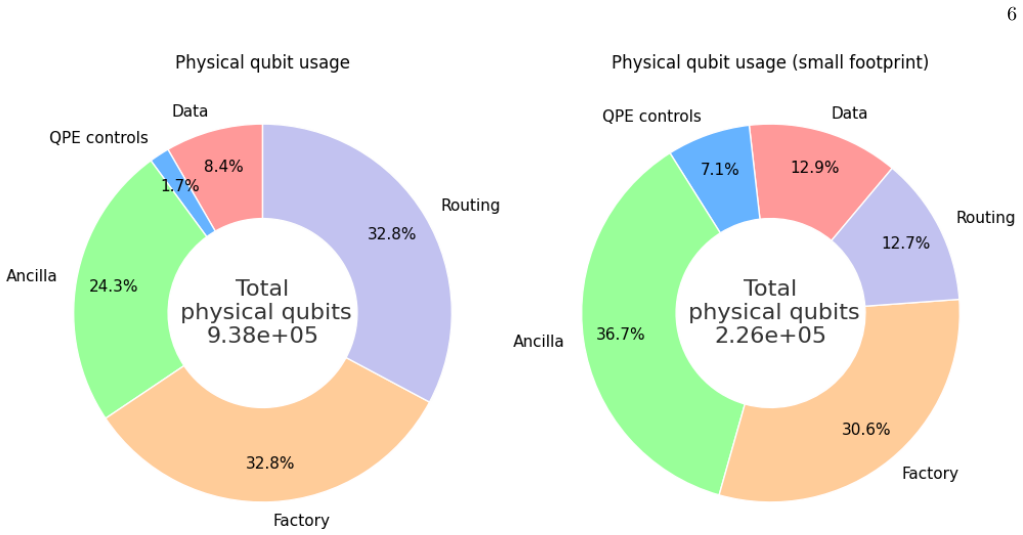
We present a quantum simulation framework capable of addressing multi-electron double quantum dots. We adopt an efficiently scaling 1st quantised representation of the system and develop algorithms based on both Trotterisation and qubitisation. Incorporating insights from classical simulations enables us to produce resource estimates that are more realistic than those obtained from theoretical error bounds. Using a standard surface code model with physical noise at 10^{-3}, our results indicate that the ground-state energy of four electrons in a double quantum dot can be estimated in approximately 24 hours using 226k physical qubits, or an eight-electron system in 3.4 days with 314k qubits (
What carries the argument
First-quantised representation of the multi-electron system paired with Trotterisation and qubitisation algorithms for ground-state energy estimation.
If this is right
- Ground-state energies of four- and eight-electron double quantum dots become reachable on early fault-tolerant hardware under the stated noise model.
- Runtime scales downward sharply once additional physical qubits are supplied.
- Dense surface-code architectures could reduce the quoted costs further.
- Early fault-tolerant computers may become useful for designing mature quantum technologies based on semiconductor nanostructures.
Where Pith is reading between the lines
- The same first-quantised approach might apply to other multi-electron nanostructures once the classical-insight step is adapted.
- A hybrid classical-quantum workflow could become standard for initial screening of quantum-dot device parameters before fabrication.
- The reported scaling suggests that modest hardware improvements beyond 300k qubits would bring many-electron cases into the hours rather than days regime.
Load-bearing premise
That insights drawn from classical simulations produce resource estimates more realistic than pure theoretical error bounds without introducing unquantified bias.
What would settle it
A direct head-to-head comparison of the quoted qubit counts and runtimes computed with versus without the classical-simulation adjustments, or an execution of the algorithm on a two-electron test case whose resource cost can be measured exactly.
Figures

read the original abstract
Semiconductor nanostructures are central to many developing technologies. Notably, double quantum dots are especially important for semiconductor spin-qubit architectures, quantum sensing applications, and quantum-dot solar cells. Accurate modelling is highly desirable but conventional methods can struggle when dynamics involve more than two interacting electrons. In this work, we present a quantum simulation framework capable of addressing multi-electron double quantum dots. We adopt an efficiently scaling 1$^\text{st}$ quantised representation of the system and develop algorithms based on both Trotterisation and qubitisation. Incorporating insights from classical simulations enables us to produce resource estimates that are more realistic than those obtained from theoretical error bounds. Using a standard surface code model with physical noise at $10^{-3}$, our results indicate that the ground-state energy of four electrons in a double quantum dot can be estimated in approximately 24 hours using 226k physical qubits, or an eight-electron system in 3.4 days with 314k qubits (with runtimes falling dramatically when more qubits are available). We anticipate that incorporating very recent advances including dense surface code architectures (Low et al. arXiv:2605.30455) may reduce these costs significantly further. We conclude that early fault tolerant computers may prove to be valuable tools for designing mature-era quantum technologies.
Editorial analysis
A structured set of objections, weighed in public.
Referee Report
Summary. The paper presents a quantum simulation framework for modeling multi-electron double quantum dots using a first-quantized representation, with algorithms based on Trotterisation and qubitisation. It incorporates insights from classical simulations to adjust theoretical error bounds and produces resource estimates for ground-state energy estimation on early fault-tolerant quantum computers under a standard surface-code model with 10^{-3} physical noise, claiming 226k physical qubits and ~24 hours for four electrons or 314k qubits and 3.4 days for eight electrons (with runtimes improving with more qubits).
Significance. If the resource estimates hold after rigorous validation of the classical adjustments, the work would offer concrete guidance on the qubit and runtime requirements for applying early fault-tolerant quantum computers to semiconductor nanostructure modeling, an area relevant to spin-qubit architectures and quantum sensing. The emphasis on realistic bounds via classical insights, rather than purely theoretical ones, addresses a practical gap in quantum algorithm resource analysis for chemistry-like problems.
major comments (2)
- [Abstract] Abstract: the headline resource numbers (226k physical qubits / 24 h for 4 electrons; 314k qubits / 3.4 days for 8 electrons) are stated to result from 'incorporating insights from classical simulations' that tighten bounds beyond theoretical error analysis, yet no derivation, error budget, or validation of this adjustment is supplied; this adjustment is load-bearing for the central feasibility claim.
- [Abstract] The 1st-quantized Trotter and qubitisation algorithms are standard (as referenced to prior literature), but the manuscript does not demonstrate how the classical-simulation adjustments reduce the bounds in a reproducible, bias-quantified manner; the estimates therefore rest on external surface-code models rather than reducing to quantities derived inside the work.
minor comments (1)
- [Abstract] The abstract mentions anticipation of further cost reductions from dense surface-code architectures (Low et al. arXiv:2605.30455) but does not quantify the expected improvement or integrate it into the presented estimates.
Simulated Author's Rebuttal
We thank the referee for their detailed and constructive report. The comments correctly identify that the abstract's headline resource estimates depend on classical-simulation adjustments whose derivation, error budget, and validation are not adequately presented. We will revise the manuscript to supply these elements explicitly. Our point-by-point responses follow.
read point-by-point responses
-
Referee: [Abstract] Abstract: the headline resource numbers (226k physical qubits / 24 h for 4 electrons; 314k qubits / 3.4 days for 8 electrons) are stated to result from 'incorporating insights from classical simulations' that tighten bounds beyond theoretical error analysis, yet no derivation, error budget, or validation of this adjustment is supplied; this adjustment is load-bearing for the central feasibility claim.
Authors: We agree that the abstract statement is insufficient without supporting detail. The classical simulations (exact diagonalization on small instances) were used to replace conservative theoretical error tolerances with tighter, empirically motivated values for the Trotter and qubitisation step sizes. However, the manuscript does not contain an explicit derivation or error-budget table. In the revised version we will add a new subsection (or appendix) that (i) states the classical data used, (ii) shows the quantitative tightening of each error parameter, (iii) provides an error-budget breakdown, and (iv) validates the adjusted bounds against exact results for the four-electron case. This will make the headline numbers traceable to quantities derived inside the work. revision: yes
-
Referee: [Abstract] The 1st-quantized Trotter and qubitisation algorithms are standard (as referenced to prior literature), but the manuscript does not demonstrate how the classical-simulation adjustments reduce the bounds in a reproducible, bias-quantified manner; the estimates therefore rest on external surface-code models rather than reducing to quantities derived inside the work.
Authors: We accept the observation. While the underlying algorithms follow established references, the specific mapping from classical data to adjusted algorithmic error bounds is not shown in reproducible form. The surface-code overhead model is indeed external (standard in the literature), but the quantum-resource quantities (T-count, logical qubits, runtime) must be derived from the adjusted parameters inside the paper. The revision will include explicit formulas relating the classically informed error tolerances to the final resource counts, together with a bias-quantification table, thereby grounding the estimates in internally derived quantities. revision: yes
Circularity Check
No significant circularity in the derivation chain
full rationale
The paper derives resource estimates for ground-state energy estimation in double quantum dots using standard first-quantized representations, Trotterisation and qubitisation algorithms drawn from prior quantum algorithm literature, and a standard surface-code error model with physical error rate 10^{-3}. The adjustment for realism via classical simulations is presented as an external input that tightens theoretical bounds, not as a parameter fitted inside the work and then relabeled as a prediction. No self-definitional equations, fitted-input-called-prediction steps, load-bearing self-citations, or reductions of the headline qubit/runtime numbers to tautological inputs by the paper's own equations are exhibited. The central feasibility claims therefore remain grounded in independent external methods and benchmarks rather than reducing to the paper's internal definitions or fits.
Axiom & Free-Parameter Ledger
axioms (2)
- domain assumption Surface-code error correction model with physical noise rate of 10^{-3}
- domain assumption First-quantized representation scales efficiently for multi-electron double quantum dots
Reference graph
Works this paper leans on
-
[1]
As explained in the Sec
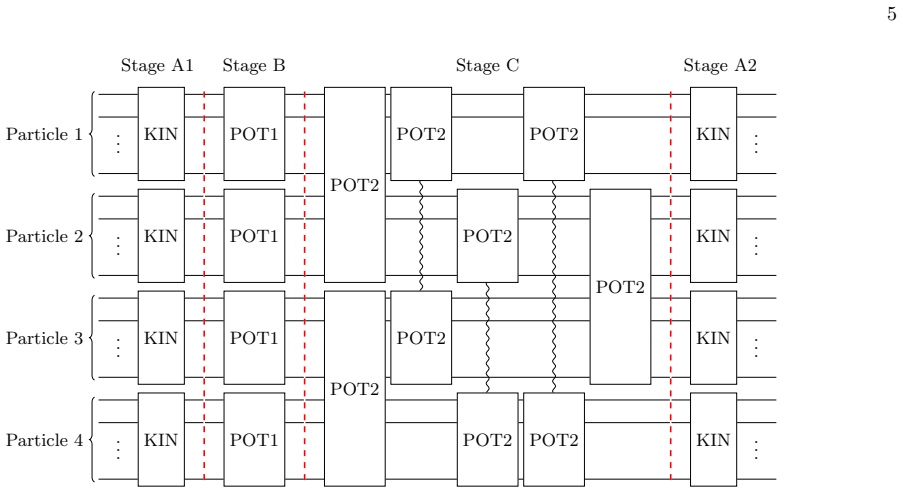
Stage A: Kinetic We first describe the action required on one of the co- ordinates of a single qubit register and calculate the cost for 2np registers at the end. As explained in the Sec. III A, the strategy is to ap- ply the phase through rotations on bits. For ann q qubit register, this requiresn q RZ gates andn q(nq −1)/2CR z gates. EachCR z gate is co...
-
[2]
The QROM phase oracle for this task is fully seri- alized to save qubits
Stage B: DQD potential We first describe the action required on a single qubit register and then compute the cost forn p registers at the end. The QROM phase oracle for this task is fully seri- alized to save qubits. The oracle needs to compute and uncomputeS 1 flags in series, each flag computa- tion/uncomputation has depth 2⌈log 2 l1⌉(wherel 1 = log2 S1...
-
[3]
We first cal- culate the squared distancer 2 between two particles and then use phase oracle to put up the Coulomb potential energy by approximating a functionf(x)∝1/ √x
Stage C: Coulomb potential This stage involing the interactions between particles and thus the operation between registers. We first cal- culate the squared distancer 2 between two particles and then use phase oracle to put up the Coulomb potential energy by approximating a functionf(x)∝1/ √x. We need to repeat this process for each particle pair. Forn p ...
-
[4]
However, phase estimation requires the controlled version of the time evolution operator
Overall logical and physical cost The above analysis is for one Trotter step in a 2nd or- der product formula. However, phase estimation requires the controlled version of the time evolution operator. The methods for making each Trotter step controlled are: •STAGE A: all the rotations (controlled rotations) become controlled rotations (controlled controll...
-
[5]
[35], which operates on 12 logical qubits and produces one CCZ state in∼5dcode cycles
We assume the 8T-to-CCZ factory from ref. [35], which operates on 12 logical qubits and produces one CCZ state in∼5dcode cycles. Therefore, the average 13 number of factories required to keep up with beat-limited computation is 31291/7018×5≈22.3, corresponding to an average of 267 logical qubits. We also allocate the equal number of qubits to account for ...
-
[6]
T rotter error bound For Hamiltonian in the formH=A+B, ref. [62] derives a tight error bound for the second-order Suzuki- Trotter formulaS 2(t) =e −i(t/2)Ae−itBe−i(t/2)A, S2(t)−e −iHt ≤ t3 12 [B,[B, A]] + t3 24 [A,[A, B]] (B18) where∥.∥denotes the spectral norm and [,] denotes the commutator. By expanding the commutators and applying∥A+B∥ ≤ ∥A∥+∥B∥and∥AB∥...
-
[7]
Z. D. Kvon, Semiconductor quantum wells and nanos- tructures, Nanomaterials13, 1924 (2023)
1924
-
[8]
F. P. Garc´ ıa de Arquer, D. V. Talapin, V. I. Klimov, 15 Y. Arakawa, M. Bayer, and E. H. Sargent, Semiconductor quantum dots: Technological progress and future chal- lenges, Science373, eaaz8541 (2021)
2021
-
[9]
Conibeer, M
G. Conibeer, M. A. Green, D. K¨ onig, I. Perez-Wurfl, S. Huang, X. Hao, D. Di, L. Shi, S. Shrestha, B. Puthen- Veetil, Y. So, B. Zhang, and Z. Wan, Silicon quantum dot based solar cells: Addressing the issues of doping, voltage and current transport, Progress in Photovoltaics: Research and Applications19, 813 (2011)
2011
-
[10]
Giavaras, J
G. Giavaras, J. Wabnig, B. W. Lovett, J. H. Jefferson, and G. A. D. Briggs, Magnetic field sensing using a driven double quantum dot, Physica E: Low-dimensional Sys- tems and Nanostructures42, 895 (2010)
2010
-
[11]
Loss and D
D. Loss and D. P. DiVincenzo, Quantum computation with quantum dots, Physical Review A57, 120 (1998)
1998
-
[12]
Burkard, T
G. Burkard, T. D. Ladd, A. Pan, J. M. Nichol, and J. R. Petta, Semiconductor spin qubits, Reviews of Modern Physics95, 025003 (2023)
2023
-
[13]
C. W. Binder, G. Burkard, and A. J. Fisher, Effective 2d envelope function theory for silicon quantum dots, arXiv preprint arXiv:2508.00139 (2025)
arXiv 2025
-
[14]
Ma, A.-R
R.-L. Ma, A.-R. Li, C. Wang, Z.-Z. Kong, W.-Z. Liao, M. Ni, S.-K. Zhu, N. Chu, C. Zhang, D. Liu, G. Cao, G.-L. Wang, H.-O. Li, and G.-P. Guo, Single-spin-qubit geometric gate in a silicon quantum dot, Phys. Rev. Appl. 21, 014044 (2024)
2024
-
[16]
Noiri, K
A. Noiri, K. Takeda, T. Nakajima, T. Kobayashi, A. Sam- mak, G. Scappucci, and S. Tarucha, Fast universal quan- tum gate above the fault-tolerance threshold in silicon, Nature601, 338 (2022)
2022
-
[17]
Russ and G
M. Russ and G. Burkard, Three-electron spin qubits, Journal of Physics: Condensed Matter29, 393001 (2017)
2017
-
[18]
Medford, J
J. Medford, J. Beil, J. M. Taylor, E. I. Rashba, H. Lu, A. C. Gossard, and C. M. Marcus, Quantum-dot-based resonant exchange qubit, Physical Review Letters111, 050501 (2013)
2013
-
[19]
Z. Shi, C. B. Simmons, D. R. Ward, J. R. Prance, X. Wu, T. S. Koh, J. K. Gamble, D. E. Savage, M. G. Lagally, M. Friesen, S. N. Coppersmith, and M. A. Eriksson, Fast coherent manipulation of three-electron states in a double quantum dot, Nature Communications5, 3020 (2014)
2014
-
[20]
A. R. Mills, C. R. Guinn, M. J. Gullans, A. J. Sigillito, M. M. Feldman, E. Nielsen, and J. R. Petta, Two- qubit silicon quantum processor with operation fidelity exceeding 99%, Science Advances8, eabn5130 (2022), https://www.science.org/doi/pdf/10.1126/sciadv.abn5130
-
[21]
M. D. Smet, Y. Matsumoto, A.-M. J. Zwerver, L. Try- puten, S. L. de Snoo, S. V. Amitonov, A. Sammak, N. Samkharadze, ¨Onder G¨ ul, R. N. M. Wasserman, M. Rimbach-Russ, G. Scappucci, and L. M. K. Vander- sypen, High-fidelity single-spin shuttling in silicon, Na- ture Nanotechnology20, 866 (2025)
2025
-
[22]
Y. Su, D. W. Berry, N. Wiebe, N. Rubin, and R. Bab- bush, Fault-tolerant quantum simulations of chemistry in first quantization, PRX Quantum2, 040332 (2021)
2021
-
[23]
P.-W. Huang, G. Boyd, G.-L. R. Anselmetti, M. Deg- roote, N. Moll, R. Santagati, M. Streif, B. Ries, D. Marti- Dafcik, H. Jnane,et al., Fullqubit alchemist: Quantum algorithm for alchemical free energy calculations, arXiv preprint arXiv:2508.16719 (2025)
Pith/arXiv arXiv 2025
-
[24]
B. I. Schneider, L. A. Collins, and S. X. Hu, Paral- lel solver for the time-dependent linear and nonlinear schr¨ odinger equation, Phys. Rev. E73, 036708 (2006)
2006
-
[25]
Cerjan,Numerical grid methods and their application to Schr¨ odinger’s equation, Vol
C. Cerjan,Numerical grid methods and their application to Schr¨ odinger’s equation, Vol. 412 (Springer Science & Business Media, 2013)
2013
-
[26]
J. C. Light and T. Carrington Jr, Discrete-variable rep- resentations and their utilization, Advances in Chemical Physics114, 263 (2000)
2000
-
[27]
I. Kassal, S. P. Jordan, P. J. Love, M. Mohseni, and A. Aspuru-Guzik, Polynomial-time quantum algorithm for the simulation of chemical dynamics, Proceedings of the National Academy of Sciences105, 18681 (2008), https://www.pnas.org/doi/pdf/10.1073/pnas.0808245105
-
[28]
P. J. Ollitrault, G. Mazzola, and I. Tavernelli, Nonadia- batic molecular quantum dynamics with quantum com- puters, Phys. Rev. Lett.125, 260511 (2020)
2020
-
[29]
Kosugi, Y
T. Kosugi, Y. Nishiya, H. Nishi, and Y.-i. Matsushita, Imaginary-time evolution using forward and backward real-time evolution with a single ancilla: First-quantized eigensolver algorithm for quantum chemistry, Phys. Rev. Res.4, 033121 (2022)
2022
-
[30]
H. H. S. Chan, R. Meister, T. Jones, D. P. Tew, and S. C. Benjamin, Grid-based methods for chemistry simulations on a quantum computer, Science Advances9, eabo7484 (2023)
2023
-
[31]
Jnane and S
H. Jnane and S. C. Benjamin, Ab initio modeling of quan- tum dot qubits: Coupling, gate dynamics, and robustness versus charge noise, Phys. Rev. Appl.24, 044042 (2025)
2025
-
[32]
Z. Sun, G. Boyd, Z. Cai, H. Jnane, B. Koczor, R. Meister, R. Minko, B. Pring, S. C. Benjamin, and N. Stamatopou- los, Low-depth phase oracle using a parallel piecewise cir- cuit, Phys. Rev. A111, 062420 (2025)
2025
-
[33]
Babbush, C
R. Babbush, C. Gidney, D. W. Berry, N. Wiebe, J. Mc- Clean, A. Paler, A. Fowler, and H. Neven, Encoding elec- tronic spectra in quantum circuits with linear t complex- ity, Phys. Rev. X8, 041015 (2018)
2018
-
[34]
Y. R. Sanders, D. W. Berry, P. C. Costa, L. W. Tessler, N. Wiebe, C. Gidney, H. Neven, and R. Babbush, Com- pilation of fault-tolerant quantum heuristics for combi- natorial optimization, PRX Quantum1, 020312 (2020)
2020
-
[35]
Gidney and A
C. Gidney and A. G. Fowler, Efficient magic state fac- tories with a catalyzed|CCZ⟩to 2|T⟩transformation, Quantum3, 135 (2019)
2019
-
[36]
J. Lee, D. W. Berry, C. Gidney, W. J. Huggins, J. R. Mc- Clean, N. Wiebe, and R. Babbush, Even more efficient quantum computations of chemistry through tensor hy- percontraction, PRX Quantum2, 030305 (2021)
2021
-
[37]
Horsman, A
D. Horsman, A. G. Fowler, S. Devitt, and R. Van Meter, Surface code quantum computing by lattice surgery, New Journal of Physics14, 123011 (2012)
2012
-
[38]
Litinski, A game of surface codes: Large-scale quan- tum computing with lattice surgery, Quantum3, 128 (2019)
D. Litinski, A game of surface codes: Large-scale quan- tum computing with lattice surgery, Quantum3, 128 (2019)
2019
-
[39]
Gidney, Inplace access to the surface code y basis, Quantum8, 1310 (2024)
C. Gidney, Inplace access to the surface code y basis, Quantum8, 1310 (2024)
2024
-
[40]
Y. Hirano and K. Fujii, Locality-aware pauli-based com- putation for local magic state preparation, arXiv preprint arXiv:2504.12091 (2025)
arXiv 2025
-
[41]
C. Gidney, How to factor 2048 bit rsa integers with less than a million noisy qubits, arXiv preprint arXiv:2505.15917 (2025)
Pith/arXiv arXiv 2048
-
[42]
C. Gidney, N. Shutty, and C. Jones, Magic state culti- 16 vation: growing t states as cheap as cnot gates, arXiv preprint arXiv:2409.17595 (2024)
Pith/arXiv arXiv 2024
-
[43]
Gidney, M
C. Gidney, M. Newman, P. Brooks, and C. Jones, Yoked surface codes, Nature Communications16, 4498 (2025)
2025
-
[44]
Katabarwa, K
A. Katabarwa, K. Gratsea, A. Caesura, and P. D. Johnson, Early fault-tolerant quantum computing, PRX Quantum5, 020101 (2024)
2024
-
[45]
Binder, (2026), manuscript in preparation; additional authors not yet listed
C. Binder, (2026), manuscript in preparation; additional authors not yet listed
2026
-
[46]
A. M. Childs and N. Wiebe, Hamiltonian simulation us- ing linear combinations of unitary operations, Quantum Info. Comput.12, 901–924 (2012)
2012
-
[47]
G. H. Low and N. Wiebe, Hamiltonian simulation in the interaction picture, arXiv preprint arXiv:1805.00675 (2018)
Pith/arXiv arXiv 2018
-
[48]
D. P. DiVincenzo, D. Bacon, J. Kempe, G. Burkard, and K. B. Whaley, Universal quantum computation with the exchange interaction, nature408, 339 (2000)
2000
-
[49]
Meunier, V
T. Meunier, V. E. Calado, and L. M. K. Vandersypen, Efficient controlled-phase gate for single-spin qubits in quantum dots, Phys. Rev. B83, 121403 (2011)
2011
-
[50]
com/solutions/qtcad/(2025), accessed: 2025-12-09
Nanoacademic Technologies Inc., QTCAD — assisted de- sign for quantum technologies,https://nanoacademic. com/solutions/qtcad/(2025), accessed: 2025-12-09
2025
-
[51]
W. J. Huggins, O. Leimkuhler, T. F. Stetina, and K. B. Whaley, Efficient state preparation for the quantum sim- ulation of molecules in first quantization, PRX Quantum 6, 020319 (2025)
2025
-
[52]
Buonacorsi, B
B. Buonacorsi, B. Shaw, and J. Baugh, Simulated coher- ent electron shuttling in silicon quantum dots, Phys. Rev. B102, 125406 (2020)
2020
-
[53]
M. Jeon, S. C. Benjamin, and A. J. Fisher, Robustness of electron charge shuttling: Architectures, pulses, charge defects, and noise thresholds, Physical Review B111, 195302 (2025)
2025
-
[54]
J. J. Turner, C. W. Binder, G. Burkard, and A. J. Fisher, Modelling the impact of device imperfections on electron shuttling in simos devices, arXiv preprint arXiv:2512.03853 (2025)
Pith/arXiv arXiv 2025
- [55]
-
[56]
T. N. Ikeda, A. Abrar, I. L. Chuang, and S. Sugiura, Minimum Trotterization Formulas for a Time-Dependent Hamiltonian, Quantum7, 1168 (2023)
2023
-
[57]
Mizuta and K
K. Mizuta and K. Fujii, Optimal Hamiltonian simulation for time-periodic systems, Quantum7, 962 (2023)
2023
-
[58]
G. H. Low, W. J. Huggins, D. W. Berry, T. Khattar, A. F. White, N. C. Rubin, and R. Babbush, A denser planar surface code (2026), arXiv:2605.30455 [quant-ph]
Pith/arXiv arXiv 2026
-
[59]
Koczor, J
B. Koczor, J. J. L. Morton, and S. C. Benjamin, Prob- abilistic interpolation of quantum rotation angles, Phys. Rev. Lett.132, 130602 (2024)
2024
-
[60]
Kiumi and B
C. Kiumi and B. Koczor, Te-pai: exact time evolution by sampling random circuits, Quantum Science and Tech- nology10, 045071 (2025)
2025
-
[61]
Koczor, Sparse probabilistic synthesis of quantum op- erations, PRX Quantum5, 040352 (2024)
B. Koczor, Sparse probabilistic synthesis of quantum op- erations, PRX Quantum5, 040352 (2024)
2024
-
[62]
M. Bothe, C. S¨ underhauf, M. J. Witham, E. T. Camp- bell, and N. S. Blunt, More efficient clifford+t synthesis for small-angle rotations and application to trotterization (2026), arXiv:2605.31544 [quant-ph]
Pith/arXiv arXiv 2026
-
[63]
Takahashi, S
Y. Takahashi, S. Tani, and N. Kunihiro, Quantum ad- dition circuits and unbounded fan-out, Quantum Info. Comput.10, 872–890 (2010)
2010
-
[64]
H.-S. Li, P. Fan, H. Xia, and G.-L. Long, The circuit design and optimization of quantum multiplier and di- vider, Science China Physics, Mechanics & Astronomy 65, 260311 (2022)
2022
-
[65]
Y. Nam, Y. Su, and D. Maslov, Approximate quantum fourier transform with o (n log (n)) t gates, NPJ Quan- tum Information6, 26 (2020)
2020
-
[66]
V. Kliuchnikov, K. Lauter, R. Minko, A. Paetznick, and C. Petit, Shorter quantum circuits via single- qubit gate approximation, Quantum7, 1208 (2023), arXiv:2203.10064 [quant-ph]
arXiv 2023
-
[67]
Gidney, Halving the cost of quantum addition, Quan- tum2, 74 (2018)
C. Gidney, Halving the cost of quantum addition, Quan- tum2, 74 (2018)
2018
-
[68]
A. M. Childs, Y. Su, M. C. Tran, N. Wiebe, and S. Zhu, Theory of trotter error with commutator scaling, Phys. Rev. X11, 011020 (2021)
2021
-
[69]
M. Reiher, N. Wiebe, K. M. Svore, D. Wecker, and M. Troyer, Elucidating reaction mechanisms on quantum computers, Proceedings of the Na- tional Academy of Sciences114, 7555 (2017), https://www.pnas.org/doi/pdf/10.1073/pnas.1619152114
-
[70]
A. M. Childs, D. Maslov, Y. Nam, N. J. Ross, and Y. Su, Toward the first quantum simula- tion with quantum speedup, Proceedings of the National Academy of Sciences115, 9456 (2018), https://www.pnas.org/doi/pdf/10.1073/pnas.1801723115
-
[71]
Babbush, J
R. Babbush, J. McClean, D. Wecker, A. Aspuru-Guzik, and N. Wiebe, Chemical basis of trotter-suzuki errors in quantum chemistry simulation, Phys. Rev. A91, 022311 (2015)
2015
-
[72]
G. H. Low and I. L. Chuang, Hamiltonian simulation by qubitization, Quantum3, 163 (2019)
2019
discussion (0)
Sign in with ORCID, Apple, or X to comment. Anyone can read and Pith papers without signing in.