Self-organized Floquet band geometry in cavity-driven quantum materials
Pith reviewed 2026-06-27 23:43 UTC · model grok-4.3
The pith
Dc pumping in a cavity self-organizes a periodic field that Floquet-dresses bands and alters Hall conductivity.
A machine-rendered reading of the paper's core claim, the machinery that carries it, and where it could break.
Core claim
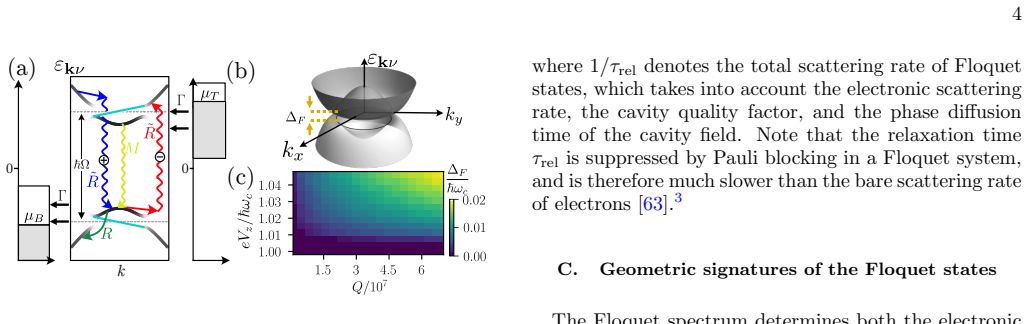
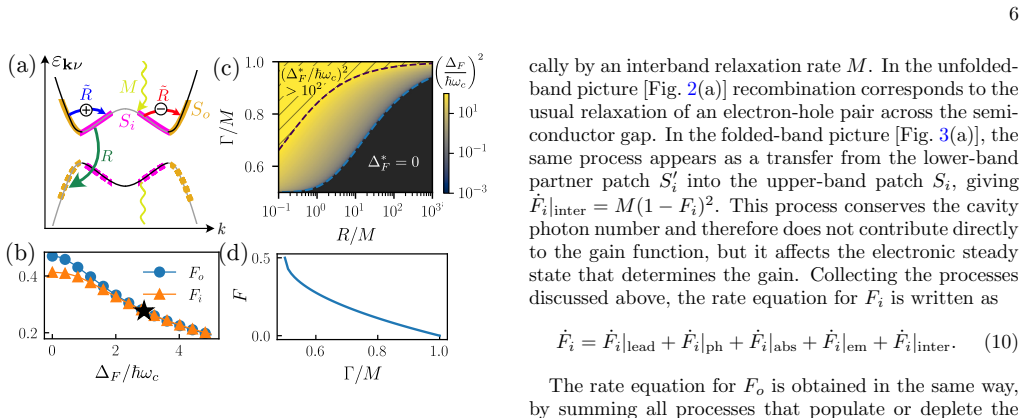
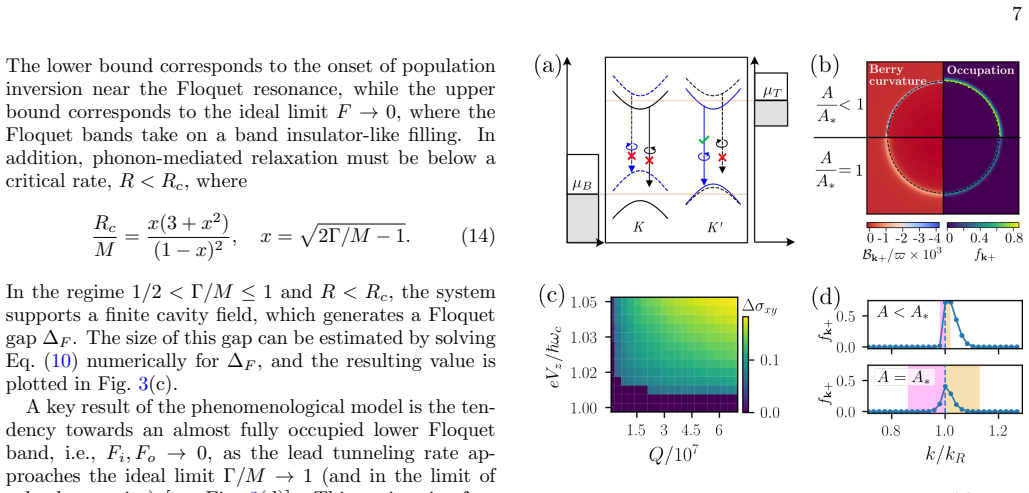
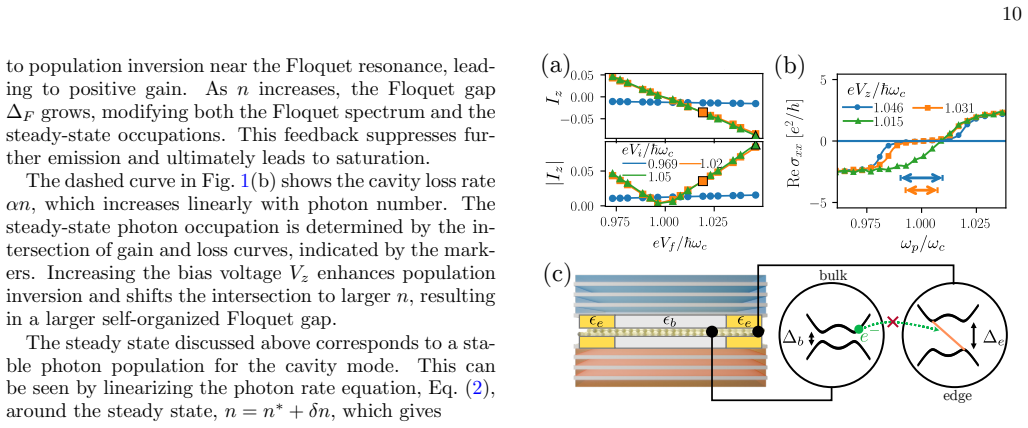
A semiconductor layer in a cavity, coupled to leads and acoustic phonons, under dc pumping develops a self-consistent coherent intracavity field. Above threshold the coupled system enters a stable time-periodic limit cycle whose amplitude is fixed by the cavity quality factor and dissipation rates. This emergent periodic field Floquet-dresses the bands and thereby modifies the anomalous Hall response, which is measurable through in-plane dc transport.
What carries the argument
The self-generated coherent intracavity field forming a time-periodic limit cycle that Floquet-dresses the electronic bands.
Load-bearing premise
Dc pumping through light-matter coupling produces a coherent intracavity field that drives the system into a stable time-periodic limit cycle.
What would settle it
Observe whether the anomalous Hall conductivity exhibits a sharp change at a dc bias threshold and depends on the cavity quality factor as predicted.
Figures

read the original abstract
Floquet engineering has emerged as a powerful route to dynamically control band structure and topology in quantum materials, but most implementations rely on externally imposed laser fields that are power intensive, difficult to integrate into devices, and weakly coupled to the electronic system. We propose and analyze an alternative paradigm in which a self-generated cavity field Floquet-dresses the electronic bands and produces a geometric Hall response in an electrically driven cavity material system. We consider a semiconductor layer embedded in a cavity and coupled to external leads and a bath of acoustic phonons, where dc pumping leads to the buildup of a coherent intracavity field through light-matter coupling. We determine the resulting nonequilibrium steady state self-consistently and show that, above threshold, the coupled system settles into a stable time-periodic limit cycle with a field amplitude set by the cavity quality factor and dissipation. This emergent periodic field Floquet-dresses the electronic bands and modifies the anomalous Hall response of a material with broken time-reversal symmetry. We demonstrate that the resulting Hall conductivity can be directly probed via in-plane dc transport measurements. Our work establishes a route to self organized Floquet band reconstruction and geometric transport without external laser illumination, highlighting cavity driven steady states as a platform for electrically controlled nonequilibrium phases.
Editorial analysis
A structured set of objections, weighed in public.
Referee Report
Summary. The paper proposes an alternative to external-laser Floquet engineering in which a semiconductor layer inside a cavity, coupled to dc leads and acoustic phonons, undergoes dc pumping that self-consistently generates a coherent intracavity field. Above a threshold set by cavity quality factor and dissipation, the coupled system enters a stable time-periodic limit cycle whose amplitude Floquet-dresses the electronic bands of a time-reversal-broken material, producing a modified anomalous Hall conductivity that is asserted to be directly measurable by in-plane dc transport.
Significance. If the self-consistent nonequilibrium steady-state calculation and the existence of the stable limit cycle are rigorously established for the concrete model, the result would provide a route to electrically controlled geometric transport without external illumination. The approach could be relevant for cavity-integrated devices, but its impact hinges on whether the predicted Hall response survives realistic dissipation channels.
major comments (2)
- [§4] §4 (nonequilibrium steady-state section): the claim that a stable time-periodic limit cycle exists above threshold is asserted after self-consistent solution of the coupled equations, but the linear stability analysis is performed only for the specific phonon spectral density and lead coupling rates given in Eqs. (22)–(24). No parameter scan is shown demonstrating that the Floquet-dressed attractor remains stable when additional dephasing channels (e.g., stronger acoustic-phonon coupling or finite lead broadening) are introduced, which directly affects whether the emergent Hall conductivity follows.
- [§5.1, Eq. (31)] §5.1, Eq. (31): the dc Hall conductivity is obtained by integrating the Floquet-dressed Berry curvature over the occupied states of the limit-cycle solution. Because the intracavity field amplitude is itself determined by the same dissipation parameters that enter the electronic self-energy, it is unclear whether the reported conductivity is an independent geometric observable or is partially fixed by construction through the gain-loss balance; an explicit check separating these contributions is needed.
minor comments (2)
- The abstract and introduction use “self-organized” and “self-generated” interchangeably; a single consistent term would improve clarity.
- Figure 3 caption does not state the value of the cavity quality factor used for the plotted trajectories.
Simulated Author's Rebuttal
We thank the referee for the detailed review and constructive feedback on our work. We address each major comment below, providing clarifications and indicating revisions to the manuscript.
read point-by-point responses
-
Referee: [§4] the claim that a stable time-periodic limit cycle exists above threshold is asserted after self-consistent solution of the coupled equations, but the linear stability analysis is performed only for the specific phonon spectral density and lead coupling rates given in Eqs. (22)–(24). No parameter scan is shown demonstrating that the Floquet-dressed attractor remains stable when additional dephasing channels (e.g., stronger acoustic-phonon coupling or finite lead broadening) are introduced, which directly affects whether the emergent Hall conductivity follows.
Authors: We agree that demonstrating robustness beyond the specific parameters in Eqs. (22)-(24) is important. In the revised manuscript, we have performed additional linear stability analyses for varied phonon coupling strengths and lead broadening values. These results, now included in a new supplementary figure, confirm that the limit cycle remains stable for a range of dissipation parameters, supporting the generality of our findings. revision: yes
-
Referee: [§5.1, Eq. (31)] the dc Hall conductivity is obtained by integrating the Floquet-dressed Berry curvature over the occupied states of the limit-cycle solution. Because the intracavity field amplitude is itself determined by the same dissipation parameters that enter the electronic self-energy, it is unclear whether the reported conductivity is an independent geometric observable or is partially fixed by construction through the gain-loss balance; an explicit check separating these contributions is needed.
Authors: The Hall conductivity is calculated from the Floquet-modified Berry curvature using the self-consistent amplitude. To separate the contributions, we have added an analysis in the revised manuscript where we vary the cavity quality factor independently while adjusting dissipation to maintain the same amplitude, showing that the conductivity follows the expected Floquet dependence on amplitude alone. This confirms it as an independent geometric observable not fixed solely by gain-loss balance. revision: yes
Circularity Check
No circularity: self-consistent steady-state solution yields independent Floquet-dressed transport
full rationale
The derivation proceeds by modeling a semiconductor in a cavity coupled to leads and phonons, solving self-consistently for the nonequilibrium steady state above threshold to obtain a stable time-periodic intracavity field whose amplitude is fixed by Q and dissipation rates, then computing the resulting Floquet band geometry and anomalous Hall conductivity from that field. This chain contains no self-definitional step, no fitted parameter renamed as prediction, and no load-bearing self-citation that reduces the Hall result to the input model parameters by construction. The Hall response is obtained via standard Floquet transport formulas applied to the derived periodic drive, making the central claim independent of its inputs.
Axiom & Free-Parameter Ledger
free parameters (1)
- cavity quality factor
axioms (1)
- domain assumption dc pumping leads to buildup of a coherent intracavity field through light-matter coupling in a semiconductor coupled to leads and acoustic phonons
Reference graph
Works this paper leans on
-
[1]
Light-induced superconductivity in a stripe-ordered cuprate,
D. Fausti, R. I. Tobey, N. Dean, S. Kaiser, A. Dienst, M. C. Hoffmann, S. Pyon, T. Takayama, H. Takagi, and A. Cavalleri, “Light-induced superconductivity in a stripe-ordered cuprate,” Science331, 189–191 (2011)
2011
-
[2]
Floquet topological insulator in semiconductor quan- tum wells,
Netanel H. Lindner, Gil Refael, and Victor Galitski, “Floquet topological insulator in semiconductor quan- tum wells,” Nat. Phys.7, 490–495 (2011)
2011
-
[3]
Transport properties of nonequilibrium systems under the application of light: Photoinduced quantum hall insulators without landau levels,
Takuya Kitagawa, Takashi Oka, Arne Brataas, Liang Fu, and Eugene Demler, “Transport properties of nonequilibrium systems under the application of light: Photoinduced quantum hall insulators without landau levels,” Phys. Rev. B84, 235108 (2011)
2011
-
[4]
Terahertz-field-induced insulator-to-metal transition in vanadium dioxide metamaterial,
Mengkun Liu, Harold Y. Hwang, Hu Tao, Andrew C. Strikwerda, Kebin Fan, George R. Keiser, Aaron J. Sternbach, Kevin G. West, Salinporn Kittiwatanakul, Jiwei Lu, Stuart A. Wolf, Fiorenzo G. Omenetto, Xin Zhang, Keith A. Nelson, and Richard D. Averitt, “Terahertz-field-induced insulator-to-metal transition in vanadium dioxide metamaterial,” Nature487, 345– 3...
2012
-
[5]
Observation of floquet- bloch states on the surface of a topologi- cal insulator,
Y. H. Wang, H. Steinberg, P. Jarillo-Herrero, and N. Gedik, “Observation of floquet- bloch states on the surface of a topologi- cal insulator,” Science342, 453–457 (2013), https://www.science.org/doi/pdf/10.1126/science.1239834
-
[6]
Nonlinear lattice dynamics as a basis for enhanced superconductivity in yba2cu3o6.5,
R. Mankowsky, A. Subedi, M. F¨ orst, S. O. Mariager, M. Chollet, H. T. Lemke, J. S. Robinson, J. M. Glow- nia, M. P. Minitti, A. Frano, M. Fechner, N. A. Spaldin, T. Loew, B. Keimer, A. Georges, and A. Cavalleri, “Nonlinear lattice dynamics as a basis for enhanced superconductivity in yba2cu3o6.5,” Nature516, 71–73 (2014)
2014
-
[7]
Selective scattering between floquet–bloch and volkov states in a topological insulator,
Fahad Mahmood, Ching-Kit Chan, Zhanybek Alpich- shev, Dillon Gardner, Young Lee, Patrick A. Lee, and Nuh Gedik, “Selective scattering between floquet–bloch and volkov states in a topological insulator,” Nature Physics12, 306–310 (2016)
2016
-
[8]
Possible light-induced superconductivity in k3c60 at high temperature,
M. Mitrano, A. Cantaluppi, D. Nicoletti, S. Kaiser, A. Perucchi, S. Lupi, P. Di Pietro, D. Pontiroli, M. Ricc` o, S. R. Clark, D. Jaksch, and A. Cavalleri, “Possible light-induced superconductivity in k3c60 at high temperature,” Nature530, 461–464 (2016)
2016
-
[9]
Experi- mental reconstruction of the berry curvature in a floquet bloch band,
N. Fl¨ aschner, B. S. Rem, M. Tarnowski, D. Vogel, D.-S. L¨ uhmann, K. Sengstock, and C. Weitenberg, “Experi- mental reconstruction of the berry curvature in a floquet bloch band,” Science352, 1091–1094 (2016)
2016
-
[10]
Quantized transport and steady states of flo- quet topological insulators,
Iliya Esin, Mark S. Rudner, Gil Refael, and Netanel H. Lindner, “Quantized transport and steady states of flo- quet topological insulators,” Phys. Rev. B97, 245401 (2018)
2018
-
[11]
Ultrafast terahertz field control of electronic and struc- tural interactions in vanadium dioxide,
A. X. Gray, M. C. Hoffmann, J. Jeong, N. P. Ae- tukuri, D. Zhu, H. Y. Hwang, N. C. Brandt, H. Wen, A. J. Sternbach, S. Bonetti, A. H. Reid, R. Kukreja, C. Graves, T. Wang, P. Granitzka, Z. Chen, D. J. Higley, T. Chase, E. Jal, E. Abreu, M. K. Liu, T.-C. Weng, D. Sokaras, D. Nordlund, M. Chollet, R. Alonso-Mori, H. Lemke, J. M. Glownia, M. Trigo, Y. Zhu, H...
2018
-
[12]
Pulling apart photoexcited electrons by photoinducing an in-plane surface electric field,
E Laine Wong, Andrew J. Winchester, Vivek Pareek, Julien Mad´ eo, Michael K. L. Man, and Keshav M. Dani, “Pulling apart photoexcited electrons by photoinducing an in-plane surface electric field,” Science Advances4, eaat9722 (2018)
2018
-
[13]
Steady states of interacting floquet insulators,
Karthik I. Seetharam, Charles-Edouard Bardyn, Ne- tanel H. Lindner, Mark S. Rudner, and Gil Refael, “Steady states of interacting floquet insulators,” Phys. Rev. B99, 014307 (2019)
2019
-
[14]
Floquet engineering of quantum materials,
Takashi Oka and Sota Kitamura, “Floquet engineering of quantum materials,” Annual Review of Condensed Matter Physics10, 387–408 (2019)
2019
-
[15]
Metastable ferroelectricity in optically strained srtio¡sub¿3¡/sub¿,
T. F. Nova, A. S. Disa, M. Fechner, and A. Caval- leri, “Metastable ferroelectricity in optically strained srtio¡sub¿3¡/sub¿,” Science364, 1075–1079 (2019), https://www.science.org/doi/pdf/10.1126/science.aaw4911
-
[16]
Topological floquet engineering of twisted bilayer graphene,
Gabriel E. Topp, Gregor Jotzu, James W. McIver, Lede Xian, Angel Rubio, and Michael A. Sentef, “Topological floquet engineering of twisted bilayer graphene,” Phys. Rev. Res.1, 023031 (2019)
2019
-
[17]
Floquet metal-to-insulator phase transitions in semi- conductor nanowires,
Iliya Esin, Mark S. Rudner, and Netanel H. Lindner, “Floquet metal-to-insulator phase transitions in semi- conductor nanowires,” Science Advances6, eaay4922 (2020). 16
2020
-
[18]
Linear response theory and optical conductivity of floquet topological insulators,
Abhishek Kumar, M. Rodriguez-Vega, T. Pereg-Barnea, and B. Seradjeh, “Linear response theory and optical conductivity of floquet topological insulators,” Phys. Rev. B101, 174314 (2020)
2020
-
[19]
Floquet engineering of interlayer couplings: Tuning the magic angle of twisted bilayer graphene at the exit of a waveguide,
Michael Vogl, Martin Rodriguez-Vega, and Gregory A. Fiete, “Floquet engineering of interlayer couplings: Tuning the magic angle of twisted bilayer graphene at the exit of a waveguide,” Phys. Rev. B101, 241408(R) (2020)
2020
-
[20]
Effective floquet hamiltonians for periodically driven twisted bilayer graphene,
Michael Vogl, Martin Rodriguez-Vega, and Gregory A. Fiete, “Effective floquet hamiltonians for periodically driven twisted bilayer graphene,” Phys. Rev. B101, 235411 (2020)
2020
-
[21]
Floquet engineering of twisted double bilayer graphene,
Martin Rodriguez-Vega, Michael Vogl, and Gregory A. Fiete, “Floquet engineering of twisted double bilayer graphene,” Phys. Rev. Res.2, 033494 (2020)
2020
-
[22]
Opti- cally induced flat bands in twisted bilayer graphene,
Or Katz, Gil Refael, and Netanel H. Lindner, “Opti- cally induced flat bands in twisted bilayer graphene,” Phys. Rev. B102, 155123 (2020)
2020
-
[23]
Laser-induced topologicals-wave superconductivity in bilayer transition metal dichalcogenides,
Hiroomi Chono, Kazuaki Takasan, and Youichi Yanase, “Laser-induced topologicals-wave superconductivity in bilayer transition metal dichalcogenides,” Phys. Rev. B 102, 174508 (2020)
2020
-
[24]
Floquet- engineered topological flat bands in irradiated twisted bilayer graphene,
Yantao Li, H. A. Fertig, and Babak Seradjeh, “Floquet- engineered topological flat bands in irradiated twisted bilayer graphene,” Phys. Rev. Res.2, 043275 (2020)
2020
-
[25]
Floquet dynamics in light-driven solids,
M. Nuske, L. Broers, B. Schulte, G. Jotzu, S. A. Sato, A. Cavalleri, A. Rubio, J. W. McIver, and L. Mathey, “Floquet dynamics in light-driven solids,” Phys. Rev. Res.2, 043408 (2020)
2020
-
[26]
Floquet engineering of topological transitions in a twisted transition metal dichalcogenide homobilayer,
Michael Vogl, Martin Rodriguez-Vega, Benedetta Fle- bus, Allan H. MacDonald, and Gregory A. Fiete, “Floquet engineering of topological transitions in a twisted transition metal dichalcogenide homobilayer,” Phys. Rev. B103, 014310 (2021)
2021
-
[27]
Light-induced topological superconductivity via floquet interaction engineering,
Hossein Dehghani, Mohammad Hafezi, and Pouyan Ghaemi, “Light-induced topological superconductivity via floquet interaction engineering,” Phys. Rev. Res.3, 023039(R) (2021)
2021
-
[28]
Nonequilib- rium floquet steady states of time-periodic driven lut- tinger liquids,
Serena Fazzini, Piotr Chudzinski, Christoph Dauer, Imke Schneider, and Sebastian Eggert, “Nonequilib- rium floquet steady states of time-periodic driven lut- tinger liquids,” Phys. Rev. Lett.126, 243401 (2021)
2021
-
[29]
Electronic floquet gyro- liquid crystal,
Iliya Esin, Gaurav Gupta, Erez Berg, Mark Rud- ner, and Netanel Lindner, “Electronic floquet gyro- liquid crystal,” Nature Communications12(2021), 10.1038/s41467-021-25511-9
-
[30]
Floquet engineer- ing and nonequilibrium topological maps in twisted tri- layer graphene,
I. A. Assi, J. P. F. LeBlanc, Martin Rodriguez-Vega, Hocine Bahlouli, and Michael Vogl, “Floquet engineer- ing and nonequilibrium topological maps in twisted tri- layer graphene,” Phys. Rev. B104, 195429 (2021)
2021
-
[31]
Giant modulation of optical nonlinearity by floquet engineering,
Junyi Shan, M. Ye, H. Chu, Sungmin Lee, Je-Geun Park, L. Balents, and D. Hsieh, “Giant modulation of optical nonlinearity by floquet engineering,” Nature 600, 235–239 (2021)
2021
-
[32]
Generalized fresnel-floquet equations for driven quantum materials,
Marios H. Michael, Michael F¨ orst, Daniele Nicoletti, Sheikh Rubaiat Ul Haque, Yuan Zhang, Andrea Cav- alleri, Richard D. Averitt, Daniel Podolsky, and Eu- gene Demler, “Generalized fresnel-floquet equations for driven quantum materials,” Phys. Rev. B105, 174301 (2022)
2022
-
[33]
Floquet en- gineering the band structure of materials with optimal control theory,
Alberto Castro, Umberto De Giovannini, Shunsuke A. Sato, Hannes H¨ ubener, and Angel Rubio, “Floquet en- gineering the band structure of materials with optimal control theory,” Phys. Rev. Res.4, 033213 (2022)
2022
-
[34]
Through the lens of a momentum microscope: Viewing light- induced quantum phenomena in 2d materials,
Ouri Karni, Iliya Esin, and Keshav M. Dani, “Through the lens of a momentum microscope: Viewing light- induced quantum phenomena in 2d materials,” Ad- vanced Materialsn/a, 2204120
-
[35]
Light driven magnetic transitions in transi- tion metal dichalcogenide heterobilayers,
Michael Vogl, Swati Chaudhary, and Gregory A Fiete, “Light driven magnetic transitions in transi- tion metal dichalcogenide heterobilayers,” Journal of Physics: Condensed Matter35, 095801 (2022)
2022
-
[36]
Optical control of slow topological elec- trons in moir´ e systems,
Christopher Yang, Iliya Esin, Cyprian Lewandowski, and Gil Refael, “Optical control of slow topological elec- trons in moir´ e systems,” Phys. Rev. Lett.131, 026901 (2023)
2023
-
[37]
Topological frequency conversion in rhombohedral multilayer graphene,
´Etienne Lantagne-Hurtubise, Iliya Esin, Gil Refael, and Frederik Nathan, “Topological frequency conversion in rhombohedral multilayer graphene,” Phys. Rev. B110, L100305 (2024)
2024
-
[38]
Quantized acoustoelectric floquet effect in quan- tum nanowires,
Christopher Yang, Will Hunt, Gil Refael, and Iliya Esin, “Quantized acoustoelectric floquet effect in quan- tum nanowires,” Phys. Rev. Lett.133, 226301 (2024)
2024
-
[39]
Yijing Liu, Christopher Yang, Gabriel Gaertner, John Huckabee, Alexey V. Suslov, Gil Refael, Frederik Nathan, Cyprian Lewandowski, Luis E. F. Foa Torres, Iliya Esin, Paola Barbara, and Nikolai G. Kalugin, “Sig- natures of floquet electronic steady states in graphene under continuous-wave mid-infrared irradiation,” Na- ture Communications16(2025), 10.1038/...
-
[40]
Time-hidden magnetic order in a multi-orbital mott insulator,
Xinwei Li, Iliya Esin, Youngjoon Han, Yincheng Liu, Hengdi Zhao, Honglie Ning, Cora Barrett, Jun-Yi Shan, Kyle Seyler, Gang Cao, Gil Refael, and David Hsieh, “Time-hidden magnetic order in a multi-orbital mott insulator,” Nature Physics21, 451–457 (2025)
2025
-
[41]
Observation of floquet–bloch states in monolayer graphene,
Dongsung Choi, Masataka Mogi, Umberto De Giovan- nini, Doron Azoury, Baiqing Lv, Yifan Su, Hannes H¨ ubener, Angel Rubio, and Nuh Gedik, “Observation of floquet–bloch states in monolayer graphene,” Nature Physics21, 1100–1105 (2025)
2025
-
[42]
Optical con- trol of orbital magnetism in magic-angle twisted bilayer graphene,
Eylon Persky, L´ eonie Parisot, Minhao He, Jiaqi Cai, Takashi Taniguchi, Kenji Watanabe, Julian May-Mann, Xiaodong Xu, and Aharon Kapitulnik, “Optical con- trol of orbital magnetism in magic-angle twisted bilayer graphene,” Nature Physics22, 39–46 (2026)
2026
-
[43]
Observa- tion of floquet-induced gap in graphene,
Fei Wang, Xuanxi Cai, Xiao Tang, Jinxi Lu, Wanying Chen, Tianshuang Sheng, Runfa Feng, Haoyuan Zhong, Hongyun Zhang, Pu Yu, and Shuyun Zhou, “Observa- tion of floquet-induced gap in graphene,” Nature Mate- rials (2026), 10.1038/s41563-026-02549-y
-
[44]
M.A. Sentef, M. Claassen, A.F. Kemper, B. Moritz, T. Oka, J.K. Freericks, and T.P. Devereaux, “Theory of floquet band formation and local pseudospin textures in pump-probe photoemission of graphene,” Nature Com- munications6(2015), 10.1038/ncomms8047
-
[45]
The floquet engineer’s handbook,
Mark S. Rudner and Netanel H. Lindner, “The floquet engineer’s handbook,” (2020), arXiv:2003.08252 [cond- mat]
arXiv 2020
-
[46]
Band structure engineering and non-equilibrium dynamics in floquet topological insulators,
Mark Rudner and Netanel Lindner, “Band structure engineering and non-equilibrium dynamics in floquet topological insulators,” Nature Reviews Physics2, 1– 16 (2020)
2020
-
[47]
Nonlinear phononics as an ultrafast route to lattice control,
M. F¨ orst, C. Manzoni, S. Kaiser, Y. Tomioka, Y. Tokura, R. Merlin, and A. Cavalleri, “Nonlinear phononics as an ultrafast route to lattice control,” Na- 17 ture Physics7, 854–856 (2011)
2011
-
[48]
Floquet time crystals,
Dominic V. Else, Bela Bauer, and Chetan Nayak, “Floquet time crystals,” Phys. Rev. Lett.117, 090402 (2016)
2016
-
[49]
Topology and broken symmetry in floquet sys- tems,
Fenner Harper, Rahul Roy, Mark S. Rudner, and S.L. Sondhi, “Topology and broken symmetry in floquet sys- tems,” Annual Review of Condensed Matter Physics11, 345–368 (2020)
2020
-
[50]
Photovoltaic hall effect in graphene,
Takashi Oka and Hideo Aoki, “Photovoltaic hall effect in graphene,” Phys. Rev. B79, 081406(R) (2009)
2009
-
[51]
Topological characterization of period- ically driven quantum systems,
Takuya Kitagawa, Erez Berg, Mark Rudner, and Eu- gene Demler, “Topological characterization of period- ically driven quantum systems,” Phys. Rev. B82, 235114 (2010)
2010
-
[52]
Anomalous edge states and the bulk-edge correspondence for periodically driven two- dimensional systems,
Mark S. Rudner, Netanel H. Lindner, Erez Berg, and Michael Levin, “Anomalous edge states and the bulk-edge correspondence for periodically driven two- dimensional systems,” Phys. Rev. X3, 031005 (2013)
2013
-
[53]
Irradiated graphene as a tun- able floquet topological insulator,
Gonzalo Usaj, P. M. Perez-Piskunow, L. E. F. Foa Tor- res, and C. A. Balseiro, “Irradiated graphene as a tun- able floquet topological insulator,” Phys. Rev. B90, 115423 (2014)
2014
-
[54]
All-optical materials design of chiral edge modes in transition-metal dichalcogenides,
Martin Claassen, Chunjing Jia, Brian Moritz, and Thomas P. Devereaux, “All-optical materials design of chiral edge modes in transition-metal dichalcogenides,” Nature Communications7(2016), 10.1038/ncomms13074
-
[55]
Floquet chiral edge states in graphene,
P. M. Perez-Piskunow, Gonzalo Usaj, C. A. Balseiro, and L. E. F. Foa Torres, “Floquet chiral edge states in graphene,” Phys. Rev. B89, 121401(R) (2014)
2014
-
[56]
Multiterminal conductance of a floquet topological insulator,
L. E. F. Foa Torres, P. M. Perez-Piskunow, C. A. Bal- seiro, and Gonzalo Usaj, “Multiterminal conductance of a floquet topological insulator,” Phys. Rev. Lett.113, 266801 (2014)
2014
-
[57]
Out- of-equilibrium electrons and the hall conductance of a floquet topological insulator,
Hossein Dehghani, Takashi Oka, and Aditi Mitra, “Out- of-equilibrium electrons and the hall conductance of a floquet topological insulator,” Phys. Rev. B91, 155422 (2015)
2015
-
[58]
Floquet topologi- cal systems in the vicinity of band crossings: Reservoir- induced coherence and steady-state entropy produc- tion,
Hossein Dehghani and Aditi Mitra, “Floquet topologi- cal systems in the vicinity of band crossings: Reservoir- induced coherence and steady-state entropy produc- tion,” Phys. Rev. B93, 245416 (2016)
2016
-
[59]
Microscopic theory for the light-induced anomalous hall effect in graphene,
S. A. Sato, J. W. McIver, M. Nuske, P. Tang, G. Jotzu, B. Schulte, H. H¨ ubener, U. De Giovannini, L. Mathey, M. A. Sentef, A. Cavalleri, and A. Rubio, “Microscopic theory for the light-induced anomalous hall effect in graphene,” Phys. Rev. B99, 214302 (2019)
2019
-
[60]
Light-induced anoma- lous hall effect in massless dirac fermion systems and topological insulators with dissipation,
S A Sato, P Tang, M A Sentef, U De Giovannini, H H¨ ubener, and A Rubio, “Light-induced anoma- lous hall effect in massless dirac fermion systems and topological insulators with dissipation,” New Journal of Physics21, 093005 (2019)
2019
-
[61]
Light- induced anomalous hall effect in graphene,
James McIver, B. Schulte, F.-U Stein, Toru Matsuyama, Gregor Jotzu, Guido Meier, and A. Cavalleri, “Light- induced anomalous hall effect in graphene,” Nature Physics16, 1–4 (2020)
2020
-
[62]
The 2025 roadmap to ultrafast dy- namics: frontiers of theoretical and computational mod- eling,
Fabio Caruso, Michael A Sentef, Claudio Attaccalite, Michael Bonitz, Claudia Draxl, Umberto De Giovan- nini, Martin Eckstein, Ralph Ernstorfer, Michael Fech- ner, Myrta Gr¨ uning, Hannes H¨ ubener, Jan-Philip Joost, Dominik M Juraschek, Christoph Karrasch, Dante Mar- vin Kennes, Simone Latini, I-Te Lu, Ofer Neufeld, En- rico Perfetto, Laurenz Rettig, Rona...
2025
-
[63]
Controlled population of floquet-bloch states via cou- pling to bose and fermi baths,
Karthik I. Seetharam, Charles-Edouard Bardyn, Ne- tanel H. Lindner, Mark S. Rudner, and Gil Refael, “Controlled population of floquet-bloch states via cou- pling to bose and fermi baths,” Phys. Rev. X5, 041050 (2015)
2015
-
[64]
Survival of flo- quet–bloch states in the presence of scattering,
Sven Aeschlimann, Shunsuke A. Sato, Razvan Krause, Mariana Ch´ avez-Cervantes, Umberto De Giovannini, Hannes H¨ ubener, Stiven Forti, Camilla Coletti, Kerstin Hanff, Kai Rossnagel, Angel Rubio, and Isabella Gierz, “Survival of flo- quet–bloch states in the presence of scattering,” Nano Letters21, 5028–5035 (2021), pMID: 34082532, https://doi.org/10.1021/a...
-
[65]
Ultrafast laser ablation of graphite,
M. Lenner, A. Kaplan, Ch. Huchon, and R. E. Palmer, “Ultrafast laser ablation of graphite,” Phys. Rev. B79, 184105 (2009)
2009
-
[66]
Ul- trastrong coupling between light and matter,
Anton Frisk Kockum, Adam Miranowicz, Simone De Liberato, Salvatore Savasta, and Franco Nori, “Ul- trastrong coupling between light and matter,” Nature Reviews Physics1, 19–40 (2019)
2019
-
[67]
Ultrastrong coupling regimes of light-matter interaction,
P. Forn-D´ ıaz, L. Lamata, E. Rico, J. Kono, and E. Solano, “Ultrastrong coupling regimes of light-matter interaction,” Rev. Mod. Phys.91, 025005 (2019)
2019
-
[68]
F. Schlawin, D. M. Kennes, and M. A. Sentef, “Cavity quantum materials,” Applied Physics Reviews9(2022), 10.1063/5.0083825
-
[69]
Circuit quantum electrodynamics,
Alexandre Blais, Arne L. Grimsmo, S. M. Girvin, and Andreas Wallraff, “Circuit quantum electrodynamics,” Rev. Mod. Phys.93, 025005 (2021)
2021
-
[70]
Light-matter correlations in quantum floquet engineering of cavity quantum materials,
Beatriz P´ erez-Gonz´ alez, Gloria Platero, and ´Alvaro Gomez-Le´ on, “Light-matter correlations in quantum floquet engineering of cavity quantum materials,” Quan- tum9, 1633 (2025)
2025
-
[71]
Lingxiao Zhou, Bin Liu, Yuze Liu, Yang Lu, Qiuyang Li, Xin Xie, Nathanial Lydick, Ruofan Hao, Chenxi Liu, Kenji Watanabe, Takashi Taniguchi, Yu-Hsun Chou, Stephen R. Forrest, and Hui Deng, “Cavity flo- quet engineering,” Nature Communications15(2024), 10.1038/s41467-024-52014-0
-
[72]
Two- dimensional semiconductors in the regime of strong light-matter coupling,
Christian Schneider, Mikhail M. Glazov, Tobias Korn, Sven H¨ ofling, and Bernhard Urbaszek, “Two- dimensional semiconductors in the regime of strong light-matter coupling,” Nature Communications9 (2018), 10.1038/s41467-018-04866-6
-
[73]
Vacuum rabi splitting in a plasmonic cavity at the single quantum emitter limit,
Kotni Santhosh, Ora Bitton, Lev Chuntonov, and Gi- lad Haran, “Vacuum rabi splitting in a plasmonic cavity at the single quantum emitter limit,” Nature Commu- nications7(2016), 10.1038/ncomms11823
-
[74]
Polari- tonic quantum matter,
D.N. Basov, Ana Asenjo-Garcia, P. James Schuck, Xi- aoyang Zhu, Angel Rubio, Andrea Cavalleri, Milan De- lor, Michael M. Fogler, and Mengkun Liu, “Polari- tonic quantum matter,” Nanophotonics14, 3723–3760 (2025)
2025
-
[75]
Quantum to classical crossover of floquet engineering in correlated quantum systems,
Michael A. Sentef, Jiajun Li, Fabian K¨ unzel, and Mar- tin Eckstein, “Quantum to classical crossover of floquet engineering in correlated quantum systems,” Phys. Rev. Res.2, 033033 (2020)
2020
-
[76]
Controlling topo- 18 logical phases of matter with quantum light,
Olesia Dmytruk and Marco Schir` o, “Controlling topo- 18 logical phases of matter with quantum light,” Communi- cations Physics5(2022), 10.1038/s42005-022-01049-0
-
[77]
Electro- magnetic coupling in tight-binding models for strongly correlated light and matter,
Jiajun Li, Denis Golez, Giacomo Mazza, Andrew J. Mil- lis, Antoine Georges, and Martin Eckstein, “Electro- magnetic coupling in tight-binding models for strongly correlated light and matter,” Phys. Rev. B101, 205140 (2020)
2020
-
[78]
Ef- fective theory of lattice electrons strongly coupled to quantum electromagnetic fields,
Jiajun Li, Lukas Schamriß, and Martin Eckstein, “Ef- fective theory of lattice electrons strongly coupled to quantum electromagnetic fields,” Phys. Rev. B105, 165121 (2022)
2022
-
[79]
Quantum floquet engineering with an exactly solvable tight- binding chain in a cavity,
Christian J. Eckhardt, Giacomo Passetti, Moustafa Othman, Christoph Karrasch, Fabio Cavaliere, Michael A. Sentef, and Dante M. Kennes, “Quantum floquet engineering with an exactly solvable tight- binding chain in a cavity,” Communications Physics5 (2022), 10.1038/s42005-022-00880-9
-
[80]
Engineering quantum materials with chiral optical cavities,
Hannes H¨ ubener, Umberto De Giovannini, Chris- tian Sch¨ afer, Johan Andberger, Michael Ruggenthaler, Jerome Faist, and Angel Rubio, “Engineering quantum materials with chiral optical cavities,” Nature Materials 20, 438–442 (2020)
2020
discussion (0)
Sign in with ORCID, Apple, or X to comment. Anyone can read and Pith papers without signing in.