Atomic-scale phase-field modeling for 2D ferroelectrics including non-Gaussian fluctuations
Pith reviewed 2026-06-28 00:03 UTC · model grok-4.3
The pith
Extending atomic-scale phase-field models to non-Gaussian fluctuations yields polarization values for monolayer SnTe that match molecular dynamics more closely and reproduces the ferroelectric-to-paraelectric transition.
A machine-rendered reading of the paper's core claim, the machinery that carries it, and where it could break.
Core claim
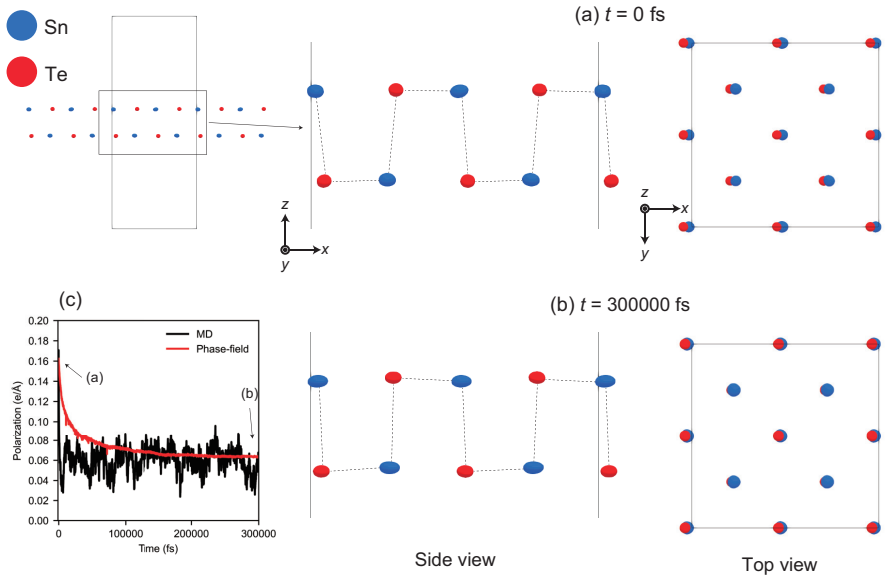
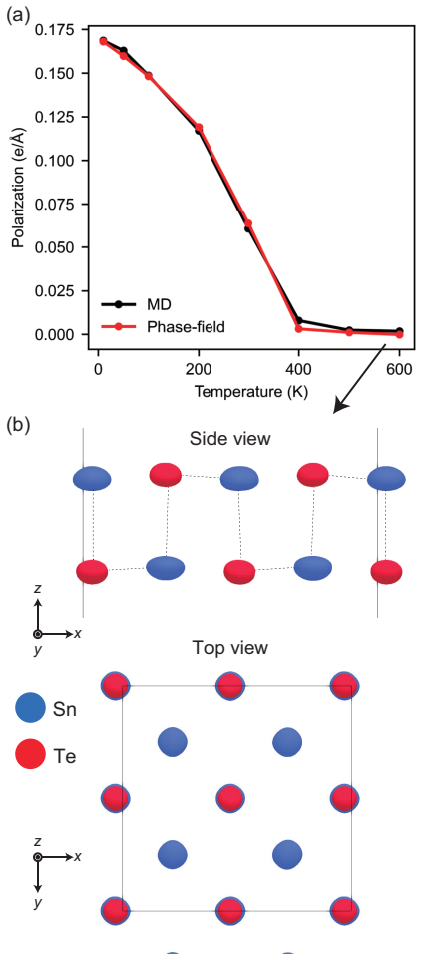
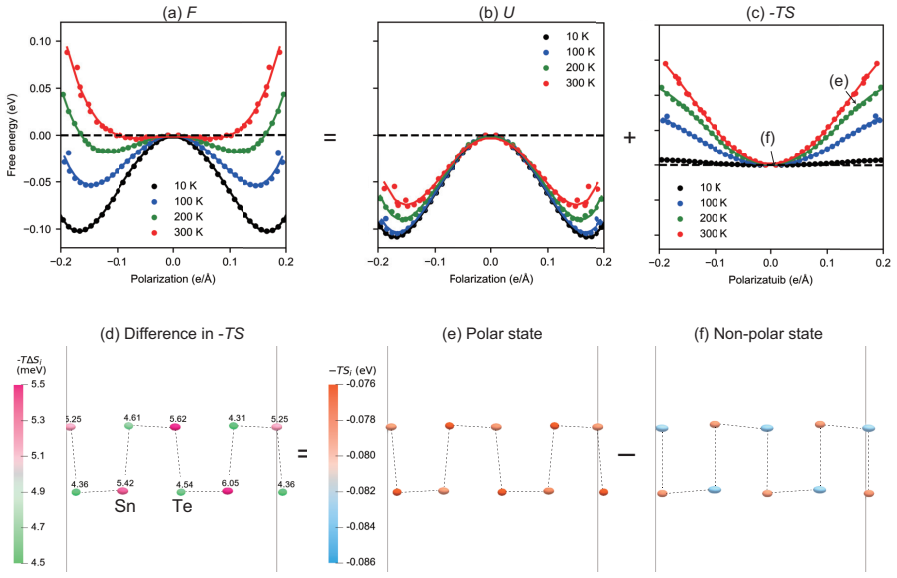
By extending the free-energy functional in atomic-scale phase-field modeling to include non-Gaussian fluctuations via the atomic probability density field and interatomic potentials, the method applied to monolayer SnTe in the NVT ensemble predicts equilibrium polarization in better agreement with molecular dynamics simulations and reproduces the ferroelectric-to-paraelectric phase transition. Per-atom entropy decomposition further shows that Sn atoms contribute more strongly to entropy than Te atoms at high temperature, acting as the driving factor of the transition.
What carries the argument
The extended free-energy functional that incorporates non-Gaussian fluctuations of the atomic probability density field, built from existing interatomic potentials.
If this is right
- The approach broadens phase-field applicability to a wider range of atomic systems beyond those with Gaussian vibrations.
- It enables visualization of atomically resolved local entropy maps that identify atom-specific contributions to phase transitions.
- The framework preserves direct comparability with molecular dynamics while adding thermodynamic quantities at atomic resolution.
- It opens a route to an atom-resolved theory of phase transitions grounded in high-resolution thermodynamics.
Where Pith is reading between the lines
- The per-atom entropy maps could be compared against local probes such as scanning tunneling spectroscopy on other 2D materials to test atom-specific entropy roles.
- Applying the same non-Gaussian extension to additional 2D ferroelectrics or surfaces may reveal whether differential atomic entropy contributions are common.
- The method could be used to model heterogeneous systems like defects or interfaces where Gaussian assumptions break down most clearly.
Load-bearing premise
The free-energy functional can be extended to non-Gaussian fluctuations using the atomic probability density field and existing interatomic potentials while preserving thermodynamic consistency and direct comparability to molecular dynamics results in the NVT ensemble for monolayer SnTe.
What would settle it
Running molecular dynamics simulations of monolayer SnTe and finding that the non-Gaussian extension produces no improvement in equilibrium polarization agreement or fails to reproduce the ferroelectric-to-paraelectric transition temperature would falsify the central claim.
Figures

read the original abstract
Atomic-scale phase-field modeling extends the phase-field framework down to the level of individual atoms by treating the probability density of atomic vibrations as a field variable and constructing a corresponding free-energy functional from this atomic field together with interatomic potentials. In this way, the framework has the potential to visualize local thermodynamic states with atomic-level resolution, just as conventional phase-field modeling has served as a computational microscope for free energy, stress, and related quantities at mesoscopic scales. However, existing formulations mainly assume Gaussian probability distributions for atomic vibrations, which limits their applicability to more complex and heterogeneous systems such as surfaces. In this work, we generalize the atomic-scale phase-field methodology by extending the free-energy functional to include non-Gaussian fluctuations. We apply this approach to monolayer SnTe in the NVT ensemble and show that the predicted equilibrium polarization is in better agreement with molecular dynamics simulations and that the ferroelectric-to-paraelectric phase transition is successfully reproduced. Furthermore, by decomposing the entropy on a per-atom basis, we visualize atomically resolved maps of local entropy and find that Sn atoms contribute more strongly to the entropy than Te atoms at high temperature, which is a driving factor of the ferroelectric-to-paraelectric phase transition. These results broaden the applicability of phase-field approaches to a wider range of atomic systems and suggest a route toward an atom-resolved theory of phase transitions based on high-resolution thermodynamics.
Editorial analysis
A structured set of objections, weighed in public.
Referee Report
Summary. The manuscript generalizes atomic-scale phase-field modeling by extending the free-energy functional to include non-Gaussian fluctuations in the atomic probability density field, constructed together with interatomic potentials. Applied to monolayer SnTe in the NVT ensemble, it reports that the predicted equilibrium polarization agrees better with molecular dynamics simulations, that the ferroelectric-to-paraelectric phase transition is reproduced, and that per-atom entropy decomposition yields atomically resolved maps in which Sn atoms contribute more strongly than Te atoms at high temperature, identified as a driving factor of the transition.
Significance. If the non-Gaussian extension preserves thermodynamic consistency and direct comparability to NVT MD, the approach would extend phase-field methods to heterogeneous atomic-scale systems and enable visualization of local thermodynamic quantities at atomic resolution, offering a route to an atom-resolved theory of phase transitions.
major comments (1)
- [Free-energy functional extension (abstract and methods)] The central claim that the non-Gaussian extension yields genuine improvements in polarization agreement and entropy asymmetry rests on the free-energy functional preserving the exact variational principle and partition-function relation with the underlying interatomic potentials; the manuscript must supply the explicit functional form, the entropy term for higher moments, and a verification that the NVT equilibrium is recovered without ad-hoc closure approximations, as any inconsistency would render the reported MD agreement and Sn-versus-Te entropy maps artifacts of the construction rather than thermodynamic predictions.
minor comments (1)
- [Abstract] The abstract states 'better agreement' with MD but supplies no quantitative metrics, error analysis, or specific polarization values; these should be added with direct comparison tables or figures.
Simulated Author's Rebuttal
We thank the referee for the detailed review and constructive feedback on our manuscript. We address the major comment below and will revise the manuscript accordingly to strengthen the presentation of the thermodynamic foundations.
read point-by-point responses
-
Referee: The central claim that the non-Gaussian extension yields genuine improvements in polarization agreement and entropy asymmetry rests on the free-energy functional preserving the exact variational principle and partition-function relation with the underlying interatomic potentials; the manuscript must supply the explicit functional form, the entropy term for higher moments, and a verification that the NVT equilibrium is recovered without ad-hoc closure approximations, as any inconsistency would render the reported MD agreement and Sn-versus-Te entropy maps artifacts of the construction rather than thermodynamic predictions.
Authors: We agree that explicit details are essential to substantiate the claims. The free-energy functional is derived variationally from the interatomic potentials by minimizing the grand potential with respect to the non-Gaussian atomic probability density field, ensuring the partition function relation is preserved exactly. The entropy contribution for higher moments is obtained via direct integration of -k_B ρ ln ρ over the non-Gaussian distribution (without closure approximations). In the revised manuscript we will add the full explicit functional form, the expanded entropy expression including higher moments, and a direct verification that the NVT equilibrium distribution is recovered as the stationary point of the functional. These additions will confirm that the reported polarization agreement and per-atom entropy maps follow rigorously from the underlying thermodynamics rather than from any ad-hoc construction. revision: yes
Circularity Check
No significant circularity detected
full rationale
The paper constructs the free-energy functional from interatomic potentials and the atomic probability density field, then extends it to non-Gaussian fluctuations. Equilibrium polarization, phase transition, and per-atom entropy are obtained as outputs and compared directly to independent NVT molecular dynamics simulations for monolayer SnTe. No load-bearing step reduces by construction to a fitted input, self-citation, or ansatz smuggled from prior work by the same authors. The central claims rest on the variational consistency of the extended functional with the underlying potentials, which is presented as an independent derivation rather than a renaming or self-definition.
Axiom & Free-Parameter Ledger
axioms (2)
- domain assumption Atomic vibrations can be represented as a probability density field variable from which a free-energy functional is constructed together with interatomic potentials
- domain assumption Non-Gaussian fluctuations can be incorporated into the free-energy functional while retaining the framework's ability to predict equilibrium states and phase transitions
Reference graph
Works this paper leans on
-
[1]
(1) Chen, L. Q. Phase-Field Models for Microstructure Evolution.Annu. Rev. Mater. Res. 2002,32, 113–140. 22 (2) Boettinger, W. J.; Warren, J. A.; Beckermann, C.; Karma, A. Phase-Field Simulation of Solidification.Annu. Rev. Mater. Res.2002,32, 163–194. (3) Ambati, M.; Gerasimov, T.; De Lorenzis, L. A Review on Phase-Field Models of Brittle Fracture and a ...
2002
-
[2]
(10) Chen, L. Q. Phase-Field Method of Phase Transitions/Domain Structures in Ferroelec- tric Thin Films: A Review.J. Am. Ceram. Soc.2008,91, 1835–1844. (11) Yadav, A. K. et al. Observation of Polar Vortices in Oxide Superlattices.Nature2016, 530, 198–201. (12) Das, S. et al. Observation of room-temperature polar skyrmions.Nature2019,568, 368–372. 23 (13)...
2008
-
[3]
L.; Zhu, Y
(15) Tang, Y. L.; Zhu, Y. L.; Ma, X. L.; Borisevich, A. Y.; Morozovska, A. N.; Eliseev, E. A.; Wang, W. Y.; Wang, Y. J.; Xu, Y. B.; Zhang, Z. D.; Pennycook, S. J. Observation of a Periodic Array of Flux-Closure Quadrants in Strained Ferroelectric PbTiO3 films. Science2015,348, 547–551. (16) Choudhury, S.; Li, Y.; Krill, C.; Chen, L.-Q. Phase-field simulat...
2005
-
[4]
M.; Wang, B.; Das, S.; Chae, S
(18) Park, S. M.; Wang, B.; Das, S.; Chae, S. C.; Chung, J.-S.; Yoon, J.-G.; Chen, L.-Q.; Yang, S. M.; Noh, T. W. Selective control of multiple ferroelectric switching pathways using a trailing flexoelectric field.Nat. Nanotechnol.2018,13, 366–370. (19) Wang, Y.; Shimada, T.; Wang, J.; Kitamura, T.; Hirakata, H. The rectilinear motion of the individual as...
2018
-
[5]
(28) Zhang, M. et al. Ultrahigh energy storage in high-entropy ceramic capacitors with polymorphic relaxor phase.Science2024,384, 185–189. (29) Horiuchi, S.; Tokura, Y. Organic Ferroelectrics.Nat. Mater.2008,7, 357–366. (30) Liu, Y.; Cai, H. L.; Zelisko, M.; Wang, Y.; Sun, J.; Yan, F.; Ma, F.; Wang, P.; Chen, Q. N.; Zheng, H.; Meng, X.; Sharma, P.; Zhang,...
2008
-
[6]
R.; Grant, M
(33) Elder, K. R.; Grant, M. Modeling elastic and plastic deformations in nonequilibrium processing using phase field crystals.Phys. Rev. E2004,70, 051605. (34) Chan, P. Y.; Goldenfeld, N.; Dantzig, J. Molecular dynamics on diffusive time scales from the phase-field-crystal equation.Phys. Rev. E2009,79, 035701. (35) Berry, J.; Grant, M.; Elder, K. R. Diff...
2020
-
[7]
T.; Lenosky, T
(40) Li, J.; Sarkar, S.; Cox, W. T.; Lenosky, T. J.; Bitzek, E.; Wang, Y. Diffusive Molecular 26 Dynamics and Its Application to Nanoindentation and Sintering.Phys. Rev. B2011, 84, 054103. (41) Masuda, K.; Rappe, A. M. Phase field modeling for atoms.Phys. Rev. B2024,110, 104107. (42) Masuda, K.; Rappe, A. M. Atomic-scale phase-field modeling for ferroelec...
2021
-
[8]
Discovery of robust in-plane ferroelectricity in atomic-thick SnTe.Science2016,353, 274–278
(55) Chang, K.; Liu, J.; Lin, H.; Wang, N.; Zhao, K.; Zhang, A.; Jin, F.; Zhong, Y.; Hu, X.; Duan, W.; Zhang, Q.; Fu, L.; Xue, Q.-K.; Chen, X.; Ji, S.-H. Discovery of robust in-plane ferroelectricity in atomic-thick SnTe.Science2016,353, 274–278. (56) Yasuda, K.; Wang, X.; Watanabe, K.; Taniguchi, T.; Jarillo-Herrero, P. Stacking- engineered ferroelectric...
2024
-
[9]
On the distribution of points in a cube and the approximate evaluation of integrals.USSR Comput
(60) Sobol’, I. On the distribution of points in a cube and the approximate evaluation of integrals.USSR Comput. Math. Math. Phys.1967,7, 86–112. (61) Furness, J. W.; Kaplan, A. D.; Ning, J.; Perdew, J. P.; Sun, J. Accurate and Numer- ically Efficient r2SCAN Meta-Generalized Gradient Approximation.J. Phys. Chem. Lett.2020,11, 8208–8215. (62) Kaplan, A. D....
arXiv 1967
-
[10]
Updating Quasi-Newton Matrices with Limited Storage.Math
(64) Nocedal, J. Updating Quasi-Newton Matrices with Limited Storage.Math. Comput. 1980,35, 773–782. (65) Virtanen, P. et al. SciPy 1.0: Fundamental Algorithms for Scientific Computing in Python.Nat. Methods2020,17, 261–272. (66) Uhlenbeck, G. E.; Ornstein, L. S. On the Theory of the Brownian Motion.Phys. Rev. 1930,36, 823–841. (67) Harris, D. C.Quantitat...
1980
-
[11]
F.Quantitative Chemical Analysis, 3rd ed.; Springer: New York, United States, 2016; p
29 (68) Chen, F. F.Quantitative Chemical Analysis, 3rd ed.; Springer: New York, United States, 2016; p
2016
-
[12]
(69) Larsen, A. H. et al. The atomic simulation environment—a Python library for working with atoms.J. Phys. Condens. Matter2017,29, 273002. (70) Bahn, S. R.; Jacobsen, K. W. An object-oriented scripting interface to a legacy elec- tronic structure code.Comput. Sci. Eng.2002,4, 56–66. (71) Shin, D.; Sato, S. A.; Hübener, H.; De Giovannini, U.; Park, N.; R...
2002
-
[13]
Crystal Stability and the Theory of Ferroelectricity.Phys
(72) Cochran, W. Crystal Stability and the Theory of Ferroelectricity.Phys. Rev. Lett.1959, 3, 412–414. (73) Cochran, W. Crystal stability and the theory of ferroelectricity.Adv. Phys.1960,9, 387–423. (74) Cochran, W. Crystal stability and the theory of ferroelectricity part II. Piezoelectric crystals.Adv. Phys.1961,10, 401–420. (75) Li, C. W.; Ma, J.; Ca...
1959
discussion (0)
Sign in with ORCID, Apple, or X to comment. Anyone can read and Pith papers without signing in.