Contacting Josephson Junctions via Airbridges in Superconducting Circuits
Pith reviewed 2026-06-27 22:01 UTC · model grok-4.3
The pith
Airbridges fabricated in a single step can replace bandages for all interconnects to Josephson junction electrodes in superconducting circuits.
A machine-rendered reading of the paper's core claim, the machinery that carries it, and where it could break.
Core claim
All electrical interconnects, including those to Josephson junction electrodes, can be formed by airbridges of varying sizes made in one step; these bridges exhibit high yield and stability across the stated size range, produce low loss in coplanar waveguide resonators and transmon qubits, and enable measured relaxation times exceeding 250 microseconds in standard transmon geometries.
What carries the argument
Single-step airbridge process that supplies every interconnect, including to Josephson junction electrodes, without bandages.
If this is right
- Device fabrication complexity drops because bandages and their associated steps are eliminated.
- Parasitic material interfaces introduced by bandages are removed from the circuit.
- Airbridges of many sizes remain mechanically stable and electrically low-loss when integrated into resonators and qubits.
- Standard transmon geometries reach relaxation times above 250 microseconds.
- The single-step process shortens overall manufacturing time for superconducting circuits.
Where Pith is reading between the lines
- Larger or more densely connected circuits could become feasible once every connection uses the same airbridge step.
- Reproducibility across fabrication runs may improve because the number of distinct process steps is reduced.
- The size range demonstrated (0.5–4 μm width, 5–40 μm length) suggests the method can adapt to varied circuit layouts without new process development.
Load-bearing premise
Airbridges made in one step can form reliable, low-loss electrical contacts to Josephson junction electrodes without creating new lossy interfaces or mechanical problems that shorten coherence times.
What would settle it
Fabricating otherwise identical transmon devices with the new airbridges and with conventional bandages, then finding that the airbridge devices show markedly shorter relaxation times, would falsify the claim that high coherence is preserved.
Figures

read the original abstract
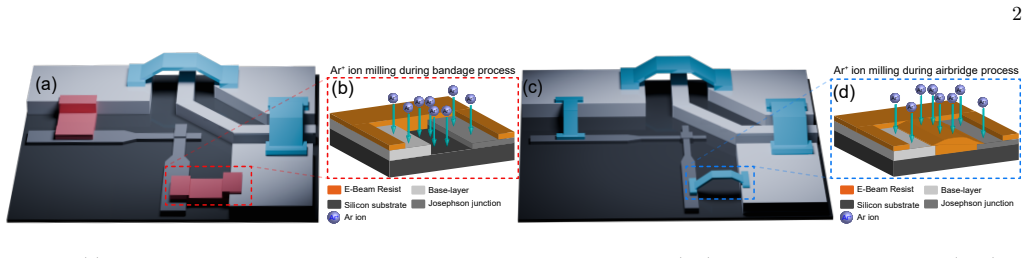
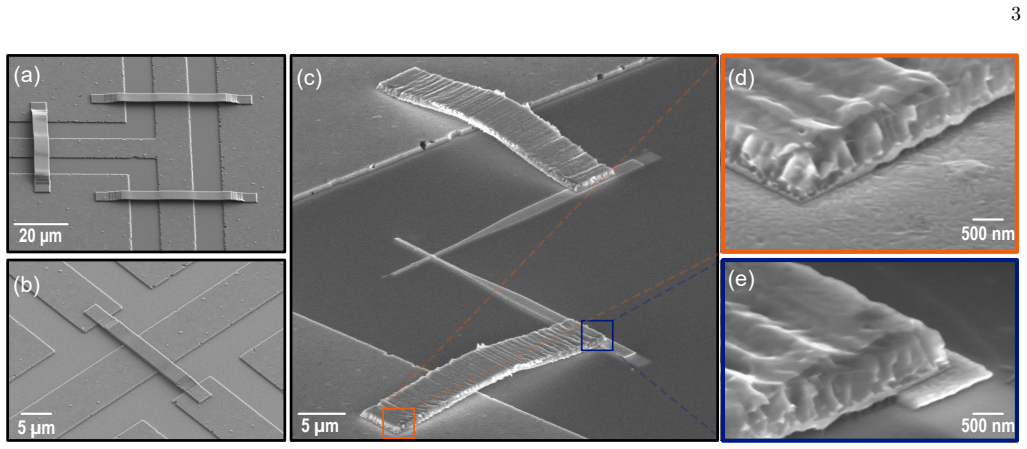
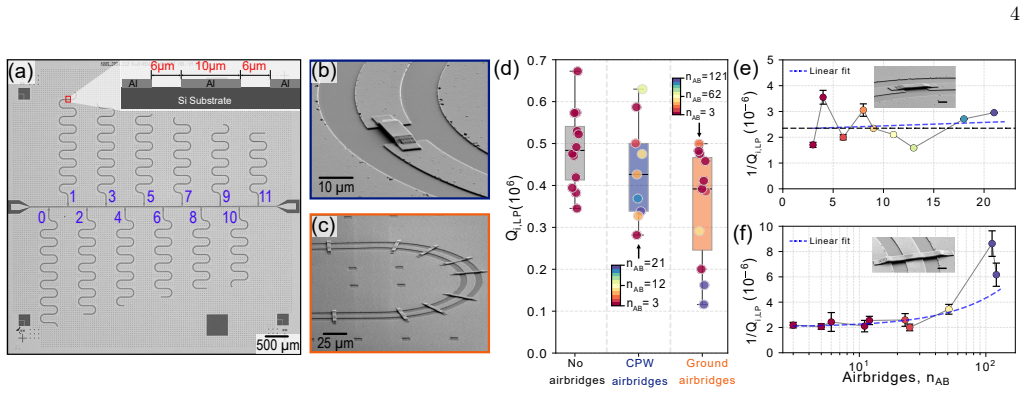
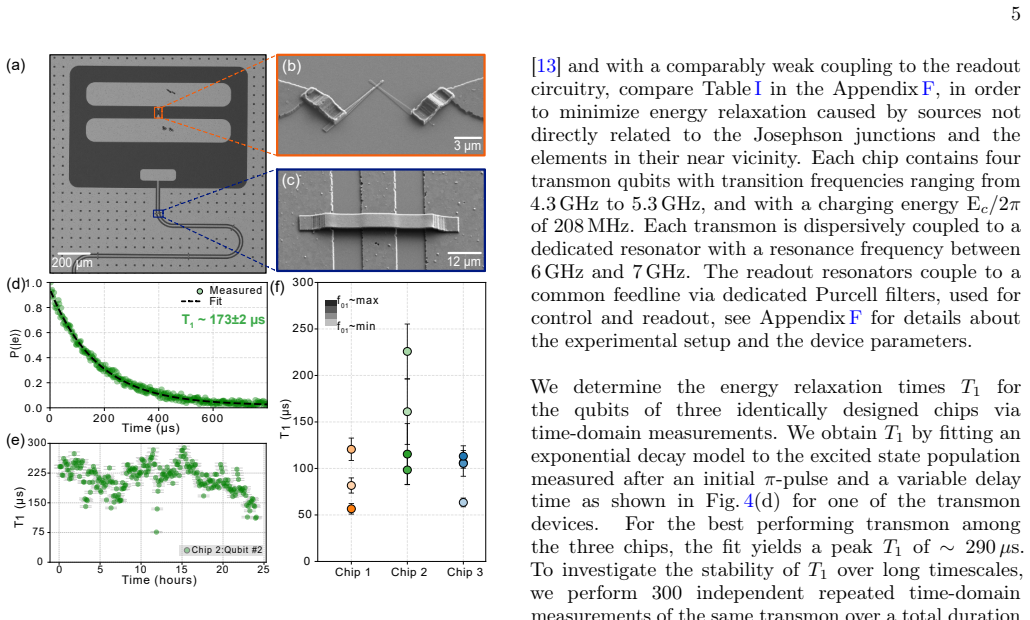
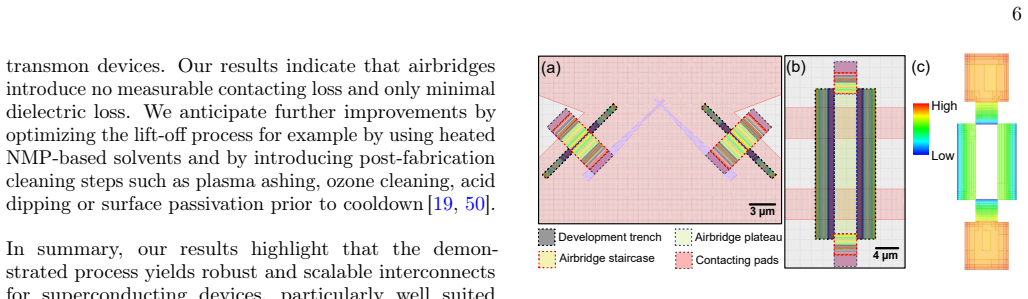
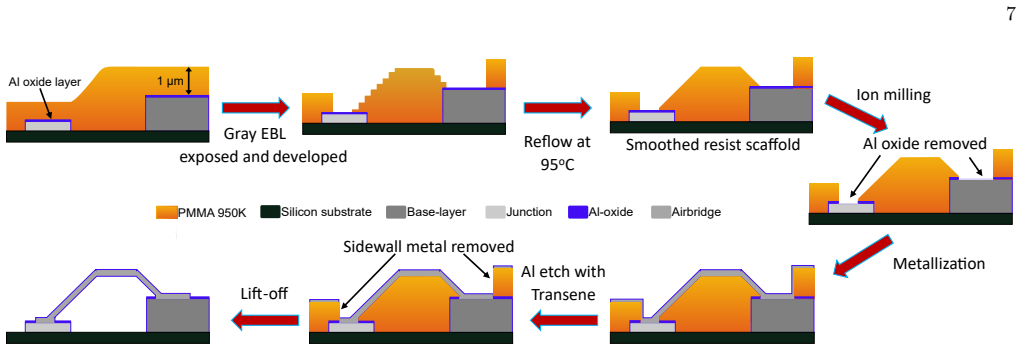
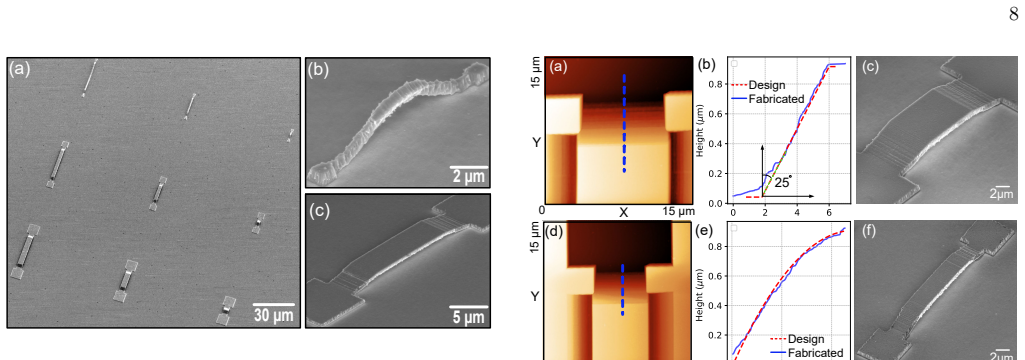
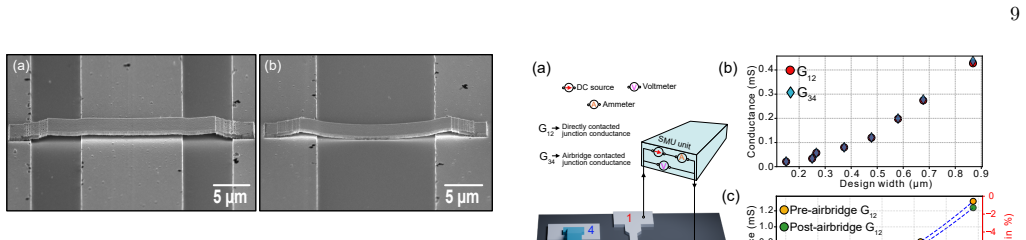
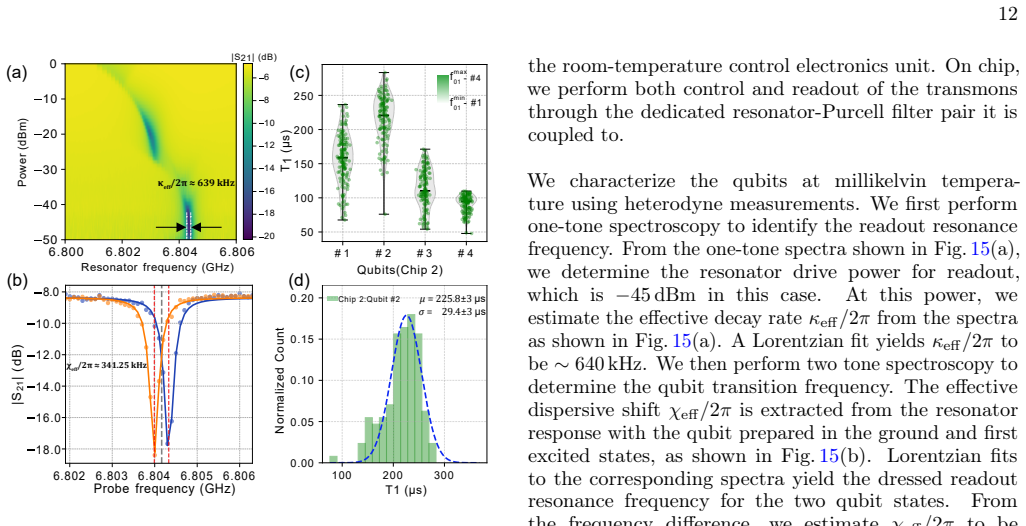
Superconducting circuit devices require electrical interconnects between different circuit elements on the chip, for which conventional device architectures use a combination of two structural elements: \textit{airbridges} to connect non-adjacent elements in the base layer, and \textit{bandages} to connect the electrodes forming the Josephson junctions to the base layer. Bandages introduce unwanted parasitic material interfaces and increase the manufacturing complexity. Here, we overcome the limitations imposed by \emph{bandages} by establishing \textit{all} electrical interconnects with airbridges of varying size fabricated in a single step. The airbridges show a high yield and mechanical stability over a wide range of sizes from $0.5\,\mu\mathrm{m}$ to $4\,\mu\mathrm{m}$ in width and from $5\,\mu\mathrm{m}$ to $40\,\mu\mathrm{m}$ in length, and show low loss when integrated in coplanar waveguide resonators and transmon qubits. Measured relaxation times up to more than $250\,\mu\mathrm{s}$ in standard transmon geometries show that the process achieves high coherence while substantially easing and accelerating device fabrication.
Editorial analysis
A structured set of objections, weighed in public.
Referee Report
Summary. The manuscript claims that all electrical interconnects in superconducting circuits—including contacts to Josephson junction electrodes—can be realized using airbridges of varying dimensions fabricated in a single lithographic step, thereby eliminating the need for separate bandage structures. It reports high fabrication yield and mechanical stability across airbridge widths of 0.5–4 μm and lengths of 5–40 μm, low microwave loss when integrated into coplanar-waveguide resonators and transmon qubits, and qubit relaxation times exceeding 250 μs in standard geometries.
Significance. If the reported yield, stability, loss, and coherence results hold under the fabrication and measurement protocols detailed in the full manuscript, the work removes a source of parasitic interfaces and fabrication complexity that has limited device yield and performance in superconducting quantum circuits. The approach is directly relevant to scaling efforts that require dense, low-loss interconnects without additional process steps.
minor comments (2)
- [Results section (device characterization)] The abstract states that airbridges show 'low loss' in resonators and qubits and 'relaxation times up to more than 250 μs,' but the main text should explicitly report the number of devices measured, the distribution of T1 values, and any exclusion criteria or control samples used to establish these figures (e.g., comparison to bandage-based devices on the same wafer).
- [Methods and Figure 2] Figure captions and the methods section should clarify the exact definition of 'yield' (e.g., fraction of bridges surviving release etch without collapse or electrical discontinuity) and how mechanical stability was quantified across the stated size range.
Simulated Author's Rebuttal
We thank the referee for their positive assessment of the work and the recommendation to accept the manuscript.
Circularity Check
No significant circularity
full rationale
This is an experimental fabrication and characterization paper. The central claims rest on direct measurements of airbridge yield, mechanical stability, resonator loss, and transmon T1 times (>250 μs). No mathematical derivations, fitted parameters renamed as predictions, or load-bearing self-citations appear in the argument structure. All reported results are independently testable via the described fabrication process and device measurements.
Axiom & Free-Parameter Ledger
axioms (1)
- domain assumption Airbridges can be fabricated with high yield and mechanical stability across the stated size range while maintaining low microwave loss when contacting Josephson junctions.
Reference graph
Works this paper leans on
-
[1]
Directly contacted
and with a comparably weak coupling to the readout circuitry, compare TableI in the AppendixF, in order to minimize energy relaxation caused by sources not directly related to the Josephson junctions and the elements in their near vicinity. Each chip contains four transmon qubits with transition frequencies ranging from 4.3 GHz to5 .3 GHz, and with a char...
-
[2]
Clarke and F
J. Clarke and F. K. Wilhelm, Nature 453, 1031 (2008)
2008
-
[3]
Devoret and R
M. Devoret and R. J. Schoelkopf, Science 339, 1169 (2013)
2013
-
[4]
Blais, A
A. Blais, A. L. Grimsmo, S. M. Girvin, and A. Wallraff, Rev. Mod. Phys. 93, 025005 (2021)
2021
-
[5]
AbuGhanem, J
M. AbuGhanem, J. Supercomput. 81, 687 (2025)
2025
-
[6]
Wallraff, D
A. Wallraff, D. I. Schuster, A. Blais, L. Frunzio, R.-S. Huang, J. Majer, S. Kumar, S. M. Girvin, and R. J. Schoelkopf, Nature 431, 162 (2004)
2004
-
[7]
Hofheinz, E
M. Hofheinz, E. M. Weig, M. Ansmann, R. C. Bialczak, E. Lucero, M. Neeley, A. D. O’Connell, H. Wang, J. M. Martinis, and A. N. Cleland, Nature 454, 310 (2008)
2008
-
[8]
X. Gu, A. F. Kockum, A. Miranowicz, Y.-X. Liu, and F. Nori, Phys. Rep. 718–719, 1 (2017)
2017
-
[9]
Forn-Díaz, L
P. Forn-Díaz, L. Lamata, E. Rico, J. Kono, and E. Solano, Rev. Mod. Phys. 91, 025005 (2019)
2019
-
[10]
DiCarlo, J
L. DiCarlo, J. M. Chow, J. M. Gambetta, L. S. Bishop, B. R. Johnson, D. I. Schuster, J. Majer, A. Blais, L. Frun- zio, S. M. Girvin, and R. J. Schoelkopf, Nature 460, 240 (2009)
2009
-
[11]
Barends, J
R. Barends, J. Kelly, A. Megrant, A. Veitia, D. Sank, E. Jeffrey, T. C. White, J. Mutus, A. G. Fowler, B. Campbell, Y. Chen, Z. Chen, B. Chiaro, A. Dunsworth, C. Neill, P. O’Malley, P. Roushan, A. Vainsencher, J. Wenner, A. N. Korotkov, A. N. Cle- land, and J. M. Martinis, Nature 508, 500 (2014)
2014
-
[12]
Arute et al., Nature 574, 505 (2019)
F. Arute et al., Nature 574, 505 (2019)
2019
-
[13]
Siddiqi, Nat
I. Siddiqi, Nat. Rev. Mater. 6, 875 (2021)
2021
-
[14]
M. P. Bland et al., Nature 647, 343 (2025)
2025
-
[15]
V. D. Kurilovich et al., Phys. Rev. X 16, 021025 (2026)
2026
-
[16]
Van Damme et al., Nature 634, 74 (2024)
J. Van Damme et al., Nature 634, 74 (2024)
2024
-
[17]
Tuokkola, Y
M. Tuokkola, Y. Sunada, H. Kivijärvi, J. Albanese, L. Grönberg, J.-P. Kaikkonen, V. Vesterinen, J. Gove- nius, and M. Möttönen, Nat. Commun. 16, 5421 (2025)
2025
-
[18]
Biznárová, A
J. Biznárová, A. Osman, E. Rehnman, L. Chayanun, C.Križan, P.Malmberg, M.Rommel, C.Warren, P.Dels- ing, A. Yurgens, J. Bylander, and A. F. Roudsari, npj Quantum Inf. 10, 78 (2024)
2024
-
[19]
Colao Zanuz et al., Phys
D. Colao Zanuz et al., Phys. Rev. Appl. 23, 044054 (2025)
2025
- [20]
-
[21]
C. R. Conner, A. Bienfait, H.-S. Chang, M.-H. Chou, É. Dumur, J. Grebel, G. A. Peairs, R. G. Povey, H. Yan, Y. P. Zhong, and A. N. Cleland, Appl. Phys. Lett. 118, 13 232602 (2021)
2021
-
[22]
G. J. Norris, L. Michaud, D. Pahl, M. Kerschbaum, C. Eichler, J.-C. Besse, and A. Wallraff, EPJ Quantum Technol. 11, 5 (2024)
2024
-
[23]
Rosenberg et al., npj Quantum Inf
D. Rosenberg et al., npj Quantum Inf. 3, 42 (2017)
2017
-
[24]
Grigoras et al., IEEE Trans
K. Grigoras et al., IEEE Trans. Quantum Eng. 3, 1 (2022)
2022
-
[25]
Superconducting Through-Silicon Vias for Quantum Integrated Circuits
M. Vahidpour et al., arXiv:1708.02226 (2017)
work page internal anchor Pith review Pith/arXiv arXiv 2017
-
[26]
J. M. Martinis, K. B. Cooper, R. McDermott, M. Steffen, M. Ansmann, K. D. Osborn, K. Cicak, S. Oh, D. P. Pappas, R. W. Simmonds, and C. C. Yu, Phys. Rev. Lett. 95, 210503 (2005)
2005
-
[27]
Lisenfeld, A
J. Lisenfeld, A. Bilmes, A. Megrant, R. Barends, J. Kelly, P. Klimov, G. Weiss, J. M. Martinis, and A. V. Ustinov, npj Quantum Inf. 5, 105 (2019)
2019
-
[28]
How to Build a Quantum Supercomputer: Scaling from Hundreds to Millions of Qubits
M. Mohseni et al., arXiv:2411.10406 (2024)
work page internal anchor Pith review Pith/arXiv arXiv 2024
-
[29]
N. I. Dib, P. B. Katehi, and G. E. Ponchak, in 1991 IEEE MTT-S Int. Microwave Symp. Digest (IEEE, 1991), pp. 469–472
1991
-
[30]
R. N. Simons, Coplanar Waveguide Circuits, Compo- nents, and Systems (Wiley, 2001)
2001
-
[31]
G. E. Ponchak, J. Papapolymerou, and M. M. Tentzeris, IEEE Trans. Microw. Theory Tech. 53, 713 (2005)
2005
-
[32]
D. M. Pozar, Microwave Engineering (Wiley, 2021)
2021
-
[33]
Wenner, M
J. Wenner, M. Neeley, R. C. Bialczak, M. Lenander, E. Lucero, A. D. O’Connell, D. Sank, H. Wang, M. Wei- des, A. N. Cleland, and J. M. Martinis, Supercond. Sci. Technol. 24, 065001 (2011)
2011
-
[34]
Z. Chen, A. Megrant, J. Kelly, R. Barends, J. Bochmann, Y. Chen, B. Chiaro, A. Dunsworth, E. Jeffrey, J. Y. Mutus, P. J. J. O’Malley, C. Neill, P. Roushan, D. Sank, A. Vainsencher, J. Wenner, T. C. White, A. N. Cleland, and J. M. Martinis, Appl. Phys. Lett. 104, 052602 (2014)
2014
-
[35]
K. Bu, S. Huai, Z. Zhang, D. Li, Y. Li, J. Hu, X. Yang, M. Dai, T. Cai, Y.-C. Zheng, and S. Zhang, npj Quan- tum Inf. 11, 17 (2025)
2025
-
[36]
Bruckmoser, L
N. Bruckmoser, L. Koch, I. Tsitsilin, M. Grammer, D. Bunch, L. Richard, J. Schirk, F. Wallner, J. Feigl, C. M. F. Schneider, S. Geprägs, V. P. Bader, M. Al- thammer, L. Södergren, and S. Filipp, Phys. Rev. Appl. 25, 024007 (2026)
2026
-
[37]
Y. Sun, J. Ding, X. Xia, X. Wang, J. Xu, S. Song, D. Lan, J. Zhao, and Y. Yu, Appl. Phys. Lett. 121, 074001 (2022)
2022
-
[38]
Stavenga, S
T. Stavenga, S. A. Khan, Y. Liu, P. Krogstrup, and L. DiCarlo, Appl. Phys. Lett. 123, 024004 (2023)
2023
-
[39]
Janzen, M
N. Janzen, M. Kononenko, S. Ren, and A. Lupascu, Appl. Phys. Lett. 121, 094001 (2022)
2022
-
[40]
J.-B. Fu, B. Ren, J.-D. Ouyang, C. Li, K.-C.-Q. Zhu, Y.-G. Che, X. Fu, S.-C. Xue, Z.-H. Yang, M.-T. Deng, and J.-J. Wu, Chin. Phys. B 35, 040312 (2026)
2026
-
[41]
Dunsworth, A
A. Dunsworth, A. Megrant, C. Quintana, Z. Chen, R. Barends, B. Burkett, B. Foxen, Y. Chen, B. Chiaro, A. Fowler, R. Graff, E. Jeffrey, J. Kelly, E. Lucero, J. Y. Mutus, M. Neeley, C. Neill, P. Roushan, D. Sank, A. Vainsencher, J. Wenner, T. C. White, and J. M. Martinis, Appl. Phys. Lett. 111, 022601 (2017)
2017
-
[42]
Nersisyan et al., in 2019 IEEE Int
A. Nersisyan et al., in 2019 IEEE Int. Electron Devices Meeting (IEDM) (IEEE, 2019), pp. 31.1.1–31.1.4
2019
-
[43]
D. S. Wisbey, J. Gao, M. R. Vissers, F. C. S. da Silva, J. S. Kline, L. Vale, and D. P. Pappas, J. Appl. Phys. 108, 093918 (2010)
2010
-
[44]
Bilmes, A
A. Bilmes, A. K. Händel, S. Volosheniuk, A. V. Usti- nov, and J. Jürgen, Supercond. Sci. Technol. 34, 125011 (2021)
2021
-
[45]
Osman, J
A. Osman, J. Simon, A. Bengtsson, S. Kosen, P. Krantz, D. P. Lozano, M. Scigliuzzo, P. Delsing, J. Bylander, and A. F. Roudsari, Appl. Phys. Lett. 118, 064002 (2021)
2021
-
[46]
Janting, J
J. Janting, J. K. M. Pedersen, R. Inglev, G. Woyessa, K. Nielsen, and O. Bang, J. Lightwave Technol. 37, 4469 (2019)
2019
-
[47]
Georgia Institute of Technology Nanolithography Facil- ity, PMMA Process and Removal, available athttps: //nanolithography.gatech.edu/pmma.html
-
[48]
C. R. H. McRae, H. Wang, J. Gao, M. R. Vissers, T. Brecht, A. Dunsworth, D. P. Pappas, and J. Mu- tus, Rev. Sci. Instrum. 91, 091101 (2020)
2020
-
[49]
Schlör, J
S. Schlör, J. Lisenfeld, C. Müller, A. Bilmes, A. Schnei- der, D. P. Pappas, A. V. Ustinov, and M. Weides, Phys. Rev. Lett. 123, 190502 (2019)
2019
-
[50]
Burnett, A
J. Burnett, A. Bengtsson, M. Scigliuzzo, D. Niepce, M. Kudra, P. Delsing, and J. Bylander, npj Quantum Inf. 5, 54 (2019)
2019
-
[51]
Marcaud et al., Commun
G. Marcaud et al., Commun. Mater. 6, 182 (2025)
2025
-
[52]
Papageorgiou, A
V. Papageorgiou, A. Khalid, and D. R. S. Cumming, in Proc. 39th Int. Conf. Micro and Nano Engineering (MNE 2013), London, UK (2013)
2013
-
[53]
Girgis, J
E. Girgis, J. Liu, and M. L. Benkhedar, Appl. Phys. Lett. 88, 202103 (2006)
2006
-
[54]
Mortelmans, D
T. Mortelmans, D. Kazazis, V. A. Guzenko, C. Padeste, T. Braun, H. Stahlberg, X. Li, and Y. Ekinci, Microelec- tron. Eng. 225, 111272 (2020)
2020
-
[55]
A. N. Bolgar, D. A. Kalacheva, V. B. Lubsanov, A. Yu. Dmitriev, E. S. Alekseeva, E. V. Korostylev, and O. V. Astafiev, J. Appl. Phys. 137, 154401 (2025)
2025
-
[56]
J. V. Migacz and M. E. Huber, IEEE Trans. Appl. Su- percond. 13, 123 (2003)
2003
-
[57]
Probst, F
S. Probst, F. B. Song, P. A. Bushev, A. V. Ustinov, and M. Weides, Rev. Sci. Instrum. 86, 024706 (2015)
2015
-
[58]
Bruno, G
A. Bruno, G. de Lange, S. Asaad, K. L. van der Enden, N. K. Langford, and L. DiCarlo, Appl. Phys. Lett. 106, 182601 (2015)
2015
-
[59]
Megrant, C
A. Megrant, C. Neill, R. Barends, B. Chiaro, Y. Chen, L. Feigl, J. Kelly, E. Lucero, M. Mariantoni, P. J. J. O’Malley, D. Sank, A. Vainsencher, J. Wenner, T. C. White, Y. Yin, J. Zhao, C. J. Palmstrom, J. M. Martinis, and A. N. Cleland, Appl. Phys. Lett. 100, 113510 (2012)
2012
-
[60]
Frasca, I
S. Frasca, I. N. Arabadzhiev, S. Y. Bros de Puechre- don, F. Oppliger, V. Jouanny, R. Musio, M. Scigliuzzo, F. Minganti, P. Scarlino, and E. Charbon, Phys. Rev. Appl. 20, 044021 (2023)
2023
-
[61]
Gupta, P
V. Gupta, P. Winkel, N. Thakur, P. van Vlaanderen, Y. Wang, S. Ganjam, L. Frunzio, and R. J. Schoelkopf, Phys. Rev. Appl. 23, 054067 (2025)
2025
-
[62]
Khorramshahi, M
M. Khorramshahi, M. Spiecker, P. Paluch, S. Geisert, N. Gosling, N. Zapata, L. Brauch, C. Kübel, S. Dehm, R. Krupke, W. Wernsdorfer, I. M. Pop, and T. Reisinger, Phys. Rev. Appl. 24, 024066 (2025)
2025
-
[63]
Kirsh, E
N. Kirsh, E. Svetitsky, S. Goldstein, G. Pardo, O. Hachmo, and N. Katz, Phys. Rev. Appl. 16, 044017 (2021)
2021
-
[64]
Introduction to Experimental Quantum Measurement with Superconducting Qubits
M. Naghiloo, arXiv:1904.09291 (2019)
work page internal anchor Pith review Pith/arXiv arXiv 1904
discussion (0)
Sign in with ORCID, Apple, or X to comment. Anyone can read and Pith papers without signing in.